
“Stumbling” and “serendipity” are two of the words that Erik Larson used as he recounted the moments that have unexpectedly led him to the subjects of his books. When he spoke at Lenoir- Rhyne on the morning of Friday, October 27, he told his interviewer, Jeffrey Delbert, Assistant Professor of Communications at LR, that he didn’t intend for his book on serial killer H.H. Holmes to be a dual narrative of Holmes and the 1893 World’s Fair. But his background reading on 1890s Chicago led him to a book–a boring monograph, as he called it–on the Colombian Exposition (the 1893 Chicago World’s Fair). Though the book bored him, one of its footnotes caught his eye: one that listed Juicy Fruit gum among the products first introduced at the fair. If not for that footnote, Larson said, he didn’t know if the book (The Devil in the White City) would have happened.
When an audience member asked about his penchant for crafting nonfiction narratives with the drama of novels, Larson remarked that he believed that such narratives can do more justice to real-life stories than a “bland historical approach.” Those words of his reminded me of Truman Capote’s In Cold Blood, which figures in the analysis of The Devil in the White City that I wrote along with my students (as they wrote their own analyses) last spring–and that I offer again here:
The White City’s Blueprint: The Architecture of Larson’s Narrative Nonfiction
In Janet Maslin’s New York Times review of The Devil in the White City, she claims that Erik Larson avoids the risk of “turning [the book] into a random compendium.” For all of his density of detail, Larson does manage to avoid that risk, creating instead a gripping dual narrative—one that succeeds, as Maslin asserts that it does—but not by using what Maslin cites as tactics that might ordinarily seem “alarming.” Rather the techniques that Larson employs are among the very building blocks of contemporary narrative.
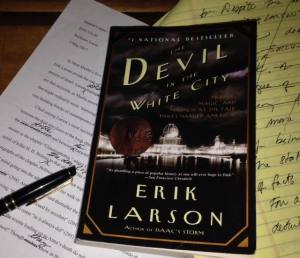 Chief among Larson’s most successful narrative strategies is his cross cutting, both between the dual storylines of the book (those of the Devil and the White City of the title) and between characters. One of his most compelling uses of cross cutting occurs in the chapter “Claustrophobia,” where Larson deftly shifts from the point of view of serial of killer H. H. Holmes, the devil of the title, to that of one of his victims, Anna “Nannie” Williams. In the first paragraphs of the chapter, Holmes and Anna are together in his office, where he asks her “if she would mind going into the adjacent room, the walk-in vault, to retrieve for him a document he had left inside” (294). Anna complies, and thereafter the point of view shifts between Anna inside the vault, believing “the door had closed by accident” (294), and Holmes standing outside the door, listening for the panic to come “as it always did” (295).
Readers witnessing the events leading up to Anna’s death do not stop to ask: How can Larson know what happened? Though they know in the back of their minds that only Holmes and Anna themselves could know what transpired, Larson’s dramatic cross cutting draws them so close to both the victim and her killer that they experience those moments as Holmes and Anna do.
In his endnotes, Larson addresses his reasons for depicting Anna’s murder as he did. Based on police speculation that Holmes killed both Anna and her sister, Minnie, in his vault, an earlier chronicler of Holmes’ exploits—Harold Schechter, author of Depraved (1994)—proposed that Holmes walked into the vault with Anna: “Grasping Nannie by the hand, he led her toward the vault” (Schechter qtd. in Larson 416). Rather than depicting the events as Schechter did, Larson presents Holmes sending Anna into the vault on a false errand because that scenario, in Larson’s words, “would have suited more closely his temperament” (416).
Whether Holmes sent Anna into his vault on a false errand, Larson’s compelling rendering of it exemplifies how the author employs the dramatic effects of fiction—not tactics that are “alarming” as Maslin claims, but ones that writers have commonly applied to narrative nonfiction for more than fifty years, since the publication of Truman Capote’s groundbreaking account of the Clutter family murders in In Cold Blood. And like In Cold Blood, The Devil in the White City presents a true crime story with the narrative arc of a novel. But Larson’s book is more ambitious and broader in scope than Capote’s. Ultimately, The Devil in the White City is a hybrid of true crime and popular history—the gruesome murders of a serial killer juxtaposed with the construction of the magical white city that inspired Walt Disney and L. Frank Baum. For readers fascinated by the minds of criminals and visionary architects, it’s a page turner. And for writers drawn to the challenge of giving facts the appeal of fiction, it offers a blueprint.
Works Cited
Larson, Erik. The Devil in the White City. Vintage, 2004.
Maslin, Janet. “Add a Serial Murderer to 1893 Chicago’s Opulent Overkill.” Review of The Devil in the White City, by Erik Larson, The New York Times, 10 Feb. 2003, http://www.nytimes.com, Accessed 26 Apr. 2017.
 When the thought of making small talk with the other guests at a fishing lodge overwhelms Charlie Baker, his friend Froggy LeSueur concocts a story to enable the shy, fretful Charlie to avoid conversation—and to do so without seeming rude. Froggy tells Betty Meeks, the owner of the lodge, that Charlie is a foreigner who doesn’t speak English. And to stave off questions about Charlie’s homeland, Froggy implies that he can’t disclose that information because Charlie is on a classified mission.
 At the book launch for his debut collection of poetry, Impossible Angles, Jordan Makant told the audience that he didn’t like writing poetry when he enrolled in a poetry workshop at Lenoir-Rhyne but found himself drawn to the form after his workshop professor, Scott Owens, told him, “write the way you think.” Those words of Owens’ led Jordan, now an LR senior, to begin drafting stream-of-consciousness verse, including “Late Night with Myself and a Four Cylinder,” one of the poems that he read at the launch.
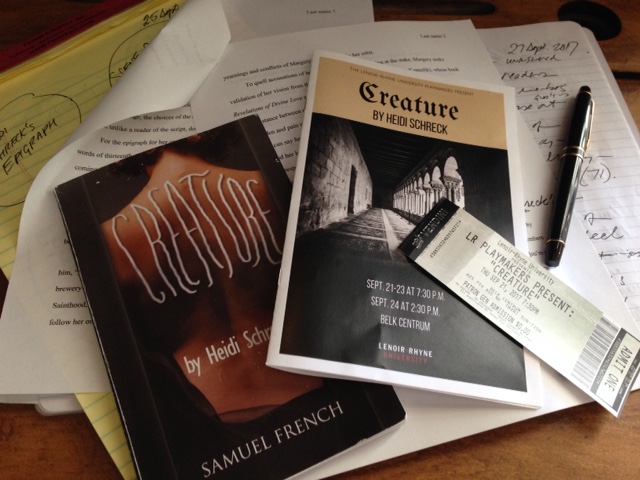 An epigraph stands out as a curious element in a play. For readers of the script, that quotation,which precedes the opening of the play and presents its prevailing theme, offers a signpost to guide them on their journey. However, for those who first encounter the play on the stage, the choices of the director and the actors must convey that idea, which the audience, unlike readers of the script, does not see in written form.
 The “South Carolina” chapter of The Underground Railroad finds the protagonist, Cora, recruited to work as a living model at the Museum of Natural Wonders. In a series of three rooms that trace the American slave experience from Africa to the plantation, Cora poses in costume, silently critiquing the scenes she inhabits, pointing out their inaccuracies. For author Colson Whitehead, Cora’s stint at the museum offers a frame story within the novel’s sprawling alternate history, one that prompts readers to reflect on Whitehead’s juxtaposition of fact and fiction.



 evidence that its author,
 Jane Lucas