I’m standing in the dark with my ear to the curtain, trying not to think about the large stock pot I’m holding, or how easily it could slip from my damp, sweaty hands. I’m trying to block those thoughts with the words that I’m speaking in my mind, over and over, until I hear my cue:
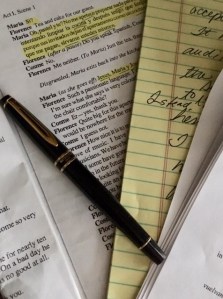 FLORENCE Please ring again.
Cosme rings the bell a second time, on this occasion with more force. After a short pause, the sound of a pan [stock pot] being slammed down is heard off stage. (1.1)
Finally dropping the stock pot offers no relief from my anxiety; instead it heightens it, because it means that I’m closer to saying María’s lines, and closer to the risk that they’ll slip away from me.
FLORENCE Ah, that sounds promising. Here she comes.
María, the Mexican cook and housemaid, enters. (1.1)
I part the curtain and cross into the unknown, a place where I don’t know whether the words that I’ve prepared to say will come to me again, as I, María, approach my boss, Florence Foster Jenkins, the worst singer in the world. Florence will ask María to bring tea and cake for her and her guest, her soon-to-be accompanist, Cosme McMoon. Disgruntled María savors the opportunity to tell Florence that she doesn’t feel like preparing cake and tea. She’s trying to clean the kitchen, and then she has to clean the carpet because Florence and her guests make such a mess. With what little Florence pays her, Florence can just serve herself. And so María tells her that:
Oh, pastel y te? No me apetece preparar nada para su mariquita. Estoy intentando limpiar la cocina y después tengo que limpiar la moqueta porque sus invitados dejan el apartamento como un cochinero. Con lo poco que me pagan, sírvanse ustedes mismos. (1.1)
I’m speaking the words rapid-fire—not as if I’m reciting lines in a script, but as if I’m someone I’m not: a fluent speaker. But no hablo español.
The rush that comes with being in the moment fades as I exit. My next line will be far shorter than the first, but as I wait backstage for my cue, I will be holding something far heavier than a stock pot: a large serving tray with a teapot, two teacups, a plate with a slice of cake, plus napkins and cutlery.
As I hold the tray, my hands begin to sweat again, and I’m trying not to think about how easily I could lose my grip (in more ways than one). I’m trying to block that thought by mouthing my next line, one with a phrase that’s particularly hard for me to say. I think that saying luego me vuelvan (then come back) means voicing consonant clusters that aren’t common in English. But don’t take my word for it. This gringa’s no linguist.
Then once again I’m on stage, speaking the words rapid-fire, blasting through luego me vuelvan as if it’s second nature, when that couldn’t be further from the truth. And again the anxiety returns as soon as I exit. Despite the apparent ease of what I’ve done onstage, backstage I will always believe—throughout the entire three-week, ten-performance run—that the lines are about to slip away from me.
Why would anyone put herself through that?
The truth is, I almost didn’t.
It wasn’t the part I’d auditioned for, but that’s not the reason I was hesitant to say yes. Instead, I was reluctant because I believed that audiences would find me utterly unconvincing as a maid from Guadalajara. And I imagined that the same audiences that would bristle at the sight (and sound) of a fair-skinned, blue-eyed María would also be indignant at the director’s decision to cast an actor who wasn’t Latina.
Recently I was reminded of my reluctance to play María when my composition students and I were studying the essay “Always Living in Spanish,” in which Marjorie Agosín meditates on the vital need of writing in Spanish as a way to hold onto her native Chilé.
As I gazed at the thumbnail photograph of Agosín on the page of the textbook, I asked myself: Would you have been so hesitant to accept the role of María if you’d known of this fair-skinned, blue-eyed Latina?
Writing of her perilous circumstances as a child who’d fled her home country, Agosín observes: “Daily I felt the need to translate myself for the strangers living around me, tell them why we’re in Georgia, why we are different, why we had fled, why my accent was so thick, and why I did not look Hispanic” (80).
Though I have experienced nothing remotely close to Agosín’s peril, backstage as María, I felt the weight of her words: “I had left a dangerous place that was my home, only to arrive in a dangerous place that was not” (80).
The stage is always a dangerous place, but accepting a role in another tongue meant venturing out of the dangerous place that was my home and into new dangerous territories: a place where some would say I shouldn’t (for lack of authenticity) and another place where some would say I couldn’t (for lack of believability). Those voices ran through my head until the director wore me down.
So this gringa said yes.
 For all of my concerns about authenticity and believability, the real danger was the words, themselves. It hadn’t occurred to me that the challenge inherent in learning lines would be compounded by the cognitive shift required of learning them as a non-native speaker. When I say kitchen, in my mind, I see a kitchen. When I say cocina, I don’t. For the first time, I wasn’t visualizing my lines. Instead I was memorizing a series of unfamiliar sounds. I knew their English translation—and I’d kept a transcription with my script—but as a novice speaker, I couldn’t link the signs to the signifiers.
I had actually studied Spanish as a high-school and college student, but I conjugated my last Spanish verb more than thirty years ago, and I’d been a mediocre student at best. One of my most vivid memories of high school is a conversation with my Spanish teacher after class. Holding my quiz marked with a red F, he said: “Josefina [my sister, Jo] is so smart. What happened to you?” Would Señor Grave de Peralta have ever believed that theatre-goers would ask, “Are you bilingual?”
I am always grateful for the opportunity to return to the stage. As a nonmusical woman of a certain age, that chance comes all too seldom. Looking back at the months of rehearsal and performance of Glorious!, I am particularly thankful for the opportunity to embody a Guadalajaran. As María Gringa, I became a stranger in a strange and dangerous new place. I not only faced a new challenge as an actor, I also became a better teacher for my students who are non-native speakers. As María Gringa, I gained insight into the fears and anxieties they face when they struggle to make meaning of a series of unfamiliar sounds.
Three months after María Gringa left the stage for the last time, I was cast as an English-speaking French housekeeper. After learning an entire role in a different tongue, learning an accent alone seemed a cinch, though it proved otherwise.
After one of the performances, an audience member who’d also seen me as María Gringa asked me, “What’s your real accent?”
“Eastern North Carolinian,” I said.
He seemed rather disappointed.
Works Cited
Agosín, Marjorie. “Always Living in Spanish.” The Norton Guide to Writing with Readings and Handbook. 4th ed., by Richard Bullock, Maureen Daly Goggin, and Francine Weinberg, 2016, pp. 79-81.
Quilter, Peter. Glorious! Samuel French, n.d.

 I bought my first pair of Chuck Taylors at the Salvation Army when I was in high school. My then-boyfriend had introduced me to thrift-store shopping, much to my parents chagrin. They didn’t mind when my boyfriend and I combed the local flea market and thrift stores for vinyl records, but buying clothes there was a different matter.
 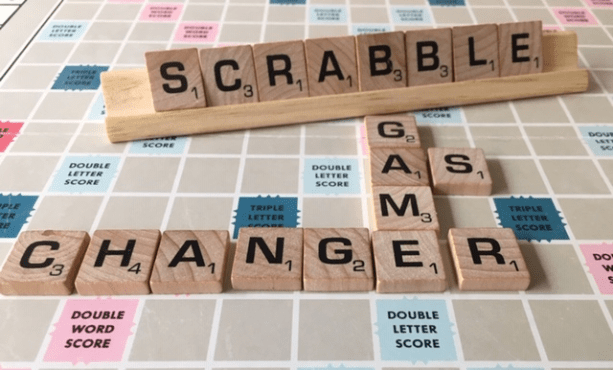 For my students’ final writing assignment in English 111: Writing and Inquiry, they compose a reflective essay that addresses the features of the course that have contributed to their development as writers and critical thinkers. As I embarked on this final assignment with them, my thoughts repeatedly returned to the hours they had devoted to playing Scrabble on Wordplay Days, a bimonthly feature that I included in my classes for the first time this semester.
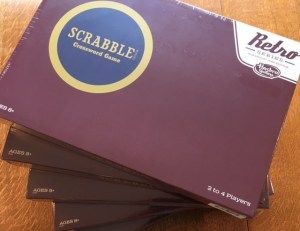 When the students in the Monday-Wednesday 8 o’clock class tore the plastic from the boxes of Retro Edition Scrabble, I had no idea how they would respond to the game. Back in August, when I had decided to include bimonthly Wordplay Days on the calendar, I did so to achieve two of my goals as a teacher: first, to offer students an opportunity to collaborate on low-stakes assignments that would develop their critical thinking skills and word power; and second, to provide another chance for them to turn away from screens.
 Noting that transformation isn’t to say that all of the students liked Scrabble. Some clearly didn’t. But even the students who agreed that “Scrabble, to put it bluntly, is a lousy game” (Kay C5) seemed to appreciate the opportunity to earn credit for an activity that didn’t seem dull or menial. And their other work in the classroom began to seem less arduous to them. Perhaps they didn’t mind reading and writing as much when they knew more Wordplay Days were still to come. Or perhaps they began to make connections between their book work and board play as they increased their word power and became more sophisticated strategists.

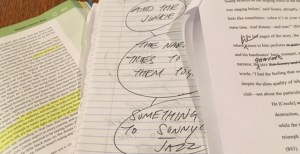 James Baldwin’s short story “Sonny’s Blues” depicts the life of a young jazz musician and addict, as seen through the eyes of his older brother. The inciting incident—what prompts the older brother to tell Sonny’s story—is a police report in the newspaper, citing Sonny’s arrest the night before. Reading that brief story, one that reduces his brother to someone who “peddle[s] and us[es] heroin” (813), leads the older-brother-narrator to meditate on the events that led to Sonny’s incarceration. The news of his arrest—albeit a brief item in the paper—plays a critical role in the opening paragraph, providing not only the inciting incident but also a counterpoint for the improvisation that breathes life into Sonny’s character. Despite the narrator’s initial dislike of Sonny’s music, the structure of his own storytelling mimics the composition of jazz, underscoring the kinship of his nonlinear, polyphonic story and the piano playing of his brother.
 In “Just One More Game . . . ,” journalist and critic Sam Anderson examines the appeal of hand-held video games—Tetris and its offspring—observing the concurrence of the crumbling of the Berlin Wall and Japanese game-maker Nintendo’s introduction of the Game Boy, the hand-held device that freed gamers to play wherever they chose. No longer were they confined to play within the walls of rec rooms and arcades.
 In my mind I have traveled back to my tenth-grade English classroom, to a desk where I haven’t sat for more than thirty-five years. Yet despite that temporal distance, parts of that room remain vivid to me: the side-by-side, long, narrow window and back door typical of public high schools built in the early 1970s and the air conditioning unit below the window. It was, in fact, the first public school in our county that was air-conditioned.
