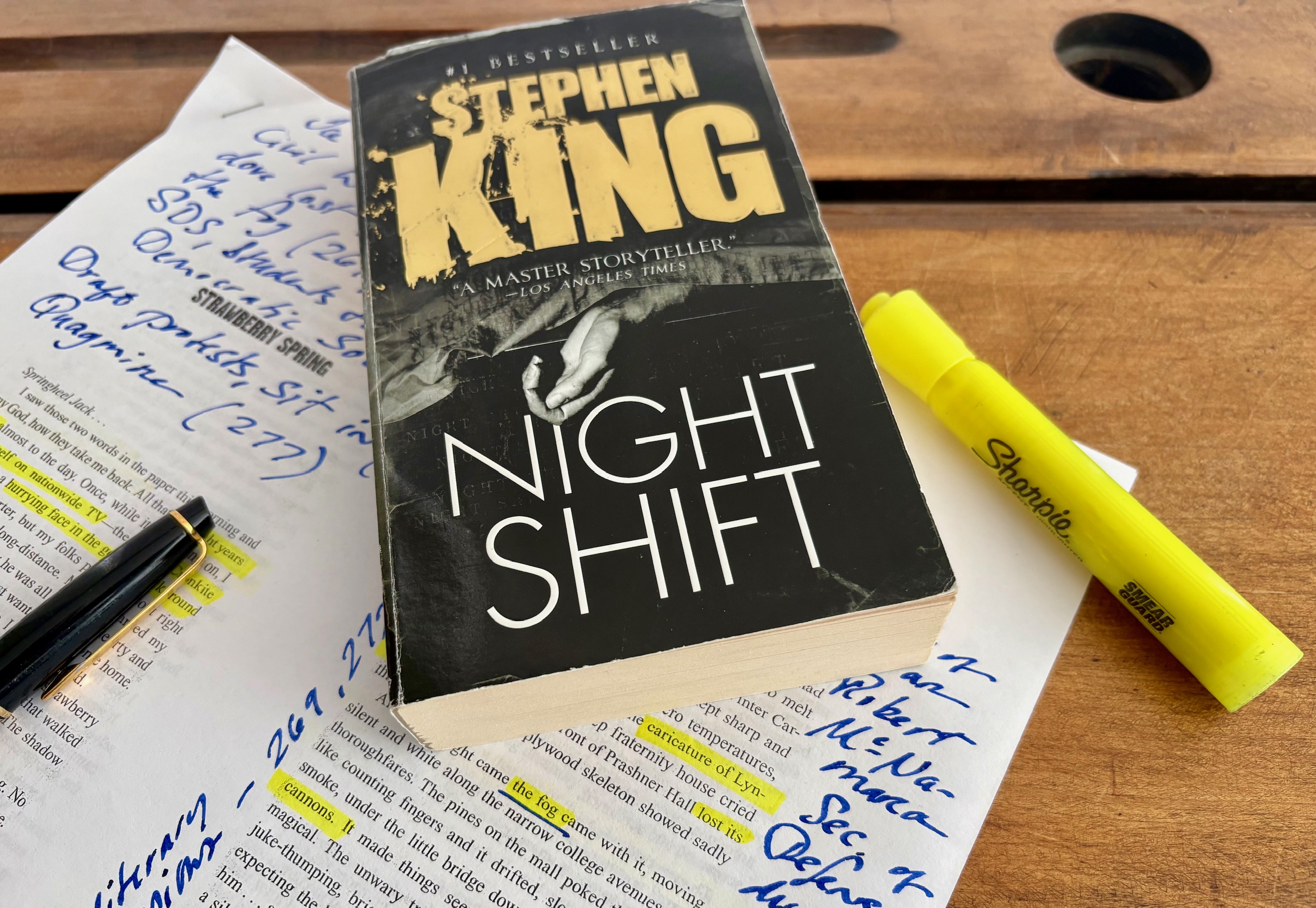
King, Stephen. “Strawberry Spring.” Night Shift. 1978. Anchor, 2011. pp. 228-82.
Today in class we will read Stephen King‘s short story “Strawberry Spring,” which was published in Ubris magazine in 1968 and included in King’s first short story collection, Night Shift (1978).
For the collaborative exercise that you will complete after we read the story, I will ask you to determine whether you can identify any details that indicate why the killer may have murdered any of his victims. Although there is no indication that he knew Gale Cerman, Adelle Parkins, or Marsha Curran, he did know Ann Bray.
I will also ask you to identify words and phrases that illustrate how the story is not only a horror story but also a commentary on war, the Vietnam War in particular, and the Vietnam era.
Lastly, I will ask you to try to identify the two literary allusions in King’s story. We will discuss your findings near the end of class today or at the beginning of class on Wednesday, and I will include the answers in tomorrow’s class notes.
Next Up
We will review “Strawberry Spring” at the beginning of Wednesday’s class, and you will have the remainder of the period to begin work on your final essay and annotated bibliography.
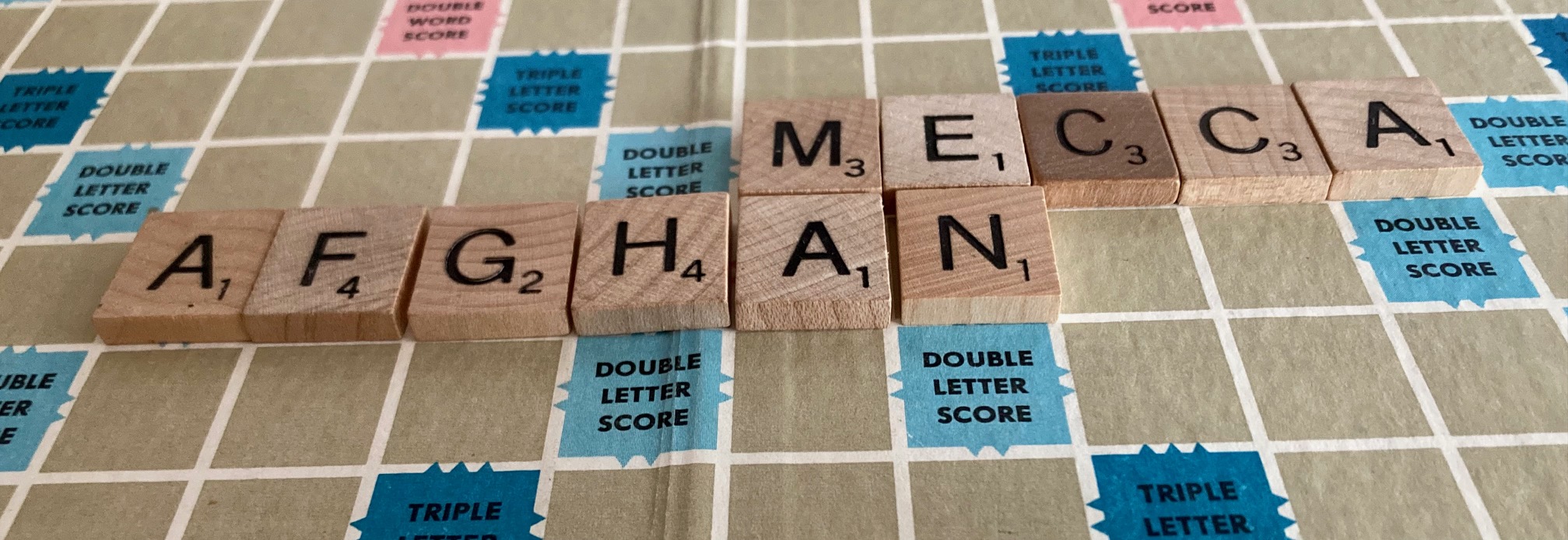
The first Scrabble post of the semester featured first names that are also common nouns, making them playable in Scrabble. Today’s post includes place names and words derived from places, or toponyms–more proper nouns that are playable in Scrabble because they’re also common nouns. Studying these words offers you additional opportunities to broaden your vocabulary and up your game.
afghan: a wool blanket
alamo: a cottonwood poplar tree
alaska: a heavy fabric
berlin: a type of carriage
bermudas: a variety of knee-length, wide-legged shorts
bohemia: a community of unconventional, usually artistic, people
bolivia: a soft fabric
bordeaux: a wine from the Bordeaux region
boston: a card game similar to whist
brazil: a type of tree found in Brazil used to make instrument bows (also brasil)
brit: a non-adult herring
cayman: a type of crocodile, also known as a spectacled crocodile (also caiman)
celt: a type of axe used during the New Stone Age
chile: a spicy pepper (also chili)
colorado: used to describe cigars of medium strength and color
congo: an eellike amphibian
cyprus: a thin fabric
dutch: referring to each person paying for him or herself
egyptian: a sans serif typeface
english: to cause a ball to spin
french: to slice food thinly
gambia: a flowering plant known as cat’s claw (also gambier, which is a small town in Ohio)
geneva: gin, or a liquor like gin
genoa: a type of jib (a triangular sail), also known as a jenny, first used by a Swedish sailor in Genoa
german: also known as the german cotillon, an elaborate nineteenth-century dance
greek: something not understood
guinea: a type of British coin minted from 1663 to 1813
holland: a linen fabric
japan: to gloss with black lacquer
java: coffee
jordan: a chamber pot
kashmir: cashmere
mecca: a destination for many people
What a Bonus a Z Makes
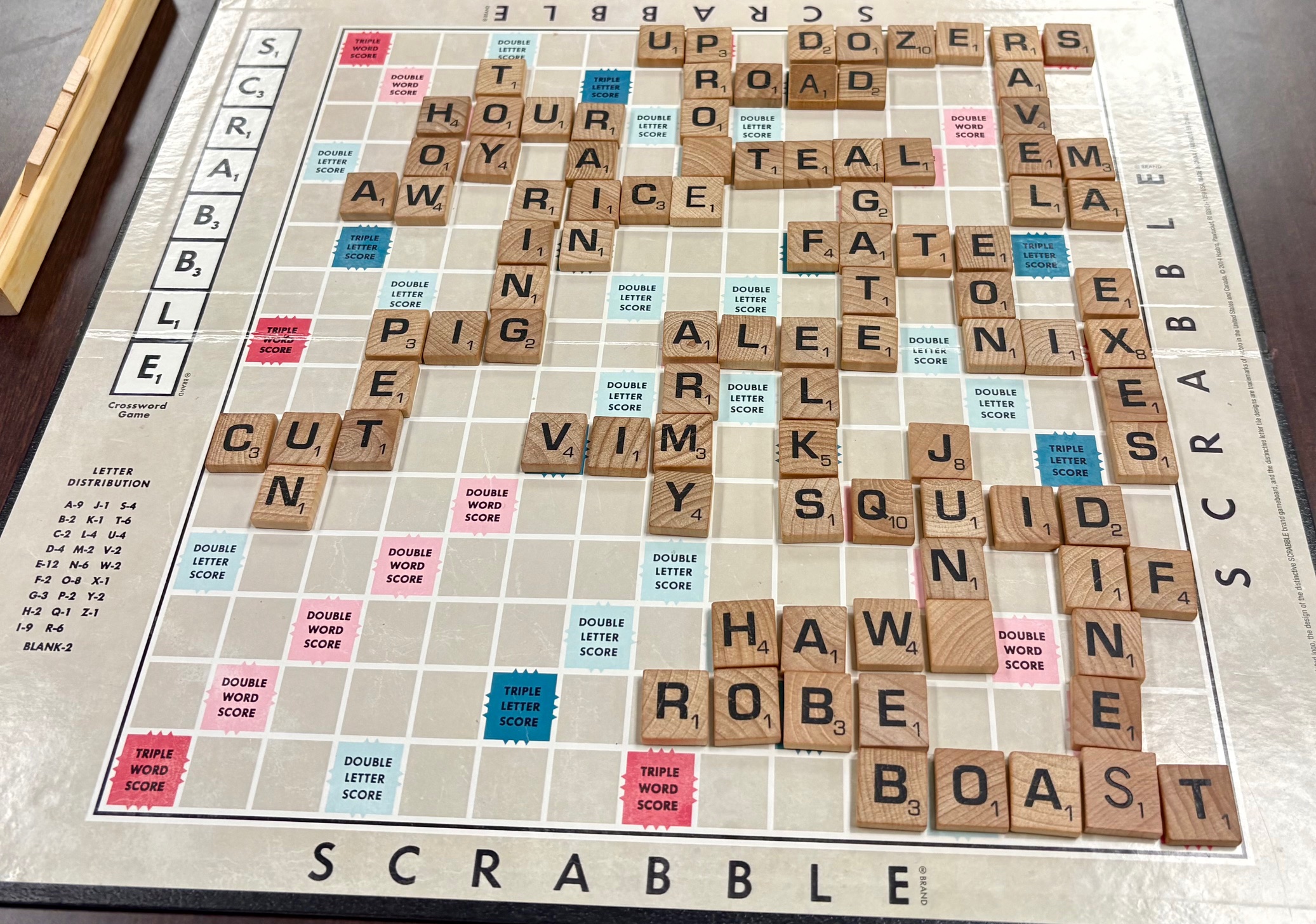
Because they knew that da (a father) and od (a hypothetical force) were playable words, the members of one of last Friday’s teams played dozers (ones who doze) in the upper right corner for a triple-word score. Because the z was played on the double-letter square, the team earned a total of eighty-four points for dozers (seventy-eight), da (three), and od (three).
Kudos
Six students took advantage of last Friday’s bonus assignment and posted comments on their classmates’ analyses.
Nick Beeker
Aidan Berlin
Jermaine Cain
Sofia Marin
Izzie McLawhorn
Dylan Virga
Kudos to Nick, Aidan, Jermaine, Sofia, Izzie, and Dylan. You can view their comments on the March 6 blog post.
In class on Monday, we will read and analyze “Strawberry Spring,” a short story by Stephen King. In preparation for our study, read the author’s page on his website.
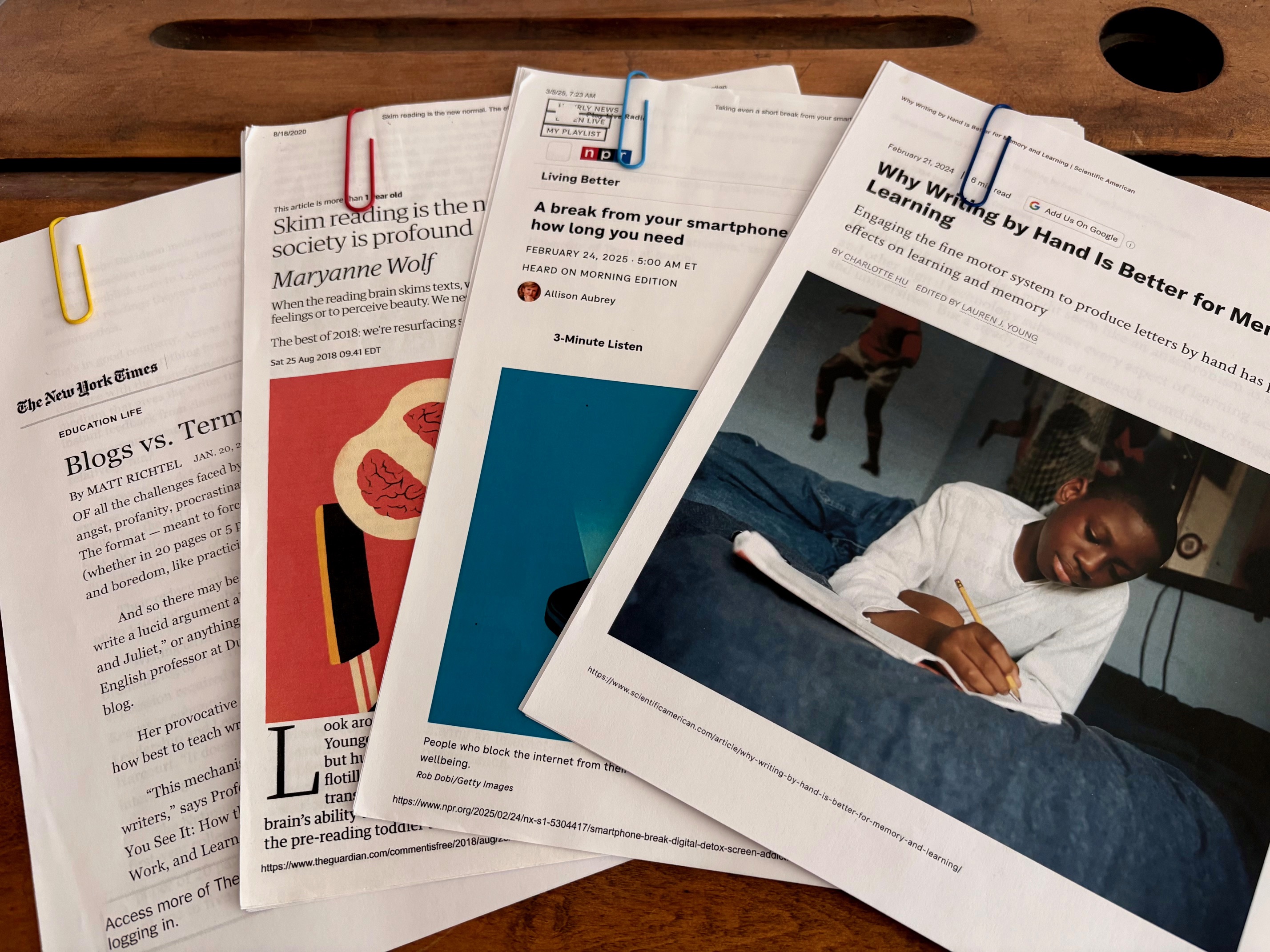
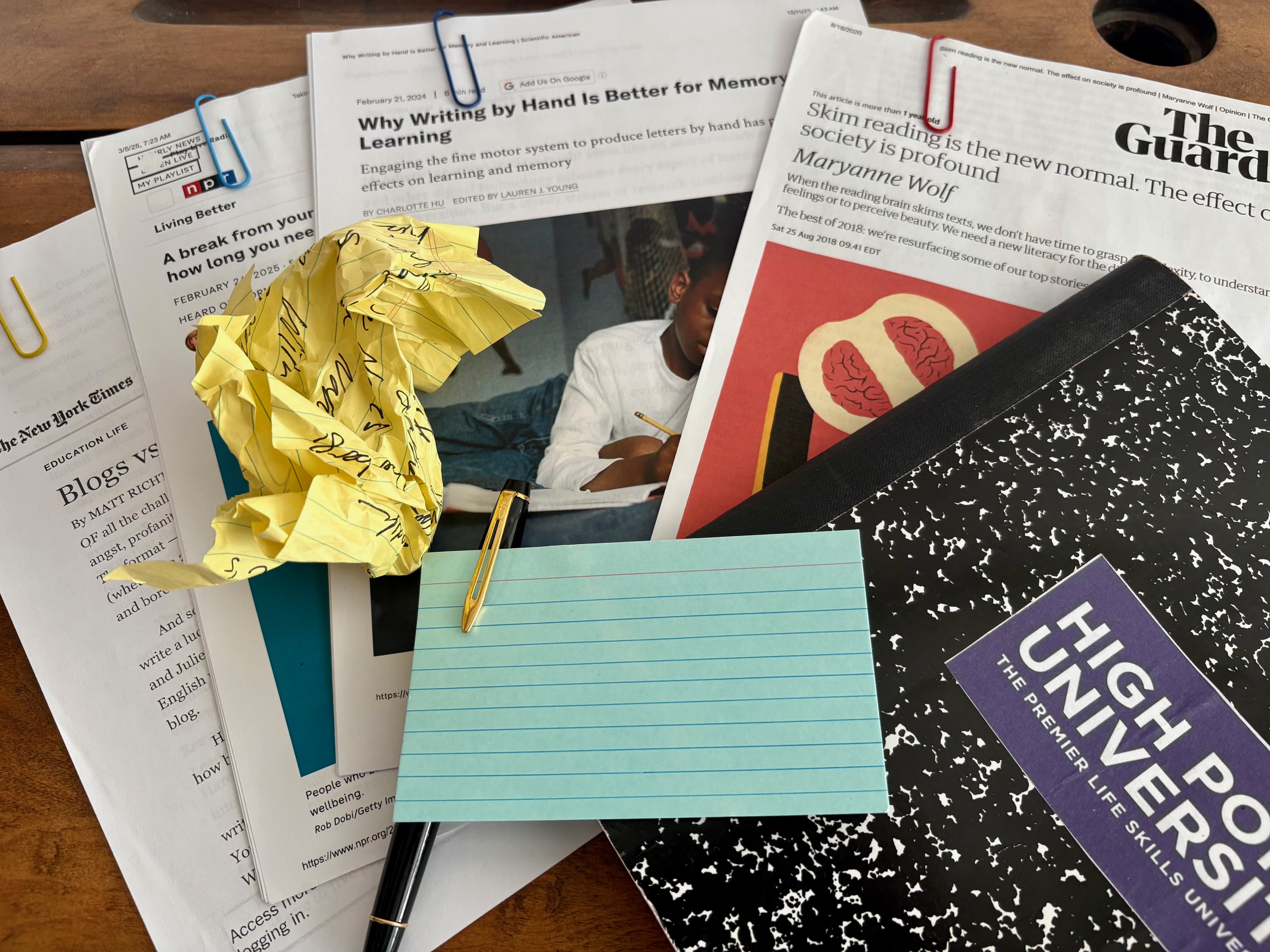
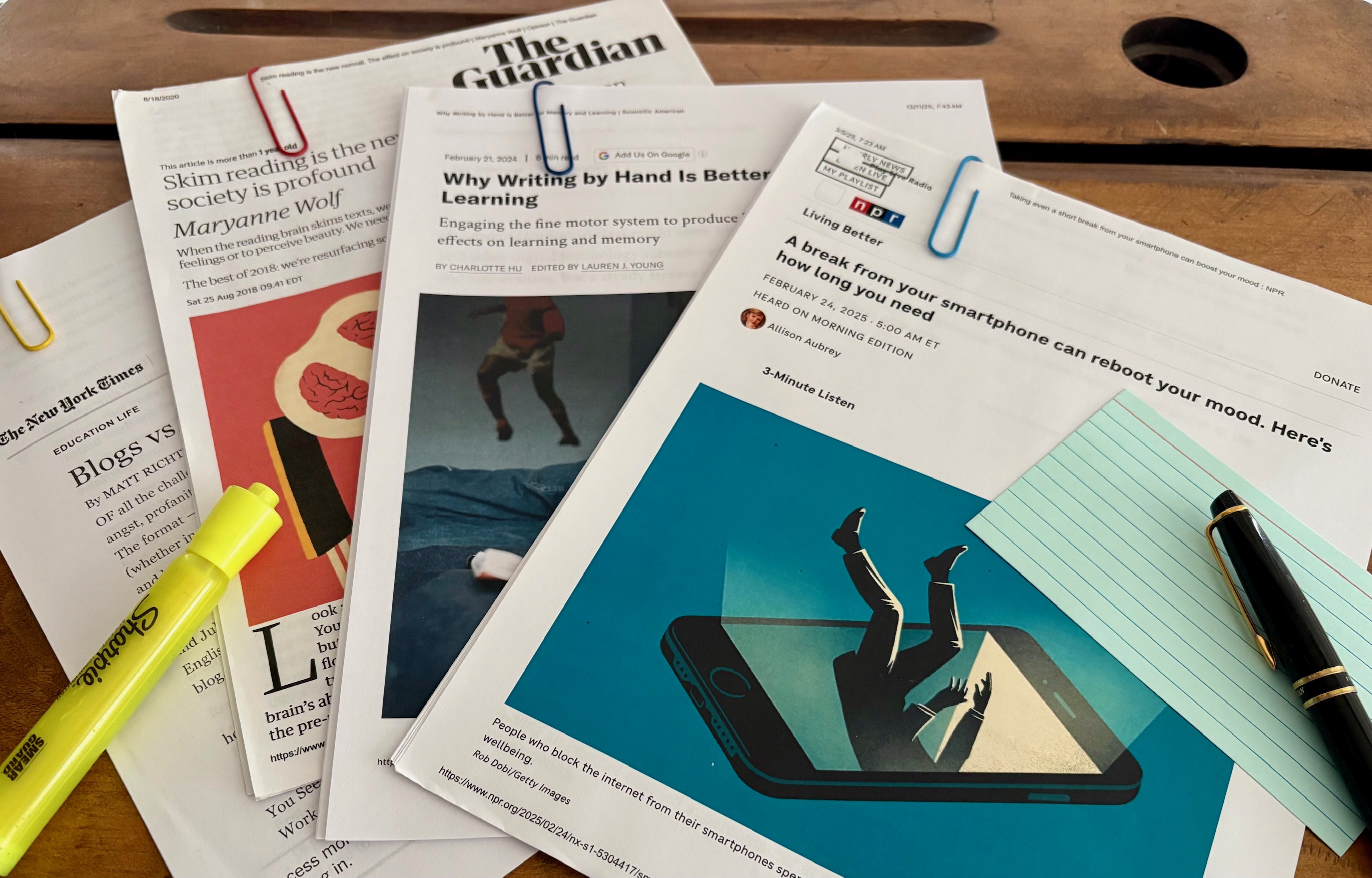
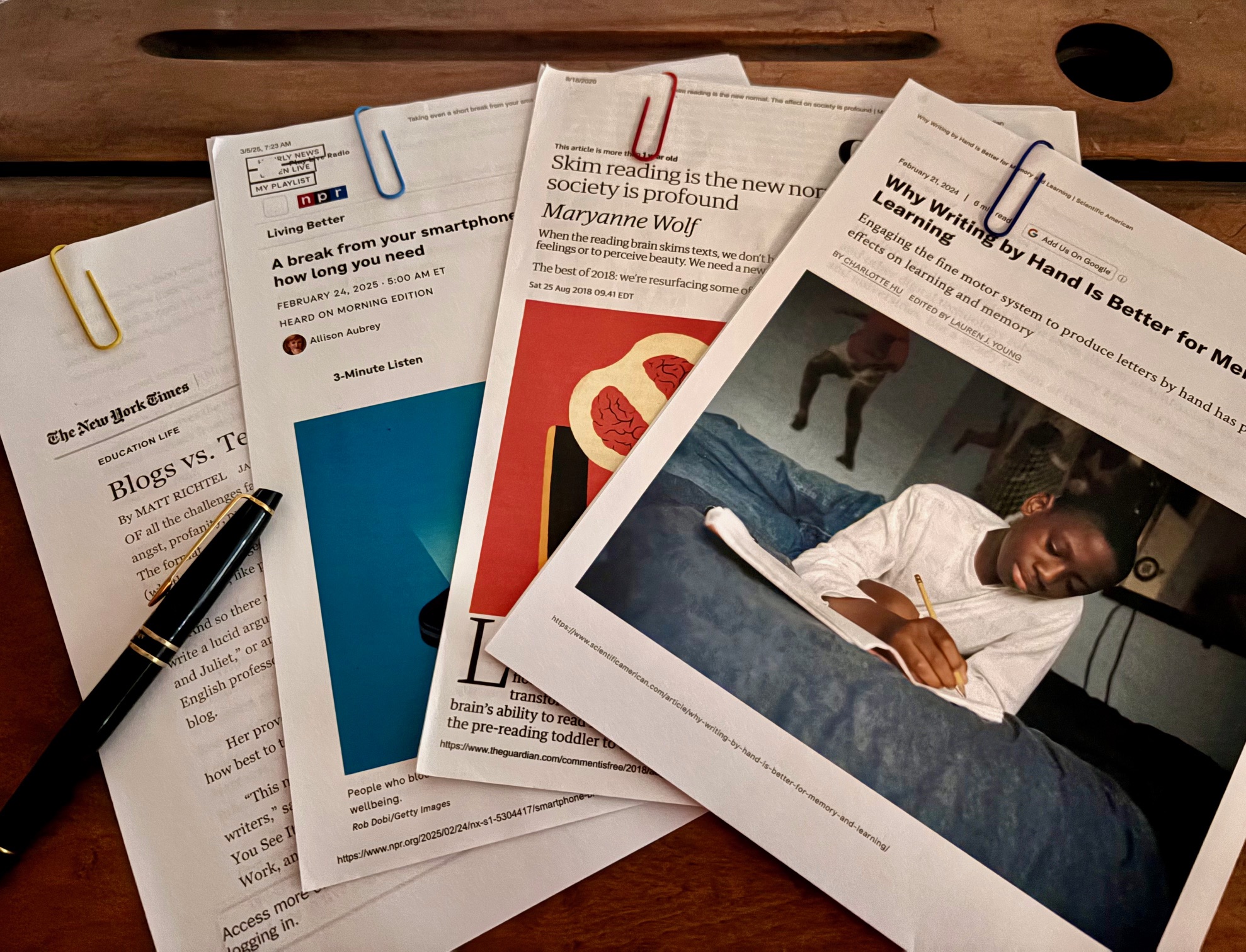
The four articles that served as the subjects for your group presentations are all secondary sources: texts that address information originally presented in primary sources. Primary sources include research studies and other original works, such as historical documents, essays, and fiction. Each of the essays, the short story, the letter, and the chapter that you read previously for class can serve as primary sources for your research. For example, David Sedaris‘s “Me Talk Pretty One Day” is a primary source for a study of Sedaris’s writing.
In “Blogs vs. Term Papers,” Matt Richtel reports on the findings of the National Survey of Student Engagement and a study of high school writing requirements conducted by William H. Fitzhugh, editor of The Concord Review, as well as the writing curricula of then-Duke University Professor Cathy Davidson and Stanford Professor Emerita Andrea Lunsford.
In “A Break from Your Smartphone,” Allison Aubrey reports on research conducted by Noah Castelo, Kostadin Kushlev, Adrian F. Ward, Michael Esterman, and Peter B. Reiner, which was published in PNAS NEXUS, the journal of the National Academy of Science.
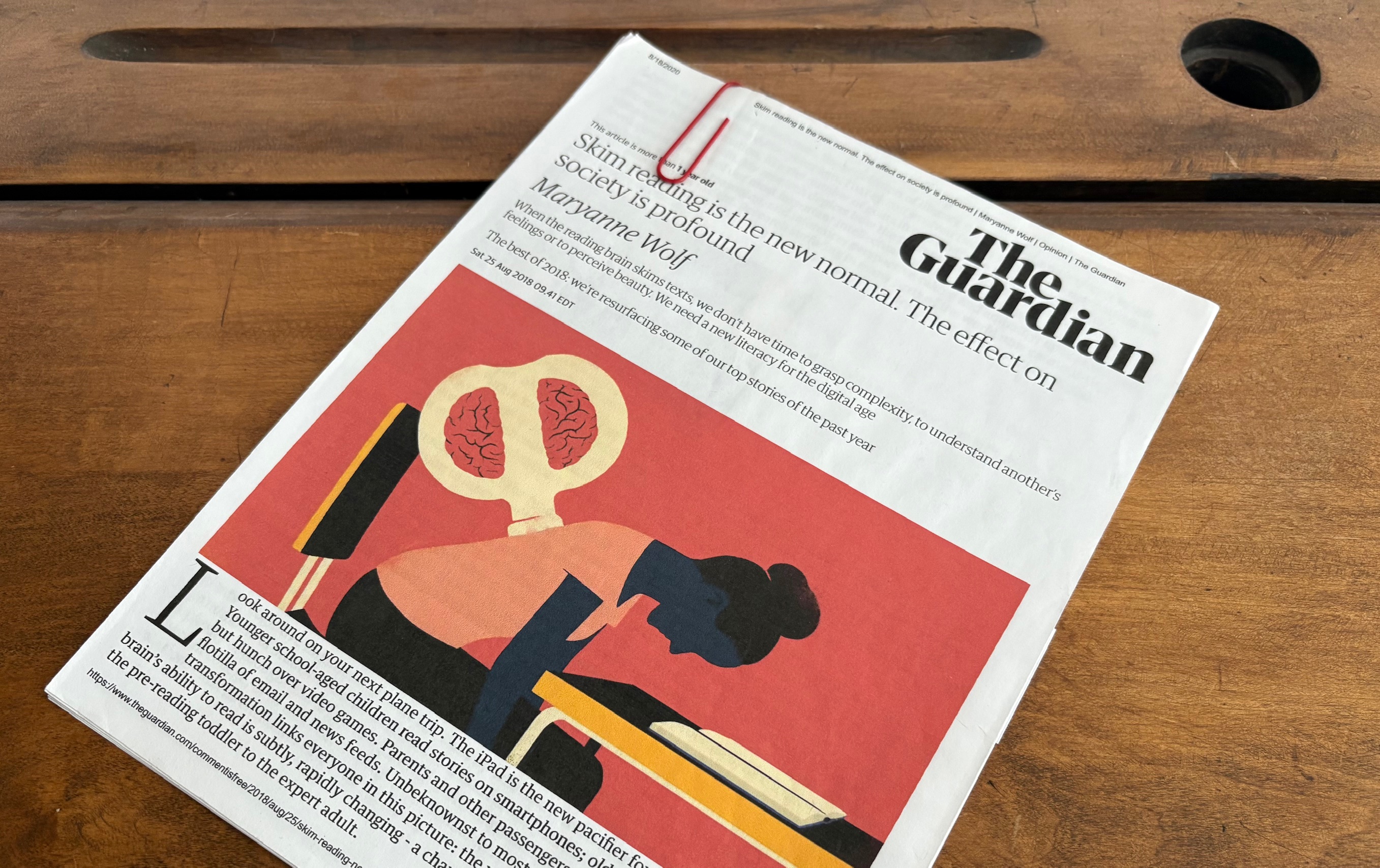
Although Maryanne Wolf’s “Skim Reading is the New Normal” cites research originally published in primary sources, she is not reporting on that research objectively. Instead, she argues that in light of researchers’ findings, “[w]e need to cultivate a new kind of brain: a ‘bi-literate’ reading brain capable of thought in either digital or traditional mediums” (par. 12). If you look at the heading on your copy of Wolf’s article, you will see the word opinion, which indicates that her article appeared in the opinion section of The Guardian‘s website and on the Op-Ed page of the physical paper.
Informed opinion pieces–such as Wolf’s, which draws on scholarly research–are suitable sources for your research, but it’s important to recognize the difference between reporting and commentary.
Great Britain’s The Guardian, which published Wolf’s article, and The New York Times, which published Richtel’s “Blogs vs. Term Papers,” are two of the most well-regarded newspapers of record, known for their accuracy and high-quality reporting. NPR (National Public Radio), which aired Aubrey’s “A Break from Your Smartphone,” is another premier news outlet. The magazine Scientific American, which published Hu’s “Writing by Hand is Better for Memory and Learning,” is yet another first-rate publication, one known for its authoritative and accessible coverage of science and technology news, written for a general audience.
AP Style vs. MLA Style
As you read the four articles that served as your presentation subjects, you probably noticed some differences among their styles and MLA (Modern Language Association) style, which you use for paper assignments in English 1103 and other courses in the humanities. Most news publications use AP (Associated Press) or their own in-house style book that shares many of AP’s rules. One of reason style rules are difficult to remember is the differences among the requirements. Here are some of the important distinctions between AP style and MLA:
In AP style, a sentence may begin with a quotation. In MLA style, a quotation must be introduced with a signal phrase. Otherwise, it is considered a dropped quotation.
AP style does not include parenthetical citations. In MLA style, quotations and paraphrases are followed by parenthetical citations–unless the sources are interviews or other nonprint sources.
In AP style, titles of publications are not enclosed in quotation marks or italicized. In MLA style, titles of short works are enclosed in quotation marks; titles of longer works are italicized (underlined in longhand).
Almost all numbers are expressed as figures in AP style. In MLA style, any number that can be expressed in one or two words is written as a word.
AP style omits the Oxford or serial comma, the comma before and in a series of three or more. Most publications other than newspapers use the Oxford or serial comma, and MLA advocates its use.
In AP style, an em dash is preceded and followed by a space. MLA style requires no space before or after an em dash.
This morning, in the first half of class, you and your classmates will deliver your group presentations. Keep in mind that when you are not presenting, you will still play a vital role in class as an audience member. Pay close attention to the other three presentations. Jot occasional notes in your journal, but don’t keep your head down for a substantial length of time. Making eye contact with the speakers and nodding your head are gestures that will convey your appreciation for your classmates’ efforts.
In the second half of class, we will look back at the four articles that served as your subjects, and you will compose reflections. Directions for your reflections are included below.
Directions
Compose a short piece of writing (two paragraphs, minimum) that reflects on your individual preparation and delivery of your portion of the presentation and your group’s presentation overall. Elements to address include the following:
The roles of your reading and writing: How did the processes of rereading the text and writing and rewriting your remarks contribute to the effectiveness of your delivery?
The introduction of your group members and opening remarks
The examination of points in the article
The conclusion
Poise, eye contact, and avoidance of filler words
The group’s cohesiveness
After you have reflected on your group’s presentation, compose an additional paragraph that addresses a presentation by one of the other groups. Choose the one that stands out the most to you. What element or elements of that presentation made it particularly effective and why?
As you continue to prepare for your presentation, be mindful of the valuable roles that reading and writing play in the process. Although the final product is your group’s three-to-four-minute oral presentation, your work began with reading and writing: reading the article that serves as your subject, and writing the plan that you composed in class yesterday.
Have you thoroughly reread the article that serves as your subject? If not, turn back to the text itself at least two more times before Wednesday. Chances are, on a second or third reading, you will notice details you didn’t notice before, ones that you may want to add to your presentation.
In addition to recording key words on your notecard, write out your portion of the presentation in your journal. Though you will not be permitted to have your journal in hand during your presentation, the act of writing down your remarks and rewriting them will help you commit them to memory.
As you practice delivering your presentation, be sure to limit the time that you look down at your notecard and your copy of the reading. Your ability to limit those glances will be greater if you spend ample time rereading the text and writing and reviewing your remarks in your journal.
Robert Klara’s “Scrabble”
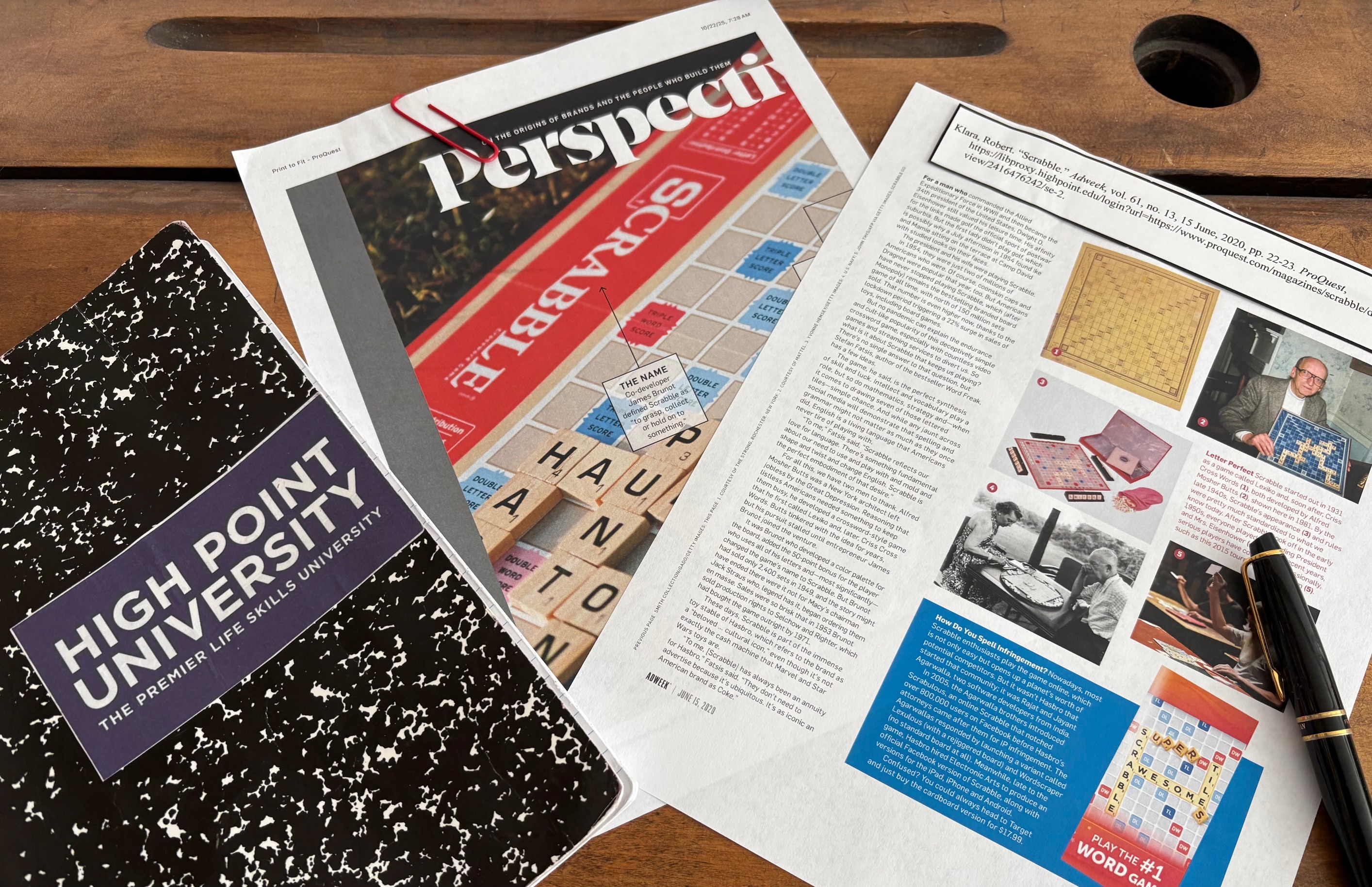
Yesterday, while you were planning your presentations, I distributed copies of Robert Klara’s article “Scrabble.” If you plan to focus on Scrabble for your final essay and annotated bibliography, Klara’s article will serve as your starting point.
Unlike the articles you read for your presentations, Klara’s does not report on research, though he does quote journalist Stefan Fatsis, author of Word Freak: Heartbreak, Triumph, Genius, and Obsession in the World of Competitive Scrabble Players. Klara’s article also provides historical context.
If you choose Scrabble as the subject for your final essay and annotated bibliography, include among your sources at least one newspaper or magazine article that reports on Scrabble research, or include the original research itself, published as a peer-reviewed article, such as “The World of Competitive Scrabble: Novice and Expert Differences in Visuospatial and Verbal Abilities,” by Diane F. Halpern and Jonathan Wai, available through the HPU Libraries.
Next Up
In class tomorrow, you will deliver your group presentations. Afterward, in the second half of class, you will compose a short essay that reflects on both your own presentation and one by another group.
This morning in class, after your Scrabble debriefing, I will distribute your group presentation assignment, and you will have the remainder of the class period to devote to planning the short presentation that you will deliver in class on Wednesday. An additional copy of the assignment is included below.
As an exercise in collaboration and oral communication, you and three or four of your classmates will plan, rehearse, and deliver a concise presentation focusing on a reading that addresses one of the practices implemented in the course. If you were absent when copies of the articles were distributed (see the titles in the group assignments below), download and print copies from the Blackboard readings folder.
Presentation Assignment Directions
Plan a presentation of three or four minutes, total, that addresses the most significant points covered in your group’s designated reading. (The lists of group assignments and designated readings are included below.)
Include in your presentation the following elements: (1) an introduction that mentions each group member’s first and last name (each group member may introduce himself or herself, or the group may assign one member the responsibility of introducing everyone), the title and author, or authors, of the reading, and a brief overview of the text, (2) A close examination of two or more points in the reading, and (3)) A conclusion that provides closure without restating the introduction and that invites questions. One strategy to consider for your conclusion is to address the relevance of the practice (the subject of your reading) to your work in English 1103, your work in other courses, and/or your life outside of the classroom.
Do not create a digital component, such as a PowerPoint or Google Slides show. You will not be permitted to use any digital devices during your presentation. Instead, you will rely only on a single three-by-five-inch index card with your notes and your paper copy of the reading.
Aim for cohesion. Turning briefly to the previous speaker and addressing him or her by first name, repeating a word or idea of his or hers, and connecting it to your own remarks are ways to unify your presentation. If your presentation seems to be a series of individual talks rather than a single group presentation, it lacks cohesion.
Every group member is not required to speak for the same length of time, but every member is required to deliver a portion of the presentation.
Directions for Rehearsing
In preparation for rehearsing, write your notes on a single three-by-five-inch index card (one card per group member). If your initial notes are written in complete sentences, rewrite them to include only words and short phrases for your key points. If your notes are too detailed, you will risk relying too heavily on them and making minimal eye contact with the audience. Plan to make as much eye contact as possible, and be sure to make eye contact with people throughout the room rather than fixing your eyes on one or two people.
Practice good posture. As you deliver your presentation, your ears should be directly above your shoulders. If you tend to shift your weight from one foot to the other, stand with your feet perpendicular to each other. If you do so, you will not be able to shift your weight from one foot to the other.
Avoid filler words, such as uh, um, like, and you know. If you tend to use filler words, practice pausing at the points where you are likely to use them.
Take turns delivering your portions of the presentation, and offer feedback to your group members. Offer both suggestions for improvement and words of encouragement.
Group Assignments
“Blogs vs. Term Papers”: Avery Clark, Madison Davis, Sofia Marin, Travis Pecararo
“Skim Reading is the New Normal”: Zach Dick, Nicole Marin, Tommy McHugh, Elise Claire Palmisano, Davis Smith
“Why Writing By Hand is Better for Memory and Learning”: Nick Beeker, Jermaine Cain, Izzie McLawhorn, Sierra Welch
“A Break from Your SmartphoneCan Reboot Your Mood . . .”: Aidan Berlin, Marcus Gerhardt, Ewan Paterson, Dylan Virga
Grade Criteria
An A presentation includes all elements outlined in the directions for planning and rehearsing and demonstrates the group members’ poise and ability to avoid filler words.
A B presentation includes all elements outlined in the directions for planning and rehearsing but may be marred by group members’ lack of poise and/or inability to avoid filler words.
A C presentation includes most but not all elements outlined in the directions for planning and rehearsing and may also be marred by group members’ lack of poise and/or inability to avoid filler words.
A D presentation includes only some elements outlined in the directions for planning and rehearsing and may also be marred by group members’ lack of poise and/or inability to avoid filler words.
An F presentation includes few if any elements outlined in the directions for planning and rehearsing and may also be marred by group members’ lack of poise and/or inability to avoid filler words.
Next Up
In class on Wednesday, you will deliver your group presentations. Afterward, in the second half of class, you will compose a short essay that reflects on both your own presentation and one by another group, one that was notable for its strengths.
On Monday, after your Scrabble debriefing, you will receive the assignment for the short group presentation you and three or four of your classmates will deliver on Wednesday, March 11. You will have the majority of Monday’s class period to devote to planning, and you will have the first ten minutes of Wednesday’s class for final preparations.
The subject of your presentation will be an article focusing on one of these aspects of English 1103:
Blogging
Limiting screen time
Reading printed texts (rather than reading online articles and ebooks)
Writing longhand
Although you and your group members will focus on only one of the four articles, all of you will read and annotate the other three in preparation for your classmates’ presentations.
If you decide to devote your final essay and annotated bibliography to one of the aspects of the course covered in the group presentations, the article focusing on that subject will serve as the starting point for your project.
Final Essay and Annotated Bibliography
Which aspect of the course or which of the writers we have studied are you interested in examining further? Your answer to that question will determine the subject of your final essay and annotated bibliography.
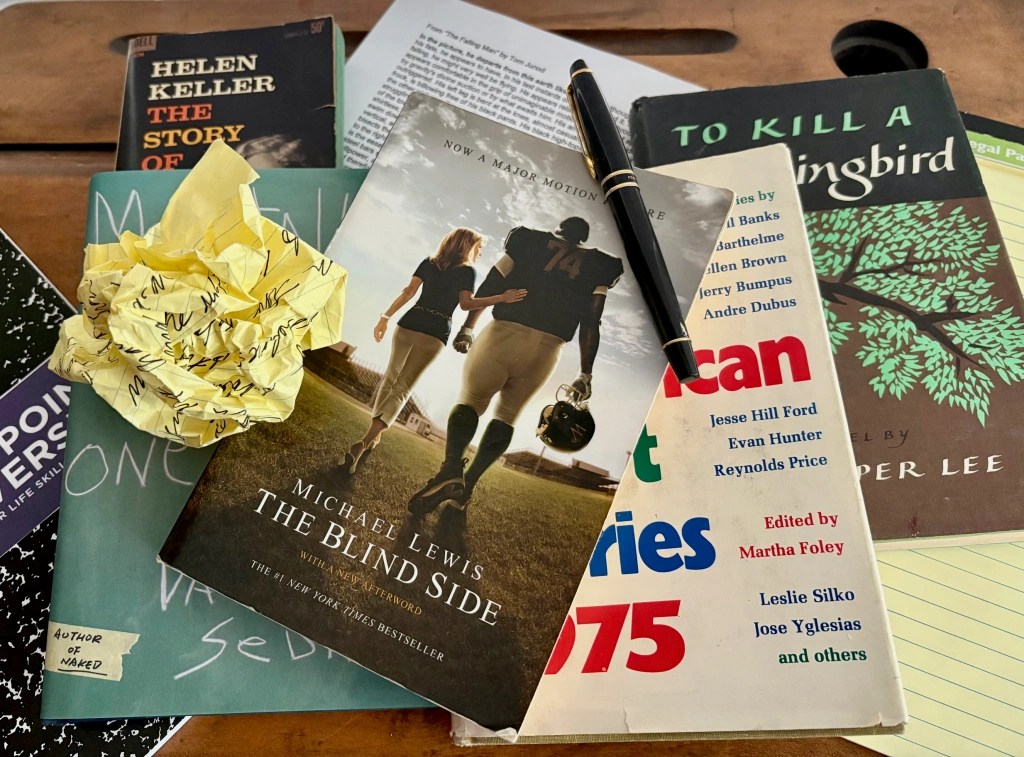
In preparation for beginning your research next week, review the list below and freewrite in your journal on the subjects that appeal to you most.
Donald Barthelme
Blogging
Tom Junod
Helen Keller
Limiting screen time
Martin Luther King, Jr.
Harper Lee
Michael Lewis
Reading printed texts (rather than reading online articles and ebooks)
Scrabble
David Sedaris
Writing longhand
If you choose to research one of the writers we have studied, keep in mind that your project will be an exploration of the author’s words, not his or her life. Your aim is not to write a biography, but instead a study of the writer’s craft.
Bonus Assignment
Directions
Go to the class blog page, and click on the link for the blog of the classmate whose name precedes yours. If you are first on the list, go to the blog of the student whose name is last.
If your designated classmate’s blog is not linked to the page, or his or her analysis is not published, choose another classmate’s blog.
Read the classmate’s analysis.
Compose a one- or two-paragraph response (75 words, minimum) that includes both the classmate’s name and the title of his or her analysis. In your comment, address one or more of these elements: the title, the thesis, evidence to support the thesis and/other claims, organization, the conclusion, the image documenting part of the writing process away from the screen, the embedded link to a relevant website. Note that you will mention the classmate by name, but you will not refer to him or her in third person. In other words, you will not write, John’s examples of “The School”‘s incongruities effectively demonstrate Donald Barthelme’s postmodernist approach to storytelling. Instead, you will write, John, your examples of “The School”‘s incongruities effectively demonstrate Donald Barthelme’s postmodernist approach to storytelling.
Recommended (not required): Draft your comment longhand in your journal.
Type your response as a comment. You should see a leave comment/reply option at the top or bottom of the post. If you do not see that option, click the title of the blog post, and scroll down. You should then see leave comment/reply.
Before you click leave comment/reply, copy your comment (on a PC, copy with control + c; on a Mac, copy with command + c).
After you submit your comment on your classmate’s blog post, return to this post, and paste your comment as a reply (on a PC, paste with control + v; on a Mac, paste with command + v). This step is critical because your classmate may not approve your comment, which means it will not be visible on his or her blog post. To receive credit for the assignment, you must post your duplicate comment as a reply to this blog post, “ENG 1103: Looking Ahead.“ To submit your comment, click the title of the post, then scroll down to the bottom. There you will see the image of an airmail envelope with a box for your comment. Type your comment in the box and click Comment. Post your comment by the 5 p.m. on Thursday, March 12.
I will make your comments visible after the deadline.
Next Up
On Monday, you will begin planning your group presentations. For more details, see the first paragraph of this post. I will provide additional instructions in class.
Last week, I published a blog post featuring playable four-letter words with three vowels. Knowing those words, and others with multiple vowels, proves useful when you’re faced with a rack of mostly, or all, vowels. Here’s a list of the remaining playable four-letter words with three vowels, beginning with the letters in the second half of the alphabet:
naoi: ancient temples (pl. of naos)
obia: form of sorcery practiced in the Caribbean (also obeah)
odea: concert halls (pl. of odeum)
ogee: an S-shaped molding
ohia: a Polynesian tree with bright flowers (also lehua)
olea: corrosive solutions (pl. of oleum)
olio: a miscellaneous collection
ouzo: a Turkish anise-flavored liquor
raia: a non-Muslim Turk (also rayah)
roue: a lecherous old man
toea: a currency in Papua, New Guinea
unai: a two-toed sloth (pl. unai; an ai is a three-toed sloth)
On Monday, after your Scrabble debriefing, you will receive your group presentation assignment, and you will have the remainder of the period to plan and rehearse.
This morning in class, you will compose a reflective essay that documents the process of planning, drafting, and revising your analysis. Include at least one relevant quotation from Writing Analytically, introduced with a signal phrase and followed by a parenthetical citation. Questions to consider in your reflection include the following:
Questions to Consider in Your Reflection
When you began transferring the words from your handwritten draft onto the screen of your laptop or tablet, what did you observe about the process?
What aspect of the writing seemed the most challenging? Choosing your topic? Deciding which text would serve as your subject? Determining your thesis? Identifying details to support your claims? Organizing the body of the essay? Composing the conclusion? Why did that aspect of the writing seem the most challenging?
Did the subject of your analysis change? If so, what was your original subject, and what did you change it to?
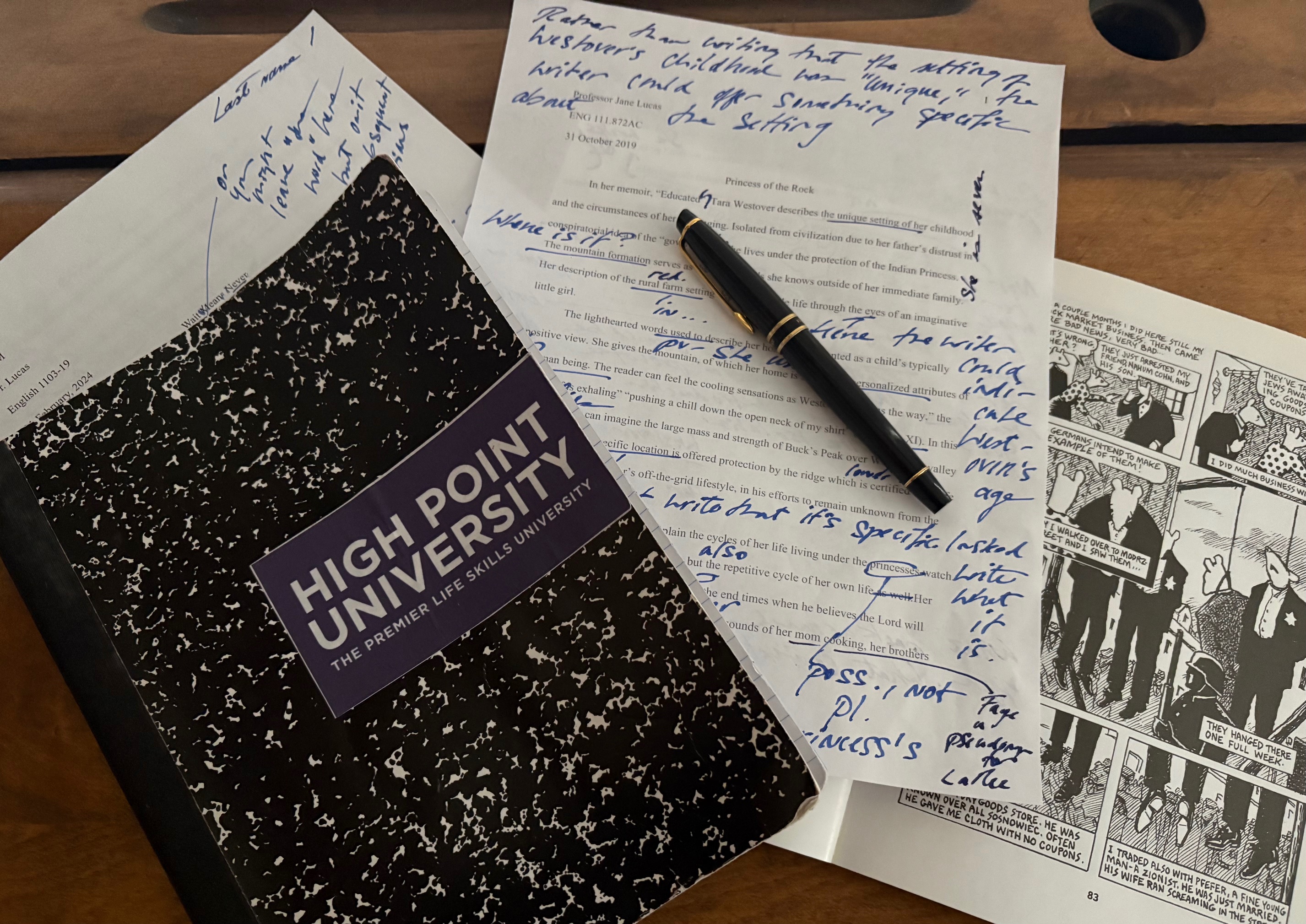
Did any of the sample analyses (“Wait Means Never,” “Princess of the Rock,” “The Strange Fruit of Sosnowiec”) prove helpful to you? If so, which one? How was it helpful?
What do you consider the strongest element of your analysis?
At what point in the process did you decide on a title? Did you change the title during the writing process? If so, what was the original title?
What image that documents part of your writing process away from the screen did you include in your blog post? Why did you choose that image?
What relevant website did you include an embedded link to in your blog post? Why did you choose that site?
Sample Works Cited Entries
Rosenwasser, David, and Jill Stephen. “Focus on Individual Words and Phrases.” Writing Analytically, 9th edition. Wadsworth/Cengage, 2024. pp. 48-49.
Rosenwasser, David, and Jill Stephen. “How Long?: Paragraphs, Readers, and Writers.” Writing Analytically, 9th edition. Wadsworth/Cengage, 2024. p. 308.
Rosenwasser, David, and Jill Stephen. “‘Interesting,’ ‘Revealing,’ ‘Strange’” Writing Analytically, 9th edition. Wadsworth/Cengage, 2024. p. 24.
Rosenwasser, David, and Jill Stephen. “Seems to Be About X, But Could Also Be (Or is ‘Really’) About Y.’” Writing Analytically, 9th edition. Wadsworth/Cengage, 2024. pp. 104-7.
Rosenwasser, David, and Jill Stephen. “What a Good Analytical Thesis Is and Does.” Writing Analytically, 9th edition. Wadsworth/Cengage, 2024. pp. 241-42.
Rosenwasser, David, and Jill Stephen. “Words Matter.” Writing Analytically, 9th edition. Wadsworth/Cengage, 2024. pp. 49-50.
Monday in class, I distributed copies of my study of a page of Art Spiegelman’s Maus, which I wrote as a model analysis in a previous semester. An additional copy, which complies with the guidelines of your analysis blog post, appears below.
The Strange Fruit of Sosnowiec
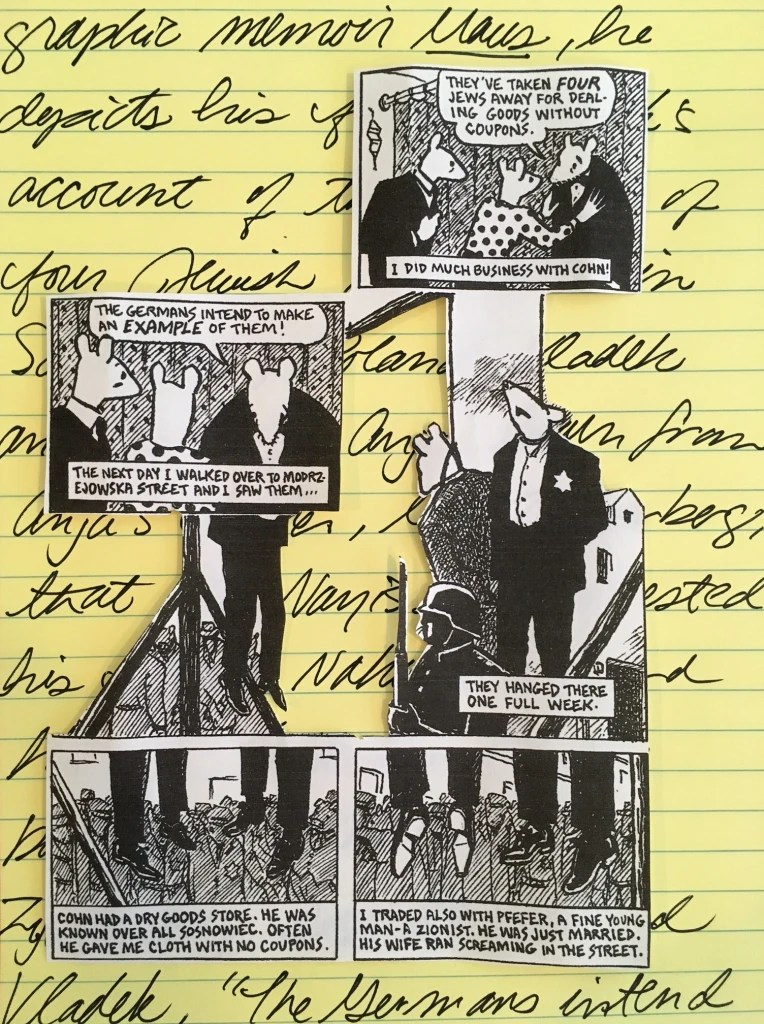
In his graphic memoir Maus, Art Spiegelman devotes a page to his father Vladek’s account of the hangings of four Jewish merchants in Sosnowiec, Poland. Vladek and his wife, Anja, learn from Anja’s father, Mr. Zylberberg, that the Nazis have arrested his friend Nahum Cohn and his son. With his head bowed in sorrow, Mr. Zylberberg says to Anja and Vladek, “The Germans intend to make an example of them!” (83). That image of Mr. Zylberberg speaking with Vladek and Anja overlies the larger panel that dominates the page, one that depicts the horror that Mr. Zylberberg anticipates: the murder of his friend Nahum Cohn, Cohn’s son, and two other Jewish merchants. That haunting panel and the smaller ones that frame it illustrate the complexity of Spiegelman’s seemingly simple composition. His rendering of the panels of the living in conjunction with the fragmented panels of the hanged merchants simultaneously conveys connection and separation: both the grieving survivors’ ties to the dead and the hanged men’s objectification at the hands of the Nazis.
The placement of the overlying panel not only hides part of the horror behind it, but it also connects Vladek’s father-in-law to one of the victims. Mr. Zylberberg’s head and torso appear directly above the suspended legs and feet of one of the hanged men, creating an image that merges the two.
Spiegelman further emphasizes the mourners’ identification with the hanged men by extending two of the nooses’ ropes upward to the smaller panel above them, linking the living to the dead. Additionally, Spiegelman underscores the link with Vladek’s line of narration at the bottom of the smaller panel: “I did much business with Cohn!” (83). The word with appears directly above the rope, punctuating the connection between both Nahum Cohn and his friend Mr. Zylberberg and Zylberberg’s son-in-law, Vladek.
While the panels of the hangings yoke the living to the dead, Spiegelman’s presentation of the hanged men in fragments also objectifies them. The final panels on the page depict only their shoes and part of their pant legs suspended above the onlookers, images that may evoke in some readers thoughts of the last remnants of the Jews who stepped barefoot into the gas chambers of Auschwitz.
Whether the hanged men’s shoes call to mind those mountains of leather left behind by the Jews, the separation of their lower legs and feet from the rest of their bodies turns them into something less than human—not people, but mere parts. Thus, Spiegelman creates a picture of the hangings that illustrates both the mourners’ identification with the victims and the Nazis’ perception of the Jews as less than human.
Spiegelman’s transformation of the Nazi propaganda portrayals of Jews as rats remains an astounding achievement thirty-five years after the publication of the first volume of Maus. But seeing the hanged merchants in Modrzejowska Street in the midst of the George Floyd murder trial in Minneapolis and less than three months after the January 6 Capitol riot reminds readers that the panels of Spiegelman’s memoir have grown more prescient. The nooses evoke images of Officer Derek Chauvin’s knee on George Floyd’s neck, the January 6 chants to hang the Vice President, and a T-shirt glimpsed in the Capitol crowd, one with a Nazi eagle below the acronym 6MWE (Six Million Wasn’t Enough), a reference to the number of Jews slaughtered in the Holocaust. Our heads are bowed in sorrow with Mr. Zylberberg’s. The strange fruit of our past, both distant and recent, should seem far stranger.
At the beginning of yesterday’s class, we examined “Wait Means Never,” the sample student analysis of Martin Luther King Jr.’s “Letter from Birmingham Jail,” and “Princessof the Rock,” the analysis of the prologue to Tara Westover’s memoir, Educated. Today’s post presents more detailed notes on the essays’ content and form. As you continue to revise, return to these notes for reminders of dos and don’ts for your own analysis.
“Wait Means Never” Content
Rather than beginning with a summary of Martin Luther King, Jr.’s “Letter from Birmingham Jail,” the writer comments on the letter by observing its relevance. Instead the writer should state what the letter is, an epistolary essay King wrote in 1962 while he was jailed in Alabama for leading nonviolent protests.
The writer ends the first paragraph with a thesis, but the statement is primarily description. Essentially, the writer states that King uses stylistic devices to deliver his message to a wider audience, but a thesis or main claim in a textual analysis should offer an assertion about how the writer’s use of those devices achieve a particular effect. The recommended revision that we examined in class–the one on the handout that I distributed–is included below, under the Revision heading.
The writer observes that King repeats “the word ‘wait’ throughout the letter” (par. 2), but King does not introduce that word until his eleventh paragraph. The writer could revise his thesis to focus specifically on King’s eleventh paragraph because that portion of the letter is the source of his claims and textual support.
In the body paragraphs, the writer effectively details King’s diction and sentence structure, but a couple of inaccuaracies undercut the prose. Neither “from bad to worse” (par. 3) nor “at the end of the letter” (par. 5) is accurate.
After ending the final body paragraph with ”’wait'” (par. 5), the writer turns to a conclusion that reads more like the ending of a history report than a textual analysis. Simply revising the opening of the last paragraph to begin, “[t]he words of Dr. Martin Luther King . . .” would maintain the focus of the analysis, the words themselves. The writer could still address the letter’s role in history by noting how the words have endured as a rallying cry for peaceful nonviolent protest. Consider how else the writer might give the analysis closure.
“Wait Means Never” Form
The document lacks a running header.
Because the writer is referring to wait and never as words in his title, both should be italicized.
In the first line, the writer defines King’s letter as a “speech of literature” (par. 1). Although King was an orator, his “Letter from Birmingham Jail,” is not one of his speeches. As the title indicates, it’s a letter. Labeling the letter “literature” is unnecessary because the analysis that unfolds will reveal the literary quality of the prose. If the writer wants to address the letter’s status as a work of literature, in the conclusion, he might note that many students first encounter King’s letter in the pages of their high school and college anthologies.
In the first sentence of the introductory paragraph and the second sentence of the second paragraph, the writer uses coordinating conjunctions that indicate contrast, but the clauses those words connect are not in contrast. See “yet remains” (par. 1) and “but irked” (par. 2). In both cases, “and” would be the accurate conjunction. That said, “yet remains” introduces an assessment of the letter–in particular, its relevance–which shouldn’t be part of the summary at the beginning of the analysis.
The writer refers to King’s voice as “the narrator’s” (par. 2), but a narrator is a person who tells a story, usually a work of fiction or a narrative poem. King should be referred to as the writer or the author.
The clauses “it can easily be acknowledged” (par. 2) and “it can be identified” (par. 5) are passive constructions that de-emphasize the subject. The sentences that contain those clauses should be revised to show the action that King performs as a writer. The second-paragraph sentence might be rewritten as this: King’s repetition of wait emphasizes how frequently he has heard the word and how its “piercing familiarity” (par. 11) has increased his frustration. The two sentences convey the same idea, but the revision is eleven words shorter.
Introductory Paragraph
The paragraphs below are the first paragraph of “Wait Means Never” and my revised version.
Original Introductory Paragraph
Dr. Martin Luther King Jr.’s “Letter from Birmingham Jail,” is a speech of literature that was composed many years ago yet remains relevant. King’s words give insight into the life of an African American during the 1960s and symbolize the significance of taking action and standing up for what is right, justice for African Americans. In this particular letter, King speaks about how it’s easy for people who have never felt pain of being oppressed, discriminated against, and segregated to say the word “wait.” The letter goes further into detail about what “wait” truly means for an African American and specifically tackles the perspective of an American father who also has to explain to his children why the world is the way it is, yet that father does not quite know himself why people act in such a harsh manner. In this letter, Martin Luther King Jr. utilizes repetition, detail, vivid imagery, and sentence structure to deliver a message to not just one person, or even a hundred people, but the entire country that justice for African Americans cannot be a patient matter.
Revision
Dr.Martin Luther King, Jr.’s “Letter from Birmingham Jail” responds to the eight white clergymen who drafted an open letter addressing King’s involvement in the civil rights movement, urging him to seek justice in the courts rather than in the streets. In his answer to the clergymen, King asserts that a Christianity that permits racial oppression and prejudice is immoral and stands in direct opposition to the teachings of the gospel. Though King’s letter draws on his 1956 sermon “Paul’s Letter to American Christians,” the hallmark of his epistolary essay is not the rhythmic cadences of his baritone voice, but instead its artful composition. With the repetition of the word wait and a series of dependent clauses, King encapsulates his testimony and delays the end of the letter’s longest sentence, creating a holding pattern that forces readers to experience their own wait.
“Princess of the Rock” Content
The writer refers to the “unique setting” (par. 1) of Tara Westover’s childhood, but doesn’t specify the location of the mountains that are home to Buck’s Peak, which features the image of the Indian Princess, Westover’s friend and protector. Identifying Buck’s Peak as part of the Bear River Range in southeast Idaho would give readers a better sense of the setting.
What appears to be the essay’s thesis–the sentence that begins, “Her description of the rural farm . . .”–is itself description rather than analysis. Shifting the focus from the fact that Westover depicts herself as a child to what Westover achieves through the adult retrospective narrator’s presentation of her younger self would move the essay in the direction of critical study.
The writer states that Westover uses “lighthearted words” (par. 2), but the line that she quotes as evidence to support her claim is not lighthearted.
Only near the end of the essay–in the fifth of its six paragraphs–does the writer identify the excerpt she is analyzing as the prologue of the memoir. Identifying the text as the prologue in the introduction and addressing its function in the thesis is another change that would move the essay in the direction of critical study. (What background or context does the prologue provide? What does it foreshadow?)
“Princess of the Rock” Form
The memoir’s title, Educated, is incorrectly enclosed in quotation marks (par. 1).
Commas incorrectly follow closing quotation marks (par. 1).
The phrase “rural farm setting” (par. 2) is redundant.
The passive construction “[t]he lighthearted words used” (par.2 ) should be recast in active voice: Westover uses lighthearted words . . .
The first quotation from Educated (par. 2) should not include the author’s last name, and the Roman numerals should be lower-case.
The word “princesses” (par. 3) should be possessive rather than plural (princess’s).
The word “has” (par. 3) should be replaced with an action verb–such as demands or forces to enliven the sentence and give readers a better sense of Westover’s father. The writer should also note that the father’s name in the memoir is Gene, a pseudonym for Val.
The second quotation from Educated (par. 3) lacks both a signal phrase and a parenthetical citation.
The third paragraph ends with an instance of faulty predication.
The writer refers to “Tara’s family” (par. 4) and “Tara wish[ing]” (par. 6) when she should refer to Westover’s and Westover.
Conclusions
Effective strategies for concluding analyses include (1) offering an insight about the text or an additional quotation from it, (2) revisiting the thesis without stating it verbatim, and (3) pointing to the broader implications of the analysis. In “The Strange Fruit of Sosnowiec,” I employ two of the three, specifically one and three. Look back at the final paragraph and note how each sentence offers insights about Maus or points to its broader implications.
As I have noted before, you should avoid the phrase in conclusion or any variation on it at the beginning of the final paragraph of your essay. While that transitional phrase can be useful in a speech (because the audience cannot see that the end is near), there is no reason to write those words when readers can see for themselves that only one paragraph remains. For more, see Harvard University Writing Center’s notes on conclusions.
Relevant Embedded Links
The relevant embedded link that you include in the blog post for your analysis should be a primary or secondary source, not a background one, such as Wikipedia, Encyclopedia Britannica, or a social cataloguing website, such as Goodreads. Appropriate websites to link include the authors’ own sites, sites where the full-text of the essay or chapter is available (without a paywall), and authors’ pages on publications that employ them, such as Michael Lewis’s page on the ESPN site. The list below includes a link to one appropriate site for each of the seven subjects. If you are unsure whether a site is appropriate to link to your analysis, ask me or simply use the relevant link below.
Note that for search purposes, the sites above are listed as complete URLs, not as embedded links. In your blog post, the site address should be embedded in a word or phrase, just as the links are embedded in the earlier sections of this post (and in my other posts).
Next Up
On Wednesday, you will compose a short reflective essay focusing on the process of planning, drafting, and revising your analysis. If you are still in the process of completing your essay on Wednesday (since you have until Friday morning’s hard deadline to post it), your reflection will address your work in progress.
Before class, review the sections of the textbook, Writing Analytically, that have guided you in the writing of your analysis:
“Focus on Individual Words and Sentences” (48-49).
“How Long?: Paragraphs, Readers, and Writers” (308).
“‘Interesting,’ ‘Revealing,’ ‘Strange’” (24).
“Seems to Be About X, But Could Also Be (Or is ‘Really’) About Y’” (104-7).
“What a Good Analytical Thesis Is and Does” (241-42).
“Words Matter” (49-50).
After you have reviewed those sections of Writing Analytically, choose a phrase, clause, or sentence relevant to your writing process and draft in your journal a short passage that connects that quotation to your writing. That passage will serve as part of your reflection. Detailed instructions for composing your reflection and including your chosen quotation will be included on the assignment handout that I distribute on Wednesday. Remember to bring your textbook to class.