 The presence of double slash marks in one of our workshop poems led me to reflect on the ways we use slashes in writing and how they both connect and separate (and/or). In a passage of prose that quotes lines of poetry, we use slashes, or virgules, to indicate a line break. Some playwrights use a slash mark to indicate the start of the next spoken line when one character talks over another. Since that stylistic convention doesn’t figure in the plays that we read in Imaginative Writing, I’m including an example here. David Lindsay-Abaire uses slash marks repeatedly in Good People to denote Margaret’s, “Margie”‘s habit of talking over Stevie:
STEVIE: Margaret, listen for a / second—
MARGARET: (But she keeps going) I don’t think they did Christmas dinners though. And your grandmother had passed by then, so there was no dinner to go to. So your mother comes into Flanagan’s, and she’s out to here. (Indicates belly) When’s Jimmy’s birthday? (6)
As you read the poems for this week’s workshop, consider where the writers indicate pauses with punctuation and 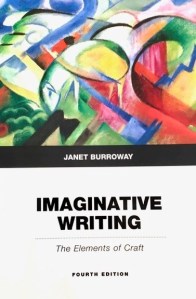 line breaks. In Imaginative Writing, Janet Burroway notes that “[t]he line directs the breath; the rhythm of the line is played against the rhythm of the sense, and this is one of the ways that poets alter, stress, and redirect their meaning” (305-06). As an example, she offers the opening lines of John Milton’s Paradise Lost:
Of Man’s First Disobedience, and the Fruit
Of that Forbidden Tree, whose mortal tast*
Brought Death into the World, and all our woe. (qtd. in Burroway 305-06)
Milton gives prominence to the apple, the forbidden fruit, by placing it at the end of the line. As Burroway observes, “the end of just about anything—line, paragraph, stanza, story—is the strongest position, and the beginning is the second strongest” (306). With that in mind, pay close attention to the first and last words of each line. Also look carefully at any caesuras, or pauses within the line (such as after “Disobedience” above). Do the poems include any enjambment, the running of a thought from one line to the next (“and the Fruit / Of that Forbidden Tree . . .”)? Are the lines of the poems end-stopped? In other words, does the end of each line coincide with the end of each thought?
To supplement our study of the poetic line, I have developed a short exercise to accompany your workshop comments this week.
Directions:
- Read aloud the poem or stanza beside your name in the list below.
- Read the poem again, and consider how caesuras or enjambments would alter its effect.
- Revise two or more lines of the poem or stanza without changing any of the words. Change only line breaks and/or punctuation.
- At the end of your comment for the poet, include the revised lines and a brief explanation of the changes you made.
This exercise isn’t meant to be prescriptive. It’s not a way of saying, these are changes that the poet should make. Instead, it’s a way of showing how someone else might see and hear the words.
- Brennan: “He is the Man”
- Zane: “Change”
- Mia: “Dependent”
- Brandy: “Self-Preservation,” stanza 1 or 3
- Trevor: “Self-Preservation,” stanza 2
As always, the points I have included below are not ones that you’re required to address in your comments. I offer them as suggestions only. I will address some of them in the follow-up remarks that I’ll post at the beginning of our next session.
“He is the Man” and “Change”
- Where in the poems does the writer use assonance, internal rhyme, and slant rhyme?
- How might the writer develop the exploration of one or both notions of change in the second poem?
- Might these two thematically similar poems evolve into two stanzas of one poem, or alternately evolve into two poems in a longer sequence of poems on the same theme?
“Dependent”
- Where in the poem does the writer depict the abstract idea of dependence with concrete images?
- Where do metaphors or similes appear in the poem?
- Where might the poet add figurative language?
“Self-Preservation”
- What discrepancy does the poet create with “slivers” in line one and “chunks” in line three? How and where might the writer develop that apparent contradiction?
- Consider the sequence of pronoun shifts (I > we > I > they > I). What does the distancing effect of third person indicate about the poem’s speaker or persona? What change, if any, does the return to first person signify?
- Why might the writer have chosen to use double slash marks?
Remember to check your CVCC email and Blackboard regularly for updates and assignments.
Works Cited
Burroway, Janet. Imaginative Writing. 4th ed. Pearson, 2014.
Lindsay-Abaire, David. Good People. TCG, 2011.
*Seventeenth-century spelling of taste.


 struggles to come to terms with it. Though Cass chooses to start a new life, she continues to see the world through the lens of the ninth-grade teaching job that she leaves behind (along with Kip), equating her mistake of marriage to a mathematical miscalculation. As she explains to Kip: “Look, I agreed to marry you based on what I knew to be true. Kip equals X. X will make me happy. Everything added up. Seven years later I find out that you’re not X at all, you’re Z. And if you’re Z, then I did the math wrong” (1.1). Ever the math teacher, Cass perceives the world as a series of signs with determinate meaning, a tendency that seems to compound the difficulty of her quest. On the bus to Niagara, where Cass adopts fellow traveler Lois Coleman as her sidekick, Cass continues to think in terms of numbers, measuring her old life as “463 road signs behind me” (1.2). Though she eventually loses track of the signs, she remains focused on her numbered to-do list, which includes becoming a contestant on The Newlywed Game, a show that turns couples’ compatibility into a numbers game.
 therapy session, Cass says that “[i]t’s not just a game! Things have meaning. Or at least they should” (2.3). Her emphasis on “should” indicates that she has embraced the concept that meaning may be indeterminate. But neither she nor the other characters can leave numbers behind, not altogether. After Captain Mike, Kip’s rival for Cass’ affection, accidentally shoots himself, rather than reflecting on his death, the characters attempt to quantify fears as they quibble over which is number one: being alone, public speaking, or needles (2.3).
 The final scene on the river leaves the audience, along with Cass and Lois, in a holding pattern. What happens remains unclear. The ambiguity comes at a risk; it may try the patience of audience members who find the play’s farcical humor too ridiculous or contrived, or as New York Times reviewer Ben Brantley wrote “
 Jane Lucas