Our Wordplay days in class gave us opportunities to build our word power, collaborate, and engage in creative problem solving. Now they offer us a way to forget our sense of isolation. I hope that games, whether table-top or digital, continue to lift your spirits.
With that hope in mind, I designed this assignment devoted to word games.
Directions:
Choose one of the options below, and post your response as a comment by 5 p.m. on Friday, April 17.
Option One:
Imagine that the first seven letters of your name (all first, or first plus part of last) are seven tiles on a Scrabble rack.
Go to the Scrabble Dictionary, click the Scrabble Word Builder tab (to the right of Scrabble Dictionary), enter your seven letters, and click “Go.”
Post a blog comment of twenty-five words or more that includes (1) the seven letters that you entered, (2) the number of playable words that you can spell with those letters, (3) at least one of the words in the list that was unfamiliar to you, and (4) the definition of the word.
Sample: Entering the first seven letters of my name, J-A-N-E-L-U-C, into the Scrabble Word Builder yields fifty-one playable words. Two that I wasn’t familiar with are fish: “alec,” a herring, and “luce,” a pike.
Post a blog comment of twenty-five words or more that includes (1) one of the newly playable words, (2) its definition, and 3) whether the word was familiar to you.
Sample: The New York Times article “New Scrabble Words Get the ‘OK’” includes the newly playable word [insert word here], which was unfamiliar to me. [Insert word here] means [insert definition here].
Do not use the word “OK.” In other words, “OK” is not okay. It’s in the title of the article, and you already know its definition.
Let the play begin!
Remember to check your CVCC email and Blackboard regularly for updates and assignments.
Wordplay days gave us opportunities to build our word power, collaborate, and engage in creative problem solving. Now they’re pastimes that can help us forget our isolation. I hope that games, whether table-top or digital, continue to lift your spirits.
With that hope in mind, I designed this assignment inspired by Fred’s Victorian parlor games In A Christmas Carol (stave 3) and our Wordplay Days. Below the directions, I’ve included a list of Victorian authors for your reference.
Directions:
Choose one of the options below, and post your response as a comment by 5 p.m. on Friday, April 17. The first ten students who post comments and the student whose letters yield the largest number of playable words will receive bonus points.
Option One:
Imagine that seven letters of a Victorian author’s last name (all last, or last plus first letter/s of the first) are the seven tiles on your Scrabble rack. See my sample below.
Go to the Scrabble Dictionary, click the Scrabble Word Builder tab (to the right of Scrabble Dictionary), enter the seven letters, and click “Go.”
Post a blog comment of twenty-five words or more that includes (1) the seven letters that you entered, (2) the number of playable words that you can spell with those letters, (3) at least one of the words in the list that was unfamiliar to you, and (4) the definition of the word.
Sample: Entering the seven letters A-R-N-O-L-D-M (for Matthew Arnold) in the Scrabble Word Builder yields 103 playable words. Two that I wasn’t familiar with are “dolma,” a stuffed grape leaf, and “lardon,” a thin slice of bacon or pork.
Welcome to our third drama workshop session, and thank you for your thoughtful feedback on The Slow Decline and the monologue from Bound. Before we turn to the untitled monologue and The Story of Shabath, I offer these follow-up notes:
The Slow Decline
Trevor mentioned the jail break in the sixth paragraph as a possible alternate starting point. How might Mr. Castillo’s story unfold between the narration of the jail break, which was “a rather profitable venture” and the change in gun restrictions when the Castillo organization’s “profits plummeted”? In other words, how might a riches-to-rags sequence framed by those events affect the play’s momentum?
Brendan, Zane, Brandy, and Mia all noted the lack of development of Mr. Castillo’s relationship with his father. The detail that he is “quiet” and the writer’s choice of having Mr. Castillo address his grandfather, but not his father, in the conclusion may serve to indicate a gulf between father and son. Was it a relationship that was too difficult for the son to put into words? If so, what in his speech or actions might convey that difficulty?
The question of details–what to leave in and what to leave out–leads me to a question that Mia raised: “What made the main character unsuitable for the job while his father and grandfather ran things so seamlessly?” The answer may lie in something else that Mia mentioned, the moment when Mr. Castillo reveals that as a young man he contemplated running away from the family business. That’s the moment I had in mind when I posed this question: What other obstacles, internal or external, might complicate the delivery of his story?
Monologue from Bound
Trevor remarked that it was admirable that the writer chose to begin at the end of the narrator’s story and focus on the mechanics of the journey.
Brennan, Mia, Zane, and Brandy noted the number of unanswered questions in the monologue. Zane also noted the apparent inconsistency in the narrator’s mental state. How might the writer convey through the narrator’s speech and actions that his consistent inconsistencies make him dangerous to the gods, or to himself, or to both?
Brandy and Brennan both noted that the monologue felt like part of a larger piece–such as a character’s speech “halfway through a fantasy novel,” as Brennan mentioned. With that in mind, reading and comparing H.G. Wells’ War of the Worlds and the radio play adapted from the novel might be a useful exercise for the writer.
Rather than making additional reading recommendations tailored for the writers of The Slow Decline and the monologue from Bound, I am offering one that’s relevant to all of us now: the recent New York Times article “Has Your Dystopian Play Come in Handy?,” which features snippets of conversations with playwrights who have authored plays about cataclysmic events and are now living through one themselves (as we all are).
Marisol, the first play addressed in the article, was written by José Rivera, author of Gas, the Persian Gulf War-era play that we read in Chapter 11 of Imaginative Writing. The eight other playwrights and plays featured in the article are these:
Anne Washburn, Mr. Burns, a Post-Electric Play (2013)
Jennifer Haley, Nether (2015)
Mac Rogers, The Honeycomb Trilogy (2015)
Penelope Skinner, The Ruins of Civilization (2016)
Zoe Kazan, After the Blast (2017)
Robert O’Hara, Mankind (2018)
Andrew R. Butler, Rags Parkland Sings the Songs of the Future (2018)
Duncan Macmillan, Lungs (2020)
The points I have included below are not ones that you’re required to address in your comments about the untitled monologue and The Story of Shabath. I offer them as suggestions only. I will address some of them in the follow-up remarks that I’ll post at the beginning of our next session.
Untitled Monologue
In the second paragraph of the monologue, Deen reveals the inciting incident, the event that creates the situation in which she finds herself: “and then they died.” In the fifth paragraph, she first mentions her current obstacle: the officer to whom she is pleading her case. Consider how altering the order of the details that Deen presents would affect the monologue’s tension and the audience’s perceptions of Deen.
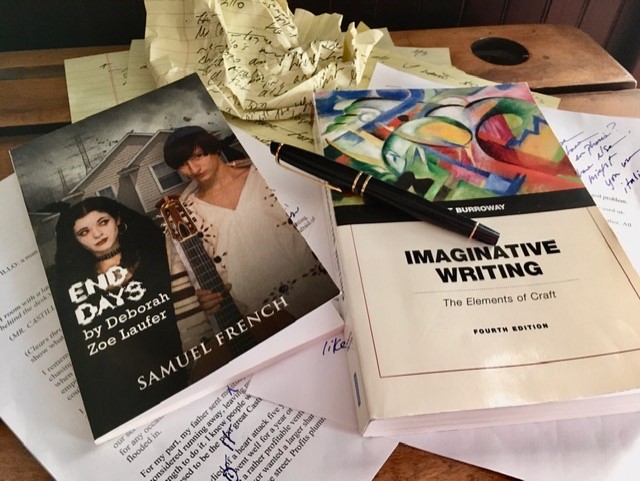
In Imaginative Writing, Janet Burroway notes the importance of varying shorter lines with longer ones. In her words, “[a] change of pace, from a sharp series of shorter lines to a longer speech and back again, keeps the rhythm interesting” (338). The writer varies lines within paragraphs and also between paragraphs one and three, and again between paragraphs six and seven. What other paragraphs might be presented as shorter–perhaps even one-line–paragraphs?
What suggestions, if any, do you have for a title?
What plays, if any–ones in Imaginative Writing or others that you’ve read–would you recommend to the writer as models or possible sources of inspiration?
The Story of Shabath
Consider the sequence of Shabath Aizwald’s recollections. How would moving what he recounts in 1:2 or 2:1 to 1:1 affect the tension?
What stage directions would clarify how the monorail figures in 1:1? Is it an actual set piece, an image projected on a scrim (a gauze cloth used as a screen or backdrop on stage), or does it figure solely as a diagetic sound?
In Imaginative Writing, Janet Burroway observes that the inability and unwillingness at times to say what we mean “breaks the flow of the talk. This is especially true when emotions are heating up. People break off, interrupt themselves and each other. Use sentence fragments. Don’t always finish their . . . (338). Where might the writer break the flow of Shabath’s words to indicate an inner conflict? What memories might be difficult for him to recount?
What plays, if any–ones in Imaginative Writing or others that you’ve read–would you recommend to the writer as models or possible sources of inspiration?
Post your two responses, twenty-five words or more each, as replies. If you address a point that one of your classmates has written in a previous reply, mention that classmate by name in your own reply. Post by midnight on Friday, April 17.
Remember to check your CVCC email and Blackboard regularly for updates and assignments.
Early-bird bonus points go to Madison St. Clair, Joshua West, Grey Sacona, Peyton Moore, Breanna Bowman, Joe Van Story, Ruben Castillo, Anna Young, Emily Brown, and Roberto Perez-Perez. Well done!
And Emily Brown earns extra credit for submitting the first correct response to the bonus questions! Very well done!
Everyone needs a little Shakespeare.
Apparently Dickens thought so.
And here’s an image of winter again to put you in more of A Christmas Carol reading mood.
Remember to check your CVCC email and Blackboard regularly for updates and assignments.
Welcome to our second drama workshop session, and thank you for your thoughtful feedback on the first script, Twins of an Ill Fate. Before we turn to the next two scripts, The Slow Declineand the monologue from Bound, I offer these follow-up notes:
Brandy, Brennan, and Zane mentioned the difficulty of distinguishing Harry from Henry. That’s a point that I’ll return to later in my notes.
Mia and Brennan both envisioned the story as one better suited for another medium, and Brennan added that there were moments that would be difficult if not impossible to stage. Since the realm of Twins of an Ill Fate lies somewhere between fourth wall realism and extreme theatricality, it might be staged with scene changes–as Mia suggested–and the Angel-to-Grim Reaper transformation could take place in a black-out or otherwise out of view.
Trevor recommended condensing the stage directions, and Brennan noted that some of them could be omitted. Often the characters’ words alone suffice. As I mentioned in our first session, in Imaginative Writing, Janet Burroway notes that “good dialogue will convey most of its tone as an integral part of the lines, and when this is the case, there is no need to announce the tone of voice in a stage direction” (327).
Although Henry and Harry are easily confused on the page, seeing them on stage played by two actors, wearing clothes that aren’t identical, would enable the audience to distinguish Harry from Henry more easily. And in all likelihood they’d be played by actors who aren’t identical twins. That said, I’ll return to the what-if I asked in our first session and add another.
What if Henry and Harry were never on stage at the same time? What if everyone except the surviving twin–Sally, Margret, the Grim Reaper, and the audience–was left without an answer to the question, did one brother lie to save his own life?
Mia questioned the need for the twins to be identified as adopted, and Trevor mentioned Romulus and Remus, the adopted twins of Rome’s founding myth, and the opportunities that twin characters present, both as archetypes and subjects for exploration of nature and nurture. One reason for the revelation of the twins’ adoption–which Margret’s phone conversation provide–may be the existential crisis that crests with the realization that we are not who we thought we were, whether children of God or the children of the people we believed were our biological parents. I don’t know whether that’s what the writer intended, but the symbolic framework of the play leaves it open to that possibility.
One play I recommend to the writer is Deborah Zoe Laufer’s End Days, a dark comedy about a family preparing for Armageddon. The mother has visions of Jesus, and the daughter has visions of Stephen Hawking. One actor plays both Jesus and Hawking.
The points I have included below are not ones that you’re required to address in your comments about The Slow Decline and the monologue from Bound. I offer them as suggestions only. I will address some of them in the follow-up remarks that I’ll post at the beginning of our third session.
The Slow Decline
Mr. Castillo begins with his earliest memories and offers his story chronologically. Where else might he begin, and what might that alternate starting point contribute to his monologue?
What costume notes could place Mr. Castillo at odds with his words? Is there a stage lie? Is he wearing pajamas or or a pin-striped suit? How does that affect our reading of the line, “[t]he doctors say I don’t have much time left”?
The tape recorder’s breakdown thwarts Mr. Castillo’s plan. What other obstacles, internal or external, might complicate the delivery of his story?
What plays, if any–ones in Imaginative Writing or others that you’ve read–would you recommend to the writer as models or possible sources of inspiration?
Monologue from Bound
What is the risk of beginning, as this monologue does, with a solution rather than a problem?
Where might the writer use italics for emphasis? David Ives’ play The Philadelphia (see Imaginative Writing, 158-64) uses italics effectively in the conversation between the characters Al and Mark. Imagine the narrator emphasizing “finally” when he repeats it, then imagine him emphasizing “god.” How does the change in emphasis affect your perception of the narrator’s stance?
Consider the stage lie again. Is the narrator reliable? What actions or gestures might reveal his reliability or lack thereof?
What plays, if any–ones in Imaginative Writing or others that you’ve read–would you recommend to the writer as models or possible sources of inspiration?
Post your two responses, twenty-five words or more each, as replies. If you address a point that one of your classmates has written in a previous reply, mention that classmate by name in your own reply. Post by 5 p.m. on Thursday, April 9.
Remember to check your CVCC email and Blackboard regularly for updates and assignments.
Part I of this blog post offers a look back at excerpts from some of the comments that you posted last week. Although I never would have chosen for us to communicate exclusively online as we are now, I am grateful for the opportunity to see your thoughts on the screen. And I hope that reading your classmates’ comments has been a comfort. I know it has been for me. If your gravatar isn’t on your blog, I encourage you to add it. It puts a human face beside your words.
From Crowson Roosa:
The past two weeks have definitely shifted my views of the novel. As Jeremy said, “being under quarantine has definitely caused me to become very cautious.” After being alone in isolation, I never really appreciated interacting with my classmates and friends until I could not see them anymore.
From: Joe Van Story:
I have learned to not look at everything at face value and to try to look deeper and try to find the good in what is happening. An example of this is the COVID-19 virus, while it is a tragedy it has brought unexpected joy in my life, such as spending more time with my family.
From Jenna Ramsey:
In regards to Del Toro’s remarks, he states how reading the book showed him “how deep, how life-changing, a monster parable could be–how it could function as art and how it could reach across distance and time to become a palliative to solitude and pain.” This also goes hand-in-hand with the virus. This virus is the ‘monster parable’ that has been life-changing to most everyone, in at least one way or another. While this virus has been ‘a monster parable,’ it could also be considered an ‘art’ of sorts in the way it has caused us to stop and think about what we truly need to be buying (if we truly need to run out to this store or that store), has caused us to spend more time at home with our families and rethink what we are doing with the time we have on our hands. It has also spread all over the world, affecting many people, leaving us to solitude/quarantine and caused pain to those who have had life-altering things happen due to the virus.
From Jacob Palmer:
As Caeley Arney mentioned in her comment, it is true that Victor Frankenstein hid himself from his creation in disgust. But we must not forget that the monster too isolated himself from society, intently watching over the DeLacey family from the safety of their hovel. Being deprived of the company of fellow creatures for such a long time, the monster took an uncharacteristic liking of this intriguing family, longing to be embraced by them and admitted into their ranks. It is in this time of isolation that we may really understand what the monster is feeling, and come to sympathize with him more so than before. One may come to recognize this desire to socialize to be unmistakably human. Thus, while the monster may be confined to the body of a monstrosity, it is evident that the feelings he expresses are none other than those of a human being. This raises questions as to what constitutes humanity and may challenge original notions over who the real monster is in this harrowing story.
Below I’ve included a works cited list as a model for citing comments on a blog post. Yes, there’s actually an MLA-style format for that, and there’s one for tweets as well. If you want to cite one of your classmates’ comments in your Victorian project, look to these entries as models. For more sample entries, see OWL’s page devoted to citing electronic sources.
As we begin our study of Victorian writers, observe how their fiction differs from the prose and poetry of the Romantics:
On the one hand romances were writings that turned, in their quest for settings conducive to supernatural happenings, to distant pasts, faraway exotic places, or both . . . . On the other hand romance also named a homegrown, native tradition of literature, made unfamiliar and alien by the passage of time. (Lynch 18; emphasis added)
The Celtic ballad “The Dæmon-lover” exemplifies those two seemingly disparate accounts of the writing of the Romantic period; it features the supernatural, and its renewed popularity in the nineteenth century illustrates the revival of interest in older forms, “native tradition[s] . . . made unfamiliar and alien by the passage of time” (18).
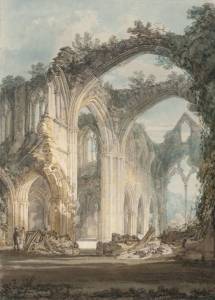
Turner, J.M.W. Interior of Tintern Abbey (1794). / tate.org
We’ve also seen the Romantics’ renewed interest in medieval literature in Victor Frankenstein’s early account of his friend Henry Clerval: “He was deeply read in books of chivalry and romance. He composed heroic songs, and began to write many a tale of enchantment and knightly adventure (Shelley 33).
Much later in Frankenstein, Victor’s description of Henry elucidates another trait of the Romantic period, the adoration of nature: “The scenery of external nature, which others regard with only admiration, he [Henry] loved with ardour” (Shelley 139). That observation of Victor’s serves as an introduction to the verse that follows in Chapter 28, eight lines from William Wordsworth’s poem “Tintern Abbey,” the first-generation Romantic’s own recollection of his attachment to nature.
As a counterpoint, consider these descriptions of the Victorian age:
In the eighteenth century the pivotal city of Western civilization had been Paris; by the second half of the nineteenth century this center of influence had shifted to London, a city that expanded from about two million inhabitants when Victoria came to the throne to six and a half million at the time of her death. The rapid growth of London is one of the many indications of the most important development of the age: the shift from a way of life based on the ownership of land to a modern urban economy based on trade and manufacturing. (Robson 3; emphasis added)
Because Britain was the first country to become industrialized, it’s transformation was an especially painful one: it experienced a host of social and economic problems consequent to rapid and unregulated industrialization. Britain also experienced an enormous increase in wealth. (Robson 4)
Works Cited
Lynch, Deidre Shauna. Introduction: “The Romantic Period, 1785-1832.” The Norton Anthology of British Literature: The Romantic Period. 10th ed. Stephen Greenblatt, General Editor. W.W. Norton, 2018. pp. 3-27.
Robson, Catherine. Introduction: “The Victorian Age, 1830-1901.” The Norton Anthology of British Literature: The Victorian Age. 10th ed. Stephen Greenblatt, General Editor. W.W. Norton, 2018. pp. 3-27.
Shelley, Mary. Frankenstein. 1818, 1831. Introduction and Notes by Karen Karbeiner. Barnes and Noble, 2003.
PART III
Engraving by John Leech (1843) / gutenberg.org, The Muppet Christmas Carol (1992) / disney.com
One of the challenges of reading A Christmas Carolnow is seeing beyond the images that are part of our collective memory. Even those who have never read Charles Dickens’ novella see in their minds Ebenezer Scrooge, the ghosts, Bob Cratchit, Tiny Tim . . . . We have watched the iconic miser’s story unfold on-screen over and over. Whether we see him as Michael Caine (in The Muppet Christmas Carol), as Disney’s Scrooge McDuck, or as Alastair Sim (A Christmas Carol, 1951), he’s there in our minds.
Your assignment this week is too look beyond those images and see the story anew through Dickens’ own words. I have assigned each of you one of the five staves. Dickens labeled each section or chapter as a stave, an archaic term for a stanza of a song or poem, to underscore the idea that the story is a Christmas carol in prose.
Directions
Study the stave assigned to you in A Christmas Carol (see the lists below), and identify at least one detail that isn’t familiar to you, something you haven’t seen or heard in an adaptation: a description, a line of dialogue, an unfamiliar term, etc.
Compose a response of twenty-five words or more that addresses that detail. Include the stave number in your response. If you include a quote, follow it with a parenthetical citation: stave with a lower-case s followed by the number (stave 1).
If you’d like to address the experience of reading Dickens’ novella in the days of the novel coronavirus, you’re welcome to do that in addition to (not in place of) addressing your assigned stave.
Post your comment as a reply to this blog post by 5 p.m. on Thursday, April 9.
To avoid the risk of students restating what classmates have written in earlier posts, I will not make the comments available for view until after the posting deadline on Thursday.
ENG 242.871AC
Stave 5: Carmen Bonilla, Gabe Carswell, Dakota Clawson, James Erwin, Caleb Fountain, Deanna Grogan, Allison Lasher, Paige Lewis, Emma Maltba, Hayleigh Marshall, Jaanai Mendez-Santiago, Mason Nance, Shea Ortiz, Andrew Parker
Stave 4: Amelia Price, Caroline Riddle, Grey Sacona, J.D. Sharpe, Kenna Sipe, Josh Sloan, Joshua West, Autumn Yang
ENG 242.872AC
Stave 4: Cierra Ballard, Mariana Bonilla-Quesada, Ashton Canipe, Allie Desantiago, Sarah Fox
Stave 3: Cristian Gonzalez-Sanchez, Candace Johnson, David Long, Hannah Maltba, Keara McCann, Peyton Moore, Jacob Palmer, Roberto Perez-Perez, Jenna Ramsey, Chandler Rhyne, Joe Robbins, Jeremy Simpson, Alex Xiong, Madison St. Clair
Stave 2: Ahira Yanez, Anna Young
ENG 242.873AC
Stave 2: Bryan Alba, Caeley Arney, Eden Austin, Breanna Bowman, Emily Brown, Ruben Castillo-Martinez, Landon Childres, Breanna Church, Colin Coffey, Chandler Danner, Noah Dietrich, Courtney Gant, Cole Harris
Stave 1: Jachin Jenkins, Caleb Little, Kayde Morgan, Luke Noble, Declan O’Halloran, Brian Paz-Tellez, Courtney Powell, Crowson Roosa, Lauren Setzer, Cole Sharpe, Madison Starnes, Joe Van Story, Riley Whitener, Linsey Wike
The first ten students to post will receive bonus points, and the first student who correctly answers the questions below will be awarded an extra credit assignment in the participation and preparedness category.
Extra Credit Questions
Along with the ghosts that visit Ebenezer Scrooge in A Christmas Carol, there’s a reference to another literary ghost. Who is the ghost, and in what work of British literature does he figure?
Remember to check your CVCC email and Blackboard regularly for updates and assignments.
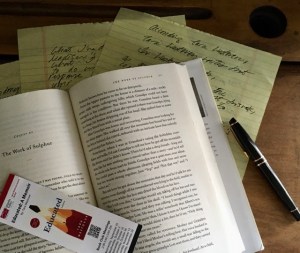
Reading your textual analyses demonstrated that an exercise in integrating quotations would be a valuable follow-up assignment. In academic writing, sentences never begin with quotations. Instead, they’re introduced with signal phrases, such as these:
According to Tara Westover,
Tara Westover writes that
In Westover’s words,
As an example for the comment you will post this week, I have turned back to the comment that Madison wrote last week. First, here is her comment as it appears word for word:
Deep down, past her internal struggle of accepting vulnerability, Westover realizes that she, too, has her own voice. This is revealed in her conflicting journal entries where she writes about a violent event involving Shawn assaulting her and her uncertainty about what to think about it. She bounces back and forth between reasoning that the attack was her fault and Shawn being in the wrong. Her doubt is disclosed as a turning point in the perceiving of her thoughts compared to her family’s.
Here’s my revised version, which introduces three lines from the end of the chapter:
Deep down, past her internal struggle of accepting vulnerability, Westover realizes that she, too, has her own voice. This is revealed in her conflicting journal entries where she writes about a violent event involving Shawn assaulting her and her uncertainty about what to think about it. She bounces back and forth between reasoning that the attack was her fault and Shawn being in the wrong. Readers witness her predicament as she reflects on her journal entries. In Westover’s words, “[t]he second entry would not obscure the words of the first. Both would remain, my memories set down alongside his. There was a boldness in not editing for consistency” (197). The bold act of writing her own memory to counter Shawn’s serves as a turning point, a place where her perceptions diverge from her family’s.
What I’ve done with Madison’s comment is what I’m asking you to do with your own response to a passage in our reading for this week.
Directions
Write a short response to a passage in Chapter 25, 26, 27, or 28 of Educated.
Include in your response a short quotation with a signal phrase and a parenthetical citation.
If you name Westover in the signal phrase, include only the page number (216).
If you do not name Westover in the signal phrase, include her last name (Westover 216). Note that there’s no comma or page abbreviation.
Post your comment/reply no later than 5 p.m. on Wednesday, April 8.
 Our Wordplay days in class gave us opportunities to build our word power, collaborate, and engage in creative problem solving. Now they offer us a way to forget our sense of isolation. I hope that games, whether table-top or digital, continue to lift your spirits.
 rack.
rack. Wordplay days gave us opportunities to build our word power, collaborate, and engage in creative problem solving. Now they’re pastimes that can help us forget our isolation. I hope that games, whether table-top or digital, continue to lift your spirits.
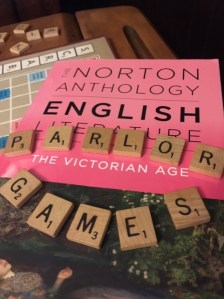 your Scrabble rack. See my sample below.
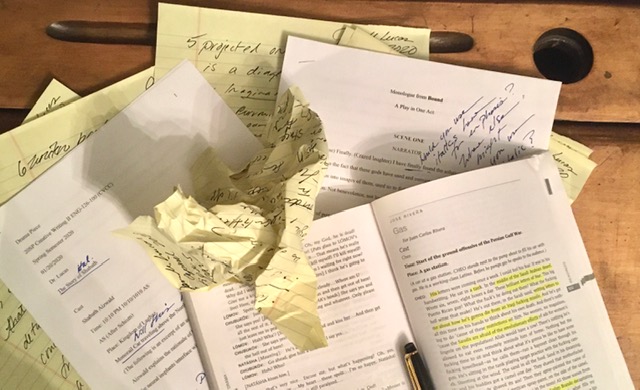 Welcome to our third drama workshop session, and thank you for your thoughtful feedback on The Slow Decline and the monologue from Bound. Before we turn to the untitled monologue and The Story of Shabath, I offer these follow-up notes:
 In the second paragraph of the monologue, Deen reveals the inciting incident, the event that creates the situation in which she finds herself: “and then they died.” In the fifth paragraph, she first mentions her current obstacle: the officer to whom she is pleading her case. Consider how altering the order of the details that Deen presents would affect the monologue’s tension and the audience’s perceptions of Deen.
 Welcome to our second drama workshop session, and thank you for your thoughtful feedback on the first script, Twins of an Ill Fate. Before we turn to the next two scripts, The Slow Decline and the monologue from Bound, I offer these follow-up notes:
 the adopted twins of Rome’s founding myth, and the opportunities that twin characters present, both as archetypes and subjects for exploration of nature and nurture. One reason for the revelation of the twins’ adoption–which Margret’s phone conversation provide–may be the existential crisis that crests with the realization that we are not who we thought we were, whether children of God or the children of the people we believed were our biological parents. I don’t know whether that’s what the writer intended, but the symbolic framework of the play leaves it open to that possibility.

 Reading your textual analyses demonstrated that an exercise in integrating quotations would be a valuable follow-up assignment. In academic writing, sentences never begin with quotations. Instead, they’re introduced with signal phrases, such as these:
 Jane Lucas