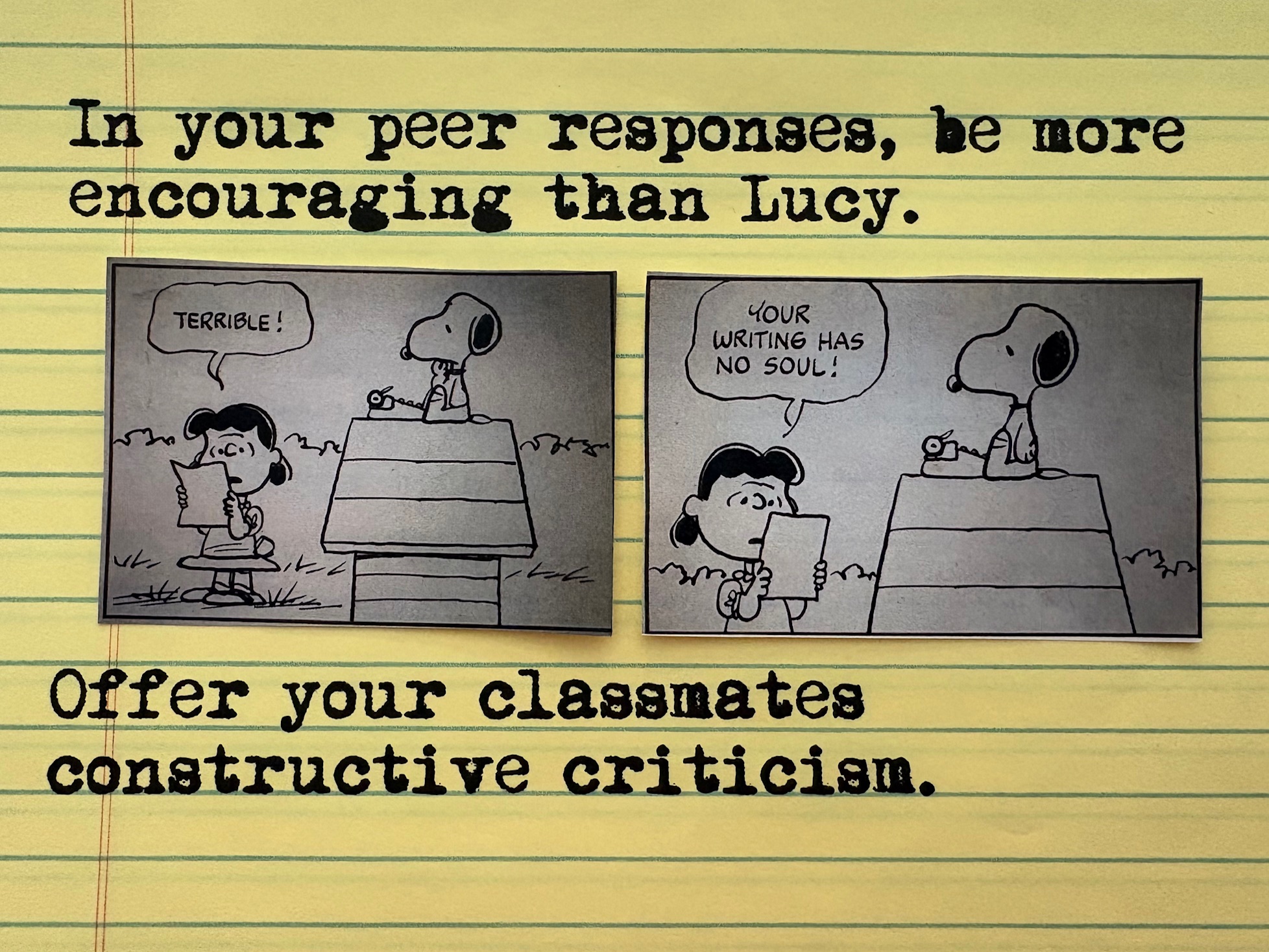
This morning, in place of our in-person class, you will compose a response to a designated* classmate’s literacy narrative. Directions for the assignment follow. Read the directions in their entirety before you begin typing your response. If you have any questions, please email me.
Directions
- Go to the class blog page, and click on the link for the blog of the classmate whose name follows yours. If you are last on the list, go to the blog of the student whose name is first.
- *If your designated classmate’s blog is not linked to the page, or his or her literacy narrative is not published, choose another classmate’s blog.
- Read the classmate’s literacy narrative.
- Compose a one- or two-paragraph response (75 words, minimum) that includes both the classmate’s name and the title of his or her literacy narrative. In your comment, address one or more of these elements: the title, vivid details, scene, dialogue, the image documenting part of the writing process away from the screen, the embedded link to a relevant website. Note that you will mention the classmate by name, but you will not refer to him or her in third person. In other words, you will not write, John’s description made me feel as if I were with him in his fourth-grade classroom. Instead, you will write, John, your description made me feel as if I were with you in your fourth-grade classroom.
- Recommended (not required): Draft your comment longhand in your journal.
- After you have composed your response, review the section of Writing Analytically devoted to basic writing errors, or BWEs (426-44), and correct any that you can identify in your blog response. This step is for your own comment, not your classmate’s literacy narrative.
- Type your response as a comment. You should see a leave comment/reply option at the top or bottom of the post. If you do not see that option, click the title of the blog post, and scroll down. You should then see leave comment/reply.
- Before you click leave comment/reply, copy your comment (on a PC, copy with control + c; on a Mac, copy with command + c).
- After you submit your comment on your classmate’s blog post, return to this post, and paste your comment as a reply (on a PC, paste with control + v; on a Mac, paste with command + v). This step is critical because your classmate may not approve your comment, which means it will not be visible on his or her blog post. To receive credit for the assignment, you must post your duplicate comment as a reply to this blog post, “ENG 1103: Literacy Narrative Peer Responses.“ To submit your comment, click the title of the post, then scroll down to the bottom. There you will see the image of an airmail envelope with a box for your comment. Type your comment in the box and click Comment. Post your comment by the end of today’s class period (11:50 a.m.).
I will make your comments visible after the deadline.
You are not required to read other classmates’ literacy narratives, but I encourage you to browse their blogs and read the posts that pique your interest.
Journal Exercise: Alternate Portraits
Since we are not meeting in person today, I will not conduct a check of the alternate portraits journal exercise that you completed, but you may have the opportunity to draw on that writing for another assignment. For now, think of that exercise as a warm-up for your analysis.
If you were absent on the day I distributed copies of the exercise, or you misplaced your copy, see the directions included in the class notes for January 21.
The photograph of Taylor Swift that accompanies Amanda Petrusich’s New Yorker piece will be included in tomorrow’s class notes.
If in-person classes are held on Wednesday, I will return your literacy narrative reflections with my annotations. Along with my handwritten notes, you will receive a handout of general notes on your reflective writing. An additional copy of those notes follows.
Reflection Notes
- The directions for your reflective essay did not specify that you should double-space your writing, but know that in the future, you should always double-space your reflections and any other individual pieces of writing that you compose in class and submit for evaluation. The double-spacing guideline does not apply to group exercises and other shorter assignments.
- You will not see a grade on your reflective essay for your literacy narrative, because that reflection and the two you will compose for your other two major writing assignments are not assigned grades. Instead, they factor in the grades for the major assignments themselves.
- You will see a grade on the midterm and final reflections that you compose because those are stand-alone assignments.
- All the reflections that you compose are essays, albeit short ones, and should consist of at least three paragraphs: an introduction, a body paragraph, and a conclusion.
- Just as you indent the first line of each paragraph of an MLA-style typed document, the first line of each of your handwritten paragraphs should be indented approximately five spaces or one-half inch. In English 1103, the one exception to the indentation guideline is the writing on your blog. WordPress posts are easier to manage if you retain the default block style.
- In all your reflections, you will be required to integrate a minimum of one quotation from a written text, either from a section of Writing Analytically or another course reading. Follow the directions for preparing to write your reflections, which will be posted on my blog. If you arrive at class unprepared or underprepared, you are likely to produce a reflection with a quotation that isn’t gracefully woven into your writing or one that isn’t properly cited.
Next Up
In class on Wednesday, we will read a short story by Donald Barthelme. As an introduction to him and his fiction, read this biographical sketch. After you read the sketch, compose a one- or two-paragraph journal entry that includes (1) what you have learned about his writing style, and (2) what you have learned about readers’ and critics’ mixed responses to his writing.

 Jane Lucas
Madison, your literacy narrative “Prompted to Say More” was very relatable for me, and not only because of the writing process for your college essay; something all of us went through that year. But, specifically the second half of the essay where you begin to refer to yourself as an “Oreo”. It kind of took me back, it made me feel like I was in that position all over again when thinking about it and reading. Not only because I was in that position, it’s because as an African-American male going to a private school, and having friends that went to inner-city schools “Oreo” was, and still is, a word I hear today.
Besides that, your writing shows how much intense pressure, care, and heart went into your college essay. You made a point of the constant revisions, drafts, double-checks, etc, which made it clear that this wasn’t just another paper to you.
The vivid detail is something that stood out to me, questioning how to approach the paper, specifically because that was something that I had trouble with as well. I didn’t want to give a sob story, or like you said “get to personal”.
Classmate Errors:
There isn’t much wrong in this paper besides repetitiveness when it comes down to describing how important this was, and then little things like punctuation. Some sentences can come off as being a “run-on sentence” in this paper as well. Paragraph 2, and Paragraph 6, and Paragraph 5 is where most of the run-on or long sentences are. One fix is when Madison stated, she didn’t want to get “to personal”, instead it should be “too personal”. That’s the only thing I could identify.
Isabelle first I want to start of by telling you this is a great literacy narrative! ” Editing the story of Myself” drew me in from the first scene with Lemon LaCroix, popcorn, and a glowing laptop. This image was so descriptive it made this event feel so real and current. It contrasted beautifully with the nervous freshman of you sitting in J201, debating wether you should drop the class or stay. Your reflection about questioning wether you were ” really” a writer was so powerful because I think it’s so relatable, at least once in our life we all question if we are ” really” for something. The way you answered that question through your experience made your growth feel earned and unique.
I do also love the way you showed your development through specific roles, moving froim student to editor, to editor in chief instead of just stating that you had improved. The detail about covering your love for AP style and finding a ” flow state” while editing made your passion feel genuine and loved-in. By the end when you returned to your laptop and smiled at your portfolio, it made the story feel like a full-circle moment that perfectly matched the story. You really show how you’ve revised not just articles but your own identity as a writer.
Dylan, I really connected with your literacy narrative, “How to Write About Myself.” Your description of struggling to write your autobiography in elementary school felt especially vivid to me. When you explained how you “knew what to say” but everything still felt wrong once it was written down, it clearly showed how frustrating and personal that experience was. That moment helped me understand how early writing experiences can shape the way we feel about expressing ourselves for years afterward.
I also liked how you walked us through the different stages of your life, especially how things began to change in high school when you started therapy and opening up more. That progression made your story feel reflective and honest. Your narrative shows how writing can grow along with a person, and it made me think about how literacy is connected to confidence and self understanding.
Adian, your literacy narrative, Surviving Ingrid, was inspiring and easy to connect to because you laid each scene out so clearly and in vivid detail. Starting with your opening, I thought it was very attention-grabbing with the embedded ink to your middle school and when you used dialogue with your cousin warning you about Ingrid, as it made me intrigued about what was coming next. The scene in the classroom where you were distracted by the unfair cubby and hall way situations felt very chaotic in a real way with how you described your situation. I also enjoyed how you were able to show Ingrid’s attitude without explaining it outright with the use of dialouge – “You don’t need one,”. Furthermore, I think my biggest takeaway from your narrative is how you learned to advocate for yourself under those circumstances and can now carry that experience with you and advocate for yourself in the future.
Sofia Marin, your literacy was good. I really liked the vivid details that made your literacy come to life. The title “The beauty of Discomfort” is a great fit for your narrative as it talks about an uncomfortable time in your life. There were some grammar issues; I would just make sure to read my work once more before submitting. Everything else was good, especially the message distributed in your work. I liked how you talked about a person that impacted your life. This reminded me of Hellen Kellers’ literacy when she talked about Anne Sullivan. Your story is impactful and can become an encouragement to others.
Dylan Virga, Your literacy narrative “How to Write About Myself?” to me had a very good hook, and really brings the reader in because your story that you told felt very truthful and easy to connect to. Describe the struggle to write about yourself, especially in the way that your elementary school autobiography. It clearly states a specific moment in your life and why this is hard for you. The way of the awkwardness and the way it was being forced on. You had a very strong emotion in this narrative, and it showed that you kept running into this feeling and the detail made the experience vivid. Something I could notice is a turning point when you talked about therapy and started to open up more and show how you shifted and started to feel earned and the growth. Overall, I think that your title really does fit your essay, and it leaves a great emotional impact on the reader.
Sierra Welch, your literacy narrative “Why I Hate the Letter R” really did have such a clear scene when you were talking about the back of the classroom and watching your classmates read aloud while you were being called on. This to me opened the detail about your tone of writing and made your anxiety feel like a real emotion. I also did like the dialogue that you included with your speech therapist, especially the rainbow moment which shows you struggled in this type of action and just explaining. The way that you describe vividly the therapy room I could really picture help write. It was in the letters all over the wall, and I could imagine myself inside of this room throughout the story. Overall, I think your narrative was very empowering, and your ending was a very strong ending and finished off this narrative even stronger than it started.
Peer review for Avery Clark’s Breaking Through the Pages:
Avery, I enjoyed reading this narrative as someone who can relate to it well, especially when you include such vivid detail and imagery on what the reading camp looked like. It is so similar to different reading experiences that I had in elementary school, as well as others that I am familiar with, so being able to hear another perspective of a little girl trying to understand how to read properly on a beanbag in the corner of the library was very refreshing.
I enjoyed how you used descriptive words in order to pile together such a well-flowing story. It genuinely felt like I was reading the progression of something right from beginning to end. You started off by explaining what was great about your elementary school experience, leading into how there was a specific topic that you struggled with, transitioning to a day by day story about the summer camp you attended to fix that struggle. I enjoyed how you provided detail about your own feelings from back then, included some details about how you changed what you were doing to fix what was potentially wrong, and was able to explain it all by a certain timeline, which I particularly loved. I liked seeing that by the final day, you weren’t dreading anything or struggling with anything, and this story displayed an immense amount of personal growth and realization.
I truly don’t have many negative things to say about this narrative, as I truly enjoyed reading it. The only thing I would say is that I would have liked to see less repetitiveness in certain imagery wording and details, such as the word “dragged.” It was great when you used it for the first time, as it actually made me chuckle a little bit, but then when that is the same word that readers continue to read multiple times, it becomes repetitive and I yearn for a different or better word to describe the “going to camp” experience.
Hey Dylan, I thought your literacy narrative, How to Write About Myself?, was very relatable. I can relate to trying to write an autobiography and everything feeling awkward. The thing about feeling embarrassed writing about your experiences and worrying that they’re “unpopular” is something everyone goes through. It’s great that you worked your way through this. I also thought the story in general was very good. The details were vivid and it felt like I could see everything you were describing.
Nick, your literacy narrative, “My Eight Grade Spanish Class,” captures how frustrating and hard it was to learn through online school during the pandemic. The vivid details you added about sitting in your room playing video games during class and using Kahoots to help you, illustrate how challenging it was to learn online. I also liked the dialogue between you and your teacher because it shows how much support the teacher gave you in overcoming Spanish.
Through this, we can see you change from being frustrated in the class because you were one of the only students who did not understand Spanish, to being able to read a full paragraph in class and understand it. This shows a major turning point in your life and allows the reader to see the growth you experienced. By adding strong details and dialogue, you show that even though the pandemic was difficult for you as a student, it helped you overcome your struggles in Spanish, and gain confidence. Overall, your story teaches the lesson that “struggling does not mean failing, and that growth often begins when you least expect it.”
Sierra, your literacy narrative “Why I Hate the Letter R” stood out to me a lot. When I read the title it popped out at me, it made me ask “why would anyone hate on a letter,” I like this title because it really made me wonder what it meant and pulled me in to readWhen you spoke about your time in speech therapy, the way you wrote about your build up in confidence was very inspiring, and something that I can relate to. I appreciated how you quoted the conversation between you and your therapist, it made it feel very vivid and I could almost imagine myself in that position.
Elise Claire,
Your literacy narrative, “The Paper That Changed my Life” beautifully tells the story of your mental health experiences in high school and how writing your senior capstone paper restored your confidence, motivation, and empowered you.
You set the scene perfectly, allowing me, the reader, to truly envision the story. The last sentence of the introduction paragraph, “In the middle of my research for the project, everything went off the rails. That is why I remember it so vividly” openly grabbed my attention, and drew me in, ready to read the story.
The emotion that you shared throughout the story via personal details such as friendships, your mental health, and eventually returning to school makes this story meaningful to me. Additionally, transition sentences like, “Now you might think, what does that have to do with your paper and this assignment? Just wait,” had me waiting to see what would come next.
The title, “The Paper That Changed my Life”, is an accurate representation of the story as a whole and summarizes the impact of your senior capstone paper. This was truly a fabulous literacy narrative, and I thoroughly enjoyed reading your story, and sharing these experiences with you. Great job, Elise!
Jermaine, I enjoyed reading “A Challenge Wrapped in a Smile.” The title was engaging and immediately interested me in the story’s meaning. I liked how the title connects to your experience. Your opening is excellent. You have vivid descriptions of the class and capture your emotions in detail, which helps set the scene. Your conclusion is well written and clearly shows how the event impacted you.
When reading The beauty of discomfort Sofia, I could easily visualize the nervousness that you felt being in a new environment and not understanding what there saying. I also really liked the message of how stepping out of your comfort zone can lead to personal growth and felt that the title really gave great insight into that theme. Sofia in your essay I also really liked the visualization in the story and it helped me when reading to not only visualize the setting but help relate to the feelings written in your narrative.
Madison, your literacy narrative “Prompted to Say More” is such a fitting title for a piece that so powerfully captures how writing can move beyond an assignment and become deeply personal. Your description of the college essay process—the constant revisions, the self-questioning, and the emotional weight of knowing this piece could shape your future—felt incredibly vivid and relatable. I especially loved how you used the Oreo analogy as both a creative hook and a way to reclaim a term that had once been used against you. That choice added a strong sense of voice and purpose to the narrative, turning reflection into empowerment. Your scenes of sitting in front of the screen, overwhelmed yet determined, made it easy to imagine myself in that moment with you. By the end, it’s clear that this essay wasn’t just about getting into college—it was about understanding and affirming who you are.