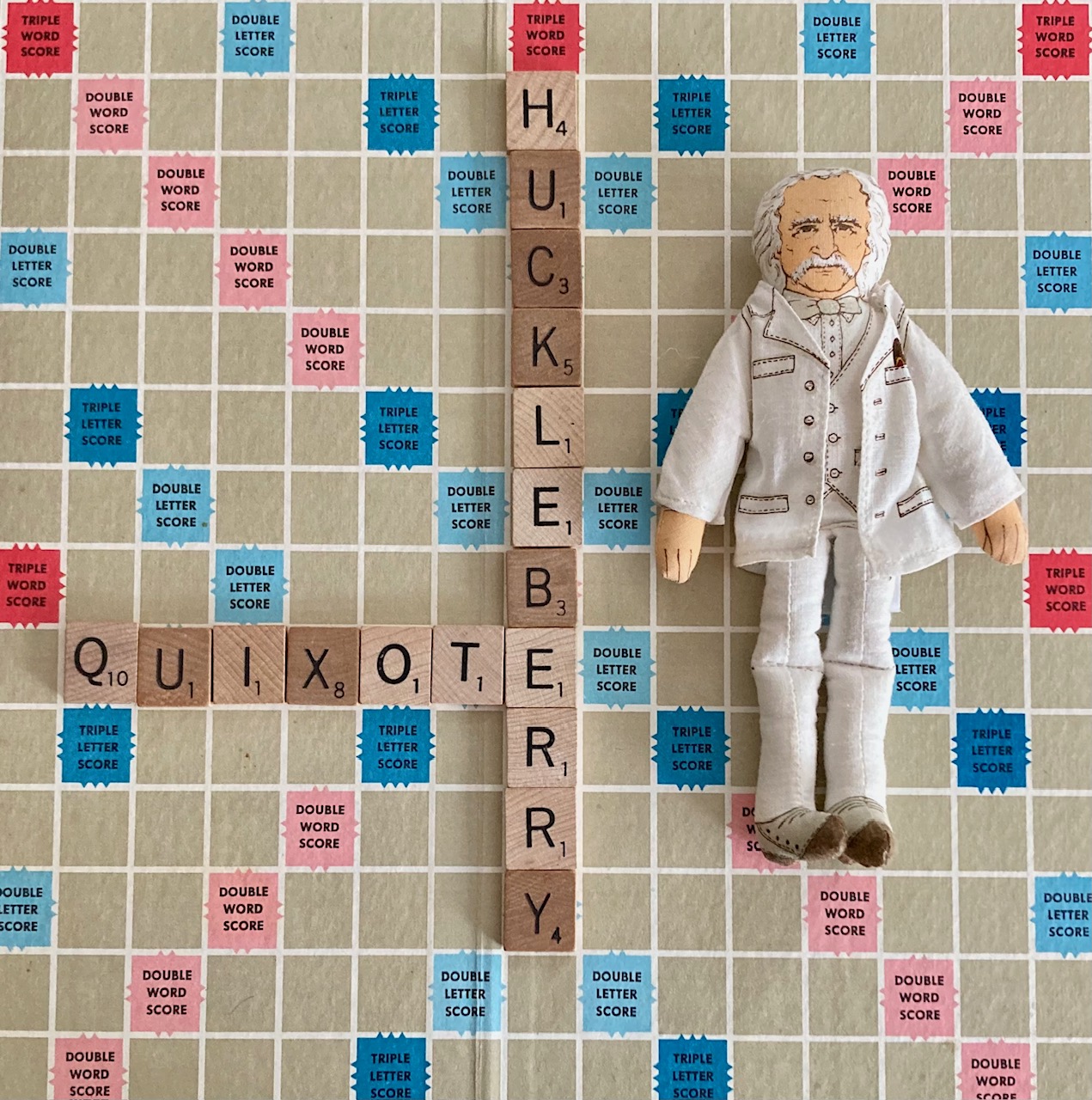
Today’s Scrabble post features the names of authors and characters that are playable words. Learning them will not only increase your word power (and up your game), but also broaden your knowledge of literature. If you haven’t read some of the classics in the list below, I encourage you to check them out.
- Eyre: a long journey (the last name of of the title character in Charlotte Bronte’s Jane Eyre, 1847)
- Dickens: a devil (Charles Dickens, 1812-1870)
- Fagin: a person, usually an adult, who instructs others, usually children, in crime (from a character of that type in Dickens’ Oliver Twist)
- Holden: the past participle of hold (Holden Caulfield, the protagonist in J.D. Salinger’s The Catcher in the Rye)
- Huckleberry: a berry like a blueberry (the first name of the title character in Mark Twain’s Adventures of Hucklebery Finn, 1884)
- Oedipal: describing libidinal feelings of a child toward the parent of the opposite sex (from the title character in Sophocles’ Oedipus Rex, c. 429 B.C.)
- Quixote: a quixotic, or extremely idealistic person; also quixotry, a quixotic action or thought (the title character in Michael de Cervantes’ Don Quixote, Part I: 1605, Part II: 1615)
Could the words in the hypothetical game featured in the image at the top of this post be the first plays in an actual game of Scrabble? They couldn’t be the first two plays, but they could be the first three. Huckleberry with the b on the center square/double-word bonus square would be worth fifty-eight points, but huckleberry has eleven letters, and the first player, or team, could not play more than seven letters. But the first play could be berry for twenty-eight points. The second player, or team, could follow with q-u-i-x-o-t to the left of the e in berry for twenty-five points. Then the first player, or team, could add h-u-c-k-l-e to berry for a total of twenty-five points.
Next Up
Monday morning in class, you will have time to plan and prepare the individual presentation that you will deliver during the exam period, 3:30 p.m., Monday, April 27. In the meantime, think about the major assignments you have completed and the skills you have developed over the course of the semester. Review your blog posts, your reflective writing, and your journal entries, and ask yourself, what accomplishments of mine in English 1103 best demonstrate the skills and habits of mind that not only benefit me as a writer and a student, but also in my life beyond the classroom?
 Jane Lucas