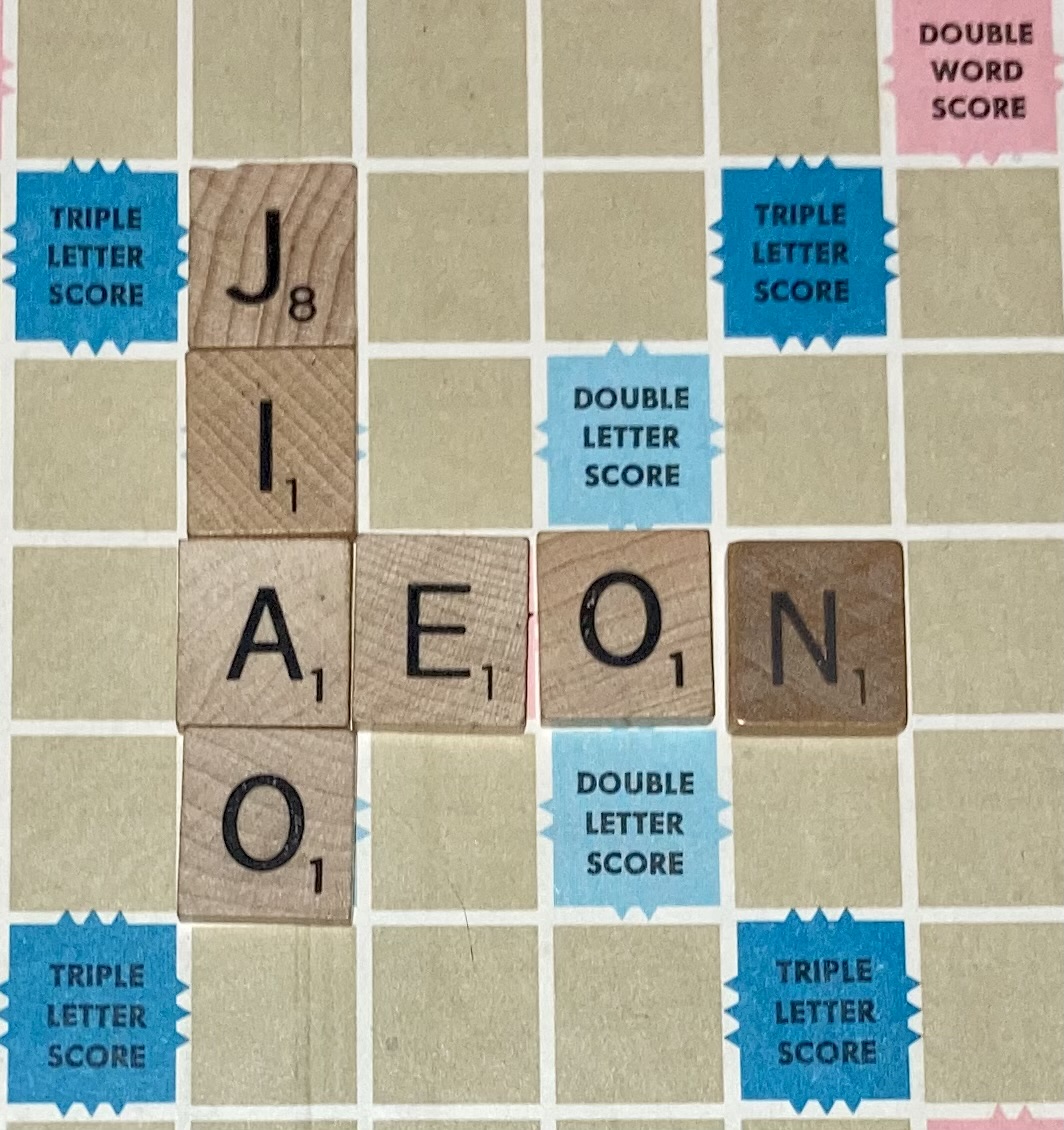
Knowing words with multiple vowels proves useful when you’re faced with a rack of mostly, or all, vowels. Here’s a list of the four-letter words with three vowels, beginning with a through m:
- aeon: a long period of time (also eon)
- agee: to one side (also ajee)
- agio: a surcharge applied when exchanging currency
- ague: a sickness associated with malaria
- ajee: to one side (also agee)
- akee: a tropical tree
- alae: wings (pl. of ala)
- alee: on the side shielded from wind
- amia: a freshwater fish
- amoa: a kind of small buffalo
- awee: a little while
- eaux: waters (pl. of eau)
- eide: distinctive appearances of things (pl. of eidos)
- emeu: an emu
- etui: an ornamental case
- euro: an Australian marsupial, also known as wallaroo, for being like the kangaroo and the wallaby; also a unified currency of much of Europe
- ilea: the terminal portions of small intestines (pl. of ileum)
- ilia: pelvic bones (pl. of ilium)
- jiao: a Chinese currency (also chiao)
- luau: a large Hawaiian feast
- meou: to meow
- moue: a pouting expression
After Fall Break
On Monday, October 12, we will examine the student analysis “One Mississippi,” which you will read and annotate for class. We will also discuss your journal entries on the excerpt from Maus as a lead-in to our reading of a second sample analysis, “The Strange Fruit of Sosnowiec,” which I will distribute in class that day.
If you were absent when I distributed “One Mississippi” and the Maus journal exercise or misplace yours, print copies from Blackboard. “One Mississippi” is in the sample papers folder; the Maus journal exercise is in the readings folder.
Also, be sure to have your copy of Dan Rockmore‘s “Should the Classroom Be More Like the Gym?” We will look back at his essay as we review some short passages from your midterm reflections.

Coverage of Covering Sci-Fi
Our September 16 sessions at Smith Library are the subject of the HPU Libraries‘ Special Collections blog post published yesterday: “Covering Science Fiction: When Special Collections Becomes the Classroom.”
I encourage you to read the post, which includes a photograph of students in each of your classes examining the book covers. Two sections of the post, “Four Ways to Read a Cover” and “From Looking to Making an Argument” may spark an idea for your revision of you analysis. If a line in the post is relevant to your analysis, you include the blog post as a second source. Here is the model for the works cited entry:
Ward, Gerald. “Covering Science Fiction: When Special Collections Becomes the Classroom.” HPU Libraries, 1 October 2026, https://www.highpoint.edu/library/.
In your MS Word or PDF file, the second line of the entry should be indented five spaces.
Read. Reflect. Connect.
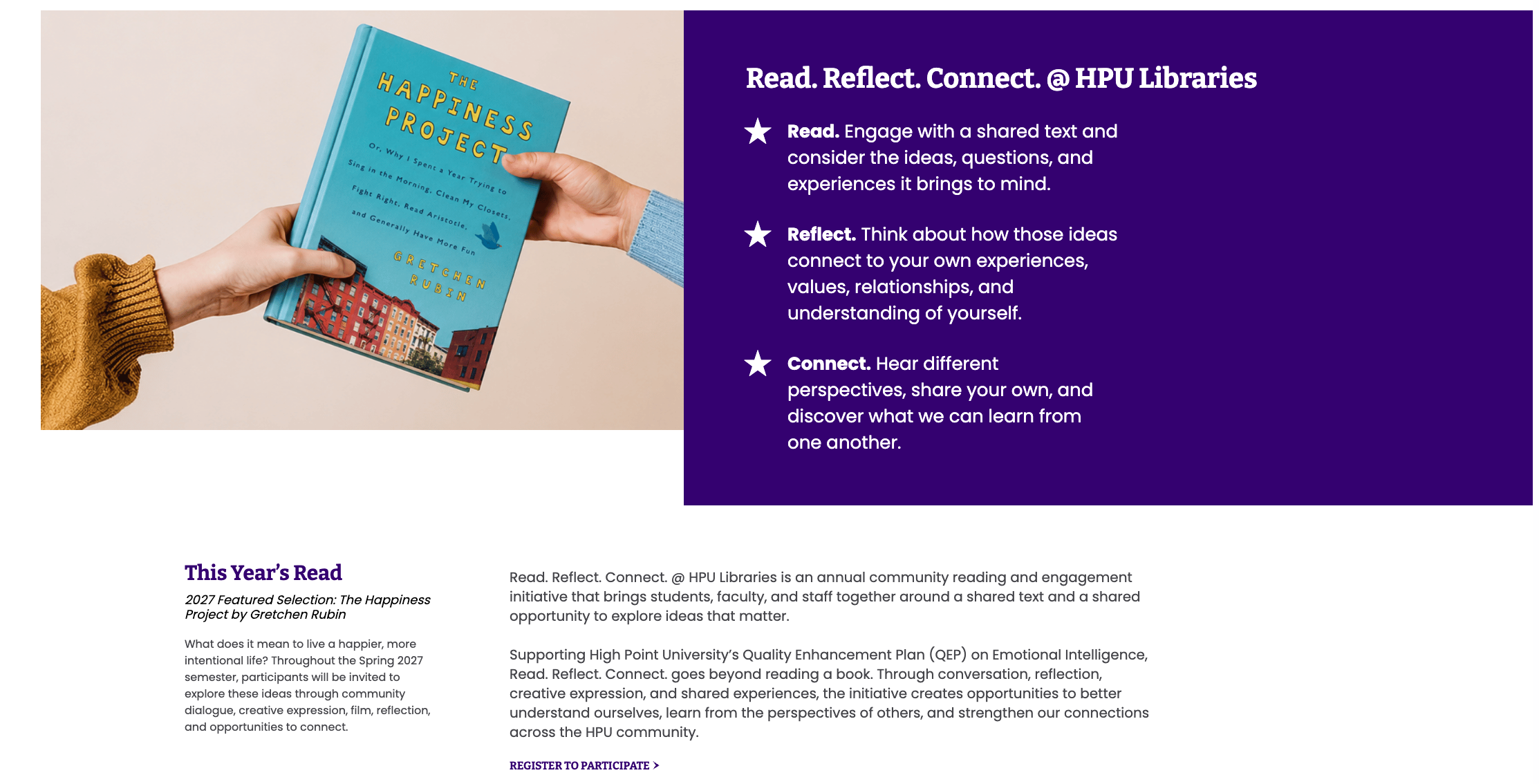
HPU Libraries‘ Read. Reflect. Connect. offers members of the university community the opportunity connect through a shared reading (this year, The Happiness Project). Registration is open now but ends this afternoon. If you sign up, later in the fall, you will receive a copy of the book (your choice of a physical or digital copy). In the spring semester, you will have the opportunity to take part in events that focus on readers shared experiences of reading Gretchen Rubin‘s book.
Bonus Assignment
- Register for Read. Reflect. Connect.
- After you have signed up, compose a brief blog comment stating that you have registered for Read. Reflect. Connect.
- Post your comment as a reply to today’s blog post by 4 p.m. today.
- To post your comment, click the title, “ENG 1103: Irritable Vowel Syndrome . . . ,” then scroll down to the bottom of the post. There you will see the image of an airmail envelope with a rectangular box for your comment. Type your comment in the box and hit return.
Happy Fall Break!
I look forward to seeing you back in class on Monday, October 12.


I registered for Read. Reflect. Connect!