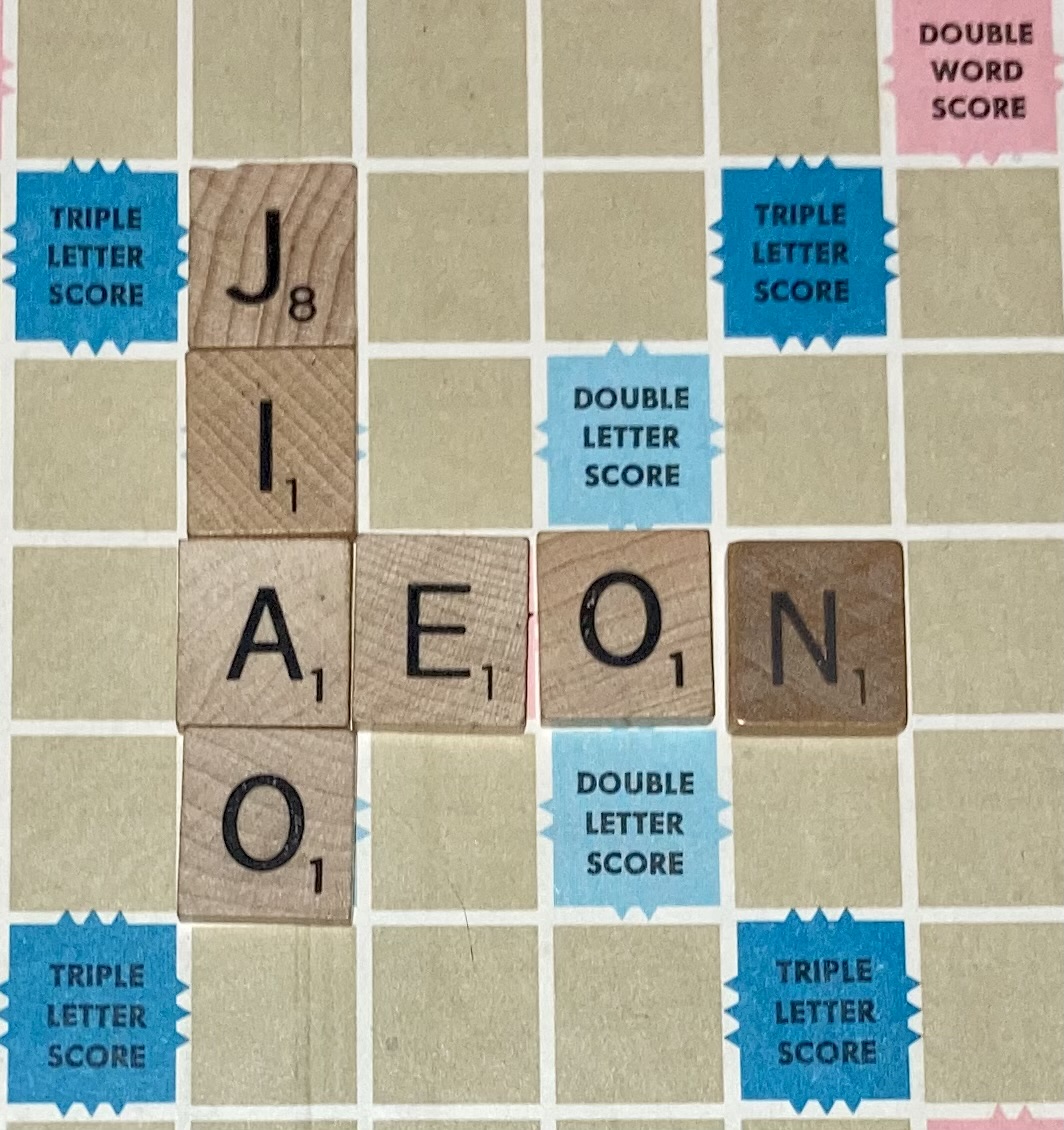
Knowing words with multiple vowels proves useful when you’re faced with a rack of mostly, or all, vowels. Here’s a list of the four-letter words with three vowels, beginning with a through m:
aeon: a long period of time (also eon)
agee: to one side (also ajee)
agio: a surcharge applied when exchanging currency
ague: a sickness associated with malaria
ajee: to one side (also agee)
akee: a tropical tree
alae: wings (pl. of ala)
alee: on the side shielded from wind
amia: a freshwater fish
amoa: a kind of small buffalo
awee: a little while
eaux: waters (pl. of eau)
eide: distinctive appearances of things (pl. of eidos)
emeu: an emu
etui: an ornamental case
euro: an Australian marsupial, also known as wallaroo, for being like the kangaroo and the wallaby; also a unified currency of much of Europe
ilea: the terminal portions of small intestines (pl. of ileum)
ilia: pelvic bones (pl. of ilium)
jiao: a Chinese currency (also chiao)
luau: a large Hawaiian feast
meou: to meow
moue: a pouting expression
After Fall Break
On Monday, October 12, we will examine the student analysis “One Mississippi,” which you will read and annotate for class. We will also discuss your journal entries on the excerpt from Maus as a lead-in to our reading of a second sample analysis, “The Strange Fruit of Sosnowiec,” which I will distribute in class that day.
If you were absent when I distributed “One Mississippi” and the Maus journal exercise or misplace yours, print copies from Blackboard. “One Mississippi” is in the sample papers folder; the Maus journal exercise is in the readings folder.
Also, be sure to have your copy of Dan Rockmore‘s “Should the Classroom Be More Like the Gym?” We will look back at his essay as we review some short passages from your midterm reflections.
I encourage you to read the post, which includes a photograph of students in each of your classes examining the book covers. Two sections of the post, “Four Ways to Read a Cover” and “From Looking to Making an Argument” may spark an idea for your revision of you analysis. If a line in the post is relevant to your analysis, you include the blog post as a second source. Here is the model for the works cited entry:
Ward, Gerald. “Covering Science Fiction: When Special Collections Becomes the Classroom.” HPU Libraries, 1 October 2026, https://www.highpoint.edu/library/.
In your MS Word or PDF file, the second line of the entry should be indented five spaces.
Read. Reflect. Connect.
HPU Libraries‘ Read. Reflect. Connect. offers members of the university community the opportunity connect through a shared reading (this year, The Happiness Project). Registration is open now but ends this afternoon. If you sign up, later in the fall, you will receive a copy of the book (your choice of a physical or digital copy). In the spring semester, you will have the opportunity to take part in events that focus on readers shared experiences of reading Gretchen Rubin‘s book.
After you have signed up, compose a brief blog comment stating that you have registered for Read. Reflect. Connect.
Post your comment as a reply to today’s blog post by 4 p.m.today.
To post your comment, click the title, “ENG 1103: Irritable Vowel Syndrome . . . ,” then scroll down to the bottom of the post. There you will see the image of an airmail envelope with a rectangular box for your comment. Type your comment in the box and hit return.
Happy Fall Break!
I look forward to seeing you back in class on Monday, October 12.
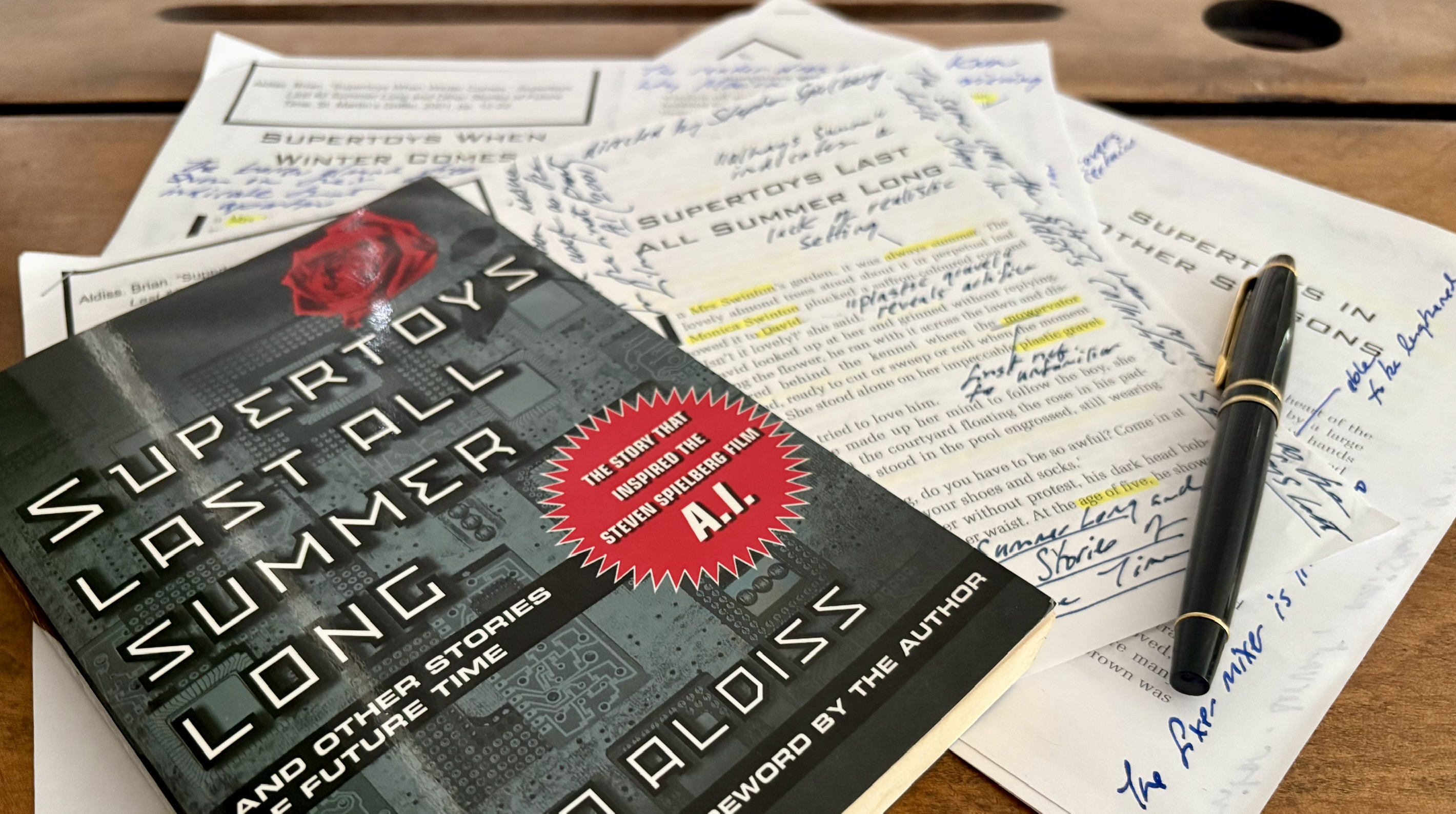
As a starting point for our study of Brian Aldiss’s supertoys stories, this morning–after your Scrabble debriefing–you and two or three classmates will address a detail from one of the stories that may figure in the analysis you will begin drafting on Wednesday.
Each group of three or four students will compose a statement of at least one complete sentence that begins with a signal phrase for a quotation from one of the stories, follows the quote with a parenthetical citation, and concludes with words that convey the detail’s significance without stating its importance explicitly but instead showing it.
Example
Near the end of “Supertoys When Winter Comes,” David spots “a sickly rose growing by a crumbling brick wall” (21), evidence of the frailty of the real world he enters after the collapse of the Swinton’s apartment.
Your group will respond to one of the prompts below. The highlighted section of your class handout designates your group’s prompt.
Although “Supertoys When Winter Comes” and “Supertoys in Other Seasons” are sequels to “Supertoys Last All Summer Long,” Aldiss’s first supertoys story was published as a stand-alone work of fiction in Harper’s Bazaar magazine in December 1969. (The second and third stories were first published in 2001, in the collection Supertoys Last All Summer Long and Other Stories of Future Time, as never-before-seen sequels to the original.) If you chose to analyze “Supertoys Last All Summer Long” as a stand-alone story, what detail would you be certain to include?
Where and how is one or more of Asimov’s Three Laws of Robotics evident in the actions of David, Teddy, or Jules, the serving-man, or where and how do the actions of one of those characters defy one of the laws?
Henry Swinton’s words about obesity and malnutrition in “Supertoys Last All Summer Long” are repeated by him, almost verbatim, in “Supertoys When Winter Comes” and the Crosswell Tape and weight gain are also mentioned in “Supertoys in Other Seasons.” How are those issues linked to technology in Aldiss’s fictional world?
In “Supertoys When Winter Comes,” Monica Swinton tells David he’s “only a little android” (20). Where in the story do her words or actions seem to contradict that assertion?
“Supertoys in Other Seasons” begins in Throwaway Town, which the narrator calls “the land of the obsolete” (24). Who besides the mechanicals becomes obsolete, and who or what leads to his demise?
English author, artist, and editor Brian Aldiss (1925-2017) was best known for his science-fiction novels and short stories. Along with writing sci-fi, he wrote Billion Year Spree (1973), a history of the genre, which he revised and expanded as Trillion Year Spree (1986), coauthored with David Wingrove.
Aldiss’s short story “Supertoys Last all Summer Long” was published in 1969, in the December issue of Harper’s Bazaar. It was later used as the basis for the first part of the film A.I. (2001), directed by Stephen Spielberg. In the year of the film’s release, the short story was republished as the title story in Aldiss’s collection Supertoys Last All Summer Long and Other Stories of Future Time.
Harper’s Bazaar. December 1969.
Scrabble Debriefing, continued
I have asked you to consider the similarities between the composing processes of writing for class and playing Scrabble. And last Friday, I mentioned that in both your writing and your Scrabble games, you should practice moving from observation to analysis. As you examine the images of the game boards and the commentary that follows, note how and where making that move to analysis more often would have benefited the players.
From Observation to Analysis
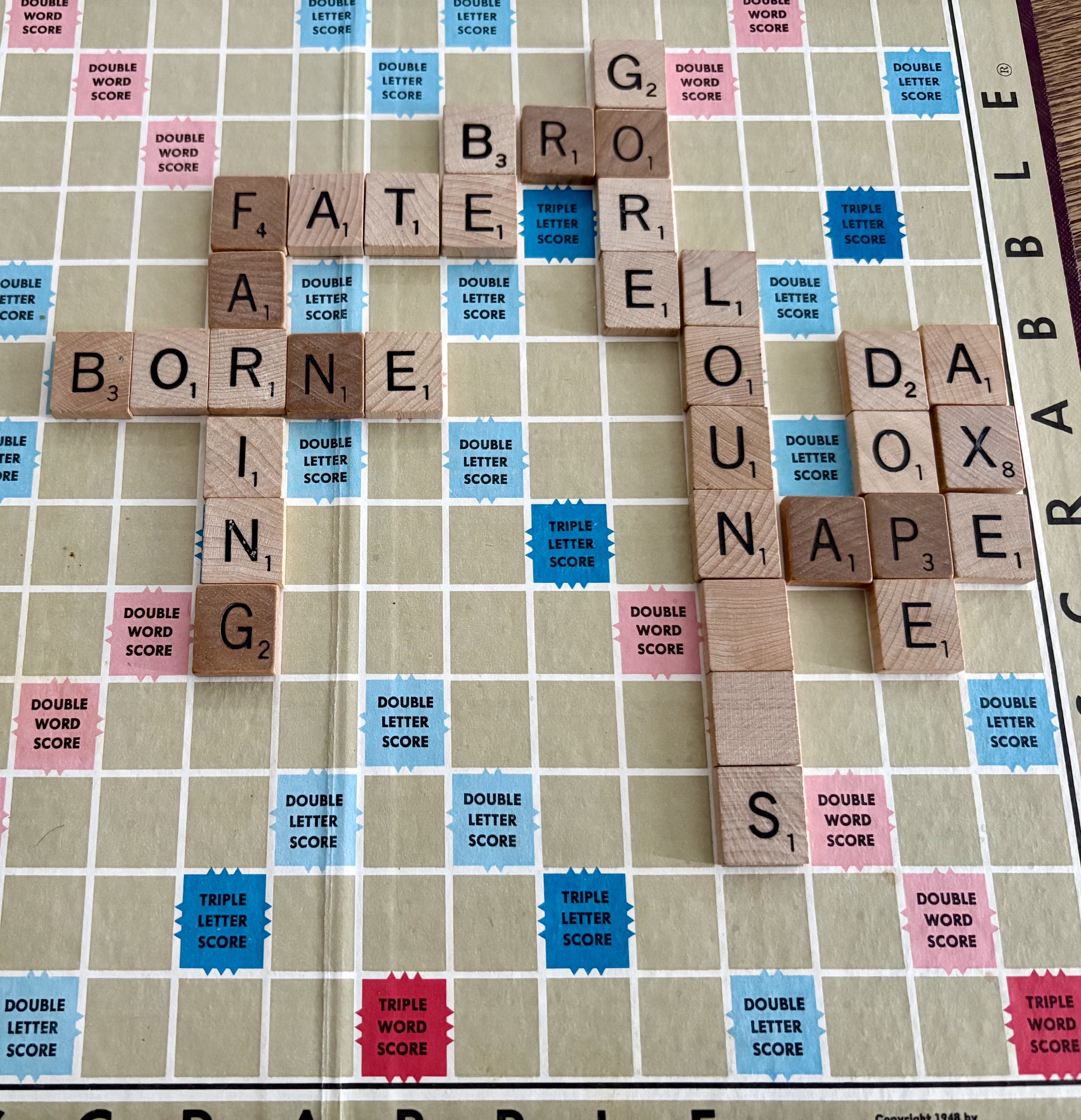
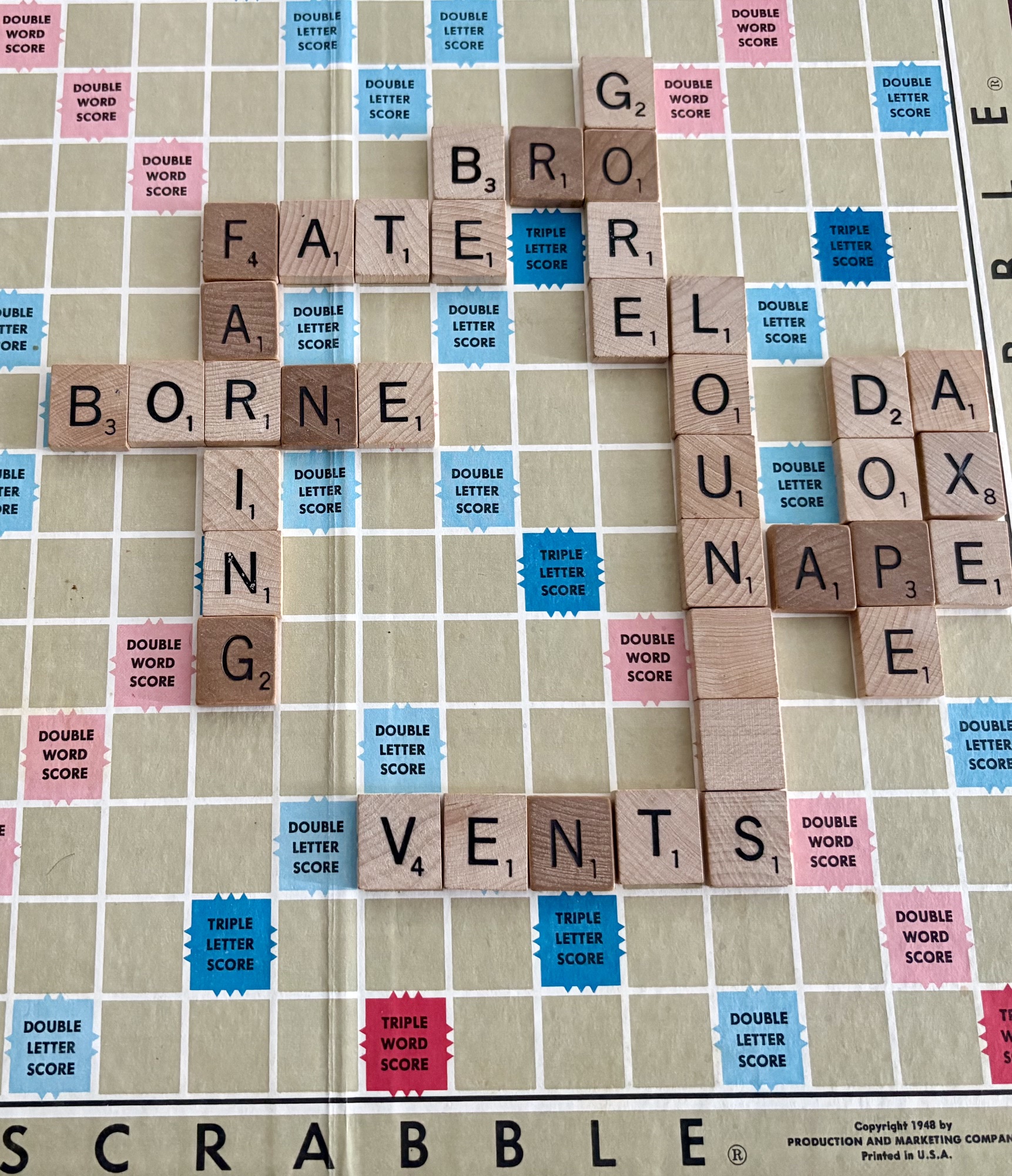
In the game below, the first team played lounges, using blanks for the g and the e. Even though playing both blanks and one u in a single turn could be a bad move, it was a good choice in this particular game. Why?
In the game above, playing both blanks and one u in a single turn was a worthwhile expenditure because the team played all seven of its tiles, which earned them an additional fifty points. So instead of scoring fourteen points for el and lounges, the team scored sixty-four points.
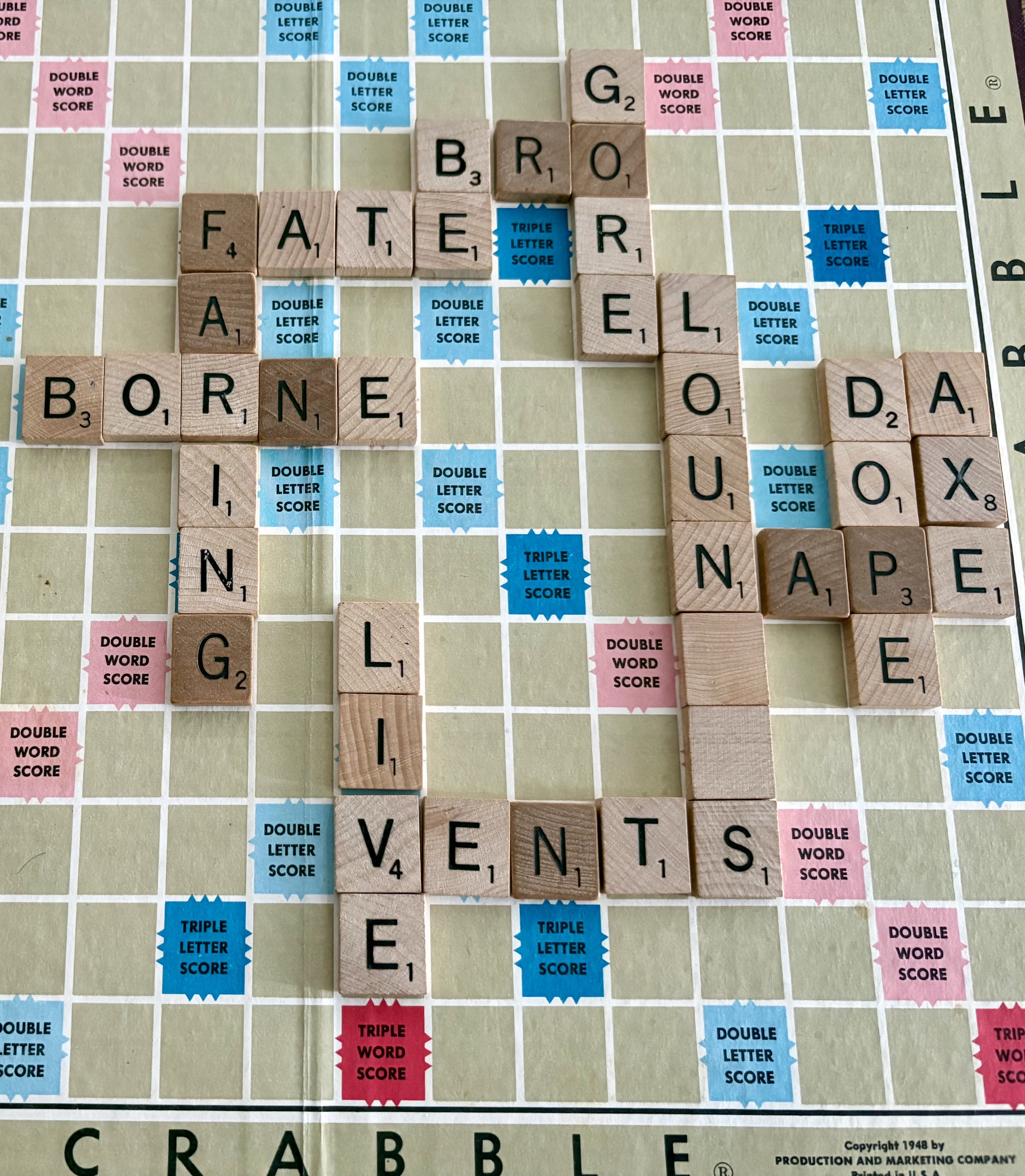
Though playing lounges (and el) was a smart move, playing vent in front of the s wasn’t. (See the board below.) There are two reasons that vets would have been a better choice. What are those two reasons?
First, vents places the e on the double-letter square for a score of nine. Playing vets instead would have placed the v on the double-letter square for a score of eleven. More importantly, playing vents sets up the opponents to score a vertical triple-word play.
As their answer to vents, the second team played live, with the i on a double-letter square, for eight points. By playing there, the second team set up their opponents to earn a score much higher than eight with a double triple-word play with a horizontal word with a d, n, or s on the triple-word square.
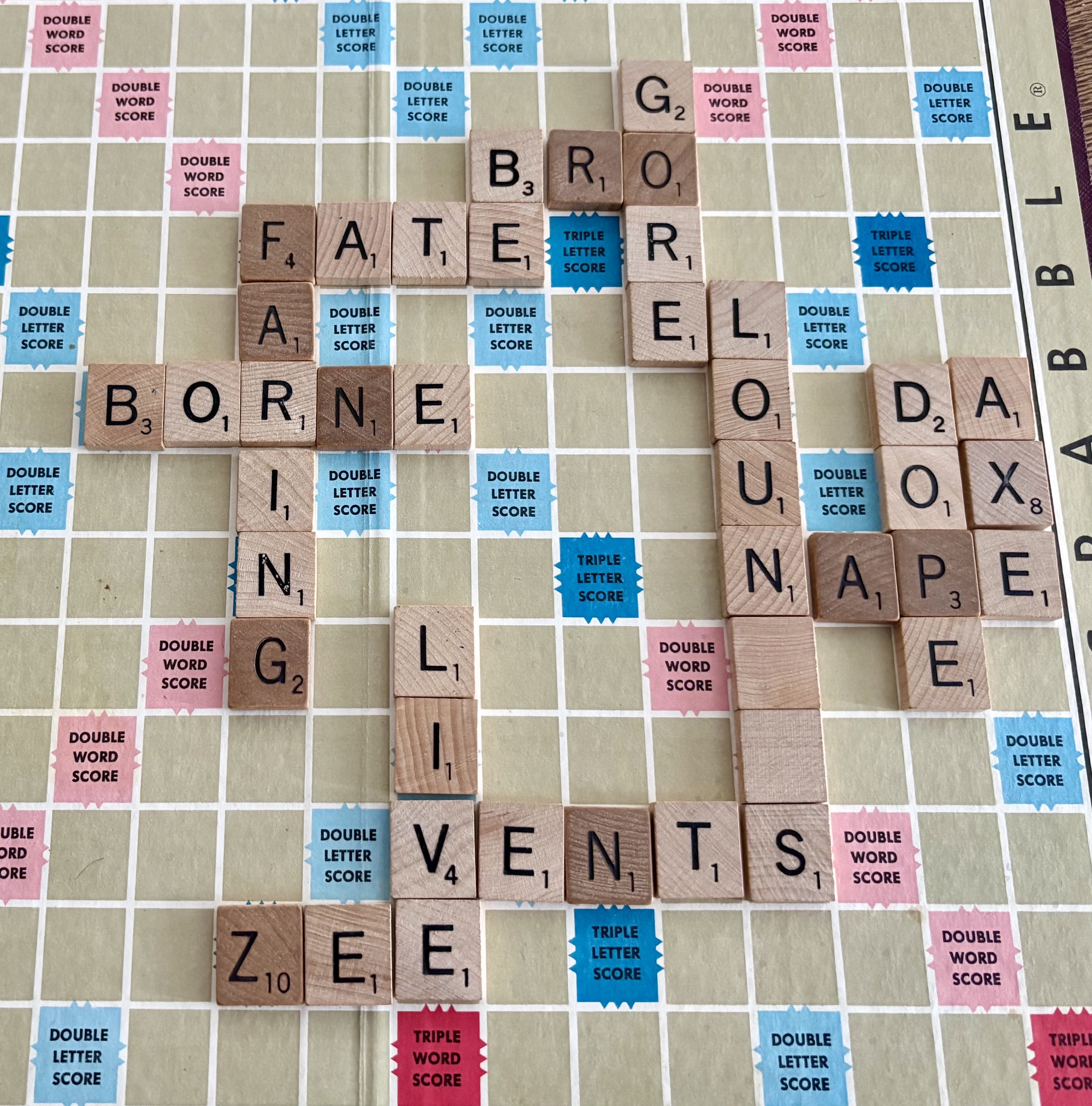
For their next play, the first team did not have d, n, or s, but they did have a z and an e, which earned them thirty-two points (with the z on a triple-letter square), four times the number of points the second team earned for live.
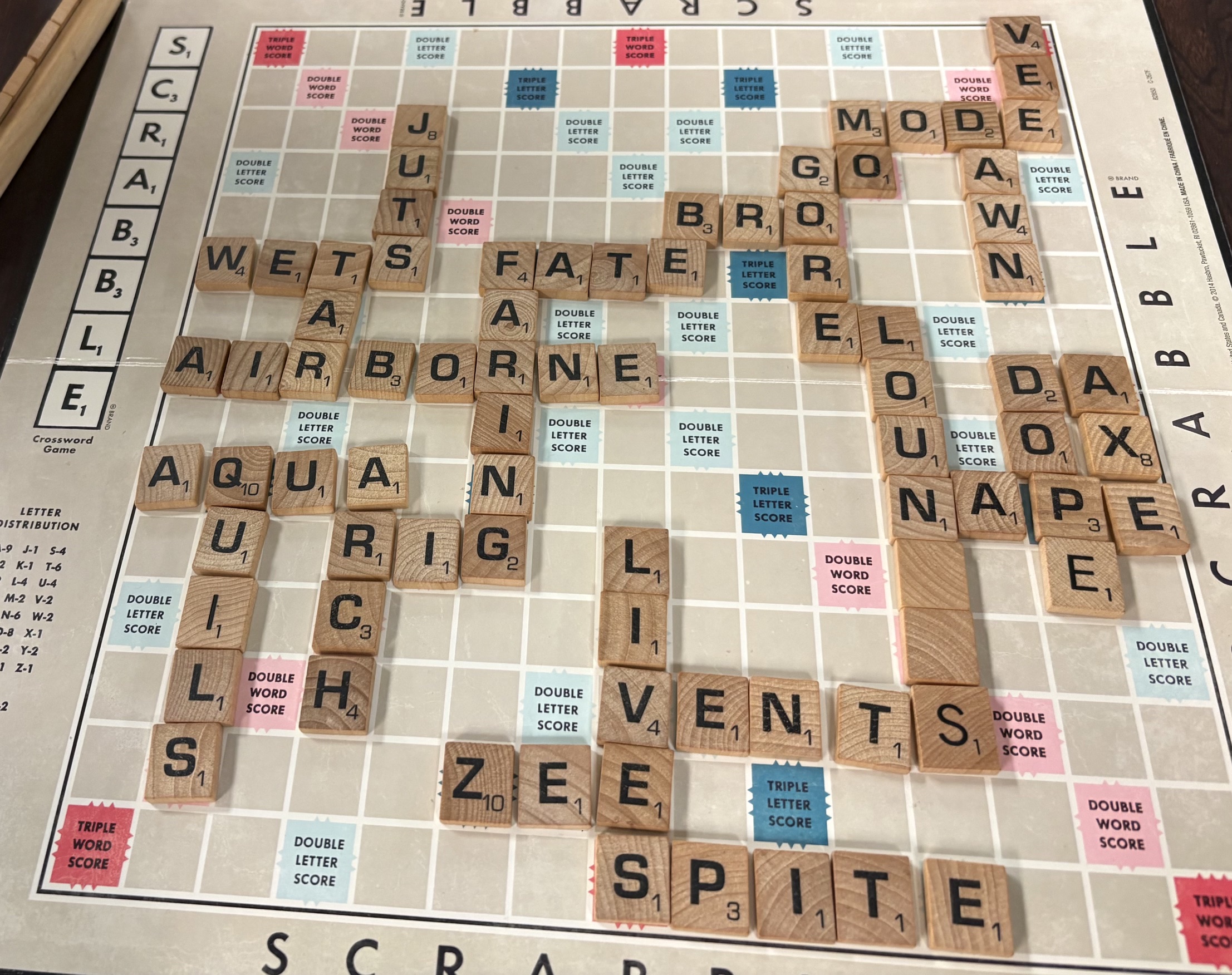
In their next play, the first team, which had drawn an s, was able to score a double-triple play with lives and spite for a total of forty-eight points. That means that the second team’s decision to play live for eight points netted the first team eighty points, ten times the points the second team scored with live.
Note that the last of the five pictures above is from the actual game played on September 4. I staged the previous four pictures to take you through some of the steps that led to live and its consequences. But the story doesn’t end there. Look back at the letters l, i, and e and ask yourself how the second team could have played those same three letters but scored a triple-word play.
By playing the e above the v and the i and l below it, the second team would have scored a twenty-four-point triple-word play, three times their score for live, and they would have prevented their opponents’ eighty-point gain.
The board pictured above includes one unplayable word: a misspelling of quills with one l.
Bonus Assignment
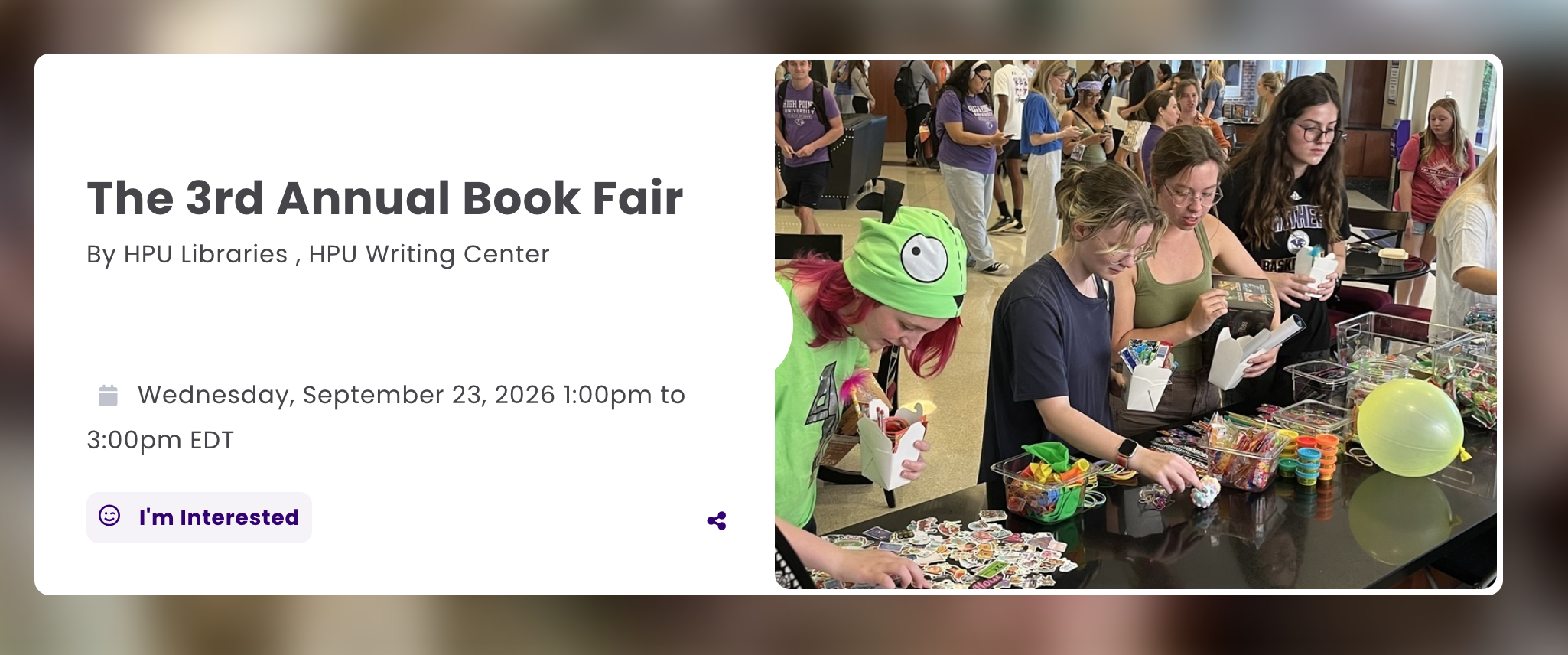
When you were growing up, did you look forward to browsing the shelves at the Scholastic Book Fair? Do you like to play classic video games? Do you like freebies? If you answered yes to one or more of those questions, drop by HPU’s Third Annual Book Fair on Wednesday, September 23, which runs from 1-3 p.m. on the outdoor basketball courts at Slane. In addition to books and video games, there will be zine-making, a food truck, and more.
If you complete the steps below, you will earn a bonus assignment credit.
Directions
Attend HPU’s Book Fair any time between 1 and 3 p.m. on Wednesday, September 23.
Compose a short blog post about the fair (one paragraph, minimum) that includes one or more pictures you took at the fair–it’s a chance to show off your freebies–and an embedded link to a relevant website. Your link may be the official site for an author whose book you received at the fair, or it may be one of the fair’s sponsors: HPU Libraries and the Writing Center.
Edit your post to eliminate errors, such as misspellings and sentence fragments, and publish it.
After you publish your post, notify me by email that it’s viewable on your blog so I can credit you for the assignment. I must receive your email no later than 7:30 a.m. on Friday, September 25.
Enjoy the Book Fair!
Next Up
In class on Wednesday, you will begin drafting your analysis longhand. Tomorrow’s blog post will offer guidance on preparing for your draft work. The post will include the prompts for your group exercise from today, along with your responses. Because the five groups in each class will respond to a different prompt, tomorrow’s class notes will provide you with five points to consider as you determine your topic.
Also, tomorrow’s post will provide you with images of eight covers from early editions of Asimov’s I, Robot. If you are interested in analyzing “Runaround” in conjunction with one or more of the covers, tomorrow’s post will give you eight options to choose from.