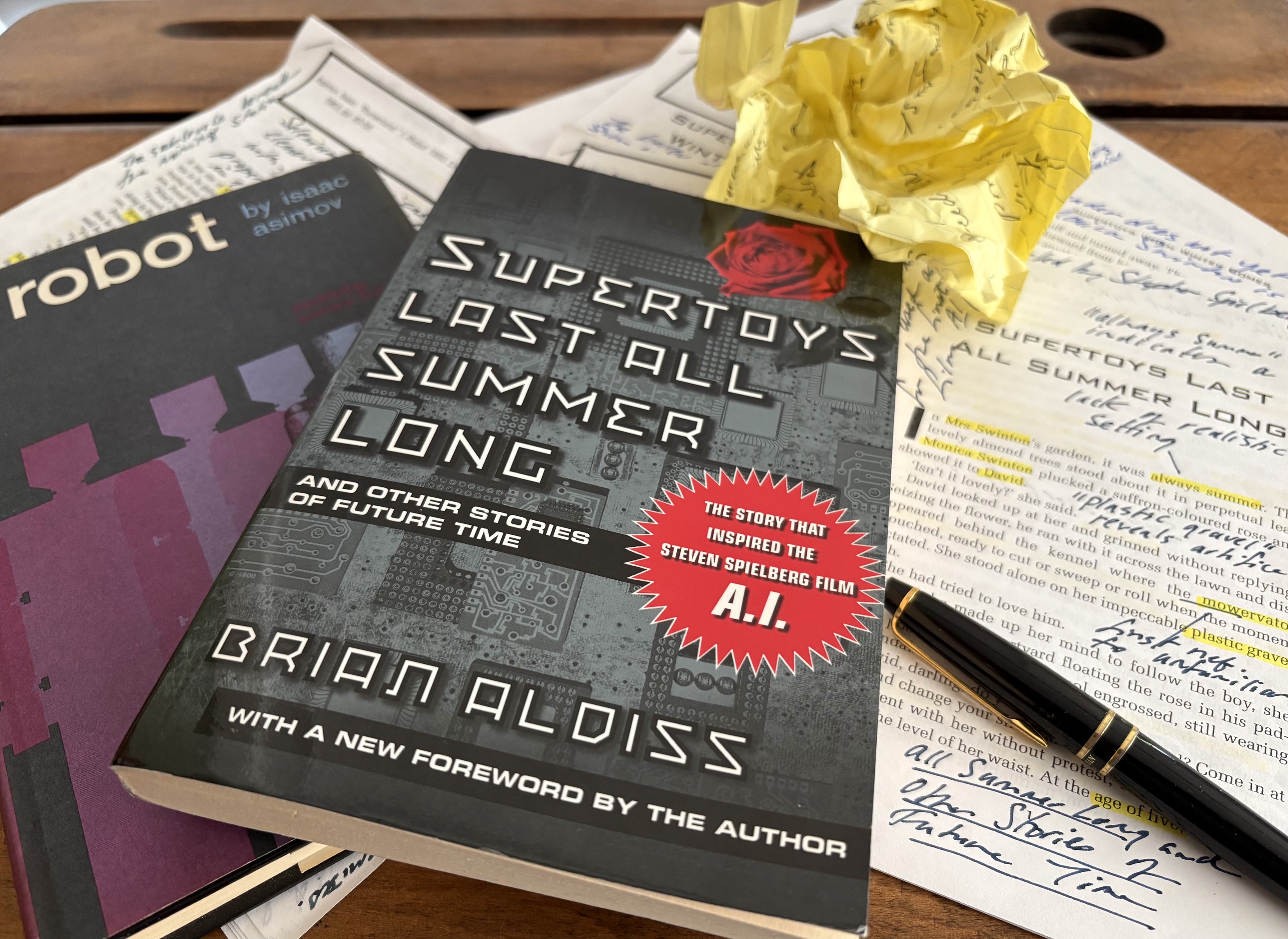
This morning in class, you will compose a reflective essay for your analysis. Directions are included below, and you will receive an additional copy in class.
Directions
Compose a reflective essay that documents the process of planning, drafting, and revising your analysis. Questions to consider in your reflection include the following:
- When you began transferring the words from your handwritten draft onto the screen of your laptop or tablet, what did you observe about the process?
- What aspect of the writing seemed the most challenging? Deciding whether Isaac Asimov’s “Runaround” or one or more of Brian Aldiss’s supertoys stories would serve as your subject? Choosing a prompt? Determining your thesis? Identifying details to support your claims? Organizing the body of the essay? Composing the conclusion? Why did that aspect of the writing seem the most challenging?
- Did the focus of your analysis change? If so, what was your original focus, and what did you change it to?
- Did any of the sample analyses (“One Mississippi,” “The Strange Fruit of Sosnowiec,” “Bots in Shining Armor”) prove helpful to you? If so, which one? How was it helpful?
- What do you consider the strongest element of your analysis?
- At what point in the process did you decide on a title? Did you change the title during the writing process? If so, what was the original title?
- What image that documents part of your writing process away from the screen did you include in your blog post? Why did you choose that image?
- What relevant website did you include an embedded link to in your blog post? Why did you choose that site?
Include a quotation that complies with the requirements outlined in the preparation guidelines in the October 13 class notes. You are not permitted to refer to that blog post or any other online resources while you compose your reflection in class. As part of your reflection planning, you should have taken notes on all the necessary information in that post.
Follow your quotation with an MLA-style parenthetical citation.
Double-space your essay and write in dark ink, preferably black. You are welcome to use both sides of the page.
At the end of the essay, include the header work cited, followed by a work cited entry for the story you quote.
Staple your assignment handout on top of your reflection, and submit it at the end of class.
Upcoming Class Readings
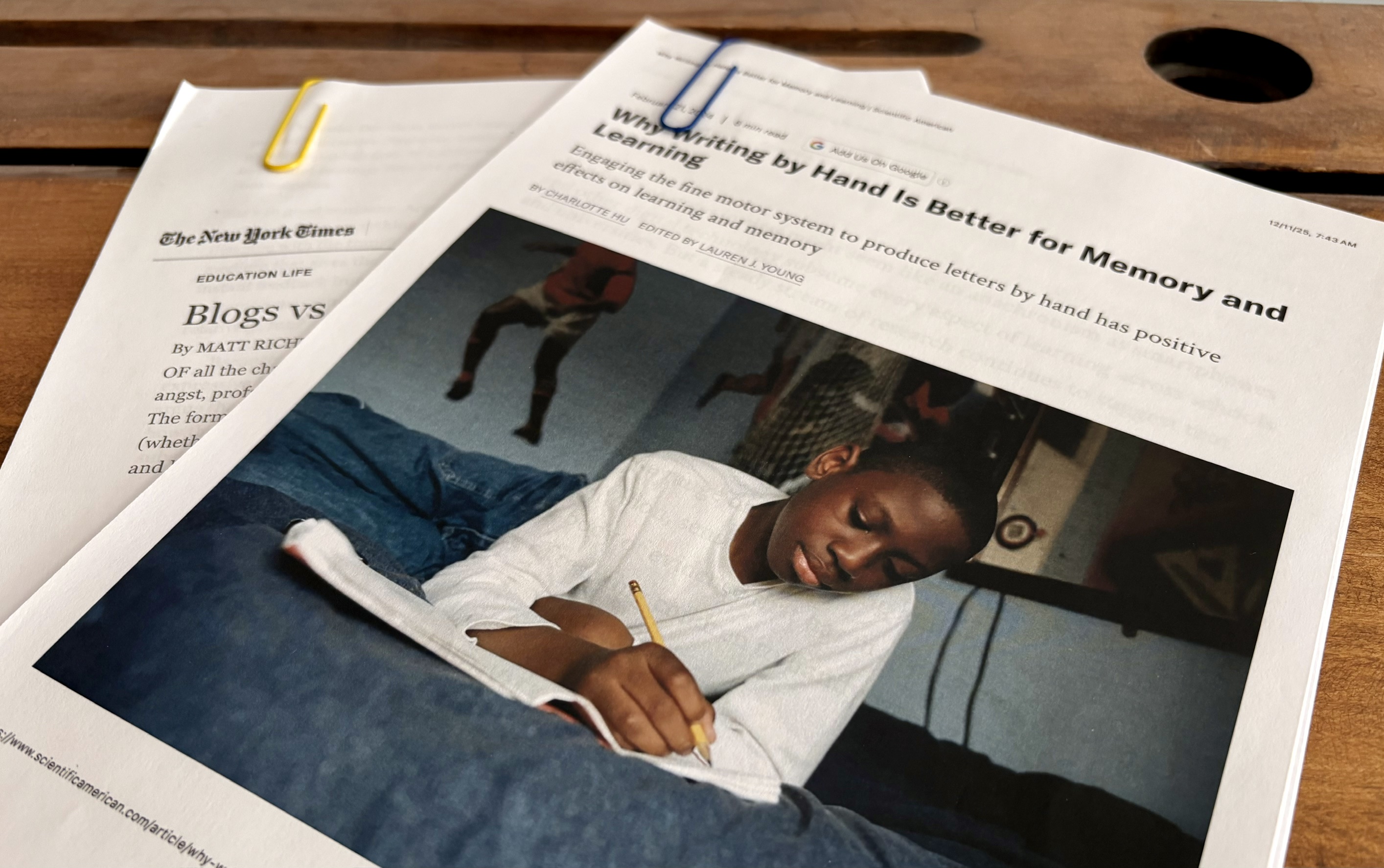
In the second half of today’s class, you will receive copies of the articles pictured above: “Blogs vs. Term Papers” by Matt Richtel and “Why Writing by Hand is Better for Memory and Learning” by Charlotte Hu, which you should read and annotate for next Monday, October 19. If you are absent from class or misplace your copies, download and print them from Blackboard.
Next Up
Wordplay Day! To prepare for class, revisit the Merriam-Webster Scrabble Word Finder page, and review your journal notes and the blog posts devoted to Scrabble tips.


