Today’s class notes serve as the posting site for the peer response assignment due on Friday, October 23. Review the directions carefully, along with the other notes that follow.
Analysis Peer Response Assignment
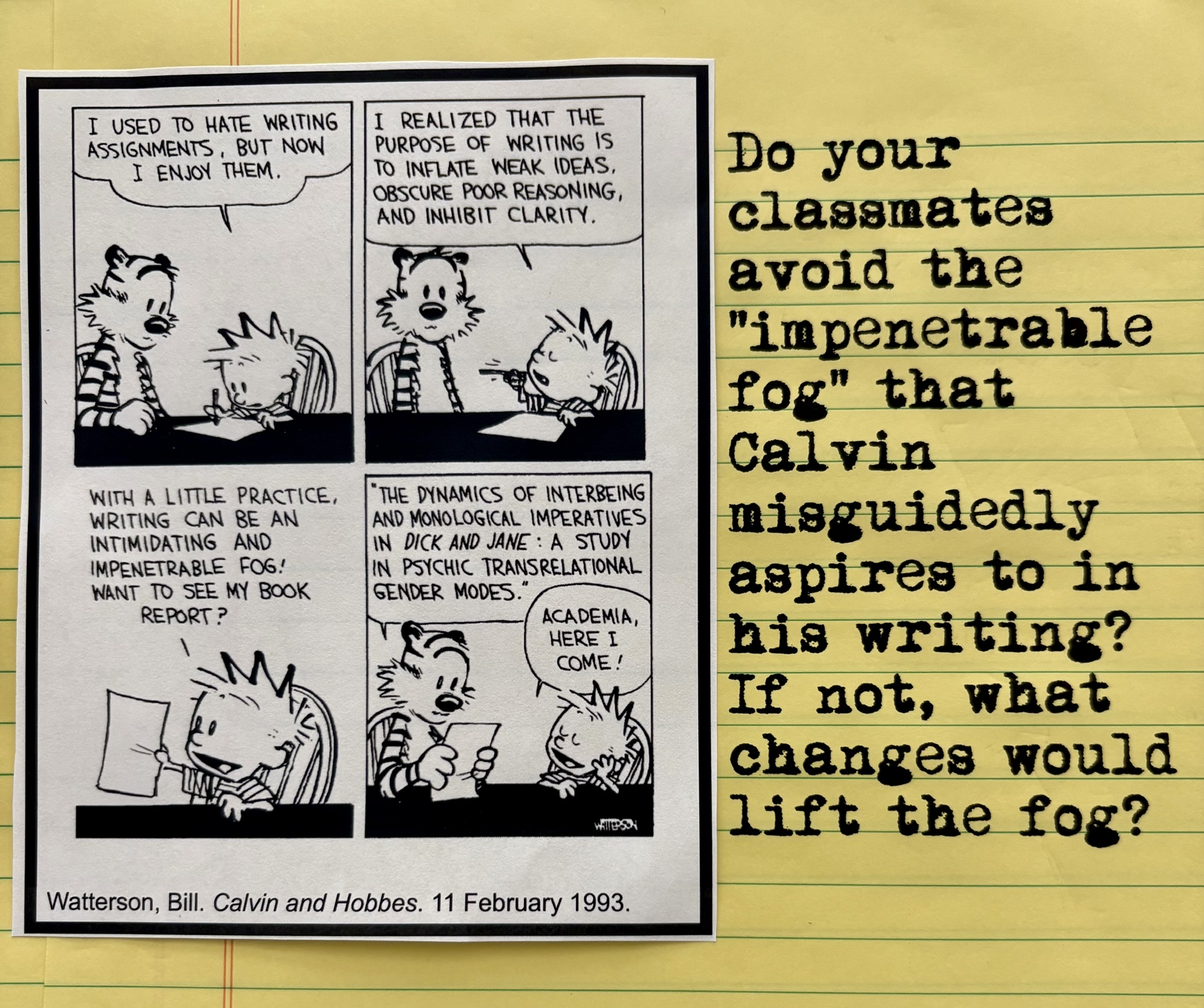
Directions
- After tomorrow’s hard deadline for the analysis, at 10:40 a.m., go to the class page, and click on the link for the blog of the classmate whose name precedes yours. If you are first on the list, go to the blog of the student whose name is last. Note the difference between this step and the first step of the blog response assignment for the literacy narrative. For that assignment, your designated classmate’s name followed yours; for this assignment, it precedes it.
- If your designated classmate’s blog is not linked to the page, or his or her analysis is not published, choose another classmate’s blog.
- Read the classmate’s analysis.
- Compose a one- or two-paragraph response (75 words, minimum) that includes both the classmate’s name and the title of his or her analysis. In your comment, address one or more of these elements: the title, the introduction, the thesis, textual evidence, the conclusion, the image documenting part of the writing process away from the screen, the embedded link to a relevant website.
- Recommended (not required): Draft your comment longhand in your journal.
- Type your response as a comment. You should see a leave comment/reply option at the top or bottom of the post. If you do not see that option, click the title of the post and scroll down. You should then see leave comment/reply.
- Before you click leave comment/reply, copy your comment (on a PC, copy with control + c; on a Mac, copy with command + c).
- After you submit your comment on your classmate’s analysis, return to this blog post, and paste your comment as a reply (on a PC, paste with control + v; on a Mac, paste with command + v). This step is critical because your classmate may not approve your comment, which means it will not be visible on his or her blog. To receive credit for the assignment, you must post your duplicate comment as a reply to this post, “ENG 1103: Analysis Peer Response.” To submit your comment, click the title of the post, then scroll down to the bottom. There you will see the image of an airmail envelope with a box for your comment. Type your comment in the box and click Comment. Post your comment by 7:30 a.m. on Friday, October 23. I will make your comments visible after the deadline.
You are not required to read other classmates’ analyses, but I encourage you to browse their blogs and read the posts that pique your interest.
Upcoming Readings
At the beginning of tomorow’s class, you will receive copies of two additional articles that focus on aspects of the course. Can you guess which ones? Read and annotate both for next Monday, October 19, along with the two distributed yesterday. If you are absent from class or misplace your copies, download and print them from Blackboard.
Next Up
Wordplay Day! To prepare for class, revisit the Merriam-Webster Scrabble Word Finder page, and review your journal notes and the blog posts devoted to Scrabble tips.
Coming Soon
In class on Monday, you will receive your group oral presentation assignment, which will focus on one of the articles distributed in class this week or on the first chapter of Ted Chiang‘s “The Life Cycle of Software Objects” in Exhalation (62-74). After I offer an overview of the assignment and distribute copies of the directions, you will have class time to devote to planning and practice. Since you don’t know which reading will be the subject of your group’s presentation, be sure to complete all five. That will ensure your class time can focus on actual preparations (rather than your initial reading of the text).


Ariana, I enjoyed reading your analysis essay “Seasons of Change.” I agreed with many of the points you make about technology having just as many harmful effects going into the future as positive ones you mention in your conclusion. While reading Aldiss’s short story trilogy I also gathered that humans are becoming dependent on technology and letting it take over their lives. I like that your image includes your first draft with notes on it because it shows where you started and how far your analysis has come. Overall, your analysis was very thorough and taught me a lot about the potential future of technology in the world we live in.
Madison, I really enjoyed reading your analysis, “More Than a Machine.” I thought that you explained very well how David struggles with wanting to feel loved and accepted even though many people just view him as a machine. Another element I really liked in your analysis is how you incorporated the quote where Henry talks about selling David and Teddy; this quote really supports your thesis and how easily they can be replaced. Your thesis was clear, and I like how each paragraph ended by connecting back to David’s struggle with his identity. Overall, I thought your analysis was thoughtful and easy to follow.
Madi Stone’s Limits of Artificial Love
Your title was a great segway into your argument that Monica’s disconnection with David is due to her not liking robots. It really gives the reader a strong idea as to what you are writing about before reading the paper itself. I love how you analyzed the quote in the final body paragraph by drawing attention to David’s childish actions, and his use of the word “Mummy”. The quote really helped add to your argument of how Monica’s hesitancy in the relationship is very one-sided.
I may be wrong, but I think it is important to note that David and Teddy lived in the Swinton household long before Monica got pregnant or had a miscarriage. And, I would refrain from making claims of what Monica wants or who she is if there is not a quote or paraphrase you can use to support that claim.
Baylee Shatten: What Does It Really Mean To Be Real?
Hi Baylee! I think your essay does a good job explaining David’s emotions and how his desire for love makes him seem human. He so badly wanted to be accepted by Monica and give her the love he yearned for. Your title is important because it should capture the main idea of your essay! It questions the contrast between David’s thinking and Monica’s actions. Did she treat him like he was real? Could have that been why he acted the way he did. You clearly depicted David questioning his reality and feeling lonely through your quotes and reasoning! Overall, your essay provides a strong analysis of what David and Monica’s relationship was and how real it was. I really enjoyed reading your analysis!
Leslie Arreola, your analysis, Limits of technology, of Isaac Asimov’s “Runaround” does a good job explaining how conflicting rules can cause problems for robots. I especially liked how you used the quote about Speedy moving in circles around the selenium pool because it supports your main idea and helps the reader understand why Speedy cannot complete his mission. Your introduction also gives a clear summary of the story and explains what your analysis will focus on. I think your conclusion is effective because you connect the story’s message to technology that people use in everyday life. One suggestion would be to add more details about how Powell and Donovan solve the problem to make your analysis even stronger.
Title: When Emotions Override the Code
Mackenzie Mossa,
I really liked how you explained the difference between David and Speedy because even though they are both robots, they struggle with completely different things. One thing that stood out to me was how David’s emotions caused him to act in ways that could potentially hurt others. I think it is interesting how humans create robots to make life easier, but giving them humanlike emotions could actually make things more complicated. It makes me wonder if making robots more human is really a good thing.
I really enjoyed reading your analysis, “A Living Desire,” Kai Jarvis! I think your title was a really good choice because it connects to David’s desire to be seen as a real human. I also liked how you explained how David’s feelings changed throughout all three stories instead of just focusing on one. I thought the evidence you used about David and Teddy calling Monica “Mommy” was really interesting because it shows how much David wants to feel loved and accepted. I also liked how you explained that by the final story, David no longer just wants to be real, but actually believes he is. Overall, I think you did a really good job explaining your ideas and connecting them back to your main point!
Nicole, I really enjoyed reading your analysis! You did a great job summarizing all three short stories and providing readers and insight into what you would be discussing. Your analysis is organized very well and I like how each paragraph shows the progression of David’s wonder. I also really like the quotations that you chose to use and you explained each one very well. Your closing paragraph does a nice job explaining your main idea. Overall, this was very well written and enjoyable to read!
Parker, I really liked your analysis of Super Toys Last All Summer Long because you explained David’s emotions and his struggle to understand what makes someone human. Your introduction was interesting because you explained how the author hides the fact that David is a robot until the end, which makes readers look at the story differently. I also liked how you included quotes from the stories to support your ideas, especially when David questions whether he is human. Your explanation of the roses and changing seasons was also interesting because it showed how symbols can represent David’s changing understanding of reality.
Overall, I think your conclusion does a good job of connecting all three stories and showing how David’s love, loneliness, and grief make readers question what it means to be human. I also think you did a great job explaining the deeper meaning behind David’s experiences and connecting his emotions to the overall message of the trilogy.
Grace, I really enjoyed reading “The Three Laws of Robotics!” I was really able to understand your analysis, as it was strong and clear, and this allowed me to better understand what the three laws actually were, as this was something that confused me previously. I also liked how you showed the connection between these laws and the effect they have on the human life living on Mercury. Additionally, I felt that your analysis and the points you made throughout your essay were aligned with and really supported your thesis.
Mariah, your thesis in your analysis Artificial Love, gave a great insight into how humans emotional connection with artificial intelligence gets complicated. The examples given of David desiring love shows the genuine emotions David has but doesn’t receive due to him being artificial intelligence. Overall, I thought your analysis was informative on the readings you decided to choose from. Your thesis provided the topic of your analysis, and the rest of the paper related back tot the thesis extremely well.
Hello Bridgett Murphy, while reading “A Product or a Person” I enjoyed reading your analysis of Brian Aldiss’s “Supertoys”. Your discussion of David’s struggle to understand whether he is real was interesting, I also liked how you used quotes from the stories to show his emotions and desire to be loved. I thought your title connected well to the main idea of the essay because David is constantly questioning his identity and purpose. The examples you added helped explain how David’s experiences make readers question what it truly means to be human. When you discussed David’s reaction when he discovers that he is just another product in the factory it also tied back to the title and helped my understanding.Your conclusion of bringing the main ideas together makes the reader question the qualities of a product and a person. Overall your analysis was great and held great understanding.
Zack, I enjoyed reading your analysis, “Serving Humanity”. I felt that the introduction was strong and captured my attention. The title was also great because it gave me insight into your whole piece of writing. The quotes were well supported and fit the analysis as a whole. The image was a great addition because it showed your writing process. The conclusion was also strong; it tied everything together while restating the original thesis. I thoroughly enjoyed reading your analysis.
Zach, I thoroughly enjoyed your essay as a whole about robots serving humanity and the problems that Speedy faced with problem-solving. The quotes that you used were very relevant and well placed in your analysis. I liked how you were able to also use textual evidence to back up your quotes, and by using that, I was able to better understand your analysis. I also thought that your title fit perfectly with the analysis and is going to be able to catch many readers’ attention and hook them into reading your analysis.
I enjoyed reading your analysis.
Vivian, your analysis, “More than Machines,” of Brian Aldiss’s Supertoys series does a great job showing how complicated Monica’s feelings are towards artificial intelligence. Your thesis is clear and concise, supported by relevant evidence, especially in the close reading of the word “only” in “you’re only a little android yourself!” I also enjoyed your conclusion connecting Monica’s complex emotions to a larger idea of how the more AI resembles humans, the harder it is to view robots as only machines and not some other form of life. Overall, your argument is well structured, organized, and eye-opening toward Monica’s side of the story.
Sebastian,
Your analysis, “Conflicts in Laws within ‘Runaround'”, presents a strong and clear argument about how designed rules can conflict with each other. Your title fits the analysis well since it tells a reader the main focus of the analysis before they start reading it. Your textual evidence is able to back this up. The quote, “Rule 3 drives him back and Rule 2 drives him forward” explains how the Laws conflict with each other in “Runaround”. Your conclusion is able to tie all of your textual evidence together by showing that following the rules won’t always ensure safety for both the robots and humans and could conflict with each other.
Devyn, your analysis shows an insightful exploration of the relationship between technology and humanity in Brian Aldiss’s story “Supertoys Last All Summer Long.” I like how you explain that David tries so hard to make Monica happy, but she does not always reciprocate the same affection. Your use of textual evidence helps support your argument and shows how David and Monica both struggle with loneliness in their different ways. I also agree with your conclusion that relying too much on technology can make human relationships feel less genuine. Your analysis does an amazing job showing how technology can provide that companionship but cannot completely replace the real human connection.
Ryder- Your Blog post, “Programmed to Fail” was very captivating and conveyed a good message and overall analysis about how both Isaac Asimov’s Runaround and Brian Aldiss’s Supertoys When Winter Comes. Tying the two stories together strengthens your thesis when talking about the weaknesses of the Three Laws of Robotics. When you were talking about both robots within the stories, it allowed the reader to gain a better understanding of why there should be different laws or adjustments to them because of the ways that Speedy and David were acting. I also thought that your conclusion was perfect in order to close the analysis tying your original claim about how laws can fail or overlap, and how emotions can take over. Overall, a really great analysis of the two stories!