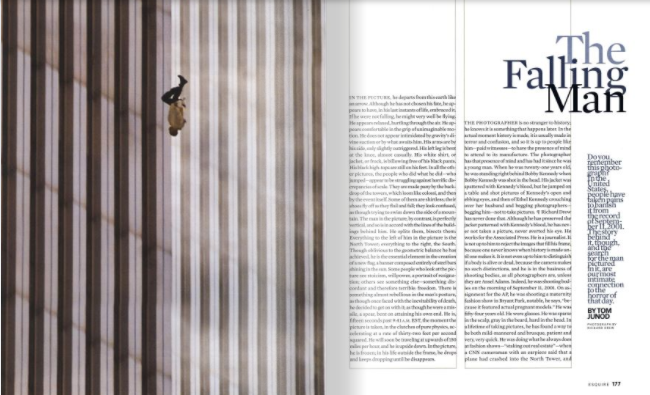
Yesterday in class, before you began composing your reflection, we examined the beginning of Tom Junod‘s article “The Falling Man,” published in Esquire magazine two years after 9-11. One of the elements that we considered–and one that I asked you to address later in your journal–is the unusually long first paragraph.
The authors of Writing Analytically recommend that “[i]f you find a paragraph growing longer than half a page–particularly if it is your opening or second paragraph–find a place to make a paragraph break” (Rosenwasser and Stephen 308). Junod does not follow that advice. He opts instead to open his article with a paragraph of more than four hundred words.
If Junod had chosen to divide the first paragraph, where might he have divided it?
Junod might have started a second paragraph with the words “[i]n all the other pictures,” because there he shifts the focus from the Falling Man to the photographs of other people who jumped from the Twin Towers. An opportunity for a third paragraph comes with the words “[t]he man in the picture, by contrast,” where Junod turns his attention back to the Falling Man. And he might have begun a fourth paragraph with “[s]ome people who look at the picture,” because there he shifts to viewers’ perceptions of the Falling Man.
Generally, one hundred to one hundred and fifty words is a suitable paragraph length. As a rule, you should begin a new paragraph whenyou present a new idea or point. If you have an extended idea that spans multiple paragraphs, each new point within that idea should have its own paragraph. But the first paragraph of “The Falling Man” defies convention. For Junod, choosing not to divide the first paragraph creates an unbroken movement that parallels the unbroken downward flight of his subject, the Falling Man. Outside of the photograph, “he drops and keeps dropping until he disappears.” With “disappears,” the last word of the paragraph,” the Falling Man disappears from the page, and Tom Junod turns to the photographer, whom we learn later in the essay is Richard Drew.
Unless you subscribe to Esquire, the magazine’s paywall will deny you access to the full text of “The Falling Man”; but if you’re interested in reading it in full, you can access it through the HPU Library site by following these steps:
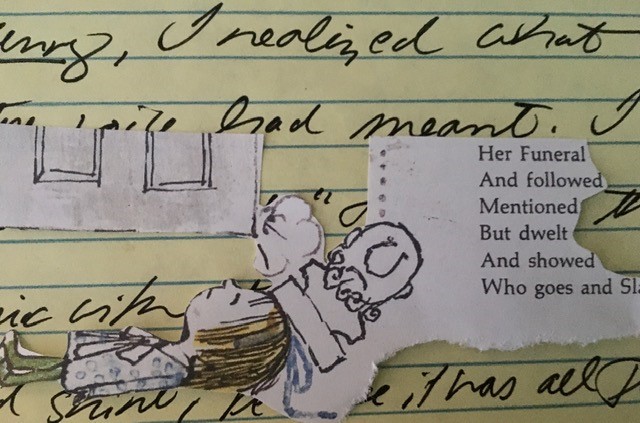
Hillaire Belloc’s “Rebecca,” illustrated by Alice and Martin Provensen
Today in class, we will examine the model literacy narrative “A Bridge to Words,” which you read for today, and you and two or three of your classmates will collaboratively compose a piece of writing that addresses these elements of the essay:
Appositives
Scene
Figurative language
Gaps in memory/what the narrator doesn’t know
The story’s significance, how the writer conveys it subtly
As you continue to revise, consider the role of those elements your own literacy narrative. All of them may not figure in your own story, but scene, at least a brief one, and a sense of the story’s significance are vital. Keep in mind that the story’s significance should be conveyed subtly. Do not tell the reader that the the event was significant, and don’t resort to such trite statements as it made me the person I am today.
A Bridge to Words
To a small child, the pages of a newspaper are enormous. Looking far back through the years, I see myself, not yet school age, trying to hold up those long, thin sheets of newsprint, only to find myself draped in them, as if covered by a shroud. Of course, back then, my inability to hold a newspaper properly was of little consequence. Even if I could have turned the pages as gracefully as my parents did, I couldn’t decipher the black marks on the page; thus, my family’s ritual reading of the newspaper separated them from me. As the youngest and the only one who couldn’t read, I was left alone on the perimeter to observe. My family’s world of written words was impenetrable; I could only look over their shoulders and try to imagine the places where all those black marks on the page had carried them—these people, my kin, who had clearly forgotten that I was in the room.
My sister, who was three years older, had her very own news source: The Mini Page, a four-page miniature paper that arrived at our house as an insert in the Sunday edition. While our parents sat in their easy chairs poring over the state and local news, my sister, Jo, perched at the drop-front desk and occupied herself with articles, puzzles, and connect-the-dots.
Finally, one Sunday, someone noticed me on the margin and led me into our family’s reading circle. Whether it was one of my parents or my sister, I don’t know. I remember only the gesture and the words: someone handing me the Sunday comics and saying, “You can read part of the funny pages, too. You can read Henry.”
I took the giant page and laid it flat in the middle of the oval, braided rug on the floor of the den. Once I situated the page, I lay on top of it with my eyes just inches above the panels of the comic strip. To my parents, my prone position was a source of amusement, but for me it was simply a practical solution. How else was someone so small supposed to manage such a large piece of paper?
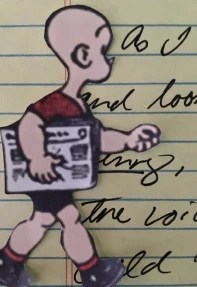
As I lay on the floor and looked at the comic strip’s panels, I realized what the voice had meant. I could “read” Henry, the comic with the bald boy in a red shirt, because it consisted entirely of pictures. In between panels of Henry walking, there were panels of him standing still, scratching his hairless head. I didn’t find Henry funny at all. I wondered how that pale forerunner of Charlie Brown had earned a prime spot in the funnies. Still, I was glad he was there. He was the bridge that led me to the written word.
Reading the wordless comic strip Henry for the first time was the beginning of a years-long habit of stretching out on the floor with newspapers and large books—not thick ones but ones that were tall and wide, among them one of my childhood favorites: The Golden Book of Fun and Nonsense. My sister and I spent hours lying on our bedroom floor, the pink shag carpet tickling our legs as we delighted in the antics of Rebecca, the mischievous title character of one of the poems.
Carl Thomas Anderson’s comic strip character Henry
“Rebecca”—which my sister read to me before I could read it myself—introduced me to the word “abhors,” the very sound of which appealed to me. Sometimes before Jo had finished reading the opening lines, my uncontrollable giggles collided with her perfect mock-serious delivery. As the last word in the first line, “abhors” serves as a lead-in to an enjambment: the continuation of a sentence or clause in a line break. It would be years before I learned the term “enjambment,” but I was immediately swept away by its effect in the opening lines: “A trick that everyone abhors/ In Little Girls is Slamming Doors” (Belloc 61). The first line lured me into the second one, and so on and so on. I was drawn both to the individual word “abhors”—with its side-by-side “b” and “h,” rare in English—and the way the words joined, like links in a chain, to yank me giggling through Rebecca’s cautionary tale:
It happened that a marble bust Of Abraham was standing just Above the door this little lamb Had carefully prepared to slam, And down it came! It knocked her flat! It laid her out! She looked like that.
Her funeral sermon (which was long And followed by a sacred song) Mentioned her virtues, it is true, But dwelt upon her vices too, And showed the dreadful end of one Who goes and slams the door for fun. (61)
Why these particular early memories visit me now, I don’t know. Perhaps rereading Art Spiegelman’s graphic memoir Maus with my students has roused the wordless Henry and the word-filled Golden Book of Fun and Nonsense from the corner of my brain where they’ve slumbered. The former wakes and stretches out in my mind as a bridge to the latter: a spot in the world of words I’ve inhabited ever since.
In the second half of today’s class, I will take you through the steps posting your literacy narrative to Blackboard and WordPress. If you are absent from class or need a review, watch these YouTube videos on submitting an assignment to Blackboard and publishing a post on WordPress.
Contractions: Are They or aren’t They Permissible?
It isn’t surprising that contractions, such as “couldn’t” for “could not,” appear in “A Bridge to Words” because it’s a personal narrative with a conversational voice. But sometimes students are uncertain whether they should use contractions in traditional academic assignments, ones of a more formal nature, such as the other major writing assignments you will produce for English 1103.
Sometimes students are told that they can’t cannot use contractions in formal writing, but MLA style does permit their use. The MLA Style Center notes, “there is nothing inherently incorrect about contractions.” But the website goes on to state that in some contexts and for reasons of clarity, avoiding contractions may be preferable. In your writing assignments for English 1103, use contractions sparingly. Your literacy narratives are an exception to that rule because of their personal nature.
Some professors may prohibit the use of contractions in writing assignments. If you’re uncertain whether a professor permits them, ask.
Rosenwasser, David and Jill Stephen. Writing Analytically, 9th edition. Wadsworth/Cengage, 2024.
Writing Analytically
For Wednesday, read “On Keeping a Writer’s Notebook” (157-58) and “Writing from Life: The Personal Essay” (161-64). Those sections of the textbook serve as companion pieces to your writing thus far in English 1103, and reading and taking notes on those sections will prepare you to compose part of the reflective essay you will write in class on Wednesday.
After you have read and taken notes on “On Keeping a Writer’s Notebook” and “Writing from Life: The Personal Essay,” choose a phrase, clause, or sentence relevant to your writing process and draft in your journal a short passage that connects that quotation to your writing. That passage will serve as part of your reflection. Here are the instructions that will be included on the handout that I distribute on Wednesday:
Directions
Include in your reflection a minimum of one relevant quotation from the textbook, Writing Analytically, from the section “On Keeping a Writer’s Notebook” or from “Writing from Life: The Personal Essay.” Introduce your quotation with a signal phrase and follow it with a parenthetical citation.
Remember that the writing that follows the quotation should demonstrate its relevance. Although you are required to include a quotation, its presence in your writing shouldn’t seem obligatory. In other words, the quotation shouldn’t appear to be there simply because you were required to include it.
Example
When I began planning my literacy narrative, I was skeptical of the assertion that “the more you write, the more you’ll find yourself noticing, and thus the more you’ll have to say” (Rosenwasser and Stephen 157). However, as I wrote in my notebook about the difficulty of holding a page of newspaper when I was a preschooler, I once again saw how those long, thin sheets of newsprint would drape over me. Then I saw my parents holding their pages of newspaper with ease, and I was back in the den with them—where I was more than fifty years ago—marveling at their ability to read.
A variation on the previous option is integrating a quotation that serves as an epigraph in Writing Analytically. If you quote an epigraph, which is a quote at the beginning of a book or book section, intended to suggest its theme, you are presenting an indirect quotation.
Example
In The Situation and the Story, memoirist Vivian Gornick observes: “What happened to the writer is not what matters; what matters is the large sense that the writer is able to make of what happened” (qtd. in Rosenwasser and Stephen). That notion of what matters became apparent to me as I drafted the conclusion of my essay. The story itself is not dramatic but the bridge it delineates—the one that connects my preliterate self to my reading self—signifies a vital crossing point in my life.
The words that I quote are Vivian Gornick’s, but the source is the textbook Writing Analytically. That is why the parenthetical citation begins with qtd. in, to indicate that the words are quoted in David Rosenwasser and Jill Stephen’s book.
At the end of your reflective writing, you will include a work cited entry for the section of the textbook that you quoted. See the samples below.
Sample Works Cited Entries
Rosenwasser, David and Jill Stephen. “On Keeping a Writer’s Notebook.” Writing Analytically, 9th edition. Wadsworth/Cengage, 2024. pp. 157-58.
Rosenwasser, David and Jill Stephen. “Writing from Life: The Personal Essay.” Writing Analytically, 9th edition. Wadsworth/Cengage, 2024. pp. 161-65.
Next Up
In class on Wednesday, you will compose a short reflective essay focusing on the process of planning, drafting, and revising your literacy narrative. If you are still in the process of completing your essay on Wednesday (since you have until Friday morning’s hard deadline to post it) your reflection will address your work in progress.
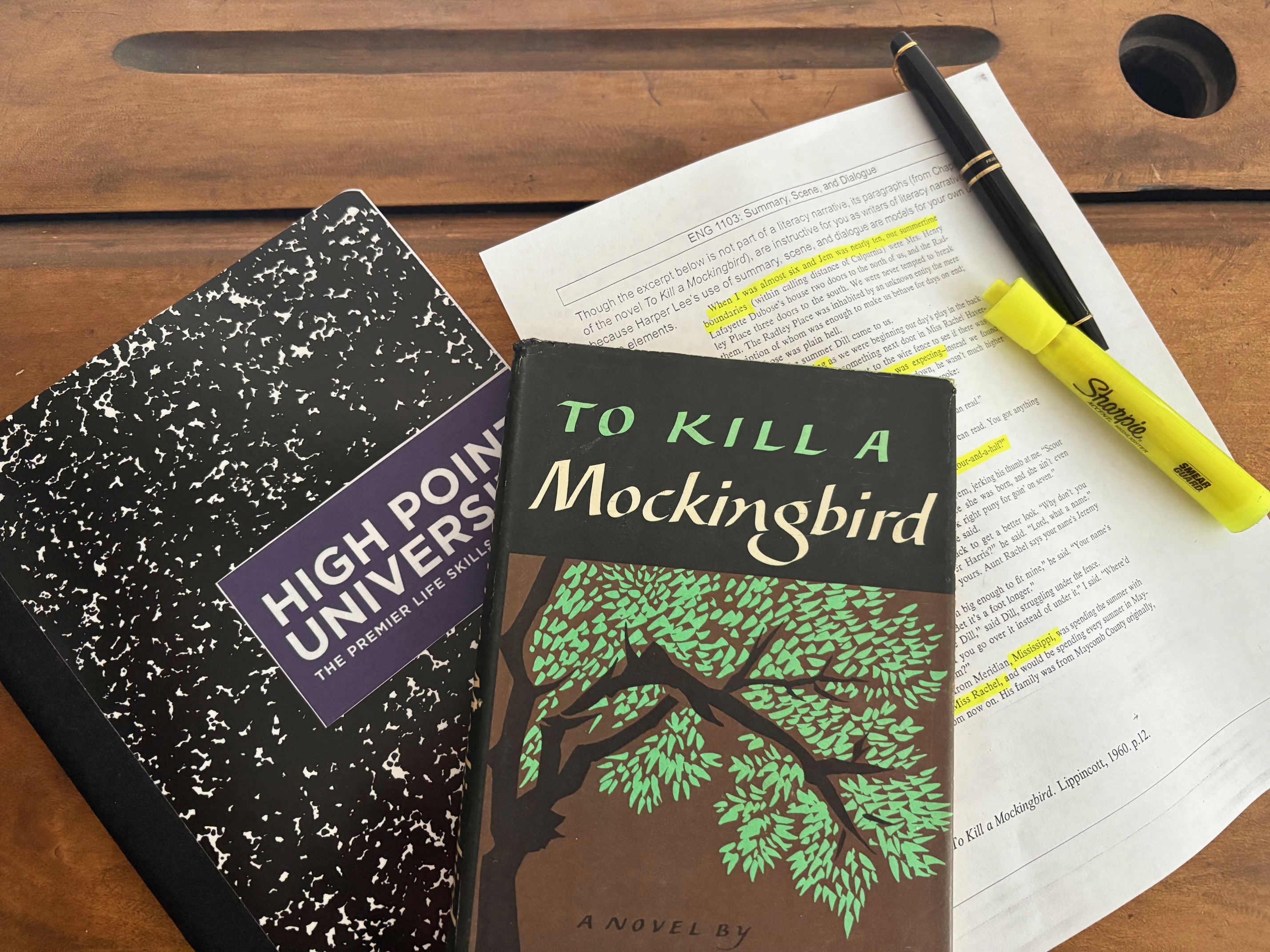
Yesterday before you you began your revision work, we examined a page (pictured above) from Harper Lee’s novel To Kill a Mockingbird. That page from the first chapter serves as a valuable model for three narrative elements: summary, scene, and dialogue–at least two of which will figure in your literacy narrative.
The first paragraph of the passage summarizes the characters’ circumstances, designating the “summertime boundaries” (12) within which the narrator, Jean Louise, “Scout,” Finch, and her older brother, Jem, may play outdoors. The short one-sentence paragraph that follows continues the summary, informing readers that the summer Scout has just summarized is the one in which Dill (Charles Baker Harris) first visits Maycomb, Alabama.
With the first words of the next paragraph, “[e]arly one morning,” Scout shifts from summary to scene (12). All of the remaining paragraphs except the final one continue the scene with dialogue. Scout returns to summary with the words “Dill was from Meridian” (12).
Note that Harper Lee begins a new paragraph whenever the speaker changes. Also note that every line of dialogue does not include a dialogue tag, such as “he said” or “she said.” If a passage of dialogue includes only two speakers, none of the paragraphs require dialogue tags after the speakers’ first lines because the start of a new paragraph signals to the reader that the other person is speaking. If a dialogue includes three or more speakers–such as Scout’s conversation with Jem and Dill–occasional tags are essential.
Lessons in Punctuation
The excerpt from To Kill a Mockingbird also demonstrates how to use a variety of punctuation marks, including em dashes, hyphens, and commas.
Harper Lee uses em dashes to set off “Miss Rachel’s rat terrier was expecting” (12) from the rest of the sentence because it is nonessential. It adds details, but the sentence can function without them. An em dash is used before and after phrases that are nonessential. Note that there is no space before or after the dash, which is made with two strikes of the hyphen key.
Jem asks if Dill is “four-and-a-half”? Hyphens appear between those words because multiple-word numbers are hyphenated.
Near the end of the excerpt, “Mississippi” and “Miss Rachel” (12) are both set off by commas because those details are nonessential. Commas are used to set off single words and short phrases of nonessentials the way that em dashes are used to set off longer units of words.
Work Cited
Lee, Harper. To Kill a Mockingbird. Lippincott, 1960. p. 12.
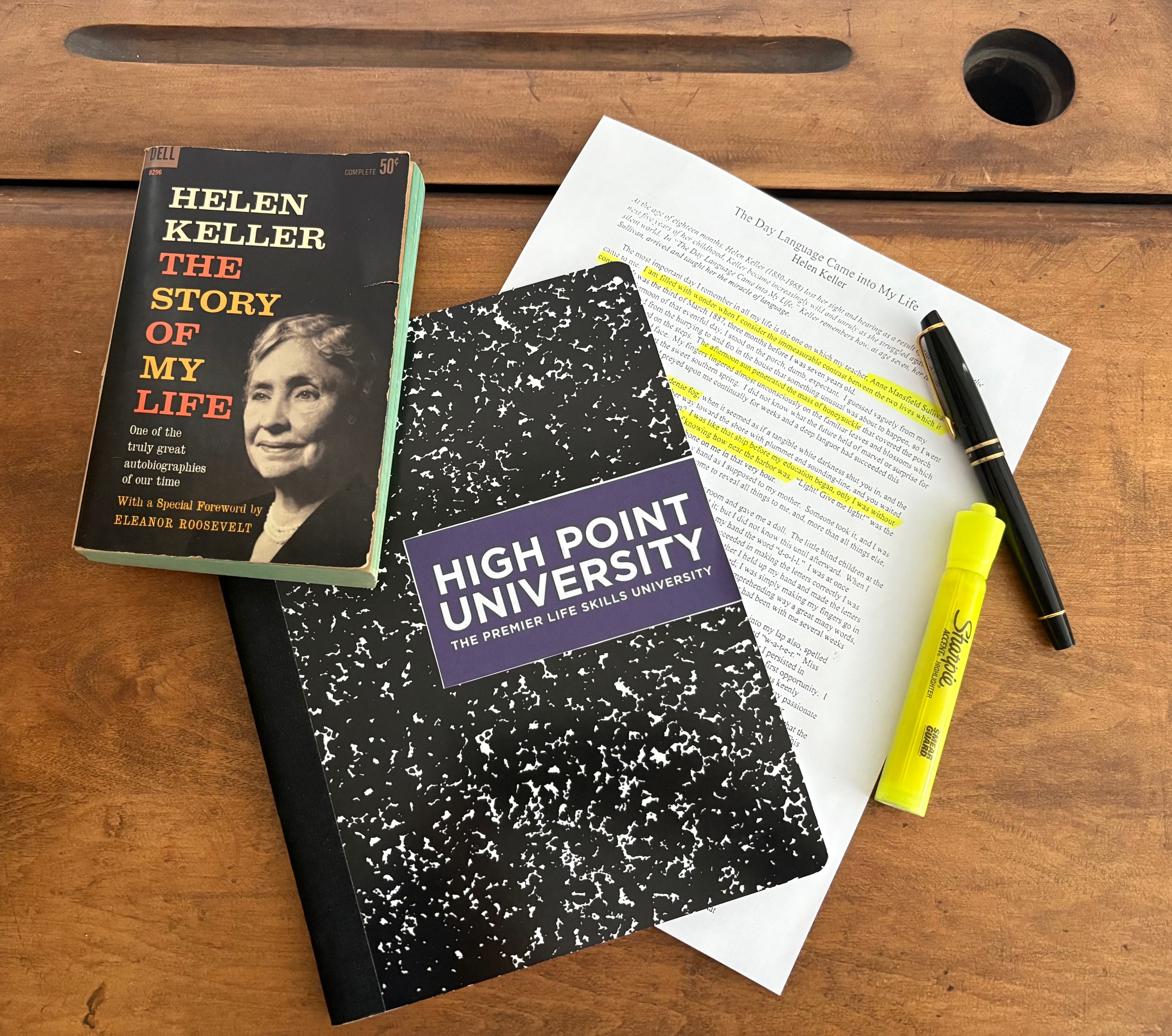
Yesterday morning, after your quiz and Scrabble debriefing, we examined “The Day Language Came into My Life,” the fourth chapter of Helen Keller’s autobiography, The Story of My Life. The details of her literacy narrative that we considered include these:
Keller draws on her sense of touch to render her world to us because she cannot see or hear. She writes of the warmth of the sun “on her upturned face” (par. 2) as she depicts herself waiting for the arrival of her teacher, Anne Mansfield Sullivan. Aim to use relevant sensory details in your own literacy narrative.
In the conclusion of her chapter, Keller writes, “I learned a great many words that day. I do not remember what they all were; but I do know that mother, father, sister, teacher were among them” (par. 9). In writing those words, Keller makes both what she doesn’t remember and what does remember part of her story. You may not remember all of the details of a memory from your childhood, but the details you do remember will render your narrative more vividly. And if there’s something you don’t remember, that uncertainty–as Keller demonstrates–can be on the page, too.
She spells out the words that her teacher spells for her by forming each letter one at a time in Keller’s hand. If you are writing about learning to spell words, let the reader see that on the page as Keller lets her reader see: “‘w-a-t-e-r’ is water” (par. 6).
In “Me Talk Pretty One Day,” David Sedaris does not spell out the French words he is learning to speak, but he does include nonsense words, such as “meimslsxp” (167), to convey his lack of understanding. If you are writing about learning a second language, consider following Sedaris’ lead and using nonsense words–not his but ones of your own making–to convey your initial confusion. Also, try including one or more words of the language itself. Remember that words you write that are not English words–nonsense words included–are italicized.
Work Cited
Keller, Helen. “The Day Language Came Into My Life.” https://janelucasdotcom. files.wordpress.com/2025/08/a0461-3.thedaylanguagecameintomylife_keller.pdf.
Sedaris, David. “Me Talk Pretty One Day.” Me Talk Pretty One Day. Little Brown, 2000. pp. 166-73.
A Pair of Samples
As you prepare to revise your own literacy narrative, review the two samples that we examined in class. While the first, “Creativity is Key,” is admirable for its conversational voice, it lacks the structure and development it needs. It is not a story, it does not meet the minumum length requirement, and it is marred by errors of punctuation, mechanics, and style.
The second sample, “Giving a Speech: Worst Nightmare to Best Feeling” is a much better effort. The essay is a narrative, not simply a series of sentences, and the writer gracefully shifts from summary to scene. Note that a significant portion of the story is presented through scenes with diaogue.
The second part of the title, “Worst Nightmare to Best Feeling,” is an appositive, which is a phrase that offers additional information about the word or phrase that precedes it. Appositives are effective ways to develop your writing. You are welcome to include one in the title of your literacy narrative, but don’t fashion one that tells the reader too much. Your title should offer a window into your essay, but it should not be a spoiler.
Pop Quiz
Rather than listing the answers to the questions on yesterday’s quiz, I have followed each question below with a note regarding where to find the answer. By finding the answers yourself, you will learn more than you would from simply reading them in a list.
In “The Day Language Came into My Life,” Helen Keller recounts what happened on that day, three months before she turned seven. Name one detail from that day. See your copy of “The Day Language Came into My Life.”
What is the style used for formatting files and documenting sources in papers for courses in English and many other courses in the humanities (philosophy, classics, religious studies, art history, and foreign languages)? See the August 29 class notes.
The class notes “ENG 1103: Matters of Style” includes details about formatting papers in the style you will use for English 1103. Name one of those details. See the August 29 class notes.
What is the topic of the most recent blog post devoted to Scrabble? Note that Scrabble is the subject, not the topic. The topic is something more specific. See the August 28 class notes.
What have you learned about writing from the Writing Notes handout distributed on August 20 or from the annotations on your introductory reflection or on one of your group exercises? Briefly note the rule or guideline. See your Writing Notes handout, your introductory reflection, and your group exercises.
Your quiz also included a bonus opportunity. Possible answers for that bonus are found in the class notes for August 21, August 22, and August 28.
Next Up
Tomorrow you will continue work on your own literacy narratives. At the beginning of class, I will return your rough drafts with my notes, and you will have the remainder of the class period to revise on your laptops. You will have an additional week to continue revising before posting your literacy narrative to Blackboard and to your WordPress blog. The due date is Wednesday, September 10 (before class); the hard deadline is Friday, September 12 (before class).
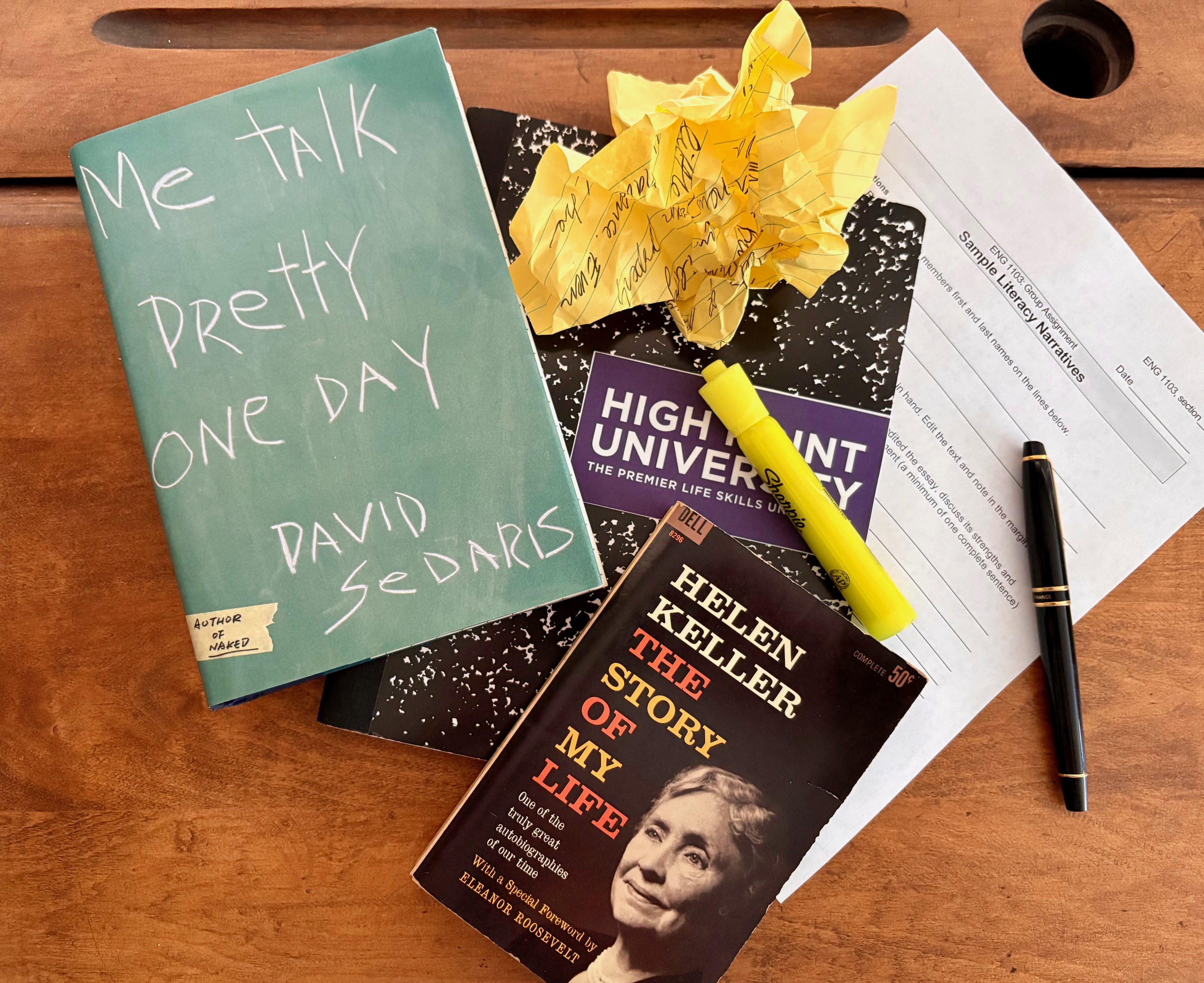
Together, Sedaris‘ essay and Keller’s chapter demonstrate two vastly different ways to present a literacy narrative. “Me Talk Pretty One Day” offers a quirky look at the challenges of learning French from a sarcastic, soul-crushing instructor. Keller’s story poignantly recounts learning to make meaning through the sign language of her teacher, Annie Sullivan, learning that certain finger positions mean “water” for those who cannot hear it, and for others, like her, who can neither see nor hear it.
Sample Student Essays
After we study Keller’s chapter, will examine two literacy narratives written in a previous semester. After you read and annotate the essays, you and two or three of your classmates will collaboratively compose a short assessment of each narrative.
In each assessement, consider whether the essay focuses on one of the following options for topics:
A memory of a reading or writing assignment that you recall vividly
Someone who helped you learn to read or write
A writing-related school event that you found humorous or embarrassing
A particular type of writing that you found (or still find) especially difficult or challenging
A memento that represents an important moment in your development as a reader or writer
Also determine whether each essay fulfills the requirements listed below.
A well-told story
Vivid detail
Some indication of the narrative’s significance
A minimum of 600 words
A title that offers a window into the essay
After you have composed your assessment, you will review the grade criteria and assign a letter grade to each narrative.
Literacy Narrative Grade Criteria
An A literacy narrative complies with all assignment guidelines: It presents a well-told story, includes vivid details, and conveys the story’s significance in a way that demonstrates a depth of understanding. An A literacy narrative is also well organized and relatively free of surface errors.
A B literacy narrative complies with all assignment guidelines but may convey the significance of the story in a superficial way, may have issues with organization, or may be flawed by surface errors.
A C literacy narrative complies with most but not all assignment guidelines and may be flawed by issues of organization and/or surface errors.
A D literacy narrative complies with only a few of the assignment guidelines and may also be flawed by issues of organization and/or surface errors.
An F literacy narrative fails to comply with most or all assignment guidelines and may also be flawed by substantial issues of organization and/or surface errors.
Next Up
On Wednesday you will continue work on your own literacy narratives. At the beginning of class, I will return your rough drafts with my notes, and you will have the remainder of the class period to revise on your laptops. You will have an additional week to continue revising before posting your literacy narrative to Blackboard and to your WordPress blog. The due date is Wednesday, September 10 (before class); the hard deadline is Friday, September 12 (before class).
Today in class, you will begin planning and drafting your first essay assignment, a literacy narrative, which is an account of a learning experience involving reading, writing, or learning to speak a language.
Begin by asking yourself some of these questions: How have you come to think about yourself as a reader or writer? What were some of your most formative experiences as a reader or writer? What are some of the dos and don’ts you have learned about writing? How has what you have learned about reading or writing enhanced your confidence and skill in that role? You don’t need to respond to all of those questions. Try picking one or two as a starting point, then begin bringing one of those experiences to life.
Your aim is to recreate your experience on the page and then to reflect on its significance. Your focus may be any one of the following:
a memory of a reading or writing assignment that you recall vividly
someone who helped you learn to read or write
a writing-related school event that you found humorous or embarrassing
a particular type of writing that you found (or still find) especially difficult or challenging
a memento that represents an important moment in your development as a reader or writer
learning to speak a second langauage
Detailed instructions are included in the assignment handout that you will receive in class today. An additional copy of the handout is posted on Blackboard in the essay assignments folder.
One of the aspects of David Sedaris‘ essay that you examined yesterday was his movement from summary to scene and vice versa. The first of those occurs with these words of his teacher’s: “If you have not meimslsxp or lpgpdmurct by this time, then you should not be in this room” (par. 4). Sedaris alternates summary and scene throughout his essay. As you begin planning and drafting your own literacy narrative tomorrow in class–and as you continue to write–look back at “Me Talk Pretty One Day” and note how Sedaris uses summary and scene as building blocks.
You also identified Sedaris’ use of similes, metaphors, and hyperboles, including these:
David Sedaris employs a simile when he describes himself as “not unlike Pa Kettle trapped backstage at a fashion show” (par. 3).
Sedaris fashions a metaphor with the words “everybody into the language pool, sink or swim” (par. 4).
The essay “Me Talk Pretty One Day” features the hyperbole “front teeth the size of tombstones” (par. 7).
David Sedaris uses a simile when he writes that one classmate’s introduction sounds “like a translation of one of those Playmate of the Month data sheets” (par. 10).
The author of “Me Talk Pretty One Day” turns to hyperbole when writes, “The teacher killed some time accusing the Yugoslavian girl of masterminding a program of genocide” (par. 14).
Sedaris’ teacher insults him with a simile when she remarks, “”Everyday spent with you is like having a cesarean section'” (par. 27).
The bulleted sentences above follow the format that you should follow in your group exercises that require quotations. These are the specific guidelines to remember:
The answer should be a minimum of one sentence. It need not be a long sentence, but it should include concrete detail.
The sentence should not begin with a quotation. Though journalists, fiction writers, and memoirists sometimes begin sentences with quotations, in academic writing, quotations are introduced with signal phrases.
Do not foreground the paragraph or page number in a sentence. The most important feature of the sentence is the writer’s particular use of words. The page or paragraph number follows in the parenthetical citation.
Work Cited
Sedaris, David. “Me Talk Pretty One Day.” Me Talk Pretty One Day. Little Brown, 2000. pp. 166-73.
“What’s in a Name” Follow-Up
Friday’s blog entry offered a bonus assignment credit to any student who posted a response that identified the classmates whose names are also common nouns, which makes them playable Scrabble words.
Kudos to Annaliese Abboud, Cameron Anderson, Haven Tucker, and Bailey Upchurch for correctly identifying playables names.
Below are the complete lists of the students in sections 8 and 18 with playable names. Their playable names appear in boldface type.
Section 8
Gi (a white garment worn in martial arts) Amitrano
Aly Deters (to discourage)
Calla (a tropical plant) Dickey* (a blouse front)
Amanda Franco (a monetary unit of Equatorial Guinea)
Chloe Freeman (a free person)
Raven (a large black bird) Houston
Campbell Nelson (a wrestling hold)
*Calla Dickey is no longer enrolled in section 8; she remains in the list because her first and last names offer opportunities for learning additional playable words.
Section 18
Adrienne and Kamauri Brown (a color created by mixing all three primary colors: red, yellow, and blue)
Grayson Crouch (to stoop)
Garrett Hickey (a scar, especially one caused by a love bite)
Heloise Richer (the comparative form of rich)
Haven (a shelter) Tucker (to tire)
Bailey (an outer castle wall) Upchurch
For their efforts, Annaliese, Cameron, Haven, and Bailey will receive a bonus assignment credit in the short assignments (course work) category
I may offer additional bonus assignments, so be on the lookout for those. Reading all of the notes that I post for you here, on my blog, will ensure that you don’t miss those opportunities.
Next Up
In class tomorrow, you will begin drafting your first major writing assignment longhand. The assignment, a literacy narrative, is an account of a learning experience involving reading, writing, or learning to speak a language. As part of your prewriting process, look back at “Me Talk Pretty One Day” and consider how you might incorporate into your own essay some of the same elements that David Sedaris includes in his.
For the cast and production staff of Stained Glass Playhouse‘s Picnic–meditations on William Inge’s play and the book that Millie reads:
William Inge’s choice to place The Ballad of the SadCafé in the hands of Picnic’s Millie Owens—along with his choosing to write, in the words of Alan Seymour, that it’s “on the reading list at college” (22)—denotes the popularity and stature that Carson McCullers’ novella achieved in a short time. Houghton Mifflin published The Ballad of the Sad Café in 1951; Picnic debuted in 1953. But Inge’s inclusion of McCullers’ novella isn’t simply a nod to a then-recent work. For Inge, Ballad serves as a countermelody, at times complementing his own themes and at times appearing as a reflection of Picnic in a funhouse mirror.
At first glance, the stories seem disparate, just as at first glance Ballad’s Lymon Willis isn’t what he appears to be. When a townsperson spots him in the distance, he says, “‘A calf got loose’” (399). Moments later, someone else says, “‘No, it’s somebody’s young’un.’” But Lymon is neither. As he draws nearer, it becomes clear that he is “a hunchback . . . scarcely more than four feet tall” (399). Though physically, he couldn’t be further from Picnic’s “exceedingly handsome” Hal Carter (7), both Lymon and Hal are the archetypal stranger-come-to-town.
Welcoming the stranger, as Helen Potts does, comes as no surprise. As Flo Owens observes, Helen “takes in every Tom, Dick, and Harry” (11). Conversely, Amelia Evans, the usually stand-offish storekeeper, has never taken in anyone before Lymon shows up and claims her as kin. But the sociability of Lymon—Cousin Lymon as Miss Amelia comes to call him—leads her to transform her store into a nightly café that offers a gathering spot in the spirit of the back porches of Helen and Flo. Yet despite the popularity of Cousin Lymon and the café he inspires, some of the townspeople are scandalized when he takes up residence in Miss Amelia’s rooms above the café:
[A]ccording to Mrs. MacPhail, a warty-nosed old busybody who is continually moving her sticks of furniture from one room to another, according to her and to certain others, these two were living in sin. If they were related, they were only a cross between first and second cousins, and even that could in no way be proved. Now, of course Miss Amelia was a powerful blunderbuss of a person more than six feet tall—and Cousin Lymon was a weakly little hunchback reaching only to her waist. But so much the better for Mrs. Stumpy McPhail and her cronies, for they and their kind glory in conjunctions which are ill-matched and pitiful. (417)
The notions of Mrs. MacPhail and the other gossips in Ballad are the reasons that Picnic’s Rosemary Sydney labels the book “filthy” and says that “Everyone in it is some sort of degenerate” (22). Though the exact nature of Amelia and Lymon’s relationship is never clear, they are judged not only for their apparent transgressions but also for their unconventional appearances—a testament to the belief that good looks, themselves, are a virtue, a tenet that Picnic’s beauty, Madge Owens, calls into question when she asks, “What good is it to be pretty?” (16).
For all of Madge’s and Hal’s natural good looks, it’s clear that what we behold as beauty is also partly artifice. When Hal tells his friend Alan Seymour about his stint in Hollywood, he says, “[Y]ou gotta have a certain kind of teeth or they can’t use you . . . they’d have to pull all my teeth and give me new ones” (26). When Madge delays getting ready for the picnic, Alan prods her, saying, “Go on upstairs and get beautiful for us” (49). Still, unlike, the cross-eyed, six-foot Amelia and the hunchback Lymon, Madge, with or without powder and lipstick, finds the image in the mirror affirming. As she says to her mother, Flo, “It just seems that when I’m looking in the mirror that’s the only way that I can prove to myself that I’m alive” (42). Yet Madge is as much a misfit as McCullers’ oddballs, a truth signified in the image of her as Miss Neewollah published in The Kansas City Star’s Sunday magazine. Due to a printing error, her mouth appears in the middle of her forehead, rendering her grotesque.
That image of Madge with her mouth in the middle of her forehead is like the woman in the Picasso prints that hang over her sister Millie’s bed, a woman that Madge sums up sarcastically as one “with seven eyes. Very Pretty” (23). Millie knows that works of art “don’t have to be pretty” (23), that the woman with her seven eyes speaks a truth that photographic realism doesn’t. Similarly, The Kansas City Star’s unrealistic photograph doesn’t lie. Objectifying Madge distorts her.
Millie vows that after she graduates from college that she’s “going to New York, and . . . write novels that’ll shock people right out of their senses” (87). Some people, like Ballad’s Mrs. McPhail and Picnic’s Rosemary Sydney, may be shocked. Others, ones with Millie’s own sensibility, will read her books and feel the way Millie herself feels when she reads The Ballad of the Sad Café. When Hal asks her what it’s about, she says, “[I]t’s kind of hard to explain, it’s just the way you feel when you read it—kind of warm inside and sad and amused—all at the same time” (53). The same may be said of Picnic. Near the play’s end, before Hal jumps the train, he says to Madge, “I feel like a freak to say this, but—I love you” (85). We all feel like freaks, Hal. We all are freaks, for that matter; and we love, for better or worse—and all at the same time.
Works Cited
Inge, William. Picnic. 1953. Dramatists Play Service Inc., n.d.
McCullers, Carson. “The Ballad of the Sad Café.” 1951. Carson McCullers: The Complete Novels. The Library of America, 2001. pp. 395-458.
Today in class you will compose a final reflective essay that documents your work in the second half of the semester, focusing on what you consider some of your most significant work and the feature or features of the course that have benefited your development as a writer and a student. Since you have already written a reflective essay on your final essay and annotated bibliography, your final reflection should focus on other assignments and features, including one, two, or three of the following:
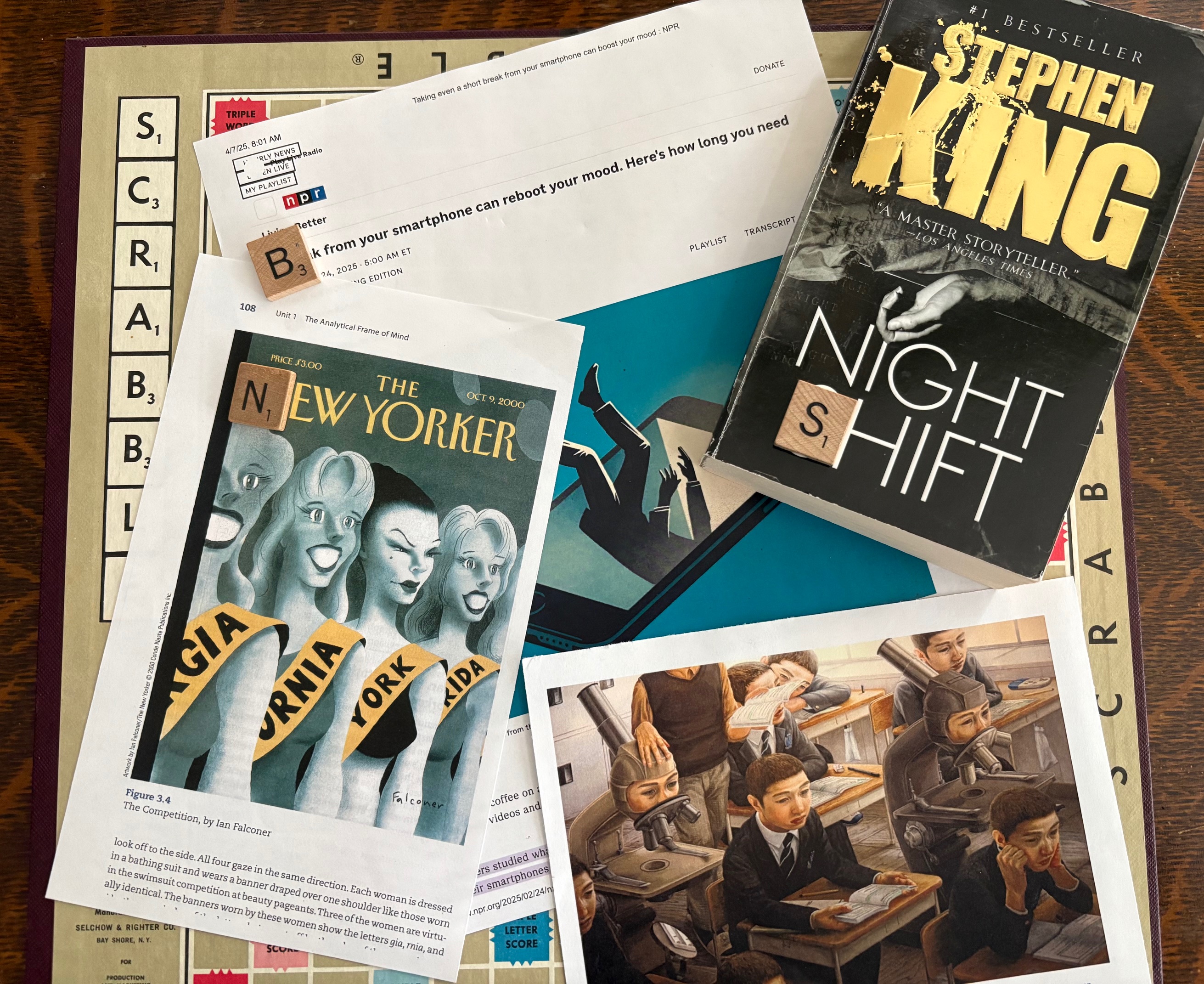
Studying one of the texts we have examined in the second half of the semester, including “The Case for Writing Longhand,” The Competition, “Scrabble is a Lousy Game,” Seedlings, “Skim Reading is the New Normal,” “Strawberry Spring,” or the sample final essay and annotated bibliography (“Scrabble as a Game Changer in the College Classroom”)
Writing for an online audience beyond the classroom/creating and maintaining a WordPress blog
Delivering your group presentation on the first four lessons of the Check, Please! course
Collaborating with your classmates on in-class writing assignments
Playing Scrabble/Collaborating with your teammates on Wordplay Day
Writing longhand
Limiting screen time
Keeping a journal
Focus on one, two, or three assignments or features of the course.
Include in your reflective essay the following elements:
A title that offers a window into your reflection
An opening paragraph that introduces your focus and presents your thesis
Body paragraphs that offer concrete details from your work to support your thesis.
A relevant quotation from Writing Analytically or a relevant quotation from one of the texts that we have studied in the second half of the semester. Introduce your quotation with a signal phrase and follow it with a parenthetical citation. Refer to your citation handout for models.
A conclusion that revisits the thesis without restating it verbatim
An MLA-style works cited entry for your source
Sample MLA Works Cited Entries
Aubrey, Allison. “A Break from Your Smartphone Can Reboot Your Mood: Here’s How Long You Need.” NPR, 24 Fb. 2025. https://www.npr.org/2025/02/24/nx-s1-5304417/smartphone-break-digital-detox-screen-addiction#:~:text=Researchers%20studied%20what%20happened%20when,felt%20better%20after%20the%20break.
Rosenwasser, David and Jill Stephen. “Arriving at an Interpretive Conclusion: Making Choices.” Writing Analytically, 9th edition. Wadsworth/Cengage, 2024. pp.111-12.
—. “Integrating Quotations into Your Paper.” Writing Analytically, 9th edition. Wadsworth/Cengage, 2024. pp. 343-46.
—. “The Idea of the Paragraph.” Writing Analytically, 9th edition. Wadsworth/Cengage, 2024. pp. 307-313.
—. “Two Methods for Conversing with Sources.” Writing Analytically, 9th edition. Wadsworth/Cengage, 2024. p. 325.
—. “Ways to use a Source as a Point of Departure.” Writing Analytically, 9th edition. Wadsworth/Cengage, 2024. p. 326.
Next Up
In class on Wednesday, you will plan and prepare for the individual oral presentation that you will deliver during the exam period, Tuesday, April 29, at 8 a.m. You will receive a copy of the assignment in class, and it will be featured in Wednesday’s blog post.
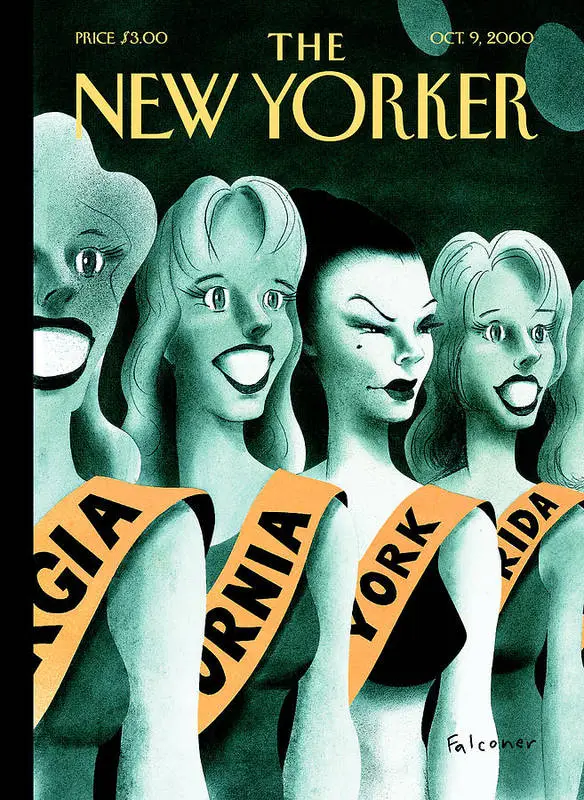
Yesterday in class, after we studied Ian Falconer’s New Yorker cover The Competition, we examined Tetsuya Ishida’s painting Seedlings (1998), and you chose one of those two visual texts as the subject of a writing exercise–a bibliographic entry, followed a paragraph of summary and a second paragraph of commentary–as practice is your ongoing annotation work. My versions of the assignment, which I wrote as samples for you, appear below.
Summary
Tetsuya Ishida’s Seedlings depicts a classroom of uniformed Japanese teenagers, all males, whose teacher, seen only from the shoulders down, holds a textbook in one hand. The teacher drapes his other hand on the head of one of the pupils, one of two students presented as microscopes with human faces.
Commentary
Although the subject at hand is biology, the study of living organisms, the student seedlings barely seem alive themselves as they stare blankly into the distance. The uniformity Ishida depicts with their haircuts, crested blazers, striped neck ties, and rows of desks, takes a surrealistic twist with the images of the two pupils who have transformed into microscopes. By placing the teacher’s hand on one of the students-turned-microscope, Ishida indicates that the instructor—himself objectified by the absence of his head—approves of the metamorphosis, that for him, the goal of education is for the individual to be consumed by the subject itself, becoming merely a cold metallic instrument.
. . . and a Second Look at The Competition
Falconer, Ian. “The Competition.” Writing Analytically by David Rosenwasser and Jill Stephen, 9th edition, Wadsorth/Cengage, 2024. p. 108.
Summary
Ian Falconer’s mostly black-and-white New Yorker cover The Competition depicts four beauty pageant contestants, three of whom stand in stark contrast to Miss New York. Her dark hair, angular body, narrowed eyes, tightly pursed lips, and two-piece bathing suit set her apart from the nearly-identical blondes–Miss Georgia, Miss California, and Miss Florida–with wide-open eyes and mouths and one-piece bathing suits.
Commentary
The self-satisfied expression of Miss New York suggests what the authors of Writing Analytically present as the second of two possible interpretations for The Competition: “[T]he magazine is . . . admitting , yes America, we do think that we’re cooler and more individual than the rest of you, but we also know that we shouldn’t be so smug about it” (Rosenwasser and Stephen 112).
Work Cited
Rosenwasser, David and Jill Stephen. Chapter 3: “Interpretation: Asking So What?” Writing Analytically, 9th edition. Wadsworth/Cengage, 2024. pp. 81-118.
Next Up
In class on Wednesday, you will compose a short essay that reflects on the process of researching, drafting and revising your final essay and annotated bibliography. In it, you will include one relevant quotation from the article that served as a starting point for your project or a relevant quotation from Writing Analytically.


 Jane Lucas