Today in class you read and summarized the September 15 article from The Wall Street Journal’s Facebook Files series. The summary that I wrote along with you appears below.
In The Wall Street Journal article “Facebook Tried to Make its Platform a Healthier Place. It Got Angrier Instead,” investigative reporters Keach Hagey and Jeff Horwitz document the social media company’s changes in its algorithms, adjustments that the company supposedly made to increase meaningful social interaction, or MSI. Although data scientists working for Facebook concluded that “[m]isinformation, toxicity, and violent content are inordinately prevalent among reshares,” the company resisted removing the boost that its algorithms gave to content most likely to be reshared by a long chain of users. In essence, the change had the opposite effect of its apparent aim.
And Moving Beyond Summary
Composing a summary seves as a useful follow-up to reading. Identifying the key points in a piece of writing and presenting them in your own words–and perhaps including a brief quotation–demonstrates that you understand what you’ve read.
When you move beyond summary to analysis, you shift your focus from a description of the subject to a close study of what the text means and how the writer constructs that meaning.
The movement from summary to argument–the move you will make in your final essay–involves a different turn. Rather than focusing on what the text means and how the writer constructs that meaning, you are placing the writer in conversation other credible sources on the subject and finding your own place in the conversation.
Next Up
On Wednesday, October 6, you will submit your completed Check, Please! Worksheet for the fourth lesson in the series. If you misplace your worksheet and cannot print a copy, complete the assignment on a sheet of notebook paper. Be sure to submit it at the beginning of class on Wednesday.
Also, on Wednesday you will receive your draft of your midterm reflection with my notes, and you will have the class period to begin revising your essay.
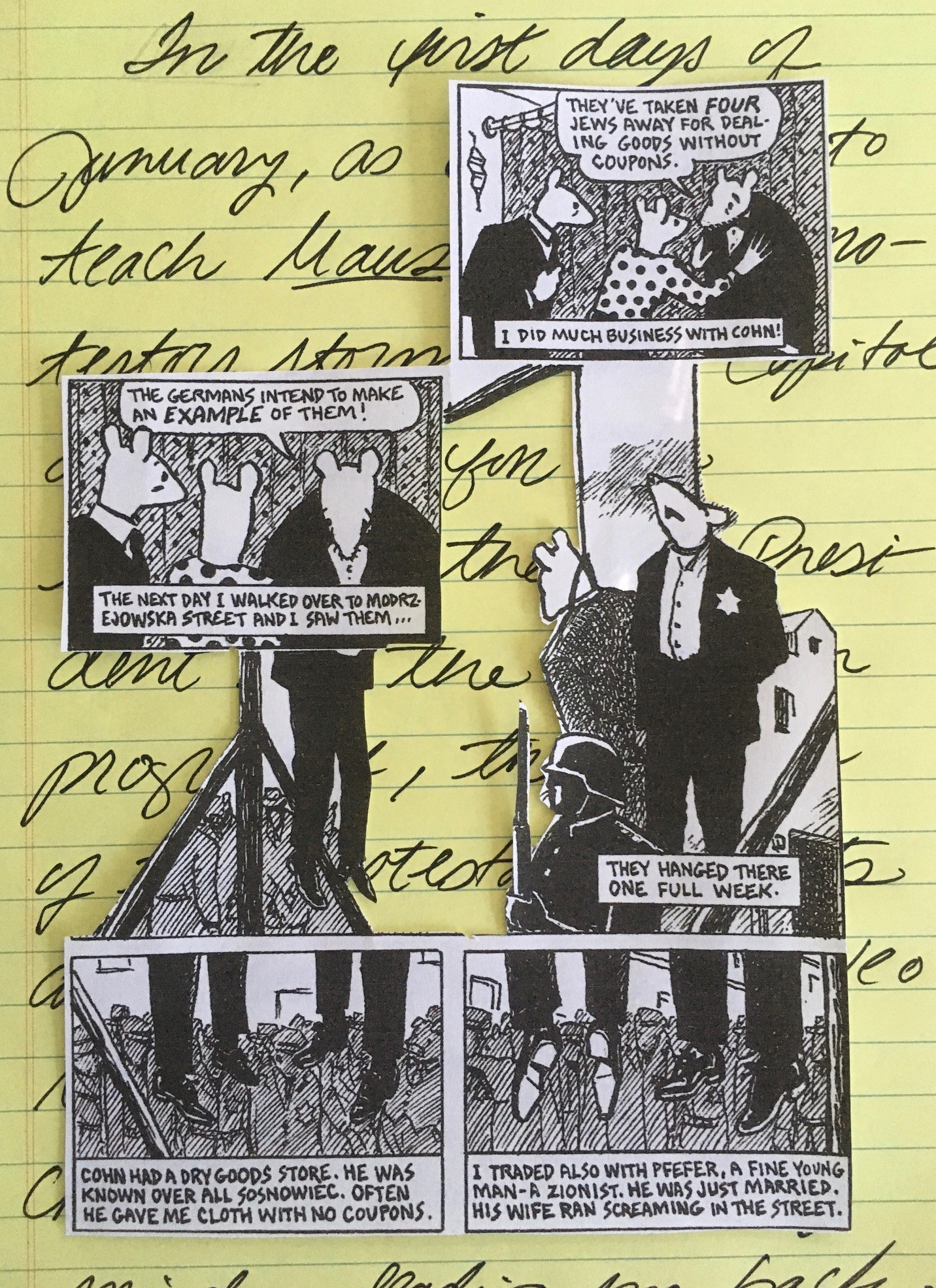
In the first days of January, as I prepared to teach Maus again, protestors stormed the Capitol and called for the hanging of the Vice President. As the semester progressed, the sound of the protestors’ chants and the image of a neo-Nazi T-shirt in the crowd lingered in my mind, leading me back repeatedly to Art Spiegelman’s depiction of the hanged merchants in Modrzejowska Street. Turning again and again to the same page of Maus solidified my decision to devote my analysis—the one I would write as a model for my students—to the panels that depicted the hangings, but I did not know how I would write about them. The prospect daunted me not only because of the painful nature of the images but also because I had written a sample analysis of Maus only a few months earlier as a model for my fall semester students. Perhaps I’ve already written all I can write about Maus, I told myself. But returning to the pages of Spiegelman’s memoir revealed that I did, after all, have more to write. Studying Spiegelman’s depiction of the hangings in Modrzejowska Street and finding the words to express my interpretation of those panels deepened my understanding of both Maus and the writing process.
The central image of the four hanged merchants, the one that evoked images of January 6, remained the panel that drew me back to the page. But as I continued to study it, I found myself drawn less to that panel in isolation than to its relationship to the ones that framed it. My observation that the bordering panels both linked the hanged men to their mourners and disconnected them from their persecutors, the Nazis, led me to my thesis: “His [Spiegelman’s] rendering of the panels of the living in conjunction with the fragmented panels of the hanged merchants simultaneously conveys connection and separation: both the grieving survivors’ ties to the dead and the hanged men’s objectification at the hands of the Nazis.”
That statement served not only as my thesis but also as an example to my students of how to develop an idea with a common form of appositive, a noun phrase that offers additional information. As we examined my analysis in class, I pointed to the abstract concept of “connection and separation” and showed how the appositive, the noun phrase that followed the colon, shows readers the specific “connection and separation,” namely “both the grieving survivors’ ties to the dead and the hanged men’s objectification at the hands of the Nazis.”
That learning opportunity grew from an essay that I had doubted would ever find its way to the page. The fact that it did take form illustrates the surprising rewards that the writing process yields.
This school year, perhaps more than any other, has demonstrated the value of writing as a mechanism for making sense of the world. Studying a Holocaust narrative is never easy. But writing to make meaning of Maus now—as we continue to don our own masks—honors the path that Spiegelman himself followed in his struggle to make meaning of his father’s life, a story that we sense, in the words of journalist Adam Gopnik, “is too horrible to be presented unmasked” (qtd. in Wilner 109).
Though I doubted that I could write a second analysis of Maus, facing the challenge expanded my understanding of Spiegelman’s achievement and strengthened my writing and teaching, providing me with another model essay for my students. As we continue to reckon with racial injustice and cultural and political division in our own country, Vladek Spiegelman’s story serves as a sobering reminder that the atrocities his son depicts in Maus are not relics of another place and time—or, as I wrote in the conclusion of my analysis, that “[t]he strange fruit of our past, both distant and recent, should seem far stranger.” As I began to put these words on paper, Derek Chauvin was convicted for the murder of George Floyd; but as I progressed from draft to revision, Andrew Brown, Jr., was shot and killed by sheriff’s deputies in Elizabeth City. As we continue to pick up the pieces of our broken world, I return to the page with the hope that putting pen to paper will also help my students—not only develop their writing but also make sense of it all—as we move toward renewal.
Wilner, Arlene Fish. “‘Happy, Happy Ever After’: Story and History in Art Spiegelman’s Maus.” Considering Maus: Approaches to Art Spiegelman’s “Survivor’s Tale” of the Holocaust, edited by Deborah R. Geis, U of Alabama P, 2003, pp. 105-21.
For your final essay assignment in English 111, you will compose a reflection that documents your work over the course of the semester focusing on what you consider your most significant work and the feature or features of the course that have contributed most to your development as a writer, a reader, and/or a critical thinker. Features to consider include the following:
Reading Maus
Keeping a journal
Writing for an online audience beyond the classroom/creating and maintaining a WordPress blog
Planning, drafting, and revising your literacy narrative
Planning, drafting, and revising your analysis of Maus
Consulting A Writer’s Reference/Revising with A Writer’s Reference
Writing longhand
Limiting screen time
You are welcome to focus on more than one feature but no more than three.
Include in your reflective essay the following elements:
An opening paragraph that introduces your focus and presents your thesis
Body paragraphs that offer concrete details from your work to support your thesis
Quotations or paraphrases from two relevant and credible sources, introduced with signal phrases and followed by parenthetical citations where needed. One of the two sources may be one of your pieces of writing. Recommended sources include Maus, A Writer’s Reference, and the articles linked to your class notes.
A conclusion that reiterates the thesis without restating it verbatim
If you quote or paraphrase your literacy narrative or your analysis of Maus, cite it as you would any other blog post. See the entries for my blog posts in the sample works cited list below.
Sample Reflective Essay
“Finding a Way Forward,” the reflective essay that I wrote as a model for my students last semester, is posted below and in Moodle.
James, Karin. “What are the Effects of Handwriting on Cognitive Development.” The Cognition and Action Neuroimaging Library, University of Indiana, 2016, https://canlab.sitehost.iu.edu/handwriting.html.
*In the Microsoft Word file or PDF that you post to Moodle, the second line and any subsequent lines of your work cited entries should be indented five spaces or one-half inch.
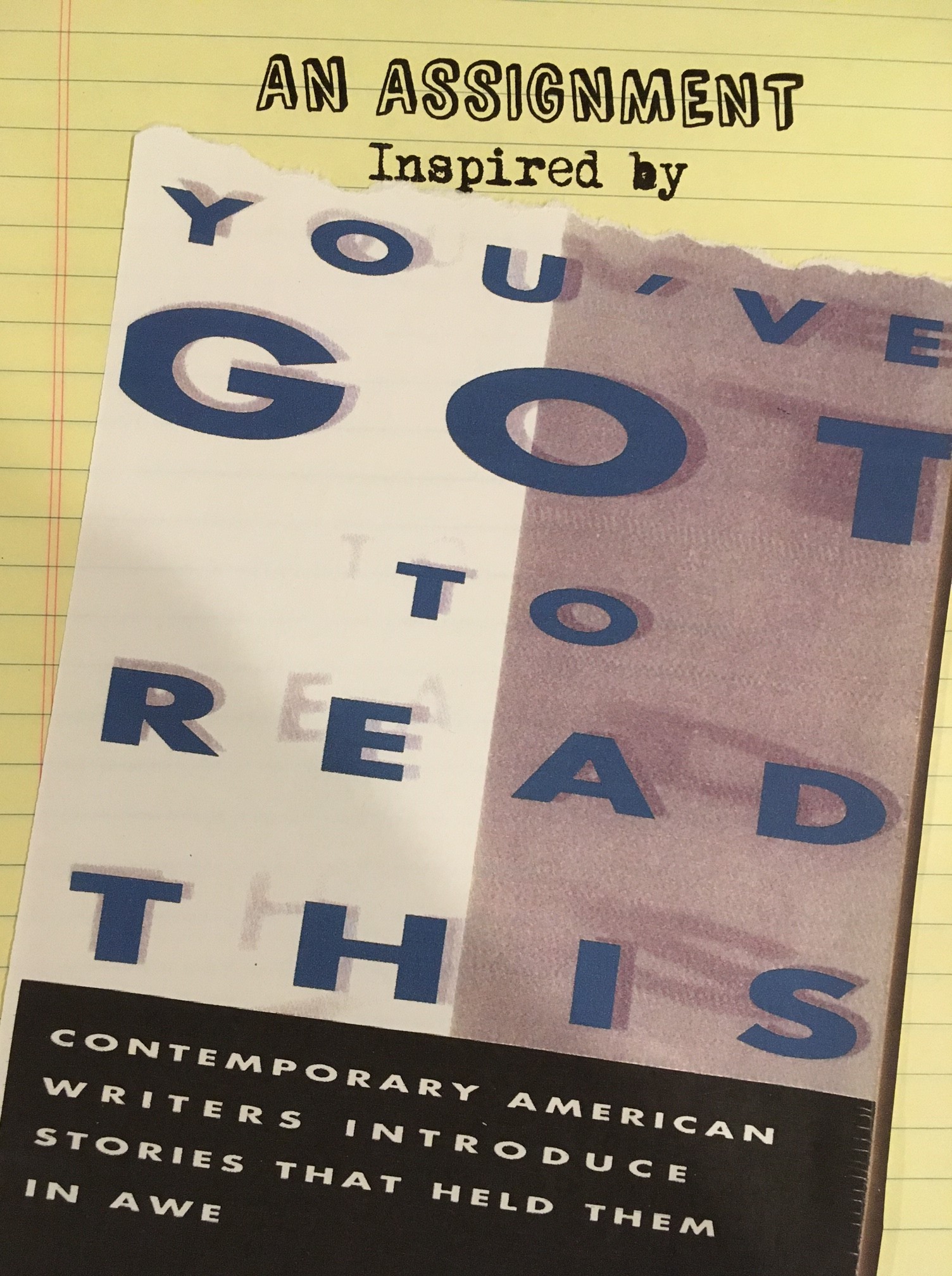
You’ve Got to Read This, edited by Ron Hansen and Jim Shepard, the book that inspired the You’ve Got to . . . Assignment
We will continue our study of Maus and examine more of the You’ve Got to . . . assignments today, but class will be devoted primarily to the questions and comments that you wrote on notecards last week. Monday’s blog post addresses the specific questions you asked about English 111 as well as your questions and comments about writing in general.
You’ve Got to . . . Assignments
Since we may have little time to examine the You’ve Got to . . . assignments today, keep the handout in your pocket portfolio and be sure to bring it to our final class meeting. Between now and then, read the assignments with a pen or pencil in hand and make notes on the text and in the margins.
The last week of class, we will turn back to these ten assignments, and I will distribute a handout with the remaining eleven.
The handout that I will distribute in class today is single-spaced to save paper. I have posted a double-spaced copy below and in Moodle.
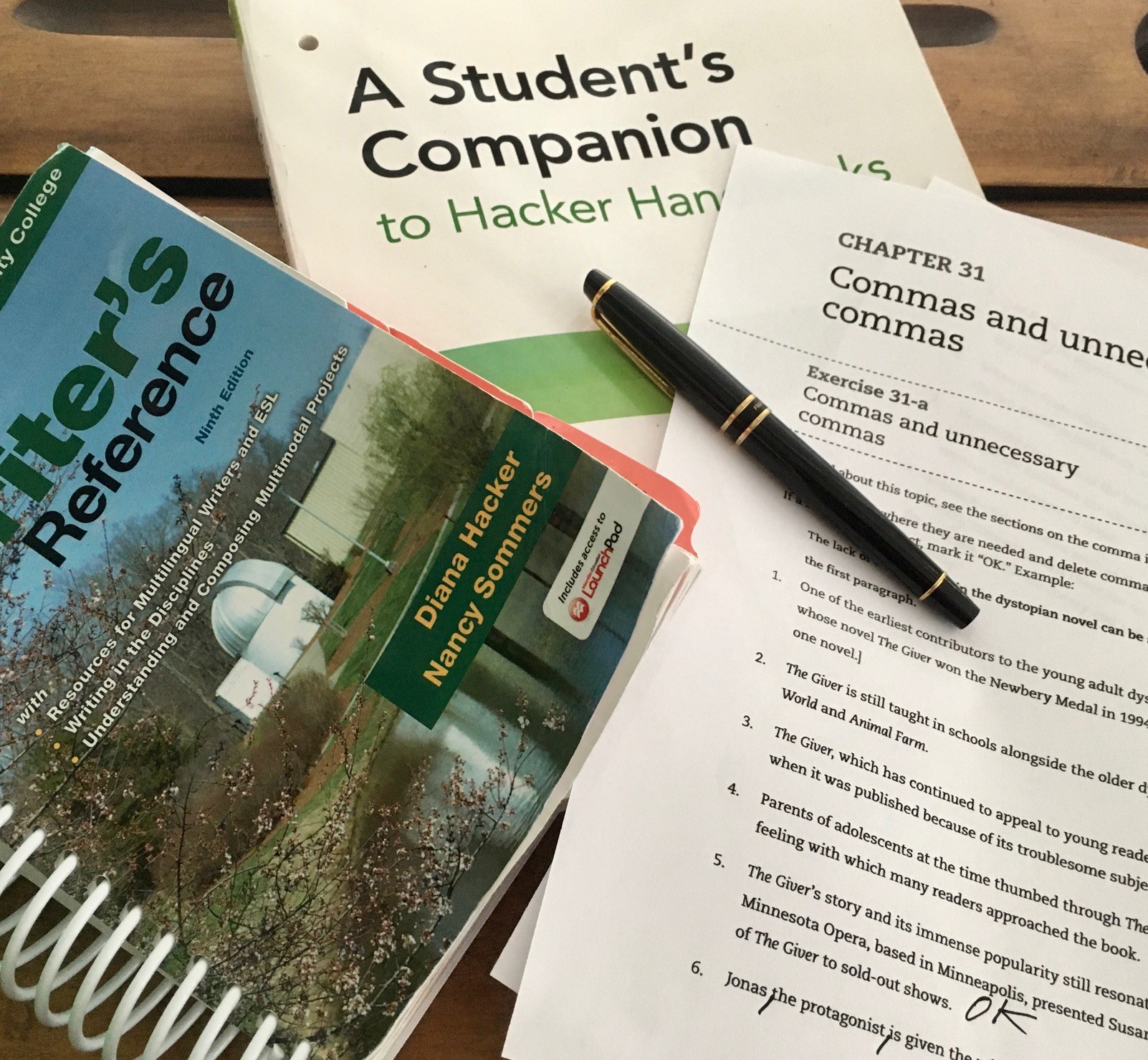
I have created a bonus assignment for you that focuses on exercises in A Student’s Companion to Hacker Handbooks, the workbook bundled with A Writer’s Reference. Directions for the assignment are posted below and in Moodle.
You’ve Got to Read This, edited by Ron Hansen and Jim Shepard, the book that inspired the You’ve Got to . . . Assignment
This week, as we continue our study of Maus, we will also examine more of your You’ve Got to . . . assignments. A file of the assignments is posted below and in Moodle, and I will distribute paper copies of the assignments in class.
Before we turn to the You’ve Got to … assignments, we will examine the questions and comments that you wrote on notecards last week. First, we’ll consider the specific questions about English 111, then we will address writing in general.
Q & A: English 111
Q: Will we use A Writer’s Reference throughout the semester?
A: Yes, your copy of A Writer’s Reference will be at your side in class as you revise your final essay the week of April 26. (Remember that my notes on each of your assignments have directed you to specific pages of AWR that address trouble spots.) A Writer’s Reference should also be close at hand when you are working outside of class on writing assignments for your other courses at GTCC. In the introductory section of the handbook, the editors emphasize the vital role that A Writer’s Reference will play in your coursework:
“[A Writer’s Reference is] a required text for ENG 110, ENG 111, ENG 112, and ENG 114, as well as many other courses at GTCC. The information in this handbook will help you with writing, research, and presentation assignments you encounter in all college courses.
“The materials in this section are designed specifically for GTCC students. Review the pages carefully, as understanding the information here will be integral to your success in your ENG courses–and beyond.
“Do not plan to sell your handbook back to the bookstore, or give it away, until all of your GTCC course work is completed.” (GT-3)
Q: Will I be required to maintain a WordPress blog for other courses?
A: You may be required to do so. Former students of mine have maintained blogs for courses in other disciplines, including psychology and Spanish. One semester, a student of mine maintained one WordPress blog site that he used both for my class and a class in communications. That student sought permission from both faculty members, his communications professor and me, to use one blog for both of our classes. If you need to maintain a blog for two classes, consult both professors before you begin. Some professors may require you to set up a site devoted solely to a single course.
Students in my English 111, 112, 126, and upper-level literature courses all maintain WordPress blogs. If you think you may enroll in another course taught by me, plan to keep your WordPress blog. You will be able to use it again.
Q: Can you see a comment that I have posted to another student’s blog if that student has not approved it?
A: No, I cannot. No comment appears on a blog without the blogger’s approval. Please approve your classmates’ comments, so that I can credit the students with posting them. If a classmate has not approved a comment of yours, email a copy to me to ensure that you receive proper credit.
Q: For this assignment, will we be posting it on our blog?
A: “This” assignment simply asked you to write questions on a notecard (so no, you will not post it to your blog). At the end of the semester you should have four assignments posted to your blog: your introductory blog post and the revisions of your three essays (the literacy narrative, the textual analysis of Maus, and the final reflective essay).
Q: How many paragraphs do we have to write for this assignment?
A: Again, “this” assignment simply asked you to write questions on a notecard (so the question of the number of paragraphs isn’t pertinent). The revisions of each of your three essays has a minimum requirement of five-hundred words, but there is no set requirement for the number of paragraphs. How many paragraphs a piece of writing needs varies, depending on its content and structure. For more on developing paragraphs and adjusting paragraph length, see A Writer’s Reference (42-53).
A: Scholarly sources are ones written by professors or independent scholars and published in academic journals and books published by university presses. Most of the secondary sources that I provided for your analysis of Maus first appeared in quarterly journals and were later collected in the book Considering Maus: Approaches to Art Spiegelman’s “Survivor’s Tale” of the Holocaust, edited by Deborah R. Geis and published by the University of Alabama Press.
As students at GTCC, you have access to the full texts of scholarly sources through the library’s databases. To limit the sources you find to ones that are scholarly, under the heading “Refine This Search” (on the left), check the box beside “Peer Reviewed.”
The New York Times and the Smithsonian website aren’t scholarly sources, but they are authoritative mainstream sources; both are appropriate to cite in many academic assignments, including your analysis of Maus, but always review your assignment guidelines and check with your professor if you have any questions regarding what constitutes an appropriate secondary source. For more on evaluating sources, see A Writer’s Reference (354).
Q: What does the perfectly formatted paper look like?
A: Style guidelines determine the correct format for a paper. The sample essays that I have posted for you on my blog and in Moodle comply with MLA (Modern Language Association) guidelines, which are the style guidelines that you will follow in many of your courses. In some courses in the social sciences and the sciences, you will follow APA (American Psychological Association) guidelines. A Writer’s Reference includes detailed information for MLA and APA and also includes sample essays (see the MLA and APA tabs). The MLA Style Center, which is another valuable resource for MLA, is linked to my blog; OWL (the Online Writing Lab at Purdue University) is an excellent resource for both MLA and APA and is also linked to my blog.
Q: What is the main thing that I am supposed to take from English 111?
A: Developing your writing skills through the processes of drafting and revising and preparing to apply those skills to writing situations beyond English 111 are the primary aims of the course.
What I Want to Learn about Writing
I just want to understand grammar better and word choice. I feel like I can never find the right word to fit what I am trying to say.
A: Study well-written models. The more you read, the more you will internalize about well-wrought prose. Also refer to the Grammatical Sentence and Punctuation and Mechanics sections of A Writer’s Reference (171-218) and (259-302). Finding the right word is always a struggle. No matter how much you’ve written, beginning a new piece of writing always means starting with a blank page or a blank screen. The right words are vital, but try not to dwell on finding them until you begin the revision process; trying to find them earlier, when you’re drafting, can be crippling.
I would like to learn about ways that I can improve my essays, being able to write a good summary.
A: For ways to improve your essays overall, see my response to the previous statement. For summaries, the most important elements to keep in mind are these: (1) a summary is concise; it addresses the text’s key points only, and (2) it is objective; neither your opinion nor the pronoun “I” appears in it.
[I want to learn] how to make a proper thesis and organize my writing accordingly.
A: Your thesis is the answer to the question, what’s my main point? It isn’t a statement of fact; it’s an informed opinion, one that can be a source of disagreement between two intelligent people. Although a thesis usually appears in the first paragraph of an essay, it’s often developed and refined late in the process. (Sometimes you have to write about a subject at length before you know where you stand.) Once you’ve determined your thesis, present each piece of evidence, one by one, to support it. Here’s a basic organization for an essay: (1) introduction and thesis, (2) body paragraphs of evidence to support your thesis and additional claims, and (3) conclusion.
I want to learn how to make my writing more impactful.
A: Many wordsmiths don’t consider “impactful” a very impactful word. They consider it a weak substitute for “powerful” and “effective.” Precise and concise word choices will strengthen your prose. Aim to be as specific as possible, and express your ideas clearly and concisely. That said, it’s important to assign those aims to the revision process; otherwise, you may not be able to move beyond your first sentence.
I want to learn how to make my writing sound more professional.
A: One way to make your writing sound more professional is to limit your use of first person. That doesn’t mean that “I” shouldn’t appear in your prose, but be mindful that if you repeatedly refer to yourself, you may come across as young and self-absorbed. Moving away from “I” shows readers that you understand that your ideas have broader implications.
[I want to learn how] to elaborate and explain what I am writing about to the reader.
A: One simple way to develop your writing is through appositives, which are nouns or noun phrases in “apposition” to (or beside) other nouns or noun phrases. One way to include an appositive in your writing is to (1) present an idea, (2) follow it with a colon, and (3) present specific details that bring the idea into sharper focus.
Here are two appositives that I wrote in the opening paragraph of my analysis of Maus:
[T]he horror that Zylberberg anticipates: the murder of his friend Nahum Cohn, Cohn’s son, and two other Jewish merchants.
His [Spiegelman’s] rendering of the panels of the living in conjunction with the fragmented panels of the hanged merchants simultaneously conveys connection and separation: both the grieving survivors’ ties to the dead and the hanged men’s objectification at the hands of the Nazis.
[I want to learn] how to write a good story.
A: Study well-written narratives. Note how the writers render scenes and develop conflict. On every page of Art Spiegelman’s Maus, at least one conflict–and often more than one–is in play. Conflict propels a narrative forward; scenes enliven it.
I want to learn how to write longhand.
A: Ask a GTCC librarian or a librarian at your local public library for help locating handbooks for writing cursive, or buy one with model letters that you can trace. Also look for how-to videos online.
[I want to learn] how to write a good college essay/everything I can to help me with my writing skills.
A: Practice, ask questions, and take notes.
I would love to learn about different writing styles that would help me find writing more interesting and captivating.
A: In recent years, several of my students have told me that the words of poet and illustrator Rupi Kaur have spoken to them in a way that no other writing has. Kaur, whose work first gained prominence on Instagram, has published three volumes of poetry: Milk and Honey (2014), The Sun and Her Flowers (2017), and Home Body (2020). For more ideas and inspiration, I recommend browsing the reading lists on Lit Hub.
I want to learn how to write better and not have to read how to write pages and just be able to write off the top of my head.
A: Unless you’re writing solely for yourself, you will need to move beyond writing off the top of your head.
Hacker, Diana, and Nancy Sommers. A Writer’s Reference. GTCC Custom 9th Edition. Bedford/St. Martin’s, 2018.
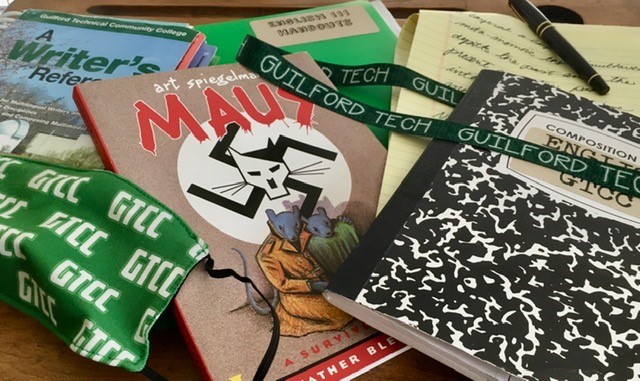
In our final weeks of English 111, we will continue our study of Maus and reflect on the assignments you have written as well as the habits that I have encouraged you to cultivate, including drafting longhand and limiting your screen time. This blog post addresses the reasons that I’ve asked you to engage in those practices.
Writing Longhand
One practical reason for writing longhand: What we mark through remains on the page. Sometimes what we cross out can be useful later on, elsewhere in our writing. More importantly, research in cognitive neuroscience indicates that writing longhand has these benefits:
When we use our phones and laptops, it’s difficult for us to give our undivided attention to one endeavor, but often that singular focus is critical.
When we type on our phones, we often aim to convey as much as we can with as few characters as possible. Texting and emailing–both of which now feature predictive text–do not foster the vital skills of developing our writing and producing original thought.
Limiting our screen time not only helps us improve our writing skills, it can also benefit our overall well-being.
The research cited in the links that I’ve included isn’t definitive, but it makes a strong case for the value of limiting our screen time and putting pen to paper. I encourage you to continue these practices after the semester ends.
Model Textual Analysis
Along with reflecting on the assignments you’ve written and the habits I’ve encouraged you to cultivate, this week we will examine the textual analysis of Maus that I wrote as an additional model for you.
What textual evidence (images and words in the panels) supports the essay’s claims?
Where do I quote or paraphrase the primary source (Maus)?
Where do I quote or paraphrase an authoritative secondary source?
After we’ve read the “The Strange Fruit of Sosnowiec,” look back at the final paragraph, and consider which strategies I use to develop the conclusion.
Do I include a quotation from a primary or secondary source, one that emphasizes the essay’s main point or puts it in a different perspective?
Do I place the analysis in a different, perhaps larger, context? (Do I link the analysis to the pandemic or the current social or political climate?)
Do I address the implications of the analysis? (Do I explore what the analysis implies, or involves, or suggests about parent-child relationships, about storytelling, about memory, or about totalitarian regimes?)
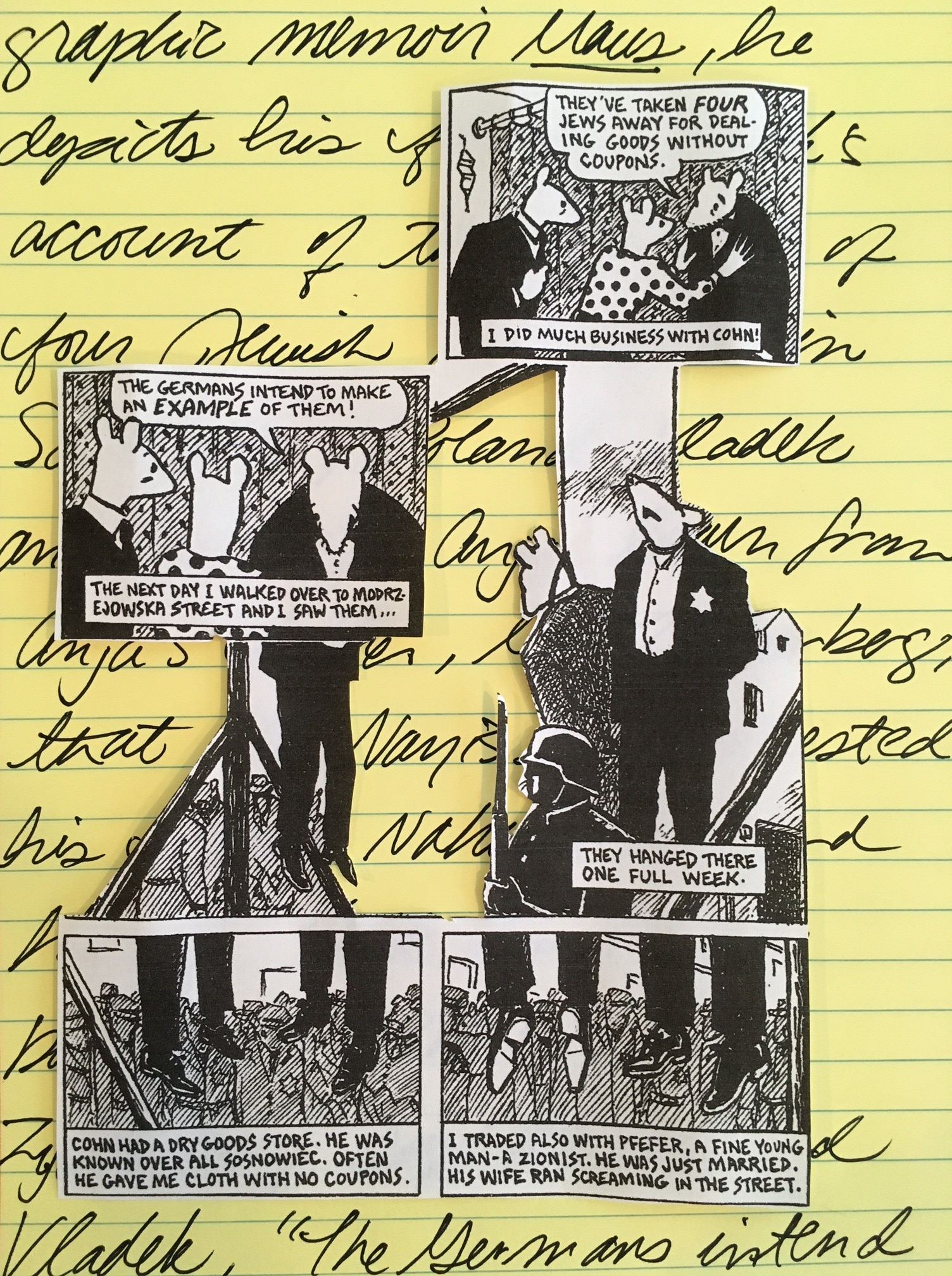
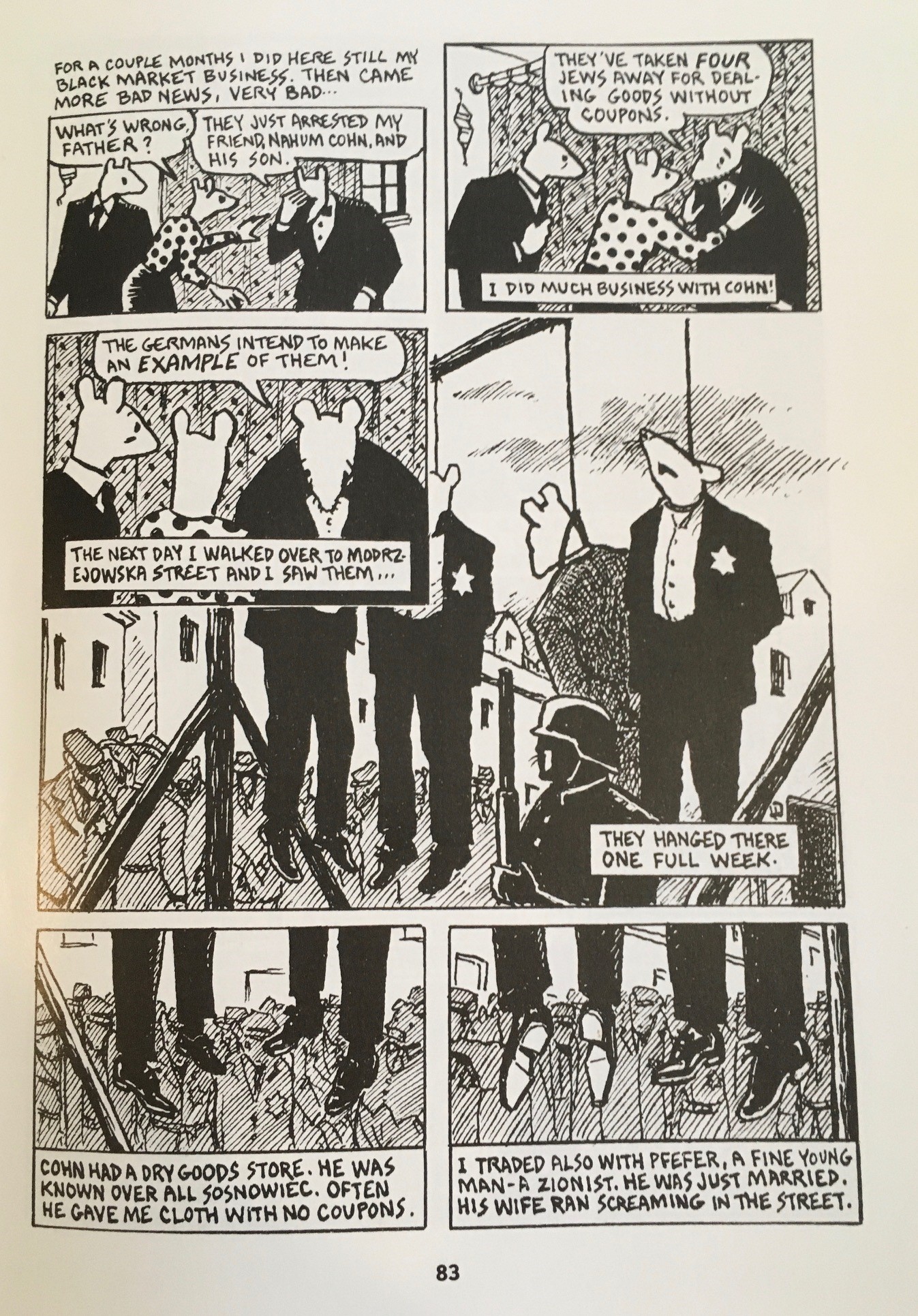
In Chapter 4 of Art Spiegelman’s graphic memoir Maus, he depicts his father Vladek’s account of the hangings of four Jewish merchants in Sosnowiec, Poland. Vladek and his wife, Anja, learn from Anja’s father, Mr. Zylberberg, that the Nazis have arrested his friend Nahum Cohn and his son. With his head bowed in sorrow, Mr. Zylberberg says to Anja and Vladek, “The Germans intend to make an example of them!” (83). That image of Mr. Zylberberg speaking with Vladek and Anja overlays the larger panel that dominates the page, one that depicts the horror that Mr. Zylberberg anticipates: the murder of his friend Nahum Cohn, Cohn’s son, and two other Jewish merchants. That haunting panel and the smaller ones that frame it illustrate the complexity of Spiegelman’s seemingly simple composition. His rendering of the panels of the living in conjunction with the fragmented panels of the hanged merchants simultaneously conveys connection and separation: both the grieving survivors’ ties to the dead and the hanged men’s objectification at the hands of the Nazis.
The placement of the overlaying panel not only hides part of the horror behind it, but it also connects Vladek’s father-in-law to one of the victims. Mr. Zylberberg’s head and torso appear directly above the suspended legs and feet of one of the hanged men, creating an image that merges the two.
Spiegelman further emphasizes the mourners’ identification with the hanged men by extending two of the nooses’ ropes upward to the smaller panel above them, linking the living to the dead. Additionally, Spiegelman underscores the link with Vladek’s line of narration at the bottom of the smaller panel: “I did much business with Cohn!” (83). The word “with” appears directly above the rope, punctuating the connection between both Nahum Cohn and his friend Mr. Zylberberg and Zylberberg’s son-in-law, Vladek.
While the panels of the hangings yoke the living to the dead, Spiegelman’s presentation of the hanged men in fragments also objectifies them. The final panels on the page depict only their shoes and part of their pant legs suspended above the onlookers, images that may evoke in some readers thoughts of the last remnants of the Jews who stepped barefoot into the gas chambers of Auschwitz.
Whether the hanged men’s shoes call to mind those mountains of leather left behind by the Jews, the separation of their lower legs and feet from the rest of their bodies turns them into something less than human—not people, but mere parts. Thus, Spiegelman creates a picture of the hangings that illustrates both the mourners’ identification with the victims and the Nazis’ perception of the Jews as less than human: the malignant ideology that the artist has pinpointed “at the very heart of the killing project.”
Spiegelman, Art. Maus I. Pantheon, 1986, p. 83.
Spiegelman’s transformation of the Nazi propaganda portrayals of Jews as rats remains an astounding achievement thirty-five years after the publication of the first volume of Maus. But seeing the hanged merchants in Modrzejowska Street in the midst of the George Floyd murder trial in Minneapolis and less than three months after the January 6 Capitol riot reminds readers that the panels of Spiegelman’s memoir have grown more prescient. The nooses evoke images of Officer Derek Chauvin’s knee on George Floyd’s neck, the January 6 chants to hang the Vice President, and a T-shirt glimpsed in the Capitol crowd, one with a Nazi eagle below the acronym “6MWE” (Six Million Wasn’t Enough), a reference to the numbers of Jews slaughtered in the Holocaust. Our heads are bowed in sorrow with Mr. Zylberberg’s. The strange fruit of our past, both distant and recent, should seem far stranger.
The authors of A Writer’s Reference note that “[r]evising is rarely a one-step process” (Hacker and Somers 19). Editing for surface-level correctness is essential, but it isn’t the only step, and it shouldn’t be the first. Begin instead by re-seeing (or re-visioning) your analysis and considering its focus and organization. Ask these questions:
Is it a focused analysis rather than an overview of a scene in Maus?
Does it present a clear thesis?
Would the analysis benefit from a different organization? If the strongest piece of textual evidence appears in the first body paragraph, try moving it to the last one.
After you have addressed those questions, examine each paragraph one by one, from first to last.
Introduction
Does the first sentence name the author, Art Spiegelman, and the title, Maus?
Does the description that follows create a picture of the panel or panels for the reader? For more on descriptive paragraphs, see pages 45-46.
Does the description include pertinent terms, such as dialogue, narration, panel, speech balloon, and tier?
Is the description followed by a clear thesis? Can the thesis be a point of disagreement among reasonable people? (If the answer to both questions isn’t yes, revise accordingly.) For more on writing a thesis for an analytical essay, see page 69.
Body Paragraphs
Does each body paragraph present textual evidence (words and images from the panel or panels) that supports the thesis? For more on supporting a thesis, see page 69.
Do the paragraphs include pertinent terms, such as dialogue, narration, panel, speech balloon, and tier?
Do the paragraphs include at least one relevant quotation or paraphrase from an authoritative secondary source and one paraphrase or quotation from Maus? Note: You may quote or paraphrase your secondary source in the conclusion rather than in the body paragraph.
Conclusion
Is the conclusion a well-developed paragraph?
Does it reiterate the thesis without repeating it verbatim? For more on writing conclusions, see page 18.
After you have revised the paragraphs one by one, review the MLA section of A Writer’s Reference to ensure your document complies with style guidelines.
MLA Style
The MS Word file or PDF that you will submit to Moodle should comply with the format guidelines for MLA (Modern Language Association) manuscripts, including in-text citations with signal phrases (384), and works cited entries (392-423).
Remember that in addition to submitting your revision to Moodle, you will publish it as a post on your WordPress blog. Your blog post will omit the first-page information included in your file submitted to Moodle (your name, my name, course, section, and date). You will include in your blog post an image that documents some part of your writing process away from the screen, such as a photo of your reading notes or a page of your handwritten draft.
Works Cited Entries
The following list includes sample works cited entries for secondary sources. Note that in your MS Word file, your works cited entries will have a hanging indent; in other words, each line except the first one will be indented five spaces or one-half inch.
Bosmajian, Hamida. “The Orphaned Voice in Art Spiegelman’s Maus.” Considering Maus: Approaches to Art Spiegelman’s “Survivor’s Tale” of the Holocaust, edited by Deborah R. Geis, U of Alabama P, 2003, pp. 26-43.
Brock, Michael and Zachary Goldstein. “The Lasting Effects of World War II and the Holocaust.” Guilford Technical Community College Globalization, Education, and Literacy Committee Presentation, Microsoft Teams Live Stream, 16 Mar., 2021. Lecture.
Chute, Hillary. “History and Graphic Representation in Maus.” A Comics Studies Reader, edited by Jeet Heer and Kent Worcester, UP of Mississippi, 2009, pp. 340-62.
Miller, Nancy K. “Cartoons of the Self: Portrait of the Artist as a Young Murderer—Art Spiegelman’s Maus.” Considering Maus: Approaches to Art Spiegelman’s “Survivor’s Tale” of the Holocaust, edited by Deborah R. Geis, U of Alabama P, 2003, pp. 44-59.
Wilner, Arlene Fish. “‘Happy, Happy Ever After’: Story and History in Art Spiegelman’s Maus.” Considering Maus: Approaches to Art Spiegelman’s “Survivor’s Tale” of the Holocaust, edited by Deborah R. Geis, U of Alabama P, 2003, pp. 105-21.
In the revision of your analysis of Maus, you will cite a relevant authoritative secondary source: a critical essay, book review, or interview published in an academic journal or a well-regarded news publication. Next week in class, I will distribute a handout that includes passages from some studies of Maus that you may cite in your essay. Excerpts from those sources appear in a later section of this post.
Why Cite an Authoritative Secondary Source?
Quoting or paraphrasing an authoritative secondary source gives your writing credibility. It indicates to readers that your ideas are trustworthy and valid because your analysis is informed by the work of an expert.
Citing an authoritative secondary source also links your analysis to a study of Maus that preceded yours. Academic writing is knowledge-building. With your analysis, you are adding to the critical conversation about Spiegelman’s memoir.
Ask yourself, what has a scholar or journalist written about Maus, and how do my own ideas about Spiegelman’s memoir fit into the conversation? Your answers to those questions can serve as a starting point for integrating your own take on Maus with the ideas presented in a secondary source.
Locating Authoritative Secondary Sources
The GTCC Libraries website includes a research guide for Maus, which features links to articles, essays, reviews, lectures, and interviews.
You can also locate scholarly, or peer-reviewed, articles on Maus by following these steps on the libraries’ home page:
Click on advanced search.
In the first search index box, select subject. In the search term box to the right, type Spiegelman, Art.
In the second search index box, select subject. In the search term box to the right, type Maus.
Click search.
On the next screen, you will see a list of more than two-hundred sources. You can refine your search by choosing one of the limiters in the menu bar on the left. Selecting articles will narrow the list of sources to fewer than ninety; selecting peer-reviewed articles will limit the list to fewer than twenty.
Another Authoritative Secondary Source
If you watched the live stream of GTCC Professors Michael Brock and Zachary Goldstein’s lecture “The Lasting Effects of World War II and the Holocaust,”you are welcome to use that presentation as a secondary source for your analysis of Maus. Here’s how you would integrate one of their points into your analysis:
Zachary Goldstein, Associate Professor of English at Guilford Technical Community College, observes that one of the misconceptions of the Holocaust is the notion that all of the deaths occurred in the gas chambers. Art Spiegelman’s depiction of the public hangings of Jewish merchants in Modrzejowska Street illustrates Goldstein’s point.
Notice that the signal phrase includes the writer’s first and last name as well as his credentials. The paraphrase does not include a page number because the source is a presentation. The works cited entry, which would appear at the end of the analysis, lists the details of the event:
Works Cited
Brock, Michael and Zachary Goldstein. “The Lasting Effects of World War II and the Holocaust.” Guilford Technical Community College Globalization, Education, and Literacy Committee Presentation, Microsoft Teams Live Stream, 16 Mar., 2021. Lecture.
For more on introducing sources with signal phrases and citing online lectures, see A Writer’s Reference, pages 376-79 and 419.
Passages from Authoritative Secondary Sources
From Hamida Bosmajian, Professor of English at Seattle University:
“[t]he Nazi flag. . . is never shown unobstructedly unfurled in Maus” (42).
From Nancy K. Miller, Distinguished Professor of English and Comparative Literature at the City University of New York:
“The Success of Maus is due to a double audacity. The first is the choice to represent the Holocaust as a cartoon, the second to cast its star witness as a victimizer in his own world, a petty tyrant at home” (48-49).
From Arlene Fish Wilner, Professor of English and American Studies at Rider University:
Adam Gopnik has noted that the animal heads given to the humans in Maus reflect “our sense that this story is too horrible to be presented unmasked” (qtd. in Wilner 109).
From Hamida Bosmajian, Professor of English at Seattle University:
The telling of stories is, of course, a primary means of ordering the disorder of experience; it provides a surface sensibleness that may be perceived as meaningful. Artie, however, will never make any sense or meaning of it all, no matter how many times he articulates the horror verbally and graphically; he can only shape an imitation, an illusion of meaning through the telling of the tale. (30-31)
In an MLA-style manuscript, the quotation above is indented one-half inch because it is one of more than four lines. The quotation marks are omitted because the indentation signals to the reader that the lines are taken word-for-word from the source. For more on presenting long quotations in MLA papers, see A Writer’s Reference (376).
From Hillary Chute, Distinguished Professor of English and Art + Design at Northeastern University:
“The most striking instance of representing past and present together in Maus is the inclusion of the autobiographical comic strip ‘Prisoner on the Hell Planet: A Case History’” (346).
Works Cited
Bosmajian, Hamida. “The Orphaned Voice in Art Spiegelman’s Maus.” Considering Maus: Approaches to Art Spiegelman’s “Survivor’s Tale” of the Holocaust, edited by Deborah R. Geis, U of Alabama P, 2003, pp. 26-43.
Chute, Hillary. “History and Graphic Representation in Maus.” A Comics Studies Reader, edited by Jeet Heer and Kent Worcester, UP of Mississippi, 2009, pp. 340-62.
Miller, Nancy K. “Cartoons of the Self: Portrait of the Artist as a Young Murderer—Art Spiegelman’s Maus.” Considering Maus: Approaches to Art Spiegelman’s “Survivor’s Tale” of the Holocaust, edited by Deborah R. Geis, U of Alabama P, 2003, pp. 44-59.
Wilner, Arlene Fish. “‘Happy, Happy Ever After’: Story and History in Art Spiegelman’s Maus.” Considering Maus: Approaches to Art Spiegelman’s “Survivor’s Tale” of the Holocaust, edited by Deborah R. Geis, U of Alabama P, 2003, pp. 105-21.
Those of you who meet with me on Wednesdays will begin planning and drafting your textual analysis of Maus today. You will receive a paper copy of the complete assignment in class. The assignment is also posted in Moodle, and I have included an additional copy below.
Here are the elements that you are required to include in your revised analysis of Maus:
an introduction that includes a description of the panel, tier, or page
a thesis statement that presents your particular reading or interpretation
textual evidence, both words and images, that support your interpretation
a relevant quotation or paraphrase from an authoritative secondary source
parenthetical citations for both Maus and your secondary source
a conclusion that revisits the thesis without restating it verbatim
a title that offers a window into your analysis
a works cited list with entries for Maus and your secondary source
Note that the requirements above are for your revision. You do not need to integrate an authoritative secondary source into your draft. Later this week, on Thursday or Friday, I will post information on secondary sources, including article excerpts that you may quote or paraphrase in your analysis.
And Keep in Mind as You Plan and Draft . . .
You are welcome to focus on a single panel or a series of panels in Maus I, but you should not focus on more than one page.
If your initial plan doesn’t seem to be taking shape, turn away from your draft for a while. Try brainstorming or freewriting in your journal. Don’t concern yourself with spelling and structure; attend to those matters later. The aim of brainstorming and freewriting is to get your ideas on paper as quickly as you can. For more on brainstorming and freewriting, see A Writer’s Reference (6).
If you write on one panel or series of panels and that doesn’t seem to lead anywhere, turn back to the pages of Maus and try writing on another panel or series of panels.
I am drafting an analysis along with you and will post my revision for you next week.
The textual analysis of Maus that I wrote for my students last fall and four students models are available to you now on my blog. My analysis is included in the March 17 blog post; the four student analyses are included in the March 15 post.