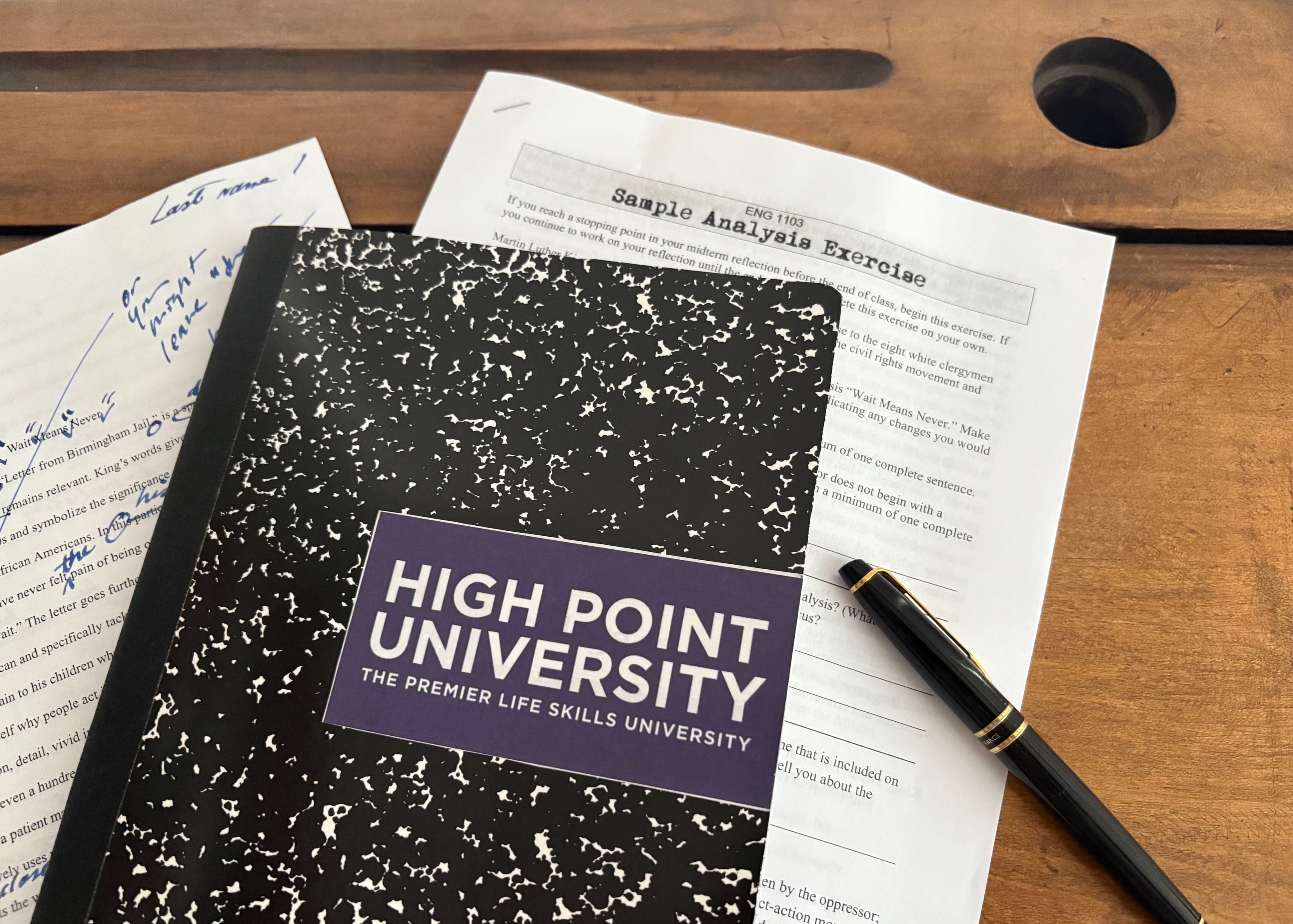
Yesterday in class, while you were composing your midterm reflections, I distributed a sample student analysis for you to read and an exercise on the analysis for you to complete for Wednesday’s class. An additional copy of the directions for the exercise are included below.
Directions
Martin Luther King Jr.’s “Letter from Birmingham Jail” is his response to the eight white clergymen who had drafted an open letter that addressed King’s involvement in the civil rights movement and urged him to seek justice in the courts rather than in the streets.
Read the excerpt from King’s letter (included below), then read the student analysis “Wait Means Never.” Make notes on the text and in the margins of “Wait Means Never,” indicating any changes you would make and posing any questions you have.
Answer question two and the questions that follow with a minimum of one complete sentence. What indicates to the reader that the introductory paragraph does or does not begin with a summary?
How could the writer refine his thesis and narrow the scope of his analysis? (What specifically in the letter—rather than the letter as a whole—might serve as his focus?)
The paragraph of King’s letter that the student examines in detail, the one that is included on this handout, is not the first paragraph of the letter. What does that fact tell you about the parenthetical citations in the student’s analysis?
If you were absent of Monday, or misplaced your copy of the sample analysis and exercise, email me a request for a copy.
From “Letter from Birmingham Jail”
We know through painful experience that freedom is never voluntarily given by the oppressor; it must be demanded by the oppressed. Frankly, I have never yet engaged in a direct-action movement that was “well timed” according to the timetable of those who have not suffered unduly from the disease of segregation. For years now I have heard the word “wait.” It rings in the ear of every Negro with a piercing familiarity. This “wait” has almost always meant “never.” It has been a tranquilizing thalidomide, relieving the emotional stress for a moment, only to give birth to an ill-formed infant of frustration. We must come to see with the distinguished jurist of yesterday that “justice too long delayed is justice denied.” We have waited for more than three hundred and forty years for our God-given and constitutional rights. The nations of Asia and Africa are moving with jetlike speed toward the goal of political independence, and we still creep at horse-and-buggy pace toward the gaining of a cup of coffee at a lunch counter. I guess it is easy for those who have never felt the stinging darts of segregation to say “wait.” But when you have seen vicious mobs lynch your mothers and fathers at will and drown your sisters and brothers at whim; when you have seen hate-filled policemen curse, kick, brutalize, and even kill your black brothers and sisters with impunity; when you see the vast majority of your twenty million Negro brothers smothering in an airtight cage of poverty in the midst of an affluent society; when you suddenly find your tongue twisted and your speech stammering as you seek to explain to your six-year-old daughter why she cannot go to the public amusement park that has just been advertised on television, and see tears welling up in her little eyes when she is told that Funtown is closed to colored children, and see the depressing clouds of inferiority begin to form in her little mental sky, and see her begin to distort her little personality by unconsciously developing a bitterness toward white people; when you have to concoct an answer for a five-year-old son asking in agonizing pathos, “Daddy, why do white people treat colored people so mean?”; when you take a cross-country drive and find it necessary to sleep night after night in the uncomfortable corners of your automobile because no motel will accept you; when you are humiliated day in and day out by nagging signs reading “white” and “colored”; when your first name becomes “nigger” and your middle name becomes “boy” (however old you are) and your last name becomes “John,” and when your wife and mother are never given the respected title “Mrs.”; when you are harried by day and haunted by night by the fact that you are a Negro, living constantly at tiptoe stance, never knowing what to expect next, and plagued with inner fears and outer resentments; when you are forever fighting a degenerating sense of “nobodyness”—then you will understand why we find it difficult to wait. There comes a time when the cup of endurance runs over and men are no longer willing to be plunged into an abyss of injustice where they experience the bleakness of corroding despair. I hope, sirs, you can understand our legitimate and unavoidable impatience.
In class tomorrow, we will examine the sample student analysis “Wait Means Never” and the accompanying exercise. Afterward, I will return your analysis drafts with my notes, and you will have the remainder of the class period to devote to revision work.
Monday in class you will plan and compose a midterm reflective essay that documents your work in the first half of the semester, focusing on two or three assignments or aspects of the course that have contributed to your development as a writer and a student. Since you have already written a reflection devoted solely to your literacy narrative, your midterm reflection should focus primarily on other assignments or aspects of the course. One of the requirements of the assignment is incorporating a relevant quotation from one of the essays or chapters you have read or from Writing Analytically. Before Monday’s class, determine what phrase, clause, or sentence you will quote, and draft a sentence in your journal that introduces the quotation with a signal phrase and follows it with a parenthetical citation.
One option for integrating a quotation into your essay is to include a line from one of your readings and explain what that passage has taught you about writing.
Examples
In the opening line of “Back Story,” Michael Lewis demonstrates that repetition can be an asset. With the words “[f]rom the snap of the ball to the snap of the first bone” (15), he repeats “snap” as a frame for the seconds leading up to Jo Theismannn’s career-ending injury. The first “snap,” the hike of the football, begins the sequence. The second “snap,” the fracture of Theismann’s tibia and fibula, ends it.
The opening line of “Back Story,” demonstrates that repetition can be an asset. The two prepositional phrases “[f]rom the snap of the ball to the snap of the first bone” (Lewis 15), repeat “snap” as a frame for the seconds leading up to Jo Theismannn’s career-ending injury. The first “snap,” the hike of the football, begins the sequence. The second “snap,” the fracture of Theismann’s tibia and fibula, ends it.
The two examples above are very similar. The first one names the author, so only the page number appears in the parenthetical citation. The second does not name the author, so his last name precedes the page number in the parenthetical citation. Note that omitting the author’s name from the passage shifts the emphasis from the writer’s actions (“he repeats ‘snap’”) to the words themselves (“prepositional phrases . . . repeat ‘snap’”).
Another option for integrating a quotation into your essay is to include a line from Writing Analytically that presents a concept that figures in your own reading or writing process.
Examples
When I write a journal entry about an essay or chapter I have read for class, I sense that I have begun what Rosenwasser and Stephen term “a mental dialogue with it” (46).
When I write a journal entry about an essay or chapter I have read for class, I sense that I have begun “a mental dialogue with it” (Rosenwasser and Stephen 46).
Works Cited
Lewis, Michael. “Back Story.” The Blind Side. 2006. Norton, 2009. pp. 15-23.
Rosenwasser, David and Jill Stephen. “Becoming Conversant with a Reading.” Writing Analytically, 9th edition. Wadsworth/Cengage, 2024. p. 46-55.
Next Up
In class on Monday you will compose your midterm reflection. To prepare, choose a phrase, clause, or sentence from one of the course readings–one that is relevant to your work in the course–and draft in your journal a short passage that connects that quotation to your writing. That passage will serve as part of your reflection.
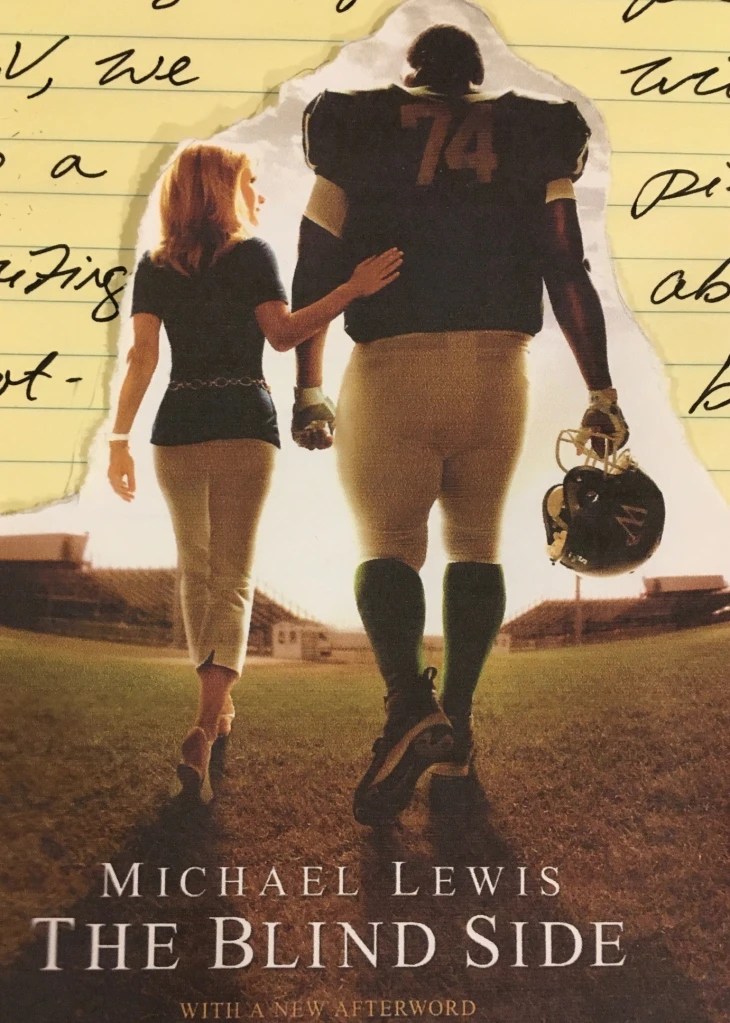
Yesterday in class, we examined “Back Story,” the first chapter of Michael Lewis’ The Blind Side, which begins with Lewis’ depiction of the moments in the November 1985 Redskins-Giants football game leading up to the injury that ended quarterback Joe Theismann’s career:
“From the snap of the ball to the snap of the first bone is closer to four seconds than to five. One Mississippi: The quarterback of the Washington Redskins, Joe Theismann, turns and hands the ball to running back John Riggins. He watches Riggins run two steps forward, turn, and flip the ball back to him. It’s what most people know as a “flea-flicker,” but the Redskins call it a “throw-back special.” Two Mississippi: Theismann searches for a receiver but instead sees Harry Carson coming straight at him. It’s a running down—the start of the second quarter, first and 10 at midfield, with the score tied 7–7—and the New York Giants’ linebacker has been so completely suckered by the fake that he’s deep in the Redskins’ backfield. Carson thinks he’s come to tackle Riggins but Riggins is long gone, so Carson just keeps running, toward Theismann. Three Mississippi: Carson now sees that Theismann has the ball. Theismann notices Carson coming straight at him, and so he has time to avoid him. He steps up and to the side and Carson flies right on by and out of the play. The play is now 3.5 seconds old. Until this moment it has been defined by what the quarterback can see. Now it–and he–is at the mercy of what he can’t see” (15).
What Theismann cannot see is Lawrence Taylor. A second later, as Taylor sacks Theismann, Taylor’s knee drives straight into Theismann’s lower right leg, leading to the “snap of the first bone” that Lewis mentions in the first sentence. He hooks the reader by linking the beginning of the play, “the snap of the ball” to the gruesome “snap of the first bone” that will follow. Lewis develops the paragraph using the common one-Mississippi, two-Mississippi method of marking seconds to present the events leading up to the compound fracture that ends Theisman’s career.
Lewis doesn’t dramatize the injury itself because his interest lies instead in the blind side that led to it and subsequently elevated the status and salary of the left tackle, the player who protects the quarterback’s blind side. Rather than immediately continuing the action of the play he presents in the opening of the chapter, Lewis turns away from the 3.5-second moment to show how, in his words, “Lawrence Taylor altered the environment and forced opposing players and coaches to adapt” (17).
When you’re struggling to develop a piece of writing, reread the opening paragraph of The Blind Side. Study how Lewis dramatizes 3.5 seconds–yes, only 3.5 seconds–with 224 words.
Work Cited
Lewis, Michael. “Back Story.” The Blind Side. 2006. W.W. Norton, 2009. pp. 15-23.
“Seems to Be About X, But Could Also Be (or is ‘Really’) About Y”
Before tomorrow’s class, complete the X-Y journal exercise that I distributed on Monday. I will not collect your journals, but I may conduct a check of the exercises while you are drafting your analyses. The instructions for the assignment are included below.
Directions
Review your reading handouts—”MeTalk Pretty One Day,” “The Day Language Came into Life,” the excerpt from the first chapter of To Kill a Mockingbird, the excerpt from “The Falling Man,” and “The School”—and repeat the “Seems to Be about X, But Could also Be (Or is ‘Really’) about Y” exercise that you completed with “Back Story.”
Even if you think you have decided which text will be the subject of your analysis, compose an X/Y statement about at least two additional texts. One of those statements may pique your interest in a different piece of writing.
After you have written at least three X/Y statements in your journal, compose a freewrite of one paragraph or more that expands on one of the X/Y contrasts.
Next Up
Tomorrow in class, you will begin planning and drafting your analysis, which will focus on one of the texts that we have studied, including David Sedaris’ “Me Talk Pretty One Day,” Helen Keller’s “The Day Language Came into My Life,” the excerpt from To Kill a Mockingbird, Tom Junod’s “The Falling Man,” and Michael Lewis’ “Back Story.”
If you have misplaced your copy of any of the readings or were absent the day that I distributed copies, download a copy from Blackboard and print it.
If you would like to analyze a larger section of the first chapter of To Kill a Mockingbird, download a copy of Chapter One from Blackboard and print it.
If you would like to analyze a larger section of “The Falling Man,” download a copy from the HPU Libraries site and print it. Directions for accessing the full text of “The Falling Man” are included in the September 11 class notes.
As an introduction to Michael Lewis, whose writing we will examine in class today, you read this overview of his publications. After you read it, you compose a one- or two-paragraph journal entry that addressed these questions: (1) Two of Lewis’ books on one subject have both been adapted for film. What is the subject, and what are the titles of the two books (and films)? (2) A third book of his, one devoted to a different subject, has also been adapted for film. What is the subject, and what is the title of the book (and film)?
As we read the first chapter of one of his books, consider what elements of his writing would attract filmmakers to his work. We will closely examine the opening of the chapter, paying special attention to its repetition of words and phrases. Later in class, we will read the remainder of the chapter and you will address in writing why Lewis may have chosen to delay the continuation of the action that he depicts in the opening paragraph.
Next Up
In class on Wednesday, you will begin planning and drafting your second major writing assignment, your analysis. The chapter of Michael Lewis’ writing that we examine in class today and the other texts we have studied thus far in English 1103–“MeTalk Pretty One Day,” “The Day Language Came into Life,” the excerpt from the first chapter of To Kill a Mockingbird,” the excerpt from “The Falling Man,” and “The School“–are among the pieces of writing that may serve as the subject of your upcoming analysis.
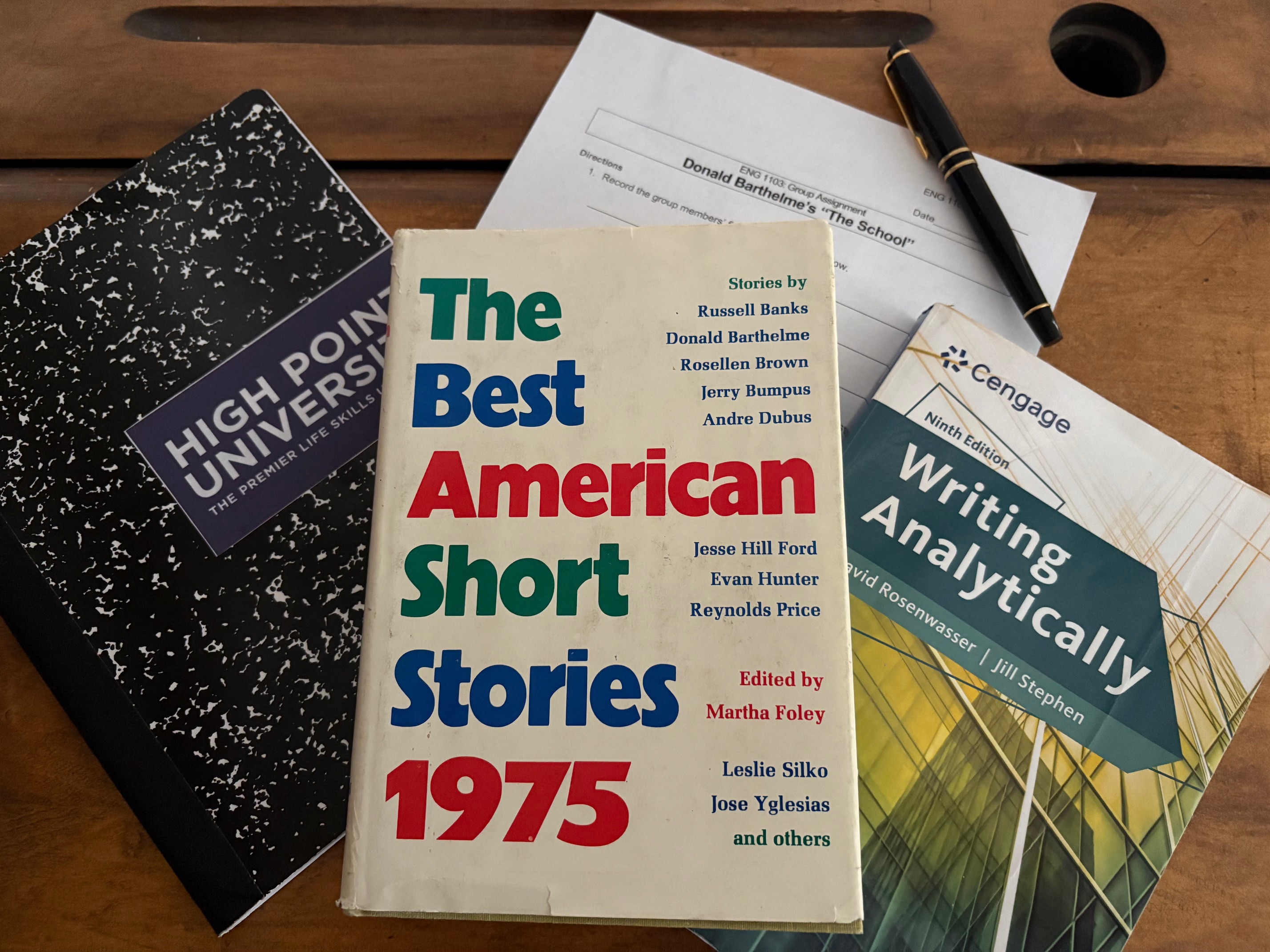
Yesterday in class we examined Donald Barthelme’s “The School” as another potential subject for your analysis. In groups of three and four, you and your classmates considered these elements.
The narrator and the narrative voice
Conflict
A short passage that strikes you as interesting, revealing, or strange
The Narrator and the Narrative Voice
The words and phrases you and your classmates used to describe the narrator, Edgar, and his voice include “awkward,” “casual,” “detached,” “emotionless,” “lack[ing] empathy,” “mixing humor with unease,” “mono[tonus],” not “filter[ing] any of his thoughts.”
Do any of those descriptions seem at odds with the narrator’s words and actions? If so, what might account for that discrepancy?
Conflict
Most of the groups addressed the existential conflict of life versus death. The children want the plants and animals in their classroom to live. They want the Korean orphan, Kim, to live; they want their classmates and relatives to live, but the children are repeatedly faced with death.
A couple of the groups addressed Edgar’s internal conflicts. On group observed that he could not explain death to them because he was trying to protect their innocence. Another group noted that Edgar could not broach the subject of death because of his uncertainty as well as the absurdity of the circumstances: the unbelievably large number of deaths.
Another group pointed to the death of the trees–perhaps due to poor soil–as a particular instance of the existential conflict.
Interesting, Revealing, or Strange
Most of the groups noted the childrens’ request for Edgar to “please make love with Helen” (11) as a strange line. Other lines mentioned include “You know what I mean” (8), “As soon as I saw the puppy I thought, Oh Christ” (9), “And then there was this Korean Orphan” (9), and “is death that which gives meaning to life?” (10).
In this post, I am not including your sentences that demonstrate why those lines are interesting, revealing, or strange, but we will address some of those next Monday when we revisit Barthelme’s story. Remember that they are “triggers for analysis” (Rosenwasser and Stephen 24). That is why your journal assignment from yesterday asked you to repeat the interesting-revealing-strange exercise with the text you have tentatively chosen as the subject of your analysis.
Works Cited
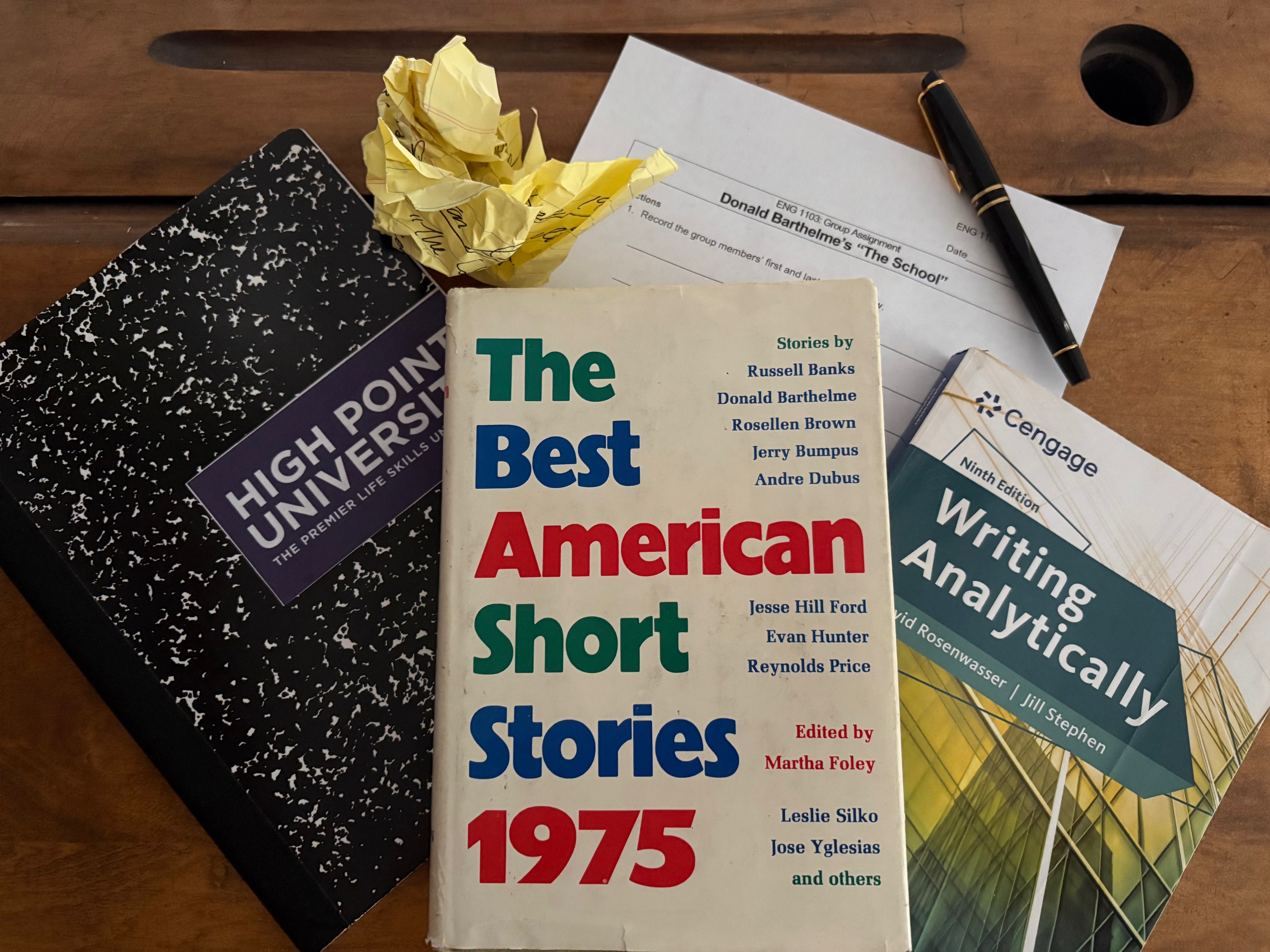
Barthelme, Donald. “The School.” The Best American Short Stories 1975, edited by Martha Foley. Houghton Mifflin, 1975. pp. 8-11.
Rosenwasser, David and Jill Stephen. “‘Interesting,’ ‘Revealing,’ ‘Strange,'” Writing Analytically, 9th edition. Wadsworth/Cengage, 2024. p. 24.
“The School,” originally published in The New Yorker magazine, was one of twenty-one stories chosen for the annual Best American Short Stories anthology in 1975.
This morning in class we will examine Donald Barthelme’s short story “The School,” and in groups of three or four you will address in writing some of the elements of the story that you might explore in an analysis. As I mentioned last week, the essays, article excerpts, and chapters that we have studied thus far are among the texts you may choose as the subject of your analysis, which you will begin drafting next week. “The School” is another text you may analyze.
The elements of Barthelme’s story that you will consider this morning are these:
The narrator and the narrative voice
Conflict
A short passage that strikes you as interesting, revealing, or strange
Whether you analyze Bartheleme’s story or one of our other readings, you will begin your first paragraph with a summary of the text. Remember that a summary is an objective synopsis of a text’s key points. It should be written in third person and present tense. For example, if you choose to analyze “The School,” you might summarize it this way:
Donald Barthelme’s short story “The School” recounts a series of classroom lessons that end with the deaths of plants and animals–deaths that serve as a prelude to the unexplained death of a Korean orphan, followed by the unexpected deaths of classmates and family members.
Notice that the summary above does not comment on the story in any way. What follows the summary will be the beginning of your commentary, or analysis, the thesis statement that offers your particular close reading, or interpretation, of the story. The passage below is the same as the one above, but at the end of it I have added a thesis statement in bold.
Donald Barthelme’s short story “The School” recounts a series of classroom lessons that end with the death of plants and animals–deaths that serve as a prelude to the unexplained death of a Korean orphan, followed by the unexpected deaths of classmates and family members. With conversational narration, accumulation of detail, and a shift in fictional mode, Barthelme deftly depicts the reality of the fleeting nature of life, even as the story itself veers from reality.
If were to continue to write the analysis that I began in the previous paragraph, I would follow that opening paragraph with body paragraphs that address each of the three story elements that I include in my thesis: (1) conversational narration, (2) accumulation of detail, and (3) shift in fictional mode.
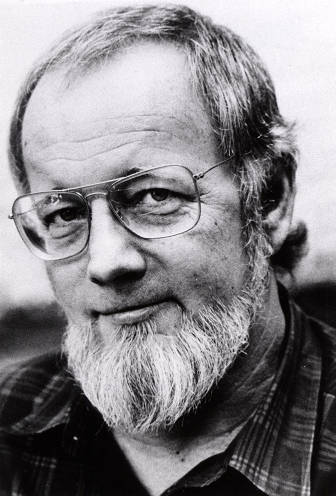
By University of Houston [Public domain], via Wikimedia Commons
As an introduction to Donald Barthelme, whose fiction we will examine in class tomorrow, read this biographical sketch. After you read the sketch, compose a one- or two-paragraph journal entry that includes what you have learned about his writing style, and what you have learned about readers’ and critics’ mixed responses to his fiction.
Bonus Assignment Follow-Up
Thanks to those of you who took advantage of yesterday’s bonus assignment: Annaliese Abboud, Gi Amitrano, Cameron Anderson, Adrienne Brown, Kylie Bussell, Myra Chatwal, Reese Danback, Amanda Franco, Dorian Grosber, Garrett Hickey, Raven Houston, Jorja Mangeot, Mariana Pavajeau, Heloise Richer, Ellie Tejada, and Bailey Upchurch.
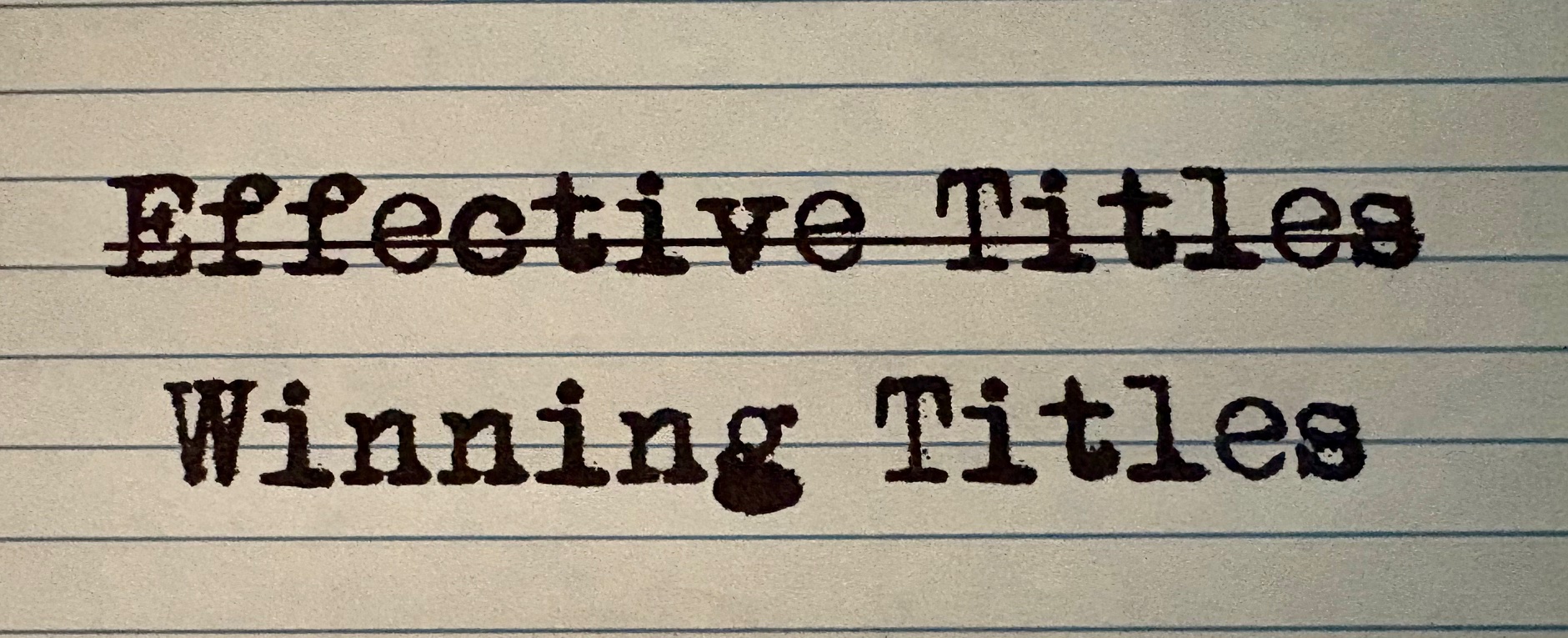
Each of the two literacy narratives listed below were named by more than one student as the narrative with the most effective title. Four students named “G is for Grandma“; two students named “Yo Soy Hockey.”
A title should be intriguing and revealing (as well as relevant), but a title that reveals too much robs the writing of its intrigue. With that in mind, review the titles above and ask yourself whether any of them reveal too much?
A Lesson in Less is More
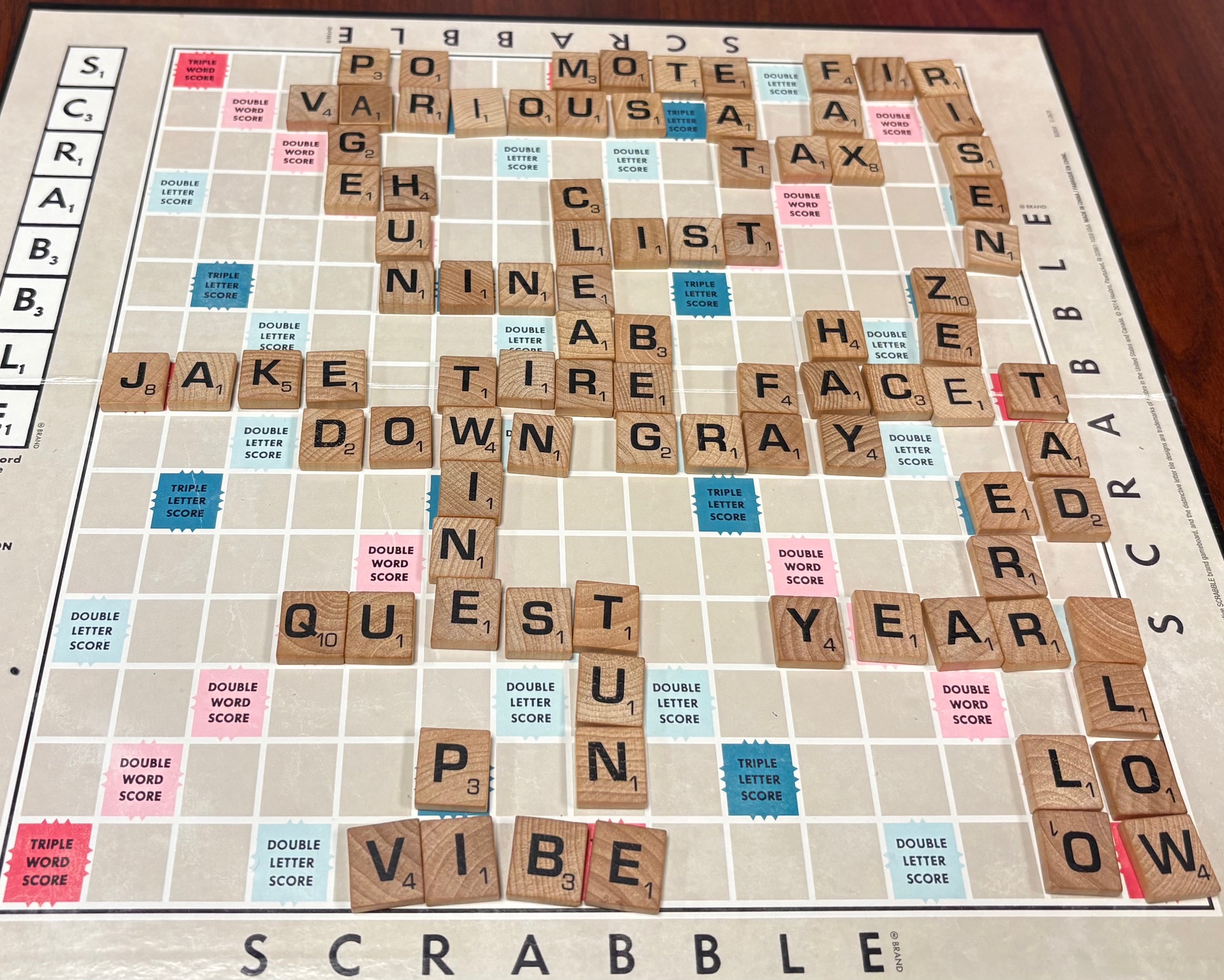
In one of last Friday’s Scrabble games, the one pictured above, the members of team one realized that with the a in age, they could play the letters v, r, i, o, u, and s to spell various. (Note that the p was later added above age.) Playing six letters to form a three-syllable, seven-letter word is an appealing move, especially if it means ridding yourself of undesirable letters, such as v, i, and u–though a u is highly desirable if the q has not been played. However, playing various as team one played in the game above comes with a risk: the placement of the word set up team two to play on the triple-word square, which they did. By playing the four letters m, o, t, and e, team two scored a double-triple through parallel play, forming three words: mote (a tiny piece of substance), mu (a Greek letter), and os (a bone). Various, with its i on a triple letter square earned team one twelve points. The double-triple mote and mu with os earned team two thirty-two points. Team one earned an average of two points per letter played; team two earned an average of eight points per letter played, evidence that less is more.
Next Up
In class on Wednesday, we will read and discuss one of Donald Barthelme’s short stories. That story and the texts we have studied thus far in English 1103–“MeTalk Pretty One Day,” “The Day Language Came into Life,” the excerpt from the first chapter of To Kill a Mockingbird,” and the excerpt from “The Falling Man”–are among the pieces of writing that may serve as the subject of your upcoming analysis. Before you begin drafting that assignment on Wednesday, September 24, we will examine another text that may serve as your subject.
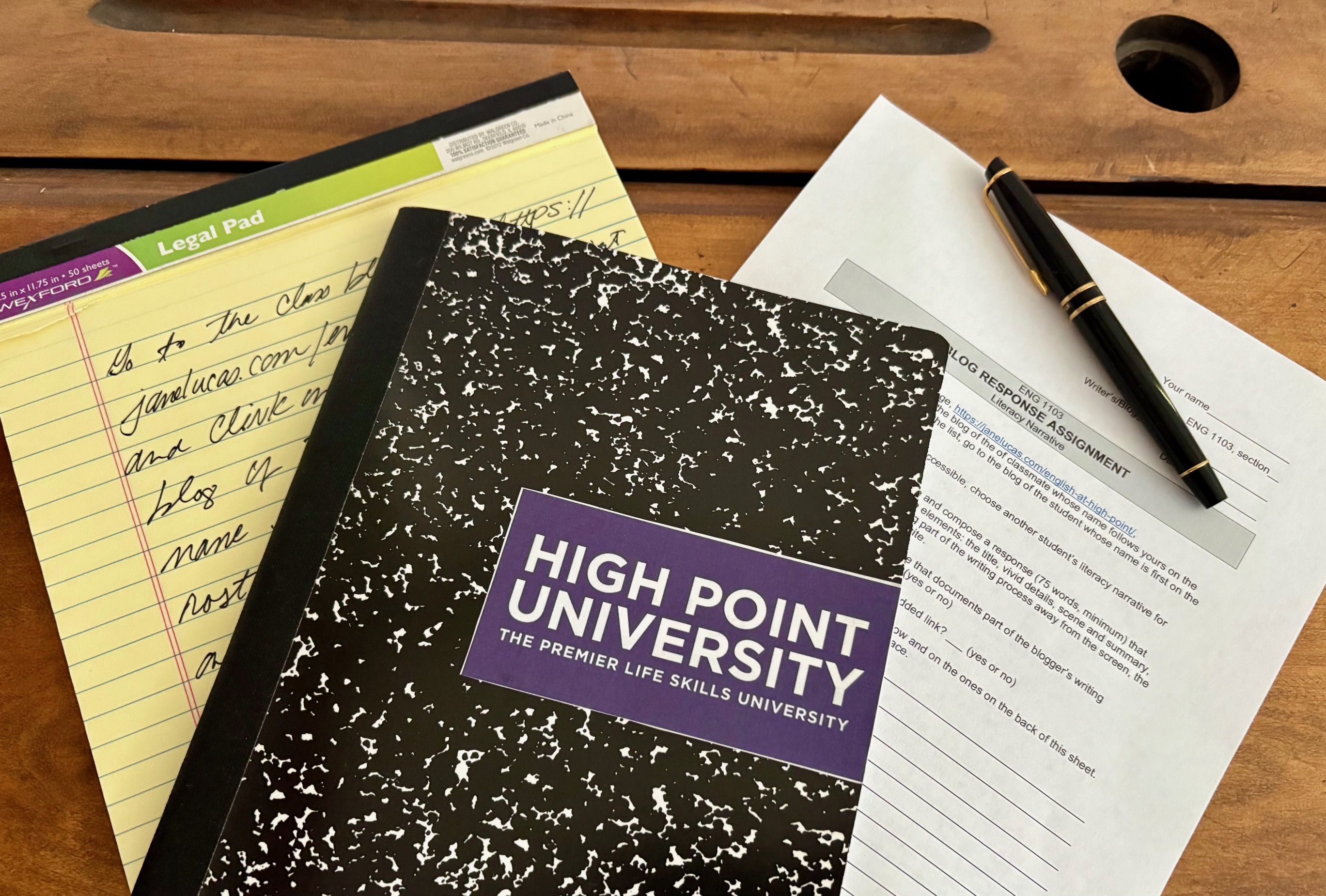
This morning in class you will compose a response to a classmate’s literacy narrative.
Directions
Go to the class blog page, and click on the link for the blog of the of classmate whose name follows yours on the roster. If you are last on the list, go to the blog of the student whose name is first on the list.
If the student’s blog is not accessible, choose another student’s literacy narrative for your response.
Read the classmate’s narrative and compose a handwritten response (75 words, minimum) that addresses one or more of these elements: the title, vivid details, scene and summary, dialogue, the image documenting part of the writing process away from the screen, the embedded link to a relevant website.
Does the blog post include an image that documents part of the blogger’s writing process away from the screen? ____ (yes or no)
Does the post include a relevant embedded link? _____ (yes or no)
After you have composed your handwritten response, review the section of Writing Analytically devoted to basic writing errors, or BWEs (426-44), and correct any that you can identify in your blog response.
Type your response as a comment for the blogger. You should see a leave comment/reply option at the top or bottom of the post. If you do not see that option, click on the title of the blog post, and scroll down. You should then see leave comment/reply.
If you do not think that you will have time to type and post your handwritten comment before the end of class, take a picture of your handwritten response. That will enable you to submit your worksheet at the end of class and post your comment afterward.
Submit this sheet at the end of class today. You will submit this paper copy of your comment because the blogger may not choose to make your comment visible. You will receive credit for this assignment only if you submit this sheet at the end of class today.
If you complete this assignment before the end of class, devote the remainder of the period to one of the following: (1) reading and commenting on other classmates’ literacy narratives, (2) drafting a blog post based on one or more of your Scrabble debriefings, (2) reviewing your reading handouts and determining which one might serve as the subject of your upcoming analysis.
What makes a title effective? That’s an important question to consider since the title contains the first words of yours that a reader will encounter. First, it should be descriptive; it should evoke an image in the reader’s mind. It should also be relevant to your subject; it should convey something about the writing to follow. Lastly, it should be intriguing; it should create in the reader a desire to keep reading. With those traits in mind, review the titles of your classmates’ literacy listed below. Which of these is most effective and why?
“Adapting to a New System”
“Breaking Language Barriers: How I Gained Confidence in Myself”
“Calmáte: A Summer so Fast”
“Challenges You Face”
“Error to Success”
“Finding My Voice with Spanish”
“From Panic to Proficiency”
“From Stumbling to Strength”
“From Terror to Hero”
“Fruitful Smells of Learning”
“G is for Grandma”
“Growing as a Writer”
“Hooked on a Book”
“If You Read, You will Succeed”
“Inside Look into Dyslexia”
“The Importance of Life”
“An Involved Teacher”
“The Journey of the Greatest Story”
“Journey to Literacy”
“The Language Barrier”
“Learning Spanish”
“Learning to Write”
“Lessons from Mr. Brady”
“Looking Back on Reading and Writing Skills”
“Mindset in Motion”
“Morning, Morning!”
“My Battle with Reading”
“My Submergence into the Unknown Realm of Words”
“One, Two, Three, Four, Five Stars for You!”
“The Pen to Paper Routine”
“Pushing through the Brick Wall”
“Removing the Mask”
“Research Paper to Passion”
“Ti Amo: The Unknown Leads to Closure Through Language”
“Who is Most Important to You?”
“Yo Soy Hockey”
Bonus Assignment Opportunity
Directions
Determine which of the titles you deem most effective.
Compose a comment of one complete sentence or more that includes (1) the title enclosed in quotation marks, and (2) a brief explanation of its effectiveness.
Post your comment as a reply to this blog entry no later than 5 p.m. today, Monday, September 15. (To post your comment, click on the post’s title, and scroll down to the bottom of the page. You will then see the image of an airmail envelope with a leave comment option.)
I will approve your responses (make your comments visible) after the 5 p.m. deadline. Commenters will earn a bonus assignment credit in the course work/short assignments category.
Next Up
In class on Wednesday, we will read a short story by Donald Barthelme. As an introduction to him and his fiction, read this biographical sketch. After you read the sketch, compose a one- or two-paragraph journal entry that includes (1) what you have learned about his writing style, and (2) what you have learned about readers’ and critics’ mixed responses to his writing.
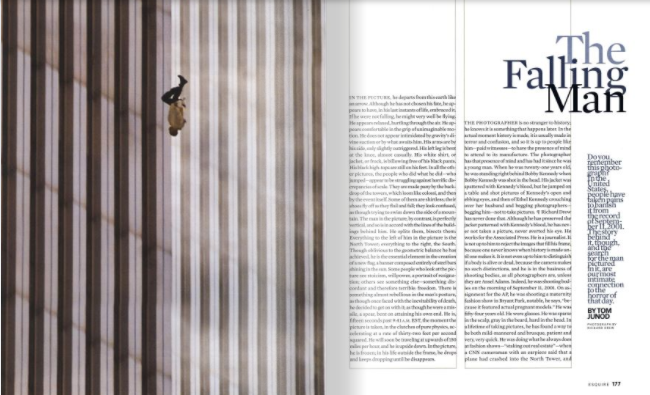
Yesterday in class, before you began composing your reflection, we examined the beginning of Tom Junod‘s article “The Falling Man,” published in Esquire magazine two years after 9-11. One of the elements that we considered–and one that I asked you to address later in your journal–is the unusually long first paragraph.
The authors of Writing Analytically recommend that “[i]f you find a paragraph growing longer than half a page–particularly if it is your opening or second paragraph–find a place to make a paragraph break” (Rosenwasser and Stephen 308). Junod does not follow that advice. He opts instead to open his article with a paragraph of more than four hundred words.
If Junod had chosen to divide the first paragraph, where might he have divided it?
Junod might have started a second paragraph with the words “[i]n all the other pictures,” because there he shifts the focus from the Falling Man to the photographs of other people who jumped from the Twin Towers. An opportunity for a third paragraph comes with the words “[t]he man in the picture, by contrast,” where Junod turns his attention back to the Falling Man. And he might have begun a fourth paragraph with “[s]ome people who look at the picture,” because there he shifts to viewers’ perceptions of the Falling Man.
Generally, one hundred to one hundred and fifty words is a suitable paragraph length. As a rule, you should begin a new paragraph whenyou present a new idea or point. If you have an extended idea that spans multiple paragraphs, each new point within that idea should have its own paragraph. But the first paragraph of “The Falling Man” defies convention. For Junod, choosing not to divide the first paragraph creates an unbroken movement that parallels the unbroken downward flight of his subject, the Falling Man. Outside of the photograph, “he drops and keeps dropping until he disappears.” With “disappears,” the last word of the paragraph,” the Falling Man disappears from the page, and Tom Junod turns to the photographer, whom we learn later in the essay is Richard Drew.
Unless you subscribe to Esquire, the magazine’s paywall will deny you access to the full text of “The Falling Man”; but if you’re interested in reading it in full, you can access it through the HPU Library site by following these steps:
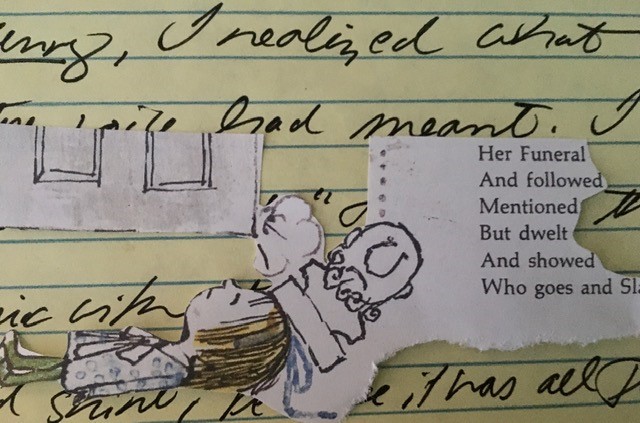
Hillaire Belloc’s “Rebecca,” illustrated by Alice and Martin Provensen
Today in class, we will examine the model literacy narrative “A Bridge to Words,” which you read for today, and you and two or three of your classmates will collaboratively compose a piece of writing that addresses these elements of the essay:
Appositives
Scene
Figurative language
Gaps in memory/what the narrator doesn’t know
The story’s significance, how the writer conveys it subtly
As you continue to revise, consider the role of those elements your own literacy narrative. All of them may not figure in your own story, but scene, at least a brief one, and a sense of the story’s significance are vital. Keep in mind that the story’s significance should be conveyed subtly. Do not tell the reader that the the event was significant, and don’t resort to such trite statements as it made me the person I am today.
A Bridge to Words
To a small child, the pages of a newspaper are enormous. Looking far back through the years, I see myself, not yet school age, trying to hold up those long, thin sheets of newsprint, only to find myself draped in them, as if covered by a shroud. Of course, back then, my inability to hold a newspaper properly was of little consequence. Even if I could have turned the pages as gracefully as my parents did, I couldn’t decipher the black marks on the page; thus, my family’s ritual reading of the newspaper separated them from me. As the youngest and the only one who couldn’t read, I was left alone on the perimeter to observe. My family’s world of written words was impenetrable; I could only look over their shoulders and try to imagine the places where all those black marks on the page had carried them—these people, my kin, who had clearly forgotten that I was in the room.
My sister, who was three years older, had her very own news source: The Mini Page, a four-page miniature paper that arrived at our house as an insert in the Sunday edition. While our parents sat in their easy chairs poring over the state and local news, my sister, Jo, perched at the drop-front desk and occupied herself with articles, puzzles, and connect-the-dots.
Finally, one Sunday, someone noticed me on the margin and led me into our family’s reading circle. Whether it was one of my parents or my sister, I don’t know. I remember only the gesture and the words: someone handing me the Sunday comics and saying, “You can read part of the funny pages, too. You can read Henry.”
I took the giant page and laid it flat in the middle of the oval, braided rug on the floor of the den. Once I situated the page, I lay on top of it with my eyes just inches above the panels of the comic strip. To my parents, my prone position was a source of amusement, but for me it was simply a practical solution. How else was someone so small supposed to manage such a large piece of paper?
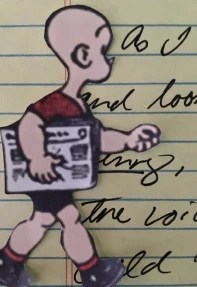
As I lay on the floor and looked at the comic strip’s panels, I realized what the voice had meant. I could “read” Henry, the comic with the bald boy in a red shirt, because it consisted entirely of pictures. In between panels of Henry walking, there were panels of him standing still, scratching his hairless head. I didn’t find Henry funny at all. I wondered how that pale forerunner of Charlie Brown had earned a prime spot in the funnies. Still, I was glad he was there. He was the bridge that led me to the written word.
Reading the wordless comic strip Henry for the first time was the beginning of a years-long habit of stretching out on the floor with newspapers and large books—not thick ones but ones that were tall and wide, among them one of my childhood favorites: The Golden Book of Fun and Nonsense. My sister and I spent hours lying on our bedroom floor, the pink shag carpet tickling our legs as we delighted in the antics of Rebecca, the mischievous title character of one of the poems.
Carl Thomas Anderson’s comic strip character Henry
“Rebecca”—which my sister read to me before I could read it myself—introduced me to the word “abhors,” the very sound of which appealed to me. Sometimes before Jo had finished reading the opening lines, my uncontrollable giggles collided with her perfect mock-serious delivery. As the last word in the first line, “abhors” serves as a lead-in to an enjambment: the continuation of a sentence or clause in a line break. It would be years before I learned the term “enjambment,” but I was immediately swept away by its effect in the opening lines: “A trick that everyone abhors/ In Little Girls is Slamming Doors” (Belloc 61). The first line lured me into the second one, and so on and so on. I was drawn both to the individual word “abhors”—with its side-by-side “b” and “h,” rare in English—and the way the words joined, like links in a chain, to yank me giggling through Rebecca’s cautionary tale:
It happened that a marble bust Of Abraham was standing just Above the door this little lamb Had carefully prepared to slam, And down it came! It knocked her flat! It laid her out! She looked like that.
Her funeral sermon (which was long And followed by a sacred song) Mentioned her virtues, it is true, But dwelt upon her vices too, And showed the dreadful end of one Who goes and slams the door for fun. (61)
Why these particular early memories visit me now, I don’t know. Perhaps rereading Art Spiegelman’s graphic memoir Maus with my students has roused the wordless Henry and the word-filled Golden Book of Fun and Nonsense from the corner of my brain where they’ve slumbered. The former wakes and stretches out in my mind as a bridge to the latter: a spot in the world of words I’ve inhabited ever since.
In the second half of today’s class, I will take you through the steps posting your literacy narrative to Blackboard and WordPress. If you are absent from class or need a review, watch these YouTube videos on submitting an assignment to Blackboard and publishing a post on WordPress.
Contractions: Are They or aren’t They Permissible?
It isn’t surprising that contractions, such as “couldn’t” for “could not,” appear in “A Bridge to Words” because it’s a personal narrative with a conversational voice. But sometimes students are uncertain whether they should use contractions in traditional academic assignments, ones of a more formal nature, such as the other major writing assignments you will produce for English 1103.
Sometimes students are told that they can’t cannot use contractions in formal writing, but MLA style does permit their use. The MLA Style Center notes, “there is nothing inherently incorrect about contractions.” But the website goes on to state that in some contexts and for reasons of clarity, avoiding contractions may be preferable. In your writing assignments for English 1103, use contractions sparingly. Your literacy narratives are an exception to that rule because of their personal nature.
Some professors may prohibit the use of contractions in writing assignments. If you’re uncertain whether a professor permits them, ask.
Rosenwasser, David and Jill Stephen. Writing Analytically, 9th edition. Wadsworth/Cengage, 2024.
Writing Analytically
For Wednesday, read “On Keeping a Writer’s Notebook” (157-58) and “Writing from Life: The Personal Essay” (161-64). Those sections of the textbook serve as companion pieces to your writing thus far in English 1103, and reading and taking notes on those sections will prepare you to compose part of the reflective essay you will write in class on Wednesday.
After you have read and taken notes on “On Keeping a Writer’s Notebook” and “Writing from Life: The Personal Essay,” choose a phrase, clause, or sentence relevant to your writing process and draft in your journal a short passage that connects that quotation to your writing. That passage will serve as part of your reflection. Here are the instructions that will be included on the handout that I distribute on Wednesday:
Directions
Include in your reflection a minimum of one relevant quotation from the textbook, Writing Analytically, from the section “On Keeping a Writer’s Notebook” or from “Writing from Life: The Personal Essay.” Introduce your quotation with a signal phrase and follow it with a parenthetical citation.
Remember that the writing that follows the quotation should demonstrate its relevance. Although you are required to include a quotation, its presence in your writing shouldn’t seem obligatory. In other words, the quotation shouldn’t appear to be there simply because you were required to include it.
Example
When I began planning my literacy narrative, I was skeptical of the assertion that “the more you write, the more you’ll find yourself noticing, and thus the more you’ll have to say” (Rosenwasser and Stephen 157). However, as I wrote in my notebook about the difficulty of holding a page of newspaper when I was a preschooler, I once again saw how those long, thin sheets of newsprint would drape over me. Then I saw my parents holding their pages of newspaper with ease, and I was back in the den with them—where I was more than fifty years ago—marveling at their ability to read.
A variation on the previous option is integrating a quotation that serves as an epigraph in Writing Analytically. If you quote an epigraph, which is a quote at the beginning of a book or book section, intended to suggest its theme, you are presenting an indirect quotation.
Example
In The Situation and the Story, memoirist Vivian Gornick observes: “What happened to the writer is not what matters; what matters is the large sense that the writer is able to make of what happened” (qtd. in Rosenwasser and Stephen). That notion of what matters became apparent to me as I drafted the conclusion of my essay. The story itself is not dramatic but the bridge it delineates—the one that connects my preliterate self to my reading self—signifies a vital crossing point in my life.
The words that I quote are Vivian Gornick’s, but the source is the textbook Writing Analytically. That is why the parenthetical citation begins with qtd. in, to indicate that the words are quoted in David Rosenwasser and Jill Stephen’s book.
At the end of your reflective writing, you will include a work cited entry for the section of the textbook that you quoted. See the samples below.
Sample Works Cited Entries
Rosenwasser, David and Jill Stephen. “On Keeping a Writer’s Notebook.” Writing Analytically, 9th edition. Wadsworth/Cengage, 2024. pp. 157-58.
Rosenwasser, David and Jill Stephen. “Writing from Life: The Personal Essay.” Writing Analytically, 9th edition. Wadsworth/Cengage, 2024. pp. 161-65.
Next Up
In class on Wednesday, you will compose a short reflective essay focusing on the process of planning, drafting, and revising your literacy narrative. If you are still in the process of completing your essay on Wednesday (since you have until Friday morning’s hard deadline to post it) your reflection will address your work in progress.

 Jane Lucas