Yesterday before you you began your revision work, we examined a page (pictured above) from Harper Lee’s novel To Kill a Mockingbird. That page from the first chapter serves as a valuable model for three narrative elements: summary, scene, and dialogue–at least two of which will figure in your literacy narrative.
The first paragraph of the passage summarizes the characters’ circumstances, designating the “summertime boundaries” (12) within which the narrator, Jean Louise, “Scout,” Finch, and her older brother, Jem, may play outdoors. The short one-sentence paragraph that follows continues the summary, informing readers that the summer Scout has just summarized is the one in which Dill (Charles Baker Harris) first visits Maycomb, Alabama.
With the first words of the next paragraph, “[e]arly one morning,” Scout shifts from summary to scene (12). All of the remaining paragraphs except the final one continue the scene with dialogue. Scout returns to summary with the words “Dill was from Meridian” (12).
Note that Harper Lee begins a new paragraph whenever the speaker changes. Also note that every line of dialogue does not include a dialogue tag, such as “he said” or “she said.” If a passage of dialogue includes only two speakers, none of the paragraphs require dialogue tags after the speakers’ first lines because the start of a new paragraph signals to the reader that the other person is speaking. If a dialogue includes three or more speakers–such as Scout’s conversation with Jem and Dill–occasional tags are essential.
Lessons in Punctuation
The excerpt from To Kill a Mockingbird also demonstrates how to use a variety of punctuation marks, including em dashes, hyphens, and commas.
Harper Lee uses em dashes to set off “Miss Rachel’s rat terrier was expecting” (12) from the rest of the sentence because it is nonessential. It adds details, but the sentence can function without them. An em dash is used before and after phrases that are nonessential. Note that there is no space before or after the dash, which is made with two strikes of the hyphen key.
Jem asks if Dill is “four-and-a-half”? Hyphens appear between those words because multiple-word numbers are hyphenated.
Near the end of the excerpt, “Mississippi” and “Miss Rachel” (12) are both set off by commas because those details are nonessential. Commas are used to set off single words and short phrases of nonessentials the way that em dashes are used to set off longer units of words.
Work Cited
Lee, Harper. To Kill a Mockingbird. Lippincott, 1960. p. 12.
Yesterday morning, after your quiz and Scrabble debriefing, we examined “The Day Language Came into My Life,” the fourth chapter of Helen Keller’s autobiography, The Story of My Life. The details of her literacy narrative that we considered include these:
Keller draws on her sense of touch to render her world to us because she cannot see or hear. She writes of the warmth of the sun “on her upturned face” (par. 2) as she depicts herself waiting for the arrival of her teacher, Anne Mansfield Sullivan. Aim to use relevant sensory details in your own literacy narrative.
In the conclusion of her chapter, Keller writes, “I learned a great many words that day. I do not remember what they all were; but I do know that mother, father, sister, teacher were among them” (par. 9). In writing those words, Keller makes both what she doesn’t remember and what does remember part of her story. You may not remember all of the details of a memory from your childhood, but the details you do remember will render your narrative more vividly. And if there’s something you don’t remember, that uncertainty–as Keller demonstrates–can be on the page, too.
She spells out the words that her teacher spells for her by forming each letter one at a time in Keller’s hand. If you are writing about learning to spell words, let the reader see that on the page as Keller lets her reader see: “‘w-a-t-e-r’ is water” (par. 6).
In “Me Talk Pretty One Day,” David Sedaris does not spell out the French words he is learning to speak, but he does include nonsense words, such as “meimslsxp” (167), to convey his lack of understanding. If you are writing about learning a second language, consider following Sedaris’ lead and using nonsense words–not his but ones of your own making–to convey your initial confusion. Also, try including one or more words of the language itself. Remember that words you write that are not English words–nonsense words included–are italicized.
Work Cited
Keller, Helen. “The Day Language Came Into My Life.” https://janelucasdotcom. files.wordpress.com/2025/08/a0461-3.thedaylanguagecameintomylife_keller.pdf.
Sedaris, David. “Me Talk Pretty One Day.” Me Talk Pretty One Day. Little Brown, 2000. pp. 166-73.
A Pair of Samples
As you prepare to revise your own literacy narrative, review the two samples that we examined in class. While the first, “Creativity is Key,” is admirable for its conversational voice, it lacks the structure and development it needs. It is not a story, it does not meet the minumum length requirement, and it is marred by errors of punctuation, mechanics, and style.
The second sample, “Giving a Speech: Worst Nightmare to Best Feeling” is a much better effort. The essay is a narrative, not simply a series of sentences, and the writer gracefully shifts from summary to scene. Note that a significant portion of the story is presented through scenes with diaogue.
The second part of the title, “Worst Nightmare to Best Feeling,” is an appositive, which is a phrase that offers additional information about the word or phrase that precedes it. Appositives are effective ways to develop your writing. You are welcome to include one in the title of your literacy narrative, but don’t fashion one that tells the reader too much. Your title should offer a window into your essay, but it should not be a spoiler.
Pop Quiz
Rather than listing the answers to the questions on yesterday’s quiz, I have followed each question below with a note regarding where to find the answer. By finding the answers yourself, you will learn more than you would from simply reading them in a list.
In “The Day Language Came into My Life,” Helen Keller recounts what happened on that day, three months before she turned seven. Name one detail from that day. See your copy of “The Day Language Came into My Life.”
What is the style used for formatting files and documenting sources in papers for courses in English and many other courses in the humanities (philosophy, classics, religious studies, art history, and foreign languages)? See the August 29 class notes.
The class notes “ENG 1103: Matters of Style” includes details about formatting papers in the style you will use for English 1103. Name one of those details. See the August 29 class notes.
What is the topic of the most recent blog post devoted to Scrabble? Note that Scrabble is the subject, not the topic. The topic is something more specific. See the August 28 class notes.
What have you learned about writing from the Writing Notes handout distributed on August 20 or from the annotations on your introductory reflection or on one of your group exercises? Briefly note the rule or guideline. See your Writing Notes handout, your introductory reflection, and your group exercises.
Your quiz also included a bonus opportunity. Possible answers for that bonus are found in the class notes for August 21, August 22, and August 28.
Next Up
Tomorrow you will continue work on your own literacy narratives. At the beginning of class, I will return your rough drafts with my notes, and you will have the remainder of the class period to revise on your laptops. You will have an additional week to continue revising before posting your literacy narrative to Blackboard and to your WordPress blog. The due date is Wednesday, September 10 (before class); the hard deadline is Friday, September 12 (before class).
Together, Sedaris‘ essay and Keller’s chapter demonstrate two vastly different ways to present a literacy narrative. “Me Talk Pretty One Day” offers a quirky look at the challenges of learning French from a sarcastic, soul-crushing instructor. Keller’s story poignantly recounts learning to make meaning through the sign language of her teacher, Annie Sullivan, learning that certain finger positions mean “water” for those who cannot hear it, and for others, like her, who can neither see nor hear it.
Sample Student Essays
After we study Keller’s chapter, will examine two literacy narratives written in a previous semester. After you read and annotate the essays, you and two or three of your classmates will collaboratively compose a short assessment of each narrative.
In each assessement, consider whether the essay focuses on one of the following options for topics:
A memory of a reading or writing assignment that you recall vividly
Someone who helped you learn to read or write
A writing-related school event that you found humorous or embarrassing
A particular type of writing that you found (or still find) especially difficult or challenging
A memento that represents an important moment in your development as a reader or writer
Also determine whether each essay fulfills the requirements listed below.
A well-told story
Vivid detail
Some indication of the narrative’s significance
A minimum of 600 words
A title that offers a window into the essay
After you have composed your assessment, you will review the grade criteria and assign a letter grade to each narrative.
Literacy Narrative Grade Criteria
An A literacy narrative complies with all assignment guidelines: It presents a well-told story, includes vivid details, and conveys the story’s significance in a way that demonstrates a depth of understanding. An A literacy narrative is also well organized and relatively free of surface errors.
A B literacy narrative complies with all assignment guidelines but may convey the significance of the story in a superficial way, may have issues with organization, or may be flawed by surface errors.
A C literacy narrative complies with most but not all assignment guidelines and may be flawed by issues of organization and/or surface errors.
A D literacy narrative complies with only a few of the assignment guidelines and may also be flawed by issues of organization and/or surface errors.
An F literacy narrative fails to comply with most or all assignment guidelines and may also be flawed by substantial issues of organization and/or surface errors.
Next Up
On Wednesday you will continue work on your own literacy narratives. At the beginning of class, I will return your rough drafts with my notes, and you will have the remainder of the class period to revise on your laptops. You will have an additional week to continue revising before posting your literacy narrative to Blackboard and to your WordPress blog. The due date is Wednesday, September 10 (before class); the hard deadline is Friday, September 12 (before class).
Today in class, you will begin planning and drafting your first essay assignment, a literacy narrative, which is an account of a learning experience involving reading, writing, or learning to speak a language.
Begin by asking yourself some of these questions: How have you come to think about yourself as a reader or writer? What were some of your most formative experiences as a reader or writer? What are some of the dos and don’ts you have learned about writing? How has what you have learned about reading or writing enhanced your confidence and skill in that role? You don’t need to respond to all of those questions. Try picking one or two as a starting point, then begin bringing one of those experiences to life.
Your aim is to recreate your experience on the page and then to reflect on its significance. Your focus may be any one of the following:
a memory of a reading or writing assignment that you recall vividly
someone who helped you learn to read or write
a writing-related school event that you found humorous or embarrassing
a particular type of writing that you found (or still find) especially difficult or challenging
a memento that represents an important moment in your development as a reader or writer
learning to speak a second langauage
Detailed instructions are included in the assignment handout that you will receive in class today. An additional copy of the handout is posted on Blackboard in the essay assignments folder.
One of the aspects of David Sedaris‘ essay that you examined yesterday was his movement from summary to scene and vice versa. The first of those occurs with these words of his teacher’s: “If you have not meimslsxp or lpgpdmurct by this time, then you should not be in this room” (par. 4). Sedaris alternates summary and scene throughout his essay. As you begin planning and drafting your own literacy narrative tomorrow in class–and as you continue to write–look back at “Me Talk Pretty One Day” and note how Sedaris uses summary and scene as building blocks.
You also identified Sedaris’ use of similes, metaphors, and hyperboles, including these:
David Sedaris employs a simile when he describes himself as “not unlike Pa Kettle trapped backstage at a fashion show” (par. 3).
Sedaris fashions a metaphor with the words “everybody into the language pool, sink or swim” (par. 4).
The essay “Me Talk Pretty One Day” features the hyperbole “front teeth the size of tombstones” (par. 7).
David Sedaris uses a simile when he writes that one classmate’s introduction sounds “like a translation of one of those Playmate of the Month data sheets” (par. 10).
The author of “Me Talk Pretty One Day” turns to hyperbole when writes, “The teacher killed some time accusing the Yugoslavian girl of masterminding a program of genocide” (par. 14).
Sedaris’ teacher insults him with a simile when she remarks, “”Everyday spent with you is like having a cesarean section'” (par. 27).
The bulleted sentences above follow the format that you should follow in your group exercises that require quotations. These are the specific guidelines to remember:
The answer should be a minimum of one sentence. It need not be a long sentence, but it should include concrete detail.
The sentence should not begin with a quotation. Though journalists, fiction writers, and memoirists sometimes begin sentences with quotations, in academic writing, quotations are introduced with signal phrases.
Do not foreground the paragraph or page number in a sentence. The most important feature of the sentence is the writer’s particular use of words. The page or paragraph number follows in the parenthetical citation.
Work Cited
Sedaris, David. “Me Talk Pretty One Day.” Me Talk Pretty One Day. Little Brown, 2000. pp. 166-73.
“What’s in a Name” Follow-Up
Friday’s blog entry offered a bonus assignment credit to any student who posted a response that identified the classmates whose names are also common nouns, which makes them playable Scrabble words.
Kudos to Annaliese Abboud, Cameron Anderson, Haven Tucker, and Bailey Upchurch for correctly identifying playables names.
Below are the complete lists of the students in sections 8 and 18 with playable names. Their playable names appear in boldface type.
Section 8
Gi (a white garment worn in martial arts) Amitrano
Aly Deters (to discourage)
Calla (a tropical plant) Dickey* (a blouse front)
Amanda Franco (a monetary unit of Equatorial Guinea)
Chloe Freeman (a free person)
Raven (a large black bird) Houston
Campbell Nelson (a wrestling hold)
*Calla Dickey is no longer enrolled in section 8; she remains in the list because her first and last names offer opportunities for learning additional playable words.
Section 18
Adrienne and Kamauri Brown (a color created by mixing all three primary colors: red, yellow, and blue)
Grayson Crouch (to stoop)
Garrett Hickey (a scar, especially one caused by a love bite)
Heloise Richer (the comparative form of rich)
Haven (a shelter) Tucker (to tire)
Bailey (an outer castle wall) Upchurch
For their efforts, Annaliese, Cameron, Haven, and Bailey will receive a bonus assignment credit in the short assignments (course work) category
I may offer additional bonus assignments, so be on the lookout for those. Reading all of the notes that I post for you here, on my blog, will ensure that you don’t miss those opportunities.
Next Up
In class tomorrow, you will begin drafting your first major writing assignment longhand. The assignment, a literacy narrative, is an account of a learning experience involving reading, writing, or learning to speak a language. As part of your prewriting process, look back at “Me Talk Pretty One Day” and consider how you might incorporate into your own essay some of the same elements that David Sedaris includes in his.
For the cast and production staff of Stained Glass Playhouse‘s Picnic–meditations on William Inge’s play and the book that Millie reads:
William Inge’s choice to place The Ballad of the SadCafé in the hands of Picnic’s Millie Owens—along with his choosing to write, in the words of Alan Seymour, that it’s “on the reading list at college” (22)—denotes the popularity and stature that Carson McCullers’ novella achieved in a short time. Houghton Mifflin published The Ballad of the Sad Café in 1951; Picnic debuted in 1953. But Inge’s inclusion of McCullers’ novella isn’t simply a nod to a then-recent work. For Inge, Ballad serves as a countermelody, at times complementing his own themes and at times appearing as a reflection of Picnic in a funhouse mirror.
At first glance, the stories seem disparate, just as at first glance Ballad’s Lymon Willis isn’t what he appears to be. When a townsperson spots him in the distance, he says, “‘A calf got loose’” (399). Moments later, someone else says, “‘No, it’s somebody’s young’un.’” But Lymon is neither. As he draws nearer, it becomes clear that he is “a hunchback . . . scarcely more than four feet tall” (399). Though physically, he couldn’t be further from Picnic’s “exceedingly handsome” Hal Carter (7), both Lymon and Hal are the archetypal stranger-come-to-town.
Welcoming the stranger, as Helen Potts does, comes as no surprise. As Flo Owens observes, Helen “takes in every Tom, Dick, and Harry” (11). Conversely, Amelia Evans, the usually stand-offish storekeeper, has never taken in anyone before Lymon shows up and claims her as kin. But the sociability of Lymon—Cousin Lymon as Miss Amelia comes to call him—leads her to transform her store into a nightly café that offers a gathering spot in the spirit of the back porches of Helen and Flo. Yet despite the popularity of Cousin Lymon and the café he inspires, some of the townspeople are scandalized when he takes up residence in Miss Amelia’s rooms above the café:
[A]ccording to Mrs. MacPhail, a warty-nosed old busybody who is continually moving her sticks of furniture from one room to another, according to her and to certain others, these two were living in sin. If they were related, they were only a cross between first and second cousins, and even that could in no way be proved. Now, of course Miss Amelia was a powerful blunderbuss of a person more than six feet tall—and Cousin Lymon was a weakly little hunchback reaching only to her waist. But so much the better for Mrs. Stumpy McPhail and her cronies, for they and their kind glory in conjunctions which are ill-matched and pitiful. (417)
The notions of Mrs. MacPhail and the other gossips in Ballad are the reasons that Picnic’s Rosemary Sydney labels the book “filthy” and says that “Everyone in it is some sort of degenerate” (22). Though the exact nature of Amelia and Lymon’s relationship is never clear, they are judged not only for their apparent transgressions but also for their unconventional appearances—a testament to the belief that good looks, themselves, are a virtue, a tenet that Picnic’s beauty, Madge Owens, calls into question when she asks, “What good is it to be pretty?” (16).
For all of Madge’s and Hal’s natural good looks, it’s clear that what we behold as beauty is also partly artifice. When Hal tells his friend Alan Seymour about his stint in Hollywood, he says, “[Y]ou gotta have a certain kind of teeth or they can’t use you . . . they’d have to pull all my teeth and give me new ones” (26). When Madge delays getting ready for the picnic, Alan prods her, saying, “Go on upstairs and get beautiful for us” (49). Still, unlike, the cross-eyed, six-foot Amelia and the hunchback Lymon, Madge, with or without powder and lipstick, finds the image in the mirror affirming. As she says to her mother, Flo, “It just seems that when I’m looking in the mirror that’s the only way that I can prove to myself that I’m alive” (42). Yet Madge is as much a misfit as McCullers’ oddballs, a truth signified in the image of her as Miss Neewollah published in The Kansas City Star’s Sunday magazine. Due to a printing error, her mouth appears in the middle of her forehead, rendering her grotesque.
That image of Madge with her mouth in the middle of her forehead is like the woman in the Picasso prints that hang over her sister Millie’s bed, a woman that Madge sums up sarcastically as one “with seven eyes. Very Pretty” (23). Millie knows that works of art “don’t have to be pretty” (23), that the woman with her seven eyes speaks a truth that photographic realism doesn’t. Similarly, The Kansas City Star’s unrealistic photograph doesn’t lie. Objectifying Madge distorts her.
Millie vows that after she graduates from college that she’s “going to New York, and . . . write novels that’ll shock people right out of their senses” (87). Some people, like Ballad’s Mrs. McPhail and Picnic’s Rosemary Sydney, may be shocked. Others, ones with Millie’s own sensibility, will read her books and feel the way Millie herself feels when she reads The Ballad of the Sad Café. When Hal asks her what it’s about, she says, “[I]t’s kind of hard to explain, it’s just the way you feel when you read it—kind of warm inside and sad and amused—all at the same time” (53). The same may be said of Picnic. Near the play’s end, before Hal jumps the train, he says to Madge, “I feel like a freak to say this, but—I love you” (85). We all feel like freaks, Hal. We all are freaks, for that matter; and we love, for better or worse—and all at the same time.
Works Cited
Inge, William. Picnic. 1953. Dramatists Play Service Inc., n.d.
McCullers, Carson. “The Ballad of the Sad Café.” 1951. Carson McCullers: The Complete Novels. The Library of America, 2001. pp. 395-458.
Today in class you will compose a final reflective essay that documents your work in the second half of the semester, focusing on what you consider some of your most significant work and the feature or features of the course that have benefited your development as a writer and a student. Since you have already written a reflective essay on your final essay and annotated bibliography, your final reflection should focus on other assignments and features, including one, two, or three of the following:
Studying one of the texts we have examined in the second half of the semester, including “The Case for Writing Longhand,” The Competition, “Scrabble is a Lousy Game,” Seedlings, “Skim Reading is the New Normal,” “Strawberry Spring,” or the sample final essay and annotated bibliography (“Scrabble as a Game Changer in the College Classroom”)
Writing for an online audience beyond the classroom/creating and maintaining a WordPress blog
Delivering your group presentation on the first four lessons of the Check, Please! course
Collaborating with your classmates on in-class writing assignments
Playing Scrabble/Collaborating with your teammates on Wordplay Day
Writing longhand
Limiting screen time
Keeping a journal
Focus on one, two, or three assignments or features of the course.
Include in your reflective essay the following elements:
A title that offers a window into your reflection
An opening paragraph that introduces your focus and presents your thesis
Body paragraphs that offer concrete details from your work to support your thesis.
A relevant quotation from Writing Analytically or a relevant quotation from one of the texts that we have studied in the second half of the semester. Introduce your quotation with a signal phrase and follow it with a parenthetical citation. Refer to your citation handout for models.
A conclusion that revisits the thesis without restating it verbatim
An MLA-style works cited entry for your source
Sample MLA Works Cited Entries
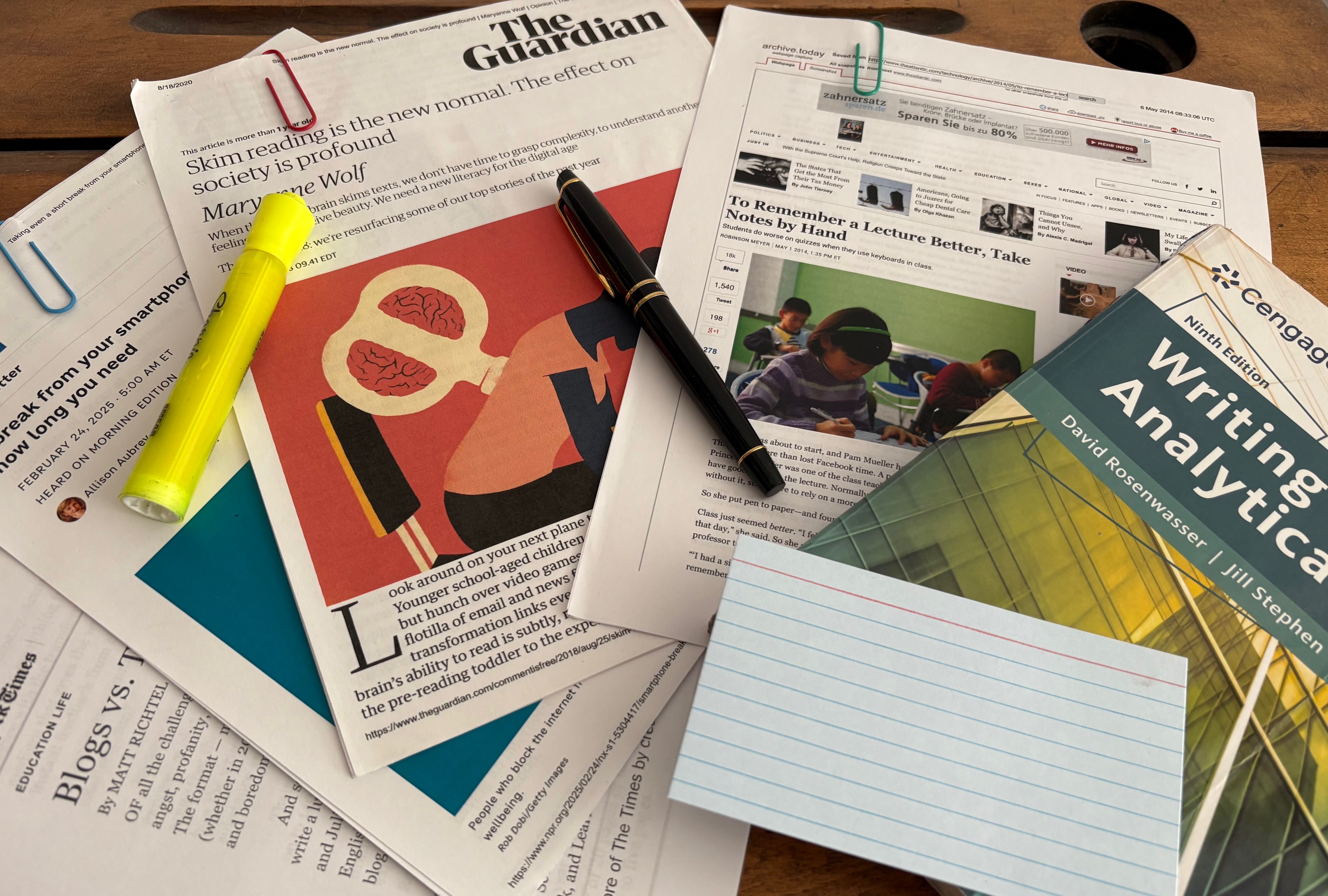
Aubrey, Allison. “A Break from Your Smartphone Can Reboot Your Mood: Here’s How Long You Need.” NPR, 24 Fb. 2025. https://www.npr.org/2025/02/24/nx-s1-5304417/smartphone-break-digital-detox-screen-addiction#:~:text=Researchers%20studied%20what%20happened%20when,felt%20better%20after%20the%20break.
Rosenwasser, David and Jill Stephen. “Arriving at an Interpretive Conclusion: Making Choices.” Writing Analytically, 9th edition. Wadsworth/Cengage, 2024. pp.111-12.
—. “Integrating Quotations into Your Paper.” Writing Analytically, 9th edition. Wadsworth/Cengage, 2024. pp. 343-46.
—. “The Idea of the Paragraph.” Writing Analytically, 9th edition. Wadsworth/Cengage, 2024. pp. 307-313.
—. “Two Methods for Conversing with Sources.” Writing Analytically, 9th edition. Wadsworth/Cengage, 2024. p. 325.
—. “Ways to use a Source as a Point of Departure.” Writing Analytically, 9th edition. Wadsworth/Cengage, 2024. p. 326.
Next Up
In class on Wednesday, you will plan and prepare for the individual oral presentation that you will deliver during the exam period, Tuesday, April 29, at 8 a.m. You will receive a copy of the assignment in class, and it will be featured in Wednesday’s blog post.
Yesterday in class, after we studied Ian Falconer’s New Yorker cover The Competition, we examined Tetsuya Ishida’s painting Seedlings (1998), and you chose one of those two visual texts as the subject of a writing exercise–a bibliographic entry, followed a paragraph of summary and a second paragraph of commentary–as practice is your ongoing annotation work. My versions of the assignment, which I wrote as samples for you, appear below.
Summary
Tetsuya Ishida’s Seedlings depicts a classroom of uniformed Japanese teenagers, all males, whose teacher, seen only from the shoulders down, holds a textbook in one hand. The teacher drapes his other hand on the head of one of the pupils, one of two students presented as microscopes with human faces.
Commentary
Although the subject at hand is biology, the study of living organisms, the student seedlings barely seem alive themselves as they stare blankly into the distance. The uniformity Ishida depicts with their haircuts, crested blazers, striped neck ties, and rows of desks, takes a surrealistic twist with the images of the two pupils who have transformed into microscopes. By placing the teacher’s hand on one of the students-turned-microscope, Ishida indicates that the instructor—himself objectified by the absence of his head—approves of the metamorphosis, that for him, the goal of education is for the individual to be consumed by the subject itself, becoming merely a cold metallic instrument.
. . . and a Second Look at The Competition
Falconer, Ian. “The Competition.” Writing Analytically by David Rosenwasser and Jill Stephen, 9th edition, Wadsorth/Cengage, 2024. p. 108.
Summary
Ian Falconer’s mostly black-and-white New Yorker cover The Competition depicts four beauty pageant contestants, three of whom stand in stark contrast to Miss New York. Her dark hair, angular body, narrowed eyes, tightly pursed lips, and two-piece bathing suit set her apart from the nearly-identical blondes–Miss Georgia, Miss California, and Miss Florida–with wide-open eyes and mouths and one-piece bathing suits.
Commentary
The self-satisfied expression of Miss New York suggests what the authors of Writing Analytically present as the second of two possible interpretations for The Competition: “[T]he magazine is . . . admitting , yes America, we do think that we’re cooler and more individual than the rest of you, but we also know that we shouldn’t be so smug about it” (Rosenwasser and Stephen 112).
Work Cited
Rosenwasser, David and Jill Stephen. Chapter 3: “Interpretation: Asking So What?” Writing Analytically, 9th edition. Wadsworth/Cengage, 2024. pp. 81-118.
Next Up
In class on Wednesday, you will compose a short essay that reflects on the process of researching, drafting and revising your final essay and annotated bibliography. In it, you will include one relevant quotation from the article that served as a starting point for your project or a relevant quotation from Writing Analytically.
Falconer, Ian. “The Competition.” Writing Analytically by David Rosenwasser and Jill Stephen, 9th edition, Wadsorth/Cengage, 2024. p. 108.
Today in class, we will examine Ian Falconer’s New Yorker magazine cover The Competition and a second visual text: Tetsuya Ishida’s painting Seedlings. Following our in-class study of Falconer’s and Ishida’s artwork, you will choose one of the two visual texts to serve as the subject of a writing exercise–a bibliographic entry followed by a paragraph of summary and a second paragraph of commentary–as practice in your ongoing annotation work.
If the style of Ian Falconer’s New Yorker cover seems familiar to you, it may be because you encountered his work when you were a child. His book Olivia, published in 2000, received the 2001 Caldecott Medal, an award the Association for Library Service bestows upon the book they deem the best children’s picture book of the year. Falconer followed Olivia with several sequels, including Olivia Saves the Circus and Olivia Helps with Christmas.
. . . A Model Final Essay and Annotated Bibliography
Scrabble as a Game Changer in the College Classroom
Earlier this month, when I reread Jonathan Kay’s Wall Street Journal op-ed feature “Scrabble is a Lousy Game,” I once again meditated on his criticism of Scrabble as a word game that deemphasizes semantics. In Kay’s words, “Scrabble treats language the way computers do—as arbitrarily ordered codes stored in a memory chip” (par. 7). I asked myself, if I want my students to play a board game that cultivates word power, collaboration, and critical thinking skills, is Scrabble the game to choose? Thus, Kay’s review became the starting point for my research on the benefits of Scrabble play. As I scrolled through search results, I found not only articles that specifically addressed Scrabble in the college classroom but also many that focused on the value of the game itself for sharpening the mind.
The bibliography that follows includes Kay’s review, the starting point for my research, four refereed research articles, and two interviews with former students of mine. Three of the four refereed articles offer windows into the classrooms of professors who have incorporated Scrabble play into their curricula: an English professor at California State University-Monterey Bay, a professor of Christian education at MidAmerica Nazarene University, and a professor of engineering at Tomsk Polytechnic University in Russia. The fourth article addresses cognitive evaluations of competitive Scrabble players and what they reveal about how experience shapes word recognition.
Though Kay’s criticism of Scrabble warrants reconsidering the inclusion of Scrabble in my first-year writing classes, his disapproval of the game stems from the practices of tournament-level players, not people for whom the game is a pastime—or from students, like mine, who play Scrabble as a classroom exercise. It’s also notable that collaboration, which is an essential component of team Scrabble, does not factor in Kay’s review.
In “Tabletop Games and 21st Century Skills Practice in the Undergraduate Classroom,” Mark Hayse and his colleagues who participated in the study report “that tabletop gameplay helped students move from classroom passivity to classroom ‘engagement’” (298). My own students did not address engagement in their interviews with me—though their engagement is evident during Scrabble play—but instead focused on vocabulary building and the relationship of the game to the composing process. Jesse Brewer noted that the game has “introduced [him] to new words,” and Ava Salvant observed that the game has “[p]robably influenced [her] ability to write.”
How much does Scrabble play cultivate our word power? The answer to that question remains unclear, but the research of psychologists and educators points to the merits of team Scrabble for improving not only our language skills but also our facility with critical thinking, team-building, and spatial skills.
As I review the research on Scrabble that I have outlined here, I envision it as groundwork for a larger project, one in which I would use the theoretical framework of composition studies to examine the benefits of incorporating Scrabble play into the first-year writing curriculum. Such a project could be an interdisciplinary one since some of the skills the game promotes, such as collaboration and problem solving, are key to a variety of disciplines. Whether I undertake that project, the knowledge that I have gained will inform my teaching as I continue to seek ways to improve my students’ quality of learning through opportunities for wordplay in the classroom.
Annotated Bibliography
Brewer, Jesse. Interview. Conducted by Jane Lucas. 20 Oct. 2023.
English 1103 student Jesse Brewer recounts how he has played Scrabble for most of his life. Ever since he was a young child, he has played the game with his grandparents whenever he visited their home in Pennsylvania. Brewer will continue to play Scrabble after the end of the semester because the game remains a tradition in his family. In his words, “[M]y grandmother is still going to want to play it every summer.” Brewer also notes how the game has expanded his vocabulary, saying it has “introduced me to new words, which allows me to read and write more capably in everyday life.”
Brewer’s remarks on vocabulary building highlight the game’s verbal benefits, and his observations on Scrabble as a family tradition serve as a point of contrast to that of some other students’—such as Ava Salvant’s—who had not played Scrabble before playing it as a weekly exercise in English 1103.
Brewer is a sophomore computer science major at High Point University, where he was enrolled in English 1103, section 20, in 2023.
“Critical Habits of Mind” addresses the teaching practices of a group of college math andwriting faculty who collaborated to develop lessons to foster intellectual capacities, such as motivation and self-efficacy. Developmental educational instructors from three Californiacolleges, Cabrillo College, California State University-Monterey Bay, and Hartnell College, partnered to pilot classroom activities, including clicker technology, peer writing review, improvisation, metacognitive writing activities, and Scrabble Fridays. Reflecting on their collaboration, Fletcher observes that foregrounding procedural knowledge, as their pilot activities did, enabled them to couple their teaching of discipline-specific content with the set of behaviors essential to teaching and learning. Fletcher notes that Hetty Yelland, who devotes her Friday classes to Scrabble play, observes “the extra effort students have to make to overcome the boredom—and their passive word knowledge . . . eventually leads to more active and internalized language practices” (54).
Fletcher’s account of Hartnell writing instructor Hetty Yelland’s Scrabble Fridays is of particular value to education researchers and teachers considering Scrabble play as a classroom activity that dovetails with discipline-specific content and also fosters foundational learning skills.
Jennifer Fletcher is a professor of English at California State University, Monterey Bay. Her books include Teaching Arguments, Teaching Literature Rhetorically, and Writing Rhetorically.
“How a Hobby Can Shape Cognition” presents the findings of Canadian researchers inthe Departments of Psychology and Medicine at Calgary University who investigated how the word recognition skills of competitive Scrabble players differed from those of age-matched nonexperts. The researchers’ cognitive evaluations revealed differences only in Scrabble-specific skills, such as anagramming. Also, the researchers observed that Scrabble expertise was associated with two specific effects: vertical fluency and semantic deemphasis. The study’s results indicate that experience shapes visual word recognition.
The research of Hargreaves and his former colleagues at Cardiff is pertinent to educators who seek to understand the cognitive benefits of frequent Scrabble play. Notably, the semantic deemphasis that the study identifies—and that Jonathan Kay addresses in his commentary—contrasts the gains in language skills that Hetty Yelland observes in her students.
Ian Hargreaves is professor emeritus of journalism, media, and culture at Cardiff University and one of the contributors to A Manifesto for the Creative Economy, a ten-point plan for bolstering creative industries.
Hayse, Mark. “Tabletop Games and 21st Century Skill Practice in the UndergraduateClassroom.” Teaching Theology & Religion, vol. 21, no. 4, 2018, pp. 288–302., https://onlinelibrary-wiley-com.libproxy.highpoint.edu /doi/epdf/10.1111/teth.12456.
“In Tabletop Games and 21st Century Skill Practice in the UndergraduateClassroom,” the research of Mark Hayse and his colleagues is guided by the primary research question, “Does tabletop gameplay require the practice of 21st century skills?” (290), and their secondary question, “What initial links might be drawn between tabletop gameplay, 21st century skill practice, and undergraduate learning?” (290). All three professors reported “that tabletop gameplay helped students move from classroom passivity to classroom ‘engagement’” (298) and that “[e]ven though tabletop gameplay technically was coursework . . . the nontraditional nature of it seemed to render it as play more than work” (298).
Hayes’s findings are useful for researchers interested in how incorporating table-top game play into college curricula fosters such twentieth-first century skills as critical thinking and problem solving, creativity and innovation, communication, and collaboration. His findings are also of particular value to educators considering adding table-top game play to their secondary- or post-secondary courses.
Mark Hayse is Director of the Honors Program and Mabee Library Professor at MidAmerica Nazarene University. His other publications include an essay on the World of Warcraft, a study of the video game featured in the collection Don’t Stop Believin’: Pop Culture and Religion from Ben Hur to Zombies, edited by Robert K. Johnston, Craig Detweiler, and Barry Taylor.
Kay, Jonathan. Review. “Scrabble is a Lousy Game.” The Wall Street Journal, 4 Oct. 2018. ProQuest, https://libproxy.highpoint.edu/login?url=https://www.proquest.com /newspapers/scrabble-is-lousy-game-why-would-anyone- play/docview/2116081665/se- 2?accountid=11411.
In “Scrabble is a Lousy Game,” writer and editor Jonathan Kay criticizes Scrabble for its lack of emphasis on semantics. In Kay’s words, the game “is like a math contest in which you are rewarded for reciting pi to the 1,000th decimal place but not knowing that it expresses the ratio of a circle’s circumference to its diameter” (par. 5). Kay asserts that the best board games for casual players involve a mix of luck and skill and recommends two other board games, Codenames and Paperback, as better options for wordplay.
While Kay’s review focuses on the competitive player’s approach to Scrabble, the concerns he raises about the game’s deemphasis of word meaning and the frustration that novice players can experience warrant the attention of educators who are researching the potential drawbacks of introducing Scrabble play into their classrooms.
Jonathan Kay is senior editor of the journal Quillette and the author of Your Move: What Board Games Teach Us About Life.
Kobzeva, Nadezda. “Scrabble as a Tool for Engineering Students’ Critical Thinking Skills and Development.” Procedia: Social and Behavioral Sciences, no. 182, 2015, pp. 369-74. ScienceDirect, https://www.sciencedirect.com/ science/article/pii/S1877042815030669.
“Scrabble as a Tool for Engineering Students’ Critical Thinking Skills and Development” presents research involving second-year engineering students and teachers of EFL (English as a Foreign Language) at Tomsk Polytechnic University in Tomsk, Russia. The students, all non- native speakers of English, played Scrabble as an in-class and out-of-class-activity for oneacademic year. At the end of the year, the best six student players competed in teams in a tournament against two teams of the six EFL teachers. Throughout the tournament—which was conducted outside of the classroom to relieve students of the pressure to obtain a high score—the researcher, Nadezda Kobzeva, observed the contrast in the students’ and teachers’ practices as players. While the EFL instructors possessed an advanced knowledge of English language, they were newcomers to Scrabble. On the other hand, the engineering students with limited knowledge of English relied on the skills they developed throughout their year-long Scrabble program. In the feedback the students provided after the tournament, which they won, the majority rated the skills they developed as Scrabble players as excellent in all five fields assessed, including team building, thinking, spatial skills, vocabulary, and spelling.
Kobzeva focuses her research on engineering students, but her findings are also valuable to researchers and teachers in other fields who seek answers to the questions of how Scrabble can be used effectively as a learning tool, and what specific skills students may develop through frequent play. Unlike Mark Hayse’s findings, which focus exclusively on the twenty-first century skills, known as the 4Cs, Kobzeva’s research highlights other skills that students develop—in particular the Russian engineering students’ (non-native speakers of English) greater facility with the English language.
Nadezda Kobzeva is a professor of engineering at Tomsk Polytechnic University. Her other research articles include “Ontology of Key Metasigns in Translatology,” published in V Mire Nauchnykh Otkrytii (In the World of Scientific Discoveries).
Salvant, Ava. Interview. Conducted by Jane Lucas. 23 Oct. 2023.
English 1103 student Ava Salvant reveals that she had never played a game of Scrabble before playing it as a weekly exercise in English 1103. She also notes that the game has “[p]robably influenced [her] ability to write because not always when you sit down to write do you know the exact words that you want to say. You kind of have to go with the flow and put down as many words as you can on the board in Scrabble or on the paper in writing.”
Salvant’s observations as a novice Scrabble player underscore the similarities between game play and the writing process, and they also serve as a point of contrast to that of some other students’—such as Jesse Brewer’s—who bring years of Scrabble experience to their first-year writing class.
Ava Salvant is a sophomore neuroscience major at High Point University, where she was enrolled in English 1103, section 19, in 2023.
Next Up
At the beginning of class on Wednesday we will revisit The Competition and Seedlings, and you will have the remainder of the period to devote to writing your reflection on your final essay and annotated bibliography.
Yesterday’s class focused on a review of the sample student essay and annotated bibliography “The King of Storytelling,” an exercise that should continue to serve as a guide for you as you develop and revise your own essay and bibliography.
The notes that follow address some of the points of content and form that we addressed in our review. As you continue your own research and revision work, revisit these notes as well as the paragraph that you wrote in class yesterday.
Content
The essay’s introduction does fulfill its basic requirements: It addresses the writer’s purpose for compiling it, clarifies what drives the research and what interests the writer in the subject, and also states what questions the writer seeks to answer.
The body paragraphs of the essay do include a minimum of two quotations from two of the five sources; however, the student does not mention all of the sources in the body pargraphs. In the introduction, he lists the five sources, but two of them are simply referred to as “two other articles” (par 1).
The student misses the opportunity to draw on lines from “Strawberry Spring” as examples of the writing strategies that King recommends. In the third and fourth paragraphs, the student mentions King’s advice to avoid using adverbs that end in ly and to avoid passive voice but offers examples of neither.
Consider again the examples that I wrote on the board in class:
“‘He got another one,'” someone said to me, his face pallid with excitement” (273).
“He got another one,” someone said excitedly.
The first sentence, which is King’s, is more effective than the second one because the ly-ending adverb “excitedly,” which modifies the verb “said,” contributes virtually nothing to the story or to the reader’s experience of it. “Excitedly” is abstract; it isn’t something readers can see. They can, however, see a “face pallid with excitement” (273), an image that indicates that the speaker’s heightened state of emotion isn’t all together pleasant since “pallid” is a paleness associated with illness.
Springheel Jack . . . “I saw those two words in the paper this morning” (269).
Springheel Jack . . . Those two words in the paper this morning were seen.
Springheel Jack . . . Those two words in the paper this morning were seen by me.
The first sentence, which is King’s, is more effective than the second and third ones because it is written in active voice. Because the narrator is performing the action in the sentence, seeing the words in the paper, readers are looking over his shoulder, seeing the news story for themeslves. In the second sentence, no one performs the action. In the third, the narrator is present but is the recipient of the action. Both the second and the third sentences distance the reader from the narrator, making them passive observers of a passive narrator.
Including such examples would enable the student to enhance his essay in several ways: (1) he would demonstrate his understanding of active voice, passive voice, and ineffectual ly-ending adverbs, (2) he would illustrate how King draws on his own writing advice in his fiction, and (3) he would synthesize information from a secondary source (Marc Hye-Knudsen’s “How Stephen King Writes and Why”) with information from a primary one (Stephen King’s “Strawberry Spring”).
Such enhancements are always the products of revision. Only after rereading your sources and annotating them can you begin to see how they complement one another.
Form
The parenthetical citations include only the author’s last name, and in some cases only part of the last name. The only quotation that should not be followed by a parenthetical citation is the one from the student’s interview with his classmate.
The bibliographic information for two of the three scholarly sources is incomplete and the entries are marred by errors of mechanics and style.
Wherever the parenthetical citation (Knudsen) appears, the student should have replaced it with a (Hye-Knudsen 8) or (Hye-Knudsen, par. 12), depending on whether the source is paginated. Additionally, if the words are actually Stephen King’s, the student should attribute those words to him with a parenthetical citation for an indirect quotation: (King qtd. in Hye-Knudsen 8) or (King qtd. in Hye-Knudsen, par. 12).
Neither the bibliographic entry for Brown’s article or Hye-Knudsen’s includes the title of the journal where the article was published. The absence of the titles coupled with the absence of page or paragraph numbers in the parenthetical citations may lead readers to wonder whether the student actually accessed and read the articles or simply read abstracts or excerpts. More troubling than the omission of the journal names are the references to Brown’s short article as a book. No careful examination of a text would lead the reader to conclude that it’s a full-length book if it’s only a few pages long.
Next Up
Tomorrow you will have the class period to continue your research and writing. Although you will be working on your laptops and tablets, you will still be required to submit a handwritten exercise at the end of the class period. It will consist of a minimum of two paragraphs, each of which mentions at least two of your sources. The two paragraphs may be paragraphs from your essay, paragraphs from your bibliography, or a combination of the two. I will include sample paragraphs on the assignment as guides for you. You will not receive a grade for the individual exercise itself; instead, it will factor in your final essay and annotated bibliography grade.
Some of you have probably already drafted paragraphs that mention two or more sources, which means that you will simply have to transcribe them for tomorrow’s exercise. If that isn’t the case and you are concerned about completing the two paragraphs by the end of the period, give yourself a head start.