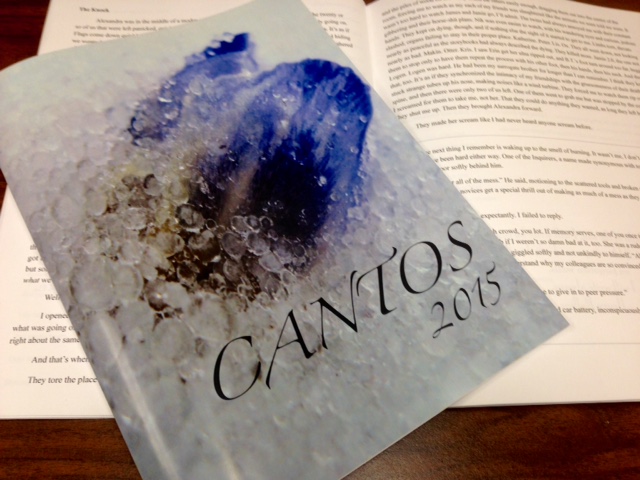
Cantos, Lenoir-Rhyne University’s literary magazine, featuring cover photography by a schwiebert (Annette Schwiebert).
I have taken a break from reading portfolios to offer this short post, one inspired by seeing so many of my students’ names in the pages of Cantos, Lenoir-Rhyne’s literary magazine. From the Italian for song, a canto is a section of a long poem, a chapter of sorts, and the students’ work both in the magazine and in their portfolios for ENG 281 serves as a last canto for the course, a final chapter in a series of innovative exercises that they, and I, have produced in our multi-genre Introduction to Creative Writing course. I look forward to reading their selections in Cantos after I finish reading their portfolios, but the two aren’t mutually exclusive. Some of the pieces in Cantos appear in their portfolios as well.
“Black Dog” and “Regulars” by Ryan Baxter (ENG 281.02)
“Strangers” by Rhonda Cheshire (ENG 281.02)
“Neither Nor was I Made for Either Door” by Charles Clark (ENG 281.02)
“Pigskin” by Peyton Hoyle (ENG 281.01)
“Green Eyes” by Richard Jordan (ENG 281.02)
“Holmes Triumphant” by Kati Waldrop (ENG 281.02)
Cantos also features photography by ENG 281.02 student a schwiebert (Annette Schwiebert) and an essay by Eddie Stiltner (ENG 231, Fall 2014).
Kati Waldrop (ENG 281) serves as Cantos’ Editor-in-Chief, and Peyton Hoyle (ENG 281) and Alexis Monthony (ENG 131, Spring 2014) serve as staff readers.
Before Nadia Bolz-Weber spoke yesterday at Lenoir-Rhyne, the students in my 8 a.m. class and I read an excerpt from her memoir Pastrix: The Cranky and Beautiful Life of a Sinner and Saint (2013). The excerpt, “La Femme Nadia,” depicts the events in late 1991 and early 1992 that led Bolz-Weber to sobriety and to God. For my students and me reading in a “writerly” way, “La Femme Nadia” served as an instructive model for its apt sensory detail (“My skin felt like the rough side of Velcro”), and its graceful shifts from summary to scene:
Margery, a leathery-faced woman with a New Jersey accent, was talking about prayer or some other nonsense when suddenly a sound like a pan falling on the tile floor came up from the kitchen below us. I jerked out of my seat like I was avoiding shrapnel, but no one else reacted. Without skipping half a beat, Margery turned to me, with a long slim cigarette in her hand and said, ‘Honey, that’ll pass.’ She took a drag and went on, ‘So anyways, prayer is. . .’
I did not revisit those details from “La Femme Nadia” with my 12:15 students because their class period coincided with the first of Bolz-Weber’s two March 5 appearances as one of the featured writers in the university’s Visiting Writers Series.
In lieu of our scheduled class, we attended the presentation—one that Bolz-Weber nearly missed due to weather-related travel woes that she recounted with humor and grace.
Her remarks focused on faith rather than writing—she would turn her focus to writing at 7 p.m.–but her 12:15 talk was relevant to writers nevertheless. In response to a question about the Eucharist, she paraphrased Flannery O’Connor and spoke eloquently in her own words: “You have to be deeply rooted in tradition to innovate with integrity.” The same is true of writing and of all other art.
Paul Muldoon was supposed to read at Lenoir-Rhyne last Thursday, as one of the featured authors in the university’s Visiting Writers Series, but the snow kept him away. Day classes were cancelled at the university, too, so my students and I didn’t read his poem “Hedgehog” together as planned. But yesterday, as the rain washed away the lingering snow, we returned to the classroom for our postponed study of poetry, beginning with “Hedgehog.” An early poem of Muldoon’s, “Hedgehog” meditates on the animal of the title as well as the snail, likening the snail to a hovercraft and the hedgehog’s quills to a crown of thorns.
The tentative responses that followed our reading showed how reluctant we can be to express our thoughts about poetry. We are so accustomed to reading straightforward prose that a poem’s roundabout way of making meaning can lead us to doubt ourselves, to sense that there’s something we’re not getting from the poem but should be.
I cannot say precisely why Muldoon chose to run the simile “The snail moves like a/Hovercraft” from the first line to the second, but I can say—and did say to my students—that it’s an example of enjambment, something to try if we want to achieve a similar run-on effect.
As we begin drafting our own poems, I keep thinking about the pleasure of reading that simile, the surprise followed by recognition. Never before had I thought of a snail moving like a propeller-driven hovercraft. And never before had I thought of the hedgehog and the snail as kindred animals for their ability to retreat into themselves.
The snail, the hovercraft, the hedgehog, the crown of thorns: these are now linked in my mind. That’s what “Hedgehog” has given me.
Writing Ideas Torn from “Hedgehog”
A poem that depicts the similarity between two animals and compares each of the two to something else
What distinguishes historical fiction from creative nonfiction about historical events? I’ve been thinking about that question since Katherine Howe’s recent talk at Lenoir-Rhyne. In her February 12 presentation, Howe–L-R’s current writer-in-residence and one of the featured authors in the university’s Visiting Writers Series–spoke about her historical novels and the seemingly contrarian nature of the form:
Historical fiction seems to embody a contradiction. If we want to know what happened, we can consult an archive. If we want a transcendent experience, we read fiction.
As a writer of historical fiction, Howe does both, conducting research for accuracy and crafting fictional worlds that breathe life into the past. When Howe mentioned the question of whether the chandelier in her forthcoming novel burns gas or whale oil—a question her research hasn’t answered yet—I was reminded of Janet Burroway’s reflections on her novel Cutting Stone, set during the Mexican revolution:
In the only historical novel I have ever written, I decided that I could put an ice house in a rural Arizona town several years before there was actually such a thing, but that I could not blow off the arm of a famous Mexican general two years before, historically, it happened (240).
Such blending of fiction and fact differs from creative nonfiction about historical events, not because creative nonfiction doesn’t include a mix—it does, sometimes—but rather because creative nonfiction doesn’t place us in the past.
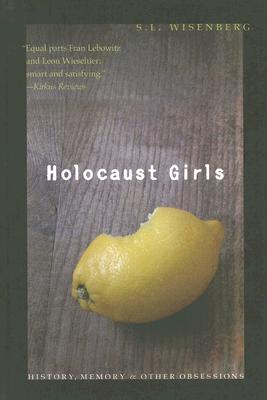
Holocaust Girls (2002) / indiebound.com
Take for example “Margot’s Diary,” (one of the essays in Burroway’s chapter on creative nonfiction in Imaginative Writing), in which writer S. L. Wisenberg speculates about the life of the Frank sister who is unknown to us because her diary didn’t survive, as Anne’s did. Wisenberg writes an un-diary of sorts, an essay in nine sections, the last titled “At Bergen-Belsen, Winter 1945.” But Wisenberg doesn’t place the readers at the concentration camp where Margot died, nor does she place us in the Frank houses in Frankfurt, Germany and Amsterdam in the earlier sections. Instead, Wisenberg imagines what Margot may have written before she “ran out of language” (255). Her aim is not is not to return us to the past, as Howe does, but to leave us with an unfinished portrait that conveys a profound sense of loss.
Wisenberg, S. L. “Margot’s Diary.” Imaginative Writing: The Elements of Craft by Janet Burroway. 3rd ed. Boston: Pearson/Longman, 2011. Print. 252-55.
In Janet Burroway’s chapter on character in Imaginative Writing, she observes that “one of the ways we understand people is by assessing, partly instinctively and partly through experience, what they express voluntarily and involuntarily” (92). I thought of those lines of Burroway’s when I read the prelude to Katherine Howe’s novel Conversion (2014), which my students and I studied as our own prelude to Howe’s upcoming presentation as one of the featured writers in the Lenoir-Rhyne Visiting Writers Series.
Howe’s Prelude: “Salem, Massachusetts, May 30, 1706,” chronicles the first minutes of the narrator’s visit with Reverend Green, an encounter that will apparently end with her confession. (“I’ve come to Reverend Green to make my confession,” she tells us.)
Though Howe doesn’t initially reveal the name of the first-person narrator, Reverend Green calls her Ann, and a later reference to the Putnam family leads readers familiar with the Salem Witch trials to conclude that the narrator is Ann Putnam, one of the key witnesses who publicly apologized in 1706 for her role in the trials.
It isn’t that history, though, that lingers in my mind. Instead it’s what Reverend Green expresses involuntarily when Ann first sees him in his study:
His tongue creeps out the corner of his mouth while he writes, the tip of it black with ink, the blacking in his gums staining his teeth. He looks like he’s got a mouthful of tar. I’ve been waiting for some time, but Reverend Green’s still writing. His quill runs across the paper, scratching like mouse paws. Scratch scratch, dip, scratch, lick, scratch.
Why does Howe present the image of the minister’s mouth blackened by ink intended for the page? What greater discrepancy might that image suggest?
Writing Ideas Torn from the Prelude of Conversion
1. A portrait of a character based on what he or she reveals involuntarily.
2. A narrative that juxtaposes historical and contemporary characters and events.
Burroway, Janet. Imaginative Writing: The Elements of Craft. 3rd ed. Boston, Longman, 2011.
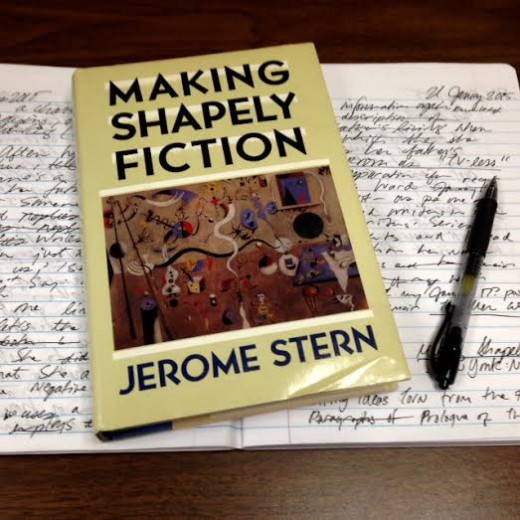
Making Shapely Fiction (1991) with a draft of this blog post
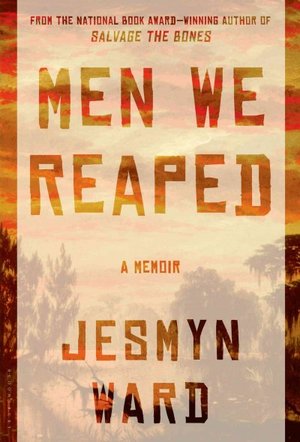
In preparation for Jesmyn Ward’s recent campus visit—as one of the featured writers in the Lenoir-RhyneVisitingWriters Series—my students and I read excerpts from her novel Salvage the Bones (the subject of my January 17 post) and her memoir Men We Reaped. For writers reading greedily, the first paragraphs of Ward’s memoir offer a model of what writing teacher Jerome Stern called negative positive knowledge: “the technique you use when you want to tell readers what is not happening. It addresses the problem of how to call readers’ attention to what a character is not saying, or doing, or thinking” (165). In the prologue, which recounts Ward’s visits to her father in New Orleans after her parents’ separation, her brother, Joshua, tells her that there’s a ghost in her father’s house, that someone died there. After those words, Ward writes: “‘You just trying to scare us,’ I said. What I didn’t say: It’s working” (par. 6). With one line, Ward lets the reader hear both what she did and did not say to her brother. Ward also uses a variation on negative positive knowledge, negative positive setting, when she describes her father’s living room as “TV-less” (par. 2).
Men We Reaped (2013) / npr.org
Writing Ideas Torn from the Prologue of Men We Reaped (and from Making Shapely Fiction)
A scene that conveys what a character is not saying, doing, or thinking
A description of a room that includes something that isn’t there
Stern, Jerome. Making Shapely Fiction. Norton, 1991.
In Imaginative Writing: The Elements of Craft, Janet Burroway notes the importance of becoming a reader of a “writerly sort”:
reading greedily, not just for entertainment but also focusing on the craft, the choices and techniques of the author; ‘reading the greats,’ in novelist Alan Cheuse’s words, ‘in that peculiar way that writer’s read, attentive to the peculiarities of the language . . . soaking up numerous narrative strategies and studying various approaches to that cave in the deep woods where the human heart hibernates’ (3).
Salvage the Bones (2011) / npr.org
Along with reading greedily, my students and I will listen greedily this semester to the observations on craft and technique offered by the writers featured in Lenoir-Rhyne’s Visiting Writers Series, beginning with National Book Award winner Jesmyn Ward, who will read and discuss her work on Monday, January 19. As an introduction to Ward’s fiction, my students and I read the opening pages of her novel Salvage the Bones (2011), which depict a pit bull struggling to give birth. While China, the pit bull, serves as the focus, the beginning of Ward’s novel offers far more than the details of the dog’s labor.
In the first paragraph, Esch, the narrator, says that China “stole all the shoes in the house, all our black tennis shoes Mama bought because they hide dirt and hold up until they’re beaten soft.” With those words, Ward shows how a single sentence can reveal details about more than one character: China, the pit bull that likes to steal “all the shoes,” and Mama, the practical woman, who always bought black tennis shoes “because they hide dirt . . . .”
The second paragraph begins, “What China is doing is nothing like what Mama did when she had my youngest brother, Junior,” introducing Mama’s labor as a point of contrast, providing a transition from the present scene centering on China to the scene seven years earlier of Mama’s own labor and the birth of Junior, who “came out purple and blue as a hydrangea: Mama’s last flower.” Ward doesn’t choose between simile and metaphor; she uses both. Junior is like a hydrangea, and he is a flower, Mama’s last one.
Writing Ideas Torn from the First Paragraphs of Salvage the Bones
A scene that triggers memories of (and cues a flashback to) an earlier event
A sentence that describes more than one character
A sentence that depicts someone or something with both a simile and a metaphor
Burroway, Janet. Imaginative Writing: The Elements of Craft. 3rd ed. Boston: Pearson/Longman, 2011. Print.
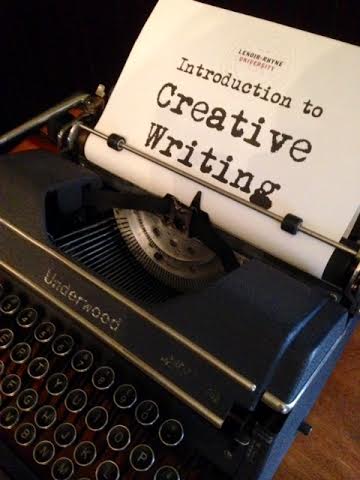
Step One: Type title of course in vintage typewriter font. Step Two: Print title on letterhead. Step Three: Roll letterhead onto platen of Underwood typewriter. Step Four: Photograph typewriter. Step Five: Post photo to course blog page.
And so I began last Tuesday . . . two sections of ENG 281: the first creative writing course I’ve taught since 1999 and my first ever multi-genre classes, featuring not just fiction, but also creative nonfiction, poetry, and one-act plays. I hope they turn out as well as the window dressing.
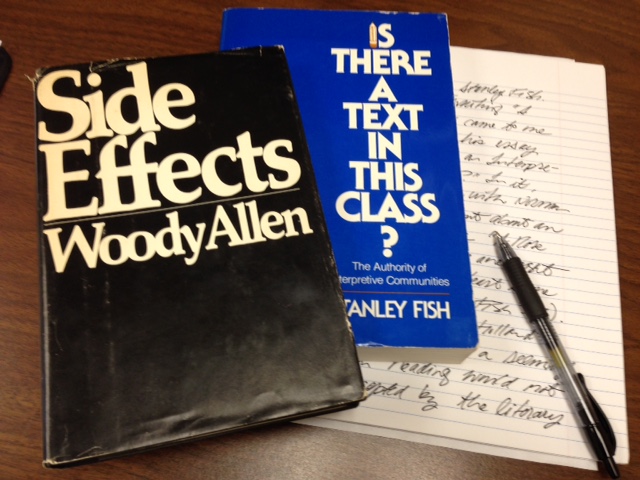
Side Effects (1980) and Is There a Text in This Class? (1980), with a draft of this blog post
Blame it on Stanley Fish. The idea for rewriting “A Rose for Emily” with an Eskimo came to me while reading his essay “What Makes an Interpretation Acceptable?” In it, Fish takes issue with Norman Holland’s argument about an Eskimo reading of “A Rose for Emily”: “We are right to rule out at least some readings” (qtd. in Fish 346). Fish agrees with Holland’s notion that such a seemingly random reading would not be accepted by the literary community, but he disagrees with Holland’s claim that the story cannot accommodate that reading. For Fish, reading the tableau of Emily and her father as an Eskimo could be a legitimate reading of William Faulkner’s story if an interpretive strategy were in place to provide for it.
As I read Fish’s essay, I took little interest in his theory and Holland’s, but I kept picturing an Eskimo inexplicably entering the story and turning it upside down. Because I couldn’t shake that image from my mind, I wrote it down, making “A Rose for Emily,” “another story altogether,” as I subtitled it. Though my adaptation, like Faulkner’s original, consists of five numbered sections, and employs the same first-person plural point of view of the townspeople, Emily finds herself no longer in conflict with her father, with herself, and with societal constraints, but instead with an Eskimo who follows her relentlessly.
In retrospect, I realize that “The Kugelmass Episode” influenced my story as well. Perhaps the first metafiction I ever read, Woody Allen’s story introduced me to the idea of trespassing on a classic work of literature and altering its plot. Though I didn’t draft the story with Allen’s in mind—not consciously, anyway—the Eskimo’s disruption of “A Rose for Emily” echoes the unsettling intrusion of Kugelmass’ in Madame Bovary.
Work Cited
Fish, Stanley. “What Makes an Interpretation Acceptable?” Is there a Text in this Class? The Authority of Interpretive Communities. Cambridge: Harvard UP. 338-55. Print.
From An Eskimo for Emily, or Another Story Altogether
I
When the Eskimo appeared at the Grierson’s house, we all stood by and watched, waiting for Mr. Grierson to chase her away. We knew that he would banish anyone he deemed an intruder, but the Eskimo was another story altogether, which of course is how the trouble began.
At first we suspected that Emily, herself, in the ultimate act of defiance, had willed the appearance of the Eskimo in the tableau. After all, what else could explain the hooded shape that stood in the doorway between Emily and her father?
Thinking that the trespasser was yet another suitor, Mr. Grierson whacked the Eskimo on the head with his horsewhip and stumbled off to fetch some bourbon from the sideboard.
“Who are you?” Emily demanded of the wounded intruder.
Still smarting from the blow, the Eskimo eyed Emily critically and said, “as if you didn’t know.”
Emily didn’t betray her ignorance, as we suspected she wouldn’t. She just tilted her head back and glared at the Eskimo for a while, until she decided to play along, pretending she knew the Eskimo’s kinfolk.
The blog entry that follows differs notably from the version I posted on October 17. The revision, posted October 21, omits many of the plot details of the earlier one and develops the examination of the three types of conflict that Atwood and Paley depict.
Last Thursday, when I gave my students copies of the earlier version as a model for their comparative analyses, I said it was still a work in progress, that there were additional changes I wanted to make. “It’s a serviceable draft”, I told them, “it gets the job done, but it could be better.” This version is better, but it’s still a draft or two from where I’d like it to be.
Why did I give my students the earlier less-polished version? Because I wanted them to have my model in hand a week before their own drafts were due.
That’s the trouble with deadlines: We have to meet them, ready or not.
But that trouble with deadlines also calls attention to the usefulness of imposing earlier deadlines–pre-deadline deadlines–as hard as that is. Two days before my students’ drafts are due, I have an additional model for them.
Stories look like life, but our daily lives don’t follow the pattern of fiction. That discrepancy between art and life forms the basis of both Margaret Atwood’s “Happy Endings” and Grace Paley’s “A Conversation with My Father.” Though stylistically different works of metafiction, Atwood’s how-to guide and Paley’s autobiographical dialogue similarly explore the limitations of plot structure and the artificial quality of endings.
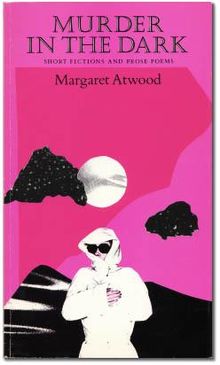
Margaret Atwood’s Murder in the Dark (1983) / wikipedia.org
Atwood’s story takes the form of templates, beginning with A, a happy ending, followed by variations on plot, labeled B, C, D, and so on, that purportedly lead back to A. In B, Atwood’s first story-within-her-story, the narrator chronicles unrequited love as the source of the conflict essential to plot: “Mary falls in love with John but John doesn’t fall in love with Mary” (27). It’s a story, not merely an anecdote, because John and Mary’s opposing desires complicate their relationship: Mary wants love from John; John wants sex, not love, from Mary. The story reaches a crisis when Mary’s friends tell her they’ve seen John in a restaurant with another woman.
In CAtwood’s narrator offers another story of unrequited love but with more complications. Both John and Mary have other partners, and their story develops not only from the conflict between them but also from their internal conflicts: Mary loves James but sleeps with middle-aged John out of pity; while John, despite his love for Mary, cannot bring himself to leave his wife.
Story D lacks the conflicts of B and C. The couple at the center of D “have no problems,” the narrator tells us. Subsequently, D’s plot develops not from the couple’s issues with each other or their internal conflicts. Instead they struggle against a force of nature, namely a tidal wave—until, at the end of the story “[f]inally on high ground they clasp each other, wet and dripping and grateful, and continue as in A” (28).
In the end, Atwood’s narrator doesn’t return to the happy ending of A, though supposedly all of the letter-labeled variations on plot lead back to it. Instead, the narrator asserts that the only authentic ending is death and concludes with these lines:
So much for endings. Beginnings are always more fun. True connoisseurs, however, are known to favor the stretch in between, since it’s the hardest to do anything with.
That’s about all that can be said for plots, which anyway are just one thing after another, a what and a what and a what.
Now try How and Why. (29)
Grace Paley’s Enormous Changes at the Last Minute (1974) / huffingtonpost.com
Atwood’s narrator keeps her distance both emotionally and spatially from the stories she tells, neither becoming a character nor inviting her readers to step into her characters’ lives. That approach makes “Happy Endings” more self-consciously metafictional than Paley’s “A Conversation with My Father.”
Upon the father’s request that his daughter “write a simple story just once more” (756), the daughter-narrator composes a story, which along with their conversation about it, yields the same variations on conflict presented in Atwood’s “Happy Endings” (with B, C, D, etc.), plot propelled by a character’s internal conflict, by a character’s conflict with another character, and by conflict with fate.
The father’s request prompts the first of the story’s conflicts, the daughter’s internal one. She wants to oblige her father by writing the kind of story he yearns to hear, what he calls “the kind de Maupassant wrote, or Chekhov, the kind you used to write” (756). But even as Paley’s narrator expresses her desire to write a story that will appeal to her father, she admits to herself that she hates the kind of story he craves: “I would like to tell such a story, if he means the kind that begins: ‘There was a woman . . .’ followed by plot, the absolute line between two points which I’ve always despised. Not for literary reasons but because it takes all hope away (756).
The story’s second source of conflict, the one between the daughter and her father, stems from the daughter’s story and her father’s dissatisfaction with it. After the daughter reads the first draft aloud, her father says “[y]ou misunderstood me on purpose. You know there’s a lot more to it than that. You know that. You left everything out” (756). To please him, or at least try to, she rewrites the story. She adds what Atwood’s narrator calls the “How and Why” (29), but the daughter’s revision doesn’t satisfy the father, either. He says to her: “I see you can’t tell a plain story” (758), but acknowledges that she was right to conclude the story with the words the end, viewing the end of the story as the end of the woman’s life. The daughter disagrees, telling her father that the end of the story isn’t the end of the character’s life. To give the protagonist, a junkie, a life after her addiction, the daughter revises her story yet again, depicting the woman as overcoming her habit and working as a receptionist at a clinic.
For the father, the daughter’s story still doesn’t ring true. He says to her: “Tragedy! You too. When will you look it in the face?” (759). It’s the same conclusion that Atwood’s narrator reaches, that death is “the only authentic ending” (29). But Paley’s narrator disagrees with her father, and with Atwood’s narrator, proclaiming that “[e]veryone, real or invented, deserves the open destiny of life” (756). The daughter’s resistance to death as the end speaks not only to her frustration with the limitations of plot but also to the sadness and strain of facing her father’s impending death from heart disease: the fate that serves as the third of the story’s conflicts.
The types of conflict Paley dramatizes parallel those of “Happy Endings,” but without Atwood’s templates. Though less self-consciously metafictional, Paley’s conversation and the story-within-a-story that the narrator writes, conveys—as “Happy Endings” does—how the process of story-writing itself is fraught with the conflict that’s essential to the form. As Paley’s narrator says to her father:
Actually that’s the trouble with stories. People start out fantastic. You think they’re extraordinary, but it turns out as the work goes along, they’re just average with a good education. Sometimes the other way around, the person’s a kind of dumb innocent, but he outwits you and you can’t think of an ending good enough. (757)
When the narrator’s father asks how she solves that problem of story-writing, the daughter replies: “Well, you just have to let the story lie around till some agreement can be reached between you and the stubborn hero” (757). In Atwood‘s and Paley’s metafiction, that “stubborn hero” is the writer, herself, and the journey is the process of wrestling once again with the prescribed aesthetic form, with all of the limitations of plot and the artificial quality of the end.
Works Cited
Atwood, Margaret. “Happy Endings.” The Story and Its Writer. Ed. Ann Charters. Compact 9th ed. Boston: Bedford/St. Martin’s, 2014. 27-29. Print.
Paley, Grace. “A Conversation with My Father.” The Story and Its Writer. Ed. Ann Charters. Compact 9th ed. Boston: Bedford/St. Martin’s, 2014. 756-59. Print.
For more on Atwood‘s and Paley’s fiction, see their Paris Review interviews:
Atwood, Margaret. The Art of Fiction No. 121: Interview with Mary Morris. the parisreview.org, The Paris Review, Winter 1990. n.d. Web. 17 Oct. 2014.
Paley, Grace. The Art of Fiction No. 131: Interview with Jonathan Dee, Barbara Jones, and Larissa MacFarquhar. the parisreview.org. The Paris Review, Fall 1992. n.d. Web. 17 Oct. 2014.




 Jane Lucas