Posted in English 1103, Reading, Teaching, Writing

ENG 1103: “Letter from Birmingham Jail”

In Wednesday’s class, before you begin drafting your literacy narrative, I will distribute copies of Martin Luther King, Jr.’s “Letter from Birmingham Jail.” Although I could ask you to listen to a recording of it, I ask that you to read it instead. King’s gift for oratory is well known, but for students of writing, closely examining his words on the page is a more pertinent exercise than listening to his voice.

What makes King’s letter an effective piece of writing? With that question in mind, consider these words in the eleventh paragraph: “Perhaps it is easy for those who have never felt the stinging darts of segregation to say, ‘Wait.’” Here King is addressing his initial audience, the eight white Birmingham-area clergymen who criticized his protest as “unwise and untimely.” He suggests to those men that waiting to act isn’t difficult when you yourself aren’t the victim of injustice, when you haven’t, in King’s words, “felt the stinging darts of segregation.” The sentence is notable not only for the contrast it illustrates between King’s reality and the lives of his readers but also for the words that King uses to show that contrast.

Consider King’s sentence and the paraphrase that follows:

  • Perhaps it is easy for those who have never felt the stinging darts of segregation to say, “Wait.”
  • Maybe it is simple for people who have not experienced segregation to say, “Wait.”

King’s sentence is stronger than the paraphrase that follows it because of the “stinging darts.” Writing that someone has not “experienced segregation” is abstract. Readers do not feel the general experience in the second sentence, but they feel King’s “stinging darts.” Sensory details strengthen sentences by appealing to readers’ senses, and figurative language invigorates writing by making the unfamiliar familiar. King’s white readers have not been the victims of segregation, but his choice of words makes them feel the sting.

While King’s “stinging darts” sentence—a relatively short one—is laudable, the long, winding sentence that follows is nothing short of staggering.

It starts with these words: “But when you have seen vicious mobs lynch your mothers and fathers at will and drown your sisters and brothers at whim.” King presents those atrocities in an introductory dependent clause, one whose full meaning depends on an independent clause that follows. But rather than immediately turning to an independent clause to complete the thought, King expands the sentence with this series of dependent clauses:

  • when you have seen hate filled policemen curse, kick and even kill your black brothers and sisters;
  • when you see the vast majority of your twenty million Negro brothers smothering in an airtight cage of poverty in the midst of an affluent society;
  • when you suddenly find your tongue twisted and your speech stammering as you seek to explain to your six year old daughter why she can’t go to the public amusement park that has just been advertised on television, and see tears welling up in her eyes when she is told that Funtown is closed to colored children, and see ominous clouds of inferiority beginning to form in her little mental sky, and see her beginning to distort her personality by developing an unconscious bitterness toward white people;
  • when you take a cross county drive and find it necessary to sleep night after night in the uncomfortable corners of your automobile because no motel will accept you;
  • when you are humiliated day in and day out by nagging signs reading “white” and “colored”;
  • when your first name becomes “n—,” your middle name becomes “boy” (however old you are) and your last name becomes “John,” and your wife and mother are never given the respected title “Mrs.”;
  • when you are harried by day and haunted by night by the fact that you are a Negro, living constantly at tiptoe stance, never quite knowing what to expect next, and are plagued with inner fears and outer resentments;
  • when you are forever fighting a degenerating sense of “nobodiness”–

The independent clause that readers have been waiting for, the statement that completes the thought is this: “then you will understand why we find it difficult to wait.” Those words could have immediately followed the first dependent clause, but instead King offers nine more dependent clauses, ten darts that sting his readers.

Ten dependent clauses connected by semicolons followed by a dash and an independent clause, a total of 316 words: That is not a structure I recommend for the sentences you write in English 111, but it’s a valuable model, nevertheless.

I hope that you, as citizens, will continue to study the words of his letter. As your writing teacher, I hope that you will return to the sentence that I have examined in detail here. Along with showing his readers why his nonviolent protests could not wait, that sentence of King’s demonstrates how to develop a piece of writing through the accumulation of detail—not just the when, but the when and when and when . . . .


King, Martin Luther, Jr. “Letter from Birmingham Jail.” The Martin Luther King, Jr. Research and Education Institute, Stanford Universityhttps://kinginstitute.stanford.edu/sites/mlk/files/letterfrombirmingham_wwcw_0.pdf.

Posted in English 1103, Teaching, Writing

ENG 1103: Habits of Mind

College writing offers you the opportunity to develop skills, such as supporting arguments with evidence, writing effective thesis statements, and using transitions well, but it also gives you the opportunity to develop habits. Successful college students develop certain habits of mind, a way of approaching learning that leads to success.

In 2011, the Council of Writing Program Administrators (CWPA), the National Council of Teachers of English (NCTE), and the National Writing Project (NWP) identified eight habits of mind that successful college students adopt.

In class on Monday, we began an exercise in written reflection focusing on four of the eight habits of mind. Later in class today, we will begin writing about the four that you did not address in your writing on Monday. The paragraphs that follow include the descriptions of the habits that you examined (and the ones you will examine today), as well as the questions that you answered in writing (and the ones you will answer in writing today).

Curiosity

Are you the kind of person who always wants to know more? This habit of mind will serve you well in courses in which your curiosity about issues, problems, people, or policies can form the backbone of a writing project.

WRITING ACTIVITY: What are you most curious to learn about? What experiences have you had in which your curiosity has led you to an interesting discovery or to more questions?

Openness

Some people are more open than others to new ideas and experiences and new ways of thinking about the world. Being open to other perspectives and positions can help you to frame sound arguments and counterarguments and solve other college writing challenges in thoughtful ways.

WRITING ACTIVITY: In the family or the part of the world in which you grew up, did people tend to be very open, not open at all, or somewhere in the middle? Thinking about your own level of open-mindedness, reflect on how much or how little your own attitude toward a quality like openness is the result of the attitudes of the people around you.

Engagement

Successful college writers are involved in their own learning process. Students who are engaged put effort into their classes, knowing that they’ll get something out of their classes—something other than a grade. They participate in their own learning by planning, seeking feedback when they need to, and communicating with peers and professors to create their own success. Write about a few of the ways you try (or plan to try) to be involved in your own learning. What does engagement look like to you?

WRITING ACTIVITY: Write about a few of the ways you try (or plan to try) to be involved in your own learning. What does engagement look like to you?

Creativity

You may be thinking that you have to be an artist, poet, or musician to display creativity. Not so. Scientists use creativity every day in coming up with ways to investigate questions in their field. Engineers and technicians approach problem solving in creative ways. Retail managers use creativity in displaying merchandise and motivating their employees.

WRITING ACTIVITY: Think about the field you plan to enter. What forms might creativity take in that field?

Persistence

You are probably used to juggling long-term and short-term commitments—both in school and in your everyday life. Paying attention to your commitments and being persistent enough to see them through, even when the commitments are challenging, are good indicators that you will be successful in college.

WRITING ACTIVITY: Describe a time when you faced and overcame an obstacle in an academic setting. What did you learn from that experience?

Responsibility

College will require you to be responsible in way you may not have had to be before. Two responsibilities you will face as an academic writer are to represent the ideas of others fairly and to give credit to writers whose ideas and language you borrow for your own purposes.

WRITING ACTIVITY: Why do you think academic responsibility is important? What kind of experience have you already had with this kind of responsibility?

Flexibility

Would your friends say you are the kind of person who can just “go with the flow”? Do you adapt easily to changing situations? If so, you will find college easier, especially college writing. When you find, for example, that you’ve written a draft that doesn’t address the right audience or that your peer review group doesn’t understand at all, you will be able to adapt. Being flexible enough to adapt to the demands of different writing projects is an important habit of mind.

WRITING ACTIVITY: Describe a situation in which you’ve had to make changes based on a situation you couldn’t control. Did you do so easily or with difficulty?

Metacognition (Reflection)

As a learner, you have probably been asked to think back on a learning experience and comment on what went well or not well, what you learned or what you wished you had learned, or what decisions you made or didn’t make. Writers who reflect on their own processes and decisions are better able to transfer writing skills to future assignments.

WRITING ACTIVITY: Reflect on your many experiences as a writer. What was your most satisfying experience as a writer?  What made it so?


Next Up

Friday marks the first Wordplay Day of the semester. To prepare for class, review the Scrabble Ground Rules posted in Blackboard, as well as the Tips and Tools pages on the Scrabble website. Also, look for a Scrabble tips posts on my blog. Most weeks of the semester, I will publish a post devoted to Scrabble strategies.

Posted in English 1103, Teaching, Writing

ENG 1103: First-Day Follow-Up

Am I the person who will teach your English 1103 class? I posed that question yesterday in class as a starting point for analysis, one of the key features of the course.

To begin the collaboration and inquiry that will figure prominently this semester—along with analysis—you worked together in groups to find the answers to some of the most frequently asked questions about the course. Continue to review the syllabus, which is posted in the Content section of Blackboard. An additional copy of the syllabus is included at the end of this blog entry. If you have any questions about the assignments, the course policies, or the calendar, please let me know.

Textbook

All of you in sections 23 and 24 of English 1103 are required to have the paperback edition of the textbook, Writing Analytically, 8th edition, by David Rosenwasser and Jill Stephen. Bring your copy to class on the days when the title, Writing Analytically, appears in bold on the course calendar. On those days, we will examine portions of the chapters in class and complete some of the exercises related to the reading.

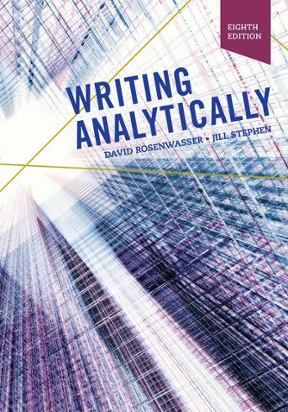
Your first reading assignment in the textbook will be scheduled for mid-September, which will give you ample time to order and receive your copy before you are required to have it in class. (Unlike my copy, pictured at the top of this blog entry, your textbook will not be in a binder.) Your textbook’s cover looks like this:

Other Required Materials

  • Writer’s notebook/journal, bring to every class. 
  • Loose leaf paper (for drafts and short in-class assignments), bring to every Monday and Wednesday class
  • Pen with dark ink, bring to every class
  • Pocket portfolio (for class handouts), bring to every class

WordPress Blog

As practice in developing your web literacy and writing for a broader online audience, you will maintain a free WordPress blog for the class. As soon as possible, create a free blog at wordpress.com. After you create your blog, email the address, or URL, to me, and I will link your blog to our class page, English at High Point. If you encounter technical difficulties creating your blog or publishing a post, email help@wordpress.com or contact the HPU Help Desk: helpdesk@highpoint.edu, 336-841-HELP (3457).

You will post the revisions of all of your major writing assignments both to your blog and to Blackboard. The posts that you publish for class will be public. You are welcome to create additional posts on your own. If you prefer for some of those posts to be private, keep them in draft form or choose the private visibility option. 

You may also be asked to post comments to your classmates’ blogs and to mine.

Posted in English 1103, Teaching, Writing

ENG 1103: The Writing Center

As you continue to revise your final reflection, consider visiting The Writing Center. If you do so, you will earn five bonus points for consulting with a Writing Center tutor.

To schedule an appointment, visit https://highpoint.mywconline.com, email the Writing Center’s director, Justin Cook, at jcook3@highpoint.edu, or scan the QR code below. To earn bonus points for your final essay and annotated bibliography, consult with a writing center tutor no later than Thursday, December 1.

Posted in English 1103, Reading, Teaching, Writing

ENG 1103: Composing the Final Reflection

Monday in class we examined Tetsuya Ishida’s painting Seedlings, which is one of the texts that you may address in your final reflection, which you began drafting in class on Wednesday. If you choose to include Seedlings, your works cited entry for the painting should follow this format:

Ishida, Tetsuya. Seedlings. https://artjouer.wordpress.com/2015/10/29/tetsuya-ishida-paintings/recalled-detail-painting-by-tetsuya-ishida.

Note that the second line of the entry should be indented five spaces.

Sample works cited entries for the other texts you may address in your reflection appear below.

Falconer, Ian. The Competition. Magazine Cover. The New Yorker, 9 Oct. 2000.

Fisher, Max. Prologue: “Consequences.” The Chaos Machine. Little, Brown. 2022.

Junod, Tom. “The Falling Man.” Esquire, vol. 140, no. 3, Sept. 2003, pp. 176+. Gale Academic OneFile Selecthttps://link.gale.com/apps/doc/A106423422/EAIM?u=hpu_main&sid=bookmark-EAIM&xid=ce48797f.

Keller, Helen. “The Day Language Came into My Life.” Chapter Four. The Story of My Life. https://digital.library.upenn.edu/women/keller/life/life.html.

King, Stephen. Strawberry Spring. https://cdn.preterhuman.net/texts/literature/books_by_title/N%20-%20S/Stephen_King/Stephen%20King%20-%20Night%20Shift%20-%20Strawberry%20Spring.html

Lewis, Michael. Chapter One: “Back Story.” The Blind Side. 2006. Norton, 2009. pp.15-16.

Lucas, Jane. “Left to Our Own Devices.” Jane Lucas, 25 Oct. 2022, https://janelucas.com/2022/10/25/left-to-our-own-devices/.

Richtel, Matt. “Blogs vs. Term Papers,” The New York Times, 20 Jan. 2012,  https://www.nytimes.com/2012/01/22/education/edlife/muscling-in-on-the-term-paper-tradition.html.

Rosenwasser, David and Jill Stephen. “Analysis Does More than Break a Subject into Its Parts.” Writing Analytically, 8th edition. Wadsworth/Cengage, 2019. pp. 4-5.

—“Making an Interpretation: The Example of a New Yorker Cover. Writing Analytically, 8th edition. Wadsworth/Cengage, 2019. pp. 84-89.

—. “Integrating Quotations.” Writing Analytically, 8th edition. Wadsworth/Cengage, 2019. pp. 231-33.

—. “Writing on Computers vs. Writing on Paper.” Writing Analytically, 8th edition. Wadsworth/Cengage, 2019. pp. 124-25.

Sedaris, David. “Me Talk Pretty One Day.” Me Talk Pretty One Day. Little, Brown, 2000. 166-73.

Wolf, Maryanne. “Skim Reading is the New Normal. The Effect on Society is Profound.” The Guardian, 25 Aug. 2018, https://www.theguardian.com/commentisfree/2018/aug/25/skim-reading-new-normal-maryanne-wolf.

Posted in English 1103, Teaching, Writing

ENG 1103: Nine Basic Writing Errors, Part II

Last Wednesday class, in you read one of your classmate’s analyses and composed a blog response to that student’s essay. This morning I asked you to revisit that exercise with a classmate’s final essay and annotated bibliography. As part of the assignment, I asked you to look for the nine basic writing errors outlined in Writing Analytically (342). Those errors are as follows:

  • Sentence fragments
  • Comma splices and fused (run-on) sentences
  • Errors in subject-verb agreement
  • Shifts in sentence structure (faulty predication)
  • Errors in pronoun reference
  • Misplaced modifiers and dangling participles
  • Errors in using possessive apostrophes
  • Comma errors
  • Spelling/diction errors that interfere with meaning

Continue to return to the textbook’s pages devoted to the nine basic errors as you work on your writing assignments for English 1103 and your other courses.

Posted in English 1103, Scrabble, Teaching, Writing

ENG 1103: Nine Basic Writing Errors

This morning in class, as part of your blog response assignment, I asked you to look for the nine basic writing errors as you read your classmate’s analysis.

The authors of your textbook, Writing Analytically, identify these as the nine basic writing errors:

  • Sentence Fragments
  • Comma splices and fused (run-on) sentences
  • Errors in subject-verb agreement
  • Shifts in sentence structure (faulty predication)
  • Errors in pronoun reference
  • Misplaced modifiers and dangling participles
  • Errors in using possessive apostrophes
  • Comma errors
  • Spelling/diction errors that interfere with meaning

Next Up

Friday is Wordplay Day. To increase your word power and up your game, revisit the Tips and Tools on the Scrabble website and also review my blog posts devoted to Scrabble.

Posted in English 1103, Teaching, Writing

ENG 1103: The Writing Center

As you continue to revise your final essay and annotated bibliography, consider visiting The Writing Center. If you–or one of your group members does so (if you’re collaborating)–you will earn five bonus points for consulting with a Writing Center tutor.

To schedule an appointment, visit https://highpoint.mywconline.com, email the Writing Center’s director, Justin Cook, at jcook3@highpoint.edu, or scan the QR code below. To earn bonus points for your final essay and annotated bibliography, consult with a writing center tutor no later than Thursday, November 3.

Posted in English 1103, Scrabble, Social Media, Teaching, Writing

ENG 1103: Left to Our Own Devices. . .

The blog post that follows is my version of the final essay and annotated bibliography, which I wrote as a sample for you.

One Teacher’s Meditations on Walden Zones for the Digital Age

In his recent essay “Scrolling,” physician and writer Gavin Francis recounts a visit to the woods near Concord, Massachusetts, where Henry David Thoreau built his cabin and wrote Walden. Although Francis anticipated that the area—now a tourist site—would be busy, what he didn’t expect “was the forest of arms holding smartphones, taking selfies, engaging in video calls.” Francis opens his essay with that anecdote about his visit to Thoreau’s woods to emphasize the pervasiveness of digital devices in our lives. Not even at a place synonymous with the retreat from daily distractions can we turn away from our phones. Francis observes one of Walden’s visitors, a student perched on a rock, “arms outstretched, angling his phone while shouting out to his retreating companions: ‘I don’t think you guys realize how much this place means to me, I mean privately.’”

Disentangling from our distractions is particularly problematic for those of us who teach, whose role in our students’ lives involves cultivating the undivided attention essential to learning. Seeking a balance between screen time and time away from it is an ongoing process, one that has taken on new importance in the last year and a half, since the onset of COVID-19. Even as the pandemic has required us to spend more hours in front of our screens, we have witnessed the critical need to turn away from them.

That ability to turn away from the screen has substantial benefits for us when we write. In their textbook, Writing Analytically, David Rosenwasser and Jill Stephen detail the problems that present themselves when we begin the process with our fingers on the keyboard:

“Perhaps the most common problem with writing on a computer is that this practice can lock you into a draft or a particular idea too soon. Words that come up on a screen look more like finished text than handwritten words in a notebook, and so, the problem of trying to draft and edit at the same time is more likely to arise, as is the likelihood that   you will close off fruitful options too soon by prematurely hitting the delete button. And then there is what we might call the low-hanging fruit problem: the temptation to keep interrupting ourselves to chase links to other people’s thinking (and any number of funny pet pictures) online” (125).

Rosenwasser and Stephen, professors emeriti at Muhlenberg College, note that “[w]riters tend to be more than a little divided” regarding writing on computers versus writing on paper, and they acknowledge that they “have had students who manage to capture their best ideas by jotting them down on their cell phones” (124). Still, they recommend that “at earlier stages in the writing process, and also, perhaps, in trying to work through a difficult revision, taking pen to paper might be the better tactic” (125).

Though many teachers have moved to all-digital assignments, I still require my students to draft longhand and move to the keyboard during the revision process. My initial reason for  continuing that practice was the benefits it offers us as writers, including the ones cited by Rosenwasser and Stephen. Now I realize that the benefits extend beyond writing. Putting pen to paper means less time in front of the screen. That said, drafting longhand doesn’t eliminate digital distractions for writers; it simply delays them. But the deferral alone is a plus. Even as I wrote these words that you are reading, I struggled to maintain my focus. I found myself returning to pen and paper to develop my ideas, ones that were too easily cut short when I hit the delete key.

Along with drafting handwritten assignments, my students play Scrabble once a week. Initially those weekly games served primarily as companions to their writing, exercises in word building and analysis on a smaller scale. But like writing longhand itself, Scrabble presented another opportunity to turn away from our screens.

In the process of writing this paper, I found minimal research on Scrabble, but I came across one article that focused on Scrabble in the college classroom. It mentioned that “[t]abletop games appeared to receive less attention from game researchers than video games, particularly within the postsecondary context” (289). The author of that study, Mark Hayse, co-director of the Center for Games and Learning at MidAmerica Nazarene University, drew his findings from the reports of three of his colleagues who incorporated tabletop games into their classes in Christian leadership, theology, and history. The professors’ focused their attention on the possible connections between gameplay and twenty-first century “learning and innovation skills,” also known as the “4Cs”: critical thinking and problem solving, creativity and innovation, communication, and collaboration (290).

The MNU professors’ primary research question was, “Does tabletop gameplay require the practice of 21st century skills?” (290). Their secondary question was, “What initial links might be drawn between tabletop gameplay, 21st century skill practice, and undergraduate learning?” They found that two of the four Cs, communication and collaboration, figured prominently, and the students themselves identified collaboration as the primary component of their gameplay. All three professors reported “that tabletop gameplay helped students move from classroom passivity to classroom ‘engagement’” (298). In my own classroom, I have observed the same movement from passive learning to active learning when my students play Scrabble. Sometimes they are so absorbed in their games, they are surprised to hear me announce that it’s time for their five-minute break. I also shared the MNU professors’ observation that “[e]ven though tabletop gameplay technically was coursework . . . the nontraditional nature of it seemed to render it as play more than work” (298). Even though some students don’t like the particulars of the game—such as the rule that prohibits proper nouns, acronyms, and hyphenated words—most of the students enjoy the time collaborating with their classmates on an activity that doesn’t seem like a compulsory task.

Describing the process of gameplay, one student in the MNU study said, “There were those intense suspense moments, but there was also this ‘Oh yeah, we got this’ when we were strategizing [together]” (299).  Those intense moments of suspense occur in my classes during Scrabble games when a team challenges a word and waits for me to find it in the dictionary or deem it unplayable (because it isn’t there). And there are frequent we-got-this moments when a team suddenly sees a possibility that wasn’t apparent to them before; for example: a square between two vowels where they can form two, two-letter words by playing one of seven consonants on their rack. Determining how to move forward with of only consonants or only vowels—or nearly all consonants and vowels—serve as some of Scrabble’s best opportunities for creative problem solving.

The findings of the MNU professors are markedly similar to my own classroom observations. And although adding Scrabble to the English 1103 curriculum has not been a subject of research for me, the process of writing this paper has prompted my interest in building on the study of MNU’s Professor Mark Hayse, perhaps with a project that explores the links between the problem-solving aspects of Scrabble and the writing process.

As I continue to reflect on writing longhand and playing Scrabble and how they figure in my classes, I am grateful that those practices—ones that I chose for skill development—have taken on greater importance as endeavors that lead us away from our screens.

The challenge of turning away from the digital devices that consume more and more of our lives isn’t simply a good habit to aspire to—a mere item on a list of New Year’s resolutions—instead it’s a critical need. Recent revelations regarding Facebook’s own internal research underscore the platform’s harmful effects, ones to which young people are particularly vulnerable. One of Facebook’s research reports found that “social comparison is worse on Instagram” and that the app’s Explore page, “which serves users photos and videos curated by an algorithm, can send users deep into content that can be harmful” (ctd. in Horwitz et al.).

Riana Elyse Anderson, an assistant professor of health behavior and health education at the University of Michigan, observes that “we’re watching college students really get impacted by the comparison that they’re seeing in their classmates online, in social media. They’re using comparison and they’re feeling particularly anxious about it for themselves” (qtd. in Yang).   

While Anderson notes that she’s heartened by Gen Z students’ willingness to seek mental health resources, “[i]t’s another thing, though, when . . . professors like myself are now saying, what do we do? How do we contend with teaching, with meeting, with doing the things we have to do for school” (qtd. In Yang). Many of us who teach college students find ourselves asking the same questions in the face of both our own anecdotal evidence and the reports of mental health crises on college campuses. 

Less than a month after The Wall Street Journal reported the findings of Facebook’s internal research, the University of North Carolina at Chapel Hill canceled classes after student leaders demanded a mental wellness day following the suicides of two students—and the hospitalization of another student after a suicide attempt. A 2021 study conducted by the American College Health Association “found that 48 percent of college students reported moderate or severe psychological distress, 53 percent reported being lonely, and one in four had considered suicide” (ctd. in Yang).

Facebook’s internal research includes an Instagram research manager’s report of teenagers “wanting to spend less time on Instagram . . . but lack[ing] the self-control to do so” (ctd. In Horwitz et al.). I observe that same lack of self-control in some of my students. And to help them overcome it, I follow a variation on a piece of advice from journalist and technologist William Powers. In his book Hamlet’s Blackberry, he recommends that “[e]very home could have at least one Walden Zone, a room where no screens of any kind are allowed” (191). When my students put words on paper and form words on a Scrabble gameboard, they are in the Walden Zone that I have created in the classroom, a place where we become temporarily free of the screens that occupy so many moments of our lives. In his conclusion to Walden, Thoreau remarks on “how easily and insensibly we fall into a particular route” (990). The one that leads us to our screens again and again cannot be abandoned, nor should it be, but the Walden zones we can strive to maintain offer a much-needed detour.

Annotated Bibliography

Francis, Gavin. “Scrolling.” The New York Review of Books, 23 Sept. 2021,             https://nybooks.com/scrolling/?lp_txn_id=1284156.

Gavin Francis’s essay-review “Scrolling” examines three books that explore how technology impacts our lives: Bored, Lonely, Angry, Stupid , Fragments of an Infinite Memory , and The Stars in Our Pockets. Bored, Lonely, Angry, Stupid: Changing Feelings about Technology from the Telegraph to Twitter, by Luke Fernandez and Susan J. Matt tracks changes in social norms and in human emotions occasioned by advances in technology across a couple of centuries and concludes that out twenty-first-century situation is different from earlier shifts both in the rate of change and in the problems introduced by cybertechnologies. Mäel Renouard’s Fragments of an Infinite Memory presents a series of thoughts experiments that circle the Internet’s impact on academia, our social lives, and its near-limitless capacity to fuel both nostalgia and the search for what’s new. Howard Axelrod’s The Stars in Our Pockets explores the author’s anxiety over what our phones are doing to our brains, and builds on the success of his 2015 memoir, The Point of vanishing, an account of his two-year trip to the Vermont woods after an accident in which he lost sight in one eye. His partial blinding occasioned a reckoning, a recalibration with the world.

Francis Gavin is a doctor and an award-winning author whose most recent book is Intensive Care: A GP, a Community & COVID-19 (2021). He contributes articles to The London Review of Books, The New York Review of Books, and The Guardian.

Hayse, Mark. “Tabletop Games and 21st Century Skill Practice in the Undergraduate Classroom.” Teaching Theology & Religion, vol. 21, no. 4, 2018, pp. 288–302., https://onlinelibrary-wiley-com.libproxy.highpoint.edu/doi/epdf/10.1111/teth.12456.

This qualitative study examines three cases from the disciplines of practical theology and history, utilizing the methods of video recordings, written assessments from students and professors, and student debriefing exercises. Undergraduate students and professors reflect on and self-report their experiences playing tabletop games in the classroom. They report that tabletop gameplay appears to intensify active learning, classroom engagement, and student motivation.

Mark Alan Hayse serves as Honors Program Director, Faculty Development Coordinator, and Professor of Christian Education in the Christian Ministry and Formation Department of MidAmerica Nazarene University. “Tabletop Games and Twenty-First Century Skill Practice in the Undergraduate Classroom” is his most recent publication.

Horwitz, Jeff, Deepa Seetharaman, and Georgia Wells. “Facebook Knows Instagram is Toxic for Teen Girls, Company Documents Show.” Wall Street Journal, Sep 14, 2021. ProQuest, https://libproxy.highpoint.edu/login?url=https://www-proquest-com.libproxy.highpoint.edu/newspapers/facebook-knows-instagram-is-toxic-teen-girls/docview/2572204393/se-2?accountid=11411.

In “Facebook Knows Instagram is Toxic for Teen Girls, Company Documents Show,” investigative journalists Jeff Horwitz, Deepa Seetharaman, and Georgia Wells report on Facebook’s three-year study of how its photo-sharing app affects its millions of young users. Repeatedly, the company’s researchers found that Instagram can how young women view and describe themselves.

Jeff Horwitz is a San Francisco-based technology reporter for The Wall Street Journal . He covers Facebook’s business and its impact on the world. His reporting has won repeated recognition, including a Society for Advancing Business Editing and Writing award and a Gerald Loeb Awards finalist citation for articles he produced with two colleagues about Facebook’s struggle to police hate in India. Deepa Seetharaman is a reporter covering the intersection of technology and politics from The Wall Street Journal’s bureau in San Francisco. Her stories explore the way tech companies and executives shape politics and society. Georgia Wells is a technology reporter for The Wall Street Journal based in San Francisco, where she covers the uses and abuses of social media. Her work has won recognition from the George Polk Awards, the Deadline Club, the New York Press Club and the Society for Advancing Business Editing and Writing.

Powers, William. Hamlet’s Blackberry: A Practical Philosophy for Building a Good Life in the Digital Age. Harper, 2010.

With Hamlet’s Blackberry, William Powersaims to help teach people how to connect more wisely. To that end, Powers looked to the past, where he found several precedents to both the current information age and the anxiety that has come with it. For example: The Roman philosopher Seneca, for example, was plagued by the connectedness that came along with living in the capital of a vast empire. Powers observes that “[t]here was noise and there was business,” and that “[t]here was more work, there was paperwork—it was papyrus work at the time, but it was paperwork. There was bureaucracy. There was just a lot of incoming.” Another major figure Powers examines developed his own strategies for coping with overstimulation. In William Shakespeare’s Hamlet, the title character, the Prince of Denmark, is visited by the ghost of his murdered father, who informs Hamlet that his murderer is none other than Hamlet’s uncle.

Powers notes that “Hamlet is so overwhelmed by this news, this new piece of information, that he’s not sure what to do with it.” So, Hamlet reaches into his pocket and pulls out his “tables,” an object Powers describes as a sort of proto-electronic planner. Powers says that in the Elizabethan age, tables were a new gadget designed to help people bring order to their lives. In his words, “It was basically an erasable, plaster-like surface inside of a little booklet,” one that “[y]ou could write notes during the day and then wipe them away clean at night.”

Richard Powers is an American novelist whose works explore the effects of modern science and technology. His novel The Echo Maker won the 2006 National Book Award for Fiction.[1][2] He has also won many other awards over the course of his career, including a MacArthur Fellowship. As of 2021, Powers has published thirteen novels and has taught at the University of Illinois and Stanford University. He won the 2019 Pulitzer Prize for Fiction for The Overstory.

Rosenwasser, David and Jill Stephen. “Writing on Computers vs. Writing on Paper.” Writing Analytically, 8th edition. Wadsworth/Cengage, 2019. pp. 124-25.

In “Writing on Computers vs. Writing on Paper,” David Rosenwasser and Jill Stephen examine the pros and cons of writing longhand and typing on a keyboard, and present the argument that typing, while faster, can “lock you into a draft or a particular idea too soon” (124-25).

Thoreau, Henry David. Walden; or, Life in the Woods. 1854. The Norton Anthology of American Literature: Beginnings to 1865. 9th ed. Robert S. Levine, General Editor. W.W. Norton, 2017. pp. 919-96.

Walden is a work of nonfiction by American transcendentalist Henry David Thoreau. The text is a reflection upon simple living in natural surroundings. The work is part personal declaration of independence, social experiment, voyage of spiritual discovery, satire, and—to some degree—a manual for self-reliance.

Thoreau is considered one of the major figures of Transcendentalism, the nineteenth-century movement of writers and philosophers in New England who were loosely bound together by adherence to an idealistic system of thought based on a belief in the essential unity of all creation, the innate goodness of humanity, and the supremacy of insight over logic and experience for the revelation of the deepest truths. Walden is widely regarded as a literary classic. 

Yang, John. “College Students’ Stress Levels are Bubbling Over.” PBS News Hour, 2 Nov. 2021, https://www.pbs.org/newshour/show/college-students-stress-levels-are-bubbling-over-heres-why-and-how-schools-can-help.

In “College Students’ Stress Levels are Bubbling Over,” PBS News Hour correspondent John Yang reports on how during the pandemic, colleges and universities have been struggling to cope with ever-increasing levels of mental distress among students. He notes that a recent study by The American College Health Association found that one in four students had considered suicide.

John Yang is a special correspondent for the PBS News Hour. He previously worked for NBC as a correspondent and commentator, covering issues for all NBC News programming, including NBC Nightly News with Brian WilliamsToday, and MSNBC. He has also worked for ABC News as a correspondent.

Posted in English 1103, Reading, Teaching, Writing

ENG 1103: Writing the Midterm Reflection

This morning in class you will plan and draft a short midterm reflection essay that documents your work in the first weeks of the semester, focusing on what you consider your most significant work and the feature or features of the course that have benefited your development as a writer and a student. Features to consider include the following:

  • Planning, drafting, and revising your literacy narrative and your analysis
  • Keeping a journal
  • Completing Check, Please! assignments
  • Studying one of the readings examined class, including “Blogs vs. Term Papers,” “Skim Reading is the New Normal,” “Me Talk Pretty One Day,” “The Day that Language Came into My Life,” ‘Back Story” (from The Blind Side), “The Falling Man,” the sample literacy narrative and analysis, “Another Way with Words” and “On Its Face, Who Could Disagree with the Transformation?,” and The Competition, The New Yorker cover by Ian Falconer.
  • Writing for an online audience beyond the classroom/creating and maintaining a WordPress blog
  • Collaborating with your classmates on in-class writing assignments
  • Playing Scrabble/Collaborating with your teammates on Wordplay Day
  • Writing longhand
  • Limiting screen time

You will include in your reflective essay the following elements:

  • An opening paragraph that introduces your focus and presents your thesis
  • Body paragraphs that offer concrete details from your work to support your thesis.
  • A quotation or paraphrase from Writing Analytically and a quotation or paraphrase from one additional relevant source. Introduce your quotations/paraphrases with signal phrases and follow them with parenthetical citations where needed.
  • A conclusion that reiterates the thesis without restating it verbatim
  • MLA-style works cited entries for your sources

SAMPLE MLA WORKS CITED ENTRIES

Junod, Tom. “The Falling Man.” Esquire, vol. 140, no. 3, Sept. 2003, pp. 176+. Gale Academic OneFile Selecthttps://link.gale.com/apps/doc/ A106423422/EAIM?u=hpu_main&sid=bookmark-EAIM&xid=ce48797f.

Keller, Helen. “The Day Language Came into My Life.” Chapter Four. The Story of My Life. ttps://digital.library.upenn.edu/women/keller/life/life.html.

Lewis, Michael. Chapter One: “Back Story.” The Blind Side. 2006. Norton, 2009. pp.15-16.

Lucas, Jane. “Another Way with Words.” Jane Lucas, 13 Sept. 2022, https://janelucas.com/2022/09/13/eng-1103-another-way-with-words-2/

—. “On its Face, “‘Who Could Disagree with the Transformation?’: Revisiting Richtel’s Report on the Blog-Term Paper Question.” Jane Lucas, 28 Sept.. 2022, https://janelucas.com/2022/09/28/eng-1103-revising-your-analysis/.

Richtel, Matt. “Blogs vs. Term Papers,” The New York Times, 20 Jan. 2012,  https://www.nytimes.com/2012/01/22/education/edlife/muscling-in-on-the-term-paper-tradition.html.

Rosenwasser, David and Jill Stephen. “Analysis Does More than Break a Subject into Its Parts.” Writing Analytically, 8th edition. Wadsworth/Cengage, 2019. pp. 4-5.

—“Making an Interpretation: The Example of a New Yorker Cover. Writing Analytically, 8th edition. Wadsworth/Cengage, 2019. pp. 84-89.

—. “Integrating Quotations.” Writing Analytically, 8th edition. Wadsworth/Cengage, 2019. pp. 231-33.

—. “Writing on Computers vs. Writing on Paper.” Writing Analytically, 8th edition. Wadsworth/Cengage, 2019. pp. 124-25.

Sedaris, David. “Me Talk Pretty One Day.” Me Talk Pretty One Day. Little, Brown, 2000. 166-73.

Wolf, Maryanne. “Skim Reading is the New Normal. The Effect on Society is Profound.” The Guardian, 25 Aug. 2018, https://www.theguardian.com/commentisfree/2018/aug/25/skim-reading-new-normal-maryanne-wolf.