Posted in English 1103, Teaching, Writing

ENG 1103: Nine Basic Writing Errors, Part II

This morning in class, as part of your blog response assignment, you will look for instances of the nine basic writing errors as you read your classmate’s analysis.

The authors of your textbook, Writing Analytically, identify these as the nine basic writing errors:

  • Sentence Fragments
  • Comma splices and fused (run-on) sentences
  • Errors in subject-verb agreement
  • Shifts in sentence structure (faulty predication)
  • Errors in pronoun reference
  • Misplaced modifiers and dangling participles
  • Errors in using possessive apostrophes
  • Comma errors
  • Spelling/diction errors that interfere with meaning (341-60).

Next Up

You will turn to Writing Analytically again in class on Wednesday when you compose your midterm reflection. In your refelection, you will quote one relevant passage from the textbook, which may be a passage devoted to analysis (4-7), to writing longhand versus writing on a computer (124-25), to one of the nine basic writing errors (341-59), or to another passage pertinent to your work in the course.

Work Cited

Rosenwasser, David and Jill Stephen. “Nine Basic Writing Errors (BWEs) and How to Fix Them.” Writing Analytically, 8th edition. Wadsworth/Cengage, 2019. pp. 341-60.

Posted in English 1103, Teaching, Writing

ENG 1103: Continuing to Revise Your Analysis

Monday in class we examined my analysis of “Blogs vs. Term Papers”as a model for your analysis. In particular, we looked at the shift in the first paragraph from my summary of Matt Richtel’s article to the thesis. From there we moved onto the final paragraph of the analysis where I asked you to consider which of these strategeis–ones recommended on the Harvard Writing Center website–were ones that I employed.

  • “Conclude with a quotation from or reference to a primary or secondary source, one that amplifies your main point or puts it in a different perspective.”
  • “Conclude by setting your discussion into a different, perhaps larger, context.”
  • “Conclude by redefining one of the key terms of your argument.”
  • “Conclude by considering the implications of your argument (or analysis or discussion). What does your argument imply, or involve, or suggest?”

The full text of my sample analysis appears below. As you continue to revise, return to it as a model. Pay close attention to the concrete examples I present to support my claims about the diction and structure of Matt Richtel’s article.

“On its Face, Who Could Disagree with the Transformation?”: Revisiting Richtel’s Report on the Blog-Term Paper Question

In The New York Times article “Blogs vs. Term Papers,” Matt Richtel reports on the debate in higher education on how best to teach writing in the digital age. While some professors have followed the lead of City University of New York’s Cathy N. Davidson, replacing the traditional term paper with shorter, more frequent blog assignments, their detractors—including Douglas B. Reeves, columnist for The American School Board Journal and William H. Fitzhugh, editor of The Concord Review—argue that blog writing lacks the academic rigor that fosters critical thinking. For Andrea Lunsford, professor of writing at Stanford University, pitting blogs against term papers creates a false opposition. Rather than replacing term papers with blog posts, Lunsford requires students to produce multi-modal assignments: term papers that evolve into blogs, websites, and video presentations. Although Richtel’s article appears to present an objective account of the disagreements among experts, a close examination of the diction and structure of “Blogs vs. Term Papers” reveals a preference for the innovations advocated by Davidson and Lundsford.

The opening paragraph of Richtel’s article focuses on the academic paper as a primary cause of “angst, profanity, and caffeine consumption” among high school and college students. In stark contrast to the images of the term paper-induced misery in his lead, Richtel writes in the second paragraph that students may be “rejoicing” because Cathy Davidson—a professor at Duke when Richtel interviewed her—favors replacing the term paper with the blog. Richtel refers to Davidson as a “champion” for students and outlines her use of a course blog as a practice that has become commonplace in a variety of academic disciplines. Richtel reports that blogs provide students with a “feeling of relevancy” and “instant feedback,” then poses the question: “[W]hy punish with a paper when a blog is, relatively, fun?”

From that question Richtel turns to the argument of defenders of the traditional academic paper, namely that the term paper teaches essential components of writing and thinking that may be absent from blog posts. Yet after letting the advocates of old-school writing have their say, Richtel undercuts their claim with this one-sentence paragraph: “Their reductio ad absurdum: why not just bypass the blog, too, and move on to 140 characters about Shermn’s Mrch?” To assert that defenders of traditional academic writing carry their opponents’ argument to an absurd conclusion presents those advocates of old-school writing as purveyors of the same flawed logic that their own traditional rhetoric supposedly teaches students to avoid.

Notably, the one-sentence paragraph, unlike paragraphs with multiple sentences, places heavy emphasis on a single idea. It says to readers, this is important. By introducing an apparent contradiction in the argument of the advocates of old-school writing, Richtel subverts their claim; and by presenting that incongruity as a one-sentence paragraph, he highlights the issue.

Richtel’s reductio ad absurdum paragraph is one of only two one-sentence paragraphs in his article. The other consists entirely of Professor Davidson’s own words. Speaking of the mechanistic quality of the term paper, she says: “As a writer, it offends me deeply.” In addition to devoting that one-sentence paragraph to Davidson’s negative feelings about term papers, Richtel returns to those feelings of hers at the end of his article and lets Davidson have the last word, literally.

In the final paragraphs of the article, Richtel recounts a tutoring session Davidson conducted with a community college student. Though she frowned on his assignment’s rigid guidelines—including prescribed sentence length—she told the student to follow the rules, knowing that teaching him what she deemed the best practice might have led the student to fail. Reflecting on that moment, Davidson said, “I hated teaching him bad writing,” and with those words of hers,  Richtel’s article ends.

Along with giving Davidson the last word, Richtel devotes far more of his article to the new literacies she and Lunsford foster in their students. Arguably, the innovative nature of the work could account for the considerable space that Richtel devotes to it. After all, what readers are familiar with—in this case the traditional term paper—isn’t news. But the preponderance of word choices that place old literacies in a negative light combined with a structure that diminishes the merits of old-school writing reveals Richtel’s implicit preference for Davidson’s and Lundsford’s innovations.

Readers revisiting Richtel’s article now, nearly ten years after he wrote it, may wonder how he would respond to the question he poses about the shift from page to screen: “On its Face, Who Could Disagree with the Transformation?” Richtel wrote “Blogs vs. Term Papers” in 2012, the year deemed the year of the MOOCs (massive open online courses). Once touted as the key to revolutionizing higher education, their success has been hampered by the same issues linked to the learning losses experienced during the pandemic. For the many students who have had little or no face-to-face instruction—writing or otherwise—in recent memory, more technology may not seem like an answer, much less an innovation.

Work Cited

Richtel, Matt. “Blogs vs. Term Papers,” The New York Times, 20 Jan. 2012, https://www.nytimes.com/2012/01/22/eduaction/edlife/muscling-in-on-the-term-paper-tradition.html.

Next Up

Today we will review your collaborative writing on Donald Barthelme’s short story “The School” and you will compose a reflection on your analysis.

Posted in English 1103, Reading, Teaching, Writing

ENG 1103: The Nine Basic Writing Errors

This morning in class, as part of your blog response assignment, you will look for instances of the nine basic writing errors as you read your classmate’s literacy narrative.

The authors of your textbook, Writing Analytically, identify these as the nine basic writing errors:

  • Sentence Fragments
  • Comma splices and fused (run-on) sentences
  • Errors in subject-verb agreement
  • Shifts in sentence structure (faulty predication)
  • Errors in pronoun reference
  • Misplaced modifiers and dangling participles
  • Errors in using possessive apostrophes
  • Comma errors
  • Spelling/diction errors that interfere with meaning (341-59).

Next Up

You will turn to Writing Analytically again in class on Wednesday when you compose a reflection on your analysis. In your refelection, you will quote one relevant passage from the textbook, which may be a passage devoted to analysis (4-7), one devoted to writing longhand versus writing on a computer (124-25), or it may focus on one of the nine basic writing errors (341-59).

Work Cited

Rosenwasser, David and Jill Stephen. Writing Analytically, 8th edition. Wadsworth/Cengage, 2019.

Posted in English 1103, Teaching, Writing

ENG 1103: Revising Your Analysis

At the beginning of today’s class you will receive your handwritten drafts with my comments, and you will have the class period to devote to revising on your laptops–or you may continue to write longhand, if you wish. Your revision is due on Blackboard and your blog next Wednesday, February 22. The hard deadline is Friday, February 24.

As you continue to revise your analysis, consider visiting The Writing Center. If you do so, you will earn five bonus points.

To schedule an appointment, visit https://highpoint.mywconline.com, email the Writing Center’s director, Justin Cook, at jcook3@highpoint.edu, or scan the QR code below. To earn bonus points for your literacy narrative, consult with a Writing Center tutor no later than Thursday, February 23.

Next Up

Friday marks your sixth Wordplay Day of the semester. To up your game and increase your word power, review the tips and tools on the Scrabble website as well as my blog posts devoted to the game.

Posted in English 1103, Reading, Teaching, Writing

ENG 1103: Beginning Your Analysis

This morning you will begin your analysis of one of the texts we have studied in class, which include these:

  • The first paragraphs of “Back Story” by Michael Lewis
  • “The Day Language Came into My Life” by Helen Keller
  • The first paragraphs of “The Falling Man” by Tom Junod
  • “Letter from Birmingham Jail” by Martin Luther King, Jr.
  • “Me Talk Pretty One Day” by David Sedaris

On Monday we will read a short story, “The School” by Donald Barthelme, which will serve as an additional option for your analysis. If you begin an analysis of one of the texts listed above and decide you would rather write about “The School,” you are welcome to change your focus.

As a starting point for your analysis planning, this morning you will read the pages in Writing Analytically devoted to analysis. Among the key points to keep in mind as you write are these:

  • “One common denominator in all effective analytical writing is that it pays close attention to detail” (5).
  • “In order to understand a subject, we need to discover what it is ‘made of,’ the particulars that contribute most strongly to the character of the whole” (5).
  • “[A]sk not just ‘What is it made of?’ but also ‘How do these parts help me to understand the meaning of the subject as a whole?” (5).
  • “Analytical writing is more concerned with arriving at an understanding of a subject than it is with either self-expression or changing readers’ views” (5).

Next Wednesday, February 15, I will return your handwritten drafts with notes, and you will have the class period to begin revising on your laptops and tablets. You will have an additional week to continue to revise. Your revisions are due on Blackboard and on your blogs on Wednesday, Febraury 22. The hard deadline is Friday, February 24

Next Up

Friday marks your fifth Wordplay Day of the semester. To up your game and increase your word power, review the tips and tools on the Scrabble website as well as my blog posts devoted to the game.

Posted in English 1103, Reading, Teaching, Writing

ENG 1103: A Close Study of Words

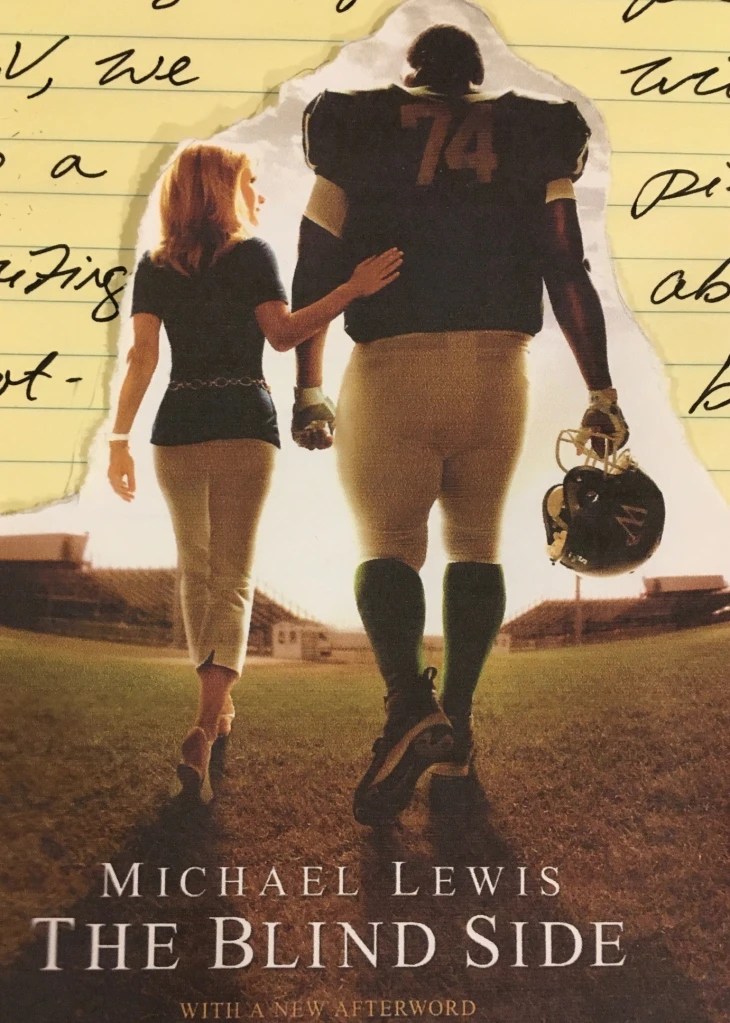
Yesterday in class we turned to a piece of writing about football–not simply to read about a sport that’s on the minds of many of us but instead as an opportunity to explore how skillfully the writer Michael Lewis dramatizes a few seconds on the football field. 

In the passage that follows, Lewis recounts the moments in the November 1985 Redskins-Giants football game leading up to the injury that ended quarterback Joe Theismann’s career. These are the words that begin Chapter 1 of The Blind Side, now widely regarded as a nonfiction masterpiece:

“From the snap of the ball to the snap of the first bone is closer to four seconds than to five. One Mississippi: The quarterback of the Washington Redskins, Joe Theismann, turns and hands the ball to running back John Riggins. He watches Riggins run two steps forward, turn, and flip the ball back to him. It’s what most people know as a “flea-flicker,” but the Redskins call it a “throw-back special.” Two Mississippi: Theismann searches for a receiver but instead sees Harry Carson coming straight at him. It’s a running down—the start of the second quarter, first and 10 at midfield, with the score tied 7–7—and the New York Giants’ linebacker has been so completely suckered by the fake that he’s deep in the Redskins’ backfield. Carson thinks he’s come to tackle Riggins but Riggins is long gone, so Carson just keeps running, toward Theismann. Three Mississippi: Carson now sees that Theismann has the ball. Theismann notices Carson coming straight at him, and so he has time to avoid him. He steps up and to the side and Carson flies right on by and out of the play. The play is now 3.5 seconds old. Until this moment it has been defined by what the quarterback can see. Now it–and he–is at the mercy of what he can’t see” (15).

What Theismann cannot see is Lawrence Taylor. A second later, as Taylor sacks Theismann, Taylor’s knee drives straight into Theismann’s lower right leg, leading to the “snap of the first bone” that Lewis mentions in the first sentence. He hooks the reader by linking the beginning of the play, “the snap of the ball” to the gruesome “snap of the first bone” that will follow. Lewis develops the paragraph using the common one-Mississippi, two-Mississippi method of marking seconds to present the events leading up to the compound fracture that ends Theisman’s career.

Lewis doesn’t dramatize the injury itself because his interest lies instead in the blind side that led to it and subsequently elevated the status and salary of the left tackle, the player who protects the quarterback’s blind side.

When you’re struggling to develop a piece of writing, reread the opening paragraph of The Blind Side. Study how Lewis dramatizes 3.5 seconds–yes, only 3.5 seconds–with 224 words.

Junod, Tom. “The Falling Man.” Esquire, vol. 140, no. 3, Sept. 2003, pp. 176+. Gale Academic OneFile Selecthttps://link.gale.com/apps/doc/A106423422/EAIM?u=hpu_main&sid=bookmark-EAIM&xid=ce48797f.

Along with the first paragraphs of The Blind Side, yesterday in class we examined the first paragraphs of Tom Junod’s essay “The Falling Man.”

Esquire writer Tom Junod begins “The Falling Man” with an uncharacteristically long paragraph to recreate on the page the lengthy vertical passage of the 9/11 victim immortalized in Richard Drew’s photograph.

If I were to write an analysis of the opening of “The Falling Man,” I would develop my essay with textual evidence–words and phrases throughout the first paragraph–to illustrate the linear movement of the unidentified man from the beginning of the first paragraph to its conclusion.

Unless you subscribe to Esquire, the magazine’s paywall will deny you  access to the full text of the feature, but you can access it through the HPU Library site by following these steps:

  1. Go to the HPU Library site.
  2. Under the heading “Search HPU Libraries . . . ,” click on the “Articles” tab.
  3. Under the “Articles” tab, type Tom Junod “Falling Man” Esquire in the search box and click “search.”
  4. On the next screen, you will see a brief summary of the article. Click “Access Online” to view the full article.

Next Up

In class on Wednesday you will begin planning and drafting your own close study, or analysis, of one of the pieces of writing we’ve examined in class: the opening paragraphs of Lewis’s “The Blind Side,” the opening paragraphs of Junod’s “The Falling Man,” David Sedaris’s “Me Talk Pretty One Day,” Helen Keller’s “The Day Language Came into My Life,” and Martin Luther King, Jr’s.’s “Letter from Birmingham Jail.”

Posted in English 1103, Reading, Teaching, Writing

ENG 1103: Model Literacy Narratives, Part II

As a model for your own literacy narratives, yesterday in class we continued to examine “Me Talk Pretty One Day,” originally published in Esquire magazine and later as the title essay in David Sedaris’s 2000 essay collection.

In groups of three and four, you and your classmates studied Sedaris’s essay with a focus on his use of scene and summary, figurative language, and hyperbole.

You observed at the beginning of the fourth paragraph how Sedaris shifts from the summary of the third paragraph to the first words that the unnamed teacher speaks to her students: “If you have not meimslsxp or lgpmurct by this time, then you should not be in this room Has everyone apzkiubjxow? Everyone? Good, we shall begin” (167).

Sedaris begins his use of figurative language early in the essay with a simile near the end of the second paragraph and a metaphor near the beginning of the third:

  • “[C]ausing me to feel not unlike Pa Kettle trapped backstage after a fashion show” (167).
  • “[E]verybody into the language pool, sink or swim” (167).

In the seventh paragraph, Sedaris uses hyperbole when he describes one of the two Polish Annas as a woman with “front teeth the size of tombstones” (168).

Continue to look for opportunities to use one or more of those elements in your own literacy narratives.

To read more of Sedaris’s essays, see the list of links under the heading Writing and Radio on his website.

In addition to studying Sedaris’s essay, examine Helen Keller’s “The Day Language Came into My Life,” and note her use of figurative lanaguage. Also observe how frequently she uses sensory detail, namely her sense of touch–not sights and sounds, because she was blind and deaf.

You can read more of Helen Keller’s autobiography, the full text in fact, here: The Story of My Life. “The Day Language Came into My Life” is Chapter Four.

Work Cited

Sedaris, David. “Me Talk Pretty One Day.” Me Talk Pretty One Day.” Little, Brown, 2000. pp. 166-73.

Next Up

In class tomorrow, we will look at your blogs on the big screen. Your literacy narrative may not be posted to your blog yet (it may still be in progress), but your blog should be launched and linked to our class page. Afterward, you will compose short reflective essays on your literacy narratives.

Posted in English 1103, Teaching, Writing

ENG 1103: The Writing Center

At the beginning of today’s class you will receive your handwritten drafts with my comments, and you will have the class period to devote to revising on your laptops–or you may continue to write longhand, if you wish. Your revision is due on Blackboard and your blog next Wednesday, February 1. The hard deadline is Friday, February 3.

As you continue to revise your literacy narrative, consider visiting The Writing Center. If you do so, you will earn five bonus points.

To schedule an appointment, visit https://highpoint.mywconline.com, email the Writing Center’s director, Justin Cook, at jcook3@highpoint.edu, or scan the QR code below. To earn bonus points for your literacy narrative, consult with a Writing Center tutor no later than Thursday, February 2.

Posted in English 1103, Teaching, Writing

ENG 1103: Model Literacy Narratives

As a model for your own literacy narratives, Monday in class we began to examine “Me Talk Pretty One Day,” originally published in Esquire magazine and later as the title essay in David Sedaris’s 2000 essay collection.

As you continue to work on your literacy narratives, study Sedaris’s essay as a model, and consider how he uses the following:

  • Shifts from summary to scene and vice versa
  • Figurative language
  • Hyperbole
  • Vivid detail

Look for opportunities to use one or more of those elements in your own literacy narratives.

To read more of Sedaris’s essays, see the list of links under the heading Writing and Radio on his website.

Next Up

Friday marks our third Wordplay Day of the semester. Review my blog posts devoted to Scrabble and review the tips and tools on the on the Scrabble site to strengthen your word power and up your game.

Coming Soon

Next Monday, we will continue our study of “Me Talk Pretty One Day,” and we will examine additional literacy narratives, including Helen Keller’s essay “The Day Language Came into My Life.” You can read more of Helen Keller’s autobiography, the full text in fact, here: The Story of My Life. “The Day Language Came into My Life” is Chapter Four.

Posted in English 1103, Reading, Teaching, Writing

ENG 1103: “Letter from Birmingham Jail”

In Wednesday’s class, before you begin drafting your literacy narrative, I will distribute copies of Martin Luther King, Jr.’s “Letter from Birmingham Jail.” Although I could ask you to listen to a recording of it, I ask that you to read it instead. King’s gift for oratory is well known, but for students of writing, closely examining his words on the page is a more pertinent exercise than listening to his voice.

What makes King’s letter an effective piece of writing? With that question in mind, consider these words in the eleventh paragraph: “Perhaps it is easy for those who have never felt the stinging darts of segregation to say, ‘Wait.’” Here King is addressing his initial audience, the eight white Birmingham-area clergymen who criticized his protest as “unwise and untimely.” He suggests to those men that waiting to act isn’t difficult when you yourself aren’t the victim of injustice, when you haven’t, in King’s words, “felt the stinging darts of segregation.” The sentence is notable not only for the contrast it illustrates between King’s reality and the lives of his readers but also for the words that King uses to show that contrast.

Consider King’s sentence and the paraphrase that follows:

  • Perhaps it is easy for those who have never felt the stinging darts of segregation to say, “Wait.”
  • Maybe it is simple for people who have not experienced segregation to say, “Wait.”

King’s sentence is stronger than the paraphrase that follows it because of the “stinging darts.” Writing that someone has not “experienced segregation” is abstract. Readers do not feel the general experience in the second sentence, but they feel King’s “stinging darts.” Sensory details strengthen sentences by appealing to readers’ senses, and figurative language invigorates writing by making the unfamiliar familiar. King’s white readers have not been the victims of segregation, but his choice of words makes them feel the sting.

While King’s “stinging darts” sentence—a relatively short one—is laudable, the long, winding sentence that follows is nothing short of staggering.

It starts with these words: “But when you have seen vicious mobs lynch your mothers and fathers at will and drown your sisters and brothers at whim.” King presents those atrocities in an introductory dependent clause, one whose full meaning depends on an independent clause that follows. But rather than immediately turning to an independent clause to complete the thought, King expands the sentence with this series of dependent clauses:

  • when you have seen hate filled policemen curse, kick and even kill your black brothers and sisters;
  • when you see the vast majority of your twenty million Negro brothers smothering in an airtight cage of poverty in the midst of an affluent society;
  • when you suddenly find your tongue twisted and your speech stammering as you seek to explain to your six year old daughter why she can’t go to the public amusement park that has just been advertised on television, and see tears welling up in her eyes when she is told that Funtown is closed to colored children, and see ominous clouds of inferiority beginning to form in her little mental sky, and see her beginning to distort her personality by developing an unconscious bitterness toward white people;
  • when you take a cross county drive and find it necessary to sleep night after night in the uncomfortable corners of your automobile because no motel will accept you;
  • when you are humiliated day in and day out by nagging signs reading “white” and “colored”;
  • when your first name becomes “n—,” your middle name becomes “boy” (however old you are) and your last name becomes “John,” and your wife and mother are never given the respected title “Mrs.”;
  • when you are harried by day and haunted by night by the fact that you are a Negro, living constantly at tiptoe stance, never quite knowing what to expect next, and are plagued with inner fears and outer resentments;
  • when you are forever fighting a degenerating sense of “nobodiness”–

The independent clause that readers have been waiting for, the statement that completes the thought is this: “then you will understand why we find it difficult to wait.” Those words could have immediately followed the first dependent clause, but instead King offers nine more dependent clauses, ten darts that sting his readers.

Ten dependent clauses connected by semicolons followed by a dash and an independent clause, a total of 316 words: That is not a structure I recommend for the sentences you write in English 111, but it’s a valuable model, nevertheless.

I hope that you, as citizens, will continue to study the words of his letter. As your writing teacher, I hope that you will return to the sentence that I have examined in detail here. Along with showing his readers why his nonviolent protests could not wait, that sentence of King’s demonstrates how to develop a piece of writing through the accumulation of detail—not just the when, but the when and when and when . . . .


King, Martin Luther, Jr. “Letter from Birmingham Jail.” The Martin Luther King, Jr. Research and Education Institute, Stanford Universityhttps://kinginstitute.stanford.edu/sites/mlk/files/letterfrombirmingham_wwcw_0.pdf.