Posted in English 1103, Teaching, Writing

ENG 1103: Presenting Quotations

The group assignment on introducing and explaining quotations that you completed last week demonstrated that you have a number of questions about the stylistic conventions of presenting quotations in academic writing. This blog post addresses several of those questions.

Does a Comma Follow the Signal Phrase?

Usually a comma follows the signal phrase. For example:

  • According to author Jonathan Kay, “Scrabble treats language the way computers do—as arbitrarily ordered codes stored in a memory chip.”

However, a comma does not follow the signal phrase if the quotation is an extension of that phrase. For example:

  • Author Jonathan Kay observes that “Scrabble treats language the way computers do—as arbitrarily ordered codes stored in a memory chip.”

Is the First Word of the Quotation Capitalized?

If the quotation is a complete sentence, the first word is capitalized. For example:

  • Maryanne Wolf states, “The possibility that critical analysis, empathy and other deep reading processes could become the unintended ‘collateral damage’ of our digital culture is not a simple binary issue about print vs. digital reading.”

If the quotation is not a complete sentence, the first word is not capitalized. For example:

  • Maryanne Wolf claims “that critical analysis, empathy and other deep reading processes could become the unintended ‘collateral damage’ of our digital culture,” and that risk “is not a simple binary issue about print vs. digital reading.”

What if I Need to Change the Case of a Letter?

If you need to change the case of a letter to comply with style rules, bracket the letter to denote the change. For example:

  • Jonathan Kay recalls, “[A]n insider once told me an unsettling story of a contestant who tried to score an illegal word by taking advantage of his disabled opponent’s difficulty in accessing the computer used to determine which words are admissible.”

How Do I Cite Someone Whose Words are Quoted or Paraphrased in a Source?

The abbreviations qtd. (for quoted) and ctd. (for paraphrased) are used to indicate that the words are not the words of the author of the source but rather the words of someone he/she quotes or paraphrases. For example:

  • As the scholar Tami Katzir observes, “[T]he negative effects of screen reading can appear as early as fourth and fifth grade–with implications not only for comprehension, but also on the growth of empathy” (ctd. in Wolf).

Do I Need to Include an Ellipsis if I omit the Beginning or the End of a Quotation?

Because it’s understood that the words you are quoting are usually preceded and followed by other words, an ellipsis does not appear before or after a quotation. An ellipsis is only necessary if you omit a word or words within the passage you are quoting.


Next Up

Wordplay Day! To up your game and increase your word power, review the tips and tools on the Scrabble website as well as my blog posts devoted to the game.
Posted in English 1103, Teaching, Writing

ENG 1103: Writing Longhand and Limiting Screen Time

Today in class, after you deliver your group presentations, we will examine The New York Times‘ article “The Case for Writing Longhand,” which may serve as a starting point for your final essay and annotated bibliography. (Other subjects for that assignment include limiting screen time, Scrabble, blogging in the classroom, and the authors whose writing we’ve studied.) Whatever subjects you choose, I ask that you continue to reflect on the the habits you have cultivated this semester, including drafting longhand and limiting your screen time. This blog post addresses the reasons that I’ve asked you to engage in those practices.

Writing Longhand

One practical reason for writing longhand: What we mark through remains on the page. Sometimes what we cross out can be useful later on, elsewhere in our writing. More importantly, research in cognitive neuroscience indicates that writing longhand has these benefits:

Simply put, writing longhand sharpens our minds in ways that typing doesn’t.

Limiting Screen Time

When we use our phones and laptops, it’s difficult for us to give our undivided attention to one endeavor, but often that singular focus is critical.

When we type on our phones, we often aim to convey as much as we can with as few characters as possible. Texting and emailing–both of which now feature predictive text–do not foster the vital skills of developing our writing and producing original thought.

Limiting our screen time not only helps us improve our writing skills, it can also benefit our overall well-being.

The research cited in the links that I’ve included isn’t definitive, but it makes a strong case for the value of limiting our screen time and putting pen to paper. I encourage you to continue these practices after the semester ends.

Posted in English 1103, Teaching, Writing

ENG 1103: Introducing and Explaining Quotations

Today in class you will collaborate on an exercise that offers practice in presenting quotations in a way that makes their relevance clear to the reader, first by introducing them with signal phrases and second by following them with an explanation.

As you begin work on your final essay and annotated bibliography next week, continue to look to these templates as models for introducing and explaining quotations from your sources.

Templates for Introducing Quotations

  • X states, “____________________________.”
  • As the scholar X puts it “____________________________.”
  • According to X, “____________________________.”
  • X himself writes, “____________________________.”
  • In her book, X maintains that “____________________________.”
  • Writing in The Wall Street Journal, X complains that “____________________________.”
  • In X’s view, “____________________________.”
  • X agrees when she writes, “____________________________.”
  • X disagrees when he writes, “____________________________.”
  • X complicates matters further when she writes, “____________________________.”

Templates for Explaining Quotations

  • Basically, X is warning that “____________________________.”
  • In other words, X believes “____________________________.”
  • In making this comment, X urges us to “____________________________.”
  • X himself writes, “____________________________.”
  • X’s point is that “____________________________.”
  • The essence of X’s argument is that “____________________________.”

Presenting Direct and Indirect Quotations

When you quote a source, look carefully at the text to determine whether the words are the writer’s or those of someone else whom the writer is quoting. The latter is an example of an indirect quotation.

Direct Quotation

According to author Jonathan Kay, “Scrabble treats language the way computers do—as arbitrarily ordered codes stored in a memory chip.”

Direct Quotation Followed by an Indirect Quotation

Educator Maryanne Wolf notes that “the sense of touch in print reading adds an important redundancy to information,” what another researcher has referred to as the “technology of recurrence” (Piper qtd. in Wolf).

In the example above, Piper qtd. in Wolf appears in parentheses to indicate that the words of the second quotation are Piper’s—not Wolf’s own words but rather ones that she quotes in “Skim Reading is the New Normal.”

For more examples of integrating sources into your writing, see Writing Analytically (219-29), the sample MLA-style research paper on OWL, Purdue’s Online Writing Lab, and the sample MLA-Style research papers at the MLA Style Center.


Next Up

Wordplay Day! To up your game and increase your word power, review the tips and tools on the Scrabble website as well as my blog posts devoted to the game.

Posted in English 1103, Teaching, Writing

ENG 1103: Midterm Reflection and Habits of Mind

Today as you write your midterm reflection, think about the eight habits of mind of successful college students. Has your work in the course helped you develop any of those habits? If so, which particular assignments or aspects of the course have contributed to which of the eight habits?

The habits themselves are abstract, but the practices that develop them are concrete. In your reflection–and in all of your other writing–aim to offer concrete details to support your claims.

In 2011, the Council of Writing Program Administrators (CWPA), the National Council of Teachers of English (NCTE), and the National Writing Project (NWP) identified the eight habits of mind that successful college students adopt.

The paragraphs that follow include the descriptions of those habits that we examined earlier in the semester, along with the questions about those habits that you answered in writing.

Curiosity

Are you the kind of person who always wants to know more? This habit of mind will serve you well in courses in which your curiosity about issues, problems, people, or policies can form the backbone of a writing project.

WRITING ACTIVITY: What are you most curious to learn about? What experiences have you had in which your curiosity has led you to an interesting discovery or to more questions?

Openness

Some people are more open than others to new ideas and experiences and new ways of thinking about the world. Being open to other perspectives and positions can help you to frame sound arguments and counterarguments and solve other college writing challenges in thoughtful ways.

WRITING ACTIVITY: In the family or the part of the world in which you grew up, did people tend to be very open, not open at all, or somewhere in the middle? Thinking about your own level of open-mindedness, reflect on how much or how little your own attitude toward a quality like openness is the result of the attitudes of the people around you.

Engagement

Successful college writers are involved in their own learning process. Students who are engaged put effort into their classes, knowing that they’ll get something out of their classes—something other than a grade. They participate in their own learning by planning, seeking feedback when they need to, and communicating with peers and professors to create their own success. Write about a few of the ways you try (or plan to try) to be involved in your own learning. What does engagement look like to you?

WRITING ACTIVITY: Write about a few of the ways you try (or plan to try) to be involved in your own learning. What does engagement look like to you?

Creativity

You may be thinking that you have to be an artist, poet, or musician to display creativity. Not so. Scientists use creativity every day in coming up with ways to investigate questions in their field. Engineers and technicians approach problem solving in creative ways. Retail managers use creativity in displaying merchandise and motivating their employees.

WRITING ACTIVITY: Think about the field you plan to enter. What forms might creativity take in that field?

Persistence

You are probably used to juggling long-term and short-term commitments—both in school and in your everyday life. Paying attention to your commitments and being persistent enough to see them through, even when the commitments are challenging, are good indicators that you will be successful in college.

WRITING ACTIVITY: Describe a time when you faced and overcame an obstacle in an academic setting. What did you learn from that experience?

Responsibility

College will require you to be responsible in way you may not have had to be before. Two responsibilities you will face as an academic writer are to represent the ideas of others fairly and to give credit to writers whose ideas and language you borrow for your own purposes.

WRITING ACTIVITY: Why do you think academic responsibility is important? What kind of experience have you already had with this kind of responsibility?

Flexibility

Would your friends say you are the kind of person who can just “go with the flow”? Do you adapt easily to changing situations? If so, you will find college easier, especially college writing. When you find, for example, that you’ve written a draft that doesn’t address the right audience or that your peer review group doesn’t understand at all, you will be able to adapt. Being flexible enough to adapt to the demands of different writing projects is an important habit of mind.

WRITING ACTIVITY: Describe a situation in which you’ve had to make changes based on a situation you couldn’t control. Did you do so easily or with difficulty?

Metacognition (Reflection)

As a learner, you have probably been asked to think back on a learning experience and comment on what went well or not well, what you learned or what you wished you had learned, or what decisions you made or didn’t make. Writers who reflect on their own processes and decisions are better able to transfer writing skills to future assignments.

WRITING ACTIVITY: Reflect on your many experiences as a writer. What was your most satisfying experience as a writer?  What made it so?


Next Up

Friday marks your eighth Wordplay Day of the semester. To up your game and increase your word power, review the tips and tools on the Scrabble website as well as this blog post and my other posts devoted to the game.

Posted in English 1103, Teaching, Writing

ENG 1103: Nine Basic Writing Errors, Part II

This morning in class, as part of your blog response assignment, you will look for instances of the nine basic writing errors as you read your classmate’s analysis.

The authors of your textbook, Writing Analytically, identify these as the nine basic writing errors:

  • Sentence Fragments
  • Comma splices and fused (run-on) sentences
  • Errors in subject-verb agreement
  • Shifts in sentence structure (faulty predication)
  • Errors in pronoun reference
  • Misplaced modifiers and dangling participles
  • Errors in using possessive apostrophes
  • Comma errors
  • Spelling/diction errors that interfere with meaning (341-60).

Next Up

You will turn to Writing Analytically again in class on Wednesday when you compose your midterm reflection. In your refelection, you will quote one relevant passage from the textbook, which may be a passage devoted to analysis (4-7), to writing longhand versus writing on a computer (124-25), to one of the nine basic writing errors (341-59), or to another passage pertinent to your work in the course.

Work Cited

Rosenwasser, David and Jill Stephen. “Nine Basic Writing Errors (BWEs) and How to Fix Them.” Writing Analytically, 8th edition. Wadsworth/Cengage, 2019. pp. 341-60.

Posted in English 1103, Teaching, Writing

ENG 1103: Continuing to Revise Your Analysis

Monday in class we examined my analysis of “Blogs vs. Term Papers”as a model for your analysis. In particular, we looked at the shift in the first paragraph from my summary of Matt Richtel’s article to the thesis. From there we moved onto the final paragraph of the analysis where I asked you to consider which of these strategeis–ones recommended on the Harvard Writing Center website–were ones that I employed.

  • “Conclude with a quotation from or reference to a primary or secondary source, one that amplifies your main point or puts it in a different perspective.”
  • “Conclude by setting your discussion into a different, perhaps larger, context.”
  • “Conclude by redefining one of the key terms of your argument.”
  • “Conclude by considering the implications of your argument (or analysis or discussion). What does your argument imply, or involve, or suggest?”

The full text of my sample analysis appears below. As you continue to revise, return to it as a model. Pay close attention to the concrete examples I present to support my claims about the diction and structure of Matt Richtel’s article.

“On its Face, Who Could Disagree with the Transformation?”: Revisiting Richtel’s Report on the Blog-Term Paper Question

In The New York Times article “Blogs vs. Term Papers,” Matt Richtel reports on the debate in higher education on how best to teach writing in the digital age. While some professors have followed the lead of City University of New York’s Cathy N. Davidson, replacing the traditional term paper with shorter, more frequent blog assignments, their detractors—including Douglas B. Reeves, columnist for The American School Board Journal and William H. Fitzhugh, editor of The Concord Review—argue that blog writing lacks the academic rigor that fosters critical thinking. For Andrea Lunsford, professor of writing at Stanford University, pitting blogs against term papers creates a false opposition. Rather than replacing term papers with blog posts, Lunsford requires students to produce multi-modal assignments: term papers that evolve into blogs, websites, and video presentations. Although Richtel’s article appears to present an objective account of the disagreements among experts, a close examination of the diction and structure of “Blogs vs. Term Papers” reveals a preference for the innovations advocated by Davidson and Lundsford.

The opening paragraph of Richtel’s article focuses on the academic paper as a primary cause of “angst, profanity, and caffeine consumption” among high school and college students. In stark contrast to the images of the term paper-induced misery in his lead, Richtel writes in the second paragraph that students may be “rejoicing” because Cathy Davidson—a professor at Duke when Richtel interviewed her—favors replacing the term paper with the blog. Richtel refers to Davidson as a “champion” for students and outlines her use of a course blog as a practice that has become commonplace in a variety of academic disciplines. Richtel reports that blogs provide students with a “feeling of relevancy” and “instant feedback,” then poses the question: “[W]hy punish with a paper when a blog is, relatively, fun?”

From that question Richtel turns to the argument of defenders of the traditional academic paper, namely that the term paper teaches essential components of writing and thinking that may be absent from blog posts. Yet after letting the advocates of old-school writing have their say, Richtel undercuts their claim with this one-sentence paragraph: “Their reductio ad absurdum: why not just bypass the blog, too, and move on to 140 characters about Shermn’s Mrch?” To assert that defenders of traditional academic writing carry their opponents’ argument to an absurd conclusion presents those advocates of old-school writing as purveyors of the same flawed logic that their own traditional rhetoric supposedly teaches students to avoid.

Notably, the one-sentence paragraph, unlike paragraphs with multiple sentences, places heavy emphasis on a single idea. It says to readers, this is important. By introducing an apparent contradiction in the argument of the advocates of old-school writing, Richtel subverts their claim; and by presenting that incongruity as a one-sentence paragraph, he highlights the issue.

Richtel’s reductio ad absurdum paragraph is one of only two one-sentence paragraphs in his article. The other consists entirely of Professor Davidson’s own words. Speaking of the mechanistic quality of the term paper, she says: “As a writer, it offends me deeply.” In addition to devoting that one-sentence paragraph to Davidson’s negative feelings about term papers, Richtel returns to those feelings of hers at the end of his article and lets Davidson have the last word, literally.

In the final paragraphs of the article, Richtel recounts a tutoring session Davidson conducted with a community college student. Though she frowned on his assignment’s rigid guidelines—including prescribed sentence length—she told the student to follow the rules, knowing that teaching him what she deemed the best practice might have led the student to fail. Reflecting on that moment, Davidson said, “I hated teaching him bad writing,” and with those words of hers,  Richtel’s article ends.

Along with giving Davidson the last word, Richtel devotes far more of his article to the new literacies she and Lunsford foster in their students. Arguably, the innovative nature of the work could account for the considerable space that Richtel devotes to it. After all, what readers are familiar with—in this case the traditional term paper—isn’t news. But the preponderance of word choices that place old literacies in a negative light combined with a structure that diminishes the merits of old-school writing reveals Richtel’s implicit preference for Davidson’s and Lundsford’s innovations.

Readers revisiting Richtel’s article now, nearly ten years after he wrote it, may wonder how he would respond to the question he poses about the shift from page to screen: “On its Face, Who Could Disagree with the Transformation?” Richtel wrote “Blogs vs. Term Papers” in 2012, the year deemed the year of the MOOCs (massive open online courses). Once touted as the key to revolutionizing higher education, their success has been hampered by the same issues linked to the learning losses experienced during the pandemic. For the many students who have had little or no face-to-face instruction—writing or otherwise—in recent memory, more technology may not seem like an answer, much less an innovation.

Work Cited

Richtel, Matt. “Blogs vs. Term Papers,” The New York Times, 20 Jan. 2012, https://www.nytimes.com/2012/01/22/eduaction/edlife/muscling-in-on-the-term-paper-tradition.html.

Next Up

Today we will review your collaborative writing on Donald Barthelme’s short story “The School” and you will compose a reflection on your analysis.

Posted in English 1103, Reading, Teaching, Writing

ENG 1103: The Nine Basic Writing Errors

This morning in class, as part of your blog response assignment, you will look for instances of the nine basic writing errors as you read your classmate’s literacy narrative.

The authors of your textbook, Writing Analytically, identify these as the nine basic writing errors:

  • Sentence Fragments
  • Comma splices and fused (run-on) sentences
  • Errors in subject-verb agreement
  • Shifts in sentence structure (faulty predication)
  • Errors in pronoun reference
  • Misplaced modifiers and dangling participles
  • Errors in using possessive apostrophes
  • Comma errors
  • Spelling/diction errors that interfere with meaning (341-59).

Next Up

You will turn to Writing Analytically again in class on Wednesday when you compose a reflection on your analysis. In your refelection, you will quote one relevant passage from the textbook, which may be a passage devoted to analysis (4-7), one devoted to writing longhand versus writing on a computer (124-25), or it may focus on one of the nine basic writing errors (341-59).

Work Cited

Rosenwasser, David and Jill Stephen. Writing Analytically, 8th edition. Wadsworth/Cengage, 2019.

Posted in English 1103, Teaching, Writing

ENG 1103: Revising Your Analysis

At the beginning of today’s class you will receive your handwritten drafts with my comments, and you will have the class period to devote to revising on your laptops–or you may continue to write longhand, if you wish. Your revision is due on Blackboard and your blog next Wednesday, February 22. The hard deadline is Friday, February 24.

As you continue to revise your analysis, consider visiting The Writing Center. If you do so, you will earn five bonus points.

To schedule an appointment, visit https://highpoint.mywconline.com, email the Writing Center’s director, Justin Cook, at jcook3@highpoint.edu, or scan the QR code below. To earn bonus points for your literacy narrative, consult with a Writing Center tutor no later than Thursday, February 23.

Next Up

Friday marks your sixth Wordplay Day of the semester. To up your game and increase your word power, review the tips and tools on the Scrabble website as well as my blog posts devoted to the game.

Posted in English 1103, Reading, Teaching, Writing

ENG 1103: Beginning Your Analysis

This morning you will begin your analysis of one of the texts we have studied in class, which include these:

  • The first paragraphs of “Back Story” by Michael Lewis
  • “The Day Language Came into My Life” by Helen Keller
  • The first paragraphs of “The Falling Man” by Tom Junod
  • “Letter from Birmingham Jail” by Martin Luther King, Jr.
  • “Me Talk Pretty One Day” by David Sedaris

On Monday we will read a short story, “The School” by Donald Barthelme, which will serve as an additional option for your analysis. If you begin an analysis of one of the texts listed above and decide you would rather write about “The School,” you are welcome to change your focus.

As a starting point for your analysis planning, this morning you will read the pages in Writing Analytically devoted to analysis. Among the key points to keep in mind as you write are these:

  • “One common denominator in all effective analytical writing is that it pays close attention to detail” (5).
  • “In order to understand a subject, we need to discover what it is ‘made of,’ the particulars that contribute most strongly to the character of the whole” (5).
  • “[A]sk not just ‘What is it made of?’ but also ‘How do these parts help me to understand the meaning of the subject as a whole?” (5).
  • “Analytical writing is more concerned with arriving at an understanding of a subject than it is with either self-expression or changing readers’ views” (5).

Next Wednesday, February 15, I will return your handwritten drafts with notes, and you will have the class period to begin revising on your laptops and tablets. You will have an additional week to continue to revise. Your revisions are due on Blackboard and on your blogs on Wednesday, Febraury 22. The hard deadline is Friday, February 24

Next Up

Friday marks your fifth Wordplay Day of the semester. To up your game and increase your word power, review the tips and tools on the Scrabble website as well as my blog posts devoted to the game.

Posted in English 1103, Reading, Teaching, Writing

ENG 1103: A Close Study of Words

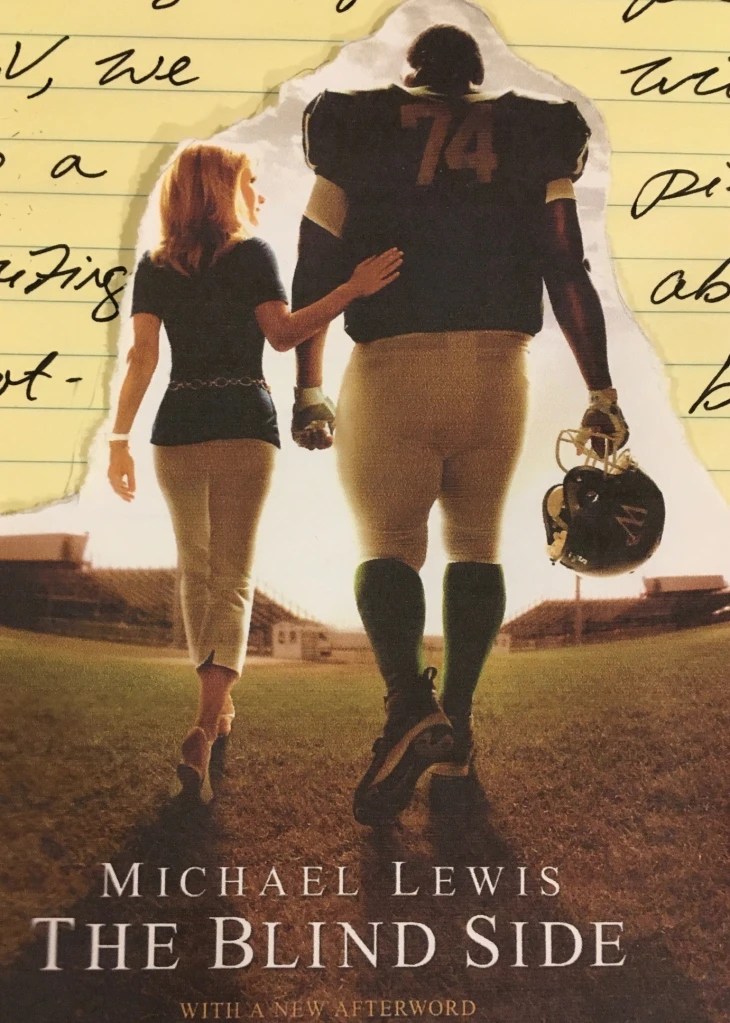
Yesterday in class we turned to a piece of writing about football–not simply to read about a sport that’s on the minds of many of us but instead as an opportunity to explore how skillfully the writer Michael Lewis dramatizes a few seconds on the football field. 

In the passage that follows, Lewis recounts the moments in the November 1985 Redskins-Giants football game leading up to the injury that ended quarterback Joe Theismann’s career. These are the words that begin Chapter 1 of The Blind Side, now widely regarded as a nonfiction masterpiece:

“From the snap of the ball to the snap of the first bone is closer to four seconds than to five. One Mississippi: The quarterback of the Washington Redskins, Joe Theismann, turns and hands the ball to running back John Riggins. He watches Riggins run two steps forward, turn, and flip the ball back to him. It’s what most people know as a “flea-flicker,” but the Redskins call it a “throw-back special.” Two Mississippi: Theismann searches for a receiver but instead sees Harry Carson coming straight at him. It’s a running down—the start of the second quarter, first and 10 at midfield, with the score tied 7–7—and the New York Giants’ linebacker has been so completely suckered by the fake that he’s deep in the Redskins’ backfield. Carson thinks he’s come to tackle Riggins but Riggins is long gone, so Carson just keeps running, toward Theismann. Three Mississippi: Carson now sees that Theismann has the ball. Theismann notices Carson coming straight at him, and so he has time to avoid him. He steps up and to the side and Carson flies right on by and out of the play. The play is now 3.5 seconds old. Until this moment it has been defined by what the quarterback can see. Now it–and he–is at the mercy of what he can’t see” (15).

What Theismann cannot see is Lawrence Taylor. A second later, as Taylor sacks Theismann, Taylor’s knee drives straight into Theismann’s lower right leg, leading to the “snap of the first bone” that Lewis mentions in the first sentence. He hooks the reader by linking the beginning of the play, “the snap of the ball” to the gruesome “snap of the first bone” that will follow. Lewis develops the paragraph using the common one-Mississippi, two-Mississippi method of marking seconds to present the events leading up to the compound fracture that ends Theisman’s career.

Lewis doesn’t dramatize the injury itself because his interest lies instead in the blind side that led to it and subsequently elevated the status and salary of the left tackle, the player who protects the quarterback’s blind side.

When you’re struggling to develop a piece of writing, reread the opening paragraph of The Blind Side. Study how Lewis dramatizes 3.5 seconds–yes, only 3.5 seconds–with 224 words.

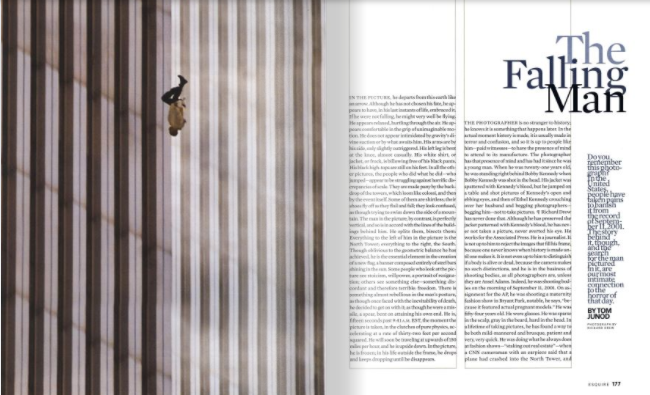
Junod, Tom. “The Falling Man.” Esquire, vol. 140, no. 3, Sept. 2003, pp. 176+. Gale Academic OneFile Select, https://link.gale.com/apps/doc/A106423422/EAIM?u=hpu_main&sid=bookmark-EAIM&xid=ce48797f.

Along with the first paragraphs of The Blind Side, yesterday in class we examined the first paragraphs of Tom Junod’s essay “The Falling Man.”

Esquire writer Tom Junod begins “The Falling Man” with an uncharacteristically long paragraph to recreate on the page the lengthy vertical passage of the 9/11 victim immortalized in Richard Drew’s photograph.

If I were to write an analysis of the opening of “The Falling Man,” I would develop my essay with textual evidence–words and phrases throughout the first paragraph–to illustrate the linear movement of the unidentified man from the beginning of the first paragraph to its conclusion.

Unless you subscribe to Esquire, the magazine’s paywall will deny you  access to the full text of the feature, but you can access it through the HPU Library site by following these steps:

  1. Go to the HPU Library site.
  2. Under the heading “Search HPU Libraries . . . ,” click on the “Articles” tab.
  3. Under the “Articles” tab, type Tom Junod “Falling Man” Esquire in the search box and click “search.”
  4. On the next screen, you will see a brief summary of the article. Click “Access Online” to view the full article.

Next Up

In class on Wednesday you will begin planning and drafting your own close study, or analysis, of one of the pieces of writing we’ve examined in class: the opening paragraphs of Lewis’s “The Blind Side,” the opening paragraphs of Junod’s “The Falling Man,” David Sedaris’s “Me Talk Pretty One Day,” Helen Keller’s “The Day Language Came into My Life,” and Martin Luther King, Jr’s.’s “Letter from Birmingham Jail.”