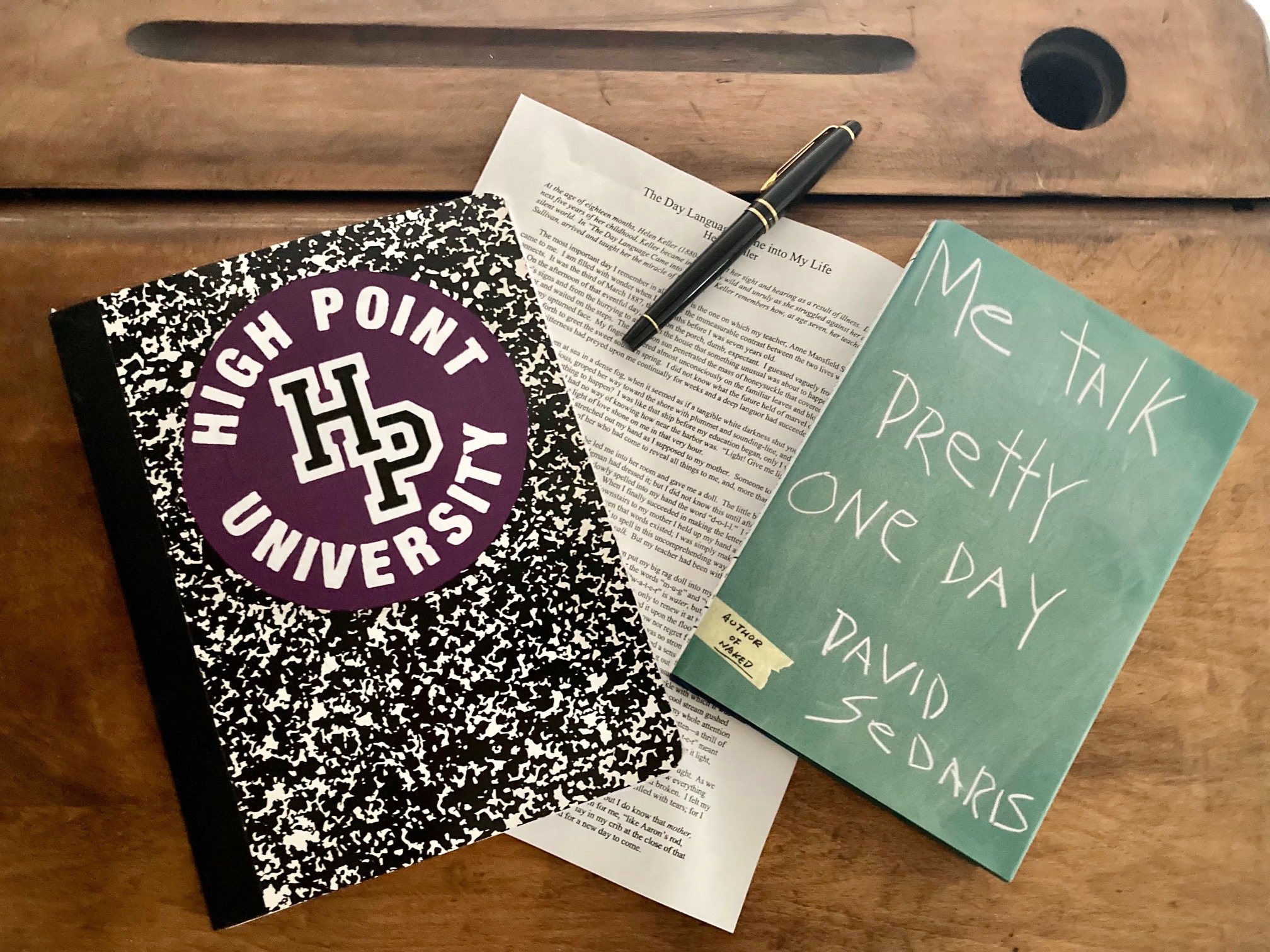
Today is class you will begin planning and drafting your first essay assignment, a literacy narrative, which is an account of a learning experience involving reading, writing, or learning to speak a language.
Begin by asking yourself some of these questions: How have you come to think about yourself as a reader or writer? What were some of your most formative experiences as a reader or writer? What are some of the do’s and don’ts you have learned about writing? How has what you have learned about reading or writing enhanced your confidence and skill in that role? You don’t need to respond to all of those questions. Try picking one or two as a starting point, then move to bringing your experiences to life.
Your aim is to recreate your experience on the page and then to reflect on its significance. Your focus may be any one of the following:
a memory of a reading or writing assignment that you recall vividly
someone who helped you learn
a writing-related school event that you found humorous or embarrassing
a particular type of writing that you found (or still find) especially difficult or challenging
a memento that represents an important moment in your development as a reader or writer
Detailed instructions are included in the assignment handout that you will receive in class today. An additional copy of the handout is posted on Blackboard in the Essay Assignments folder.
Next Up
Friday marks the second Wordplay Day of the semester. To prepare for class, review the Dictionary and World Builder pages on the Scrabble website. Also review the posts on my blog devoted to Scrabble tips.
Mike Caulfield, author of Check, Please! and Director of Blended and Networked Learning at Washington State University. https://webliteracy.pressbooks.com/ front-matter/updated-resources-for-2021/.
At the beginning of class on Wednesday, August 30, I will collect your worksheets for Lesson One of the Check, Please! starter course. My sample version of the assignment appears below, as well as on your worksheet and on Blackboard.
Sample Check, Please! Assignment
Check, Please! Lesson One Assignment
In the first lesson of the Check, Please! Starter Course, Mike Caulfield, author of the course and Director of Blended and Networked Learning at Washington State University, introduces the four-step SIFT approach to determining the reliability of a source: (1) “Stop,” (2) “Investigate,” (3) “Find better coverage,” and (4) “Trace claims, quotes, and media to the original context.”
One of the most useful practices presented in lesson one is what the author terms the “Wikipedia Trick.” Deleting everything that follows a website’s URL (including the slash), adding a space, typing “Wikipedia,” and hitting “enter” will yield the site’s Wikipedia page. The Wikipedia entry that appears at the top of the screen may indicate the source’s reliability or lack thereof.
The most memorable segment of lesson one is the short, riveting video “The Miseducation of Dylann Roof,” which begins with the narrator asking the question, “How does a child become a killer?” Produced by the Southern Poverty Law Center, it documents how algorithms can lead unskilled web searchers down paths of disinformation. In the worst cases, such as Roof’s, algorithms can lead searchers to the extremist propaganda of radical conspiracy theorists.
As a model for your own literacy narrative, today in class will examine “Me Talk Pretty One Day,” originally published in Esquire magazine and later as the title essay in David Sedaris’s 2000 essay collection.
To read more of Sedaris’s essays, see the list of links under the heading Writing and Radio on his website.
Next Up
As you begin work on your own literacy narrative on Wednesday, study Sedaris’s essay as a model, and consider how he uses the following:
Shifts from summary to scene and vice versa
Figurative language
Hyperbole
Vivid detail
Look for opportunities to use those elements in your own essay.
Am I the person who will teach your English 1103 class? I posed that question this morning at the beginning of class as a starting point for analysis, one of the key features of the course.
To begin the collaboration and inquiry that will figure prominently this semester—along with analysis—you will work together in groups today to find the answers to some of the most frequently asked questions about the course. After class, continue to review the syllabus, which is posted in Blackboard. If you have any questions about the assignments, the course policies, or the calendar, please let me know.
Textbook
All of you in sections 19 and 20 of English 1103 are required to have the paperback edition of the textbook, Writing Analytically, 8th edition, by David Rosenwasser and Jill Stephen. Bring your copy to class on the days when the title, Writing Analytically, appears in bold on the course calendar. On those days, we will examine portions of the chapters in class and complete some of the exercises related to the reading.
Your first reading assignment in the textbook will be scheduled for mid-September, which will give you ample time to order and receive your copy before you are required to have it in class. (Unlike my copy, pictured at the top of this blog entry, your textbook will not be in a binder.) Your textbook’s cover looks like this:
Other Required Materials
Writer’s notebook/journal, bring to every class.
Loose leaf paper (for drafts and short in-class assignments), bring to every Monday and Wednesday class
Pen with dark ink, bring to every class
Pocket portfolio (for class handouts), bring to every class
WordPress Blog
As practice in developing your web literacy and writing for a broader online audience, you will maintain a free WordPress blog for the class. As soon as possible, create a free blog at wordpress.com. After you create your blog, email the address, or URL, to me, and I will link your blog to our class page, English at High Point. If you encounter technical difficulties creating your blog or publishing a post, email help@wordpress.com or contact the HPU Help Desk: helpdesk@highpoint.edu, 336-841-HELP (3457).
You will post the revisions of all of your major writing assignments both to your blog and to Blackboard. The posts that you publish for class will be public. You are welcome to create additional posts on your own. If you prefer for some of those posts to be private, keep them in draft form or choose the private visibility option.
You may also be asked to post comments to your classmates’ blogs and to mine.
Today in class you will compose a short final reflection essay that documents your work over the course of the semester, focusing on what you consider your most significant work and the feature or features of the course that have benefited your development as a writer and a student. Fetures to consider include the following:
Planning, drafting, and revising your literacy narrative and/or your analysis. You are welcome to address your final essay and annotated bibliography, but since you recently composed a refelection for it, you should address it only briefly in your final refelection.
Keeping a journal
Completing Check, Please! assignments
Delivering your group presentation on one of the Check, Please! lessons
Studying one of the readings examined in class, including “Blogs vs. Term Papers,” “The Case for Writing Longhand,” “Skim Reading is the New Normal,” “Letter from Birmingham Jail,” “Me Talk Pretty One Day,” “The Day that Language Came into My Life,” “Back Story” (from The Blind Side), “The Falling Man,” and “Scrabble is a Lousy Game.”
Writing collaboratively with your classmates
Completing follow-up revsving and editing exercises for your collaborative writing
Writing for an online audience/creating and maintaining a WordPress blog, and/or reading and responding to your classmates’ blog posts
Playing Scrabble/collaborating with your teammates on Wordplay Day
Writing longhand
Limiting screen time
You are welcome to focus on more than one feature but no more than four.
Include in your reflective essay the following elements:
An opening paragraph that introduces your focus and presents your thesis
Body paragraphs that offer concrete details from your work to support your thesis
A quotation from Writing Analytically, a quotation from one of the class readings, or a quotation from one of the sources included in your final essay and annotated bibliography. Introduce your quotation with a signal phrase and follow it with a parenthetical citation, if needed.
A conclusion that restates your thesis without restating it verbatim
Wordplay Day! To up your game and increase your word power, review the tips and tools on the Scrabble website as well as my blog posts devoted to the game.
Today in class you willl plan and draft a short reflective essay that documents your writing process and includes at least one relevant quotation from Writing Analytically, the article or essay that served as your starting point, or one of your other sources. Introduce your quotation with a signal phrase, and include a work cited entry for Writing Analytically. For MLA-style entries, see the samples below.
Questions to address in your reflection include the following:
Did your subject change? If so, what was your original subject, and why did you change it?
What aspect of the writing seemed the most challenging? Determining which article or essay would serve as you starting point? Locating additional useful sources? Composing your annotations? Developing the final essay? Why did that aspect of the writing seem the most challenging?
What do you consider the strongest element of your final essay and annotated bibliography?
At what point in the process did you decide on a title? Did you change the title during the writing process? If so, what was the original title?
What image that documents part of your writing process away from the screen did you include in your blog post? Why did you choose that particular image?
What additional images, if any, did you include?
Next Up
Wordplay Day! To up your game and increase your word power, review the tips and tools on the Scrabble website as well as my blog posts devoted to the game.
At the beginning of today’s class you will receive your handwritten drafts with my comments, and you will have the class period to devote to revising on your laptops–or you may continue to write longhand, if you wish. Your revision is due on Blackboard and your blog next Wednesday, April 12. The hard deadline is Friday, April 14.
As you continue to revise your final essay and annotated bibliography, consider visiting The Writing Center. If you do so, you will earn five bonus points.
To schedule an appointment, visit https://highpoint.mywconline.com, email the Writing Center’s director, Justin Cook, at jcook3@highpoint.edu, or scan the QR code below. To earn bonus points for your final essay and annotated bibliography, consult with a Writing Center tutor no later than Thursday, April 13.
Next Up
Good Friday! Enjoy Easter and the rest of your four-day weekend.
Falconer, Ian. The Competition. 2000. The New Yorker, 9 Oct. 2000. Copyright 2000 Condé Nast Publications, Inc.
Yesterday in class, we examined Ian Falconer’s The Competition, and as a collaborative exercise, you and two or three of your classmates composed a one-paragraph summary of the magazine cover, followed by a second paragraph that presented your close reading or analysis of The Competition.
Below are three sample paragraphs that I wrote as models for you. The first is a summary of Falconer’s cover. The second and third offer close readings of the magazine cover. Each integrates one of the two possible interpretations that the authors of Writing Analytically offer on page 89.
Summary
Ian Falconer’s mostly black-and-white New Yorker cover The Competition depicts four beauty pageant contestants, three of whom stand in stark contrast to Miss New York. Her dark hair, angular body, narrowed eyes, tightly pursed lips, and two-piece bathing suit set her apart from the nearly-identical blondes–Miss Georgia, Miss California, and Miss Florida–whose wide-open eyes and mouths and one-piece bathing suits are typical of pageant contestants.
Analyses
The contrast between the raven hair and eyes of Miss New York and the platinum-blonde and pale-eyed contestants from Georgia, California, and Florida in The New Yorker cover The Competition by Ian Falconer suggests what the authors of Writing Analytically present as the first of two possible interpretations: The cover “speak[s] to American history, in which New York has been the point of entry for generations of immigrants, the ‘dark’ (literally and figuratively) in the face of America’s blonde European legacy” (Rosenwasser and Stephen 89).
The self-satisfied expression of Miss New York in The New Yorker cover The Competition by Ian Falconer suggests what the authors of Writing Analytically present as the second of two possible interpretations: “[T]he magazine is . . . admitting , yes America, we do think that we’re cooloer and more individual and less plastic than the rest of you, but we also know that we shouldn’t be so smug about it” (Rosenwasser and Stephen 89).
Work Cited
Rosenwasser, David and Jill Stephen. Chapter 3: “Interpretation: Moving from Observation to Implication.” Writing Analytically, 8th edition. Wadsworth/Cengage, 2019. pp. 70-97.
As you continue to work on your final essay and annotated bibliography, review these samples as models for your own summaries and close readings of your sources.
The final essay and annotated bibliogaphy are ones that I wrote as models for you. The bibliography includes Jonathan Kay’s essay “Scrabble is a Lousy Game,” the starting point for my research, four refereed research articles, and a newspaper story featuring a Scrabble prodigy who began playing the game during the COVID-19 pandemic lockdown.
Scrabble as a Game Changer in the College Classroom
Earlier this month, when I reread Jonathan Kay’s Wall Street Journal review “Scrabble is a Lousy Game,” I once again meditated on his criticism of Scrabble as a word game that deemphasizes semantics. In Kay’s words, “Scrabble treats language the way computers do—as arbitrarily ordered codes stored in a memory chip” (C5). I asked myself, if I want my students to play a board game that cultivates word power, collaboration, critical thinking skills, is Scrabble the game to choose? Thus, Kay’s review became the starting point for my research on the benefits of Scrabble play. As I scrolled through search results, I found only a handful of articles that specifically addressed Scrabble in the college classroom, but many that focused on the value of the game, itself, for sharpening the mind.
The dearth of articles on Scrabble in the college classroom may be explained by the emphasis on classwork with assessable outcomes rather than activities that foster the habits of mind essential to lifelong learning. The bibliography that follows includes Kay’s review, the starting point for my research, four refereed research articles, and a newspaper story featuring a Scrabble prodigy who began playing the game during the COVID-19 pandemic lockdown. Three of the four refereed articles offer windows into the classrooms of professors whose students play Scrabble: one an English professor at a two-year college in California, a second, a director of the honors program at a university in Kansas; and third, a professor of engineering at a polytechnic university in Russia. The fourth article addresses cognitive evaluations of competitive Scrabble players and what they reveal about how experience shapes word recognition.
Though Kay’s criticism of Scrabble warrants reconsidering the inclusion of Scrabble in my first-year writing classes, his disapproval of the game stems from the practices of tournament-level players, not people for whom the game is a pastime—or from students, like mine, who play Scrabble as a classroom exercise. It’s also notable that collaboration, which is an essential component of team Scrabble, does not factor in Kay’s review.
In “Tabletop Games and 21st Century Skills Practice in the Undergraduate Classroom,” Mark Hayse observes that “[T]wo of the four Cs, communication and collaboration, figured prominently” (298). And he and his two colleagues who participated in the study all reported “that tabletop gameplay helped students move from classroom passivity to classroom ‘engagement’” (298).
How much does Scrabble play cultivate our word power? The answer to that question remains unclear, but the research of psychologists and educators points to the merits of team Scrabble for improving not only our language skills, but also our facility with critical thinking, team-building, and spatial skills.
As I review my research on Scrabble, I look forward to searching for additional studies and commentary on the game. Whether it will lead to a larger project of my own, I do not know. But the knowledge I have gained will inform my teaching as I continue to revise the curriculum and consider additional opportunities for wordplay in the classroom.
“Critical Habits of Mind” addresses the teaching practices of a group of college math and writing faculty who collaborated to develop lessons to foster intellectual capacities, such as motivation and self-efficacy. Developmental educational instructors from three California colleges, Cabrillo, California State University-Monterey Bay, and Hartnell College, partnered to pilot classroom activities, including clicker technology, peer writing review, improvisation, metacognitive writing activities (e.g. “Math Anxiety Essays”), and Scrabble Fridays. Reflecting on their collaboration, Fletcher observes that foregrounding procedural knowledge, as their pilot activities did, enabled them to couple their teaching of discipline-specific content with the set of behaviors essential to teaching and learning. Fletcher notes that Hetty Yelland observes “the extra effort students have to make to overcome the boredom—and their passive word knowledge—that eventually leads to more active and internalized language practices” (54).
Jennifer Fletcher is a Professor of English at California State University, Monterey Bay. Her books include Teaching Arguments, Teaching Literature Rhetorically, and Writing Rhetorically. Fletcher’s account of Hartnell writing instructor Hetty Yelland’s Scrabble Fridays is of particular value to educators who are considering Scrabble play as a classroom activity.
“How a Hobby Can Shape Cognition” presents the findings of Canadian researchers in the Departments of Psychology and Medicine at Calgary University who investigated how the word recognition skills of competitive Scrabble players differed from those of age-matched nonexperts. The researchers’ cognitive evaluations revealed differences only in Scrabble-specific skills, such as anagramming. Also, the researchers observed that Scrabble expertise was associated with two specific effects: vertical fluency and semantic deemphasis. The study’s results indicate that experience shapes visual word recognition.
Ian Hargreaves is Professor Emeritus of Journalism, Media, and Culture at Cardiff University and one of the contributors to A Manifesto for the Creative Economy, a the-point plan for bolstering creative industries. The research of Hargreaves and his former colleagues at Cardiff is pertinent to educators who seek to understand the cognitive benefits of frequent Scrabble play. Notably, the semantic deemphasis that the study identifies—and that Jonathan Kay addresses in his review—contrasts the gains in language skills that Hetty Yelland observes in her English students.
Mark Hayse’s and his colleagues’ primary research question was, “Does tabletop gameplay require the practice of 21st century skills?” (290). Their secondary question was, “What initial links might be drawn between tabletop gameplay, 21st century skill practice, and undergraduate learning?” All three professors reported “that tabletop gameplay helped students move from classroom passivity to classroom ‘engagement’” (298) and that “[e]ven though tabletop gameplay technically was coursework . . . the nontraditional nature of it seemed to render it as play more than work” (298).
Mark Hayes is Director of the Honors Program and Mobee Library Professor at MidAmerica Nazarene University. His other publications include an essay on the World of Warcraft, a study of the video game featured in the collection Don’t Stop Believin’: Pop Cultureand Religion from Ben Hur to Zombies, edited by Robert K. Johnston, Craig Detweiler, and Barry Taylor.
In “Scrabble is a Lousy Game,” writer and editor Jonathan Kay criticizes Scrabble for its lack of emphasis on semantics. In Kay’s words, the game “is like a math contest in which you are rewarded for reciting pi to the 1,000th decimal place but not knowing that it expresses the ratio of a circle’s circumference to its diameter” (C5). Kay asserts that the best board games for casual players involve a mix of luck and skill and recommends two other board games, Codenames and Paperback, as better options for wordplay.
Jonathan Kay is senior editor of the journal Quillette and the author of Your Move: What Board Games Teach Us About Life. While Kay’s review focuses on the competitive player’s approach to Scrabble, the concerns he raises about the game’s deemphasis of word meaning and the frustration that novice players can experience warrant the attention of educators who are researching the potential drawbacks of introducing Scrabble play into their classrooms.
“Scrabble as a Tool for Engineering Students’ Critical Thinking Skills and Development” presents research involving second-year engineering students and teachers of EFL (English as a Foreign Language) at Tomsk Polytechnic University in Tomsk, Russia. The students—all non-native speakers of English—played Scrabble as an in-class and out-of-class-activity for one academic year. At the end of the year, the best six student players competed in teams in a tournament against two teams of the six EFL teachers. Throughout the tournament—which was conducted outside of the classroom to relieve students of the pressure to obtain a high score—the researcher, Nadezda Kobzeva, observed the contrast in the students’ and teachers’ practices as players. While the EFL instructors possessed an advanced knowledge of English language, they were newcomers to Scrabble. On the other hand, the engineering students with limited knowledge of English relied on the skills they developed throughout their year-long Scrabble program. In the feedback the students provided after the tournament, which they won, the majority of students rated the skills they developed as Scrabble players as excellent in all five fields assessed, including team building, thinking, spatial skills, vocabulary, and spelling.
Kobzeva, Professor of Engineering at Tomsk Polytechnic University, focuses her research on engineering students, but her findings are valuable to researchers and teachers in other fields who seek answers to the questions of how Scrabble can be used effectively as a learning tool, and what specific skills students may develop through frequent play.
Liu, Rebecca. “‘Dig Deep and Think as Hard as Possible: The Secrets of Success in Scrabble, Sudoku, Jenga and More.” TheGuardian, 24 Dec. 2022. Gale Business: Insights, link.gale.com/apps/doc/A731074943/GBIB?u=hpu_main&sid=bookmark-GBIB&xid=174c68bc.
“‘Dig Deep and Think as Hard as Possible: The Secrets of Success in Scrabble, Sudoku, Jenga and More,” introduces Guardian readers to Samarth Manchali, a Scrabble prodigy who began playing the game at seven during the pandemic, after watching his mother and his older brother play while stuck at home during COVID-19. For those aspiring to improve their Scrabble play, Manchali offers these tips: (1) learn all permissible two- and three-letter words, (2) put the high-scoring letters—such as J, K, Q, Z—on the triple-letter squares, (3) have “board vision,” which means taking your lead from the board, rather than your letters , and (4) focus on what spots can give maximum points, and places where you can block your opponent from high-scoring words. Manchali’s mother describes a more advanced method called tracking, which involves keeping tabs on which tiles haven’t been played. In her words, “If I know that my opponent is left with a Q, I will look for the place where it can be put, and I’ll try to place a letter there.”
Rebecca Liu is a commissioning editor at The Guardian and staff writer for the feminist film journal Another Gaze. Her work has been published in The Guardian, The Times Literary Supplement, gal-dem, The Financial Times, The White Review, and Internazionale, and has been translated into Italian and Portuguese. Liu’s Guardian article would be useful to educators who are researching the particular strategies that Scrabble players employ to improve their game. It would also be a valuable source for those researching the rise in the popularity of board games during the COVID-19 pandemic.
Next Up
At the beginning of class on Wednesday, you will receive your drafts with my written feedback, and you will have the class period to devote to additional research and writing. The revision of your final essay and annotated bibliography is due on Blackboard and your blog the following Wednesday, April 12. The hard deadline is Friday, April 14.
Today in class you will use the HPU Libraries website and Google Scholar to locate, read, and annotate aditional sources for your final essay and annotated bibliography. The work that you submit at the end of class today should include at least one MLA-style annotated bibliographic entry. The sample entry that I composed as a model for you appears below.
Cardell, Kylie, and Victoria Kuttainen. “The Ethics of Laughter: David Sedaris and Humour Memoir.” Mosaic: An Interdisciplinary Critical Journal, vol. 45, no. 3, 2012, pp. 99-114. JSTOR, http://www.jstor.org/stable/44030697.
“The Ethics of Laughter: David Sedaris and Humour Memoir” explores the implications of the blending of truth and artifice in David Sedaris’s writing. In the words of the authors, Sedaris’s “memoirs have attracted controversy for their blurring (or, as we argue, contesting) of boundaries between fiction and non-fiction” (Cardell and Kuttainen 100). While some critics, such as journalist Alex Heard, believe that “Sedaris exaggerates too much for a writer using the non-fiction label” (qtd. in Cardell and Kuttainen 103); Cardell and Kuttainen assert that Sedaris’s use of hyperbole, a staple of his prose style, is ethical in the context of the humor memoir.
Kylie Cardell, Ph.D., author of Dear World: Contemporary Uses of Autobiography, is Associate Professor of Humanities at Flinders University. Her co-author, Victoria Kuttainen, Ph.D., author of Unsettling Stories and The Transported Imagination, is Associate Professor of Art and Creative Media at James Cook University. Cardell’s and Kuttainen’s essay would serve as a useful source for a study of Sedaris’s mingling of the real and what he refers to as the “realish” in his writing (qtd. in Cardell and Kuttainen 99). It could also play a significant role as a source for a comparative study of the writing of Sedaris and other memoirists who blur the line between fiction and nonfiction.
Note that the blog format of the annotated bibliographic entry above is different from MLA format, which features paragraph indentations and double spacing.
The bibliographic entry above and the two paragraphs that follow total 241 words. The minimum word count for the entire assignment (essay and bibliography together) is 1,800 words.
If you compose four annotations of the length of the one above, your bibliography and the essay that introduces may be roughly the same length. If you annotate five or more sources, your bibliography may be longer than your essay.
Next Up
Wordplay Day! To up your game and increase your word power, review the tips and tools on the Scrabble website as well as my blog posts devoted to the game.
This morning in class you began research for your final essay and annotated bibliography, which will focus on one of the authors we have studied or one of the elements of the course, including (1) blogging in the classroom, (2) limiting screen time, and (3) writing longhand.
The starting point for your assignment was composing a bibliographic entry and annotation for reading that focuses on your subject, which includes the following texts:
Rosenwasser, David and Jill Stephen. “Writing on Computers vs. Writing on Paper.” Writing Analytically, 8th edition. Wadsworth/Cengage, 2019. pp. 124-25.
Sedaris, David. “Me Talk Pretty One Day.” Me Talk Pretty One Day. Little, Brown, 2000. 166-73.
If you were absent today or misplaced your assignment handout, you can download a copy from Blackboard.
Next Up
In class on Wednesday you will use the HPU Libraries website and Google Scholar to locate, read, and annotate aditional sources for your final essay and annotated bibliography. Also, remember that although Wikipedia is a tertiary source that is not appropriate to cite in academic research, the footnotes at the bottom of Wikpedia pages often include useful primary and secondary sources.