Posted in English 1103, Teaching, Writing

ENG 1103: Left to Our Own Devices: One Teacher’s Meditations on Walden Zones for the Digital Age

In his recent essay “Scrolling,” physician and writer Gavin Francis recounts a visit to the woods near Concord, Massachusetts, where Henry David Thoreau built his cabin and wrote Walden. Although Francis anticipated that the area—now a tourist site—would be busy, what he didn’t expect “was the forest of arms holding smartphones, taking selfies, engaging in video calls.” Francis opens his essay with that anecdote about his visit to Thoreau’s woods to emphasize the pervasiveness of digital devices in our lives. Not even at a place synonymous with the retreat from daily distractions can we turn away from our phones. Francis observes one of Walden’s visitors, a student perched on a rock, “arms outstretched, angling his phone while shouting out to his retreating companions: ‘I don’t think you guys realize how much this place means to me, I mean privately.’”

Disentangling from our distractions is particularly problematic for those of us who teach, whose role in our students’ lives involves cultivating the undivided attention essential to learning. Seeking a balance between screen time and time away from it is an ongoing process, one that has taken on new importance in the last year and a half, since the onset of COVID-19. Even as the pandemic has required us to spend more hours in front of our screens, we have witnessed the critical need to turn away from them.

That ability to turn away from the screen has substantial benefits for us when we write. In their textbook, Writing Analytically, David Rosenwasser and Jill Stephen detail the problems that present themselves when we begin the process with our fingers on the keyboard:

Perhaps the most common problem with writing on a computer is that this practice can lock you into a draft or a particular idea too soon. Words that come up on a screen look more like finished text than handwritten words in a notebook, and so, the problem of trying to draft and edit at the same time is more likely to arise, as is the likelihood that you will close off fruitful options too soon by prematurely hitting the delete button. And then there is what we might call the low-hanging fruit problem: the temptation to keep interrupting ourselves to chase links to other people’s thinking (and any number of funny pet pictures) online. (125)

Rosenwasser and Stephen, professors emeriti at Muhlenberg College, note that “[w]riters tend to be more than a little divided” regarding writing on computers versus writing on paper, and they acknowledge that they “have had students who manage to capture their best ideas by jotting them down on their cell phones” (124). Still, they recommend that “at earlier stages in the writing process, and also, perhaps, in trying to work through a difficult revision, taking pen to paper might be the better tactic” (125).

Though many teachers have moved to all-digital assignments, I still require my students to draft longhand and move to the keyboard during the revision process. My initial reason for  continuing that practice was the benefits it offers us as writers, including the ones cited by Rosenwasser and Stephen. Now I realize that the benefits extend beyond writing. Putting pen to paper means less time in front of the screen. That said, drafting longhand doesn’t eliminate digital distractions for writers; it simply delays them. But the deferral alone is a plus. Even as I wrote these words that you are reading, I struggled to maintain my focus. I found myself returning to pen and paper to develop my ideas, ones that were too easily cut short when I hit the delete key.

Along with drafting handwritten assignments, my students play Scrabble once a week. Initially those weekly games served primarily as companions to their writing, exercises in word building and analysis on a smaller scale. But like writing longhand itself, Scrabble presented another opportunity to turn away from our screens.

In the process of writing this paper, I found minimal research on Scrabble. Notably, the one article that focused on Scrabble in the college classroom mentioned that “[t]abletop games appeared to receive less attention from game researchers than video games, particularly within the postsecondary context” (289). The author of that study, Mark Hayse, co-director of the Center for Games and Learning at MidAmerican Nazarene University, drew his findings from the reports of three of his colleagues who incorporated tabletop games into their classes in Christian leadership, theology, and history. The professors’ focused their attention on the possible connections between gameplay and twenty-first century “learning and innovation skills,” also known as the “4Cs”: critical thinking and problem solving, creativity and innovation, communication, and collaboration (290).

The MNU professors’ primary research question was, “Does tabletop gameplay require the practice of 21st century skills?” (290). Their secondary question was, “What initial links might be drawn between tabletop gameplay, 21st century skill practice, and undergraduate learning?” They found that two of the four Cs, communication and collaboration, figured prominently, and the students themselves identified collaboration as the primary component of their gameplay. All three professors reported “that tabletop gameplay helped students move from classroom passivity to classroom ‘engagement’” (298). In my own classroom, I have observed the same movement from passive learning to active learning when my students play Scrabble. Sometimes they are so absorbed in their games, they are surprised to hear me announce that it’s time for their five-minute break. I also shared the MNU professors’ observation that “[e]ven though tabletop gameplay technically was coursework . . . the nontraditional nature of it seemed to render it as play more than work” (298). Even though some students don’t like the particulars of the game—such as the rule that prohibits proper nouns, acronyms, and hyphenated words—most of the students enjoy the time collaborating with their classmates on an activity that doesn’t seem like a compulsory task.

Describing the process of gameplay, one student in the MNU study said, “There were those intense suspense moments, but there was also this ‘Oh yeah, we got this’ when we were strategizing [together]” (299).  Those intense moments of suspense occur in my classes during Scrabble games when a team challenges a word and waits for me to find it in the dictionary or deem it unplayable (because it isn’t there). And there are frequent we-got-this moments when a team suddenly sees a possibility that wasn’t apparent to them before; for example: a square between two vowels where they can form two, two-letter words by playing one of seven consonants on their rack. Determining how to move forward with of only consonants or only vowels—or nearly all consonants and vowels—serve as some of Scrabble’s best opportunities for creative problem solving.

The findings of the MNU professors are markedly similar to my own classroom observations. And although adding Scrabble to the English 1103 curriculum has not been a subject of research for me, the process of writing this paper has prompted my interest in building on the study of MNU’s Professor Mark Hayse, perhaps with a project that explores the links between the problem-solving aspects of Scrabble and the writing process.

As I continue to reflect on writing longhand and playing Scrabble and how they figure in my classes, I am grateful that those practices—ones that I chose for skill development—have taken on greater importance as endeavors that lead us away from our screens.

The challenge of turning away from the digital devices that consume more and more of our lives isn’t simply a good habit to aspire to—a mere item on a list of New Year’s resolutions—instead it’s a critical need. Recent revelations regarding Facebook’s own internal research underscore the platform’s harmful effects, ones to which young people are particularly vulnerable. One of Facebook’s research reports found that “social comparison is worse on Instagram” and that the app’s Explore page, “which serves users photos and videos curated by an algorithm, can send users deep into content that can be harmful” (ctd. in Horwitz et al.).

Riana Elyse Anderson, an assistant professor of health behavior and health education at the University of Michigan, observes that “we’re watching college students really get impacted by the comparison that they’re seeing in their classmates online, in social media. They’re using comparison and they’re feeling particularly anxious about it for themselves” (qtd. In Yang).   

While Anderson notes that she’s heartened by Gen Z students’ willingness to seek mental health resources, “[i]t’s another thing, though, when . . . professors like myself are now saying, what do we do? How do we contend with teaching, with meeting, with doing the things we have to do for school” (qtd. In Yang). Many of us who teach college students find ourselves asking the same questions in the face of both our own anecdotal evidence and the reports of mental health crises on college campuses. 

Less than a month after The Wall Street Journal reported the findings of Facebook’s internal research, the University of North Carolina at Chapel Hill canceled classes after student leaders demanded a mental wellness day following the suicides of two students—and the hospitalization of another student after a suicide attempt. A 2021 study conducted by the American College Health Association “found that 48 percent of college students reported moderate or severe psychological distress, 53 percent reported being lonely, and one in four had considered suicide” (ctd. in Yang).

Facebook’s internal research includes an Instagram research manager’s report of teenagers “wanting to spend less time on Instagram . . . but lack[ing] the self-control to do so” (ctd. In Horwitz et al.). I observe that same lack of self-control in some of my students. And to help them overcome it, I follow a variation on a piece of advice from journalist and technologist William Powers. In his book Hamlet’s Blackberry, he recommends that “[e]very home could have at least one Walden Zone, a room where no screens of any kind are allowed” (191). When my students put words on paper and form words on a Scrabble gameboard, they are in the Walden Zone that I have created in the classroom, a place where we become temporarily free of the screens that occupy so many moments of our lives. In his conclusion to Walden, Thoreau remarks on “how easily and insensibly we fall into a particular route” (990). The one that leads us to our screens again and again cannot be abandoned, nor should it be, but the Walden zones we can strive to maintain offer a much-needed detour.

Works Cited

Gavin, Francis. “Scrolling.” The New York Review of Books, 23 Sept. 2021,             https://nybooks.com/scrolling/?lp_txn_id=1284156.

Hayse, Mark. “Tabletop Games and 21st Century Skill Practice in the Undergraduate       Classroom.” Teaching Theology & Religion, vol. 21, no. 4, 2018, pp. 288–302., https://onlinelibrary-wiley-com.libproxy.highpoint.edu/doi/epdf/10.1111/teth.12456.

Horwitz, Jeff, Deepa Seetharaman, and Georgia Wells. “Facebook Knows Instagram is Toxic for Teen Girls, Company Documents Show.” Wall Street Journal, Sep 14, 2021. ProQuest, https://libproxy.highpoint.edu/login?url=https://www-proquest-com.libproxy.highpoint.edu/newspapers/facebook-knows-instagram-is-toxic-teen-girls/docview/2572204393/se-2?accountid=11411.

Powers, William. Hamlet’s Blackberry: A Practical Philosophy for Building a Good Life in the Digital Age. Harper, 2010.

Thoreau, Henry David. Walden; or, Life in the Woods. 1854. The Norton Anthology of American Literature: Beginnings to 1865. 9th ed. Robert S. Levine, General Editor. W.W. Norton, 2017. pp. 919-96.

Yang, John. “College Students’ Stress Levels are Bubbling Over.” PBS News Hour, 2 Nov. 2021, https://www.pbs.org/newshour/show/college-students-stress-levels-are-bubbling-over-heres-why-and-how-schools-can-help.

Posted in English 1103, Teaching, Writing

ENG 1103: Strategies for Analyzing Sources

Rosenwasser, David, and Jill Stephen. “Six Strategies for Analyzing Sources.” Writing Analytically, 8th edition. Wadsworth/Cengage, 2019. p. 219.

Using the six strategies that follow will help your develop a nuanced revision:

  • “Make Your Sources Speak
  • Attend Carefully to the Language of Your Sources by Quoting or Paraphrasing
  • Supply Ongoing Analysis of Your Sources (Don’t Wait Until the End)
  • Use Your Sources to Ask Questions, Not Just to Provide Answers
  • Put Your Sources in Conversation with One Another
  • Find Your Own Role in the Conversation”

Work Cited

Rosenwasser, David, and Jill Stephen. “Six Strategies for Analyzing Sources.” Writing Analytically, 8th edition. Wadsworth/Cengage, 2019. p. 219.

The Writing Center

Remember that you have the opportunity to earn extra credit for your essay if you consult with a Writing Center tutor. To schedule an appointment, go to https://highpoint.mywconline.com.

Posted in English 1103, Teaching, Writing

ENG 1103: Integrating Sources and In-Text Citations

Today in class you will complete two exercises that offer practice in integrating sources and creating in-text citations in MLA style. One of the exercises features the excerpt above, from Malcom Gladwell‘s New Yorker article “Big and Bad.”

For more information on integrating sources and in-text citations, see the MLA Style Center and OWL, Purdue University’s Online Writing Lab.

Next Up

In class on Wednesday, November 10, I will return your handwritten drafts with my notes, and you will have the class period to continue drafting and begin revising on your laptops.

Posted in English 1103, Teaching, Writing

ENG 1103: Using First-Person “I”

During Wednesday’s class, while you were planning, drafting, and researching, some students asked whether it was acceptable to write your final essay in first person. Yes, you are welcome to write in first person.

Some of the writing you produce as a college student and as a professional will require third person, but writing in the humanities—fields such as English, history, philosophy, religion, and art—often features first person. Although “I” is far less common in the sciences, some science professors advocate a less personal “I.” Richard Neisenbaum, a professor of biology at Muhlenburg College, guides his students toward a more formal “I.” In his words:

“The biggest stylistic problem is that students tend to be too personal or colloquial in their writing, using phrases such as the following: ‘Scientists all agree,’ ‘I find it amazing that,’ ‘The thing that I find most interesting.’ Students are urged to present data and existing information in their own words, but in an objective way. My preference is to use the active voice in the past tense. I feel this is the most direct and least wordy approach: “I asked this,” “I found out that,” These data show” (ctd. in Rosenwasser and Stephen 335).

Keri Colabroy, a professor of Chemistry Muhlenburg College, favors a different approach. On the subject of pronouns, she tells her students, “[I]t’s safer to avoid them” (ctd. in Rosenwasser and Stephen 335).

Work Cited

Rosenwasser, David and Jill Stephen. Chapter 11: “Choosing Words, Shaping Sentences.” Writing Analytically, 8th edition. Wadsworth/Cengage, 2019. pp. 299-340.

Posted in English 1103, Reading, Teaching, Writing

ENG 1103: Starting Points for Research

Yesterday in class, I demonstrated a variety of starting points for your research, including these:

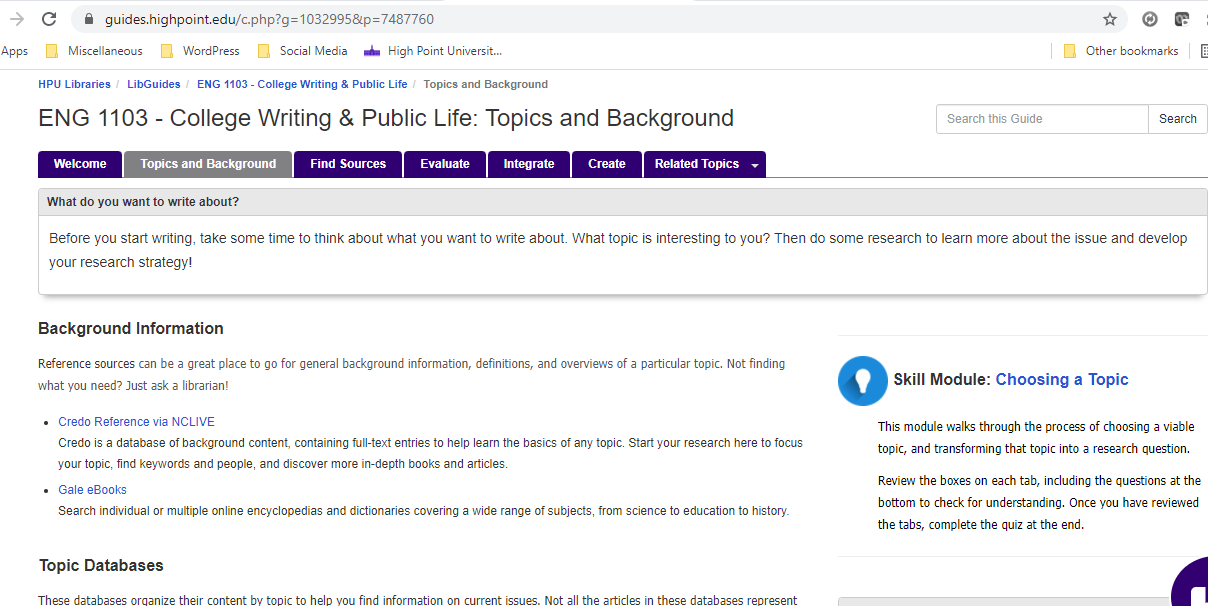
  • The English 1103 Research Guide, which is linked to my blog (see the list of links on the right).
  • The HPU Library home page, which is also linked to my blog. At the library’s home page, you can conduct searches by source type (articles, books, etc.), you can search for articles in particular publications, such as newspapers of record–including The New York Times, The Wall Street Journal, and The Washington Post—and you can search by keywords or by an author’s name.
  • An article you have read may offer a starting point. For example: If you’re interested in writing about the harmful effects of Instagram reported in September 14 Wall Street Journal article, you might look for research by Jean Twenge, a professor of psychology at San Diego Sate University, who is quoted in the article.

Though you will plan and draft longhand in class tomorrow, you will have the opportunity to use your laptop to conduct research. Your revised essay will include a minimum of three relevant sources, but the notes and any draft work that you produce in class tomorrow, November 3, does not need to incorporate three sources. You may devote a significant portion of class time tomorrow to research itself.

Stephen King’s “Strawberry Spring”

King, Stephen. Night Shift. Doubleday, 1978.

To earn an extra-credit course work assignment, read Stephen King’s short story, and publish a response to it of seventy-five words or more on your blog no later than Wednesday, November 10. Questions to consider include, but are not limited to, the following:

  • What, if anything, in Stephen King’s story prepared you for its ending? (What, if anything, would you point to as foreshadowing?)
  • Where in the story did you encounter references to war? Why might King have included so many references to Vietnam and the U.S. Civil War?
  • How is “Strawberry Spring” similar to or different from another horror story of Stephen King’s? How is the story similar to or different from a horror story by another writer?
Posted in English 1103, Teaching, Writing

ENG 1103: A First Sentence

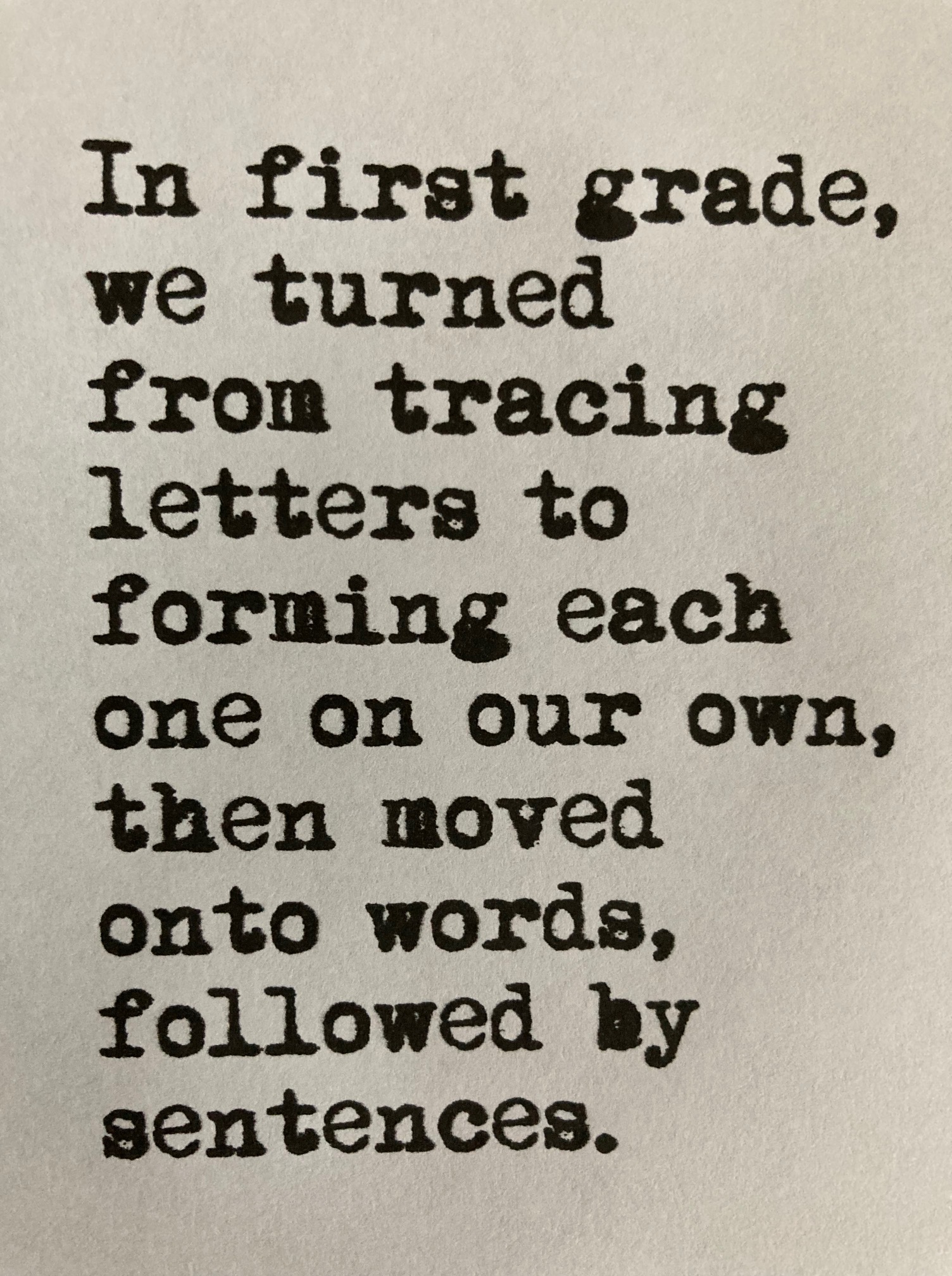
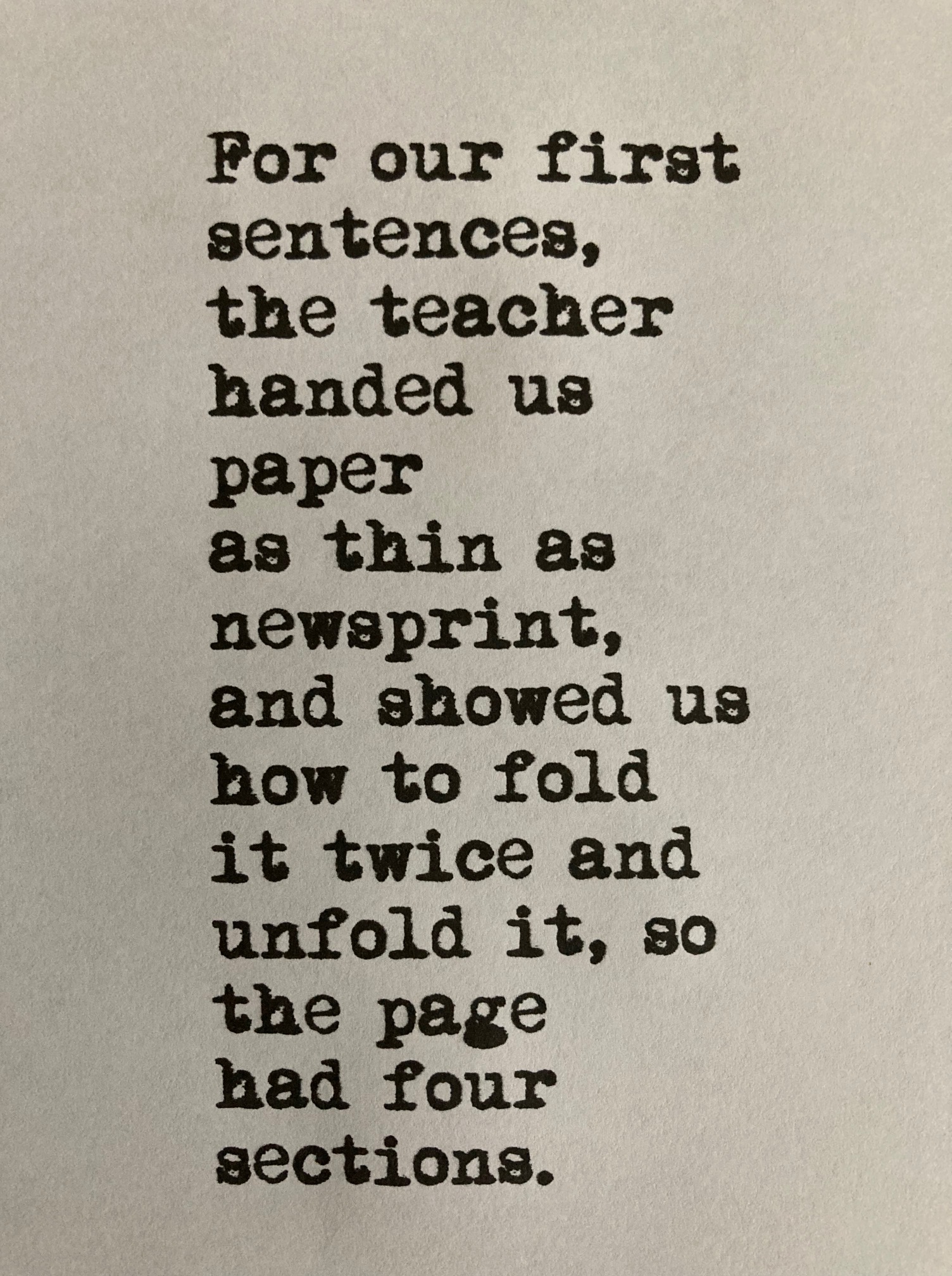
The “stanzas” below and the two paragraphs that follow them are my version of the English 1103 creative project.

A First Sentence

Although many moments of my childhood are lost to me, the memory of writing one of my first sentences resurfaces in my mind because it marks a turning point. Before that sentence-writing exercise, I had recorded letters on a page, but I had not truly written. When I looked at the words on the chalkboard and said to myself, “The pig wore a wig,” I had formed an idea. I composed it in my mind and wrote it on the page.

I  cannot return to the pure joy of that moment whenever I sit down to write, but I try to remind myself often that all writing is creative. We always begin with a blank page or screen and create.

Posted in English 1103, Reading, Teaching, Writing

ENG 1103: Beginning Your Creative Project

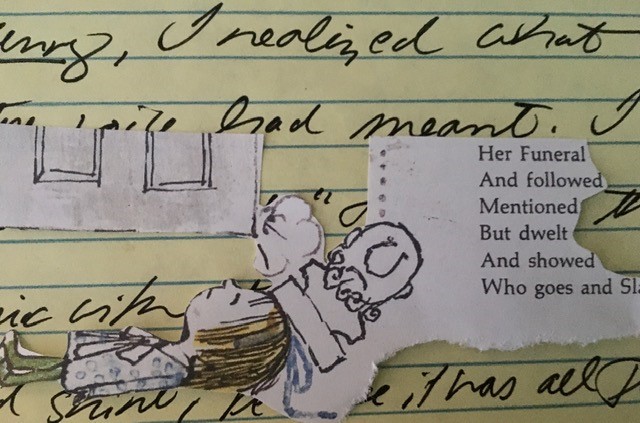
Collage image: an illustration by Alice and Martin Provensen for the poem “Rebecca” by Hilaire Belloc

Today in class you freewrote on seven prompts to generate ideas for the creative project that you will produce this week. The project is a variation on a literacy narrative, which the authors of our text book refer to as “an acount of how you came to think about writing in the ways that you do” (118).

Your project is a variation on the literacy narrative; it’s a piece of imaginative writing–in prose, verse, or a combination of the two–that recreates a memory of one of your reading or writing experiences and conveys the significance of that experience in your development as writer, a reader, and/or a critical thinker.

At the beginning of class on Wednesday, you will receive the assignment, and you will have the class period to continue planning and begin drafting. Your project is due on your blog Friday morning; the hard deadline is Monday before class. You will not post your project to Blackboard.

Consider asking family members about their memories of your early reading or writing experiences. What they remember may lead you to additional ideas for your project. You might also browse the children’s collection at the Stout School of Education Resource Center.

Work Cited

Rosenwasser, David and Jill Stephen. Chapter “Thinking Like a Writer.”Writing Analytically, 8th edition. Wadsworth/Cengage, 2019. pp. 1116-4

Posted in English 1103, Reading, Scrabble, Teaching, Writing

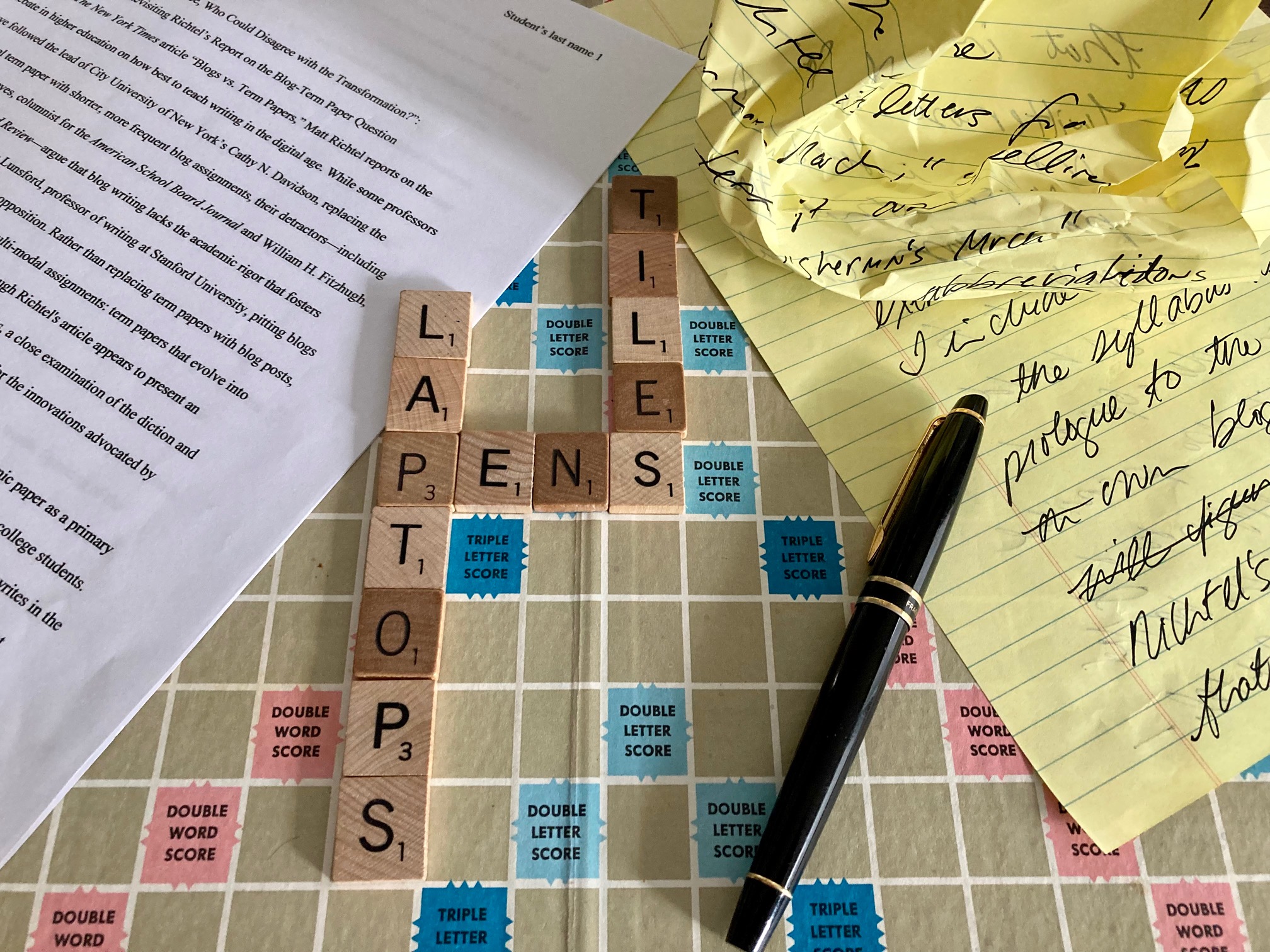
ENG 1103: Tiles, Pens, and Laptops: Reflections on Word Building

Although I have read Matt Richtel’s article “Blogs vs. Term Papers” many times, this semester marked the first time I had studied it as an exercise in analysis. Ordinarily, I include Richtel’s article on the syllabus as a prologue to my students’ own blogging. The article served that purpose in August as well. But as I found myself teaching a different composition curriculum that features an analysis as the first major paper assignment, Richtel’s article served a dual purpose: It not only oriented my students to the role that blogs would play in the class, it also provided them with the opportunity to study the way a writer—in this case, Matt Richtel—presents the ideas of the experts he interviews. By reading Richtel’s article, the students learned about changes in writing practices in college classrooms; by rereading Richtel, they began to see how his writing takes shape. The same was true for me.

The process of crafting a study of “Blogs vs. Term Papers” prompted me to meditate on the similarities between analysis and Scrabble, another feature of the course. The more I examined Richtel’s words, the more details I noticed. Similarly, the more closely I study the words on a Scrabble board and the tiles on a rack, the more opportunities for word building become apparent to me. This semester, the processes of writing an analysis of “Blogs vs. Term Papers” and playing Scrabble have deepened my understanding of how those two activities cultivate the focus that leads to the discoveries intrinsic to learning.

One of those moments of discovery occurred for me as I was rereading the paragraph in Richtel’s article where he addresses an argument put forth by experts who frown on replacing the term paper with the blog. Richtel reports their claim that if teachers want to reduce term papers to blog posts, why not bypass blogs altogether and ask nothing more of their students than tweets? In my previous readings of the paragraph, I was drawn primarily to the clever mimicry at the end. There Richtel omits letters from the words “Sherman’s March,” spelling it as “Shermn’s Mrch” to imitate the word-shortening technique characteristic of the Twitter platform.

As I studied the paragraph more closely, I saw beyond the intentional misspellings at the conclusion. Subsequently, what preceded the imitation of Twitterese became far more revealing. I noticed that the paragraph consisted of only one sentence—one of only two one-sentence paragraphs in the article—and that Richtel’s presentation of the claim demonstrates a flaw in the experts’ logic: “Their reductio ad absurdum: why not just bypass the blog, too, and move on to 140 characters about Shermn’s Mrch?” Realizing that Richtel presented one of their assertions as a logical fallacy, led me to this point: “To assert that defenders of traditional academic writing carry their opponents’ argument   to an absurd conclusion presents those advocates of old-school writing as purveyors of the same flawed logic that their own traditional rhetoric supposedly teaches students to avoid.”

Additionally, I considered the effect of choosing to present the fallacy as a one-sentence paragraph, noting that “[b]y introducing an apparent contradiction in the argument of the advocates of old-school writing, Richtel subverts their claim; and by presenting that incongruity as a one-sentence paragraph, he highlights the issue.”

Reflecting on the effect of the one-sentence paragraph, with its emphasis on a single idea, led me to reexamine the other one-sentence paragraph in the article. That paragraph, a sentence spoken by Professor Cathy Davidson of the City University of New York, underscores the prominence of her words and ideas in Richtel’s article, an observation of mine that led me to the thesis, that “[a]lthough Richtel’s article appears to present an objective account of the disagreements among experts, a close examination of the diction and structure of ‘Blogs vs. Term Papers’ reveals a preference for the innovations advocated by Davidson and Lundsford.”

Rereading Richtel’s article through a writer’s lens showed me details I had scarcely noticed before, ones that now in plain view lead me to ask repeatedly, How could I have missed that? It’s a question I have also found myself asking when a word emerges from a seemingly hopeless combination of Scrabble tiles. Sometimes my students chide themselves for what they didn’t see on the board or the rack, but those realizations are almost always part of the composing process, whether we’re building words with tiles, or pens, or laptops. The closer we look, the more we discover, which is learning in its purest form.

Works Cited

Lucas, Jane. “ENG 1103: On its Face, Who Could Disagree with the Transformation?: Revisiting Richtel’s Report on the Blog-Term Paper Question.” Jane Lucas, 20 Sept. 2021, https://janelucas.com/2021/09/20/eng-1103-on-its-face-who-could-disagree-with-the-transformation-revisiting-richtels-report-on-the-blog-term-paper-question/.

Richtel, Matt. “Blogs vs. Term Papers,” The New York Times, 20 Jan. 2012,             https://www.nytimes.com/2012/01/22/education/edlife/muscling-in-on-the-term-paper-tradition.html.

Posted in English 1103, Teaching, Writing

ENG 1103: From Drafting to Revision

Today in class you received your handrwritten draft with my notes and you began revising your midterm reflection on your laptop. I am writing a reflection as a model for you and will post it to Blackboard and to my blog before your reflection is due on October 20, the Wednesday after fall break. In the meantime, I am including here, as well as on Blackboard, the model reflection that I wrote for my students in late November and early December 2020.

Check, Please!

Also in class today, you submitted the worksheet for the fourth lesson in the Check, Please! course. The summary and commentary that I wrote along with you appears below.

In the fourth lesson of the Check, Please!, Starter Course, Mike Caulfield, author of the course and Director of Blended and Networked Learning at Washington State University, focuses his instruction on the third step in the four-step SIFT approach to determining the reliability of a source. Lesson four, “Find Trusted Coverage,” addresses these topics: (1) scanning Google News for relevant stories, (2) using known fact-checking sites, and (3) conducting a reverse-image search to find a relevant source for an image.

One of the concepts Caulfield introduces in lesson four is click restraint, which was given its name by Sam Wineberg, Professor of History and Education at Stanford, and Sarah McGrew, Assistant Professor of Education at the University of Maryland. Click restraint is an activity that fact checkers practice regularly, but many average people do not. Fact checkers resist the impulse to click on the first result, opting instead to scan multiple results to find one that combines trustworthiness and relevance.

Caulfield also considers the issue of false frames and offers as an example the miscaptioned photo of a young woman that circulated widely after the 2017 London Bridge attack. In the photo, the woman, who is wearing a hijab, is looking down at her phone as she walks past one of the victims lying by the side of the road, surrounded by members of the rescue team. Because the woman’s face is blurred, viewers of the miscaptioned picture cannot see the look of shock that is visible in her face in another image taken by the same photographer. Subsequently, her apparent lack of concern for the victim seems to confirm the caption in the infamous tweet.

Choosing a general search term over a specific one is a useful and unexpected tip Caulfield includes in his discussion of image searches. He explains that the benefit of such a bland term as “letter” or “photo” will prevent the confirmation bias that can lead to the proliferation of disinformation through false frames.

Work Cited

Caulfield, Mike. Check, Please! Starter Course, 2021,             https://webliteracy.pressbooks.com/front-matter/updated-resources-for-2021/.

Next Up

Friday marks our seventh Wordplay Day of the semester. To prepare for class and to up your game, browse the Scrabble site’s Tips and Tools and my blog posts devoted to the game.

Posted in English 1103, Reading, Teaching, Writing

ENG 1103: Starting with Summary

Today in class you read and summarized the September 15 article from The Wall Street Journal’s Facebook Files series. The summary that I wrote along with you appears below.

In The Wall Street Journal article “Facebook Tried to Make its Platform a Healthier Place. It Got Angrier Instead,” investigative reporters Keach Hagey and Jeff Horwitz document the social media company’s changes in its algorithms, adjustments that the company supposedly made to increase meaningful social interaction, or MSI. Although data scientists working for Facebook concluded that “[m]isinformation, toxicity, and violent content are inordinately prevalent among reshares,” the company resisted removing the boost that its algorithms gave to content most likely to be reshared by a long chain of users. In essence, the change had the opposite effect of its apparent aim.

And Moving Beyond Summary

Composing a summary seves as a useful follow-up to reading. Identifying the key points in a piece of writing and presenting them in your own words–and perhaps including a brief quotation–demonstrates that you understand what you’ve read.

When you move beyond summary to analysis, you shift your focus from a description of the subject to a close study of what the text means and how the writer constructs that meaning.

The movement from summary to argument–the move you will make in your final essay–involves a different turn. Rather than focusing on what the text means and how the writer constructs that meaning, you are placing the writer in conversation other credible sources on the subject and finding your own place in the conversation.

Next Up

On Wednesday, October 6, you will submit your completed Check, Please! Worksheet for the fourth lesson in the series. If you misplace your worksheet and cannot print a copy, complete the assignment on a sheet of notebook paper. Be sure to submit it at the beginning of class on Wednesday.

Also, on Wednesday you will receive your draft of your midterm reflection with my notes, and you will have the class period to begin revising your essay.

Work Cited

Hagey, Keach, and Jeff Horwitz. “Facebook Tried to Make its Platform a Healthier Place. It Got Angrier Instead. Internal Memos Show How a Big 2018 Change Rewarded Outrage and that CEO Mark Zuckerberg Resisted Proposed Fixes.” Wall Street Journal, Sep 15, 2021. ProQuest, https://libproxy.highpoint.edu/login?url=https://www-proquest-com.libproxy.highpoint.edu/newspapers/facebook-tried-make-platform-healthier-place-got/docview/2572526410/se-2?accountid=11411.