For your literacy narrative, as well as all of your other major writing assignments, you have the opportunity to earn five extra credit points for consulting with a Writing Center tutor.
To schedule an appointment, visit https://highpoint.mywconline.com, email the Writing Center’s director, Justin Cook, at jcook3@highpoint.edu, or scan the QR code below. To earn bonus points for your literacy narrative, consult with a writing center tutor no later than Thursday, September 15.
Check, Please! Lesson Two
At the beginning of class on Monday, September 5, I collected your worksheets for Check, Please! lesson two. My sample version of the assignment appears below.
Check, Please! Lesson Two Assignment
In the second lesson of the Check, Please! Starter Course, Mike Caulfield, author of the course and Director of Blended and Networked Learning at Washington State University, introduces the second step in four-step SIFT approach to determining the reliability of a source. Lesson two offers instruction in “move” (“Investigate the Source”) and one of the web search techniques associated with it (“[J]ust add Wikipedia”).
One of the most useful practices presented in lesson two is Caulfield’s follow-up to the Wikipedia strategy that he outlines in the previous lesson. After he reviews that strategy, Caulfield explains how to use the control-f keyboard shortcut (command-f on a Mac). Typing control-f (or command-f) will open a small textbox in the upper right of the screen. Typing a word you are searching for will highlight the first appearance of the word in the text. Hitting return will highlight each subsequent appearance of the word.
Lesson two introduced me to fauxtire, a term for websites such as World News Daily Report, based in Tel Aviv, that present themselves as satirical but in fact serve primarily to perpetuate disinformation.
Perhaps the most memorable portion of lesson two was the side-by-side comparison of the websites for the American Academy of Pediatrics and the American College of Pediatricians. Though at first glance the two appear comparable, using the Wikipedia strategy reveals their profound differences. While AAP is the premiere authority on children’s health and well-being, ACP was founded to protest the adoption of children by single-sex couples and is widely viewed as a single-issue hate organization.
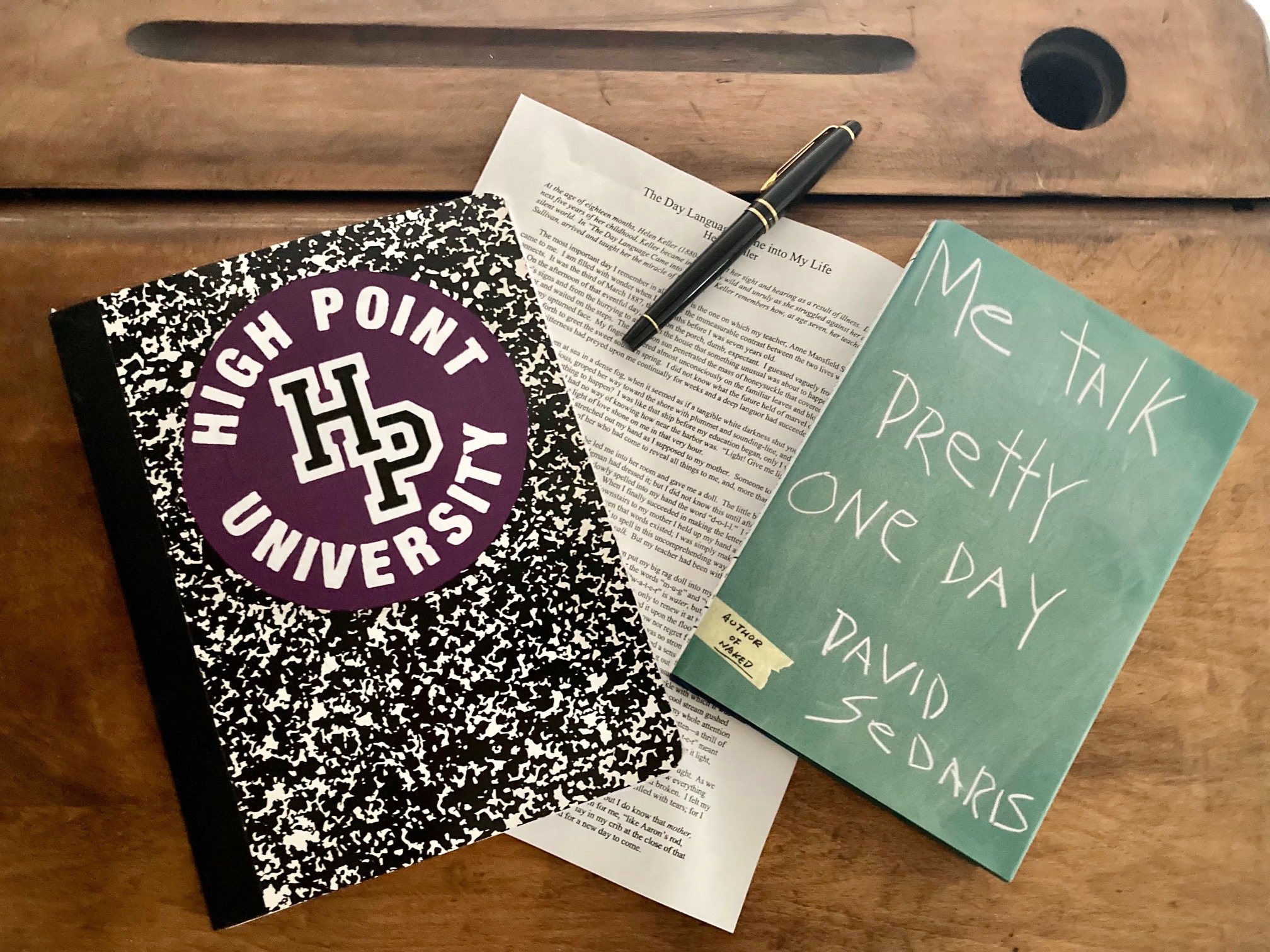
As a model for your own literacy narratives, today in class we will examine “Me Talk Pretty One Day,” originally published in Esquire magazine and later as the title essay in David Sedaris’ 2000 essay collection.
After we read Sedaris’ essay, you will collaborate in groups of four to complete an exercise that involves exploring these aspects of his writing:
Shifts from summary to scene and vice versa
Figurative language
Hyperbole
Vivid detail
I will also ask you to consider what elements are the strongest aspects of the essay and whether “Me Talk Pretty One Day” has given you any ideas for developing your own narrative. Time permitting, we will also read Helen Keller’s essay “The Day Language Came into My Life.”
To read more of Sedaris’ essays, see the list of links under the heading Writing and Radio on his website. You can read more of Helen Keller’s autobiography, the full text in fact, here: The Story of My Life. “The Day Language Came into My Life” is Chapter Four.
Next Up
For Wednesday you should read Keller’s essay (if you don’t have time to read it in class today), and compose a short summary of both her essay and Sedaris.’ Aim for a minimum of fifty words each.
Keep Keller’s and Sedaris’ essays in your pocket portfolio and continue to look to them as models as you revise your literacy narrative. You will receive your draft with my notes at the beginning of Wednesday’s class, and you will have the class period to continue to revise. You will have an additional week to devote to your essay before you post it. It is due (on Blackboard and on your WordPress blog) before class the morning of Wednesday, September 14; the hard deadline is the morning of Friday, September 16.
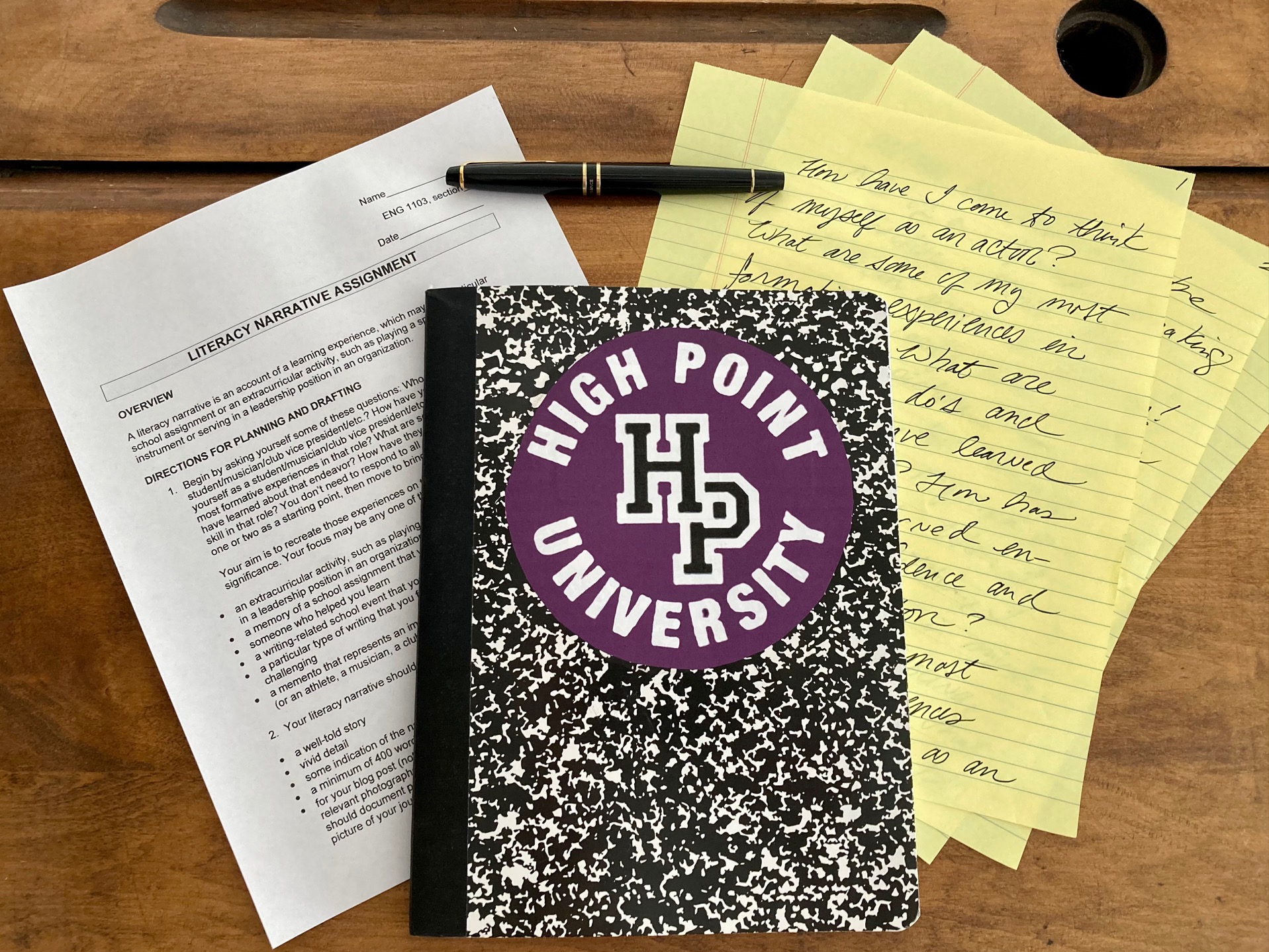
Today in class you will begin planning and drafting your literacy narrative, an an account of a learning experience, which may be a particular school assignment or an extracurricular activity, such as playing a sport or a musical instrument or serving in a leadership position in an organization.
How to Begin
Begin by asking yourself some of these questions: Who are you as a student/musician/club vice president/etc.? How have you come to think about yourself as a student/musician/club vice president/etc.? What were some of your most formative experiences in that role? What are some of the do’s and don’ts you have learned about that endeavor? How have they enhanced your confidence and skill in that role? You don’t need to respond to all of those questions. Try picking one or two as a starting point, then move to bringing your experiences to life.
Your aim is to recreate those experiences on the page and then to reflect on their significance. Your focus may be any one of the following:
an extracurricular activity, such as playing a sport or a musical instrument or serving in a leadership position in an organization.
a memory of a school assignment that you recall vividly
someone who helped you learn
a writing-related school event that you found humorous or embarrassing
a particular type of writing that you found (or still find) especially difficult or challenging
a memento that represents an important moment in your development as a student (or an athlete, a musician, a club leader, etc.)
In class this morning you will receive the assignment sheet that details the guidelines for the literacy narrative. If you are absent today, you can download a copy of the assignment sheet from Blackboard or from this blog post. Next Wednesday, September 7, I will return your draft with my notes, and you will have the class period to revise on your laptop or tablet. You will have an additional week to continue to revise before you post your revision to Blackboard and publish it on your blog on or before the morning of Wednesday, September 14.
Today in class you will also receive a paper copy of the updated course calendar. If you are absent, you can download a copy from Blackboard
“Blogs vs. Term Papers”
For today’s class you read and summarized Matt Richtel’s New York Times‘ article “Blogs vs. Term Papers.” My sample summary of the article appears below.
“Blogs vs. Term Papers” Summary
In The New York Times article “Blogs vs. Term Papers,” Matt Richtel reports on the debate in higher education on how best to teach writing in the digital age. While some professors have followed the lead of City University of New York’s Cathy N. Davidson, replacing the traditional term paper with shorter, more frequent blog assignments, their detractors—including Douglas B. Reeves, columnist for the American School Board Journal and William H. Fitzhugh, editor of The Concord Review—argue that blog writing lacks the academic rigor that fosters critical thinking. For Andrea Lunsford, professor of writing at Stanford University, pitting blogs against term papers creates a false opposition. Rather than replacing term papers with blog posts, Lunsford requires students to produce multi-modal assignments: term papers that evolve into blogs, websites, and video presentations.
We will return to “Blogs vs. Term Papers” in the coming weeks. You will have the option to choose it for the subject of your analysis essay, and you may want to want to address Richtel’s article in your midterm reflection, too.
Next Up
Wordplay Day! To prepare for class, review Tips and Tools on the Scrabble site. Also review the blog posts devoted to Scrabble.
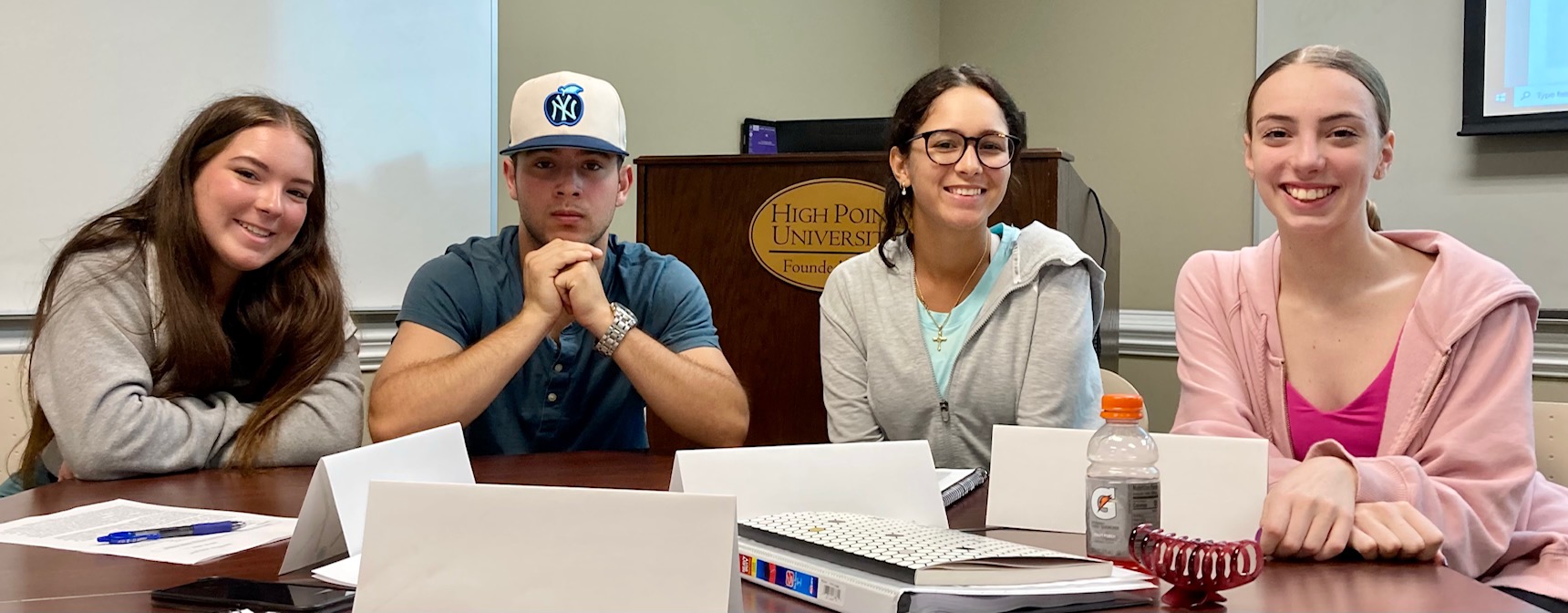
ENG 1103. 24, (L-R): Rachael King, Amelia Cambio, Jaden Gleiber, Harrison Walls
Yesterday in class, along with submitting your first Check, Please! assignment, you examined three of the paragraphs that students collaboratively composed last Wednesday on some of the habits of mind cultivated by successful college students. The paragraphs that follow are revised versions of those paragraphs. Changes I made include ones of punctuation, diction, and grammar. The paragraphs would benefit from additional concrete details, too, but those particular additions can be made only by the students themselves. Keep the annotated handout in your pocket portfolio, and look to it as a model for editing for both individual and group assignments.
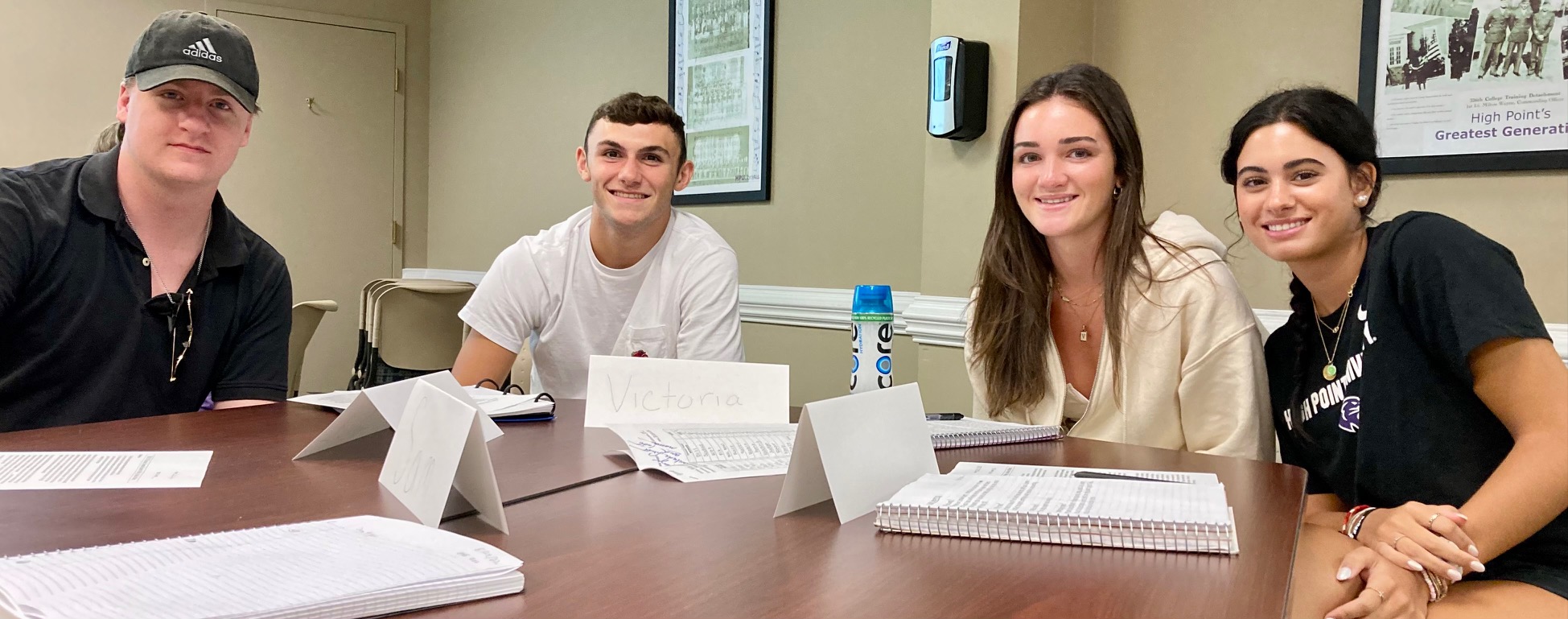
ENG 1103. 24, (L-R): Sam Kaylor, Nick Laurenco, Victoria Leary, Melanie Hale
Student Writing, Sample One
Persistency, or continuing when faced with adversity, poses challenges for students who procrastinate. One member of our group shared an example from many years ago when they [he or she if the person is not nonbinary] received a failing grade on their [see previous pronoun note] first exam. Because the student did not study for the exam, he/she/they earned a failing grade, a grade that no student wants to earn and no teacher wants to record in the gradebook. That experience prompted him/her/they to develop the habit of preparing for class. By completing the same routine over and over, the student found himself/herself/themselves ready for any situation. By practicing consistent persistence, that student—and all of the rest of us—can always be successful.
ENG 1103. 24, (L-R): Jackson Tuomey, Chris Sciortino, Josh Stevens, Janie McDowell
Student Writing, Sample Two
Flexibility, or the ability to adapt in a new environment and unfamiliar situations, resonates with each of us in our group. Our group members are very similar in terms of how we have adapted to situations that challenged us to be flexible. For example: [name ommitted for anonymity]’s work environment involved conflicts with priorities and time management. In order to accommodate to such issues, he went with the flow when he faced problems at work. Doing so enabled him to minimize his stress, and he could often relax.
ENG 1103. 24, (L-R): LaToya Darden-Dixon, Rachel Cornovas, Mer Mixon, Sean O’Donnell
Student Writing, Sample Three
Curiosity—or the desire to learn new things about issues, problems, people, or policies—is a habit of mind that all of us have cultivated. We all grew up wanting to explore the unknown, wanting to learn the realities of other people and look at the world from different perspectives. [Name omitted for anonymity], specifically, is very curious about the food in different cultures. She was very picky when she was young but her willingness to try new foods stemmed from her innate curiosity, she learned which ones she liked through and trial and error. [Name omitted for anonymity] developed the habit of curiosity in the classroom. For him/her/they, school opened up broad subjects like psychology, which developed into a curiosity about the anatomy of the brain. [Name omitted for anonymity] is curious about the uniqueness of the human experience. She is fascinated by how we all experience the same life so differently. Embracing the beauty of difference allows small connections to manifest into much more. Through travelling, meeting new people, and experiencing other cultures, her curiosity has only grown. Our curiosity mindsets have enabled us to branch out and expand our knowledge.
ENG 1103. 24, (L-R): Alexa Hooten, Nick Kernaghan, Dary Guzman, Devlin Turner
Guidelines for Writing and Editing
When you’re composing collaboratively, make sure that everyone—not just the notetaker—is involved in the writing process.
After you have completed composing the piece, allow time for every group member to review the writing. If you recommend changes, let your group know and revise as needed.
Whether you’re writing collaboratively or alone, read your writing aloud. Hearing awkward passages will indicate where you need to edit for brevity. Noting where you pause in your reading may indicate where you need to add a comma or another punctuation mark.
Avoid passive constructions. The subject of the sentence should perform the action rather simply serve as a passive recipient—or worse, an absent subject.
Passive: The work was completed. Active: The students collaboratively composed the assignment.
Next Up
For Wednesday’s class, read Matt Richtel’s New York Times article “Blogs versus Term Papers.” Annotate (make notes in the margin) as you read, and afterward complete a short, fifty to one-hundred word, summary in your journal/writer’s notebook. Those of you in the 9:15 class (section 23) received a paper copy of the article in class. Those of you in the 10:40 class (section 24) should read the copy posted on Blackboard in the Readings folder or the one attached at the end of this post. Rather than annotating the article (since those of you in section 24 don’t have a paper copy yet), make your notes in your journal before you compose your summary of the article. In class on Wednesday I will give you a paper copy.
Important Note: The pages of the paper copies of “Blogs versus Term Papers” are not printed in the correct order. The front-to-back order is 1-3-2-4, so the pages should be read in this order: (1) front of first page, (2) front of second page, (3) back of first page, (4) back of second page. I apologize for the inconvenience.
Mike Caulfield, author of the Check, Please! starter course and Director of Blended and Networked Learning at Washington State University / Caulfield, Mike. Check, Please! Starter Course, 2021, htttps://webliteracy.pressbooks.com/front-matter/updated-resources-for-2021/.
At the beginning of today’s class I will collect your worksheets for Lesson One of the Check, Please! starter course. My sample version of the assignment appears below (as well as on your worksheet and on Blackboard).
Sample Check, Please! Assignment
Check, Please! Lesson One Assignment
In the first lesson of the Check, Please!, Starter Course, Mike Caulfield, author of the course and Director of Blended and Networked Learning at Washington State University, introduces the four-step SIFT approach to determining the reliability of a source: (1) “Stop,” (2) “Investigate,” (3) “Find better coverage,” and (4) “Trace claims, quotes, and media to the original context.”
One of the most useful practices presented in lesson one is what the author terms the “Wikipedia Trick.” Deleting everything that follows a website’s URL (including the slash), adding a space, typing “Wikipedia,” and hitting “enter” will yield the site’s Wikipedia page. The Wikipedia entry that appears at the top of the screen may indicate the source’s reliability or lack thereof.
The most memorable segment of lesson one is the short, riveting video “The Miseducation of Dylann Roof,” which begins with the narrator asking the question, “How does a child become a killer?” Produced by the Southern Poverty Law Center, it documents how algorithms can lead unskilled web searchers down paths of disinformation. In the worst cases, such as Roof’s, algorithms can lead searchers to the extremist propaganda of radical conspiracy theorists.
Today in class we will also examine some anonymous student samples from last Friday’s collaborative writing on habits of mind. Among the questions I will ask you to consider are these:
Have the writers briefly defined the subject (the habit of mind)?
Have they included concrete details that demonstrate how one or more group members have developed that habit of mind?
Post Script
Scrabble invloves a combination of luck and skill, and luck was clearly on my side yesterday morning when I was able to Scrabble, or Bingo (for an additional fifty points), by playing all seven of my tiles. Using the e in ace as a bridge, I was able to play squeezes with the q on a double letter score, the first e on a double letter score, and the final letter, s, on a double word score for a total of 124 points.
College writing offers you the opportunity to develop skills, such as supporting arguments with evidence, writing effective thesis statements, and using transitions well, but it also gives you the opportunity to develop habits. Successful college students develop certain habits of mind, a way of approaching learning that leads to success.
In 2011, the Council of Writing Program Administrators (CWPA), the National Council of Teachers of English (NCTE), and the National Writing Project (NWP) identified eight habits of mind that successful college students adopt.
In class on Monday, we began an exercise in written reflection focusing on four of the eight habits of mind. (The 9:15 class wrote on the first four; the 10:40 class wrote on the second four.) Later in class today, we will begin writing about the four that you did not address in your writing on Monday. The paragraphs that follow include the descriptions of the habits that you examined (and the ones you will examine today), as well as the questions that you answered in writing (and the ones you will answer in writing today).
Curiosity
Are you the kind of person who always wants to know more? This habit of mind will serve you well in courses in which your curiosity about issues, problems, people, or policies can form the backbone of a writing project.
WRITING ACTIVITY: What are you most curious to learn about? What experiences have you had in which your curiosity has led you to an interesting discovery or to more questions?
Openness
Some people are more open than others to new ideas and experiences and new ways of thinking about the world. Being open to other perspectives and positions can help you to frame sound arguments and counterarguments and solve other college writing challenges in thoughtful ways.
WRITING ACTIVITY: In the family or the part of the world in which you grew up, did people tend to be very open, not open at all, or somewhere in the middle? Thinking about your own level of open-mindedness, reflect on how much or how little your own attitude toward a quality like openness is the result of the attitudes of the people around you.
Engagement
Successful college writers are involved in their own learning process. Students who are engaged put effort into their classes, knowing that they’ll get something out of their classes—something other than a grade. They participate in their own learning by planning, seeking feedback when they need to, and communicating with peers and professors to create their own success. Write about a few of the ways you try (or plan to try) to be involved in your own learning. What does engagement look like to you?
WRITING ACTIVITY: Write about a few of the ways you try (or plan to try) to be involved in your own learning. What does engagement look like to you?
Creativity
You may be thinking that you have to be an artist, poet, or musician to display creativity. Not so. Scientists use creativity every day in coming up with ways to investigate questions in their field. Engineers and technicians approach problem solving in creative ways. Retail managers use creativity in displaying merchandise and motivating their employees.
WRITING ACTIVITY: Think about the field you plan to enter. What forms might creativity take in that field?
Persistence
You are probably used to juggling long-term and short-term commitments—both in school and in your everyday life. Paying attention to your commitments and being persistent enough to see them through, even when the commitments are challenging, are good indicators that you will be successful in college.
WRITING ACTIVITY: Describe a time when you faced and overcame an obstacle in an academic setting. What did you learn from that experience?
Responsibility
College will require you to be responsible in way you may not have had to be before. Two responsibilities you will face as an academic writer are to represent the ideas of others fairly and to give credit to writers whose ideas and language you borrow for your own purposes.
WRITING ACTIVITY: Why do you think academic responsibility is important? What kind of experience have you already had with this kind of responsibility?
Flexibility
Would your friends say you are the kind of person who can just “go with the flow”? Do you adapt easily to changing situations? If so, you will find college easier, especially college writing. When you find, for example, that you’ve written a draft that doesn’t address the right audience or that your peer review group doesn’t understand at all, you will be able to adapt. Being flexible enough to adapt to the demands of different writing projects is an important habit of mind.
WRITING ACTIVITY: Describe a situation in which you’ve had to make changes based on a situation you couldn’t control. Did you do so easily or with difficulty?
Metacognition (Reflection)
As a learner, you have probably been asked to think back on a learning experience and comment on what went well or not well, what you learned or what you wished you had learned, or what decisions you made or didn’t make. Writers who reflect on their own processes and decisions are better able to transfer writing skills to future assignments.
WRITING ACTIVITY: Reflect on your many experiences as a writer. What was your most satisfying experience as a writer? What made it so?
Next Up
Friday marks the first Wordplay Day of the semester. To prepare for class, review the Scrabble Ground Rules posted in Blackboard, as well as the Tips and Tools pages on the Scrabble website. Also, look for a Scrabble tips post on my blog. Some weeks, not every week, I will publish a post devoted to Scrabble strategies.
Required materials (l-r): Writing Analytically by David Rosenwasser and Jill Stephen, pen with dark ink, writer’s notebook/journal, pocket portfolio for class handouts, loose leaf paper for drafts and in-class exercises.
Am I the person who will teach your English 1103 class? I posed that question this morning as a starting point for analysis, one of the key features of the course.
To begin the collaboration and inquiry that will figure prominently this semester—along with analysis—you worked together in groups to find the answers to some of the most frequently asked questions about the course. Continue to review the syllabus, which is posted in the Content section of Blackboard. An additional copy of the syllabus is included at the end of this blog entry. If you have any questions about the assignments, the course policies, or the calendar, please let me know.
Textbook
All of you in sections 23 and 24 of English 1103 are required to have the paperback edition of the textbook, Writing Analytically, 8th edition, by David Rosenwasser and Jill Stephen. Bring your copy to class on the days when the title, Writing Analytically, appears in bold on the course calendar. On those days, we will examine portions of the chapters in class and complete some of the exercises related to the reading.
Your first reading assignment in the textbook will be scheduled for mid-September, which will give you ample time to order and receive your copy before you are required to have it in class. (Unlike my copy, pictured at the top of this blog entry, your textbook will not be in a binder.)
Other Required Materials
Writer’s notebook/journal, bring to every class.
Loose leaf paper (for drafts and short in-class assignments), bring to every Monday and Wednesday class
Pen with dark ink, bring to every class
Pocket portfolio (for class handouts), bring to every class
WordPress Blog
As practice in developing your web literacy and writing for a broader online audience, you will maintain a free WordPress blog for the class. As soon as possible, create a free blog at wordpress.com. After you create your blog, email the address, or URL, to me, and I will link your blog to our class page, English at High Point. If you encounter technical difficulties creating your blog or publishing a post, email help@wordpress.com or contact the HPU Help Desk: helpdesk@highpoint.edu, 336-841-HELP (3457).
You will post the revisions of all of your major writing assignments both to your blog and to Blackboard. The posts that you publish for class will be public. You are welcome to create additional posts on your own. If you prefer for some of those posts to be private, keep them in draft form or choose the private visibility option.
You may also be asked to post comments to your classmates’ blogs and to mine.
Next Up
For class on Wednesday, August 24, complete the Habits of Mind exercise, Part I, distributed in class. If you missed today’s class, you can download a copy from the link below.
Syllabus and Habits of Mind Exercise, Parts I and II
Today in class you will plan and draft the reflection essay that will serve as an introduction to your final portfolio: a file and a blog post that will include your analysis, your midterm reflection, your creative project/literacy narrative, and your research project.
The post that follows is the sample portfolio that I wrote as a model for my students last semester.
More Reflections on Word Building
Although my students ordinarily write a literacy narrative at the beginning of the semester, High Point University’s English 1103 curriculum includes a creative project following the midterm reflection. So instead of writing a model literacy narrative for my students in the first weeks of the course—as I have for so many years—I found myself instead beginning that piece of writing in October. Teaching a first-year writing course with a different assignment sequence led me to ask myself how my students and I may benefit from crafting literacy narratives in between more conventional assignments. In retrospect, I realize that those personal stories not only offered a welcome departure from the more traditional academic essays typical of a freshman composition course, they also provided us a chance to reflect on our earlier learning experiences as a prelude to beginning the most rigorous assignment of the course: the research project. Together, the literacy narrative, the research project, and the ongoing weekly Wordplay Days increased my understanding of how those seemingly disparate endeavors enable the discoveries essential to our learning.
One of those discoveries occurred as I began writing my model literacy narrative for my students. Because I have written so many literacy narratives, beginning another one always tests my ability to recollect an early learning experience that I haven’t already recounted in an essay. As I began to freewrite with my students, I was reminded of the importance of trusting the process. Even though I did not have a subject when I first put pen to paper, as I continued to scribble in my journal, I found myself returning in my mind to my first-grade classroom. There I saw my six-year-old self writing my first sentences. And there my literacy narrative began. As I noted in the narrative, itself, “the memory of writing one of my first sentences resurface[d] in my mind because it marked a turning point. Before that sentence-writing exercise, I had recorded letters on a page, but I had not truly written. When I looked at the words on the chalkboard and said to myself, “The pig wore a wig,” I had formed an idea. I composed it in my mind and wrote it on the page.”
I experienced a similar discovery in the process of working on my model research project. Though I had uncovered useful source material on the aspects of my course that would serve as my subject, tying it all together proved to be an arduous task. Rereading my sources and placing myself in conversation with them deepened my understanding of my classroom practices and also helped me develop some ideas for redesigning activities. Yet the organization that my essay needed still eluded me.
As I continued to browse articles devoted to screen time, I happened upon Gavin Francis’ essay “Scrolling” in a recent issue of The New York Review of Books. In the opening paragraph of the essay, Francis, a physician and author, recounts his visit to Walden, an excursion that showed him that our daily distractions had even encroached on the site of Henry David Thoreau’s cabin, the place where he wrote Walden, the place that had come to be considered the quintessential retreat. That observation of Francis’ and his reference to William Powers’ concept of Walden Zones helped my essay take shape. What linked the pieces of my research project were the ways in which the classroom practices I examined in my research served as opportunities for Walden Zones. Once I realized that, I was able to connect the components of my essay.
One of those components, the study of Scrabble play in the college classroom, introduced me to the ways in which professors at MidAmerican Nazarene University had incorporated tabletop games into their undergraduate courses. Along with replacing individual play with teams to offer students exercises in collaboration, the MNU professors included debriefing sessions, which I am contemplating as an addition to my classes next semester. Each Monday may find my students returning to their Friday groups to review images of their game boards and discuss their play. Were they faced with the challenge of a rack full of vowels or consonants (or nearly all vowels or consonants)? Were they able to spell multiple words in one turn with parallel play? If so, how many words did they play? Did the teammates encounter any disagreements regarding how to advance? Those are some of the questions that I may ask my students to consider as a way of re-examining their collaboration and creative problem solving.
Now as my students and I near the end of the semester, each of us can look back on a body of work that exceeds what we believed we could accomplish. As I wrote in my research project, “Even as I wrote these words that you are reading, I struggled to maintain my focus. I found myself returning to pen and paper to develop my ideas, ones that were too easily cut short when I hit the delete key.” That was true of this reflection as well, another piece of writing that has reminded me to trust the process and that has shown me how much I have learned along the way.
“On its Face, Who Could Disagree with the Transformation?”: Revisiting Richtel’s Report on the Blog-Term Paper Question
In The New York Times article “Blogs vs. Term Papers,” Matt Richtel reports on the debate in higher education on how best to teach writing in the digital age. While some professors have followed the lead of City University of New York’s Cathy N. Davidson, replacing the traditional term paper with shorter, more frequent blog assignments, their detractors—including Douglas B. Reeves, columnist for the American School Board Journal and William H. Fitzhugh, editor of The Concord Review—argue that blog writing lacks the academic rigor that fosters critical thinking. For Andrea Lunsford, professor of writing at Stanford University, pitting blogs against term papers creates a false opposition. Rather than replacing term papers with blog posts, Lunsford requires students to produce multi-modal assignments: term papers that evolve into blogs, websites, and video presentations. Although Richtel’s article appears to present an objective account of the disagreements among experts, a close examination of the diction and structure of “Blogs vs. Term Papers” reveals a preference for the innovations advocated by Davidson and Lundsford.
The opening paragraph of Richtel’s article focuses on the academic paper as a primary cause of “angst, profanity, and caffeine consumption” among high school and college students. In stark contrast to the images of the term paper-induced misery in his lead, Richtel writes in the second paragraph that students may be “rejoicing” because Cathy Davidson—a professor at Duke when Richtel interviewed her—favors replacing the term paper with the blog. Richtel refers to Davidson as a “champion” for students and outlines her use of a course blog as a practice that has become commonplace in a variety of academic disciplines. Richtel reports that blogs provide students with a “feeling of relevancy” and “instant feedback,” then poses the question: “[W]hy punish with a paper when a blog is, relatively, fun?”
From that question Richtel turns to the argument of defenders of the traditional academic paper, namely that the term paper teaches essential components of writing and thinking that may be absent from blog posts. Yet after letting the advocates of old-school writing have their say, Richtel undercuts their claim with this one-sentence paragraph: “Their reductio ad absurdum: why not just bypass the blog, too, and move on to 140 characters about Shermn’s Mrch?” To assert that defenders of traditional academic writing carry their opponents’ argument to an absurd conclusion presents those advocates of old-school writing as purveyors of the same flawed logic that their own traditional rhetoric supposedly teaches students to avoid.
Notably, the one-sentence paragraph, unlike paragraphs with multiple sentences, places heavy emphasis on a single idea. It says to readers, this is important. By introducing an apparent contradiction in the argument of the advocates of old-school writing, Richtel subverts their claim; and by presenting that incongruity as a one-sentence paragraph, he highlights the issue.
Richtel’s reductio ad absurdum paragraph is one of only two one-sentence paragraphs in his article. The other consists entirely of Professor Davidson’s own words. Speaking of the mechanistic quality of the term paper, she says: “As a writer, it offends me deeply.” In addition to devoting that one-sentence paragraph to Davidson’s negative feelings about term papers, Richtel returns to those feelings of hers at the end of his article and lets Davidson have the last word, literally.
In the final paragraphs of the article, Richtel recounts a tutoring session Davidson conducted with a community college student. Though she frowned on his assignment’s rigid guidelines—including prescribed sentence length—she told the student to follow the rules, knowing that teaching him what she deemed the best practice might have led the student to fail. Reflecting on that moment, Davidson said, “I hated teaching him bad writing,” and with those words of hers, Richtel’s article ends.
Along with giving Davidson the last word, Richtel devotes far more of his article to the new literacies she and Lunsford foster in their students. Arguably, the innovative nature of the work could account for the considerable space that Richtel devotes to it. After all, what readers are familiar with—in this case the traditional term paper—isn’t news. But the preponderance of word choices that place old literacies in a negative light combined with a structure that diminishes the merits of old-school writing reveals Richtel’s implicit preference for Davidson’s and Lundsford’s innovations.
Readers revisiting Richtel’s article now, nearly ten years after he wrote it, may wonder how he would respond to the question he poses about the shift from page to screen: “On its Face, Who Could Disagree with the Transformation?” Richtel wrote “Blogs vs. Term Papers” in 2012, the year deemed the year of the MOOCs (massive open online courses). Once touted as the key to revolutionizing higher education, their success has been hampered by the same issues linked to the learning losses experienced during the pandemic. For the many students who have had little or no face-to-face instruction—writing or otherwise—in recent memory, more technology may not seem like an answer, much less an innovation.
Tiles, Pens, and Laptops: Midterm Reflections on Word Building
Although I have read Matt Richtel’s article “Blogs vs. Term Papers” many times, this semester marked the first time I had studied it as an exercise in analysis. Ordinarily, I include Richtel’s article on the syllabus as a prologue to my students’ own blogging. The article served that purpose in August as well. But as I found myself teaching a different composition curriculum that features an analysis as the first major paper assignment, Richtel’s article served a dual purpose: It not only oriented my students to the role that blogs would play in the class, it also provided them with the opportunity to study the way a writer—in this case, Matt Richtel—presents the ideas of the experts he interviews. By reading Richtel’s article, the students learned about changes in writing practices in college classrooms; by rereading Richtel, they began to see how his writing takes shape. The same was true for me.
The process of crafting a study of “Blogs vs. Term Papers” prompted me to meditate on the similarities between analysis and Scrabble, another feature of the course. The more I examined Richtel’s words, the more details I noticed. Similarly, the more closely I study the words on a Scrabble board and the tiles on a rack, the more opportunities for word building become apparent to me. This semester, the processes of writing an analysis of “Blogs vs. Term Papers” and playing Scrabble have deepened my understanding of how those two activities cultivate the focus that leads to the discoveries intrinsic to learning.
One of those moments of discovery occurred for me as I was rereading the paragraph in Richtel’s article where he addresses an argument put forth by experts who frown on replacing the term paper with the blog. Richtel reports their claim that if teachers want to reduce term papers to blog posts, why not bypass blogs altogether and ask nothing more of their students than tweets? In my previous readings of the paragraph, I was drawn primarily to the clever mimicry at the end. There Richtel omits letters from the words “Sherman’s March,” spelling it as “Shermn’s Mrch” to imitate the word-shortening technique characteristic of the Twitter platform.
As I studied the paragraph more closely, I saw beyond the intentional misspellings at the conclusion. Subsequently, what preceded the imitation of Twitterese became far more revealing. I noticed that the paragraph consisted of only one sentence—one of only two one-sentence paragraphs in the article—and that Richtel’s presentation of the claim demonstrates a flaw in the experts’ logic: “Their reductio ad absurdum: why not just bypass the blog, too, and move on to 140 characters about Shermn’s Mrch?” Realizing that Richtel presented one of their assertions as a logical fallacy, led me to this point:
To assert that defenders of traditional academic writing carry their opponents’ argument to an absurd conclusion presents those advocates of old-school writing as purveyors of the same flawed logic that their own traditional rhetoric supposedly teaches students to avoid.
Additionally, I considered the effect of choosing to present the fallacy as a one-sentence paragraph, noting that “[b]y introducing an apparent contradiction in the argument of the advocates of old-school writing, Richtel subverts their claim; and by presenting that incongruity as a one-sentence paragraph, he highlights the issue.”
Reflecting on the effect of the one-sentence paragraph, with its emphasis on a single idea, led me to reexamine the other one-sentence paragraph in the article. That paragraph, a sentence spoken by Professor Cathy Davidson of the City University of New York, underscores the prominence of her words and ideas in Richtel’s article, an observation of mine that led me to the thesis, that “[a]lthough Richtel’s article appears to present an objective account of the disagreements among experts, a close examination of the diction and structure of ‘Blogs vs. Term Papers’ reveals a preference for the innovations advocated by Davidson and Lundsford.”
Rereading Richtel’s article through a writer’s lens showed me details I had scarcely noticed before, ones that now in plain view lead me to ask repeatedly, How could I have missed that? It’s a question I have also found myself asking when a word emerges from a seemingly hopeless combination of Scrabble tiles. Sometimes my students chide themselves for what they didn’t see on the board or the rack, but those realizations are almost always part of the composing process, whether we’re building words with tiles, or pens, or laptops. The closer we look, the more we discover, which is learning in its purest form.
In first grade, we turned from tracing letters to forming each one on our own, then moved onto words, followed by sentences. For our first sentences, the teacher handed us paper as thin as newsprint, and showed us how to fold it twice and unfold it, so the page had four sections.
At the bottom of each, we wrote a sentence with words listed on the chalkboard. Above our sentences, we drew what we had just written with words.
One of my sentences was, “The pig wore a wig.” I don’t remember the other three, but the delight of forming that sentence has remained with me.
Although many moments of my childhood are lost to me, the memory of writing one of my first sentences resurfaces in my mind because it marks a turning point. Before that sentence-writing exercise, I had recorded letters on a page, but I had not truly written. When I looked at the words on the chalkboard and said to myself, “The pig wore a wig,” I had formed an idea. I composed it in my mind and wrote it on the page.
I cannot return to the pure joy of that moment whenever I sit down to write, but I try remind myself often that all writing is creative. We always begin with a blank page or screen and create.
Left to Our Own Devices: One Teacher’s Meditations on Walden Zones for the Digital Age
In his recent essay “Scrolling,” physician and writer Gavin Francis recounts a visit to the woods near Concord, Massachusetts, where Henry David Thoreau built his cabin and wrote Walden. Although Francis anticipated that the area—now a tourist site—would be busy, what he didn’t expect “was the forest of arms holding smartphones, taking selfies, engaging in video calls.” Francis opens his essay with that anecdote about his visit to Thoreau’s woods to emphasize the pervasiveness of digital devices in our lives. Not even at a place synonymous with the retreat from daily distractions can we turn away from our phones. Francis observes one of Walden’s visitors, a student perched on a rock, “arms outstretched, angling his phone while shouting out to his retreating companions: ‘I don’t think you guys realize how much this place means to me, I mean privately.’”
Disentangling from our distractions is particularly problematic for those of us who teach, whose role in our students’ lives involves cultivating the undivided attention essential to learning. Seeking a balance between screen time and time away from it is an ongoing process, one that has taken on new importance in the last year and a half, since the onset of COVID-19. Even as the pandemic has required us to spend more hours in front of our screens, we have witnessed the critical need to turn away from them.
That ability to turn away from the screen has substantial benefits for us when we write. In their textbook, Writing Analytically, David Rosenwasser and Jill Stephen detail the problems that present themselves when we begin the process with our fingers on the keyboard:
Perhaps the most common problem with writing on a computer is that this practice can lock you into a draft or a particular idea too soon. Words that come up on a screen look more like finished text than handwritten words in a notebook, and so, the problem of trying to draft and edit at the same time is more likely to arise, as is the likelihood that you will close off fruitful options too soon by prematurely hitting the delete button. And then there is what we might call the low-hanging fruit problem: the temptation to keep interrupting ourselves to chase links to other people’s thinking (and any number of funny pet pictures) online. (125)
Rosenwasser and Stephen, professors emeriti at Muhlenberg College, note that “[w]riters tend to be more than a little divided” regarding writing on computers versus writing on paper, and they acknowledge that they “have had students who manage to capture their best ideas by jotting them down on their cell phones” (124). Still, they recommend that “at earlier stages in the writing process, and also, perhaps, in trying to work through a difficult revision, taking pen to paper might be the better tactic” (125).
Though many teachers have moved to all-digital assignments, I still require my students to draft longhand and move to the keyboard during the revision process. My initial reason for continuing that practice was the benefits it offers us as writers, including the ones cited by Rosenwasser and Stephen. Now I realize that the benefits extend beyond writing. Putting pen to paper means less time in front of the screen. That said, drafting longhand doesn’t eliminate digital distractions for writers; it simply delays them. But the deferral alone is a plus. Even as I wrote these words that you are reading, I struggled to maintain my focus. I found myself returning to pen and paper to develop my ideas, ones that were too easily cut short when I hit the delete key.
Along with drafting handwritten assignments, my students play Scrabble once a week. Initially those weekly games served primarily as companions to their writing, exercises in word building and analysis on a smaller scale. But like writing longhand itself, Scrabble presented another opportunity to turn away from our screens.
In the process of writing this paper, I found minimal research on Scrabble. Notably, the one article that focused on Scrabble in the college classroom mentioned that “[t]abletop games appeared to receive less attention from game researchers than video games, particularly within the postsecondary context” (289). The author of that study, Mark Hayse, co-director of the Center for Games and Learning at MidAmerican Nazarene University, drew his findings from the reports of three of his colleagues who incorporated tabletop games into their classes in Christian leadership, theology, and history. The professors’ focused their attention on the possible connections between gameplay and twenty-first century “learning and innovation skills,” also known as the “4Cs”: critical thinking and problem solving, creativity and innovation, communication, and collaboration (290).
The MNU professors’ primary research question was, “Does tabletop gameplay require the practice of 21st century skills?” (290). Their secondary question was, “What initial links might be drawn between tabletop gameplay, 21st century skill practice, and undergraduate learning?” They found that two of the four Cs, communication and collaboration, figured prominently, and the students themselves identified collaboration as the primary component of their gameplay. All three professors reported “that tabletop gameplay helped students move from classroom passivity to classroom ‘engagement’” (298). In my own classroom, I have observed the same movement from passive learning to active learning when my students play Scrabble. Sometimes they are so absorbed in their games, they are surprised to hear me announce that it’s time for their five-minute break. I also shared the MNU professors’ observation that “[e]ven though tabletop gameplay technically was coursework . . . the nontraditional nature of it seemed to render it as play more than work” (298). Even though some students don’t like the particulars of the game—such as the rule that prohibits proper nouns, acronyms, and hyphenated words—most of the students enjoy the time collaborating with their classmates on an activity that doesn’t seem like a compulsory task.
Describing the process of gameplay, one student in the MNU study said, “There were those intense suspense moments, but there was also this ‘Oh yeah, we got this’ when we were strategizing [together]” (299). Those intense moments of suspense occur in my classes during Scrabble games when a team challenges a word and waits for me to find it in the dictionary or deem it unplayable (because it isn’t there). And there are frequent we-got-this moments when a team suddenly sees a possibility that wasn’t apparent to them before; for example: a square between two vowels where they can form two, two-letter words by playing one of seven consonants on their rack. Determining how to move forward with of only consonants or only vowels—or nearly all consonants and vowels—serve as some of Scrabble’s best opportunities for creative problem solving.
The findings of the MNU professors are markedly similar to my own classroom observations. And although adding Scrabble to the English 1103 curriculum has not been a subject of research for me, the process of writing this paper has prompted my interest in building on the study of MNU’s Professor Mark Hayse, perhaps with a project that explores the links between the problem-solving aspects of Scrabble and the writing process.
As I continue to reflect on writing longhand and playing Scrabble and how they figure in my classes, I am grateful that those practices—ones that I chose for skill development—have taken on greater importance as endeavors that lead us away from our screens.
The challenge of turning away from the digital devices that consume more and more of our lives isn’t simply a good habit to aspire to—a mere item on a list of New Year’s resolutions—instead it’s a critical need. Recent revelations regarding Facebook’s own internal research underscore the platform’s harmful effects, ones to which young people are particularly vulnerable. One of Facebook’s research reports found that “social comparison is worse on Instagram” and that the app’s Explore page, “which serves users photos and videos curated by an algorithm, can send users deep into content that can be harmful” (ctd. in Horwitz et al.).
Riana Elyse Anderson, an assistant professor of health behavior and health education at the University of Michigan, observes that “we’re watching college students really get impacted by the comparison that they’re seeing in their classmates online, in social media. They’re using comparison and they’re feeling particularly anxious about it for themselves” (qtd. In Yang).
While Anderson notes that she’s heartened by Gen Z students’ willingness to seek mental health resources, “[i]t’s another thing, though, when . . . professors like myself are now saying, what do we do? How do we contend with teaching, with meeting, with doing the things we have to do for school” (qtd. In Yang). Many of us who teach college students find ourselves asking the same questions in the face of both our own anecdotal evidence and the reports of mental health crises on college campuses.
Less than a month after The Wall Street Journal reported the findings of Facebook’s internal research, the University of North Carolina at Chapel Hill canceled classes after student leaders demanded a mental wellness day following the suicides of two students—and the hospitalization of another student after a suicide attempt. A 2021 study conducted by the American College Health Association “found that 48 percent of college students reported moderate or severe psychological distress, 53 percent reported being lonely, and one in four had considered suicide” (ctd. in Yang).
Facebook’s internal research includes an Instagram research manager’s report of teenagers “wanting to spend less time on Instagram . . . but lack[ing] the self-control to do so” (ctd. In Horwitz et al.). I observe that same lack of self-control in some of my students. And to help them overcome it, I follow a variation on a piece of advice from journalist and technologist William Powers. In his book Hamlet’s Blackberry, he recommends that “[e]very home could have at least one Walden Zone, a room where no screens of any kind are allowed” (191). When my students put words on paper and form words on a Scrabble gameboard, they are in the Walden Zone that I have created in the classroom, a place where we become temporarily free of the screens that occupy so many moments of our lives. In his conclusion to Walden, Thoreau remarks on “how easily and insensibly we fall into a particular route” (990). The one that leads us to our screens again and again cannot be abandoned, nor should it be, but the Walden Zones we can strive to maintain offer a much-needed detour.
Powers, William. Hamlet’s Blackberry: A Practical Philosophy for Building a Good Life in the Digital Age. Harper, 2010.
Thoreau, Henry David. Walden; or, Life in the Woods. 1854. The Norton Anthology of American Literature: Beginnings to 1865. 9th ed. Robert S. Levine, General Editor. W.W. Norton, 2017. pp. 919-96.
Today in class you will begin your creative project, which is a literacy narrative that recreates one of your learning experiences as a writer. The model literacy narrative that I wrote for my students in 2019 appears below.
Too Many Words: Reflections on Research
I wrote my first research paper in seventh grade. All of us in Mr. Lord’s English class were required to select a subject of our choice, perhaps the subject had to be a historical figure. Whatever the case, I chose Albert Einstein. I remember sitting at the small, drop-front desk in my bedroom, printing sentence after sentence on three-by-five index cards. Mr. Lord had told us in class that we should limit each card to one fact. One of my most vivid memories of that project is the sight of my large, uneven letters spilling over onto the back of the cards. What I construed as one fact wouldn’t fit on one side.
I was probably as unclear about what constituted a single fact as I was about the goal of the assignment itself. I knew that I was conducting research on a scientific genius, but what was my writing supposed to do?
In the process of writing too many words on my index cards, I came across this detail that stopped me in my tracks: When Einstein was a young child, he was perceived as slow-witted. It seemed preposterous that anyone could believe that the theoretical physicist who developed the theory of relativity was stupid; however, I was also aware of the discrepancy between appearance and reality. I didn’t think that I was the same person that others saw when they looked at me. I imagined, as perhaps all adolescents do, that I would never be truly understood, just as I would never truly understand what I was supposed to write about Albert Einstein.
A little more than ten years later, I was walking across the main quad at Hollins College when Professor Dillard stopped me and told me that my paper on The Monk by Matthew Gregory Lewis was one of the best analyses he’d ever read by a student. Stunned and pleased, I thanked him, thinking of how the process of writing that essay had felt different to me, as if something that I needed to achieve in a piece of academic writing had slowly come into focus. I was a graduate student in creative writing then, so most of my writing for my courses was fiction. Yet the years of studying literature and criticism as an undergraduate had led me to an understanding that somehow only surfaced when I wrote that essay for Professor Dillard.
My next breakthrough came about four years later, when the process of writing became more than the act of fulfilling an assignment for a Ph.D. seminar. I was reading studies of contemporary Southern writing and sensed that something was missing. That something was my own analysis:
In The Southern Writer and the Postmodern World, Fred Hobson tags Bobbie Ann Mason “not so much a New South as a No South writer” (81), limiting his discussion of Mason’s work to In Country’s Samantha Hughes. . . . What Hobson refers to in Mason’s characters as a “relative lack of southern self-consciousness” (6), though, is not evident in her other work. (Meekins 147)
As I wrote, I was witnessing for the first time how I could develop scholarship of my own by placing myself in conversation with other scholars, such as Fred Hobson.
Now as I revisit research writing with my students, I am reminded of why the study of imaginative literature, Southern or not, continues to appeal to me twenty-five years after I wrote that paper. As I read in our textbook that the purpose of humanities is “to explore and analyze aspects of the human experience” (Bullock et al. 307), I think of how the ways that writers continue to retell our stories is a source of never-ending fascination for me. I hope that in the process of reflecting on their own research, my students find their own sources of never-ending fascination, too—or at least begin to see their research as more than a course requirement. When they encounter unfamiliar words, I hope they’ll keep reading, as Tara Westover did. In her memoir, Educated, she writes of learning to study by mimicking her brother Tyler. In her words, “[t]he skill I was learning was a crucial one, the patience to read things I could not yet understand” (62). In retrospect, I realize that’s what I was doing forty years ago when I sat at my drop-front desk writing too many words on my note cards. Only now I understand.
Works Cited
Bullock, Richard et al. Chapter 24: “Reading Across Fields of Study.” The Norton Field Guide to Writing with Readings and Handbook. 5th ed. Norton, 2019. pp. 291-93.
Hobson, Fred. The Southern Writer in the Postmodern World. University of Georgia Press, 1991.
Meekins, Beth. “Lost in the Laughing Place: Notes on the Postmodern Postsouthern Condition.” The Black Warrior Review, vol. 20, no. 2, 1994. pp. 146-59.*
Westover, Tara. Educated. Random, 2018.
*The essay “Lost in the Laughing Place” was published five years before I married and three years before I began using my first name rather my nickname, hence the byline Beth Meekins rather than Jane Lucas.
For your midterm reflection, as well as all of your other major writing assignments, you have the opportunity to earn five extra credit points for consulting with a Writing Center tutor.