Posted in Reading, Teaching, Writing

Q&A with Rob Peace’s Nick Carraway

Yesterday afternoon, Jeff Hobbs—one of the featured authors in Lenoir-Rhyne’s Visiting Writers Series—STLRP Bannerconducted a Q&A session with an audience primarily of students, mostly freshman who are reading his book The Short and Tragic Life of Robert Peace for their FYE (First-Year Experience) classes. As Hobbs began to speak, I was reminded of the phone conversation that he recounts in Chapter 12: “You sound like a mouse,” Rob says, “same as you did in college” (295). Though I thought his voice was too low-pitched to be mouse-like, I could see how Rob had found it mousy—and admittedly it was, as Hobbs describes in Chapter 12, “soft-spoken” and “halting” (295).
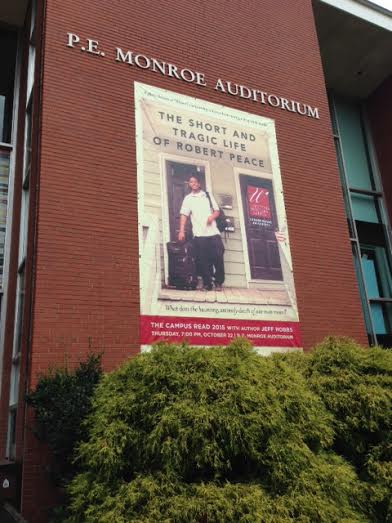
Yet despite the “soft-spoken” and “halting” quality of Hobbs’ voice, he delivered powerful responses to students’ questions. When someone asked, what made you want to write the book? Hobbs answered with remarks about the vast array of mourners—evidence of the variety of people whose lives had been touched by Rob—echoing Hobbs’ words in Chapter 17:

The line for the viewing was two blocks long and one of the most diverse collections of people I’d ever seen: Yale students and professors, people conversing in Portuguese, Croatian, and Spanish, young and old residents of all of the boroughs of New York City and all the townships surrounding Newark. (388)

Near the end of Hobbs’ Q&A, my thoughts returned to Chapter 12, when in response to a question regarding how the process of writing the book had affected him, Hobbs answered that it made him “lament the nature of male friendship,” which he illustrates in his reflections on his conversation with Rob:

Jeff Hobbs / visitingwriters.lr.edu

The distance between us and the maleness of our friendship precluded revealing anything that truly mattered, and at the time I was too naïve to know that if you were friends with someone—truly friends—then you told him what was going on (“It’s called ‘catching up,’” my wife informed me when I asked how it was possible for her to yap with her girlfriends for as long as she did and share every innocuous detail of her life). Instead, I thought that by concisely presenting the most easygoing and put-together version of myself, I was being ‘all good.’ (295-96)

Hobbs did not address his writing process—something he may have spoken about at one of his other two appearances at L-R, Thursday evening and Friday morning—but he did convey what he hoped his biography of Rob would give to readers: a narrative that challenges the “predictable media spin of potential squandered” (386). The questions that audience members asked—as if they, too, had been acquainted with Rob—indicated that Hobbs did achieve that goal, one that any of us writing a book-length narrative would hope for: breathing life into our subjects, whether fictional or real, and enabling readers to see them as three-dimensional human beings, with all of their consistent inconsistencies.

Work Cited

Hobbs, Jeff. The Short and Tragic Life of Robert Peace. New York: Scribner, 2014. Print.

Posted in Reading, Teaching, Writing

A Storytelling Poet on the Eve of 9/11

Last Thursday, when Jaki Shelton Green appeared at Lenoir-Rhyne as the first featured author in this year’s Visiting Writers Series, she spoke as both a poet and a storyteller, noting that her poems live inside her stories.

Jaki Shelton Green / visitingwriters.lr.edu

I found myself drawn more to her stories than the poems they linked, but my ears welcomed the sound of Green’s own voice reading her poem “i know the grandmother one had hands,” just a day after my students and I studied the poem and read it aloud ourselves in class. As she introduced the poem, Green recounted her stint teaching poetry writing to women on death row, giving them the assignment of writing about hands because of the acts that they had committed with their own hands. She didn’t say that the poem was her answer to the assignment, but it may have been, just as this blog entry and the earlier one on the poem, itself, are my answers to the blog assignment that I have given to my students.

Through her poems and stories, Green spoke of painful subjects on the eve of 9/11: the imminent anniversary, her great-great grandmother’s life in slavery, and the death of her own daughter. But her words offered hope rather than sadness. As I reflect on those words, I hope that the ones that my students and I write this semester will show us what Green’s showed us Thursday night: that writing gives us a way of making sense of the world.

Posted in Reading, Teaching, Writing

A Poem in the Hands of a Composition Class

Jaki Shelton Green’s poem “i know the grandmother one had hands” evokes images of a woman whose busy hands remain unseen as they perform a litany of tasks, some literal: “folding, pinching, rolling the dough” (3), others metaphorical: “growing knives” (14).

As my students and I read Green’s poem in class yesterday–in preparation for her presentation tonight as one of the featured writers in Lenoir-Rhyne’s Visiting Writers Series–I expected that the conversation that followed might be markedly poemdifferent from the ones last semester in my Introduction to Creative Writing class. Those students, after all, were reading poems, short stories, plays, and narrative nonfiction as models for their own work. Yet even though my current students in Critical Thinking and Writing will not produce creative writing for class, their responses to Green’s work were similar to those of my creative writing students.

In retrospect, I realize that the similarities should not surprise me since I asked the students in ENG 131 (Critical Thinking and Writing) to begin their exploration of Green’s poem by considering her choices, just as I asked the students in ENG 281 (Intro. to Creative Writing) to begin.

I do not know why Green uses a lower-case “i,” or why she refers to “the grandmother one,” rather than a grandmother or my grandmother, but posing such questions and considering the effects of those choices places us on the path of writing, whether the destination is a poem of one’s own or a study of someone else’s.

Posted in Reading, Writing

Go Set a Watchful Editor

Watchman and Mockingbird with a draft of this blog post
“Watchman” and “Mockingbird” with a draft of this blog post.

In To Kill a Mockingbird, when Nathan Radley discovers that his brother, Arthur “Boo” Radley, has been leaving gifts for Jem and Scout in the knot-hole of a live oak tree, he fills the hole with cement. Some readers would like to entomb Go Set a Watchman in a similar fashion, troubled as they are by the timing of the novel’s publication—suspicious of the motives of Harper Lee’s estate trustee, Tonja Carter—and angered by the revelation of Atticus Finch’s bigotry.

When readers of Watchman learn along with Scout that Atticus not only opposes desegregation but was also once a member of the Klan, it’s more than we and the twenty-six-year-old Jean Louise can take. She says to her father, “You’ve cheated me in a way that’s inexpressible” (252), and we agree, wondering if Lee was cheated as well. Whatever the motives for its publication, the novel is here for us now, its appearance stopping us the way the knot-hole stops Scout and Jem. Rather than deeming Watchman’s arrival unwelcome, it serves us to examine the book with care, in particular the scene at the courthouse where Jean Louise secretly watches her father at a meeting of the Maycomb County Citizen’s Council. As Scout looks down at Atticus from the balcony, she remembers a very different scene twenty years earlier, one of her father “accomplish[ing] what was never before or afterwards done in Maycomb County: he won an acquittal for a colored boy on a rape charge” (109).

Reading that brief flashback, Harper Lee’s editor at Lippincott, Tay Hohoff, realized what was only a five-paragraph summary could become the moral and structural center of the novel. Though he isn’t acquitted in Mockingbird, the unnamed defendant gains a name, Tom Robinson, an arm—in Watchman it was “chopped off in a sawmill accident” (109)—and, most importantly, his essential human dignity. After more than two years of revision, Harper Lee gave us the re-imagined Tom, and Maudie Atkinson, and Mrs. Henry Lafayette Dubose, and added to them Boo, who along with the rest of the Radley family is absent from Watchman. We know those characters and empathize with them because Lee, with the coaxing of a watchful editor, returned to them again and again, giving us people we can consider from their own points of view, whose skin we “walk around in” (32), as Atticus teaches young Scout to do.

Near the end of Mockingbird, Scout reflects on Boo’s gifts to her and Jem: “two soap dolls, a broken watch and chain, a pair of good luck pennies, and our lives. But neighbors give in return. We never put back into the tree what we took out of it: we had given him nothing, and it made me sad” (253).

The least we can give Go Set a Watchman is our attention. It isn’t Harper Lee’s greatest gift to us, but it’s something more important in a way: it’s the apprentice work that gave life to the classic we love.

Works Cited

Lee, Harper. Go Set a Watchman. New York: HarperCollins, 2015. Print.

—. To Kill a Mockingbird. Philadelphia: Lippincott, 1960. Print.

Posted in Reading, Teaching, Writing

A Slow-moving Reminder

"Mov[ing] like a hovercraft . . ."
“mov[ing] like a hovercraft” across one of the granite steps that lead to the front porch
Earlier this afternoon when I spotted a snail on one of the steps to the front porch, I thought of the snail in Paul Muldoon‘s poem “Hedgehog,” the subject of my post from March 4. As I watched the snail glide across the granite, still wet from the rain, I remembered Muldoon’s snail “mov[ing] like a hovercraft, held up by a/Rubber cushion of itself,/Sharing its secret/With the hedgehog.”

And I thought of these lines from my post on March 4:

I cannot say precisely why Muldoon chose to run the simile ‘The snail moves like a/Hovercraft’ from the first line to the second, but I can say—and did say to my students—that it’s an example of enjambment, something to try if we want to achieve a similar run-on effect.

As we begin drafting our own poems, I keep thinking about the pleasure of reading that simile, the surprise followed by recognition. Never before had I thought of a snail moving like a propeller-driven hovercraft. And never before had I thought of the hedgehog and the snail as kindred animals for their ability to retreat into themselves.

The snail, the hovercraft, the hedgehog, the crown of thorns: these are now linked in my mind. That’s what ‘Hedgehog’ has given me.

Posted in Teaching, Writing

Last Canto(s) for the Semester

Cantos
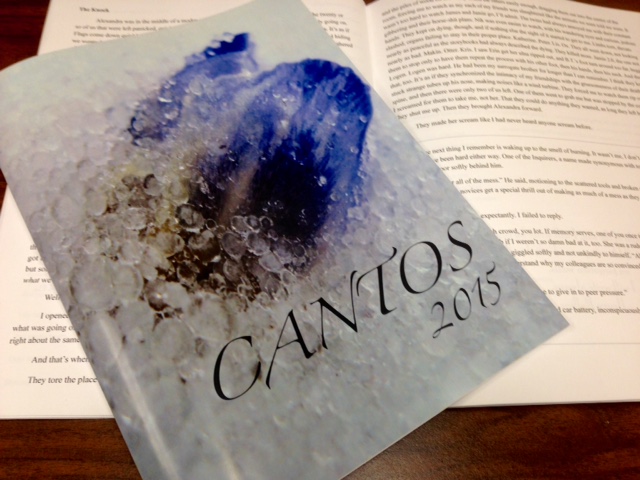
Cantos, Lenoir-Rhyne University’s literary magazine, featuring cover photography by a schwiebert (Annette Schwiebert).

I have taken a break from reading portfolios to offer this short post, one inspired by seeing so many of my students’ names in the pages of Cantos, Lenoir-Rhyne’s literary magazine.  From the Italian for song, a canto is a section of a long poem, a chapter of sorts, and the students’ work both in the magazine and in their portfolios for ENG 281 serves as a last canto for the course, a final chapter in a series of innovative exercises that they, and I, have produced in our multi-genre Introduction to Creative Writing course. I look forward to reading their selections in Cantos after I finish reading their portfolios, but the two aren’t mutually exclusive. Some of the pieces in Cantos appear in their portfolios as well.

  • “Black Dog” and “Regulars” by Ryan Baxter (ENG 281.02)
  • “Strangers” by Rhonda Cheshire (ENG 281.02)
  • “Neither Nor was I Made for Either Door” by Charles Clark (ENG 281.02)
  • “Pigskin” by Peyton Hoyle (ENG 281.01)
  • “Green Eyes” by Richard Jordan (ENG 281.02)
  • “Holmes Triumphant” by Kati Waldrop (ENG 281.02)
  • Cantos also features photography by ENG 281.02 student a schwiebert (Annette Schwiebert) and an essay by Eddie Stiltner (ENG 231, Fall 2014).
  • Kati Waldrop (ENG 281) serves as Cantos’ Editor-in-Chief, and Peyton Hoyle (ENG 281) and Alexis Monthony (ENG 131, Spring 2014) serve as staff readers.
Posted in Reading, Teaching, Writing

“La Femme Nadia”

Pastrix (2013) / nadiabolzweber.com

Before Nadia Bolz-Weber spoke yesterday at Lenoir-Rhyne, the students in my 8 a.m. class and I read an excerpt from her memoir Pastrix: The Cranky and Beautiful Life of a Sinner and Saint (2013). The excerpt, “La Femme Nadia,” depicts the events in late 1991 and early 1992 that led Bolz-Weber to sobriety and to God. For my students and me reading in a “writerly” way, “La Femme Nadia” served as an instructive model for its apt sensory detail (“My skin felt like the rough side of Velcro”), and its graceful shifts from summary to scene:

Margery, a leathery-faced woman with a New Jersey accent, was talking about prayer or some other nonsense when suddenly a sound like a pan falling on the tile floor came up from the kitchen below us. I jerked out of my seat like I was avoiding shrapnel, but no one else reacted. Without skipping half a beat, Margery turned to me, with a long slim cigarette in her hand and said, ‘Honey, that’ll pass.’ She took a drag and went on, ‘So anyways, prayer is. . .’

I did not revisit those details from “La Femme Nadia” with my 12:15 students because their class period coincided with the first of Bolz-Weber’s two March 5 appearances as one of the featured writers in the university’s Visiting Writers Series.

In lieu of our scheduled class, we attended the presentation—one that Bolz-Weber nearly missed due to weather-related travel woes that she recounted with humor and grace.

Her remarks focused on faith rather than writing—she would turn her focus to writing at 7 p.m.–but her 12:15 talk was relevant to writers nevertheless. In response to a question about the Eucharist, she paraphrased Flannery O’Connor and spoke eloquently in her own words: “You have to be deeply rooted in tradition to innovate with integrity.” The same is true of writing and of all other art.

Posted in Reading, Teaching, Writing

The Hedgehog and the Snail

. . . and the poet who wasn’t here.

New Weather (1973) / timkcbooks.com

Paul Muldoon was supposed to read at Lenoir-Rhyne last Thursday, as one of the featured authors in the university’s Visiting Writers Series, but the snow kept him away. Day classes were cancelled at the university, too, so my students and I didn’t read his poem “Hedgehog” together as planned. But yesterday, as the rain washed away the lingering snow, we returned to the classroom for our postponed study of poetry, beginning with “Hedgehog.” An early poem of Muldoon’s, “Hedgehog” meditates on the animal of the title as well as the snail, likening the snail to a hovercraft and the hedgehog’s quills to a crown of thorns.

The tentative responses that followed our reading showed how reluctant we can be to express our thoughts about poetry. We are so accustomed to reading straightforward prose that a poem’s roundabout way of making meaning can lead us to doubt ourselves, to sense that there’s something we’re not getting from the poem but should be.

I cannot say precisely why Muldoon chose to run the simile “The snail moves like a/Hovercraft” from the first line to the second, but I can say—and did say to my students—that it’s an example of enjambment, something to try if we want to achieve a similar run-on effect.

As we begin drafting our own poems, I keep thinking about the pleasure of reading that simile, the surprise followed by recognition. Never before had I thought of a snail moving like a propeller-driven hovercraft. And never before had I thought of the hedgehog and the snail as kindred animals for their ability to retreat into themselves.

The snail, the hovercraft, the hedgehog, the crown of thorns: these are now linked in my mind. That’s what “Hedgehog” has given me.


 Writing Ideas Torn from “Hedgehog”

  1. A poem that depicts the similarity between two animals and compares each of the two to something else
  2. A poem that features enjambment
Posted in Reading, Teaching, Writing

An Unfinished Portrait

What distinguishes historical fiction from creative nonfiction about historical events? I’ve been thinking about that question since Katherine Howe’s recent talk at Lenoir-Rhyne. In her February 12 presentation, Howe–L-R’s current writer-in-residence and one of the featured authors in the university’s Visiting Writers Series–spoke about her historical novels and the seemingly contrarian nature of the form:

Historical fiction seems to embody a contradiction. If we want to know what happened, we can consult an archive. If we want a transcendent experience, we read fiction.

As a writer of historical fiction, Howe does both, conducting research for accuracy and crafting fictional worlds that breathe life into the past. When Howe mentioned the question of whether the chandelier in her forthcoming novel burns gas or whale oil—a question her research hasn’t answered yet—I was reminded of Janet Burroway’s reflections on her novel Cutting Stone, set during the Mexican revolution:

In the only historical novel I have ever written, I decided that I could put an ice house in a rural Arizona town several years before there was actually such a thing, but that I could not blow off the arm of a famous Mexican general two years before, historically, it happened (240).

Such blending of fiction and fact differs from creative nonfiction about historical events, not because creative nonfiction doesn’t include a mix—it does, sometimes—but rather because creative nonfiction doesn’t place us in the past.

Holocaust Girls (2002) / indiebound.com

Take for example “Margot’s Diary,” (one of the essays in Burroway’s chapter on creative nonfiction in Imaginative Writing), in which writer S. L. Wisenberg speculates about the life of the Frank sister who is unknown to us because her diary didn’t survive, as Anne’s did. Wisenberg writes an un-diary of sorts, an essay in nine sections, the last titled “At Bergen-Belsen, Winter 1945.” But Wisenberg doesn’t place the readers at the concentration camp where Margot died, nor does she place us in the Frank houses in Frankfurt, Germany and Amsterdam in the earlier sections. Instead, Wisenberg imagines what Margot may have written before she “ran out of language” (255). Her aim is not is not to return us to the past, as Howe does, but to leave us with an unfinished portrait that conveys a profound sense of loss.


Wisenberg, S. L. “Margot’s Diary.” Imaginative Writing: The Elements of Craft by Janet Burroway. 3rd ed. Boston: Pearson/Longman, 2011. Print. 252-55.


Posted in Reading, Teaching, Writing

An Inkling of Character

Conversion (2014) / katherinehowe.com

In Janet Burroway’s chapter on character in Imaginative Writing, she observes that “one of the ways we understand people is by assessing, partly instinctively and partly through experience, what they express voluntarily and involuntarily” (92). I thought of those lines of Burroway’s when I read the prelude to Katherine Howe’s novel Conversion (2014), which my students and I studied as our own prelude to Howe’s upcoming presentation as one of the featured writers in the Lenoir-Rhyne Visiting Writers Series.

Howe’s Prelude: “Salem, Massachusetts, May 30, 1706,” chronicles the first minutes of the narrator’s visit with Reverend Green, an encounter that will apparently end with her confession. (“I’ve come to Reverend Green to make my confession,” she tells us.)

Though Howe doesn’t initially reveal the name of the first-person narrator, Reverend Green calls her Ann, and a later reference to the Putnam family leads readers familiar with the Salem Witch trials to conclude that the narrator is Ann Putnam, one of the key witnesses who publicly apologized in 1706 for her role in the trials.

It isn’t that history, though, that lingers in my mind. Instead it’s what Reverend Green expresses involuntarily when Ann first sees him in his study:

His tongue creeps out the corner of his mouth while he writes, the tip of it black with ink, the blacking in his gums staining his teeth. He looks like he’s got a mouthful of tar. I’ve been waiting for some time, but Reverend Green’s still writing. His quill runs across the paper, scratching like mouse paws. Scratch scratch, dip, scratch, lick, scratch.

Why does Howe present the image of the minister’s mouth blackened by ink intended for the page? What greater discrepancy might that image suggest?

 Writing Ideas Torn from the Prelude of Conversion

1. A portrait of a character based on what he or she reveals involuntarily.

2. A narrative that juxtaposes historical and contemporary characters and events.


Burroway, Janet. Imaginative Writing: The Elements of Craft. 3rd ed. Boston, Longman, 2011.