Today’s class notes serve as the posting site for the response you will write, addressing both your group’s presentation and one of the other four. (See the directions below.)
Directions
Compose a short piece of writing (two paragraphs, minimum) that reflects on your individual preparation and delivery of your portion of the presentation and your group’s presentation overall. Although you are not required to draft your response longhand in your journal, I encourage you to write it by hand before you type it as a blog comment.
Elements to address include the following:
The roles of your reading and writing: How did the processes of rereading the text and writing and rewriting your remarks contribute to the effectiveness of your delivery?
The introduction of your group members and opening remarks
The examination of points in the article
The conclusion
The cohesiveness of the presentation
Poise, eye contact, and avoidance of filler words
Note that even though you are composing a blog comment, the assignment requires multiple, albeit short, block paragraphs. Use the enter or return key to create a space in the text box.
After you complete your two-paragraph reflection on your group’s presentation, compose an additional paragraph that addresses a presentation by one of the other groups. Choose the one that stands out the most to you. What element or elements of that presentation made it particularly effective and why?
Post your response as a comment on today’s blog post. To receive credit for the assignment, you must post your comment as a reply to today’s post, “ENG 1103: Delivering Your Group Presentations.” To submit your comment, click the title of the post, then scroll down to the bottom. There you will see the image of an airmail envelope with a box for your comment. Type your comment in the box and click Comment. Post your comment by 7:30 a.m. on Wednesday, October 28. I will make your comments visible after the deadline.
Next Up
Wordplay Day! To prepare for class, revisit the Merriam-Webster Scrabble Word Finder page, and review your journal notes and the blog posts devoted to Scrabble tips.
As you continue to prepare for your presentation, be mindful of the valuable roles that reading and writing play in the process. Although the final product is your group’s three-to-four-minute oral presentation, your work began with reading and writing: reading the article or chapter that serves as your subject, and writing the plan that you composed in class yesterday.
Have you reread the article or chapter that serves as your subject? If not, turn back to the text itself at least two more times before Wednesday. Chances are, on a second or third reading, you will notice details you didn’t notice before, ones that you may want to add to your presentation.
In addition to recording key words on your notecard, write out your portion of the presentation in your journal. Though you will not be permitted to have your journal in hand during your presentation, the act of writing down your remarks and rewriting them will help you commit them to memory.
Remember that your notes are limited to a three-by-five notecard, not a four-by-six one, or a standard sheet of paper. If you do not have three-by-five index cards of your own, ask for one at the Circulation-Reserves counter near the main entrance of Smith Library.
As you practice delivering your presentation, minimize the time you look down at your notecard. Your ability to limit those glances will be greater if you spend ample time rereading the text and writing and reviewing your remarks in your journal.
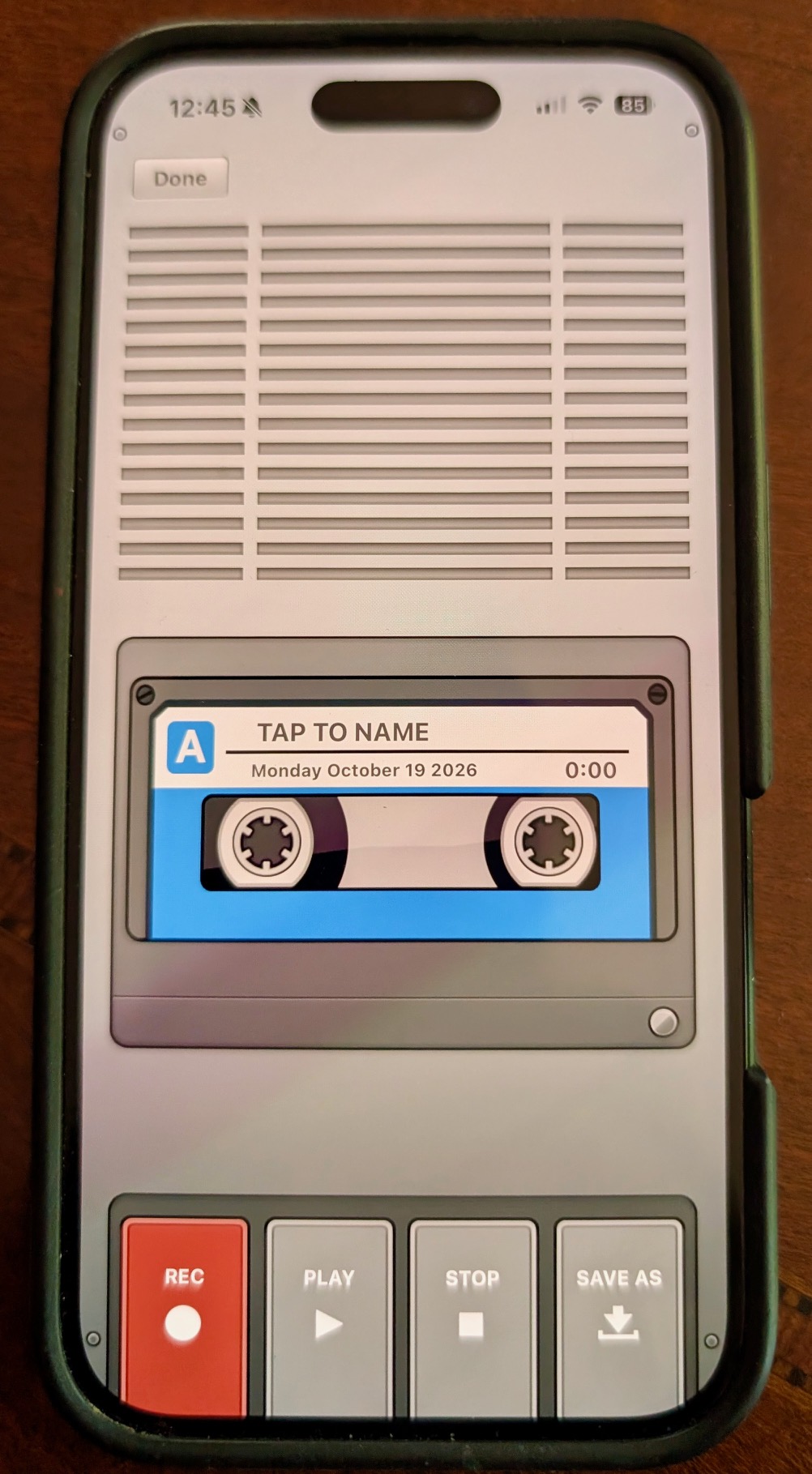
Also, consider recording your presentation remarks and listening to them today and tomorrow morning. The picture above features my iPhone with the Voice Recorder app that I use to memorize lines for roles in plays, something I’ve done four times already in 2026–twice in plays in Greensboro and twice in Winston-Salem. Whenever I’m in rehearsal, I spend as much time as I can listening to my voice speaking my lines. I listen to them on my daily walks in my neighborhood, when I’m driving, and when I’m pedaling on a stationary bike at the gym. Hearing myself speak the words over and over enables me to learn the lines more quickly than I could by simply reveiwing them on the page.
Another strategy to try is psychology professor Bennett Schwartz’s retrieval practice, the subject of Ulrich Boser’s article “Want to Play Scrabble Like a Pro? . . . . .” Try turning away from the written page–and away from the sound of your voice if you record it–and simply ask yourself what words and phrases you recall. The more often you ask yourself, the more you will remember. As Boser notes, “Indeed, it appears that at a very basic neurological level, grappling with material in a dedicated way promotes a type of shifting in our neural circuits–and a richer form of expertise” (par. 21). In the words of Schwartz, himself, “If we process things too easily, they do not form in our memories (qtd. in Boser, par. 21). Memorizing lines is a tedious process, but embracing the process will help you develop into a stronger public speaker.
Next Up
In class tomorrow, you will deliver your group presentation and you will serve as the audience for the other four groups’ presentations. It’s vital that you pay close attention to your classmate’s presentations and take notes on them because you will have a blog comment assignment that will require you to address your own presentation as well as one of the others.
This morning in class, after your Scrabble debriefing, I will distribute your group presentation assignment, and you will have the remainder of the class period to devote to planning the short presentation that you will deliver in class on Wednesday. An additional copy of the assignment is included below.
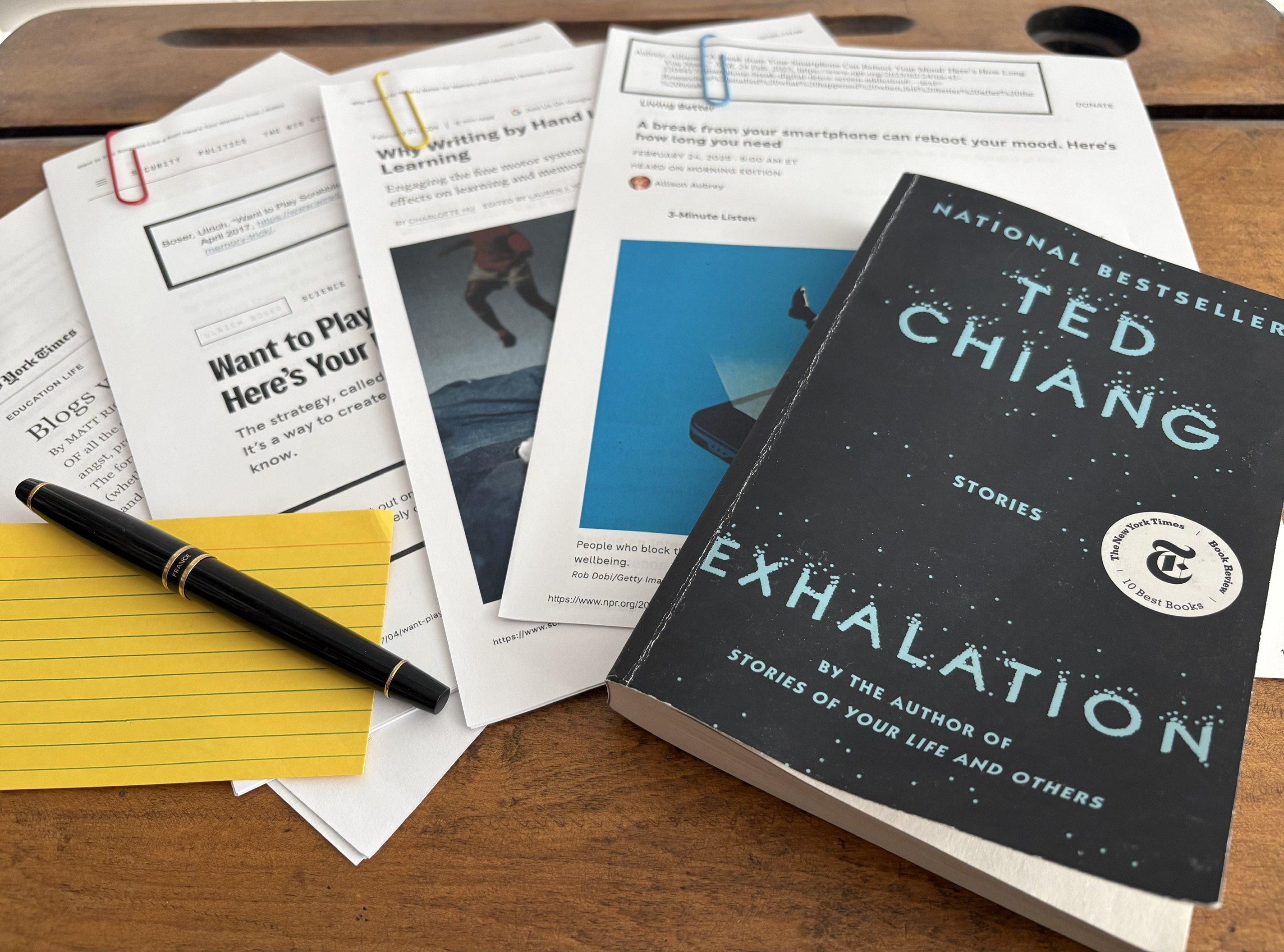
As an exercise in collaboration and oral communication, you and two or three of your classmates will plan, rehearse, and deliver a concise presentation focusing on a reading that focuses on one of the articles distributed in class last week or on the first chapter of Ted Chiang‘s “The Life Cycle of Software Objects” in Exhalation (62-74).
Presentation Assignment Directions
Plan a presentation of three or four minutes, total, that addresses the most significant points covered in your group’s designated reading. (The lists of group assignments and designated readings are included below.)
Include in your presentation the following elements: (1) an introduction that mentions each group member’s first and last name (each group member may introduce himself or herself, or the group may assign one member the responsibility of introducing everyone), the title and author, or authors, of the reading, and a brief overview of the text, (2) A close examination of two or more points in the reading, and (3)) A conclusion that provides closure without restating the introduction and that invites questions. One strategy to consider for your conclusion is to address the relevance of the practice (the subject of your reading) to your work in English 1103, your work in other courses, and/or your life outside of the classroom.
Do not create a digital component, such as a PowerPoint or Google Slides show. You will not be permitted to use any digital devices during your presentation. Instead, you will rely only on a single three-by-five-inch index card with your notes.
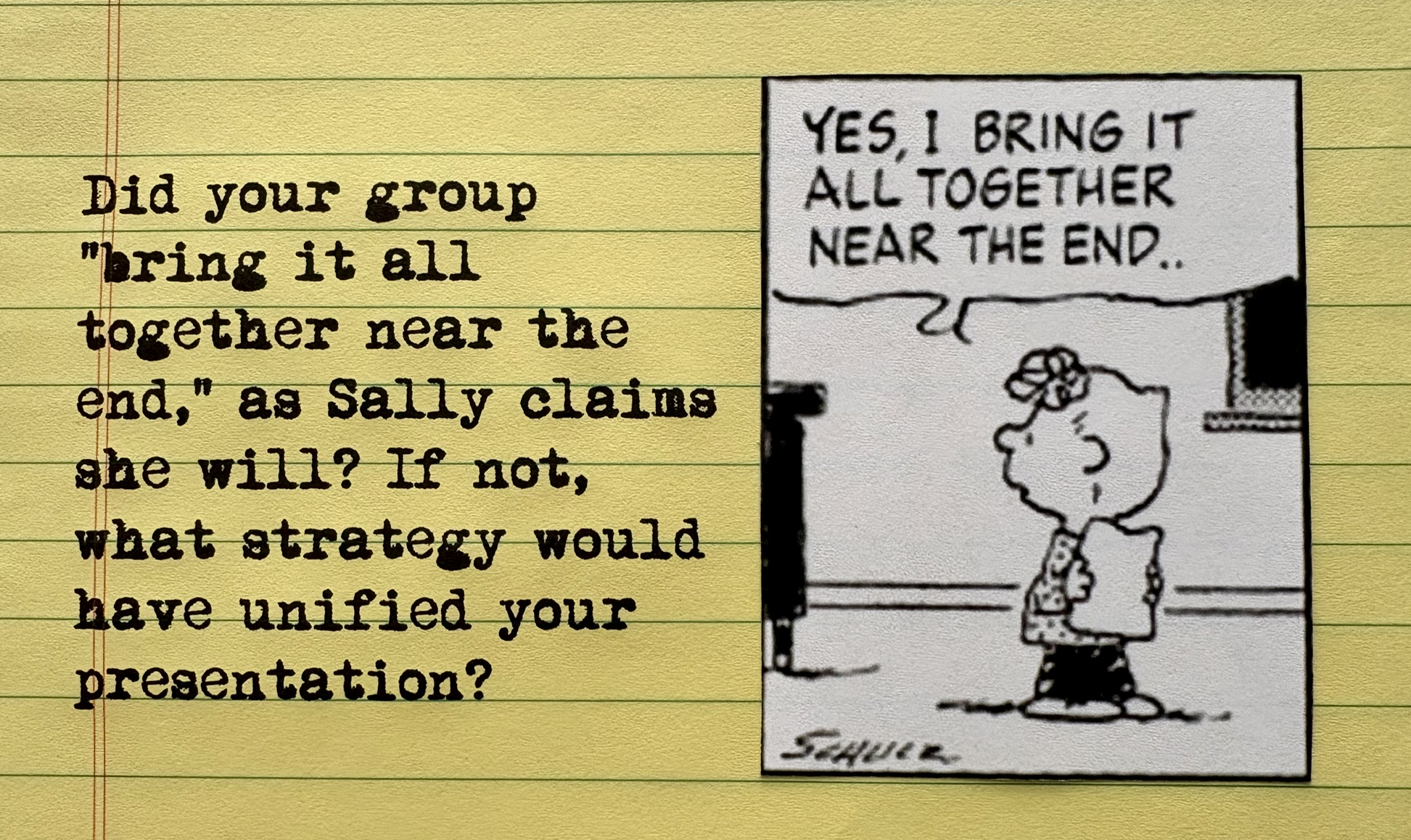
Aim for cohesion. Turning briefly to the previous speaker and addressing him or her by first name, repeating a word or idea of his or hers, and connecting it to your own remarks are ways to unify your presentation. If your presentation seems to be a series of individual talks rather than a single group presentation, it lacks cohesion.
Every group member is not required to speak for the same length of time, but every member is required to deliver a portion of the presentation.
Directions for Rehearsing
In preparation for rehearsing, write your notes on a single three-by-five-inch index card (one card per group member). If your initial notes are written in complete sentences, rewrite them to include only words and short phrases for your key points. If your notes are too detailed, you will risk relying too heavily on them and making minimal eye contact with the audience. Plan to make as much eye contact as possible, and be sure to make eye contact with people throughout the room rather than fixing your eyes on one or two people.
Practice good posture. As you deliver your presentation, your ears should be directly above your shoulders. If you tend to shift your weight from one foot to the other, stand with your feet perpendicular to each other. If you do so, you will not be able to shift your weight from one foot to the other.
Avoid filler words, such as uh, um, like, and you know. If you tend to use filler words, practice pausing at the points where you are likely to use them.
Take turns delivering your portions of the presentation, and offer feedback to your group members. Offer both suggestions for improvement and words of encouragement.
Group Assignments
Section One
“Blogs vs. Term Papers”: Grace Duffy, Claire Jahnke, Kai Jarvis, Sebastian Olander
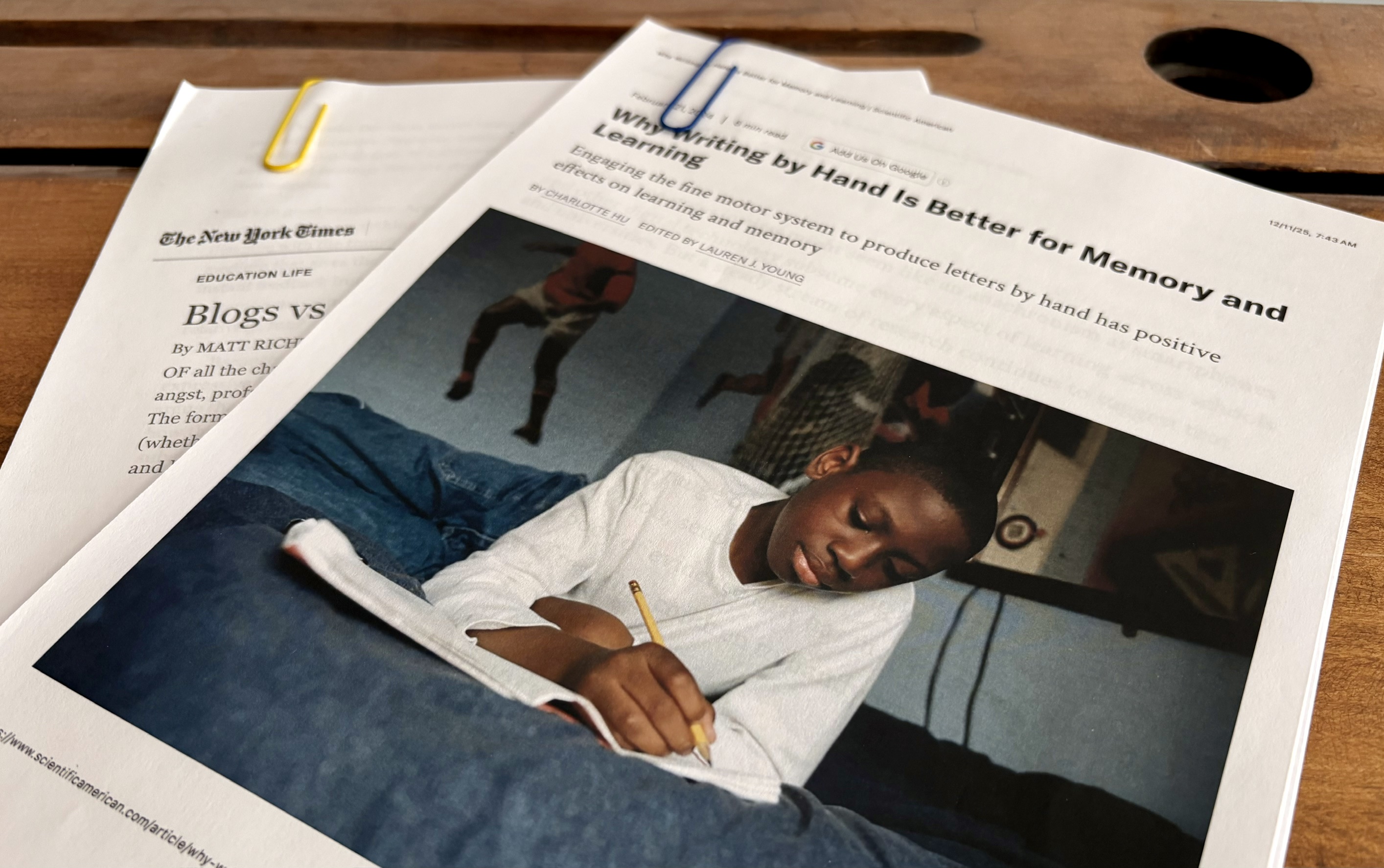
“Why Writing By Hand is Better for Memory and Learning”: Madison Haugk, Oliver Henderson, Olivia Lavallee, Bridgett Murphy
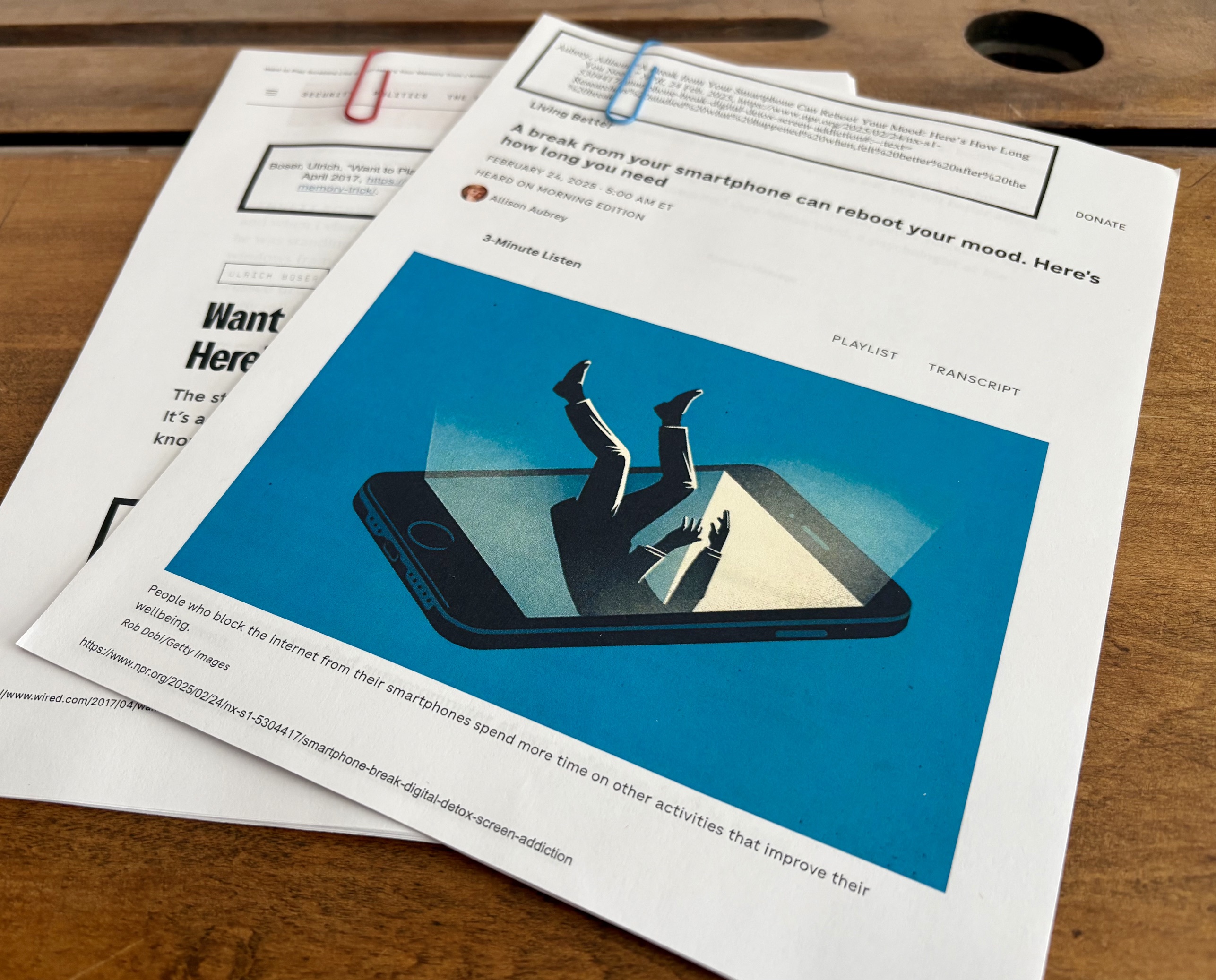
“A Break from Your SmartphoneCan Reboot Your Mood . . .”: Michael McNamara, Brenna Murphy, Hayden Porter
“Want to Play Scrabble Like a Pro? Here’s Your Memory Trick“: Gavin Godfrey-Ryan, Nicole Halucka, Ryder Pitek, Alexis Zavalishin
“The Lifecycle of Software Objects,” Chapter One (62-74): Will Roberts, Baylee Shattenberg, Madi Stone, Kel Wadley
Section Eight
“Blogs vs. Term Papers”: Avery Broadbent, Parker Davenport, Ariana Foy, Mackenzie Mossa
“Why Writing By Hand is Better for Memory and Learning”: Skylar Bowry, Dev Broomer, Mariah Robinson, Cole Wilhelmsen
“A Break from Your SmartphoneCan Reboot Your Mood . . .”: Devyn Jones, Ryan Lofton, Leslie Mendoza Arreola
“Want to Play Scrabble Like a Pro? Here’s Your Memory Trick“: Rocco Marcello, Lance Morgan, Layla Rothberg, Sophia Stewart
“The Lifecycle of Software Objects,” Chapter One (62-74): Kathleen Barr, Vivian Lalliberte, Marisol Moreno, Zach Roseman
Scrabble Debriefing, Part II
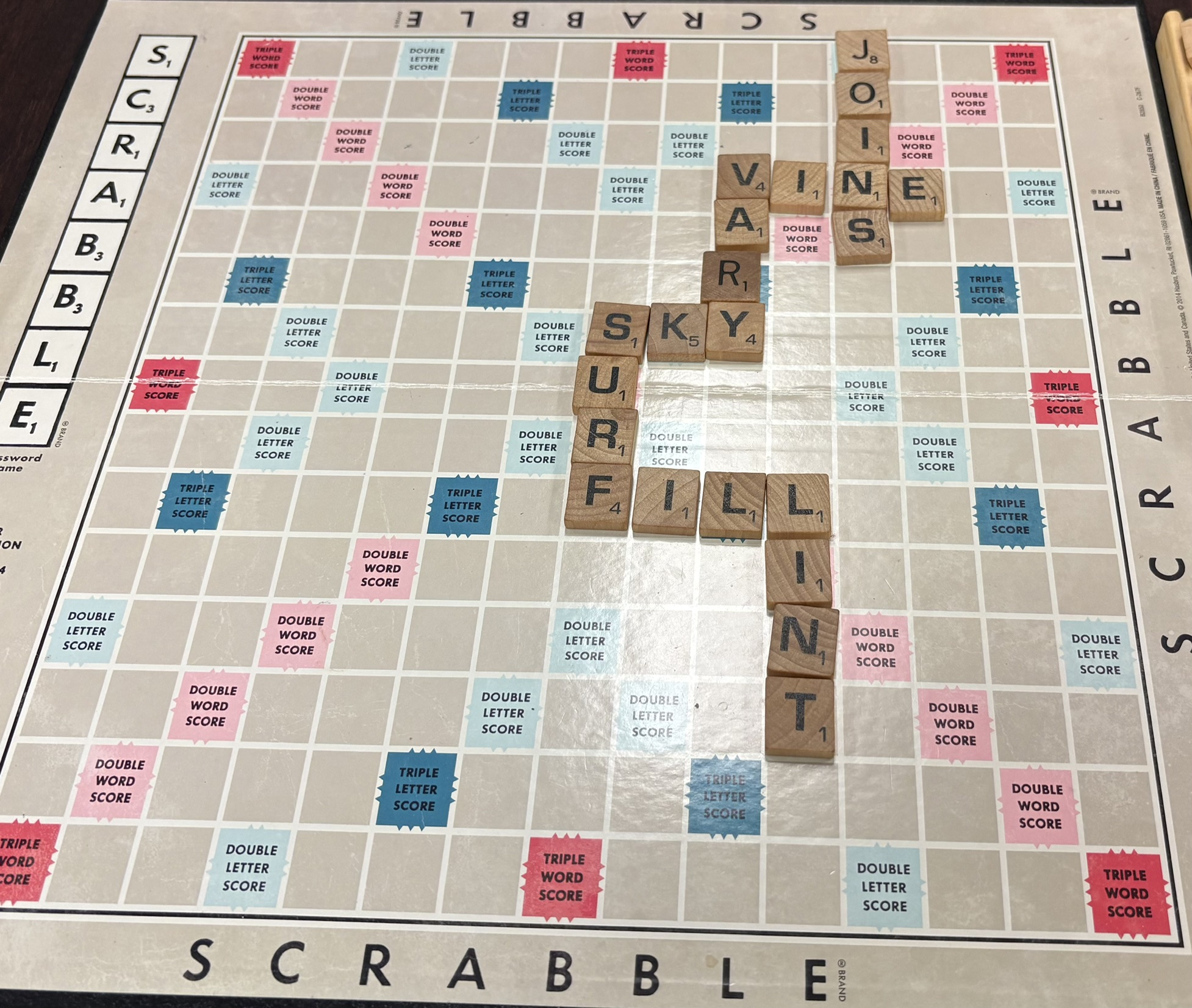
As a follow-up to your Scrabbble games last Friday, consider the plays addressed in commentaries below.
Surf’s Up First, Join Later
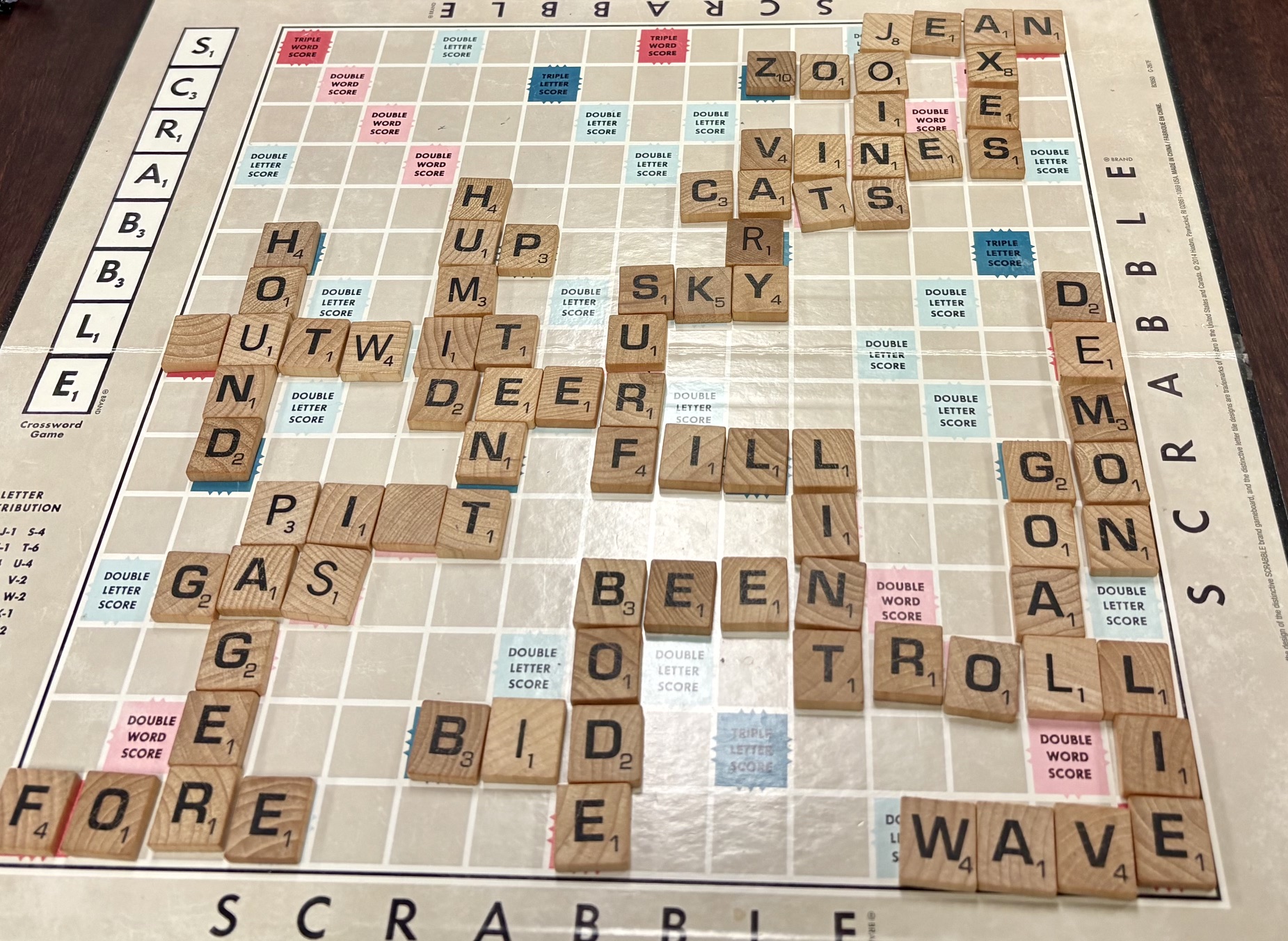
On the board pictured above, the first team began the game with the play of surf for fourteen points. Although surf is an acceptable choice, it isn’t a judicious one. Why would the first team have benefited in the long run from playing only three of the letters in surf for a score twelve? Also, consider the play of join. (The s was added later.)
Playing surf uses one of the four s‘s and one of the four u‘s. If the team’s only vowel was the u, and the team did not have the consonants required to play an all-consonant word, then the team would have no choice but to play the u. However, the team could have avoided using both a u and an s by playing fur for twelve points rather than surf fourteen. Although the opening play of fur would earn fewer points, s is a valuable letter, and seasoned Scrabble players advise not playing one unless you can score at least twenty points.
The play of join placed the j on a double-letter score square, earning the second team an admirable score of nineteen points, but the placement of the j gave the opponents the opportunity to score with a triple-word play, likely one that would earn them more than thirty points. If a team played two blanks and a one-point letter to the right of the j, the triple-word score would be twenty-seven. However, it’s more likley that a team would play three letters worth one or more points each, for a total of thirty-three or more. The first team did not take advantage of that opportunity–and may not have had the letters to do so–but the placement of join did enable them to play zoo for thirty-two points. Later, the second team was able to play jean for the triple-word score of thirty-three.
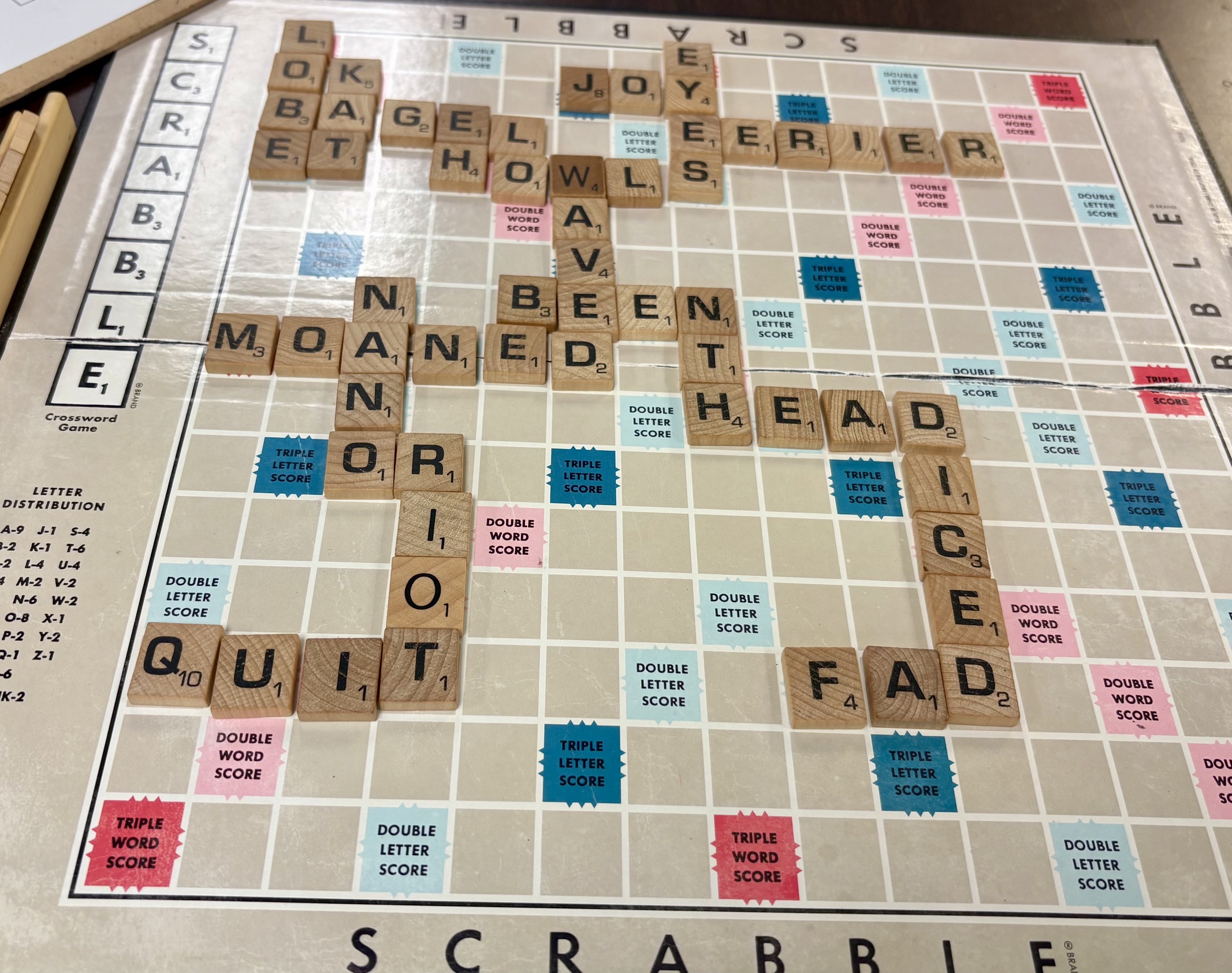
Q Query
Midway through the game pictured below, the second team played quit for a total of twenty-six points. Although that may have been the highest-scoring play the second team could have made at that point in the game, why would they have been well-advised to hold the q and the u for a later turn?
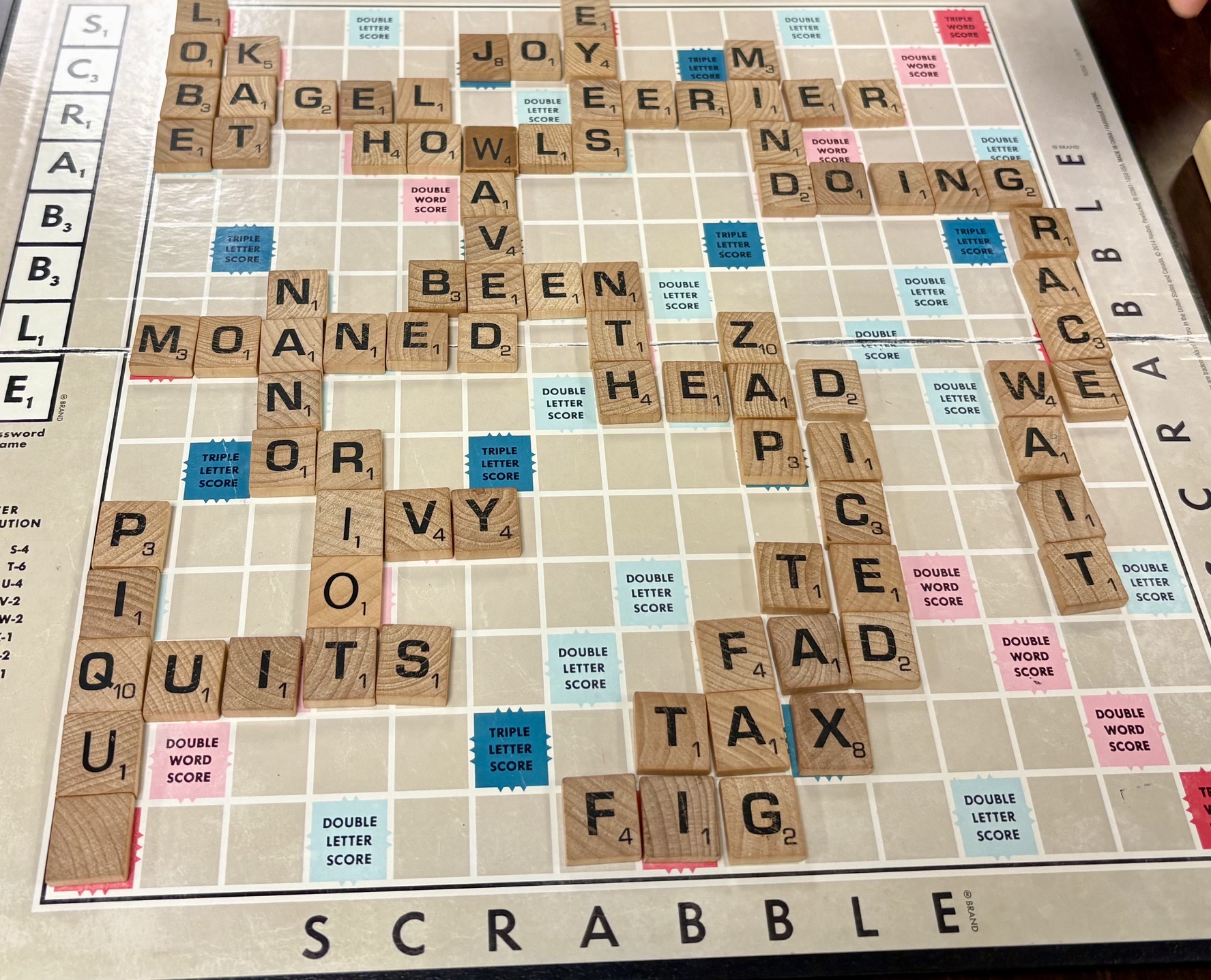
When the second team played quit in the game pictured above, none of the other three u’s and neither of the blanks had been played, making it very likely that the first team would be able to make a triple-word score play with the q.
Initially, the first team did not have the letters for a triple-word play using the second team’s q. However, a couple of turns later, the first team used a blank for an e to play pique for forty-eight points.
Next Up
In class on Wednesday, you will deliver your group presentations. Afterward, in the second half of class, we will discuss the five readings and consider each as a possible starting point for the research you will conduct in the second half of the semester.
Last week, I published a blog post featuring playable four-letter words with three vowels. Knowing those words, and others with multiple vowels, proves useful when you’re faced with a rack of mostly, or all, vowels. Here’s a list of the remaining playable four-letter words with three vowels, beginning with the letters in the second half of the alphabet:
naoi: ancient temples (pl. of naos)
obia: form of sorcery practiced in the Caribbean (also obeah)
odea: concert halls (pl. of odeum)
ogee: an S-shaped molding
ohia: a Polynesian tree with bright flowers (also lehua)
olea: corrosive solutions (pl. of oleum)
olio: a miscellaneous collection
ouzo: a Turkish anise-flavored liquor
raia: a non-Muslim Turk (also rayah)
roue: a lecherous old man
toea: a currency in Papua, New Guinea
unai: a two-toed sloth (pl. unai; an ai is a three-toed sloth)
In class on Monday, you will receive your group oral presentation assignment, which will focus on one of the articles distributed in class this week or on the first chapter of Ted Chiang‘s “The Life Cycle of Software Objects” in Exhalation (62-74). After I offer an overview of the assignment and distribute copies of the directions, you will have class time to devote to planning and practice. Since you don’t know which reading will be the subject of your group’s presentation, be sure to complete all five. That will ensure your class time can focus on actual preparations (rather than your initial reading of the text).
Today’s class notes serve as the posting site for the peer response assignment due on Friday, October 23. Review the directions carefully, along with the other notes that follow.
Analysis Peer Response Assignment
Directions
After tomorrow’s hard deadline for the analysis, at 10:40 a.m., go to the class page, and click on the link for the blog of the classmate whose name precedes yours. If you are first on the list, go to the blog of the student whose name is last. Note the difference between this step and the first step of the blog response assignment for the literacy narrative. For that assignment, your designated classmate’s name followed yours; for this assignment, it precedes it.
If your designated classmate’s blog is not linked to the page, or his or her analysis is not published, choose another classmate’s blog.
Read the classmate’s analysis.
Compose a one- or two-paragraph response (75 words, minimum) that includes both the classmate’s name and the title of his or her analysis. In your comment, address one or more of these elements: the title, the introduction, the thesis, textual evidence, the conclusion, the image documenting part of the writing process away from the screen, the embedded link to a relevant website.
Recommended (not required): Draft your comment longhand in your journal.
Type your response as a comment. You should see a leave comment/reply option at the top or bottom of the post. If you do not see that option, click the title of the post and scroll down. You should then see leave comment/reply.
Before you click leave comment/reply, copy your comment (on a PC, copy with control + c; on a Mac, copy with command + c).
After you submit your comment on your classmate’s analysis, return to this blog post, and paste your comment as a reply (on a PC, paste with control + v; on a Mac, paste with command + v). This step is critical because your classmate may not approve your comment, which means it will not be visible on his or her blog. To receive credit for the assignment, you must post your duplicate comment as a reply to this post, “ENG 1103: Analysis Peer Response.” To submit your comment, click the title of the post, then scroll down to the bottom. There you will see the image of an airmail envelope with a box for your comment. Type your comment in the box and click Comment. Post your comment by 7:30 a.m. on Friday, October 23. I will make your comments visible after the deadline.
You are not required to read other classmates’ analyses, but I encourage you to browse their blogs and read the posts that pique your interest.
Upcoming Readings
At the beginning of tomorow’s class, you will receive copies of two additional articles that focus on aspects of the course. Can you guess which ones? Read and annotate both for next Monday, October 19, along with the two distributed yesterday. If you are absent from class or misplace your copies, download and print them from Blackboard.
Next Up
Wordplay Day! To prepare for class, revisit the Merriam-Webster Scrabble Word Finder page, and review your journal notes and the blog posts devoted to Scrabble tips.
Coming Soon
In class on Monday, you will receive your group oral presentation assignment, which will focus on one of the articles distributed in class this week or on the first chapter of Ted Chiang‘s “The Life Cycle of Software Objects” in Exhalation (62-74). After I offer an overview of the assignment and distribute copies of the directions, you will have class time to devote to planning and practice. Since you don’t know which reading will be the subject of your group’s presentation, be sure to complete all five. That will ensure your class time can focus on actual preparations (rather than your initial reading of the text).
This morning in class, you will compose a reflective essay for your analysis. Directions are included below, and you will receive an additional copy in class.
Directions
Compose a reflective essay that documents the process of planning, drafting, and revising your analysis. Questions to consider in your reflection include the following:
When you began transferring the words from your handwritten draft onto the screen of your laptop or tablet, what did you observe about the process?
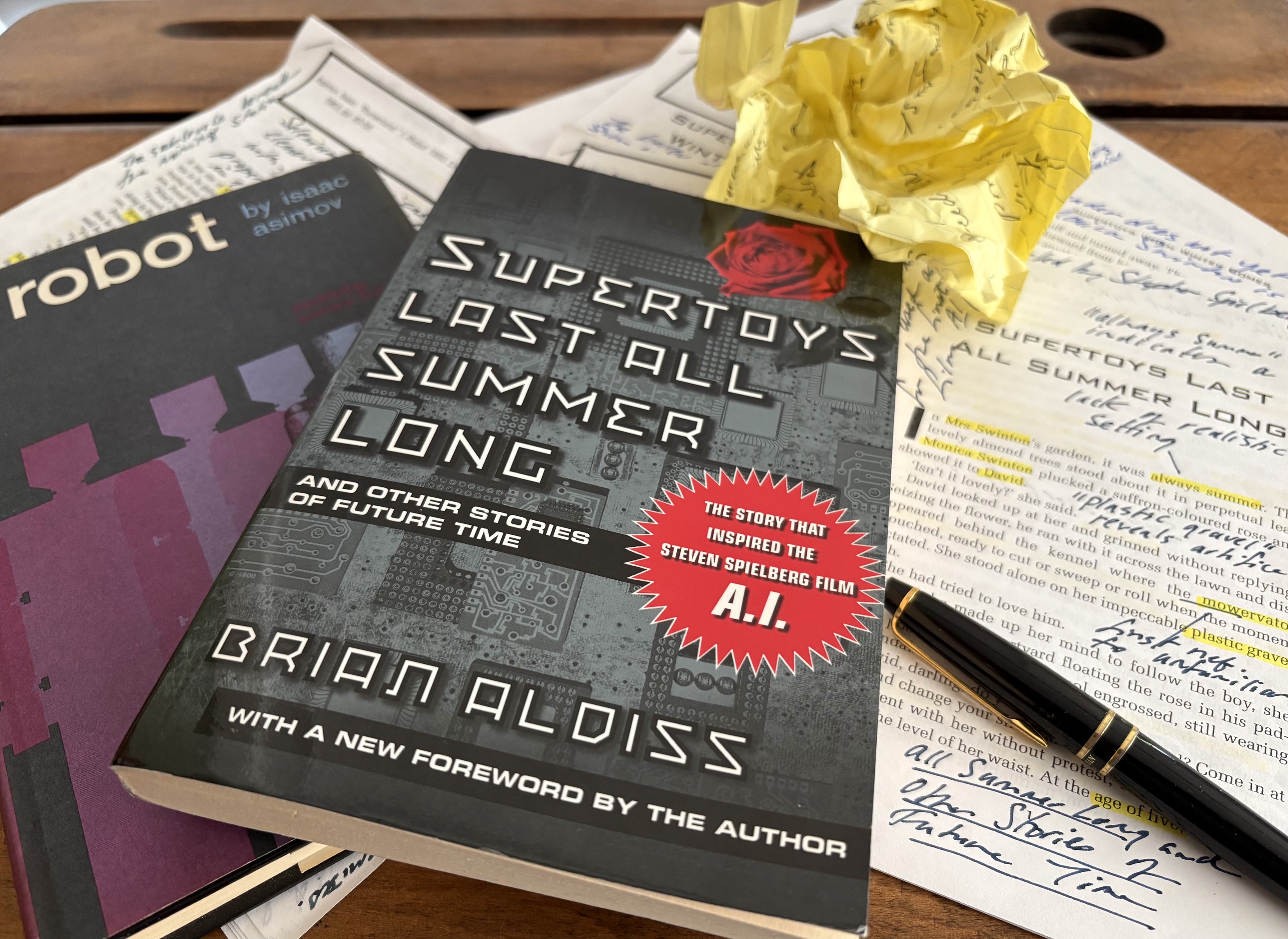
What aspect of the writing seemed the most challenging? Deciding whether Isaac Asimov’s “Runaround” or one or more of Brian Aldiss’s supertoys stories would serve as your subject? Choosing a prompt? Determining your thesis? Identifying details to support your claims? Organizing the body of the essay? Composing the conclusion? Why did that aspect of the writing seem the most challenging?
Did the focus of your analysis change? If so, what was your original focus, and what did you change it to?
Did any of the sample analyses (“One Mississippi,” “The Strange Fruit of Sosnowiec,” “Bots in Shining Armor”) prove helpful to you? If so, which one? How was it helpful?
What do you consider the strongest element of your analysis?
At what point in the process did you decide on a title? Did you change the title during the writing process? If so, what was the original title?
What image that documents part of your writing process away from the screen did you include in your blog post? Why did you choose that image?
What relevant website did you include an embedded link to in your blog post? Why did you choose that site?
Include a quotation that complies with the requirements outlined in the preparation guidelines in the October 13 class notes. You are not permitted to refer to that blog post or any other online resources while you compose your reflection in class. As part of your reflection planning, you should have taken notes on all the necessary information in that post.
Follow your quotation with an MLA-style parenthetical citation.
Double-space your essay and write in dark ink, preferably black. You are welcome to use both sides of the page.
At the end of the essay, include the header work cited, followed by a work cited entry for the story you quote.
Staple your assignment handout on top of your reflection, and submit it at the end of class.
Upcoming Class Readings
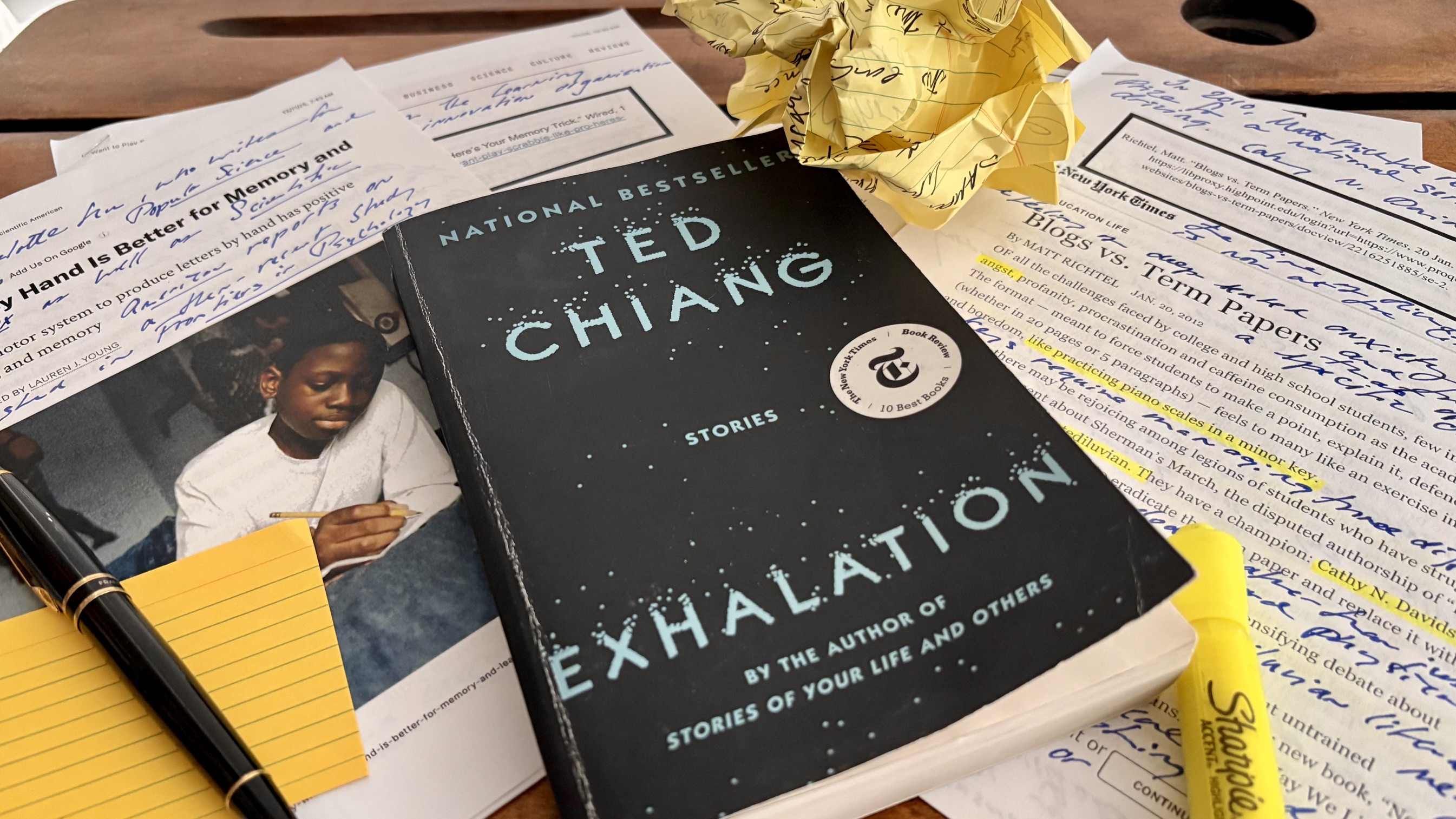
In the second half of today’s class, you will receive copies of the articles pictured above: “Blogs vs. Term Papers” by Matt Richtel and “Why Writing by Hand is Better for Memory and Learning” by Charlotte Hu, which you should read and annotate for next Monday, October 19. If you are absent from class or misplace your copies, download and print them from Blackboard.
Next Up
Wordplay Day! To prepare for class, revisit the Merriam-Webster Scrabble Word Finder page, and review your journal notes and the blog posts devoted to Scrabble tips.
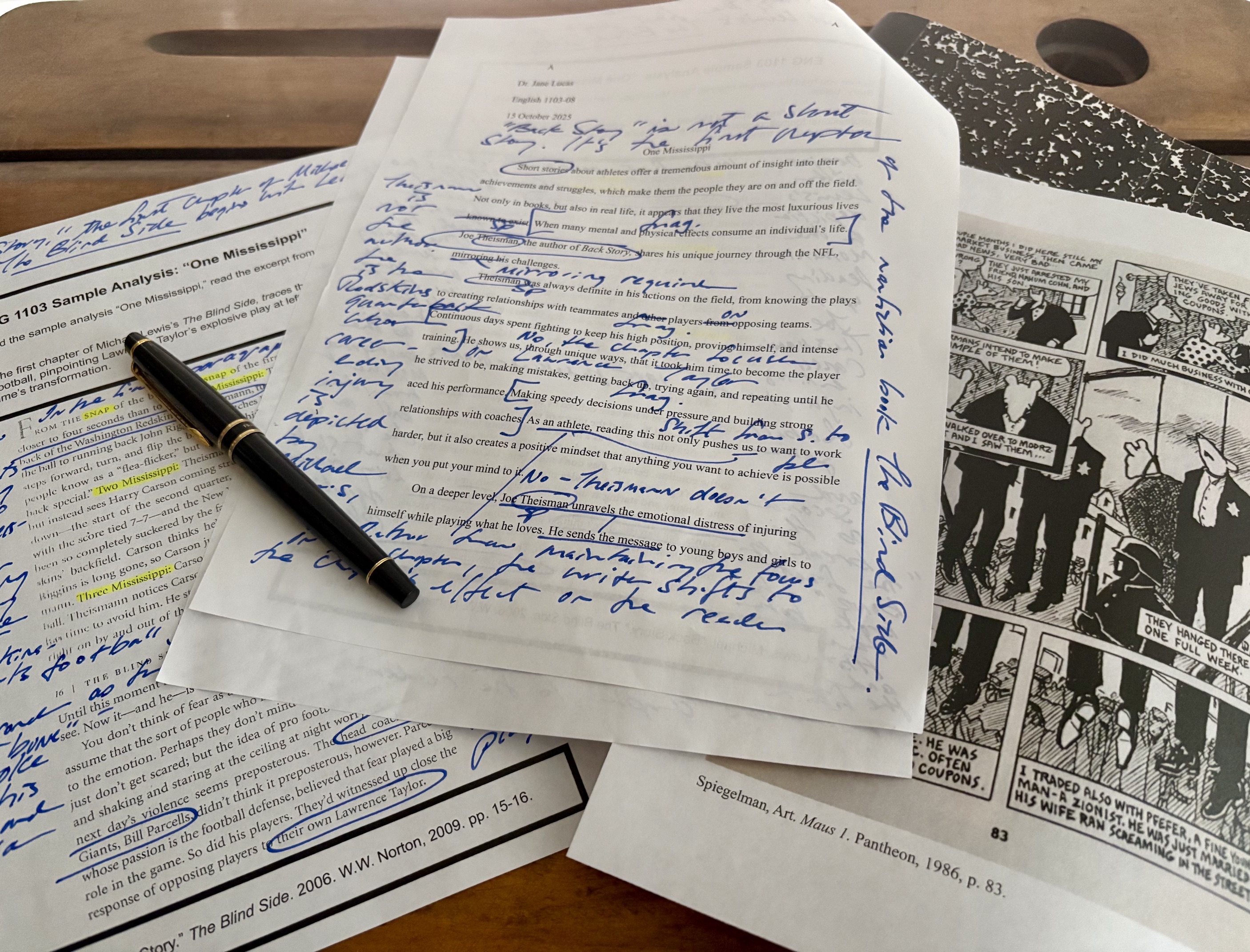
Yesterday in class, you and your classmates collaboratively reviewed the student essay “One Mississippi” and used the analysis revision guidelines for the grade you assigned to it. Afterward, we examined “One Mississippi” paragraph by paragraph. The matters of content and form addressed are included in the lists that follow.
“One Mississippi”: Notes on Content
In the first paragraph, the writer generalizes about sports rather than pinpointing the subject, implies the chapter is a work of short fiction, and incorrectly identifies the author as Joe Theismann.
Instead of presenting a claim, the thesis describes the chapter, but it’s not an accurate description. “Back Story”‘s central figure isn’t Joe Theismann; it’s Lawrence Taylor.
In the second paragraph, the writer offers more generalizations about sports and shifts the focus away from the chapter itself to its effects on readers.
The writer turns back to Theismann, offering an assessment of his mindset that isn’t warranted by anything in the chapter. He mentions Theismann’s “terrible state” (par. 3) but doesn’t specify its cause, which is dramatized in the opening of the chapter.
In the third paragraph, the writer lets readers see Michael Lewis’s words for the first time, but doesn’t introduce the quotation or demonstrate its significance.
The writer mentions Lewis’s “inclusion of Mississippi” (par. 4), but doesn’t provide evidence to support his claim that the word “indicates where the story is heading and the tone” (par. 4).
In the final paragraph, the writer offers more generalizations rather than employing one of the effective strategies for conclusions, including these: (1) offering an insight about the text or an additional quotation from it, (2) revisiting the thesis without stating it verbatim, and (3) pointing to the broader implications of the analysis.
“One Mississippi”: Notes on Form
The analysis contains three sentence fragments: “When many mental . . . ” (par. 1), “Continuous days spent . . . ” (par. 2), and “Making speedy decisions . . . ” (par. 2).
The writer repeatedly misspells Joe Theismann’s last name (pars. 1, 3, and 5).
The writer refers to Theismann as Joe rather than by his last name (par. 5). In formal writing, refer to people by first and last name on first reference. On subsequent references, refer to them by last name. Fictional characters are an exception to that rule. Refer to them by first name after the first reference unless they are called by their last names (as Donovan and Powell are in Isaac Asimov’s “Runaround”).
The title of the chapter is italicized and enclosed in quotation marks (pars. 1, 4, and 5). In MLA style, chapter titles are enclosed in quotation marks, not italicized.
The title of The Blind Side isn’t italicized (par. 4).
The quotation from “Back Story” isn’t introduced with a signal phrase.
The parenthetical citation doesn’t include the page number. Instead, it incorrectly includes the paragraph number, which should only be included if the source lacks page numbers.
The work cited entry includes “Chapter one” (it shouldn’t) and omits the period required at the end.
As you continue to revise your analysis, review the lists above to minimize your chances of commiting the same errors.
Preparing for Your Analysis Reflection
Tomorrow in class, you will compose a reflective essay that documents the process of planning, drafting, and revising your analysis. In your reflection, you will include one quotation, which you will introduce with a signal phrase and follow with a parenthetical citation.
To comply with the requirements for your reflection assignment, you will need to complete the planning exercise that follows. In class, you will not be permitted to refer to this blog post or any other online resources. You will need to have all the necessary information written longhand in your journal.
Directions
Review the story or stories that serve as your subject of your analysis, and identify the line that led you to choose that story (or story series) as your subject. The line doesn’t have to be one that you quote in your analysis, but it should be the one that piqued your interest in the narrative.
Once you have identified that line, draft in your journal a passage for your reflective essay that introduces the quotation with a signal phrase and follows it with a parenthetical citation.
Following the parenthetical citation, include a transitional phrase, clause, or sentence that logically connects those words from the story to your analysis. (See the example below.) After you draft your passage, keep in mind the questions you asked of the excerpts you examined in class on Monday, and ask similar ones of your own writing: Do I provide sufficient context for the quotation? Do my words that follow the quotation connect logically to Aldiss’s or Asimov’s? Do I demonstrate the quotation’s significance to the development of my analysis?
Optional: Compose a work cited entry or works cited entries for your reflection. In class, you will not need to refer to your journal for that information because the MLA -style entry is included on Asimov’s and Aldiss’s stories. Keep in mind, however, that those entries are single-spaced and yours should be double-spaced. For additional examples of works cited entries for the stories, see the October 1 class notes.
Example
When I reread “Runaround,” and noticed the narrator’s reference to Speedy as “the errant robot” (49), I recalled my initial reaction to some of the early covers for I, Robot. At the time, I viewed their similarity to medeival knights as a simple matter of marketing. But later I noted how Asimov’s descriptions of Donovan and Powell riding the older robots repeatedly likened the machines to horses. Those images, the parallels between the Three Laws of Robotics and the code of chivalry, and the descriptor errant provided the foundation for my analysis.
Submitting Your Analysis Revision
The due date for your revised analysis is tomorrow, Wednesday, October 14 (before class). If you do not remember how to submit an MS Word file or PDF to Blackboard or publish a blog post on WordPress, review the step-by-step directions in the September 8 class notes.
Remember that your analysis blog post needs to include both a picture that documents your writing away from the screen (longhand) and an embedded link. If your analysis focuses on the fiction of Brian Aldiss, I recommend embedding a link to his official website or to “Supertoys Last all Summer Long” on Wired magazine’s website. To view those sites, click on the links in the previous sentence. If your analysis focuses on “Runaround,” I recommend embedding a link to a PDF of the story posted by Steven J. Miller, professor of mathematics at Williams College. To view that link, click on the story title in the previous sentence.
Next Up
In class tommorow, you will compose your reflective essay focusing on the process of planning, drafting, and revising your analysis. If you are still in the process of completing your essay on Wednesday (since you have until Friday morning’s hard deadline to post it without a late penalty), your reflection will address your work in progress. Follow the guidelines included above to ensure you will be prepared to complete all requirements for your reflection.
This morning in class, we will reveiw “One Mississippi,” the student analysis that you read and annotated for today, and we will also examine excerpts from midterm reflections and possibly a second sample analysis: “The Strange Fruit of Sosnowiec.”
Before we turn to “One Mississippi,” you will read and annotate three passages from midterm reflections, each of which includes the required quotation from Dan Rockmore’s essay “Should the Classroom Be More Like the Gym?” In your annotations, you will address these questions:
Does the writer demonstrate the relevance of Rockmore’s words to his or her experience in English 1103?
Does the writer provide sufficient context for the quotation?
Do the words that follow the quotation logically connect Rockmore’s ideas to the writer’s own?
As you prepare to write your analysis reflection, which you will compose in class on Wednesday, ask similar questions of the reflection passage that you draft in your journal.
After our discussion of the midterm reflection excerpts, we will read the opening paragraphs of Michael Lewis‘s “Back Story” as a lead-in to our paragraph-by-paragraph study of the student analysis “One Mississippi.
Time permitting, we will examine “The Strange Fruit of Sosnowiec,” an analysis I wrote as a model for my students in a previous semester. If we do not have time to address that essay in class, read it on your own. Make note of where I turn from the summary to my thesis in the opening paragraph. Also, consider which of strategies for conclusions I employ in the last paragraph. (See the list below.)
Strategies for Conclusions
Offer an insight about the text or an additional quotation
Revisit the thesis without stating it verbatim
Point to the broader implications of the analysis
Model Analysis
The October 1 class notes include the introduction and a body paragraph of an analysis of mine in progress. The full text of that analysis, which I completed over fall break, appears below.
Bots in Shining Armor
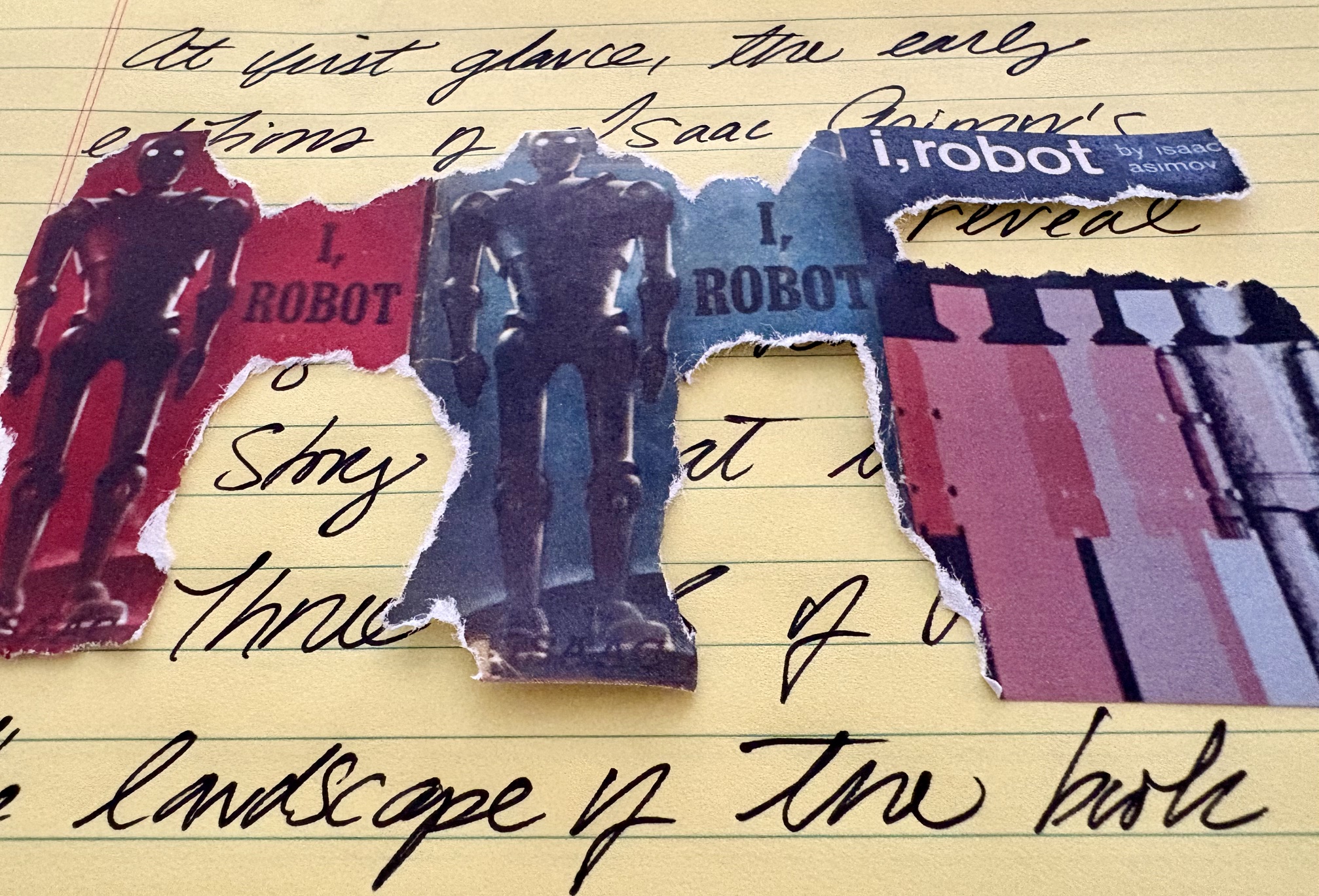
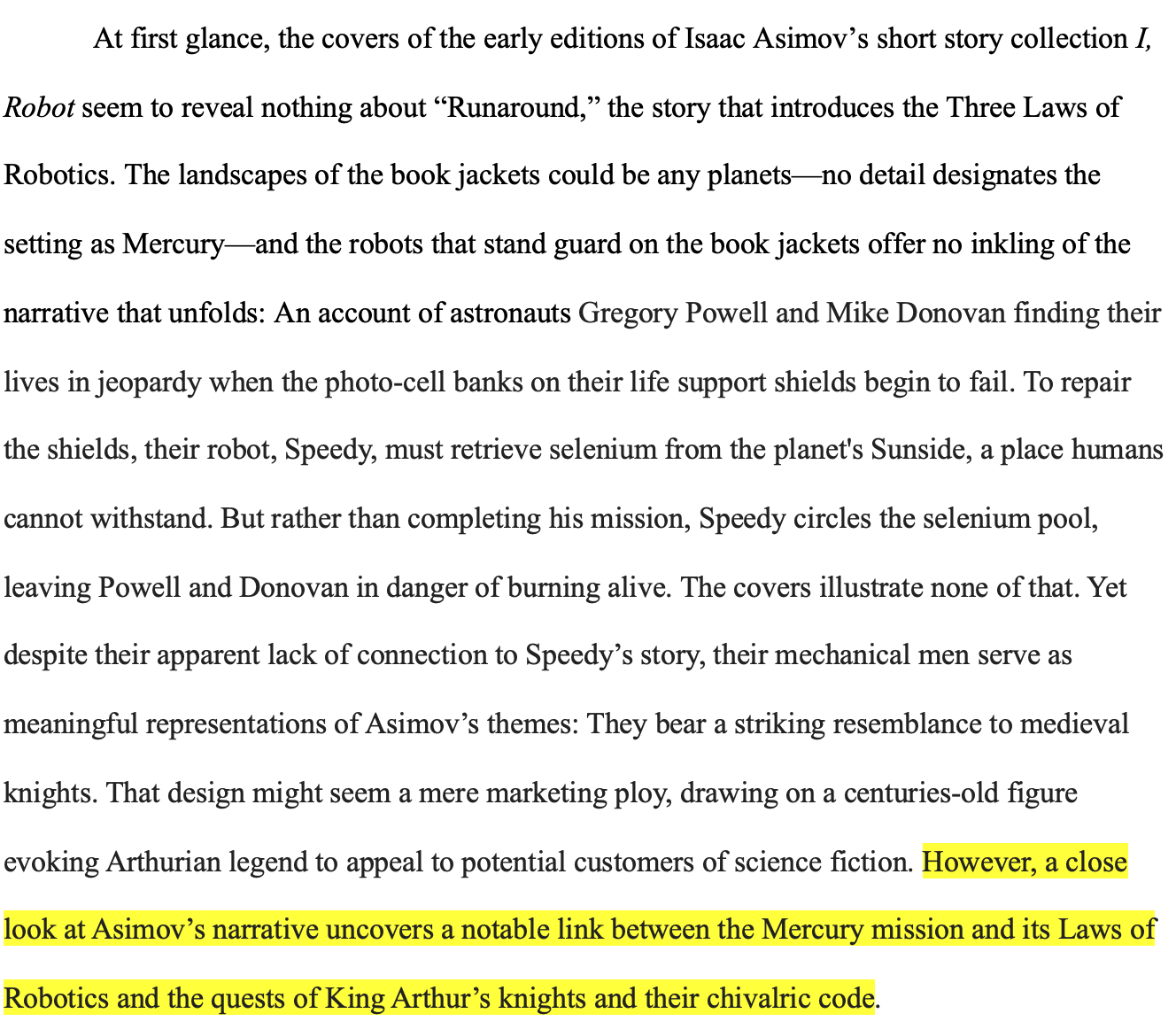
At first glance, the covers of the early editions of Isaac Asimov’s short story collection I, Robot seem to reveal nothing about “Runaround,” the story that introduces the Three Laws of Robotics. The landscapes of the book jackets could be any planets—no detail designates the setting as Mercury—and the robots that stand guard on the book jackets offer no inkling of the narrative that unfolds: An account of astronauts Gregory Powell and Mike Donovan finding their lives in jeopardy when the photo-cell banks on their life support shields begin to fail. To repair the shields, their robot, Speedy, must retrieve selenium from the planet’s Sunside, a place humans cannot withstand. But rather than completing his mission, Speedy circles the selenium pool, leaving Powell and Donovan in danger of burning alive. The covers illustrate none of that. Yet despite their apparent lack of connection to Speedy’s story, their mechanical men serve as meaningful representations of Asimov’s themes as figures that bear a striking resemblance to medieval knights. That design might seem a mere marketing ploy, drawing on a centuries-old figure evoking Arthurian legend to appeal to potential customers of science fiction. However, a close look at Asimov’s narrative uncovers a notable link between the Mercury mission and its Laws of Robotics and the quests of King Arthur’s knights and their chivalric code.
The word chivalry derives from the Old French word chevalerie (and French chevalier), meaning horse soldier or horseman, and notably, images of the astronauts as ersatz horsemen enter Asimov’s story after Powell summons one of the older robots, from the first Mercury expedition, to find Speedy. In reply, the machine says it cannot proceed with its mission yet because Powell “must mount first” (44). Donovan solidifies the analogy when he responds incredulously, “‘We got to ride him? Like a horse?’” (44). Asimov returns to the image of the chevalerie, or horseman, when Powell spots Speedy in the distance and urges his robot forward, saying, “‘Giddy-up!’” and “thump[ing] his heels spur fashion” (48).
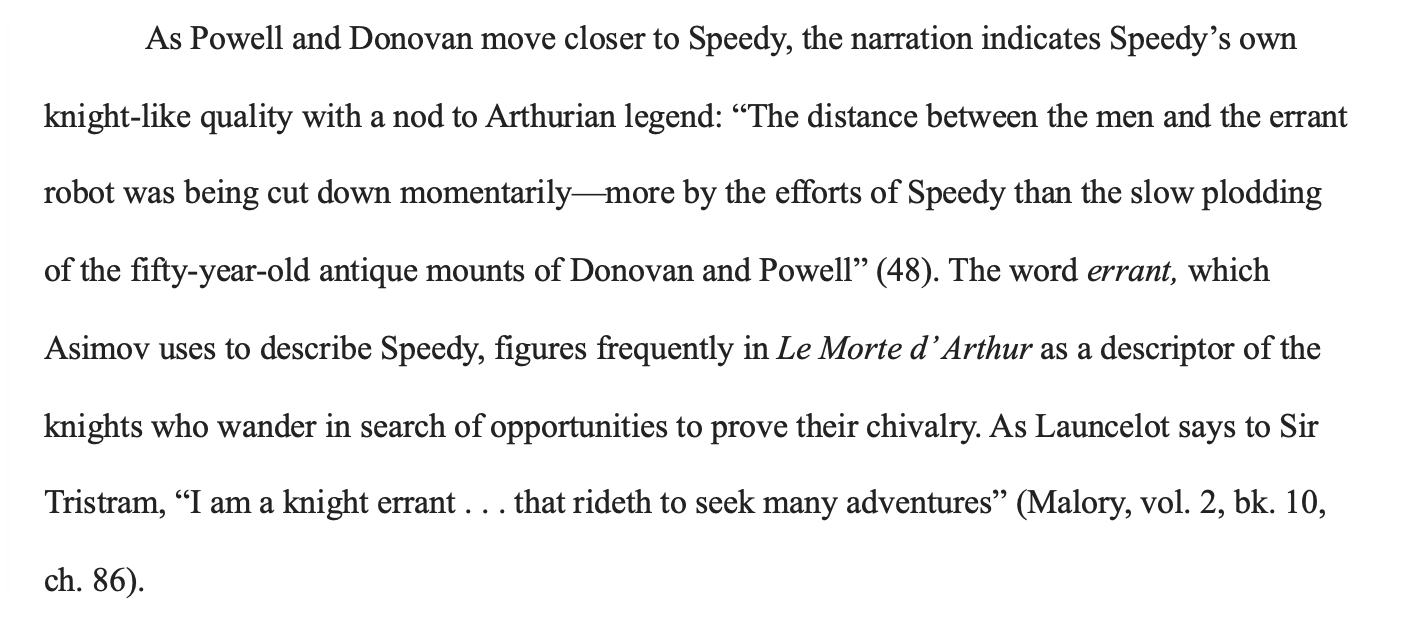
As Powell and Donovan move closer to Speedy, the narration indicates Speedy’s own knight-like quality with a nod to Arthurian legend: “The distance between the men and the errant robot was being cut down momentarily—more by the efforts of Speedy than the slow plodding of the fifty-year-old antique mounts of Donovan and Powell” (48). The word errant, which Asimov uses to describe Speedy, figures frequently in Le Morte d’ Arthur as a descriptor of the knights who wander in search of opportunities to prove their chivalry. As Launcelot says to Sir Tristram, “I am a knight errant . . . that rideth to seek many adventures” (Malory, vol. 2, bk. 10, ch. 86).
For Speedy, Powell, and Donovan, the holy grail is the selenium essential to the astronauts’ survival. Speedy’s initial inability to secure the selenium is not a violation of his chivalric code (the Three Laws of Robotics), but rather the result of his unfailing fidelity to the two Laws in conflict: He cannot obey his orders and protect his existence with the looming danger of volcanic action.
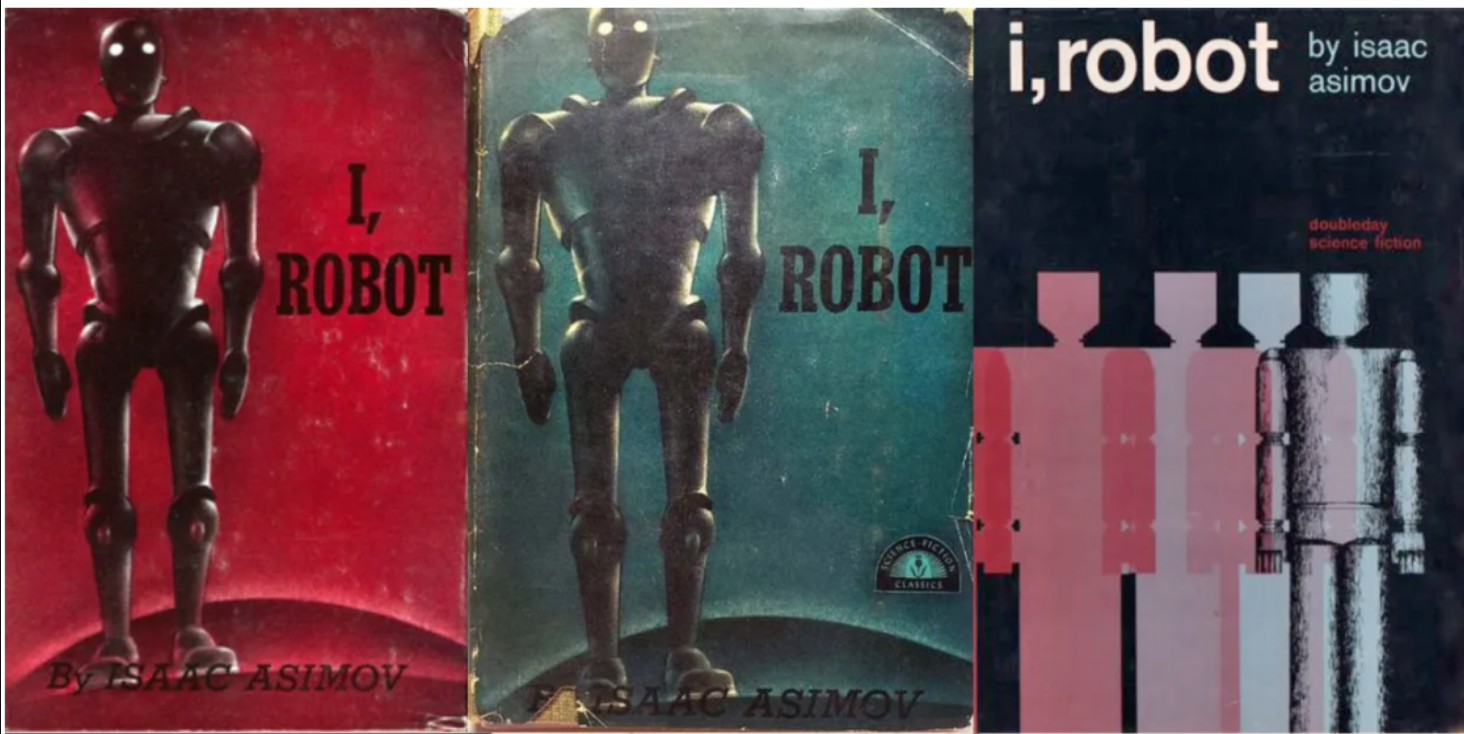
The repeated image in Johannes Regn’s Doubleday cover for I, Robot (1963) seems to pay homage to Edd Cartier’s first-edition jacket (Gnome, Grossett & Dulap 1950) with its solitary robot gazing out from the cover. The silhouettes that span Regn’s cover, in alternating shades of lavender, lead to a pen-and-ink version of the machines at its side. From the indeterminate figures emerges a clearly defined image of the future that evokes soldiers of the past, seen both in the distant past of the Middle Ages and the then-recent past of I, Robot’s first book jackets. The metal body Cartier renders with his paintbrush accentuates the articulated joint guards of medieval armor—pauldrons at the shoulders, couters at the elbows, poleynes at the knees—details that define the iron and steel suits worn by mounted soldiers whose chivalric code informs Asimov’s fictional world. The similarities between the narratives of Arthurian legend and “Runaround”—seen both in the story itself and in Cartier and Regn’s covers—may speak to a basic need in the shadow of A.I. Lifting the visor of a knight’s helmet revealed the windows to the soul. When we examine artificial intelligence, we see no face in the cloud, no soldier in our service sworn to bring us no harm.
Works Cited
Asimov, Isaac. “Runaround.” I, Robot. 1950. Doubleday, 1963, pp. 40-58.
Malory, Thomas. Le Morte d’ Arthur. 1485. Project Gutenberg, https://www.gutenberg.org/ files/1252/1252-h/1252-h.htm#chap88.
Next Up
In class on Wednesday, you will compose a reflective essay that documents the process of planning, drafting, and revising your analysis. In your reflection, you will include one quotation, which you will introduce with a signal phrase and follow with a parenthetical citation.
To comply with the requirements for your reflection assignment, you will need to complete the planning exercise in tomorrow’s class notes. In class, you will not be permitted to refer to my blog or any other online resources. You will need to have all the necessary information written longhand in your journal.
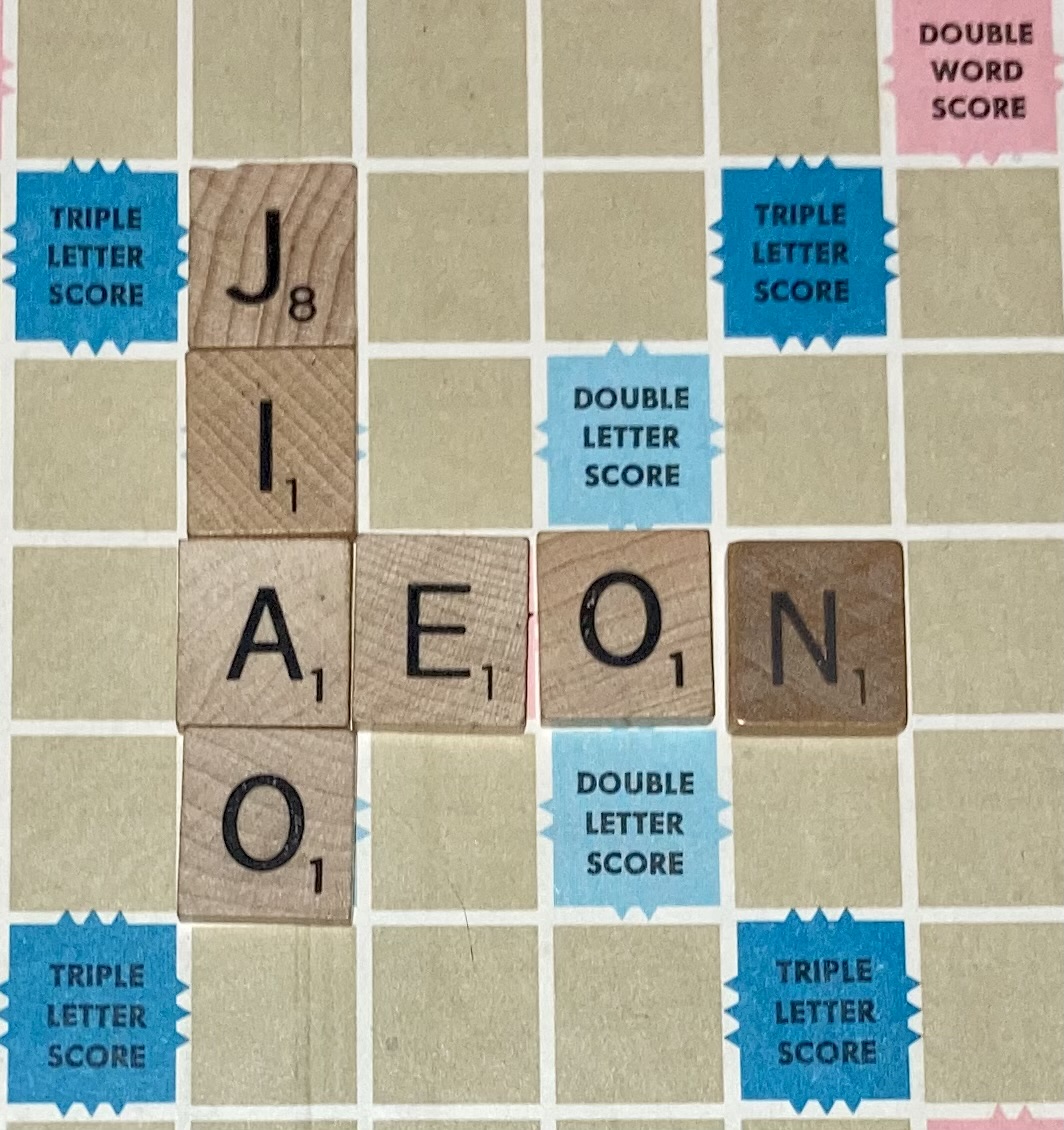
Knowing words with multiple vowels proves useful when you’re faced with a rack of mostly, or all, vowels. Here’s a list of the four-letter words with three vowels, beginning with a through m:
aeon: a long period of time (also eon)
agee: to one side (also ajee)
agio: a surcharge applied when exchanging currency
ague: a sickness associated with malaria
ajee: to one side (also agee)
akee: a tropical tree
alae: wings (pl. of ala)
alee: on the side shielded from wind
amia: a freshwater fish
amoa: a kind of small buffalo
awee: a little while
eaux: waters (pl. of eau)
eide: distinctive appearances of things (pl. of eidos)
emeu: an emu
etui: an ornamental case
euro: an Australian marsupial, also known as wallaroo, for being like the kangaroo and the wallaby; also a unified currency of much of Europe
ilea: the terminal portions of small intestines (pl. of ileum)
ilia: pelvic bones (pl. of ilium)
jiao: a Chinese currency (also chiao)
luau: a large Hawaiian feast
meou: to meow
moue: a pouting expression
After Fall Break
On Monday, October 12, we will examine the student analysis “One Mississippi,” which you will read and annotate for class. We will also discuss your journal entries on the excerpt from Maus as a lead-in to our reading of a second sample analysis, “The Strange Fruit of Sosnowiec,” which I will distribute in class that day.
If you were absent when I distributed “One Mississippi” and the Maus journal exercise or misplace yours, print copies from Blackboard. “One Mississippi” is in the sample papers folder; the Maus journal exercise is in the readings folder.
Also, be sure to have your copy of Dan Rockmore‘s “Should the Classroom Be More Like the Gym?” We will look back at his essay as we review some short passages from your midterm reflections.
I encourage you to read the post, which includes a photograph of students in each of your classes examining the book covers. Two sections of the post, “Four Ways to Read a Cover” and “From Looking to Making an Argument” may spark an idea for your revision of you analysis. If a line in the post is relevant to your analysis, you include the blog post as a second source. Here is the model for the works cited entry:
Ward, Gerald. “Covering Science Fiction: When Special Collections Becomes the Classroom.” HPU Libraries, 1 October 2026, https://www.highpoint.edu/library/.
In your MS Word or PDF file, the second line of the entry should be indented five spaces.
Read. Reflect. Connect.
HPU Libraries‘ Read. Reflect. Connect. offers members of the university community the opportunity connect through a shared reading (this year, The Happiness Project). Registration is open now but ends this afternoon. If you sign up, later in the fall, you will receive a copy of the book (your choice of a physical or digital copy). In the spring semester, you will have the opportunity to take part in events that focus on readers shared experiences of reading Gretchen Rubin‘s book.
After you have signed up, compose a brief blog comment stating that you have registered for Read. Reflect. Connect.
Post your comment as a reply to today’s blog post by 4 p.m.today.
To post your comment, click the title, “ENG 1103: Irritable Vowel Syndrome . . . ,” then scroll down to the bottom of the post. There you will see the image of an airmail envelope with a rectangular box for your comment. Type your comment in the box and hit return.
Happy Fall Break!
I look forward to seeing you back in class on Monday, October 12.
Early editions of I, Robot (l-r): 1950 1st edition hardcover by Gnome Press; 1950 dust jacket of 1st edition hardcover by Grosset & Dunlap; 1963 Science Fiction Book Club edition by Doubleday
As a model for your own analyses, I am writing one that examines Isaac Asimov’s “Runaround” and three early covers of I, Robot (pictured above). The first part of today’s blog post features excerpts from my draft in progress and my commentary on the writing.
One of the hardest parts of composing an analysis is building paragraphs by moving effectively from sentence to sentence. The ideas you want to express may be clear to you, but shifting from one idea to the next logically and gracefully requires revision. The screenshots and commentary that follow demonstrate how I have structured my introductory paragraph and one of the body paragraphs.
Writing the first paragraph required solving several problems, including these:
I needed to show a connection where there is no readily apparent one (between “Runaround” and early covers for I, Robot).
The opening paragraph needed to include a summary, but I did not want to begin with a summary.
Whatever I began with would need to lead to the summary. How would I connect the first lines to the summary that would follow?
The summary would need to lead to the thesis. How would I turn from an overview of the short story to a claim about the story and the I, Robot covers?
In the opening paragraph (above), I begin by acknowledging the lack of any readily apparent connection between the book covers and “Runaround.” In the second sentence, I offer details that show the lack of a readily apparent connection (nothing indicates that Mercury is the setting), and I liken the robots to guards. I use what the robots don’t do (“offer any inkling of the narrative that unfolds”) as a lead-in to the summary, the first sentence of which serves as an appositive for “the narrative that unfolds.” The next two sentences continue the summary.
At the end of the summary, I turn back to the covers with the statement, “The covers illustrate none of that.” Then I shift from what the covers don’t depict to the connection I have identified, which I present as an appositive after “representations of Asimov’s themes.” After I assert the similarity between the robots on the covers and medieval knights, I acknowledge that the parallels could simply be the product of a marketing decision. I disagree with that theory; however, and my reason for that disagreement serves as my thesis: the last sentence of the paragraph (highlighted above).
In the body paragraph below, which is not the second paragraph of the analysis, I demonstrate how images of the knights of chivalry–a word that derives from an Old French term for horse soldier or horseman–occur in “Runaround.”
You are not required to cite any text other than the story or stories that serve as your subject. In the paragraph above, I cite Le Morte d’ Arthur to demonstrate the use of the term errant. No page numbers appear in the parenthetical citation because I am quoting an unpaginated online version of Thomas Malory’s chivalric romance on Project Gutenberg.
Elsewhere, I note the descriptions of Donovan and Powell riding the old robots as if they’re on horseback, and the parallels between the Three Laws of Robotics and the chivalric code. After fall break, I will post the complete analysis.
Parenthetical Citations
Yesterday in the 10:40 class (section eight), I presented models for the parenthetical citations required if you need to clarify which supertoys story you are quoting. Those models appear below.
(“Supertoys Last” 3).
(“Supertoys When” 16).
(“Supertoys in Other” 27).
Note the abbreviated versions of the titles and the placement of the periods. Brian Aldiss‘s last name is not included because you establish in your introductory paragraph that he is the author. If it’s clear in your analysis which story you are citing, do not include the abbreviated title; it’s used only to clarify the source.
Works Cited
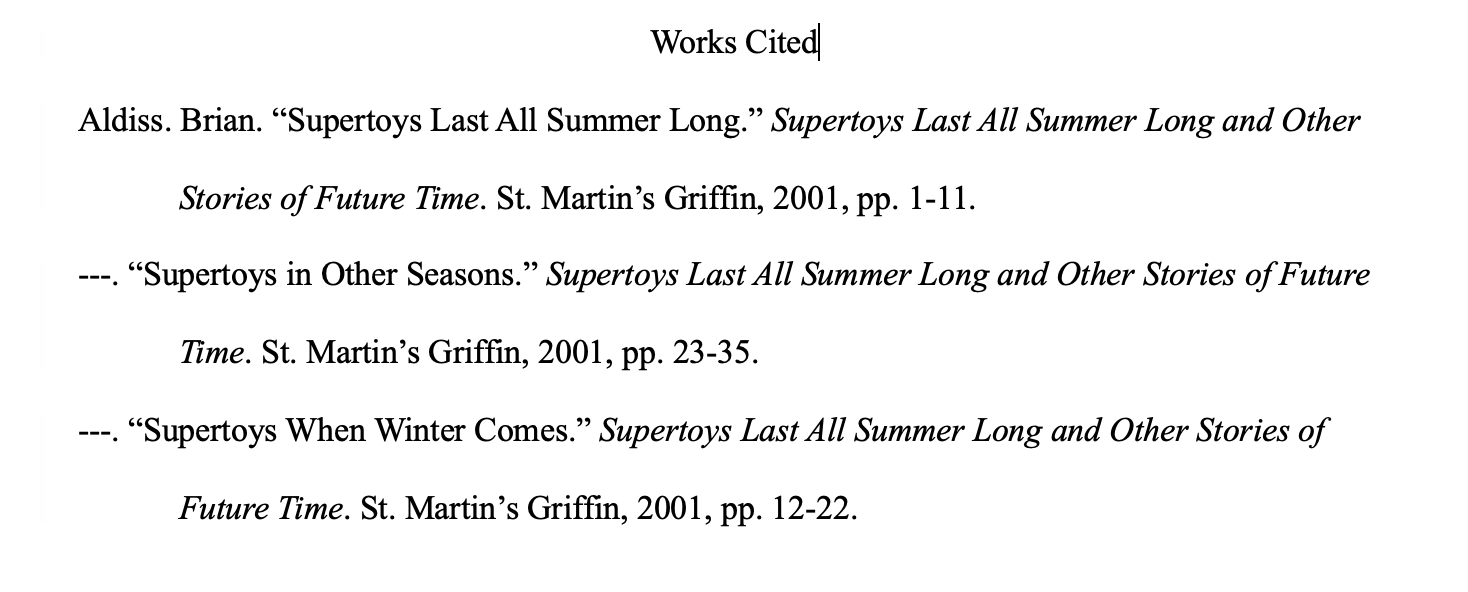
If you cite two or more of Brian Aldiss’s stories, use the list below as your model.
Note that if you cite more than one work by an author, his or her name is not repeated. Instead, three strikes of the hyphen key denote that the entry has the same author as the previous entry. Also note that the stories are alphabetized by title. “Supertoys When Winter Comes” is the second story chronologically, but it’s the last story alphabetically, so it’s listed third.
If your analysis focuses on “Runaround,” use the entry below as your model.
Note that the first date, 1950, indicates the book’s date of publication, and the second date, 1963, is the publication year of the edition you are citing. (Your class handout is a copy of the story in the 1963 Doubleday Science Fiction Book Club edition.)
If your analysis focuses on one or more of Aldiss’s stories, but you quote or paraphrase the Three Laws of Robotics, your works cited list should include an entry for “Runaround,” and the analysis should include a parenthetical citation for the laws.
Next Up
Wordplay Day! To prepare for class, revisit the Merriam-Webster Scrabble Word Finder page, and review your journal notes and the blog posts devoted to Scrabble tips.