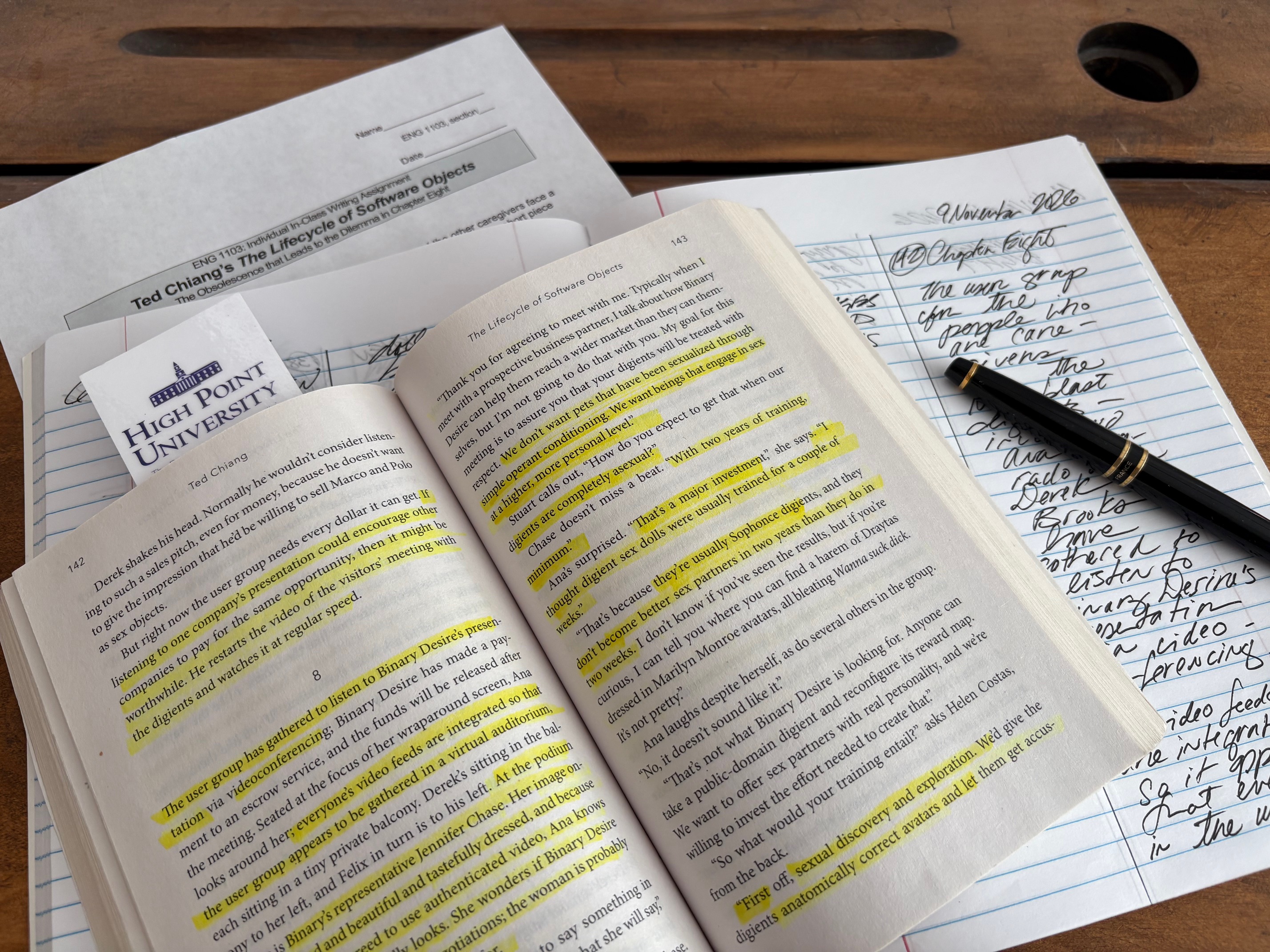
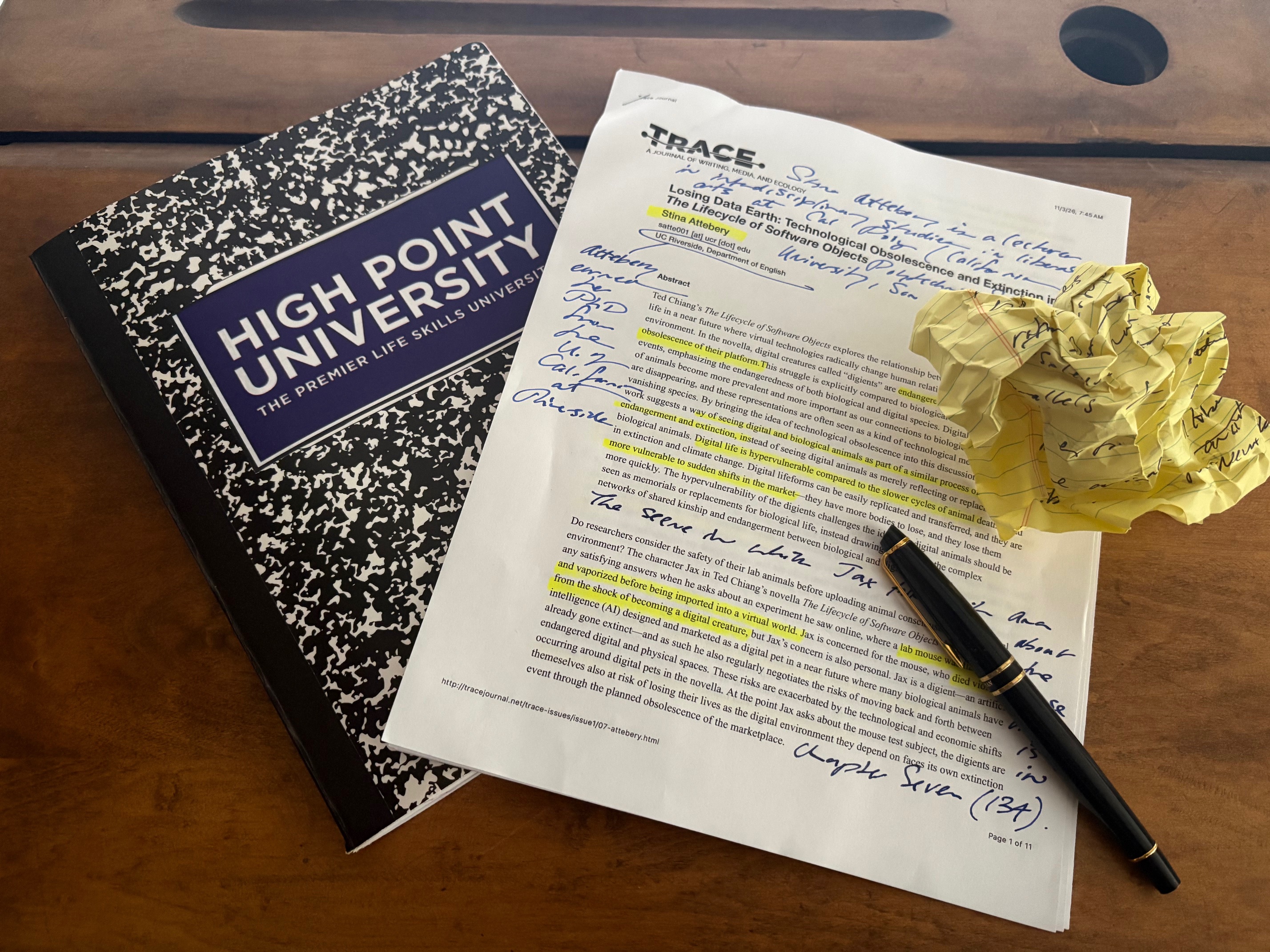
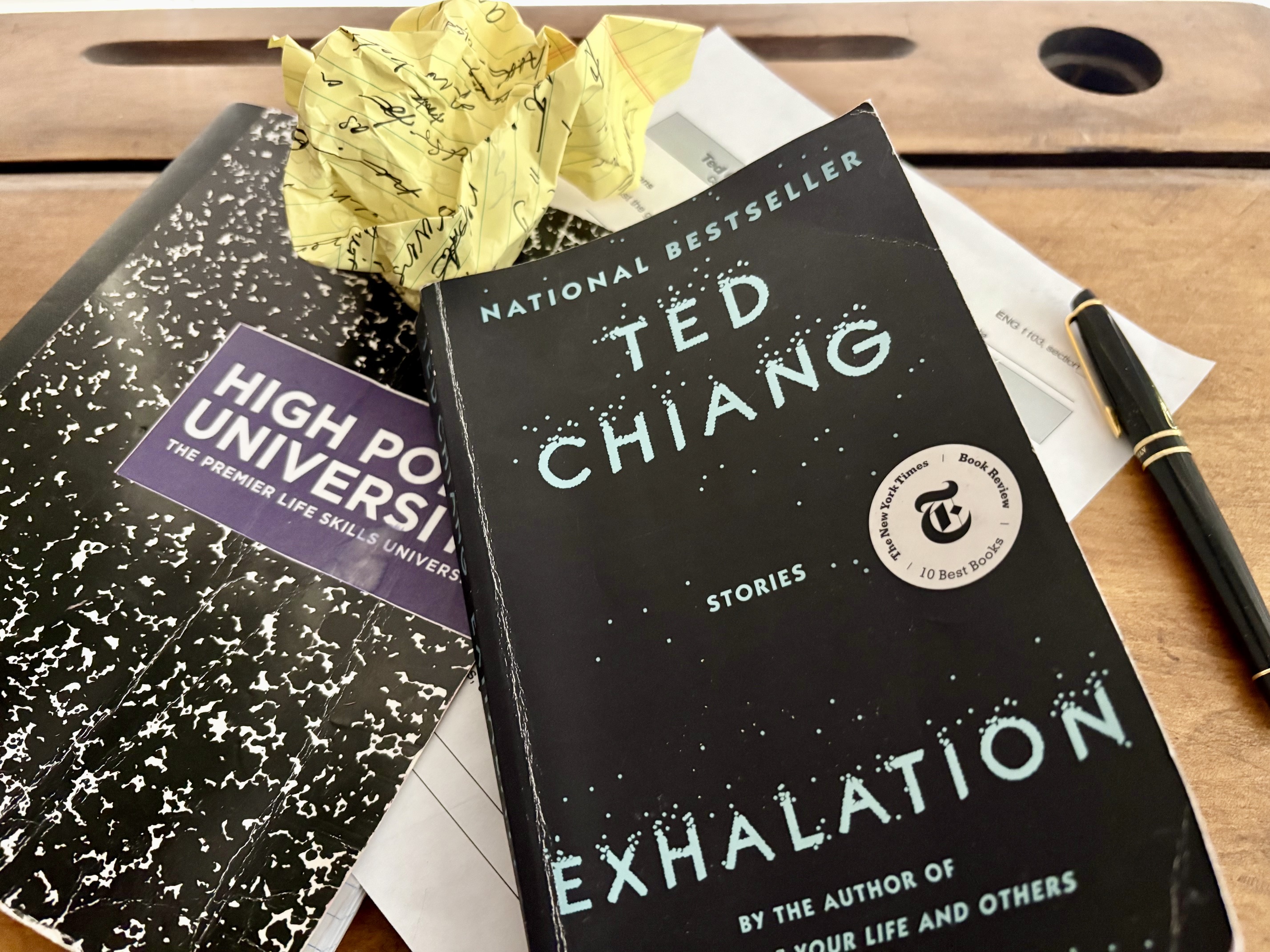
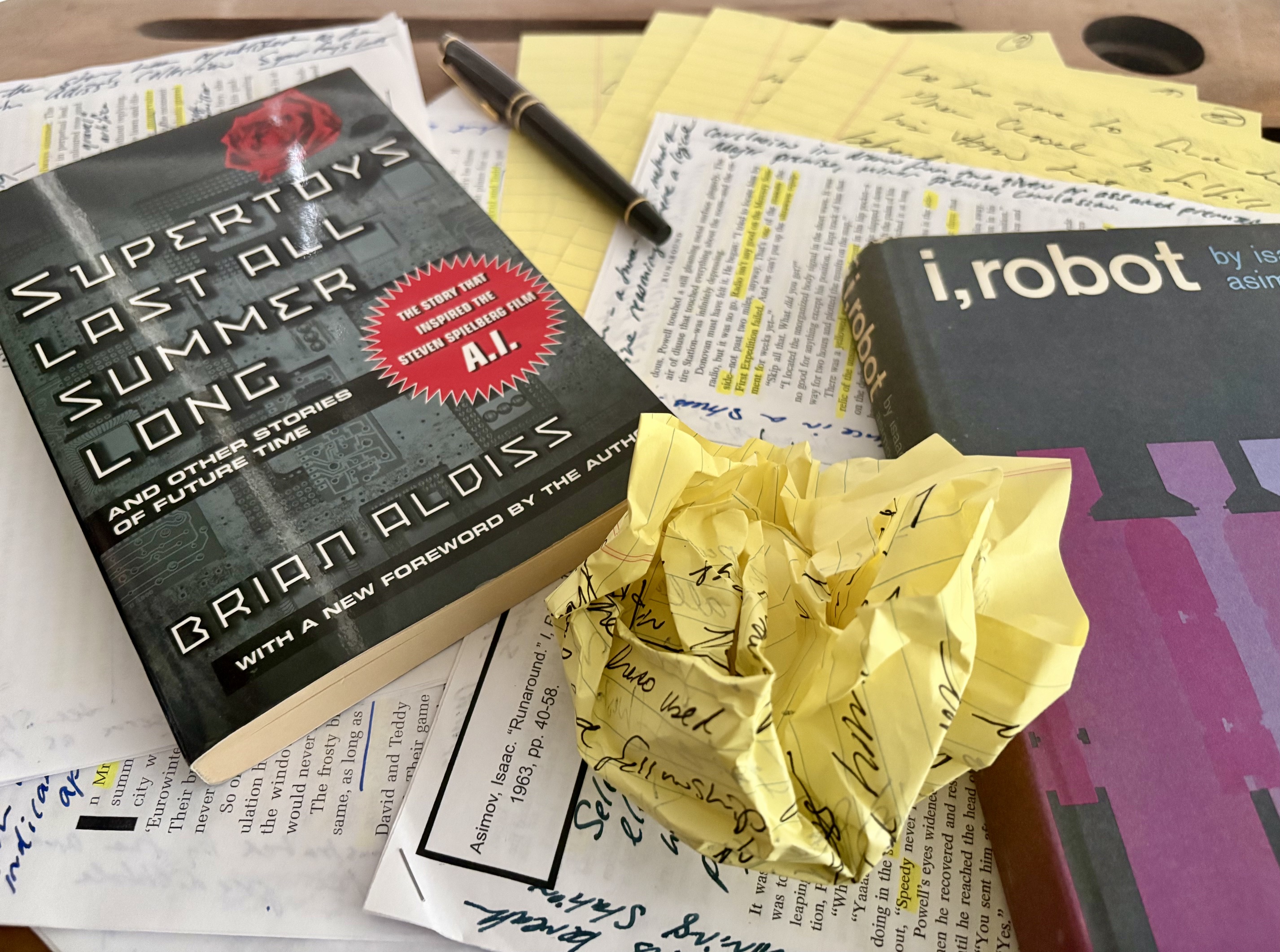
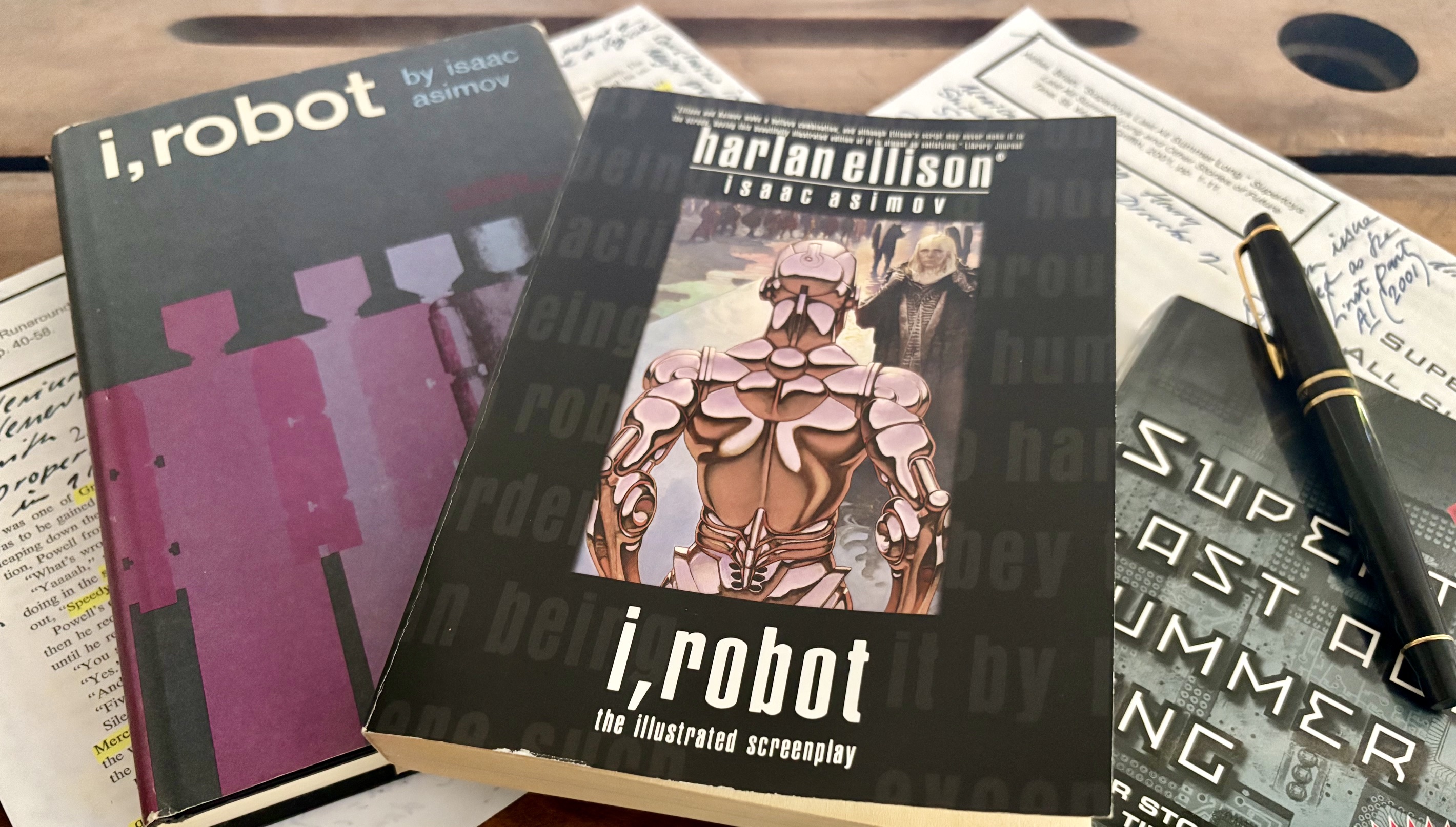
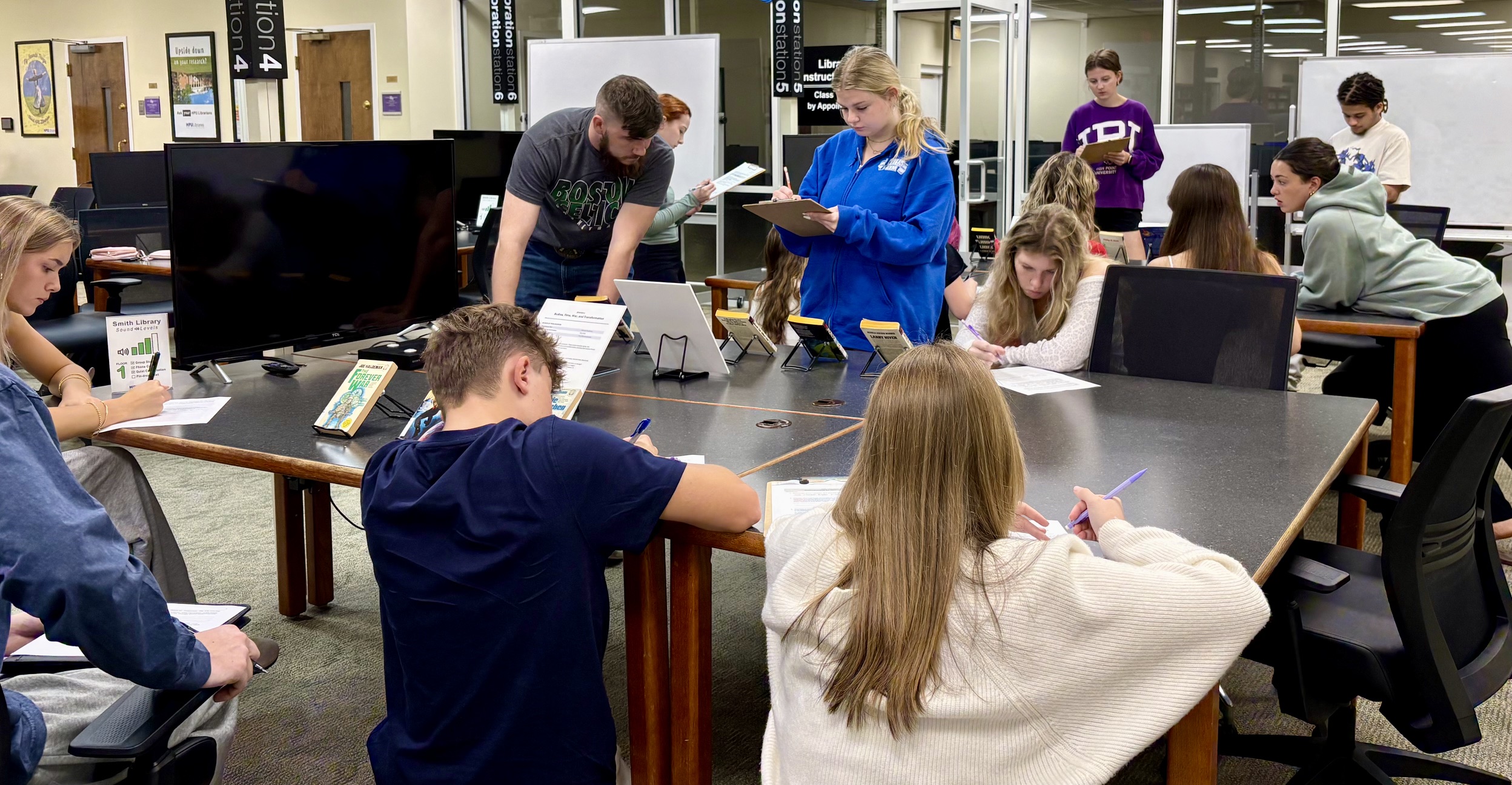
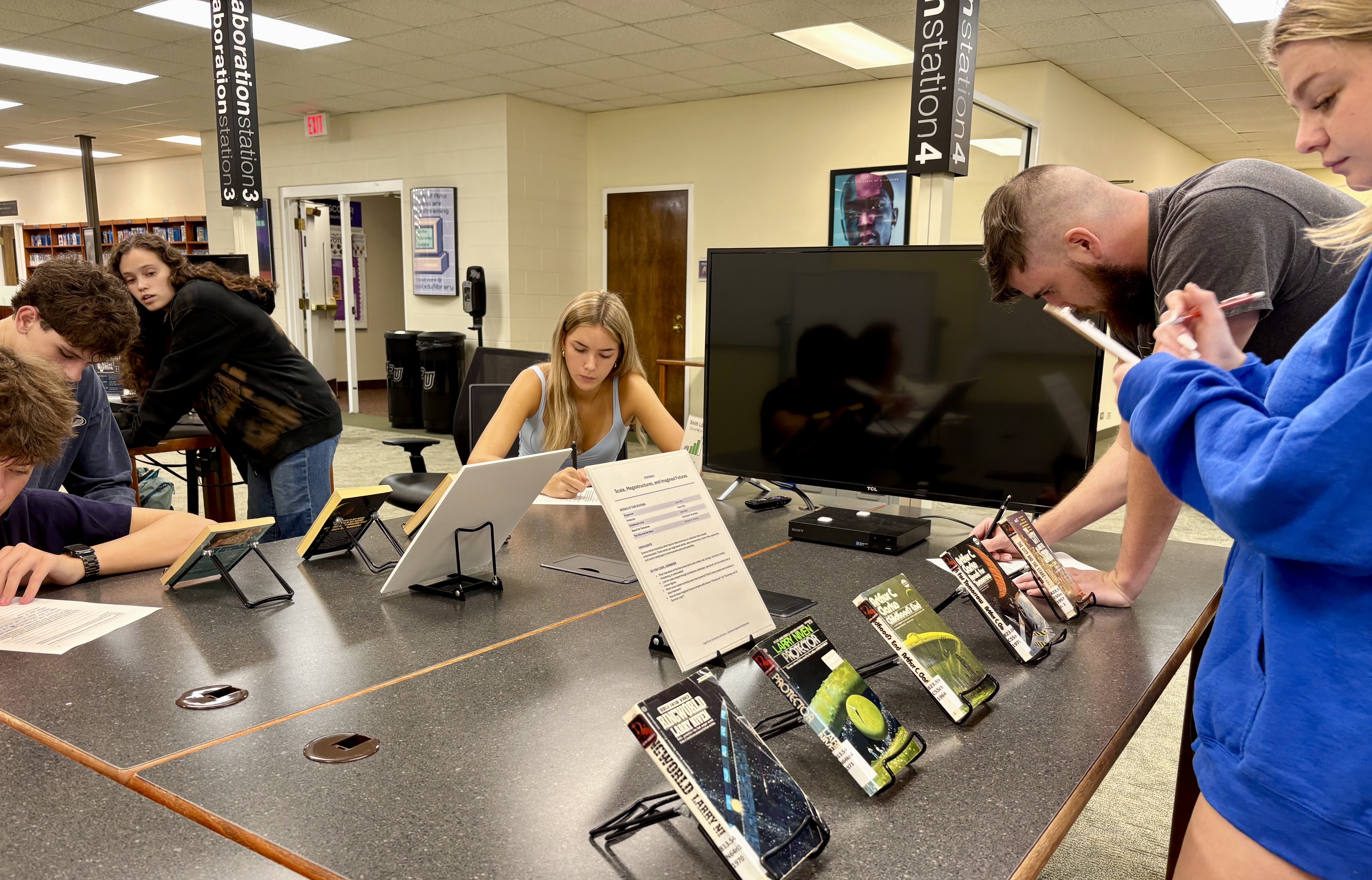
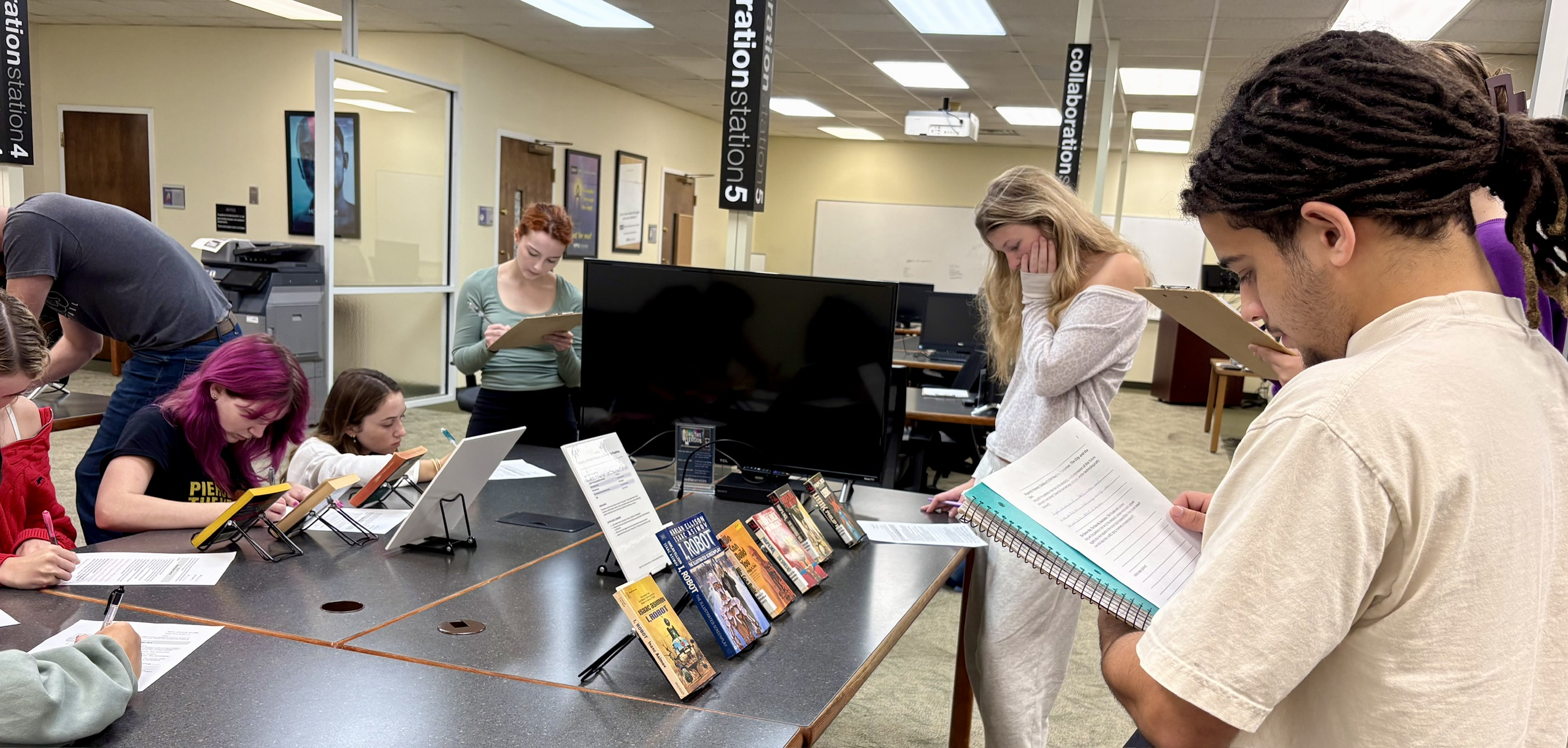
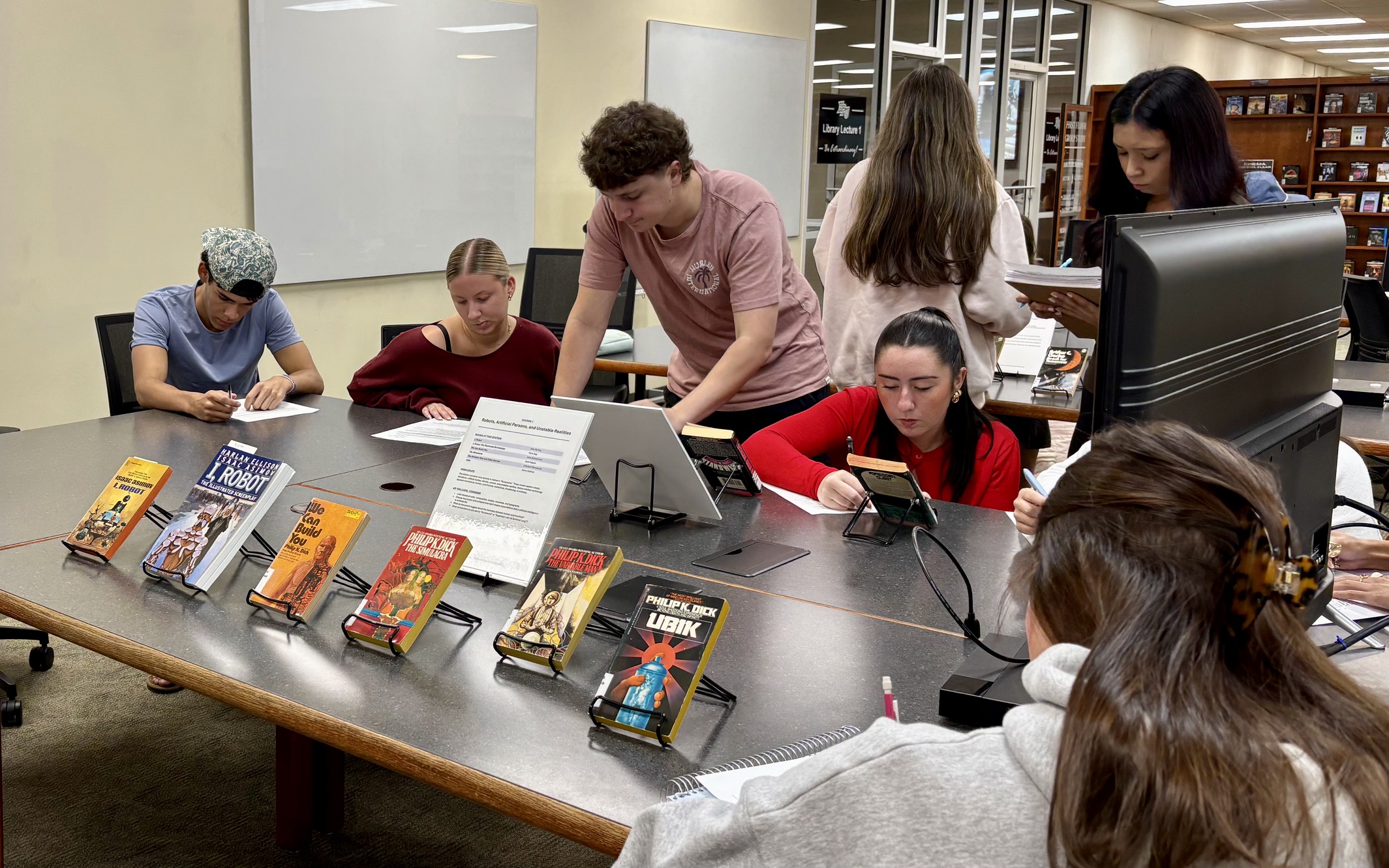
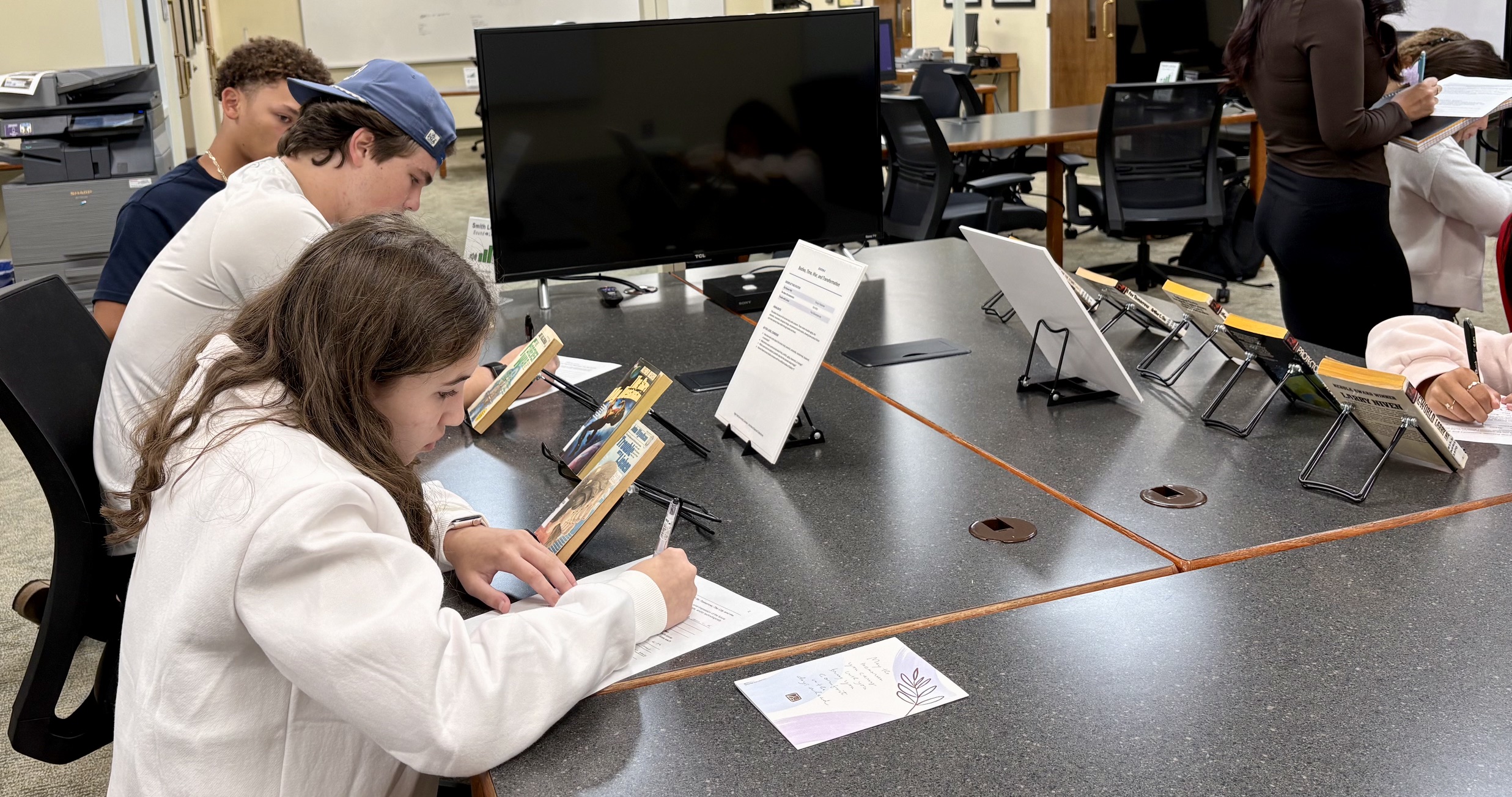
My annotations do not appear in the margins of the pages of my copy of Exhalation: Stories because I opted to record my reading notes in my journal, as many of you have.
In your reading for today, Ana Alvarado, Derek Brooks, and the other caregivers in their discussion forum find themselves behind the eight ball as they face a dilemma prompted by the Neuroblast digients’ obsolescence. In class, you will compose a short piece of writing, a minimum of two complete sentences, that explains the technological reason for the obsolescence and quotes the passage that addresses the specific action required for the Neuroblast digients to remain viable. Note that Chapter Eight, your reading for today, presents the dilemma, but the issue that prompts it surfaces earlier in the narrative.
In your writing, you will include a signal phrase that introduces the quotation, followed by the quotation and an MLA-style parenthetical citation.
Bonus Points
You may earn five extra points for your assignment if you continue your writing to include one additional sentence or more that addresses the difference between the Neuroblast digients’ predicament and the obsolescence of the inhabitants of Throwaway Town in Brian Aldiss’s “Supertoys in Other Seasons.” In your additional writing, include a signal phrase that introduces the quotation from Aldiss’s story, followed by the quotation and an MLA-style parenthetical citation.
Developments in Chapters Five, Six, and Seven
As a lead-in to your in-class writing, we will examine a couple of Monday’s collaborative responses to developments in Chapters Five, Six, and Seven. Among the aspects of the writing you will consider are these:
Do the writers provide sufficient context for the quotation?
Do the words that follow the quotation logically connect Chiang’s ideas to the writers’ own or to additional details in the novella?
Do the writers adequately demonstrate their knowledge of the novella’s events?
Sample Annotated Bibliography Entries
Previous class notes include three annotated bibliography entries I drafted as models for you. The class notes for October 29 feature the entry for my starting-point source, Ted Chiang’s novella The Lifecycle of Software Objects; and yesterday’s class notes present drafts of my entries for two peer-reviewed articles. Tomorrow’s class notes will include a fourth entry: one for a student interview.
Next Up
Wordplay Day! To prepare for class, revisit the Merriam-Webster Scrabble Word Finder page, and review your journal notes and the blog posts devoted to Scrabble tips.
Last Thursday’s class notes detailed how perusing the works cited list for the peer-reviewed article “The Everyday Life of Artificial Intelligence: The Humanism of Ted Chiang’s The Lifecycle of Software Objects,” by Sunyoung Ahn, led me to three potential sources, one of which I have decided to include in my bibliography as a second peer-reviewed source. You are required to include only one peer-reviewed article or chapter from a university press book, but you are welcome to include more than one.
Today’s class notes include drafts of my annotated bibliography entries for my two peer-reviewed sources: “Losing Data Earth: Technological Obsolescence and Extinction in The Lifecycle of Software Objects,” by Stina Attebery, and Sunyoung Ahn’s article, which led me to Atteberry’s.
Sunyoung Ahn cites French philosopher Henri Lefebvre’s The Critique of Everyday Life (1977), in which Lefebvre speculates “that in the not-too-distant future human cells will be created artificially (which is perfectly conceivable) and given consciousness” (qtd. in Ahn 73). From that premise, Lefebvre supposes that such artificial intelligence will experience the same struggles in everyday life that humans face. For Ahn, that philosophy of Lefebvre’s aligns with Ted Chiang’s depiction of his digients’ development and their relationships to the trainer Ana Alvarado and animator Derek Brooks, the humans who work with the digients at Blue Gamma and later become their caregivers. Ahn notes that such scenarios in science fiction are rare: Rather than turning to the trope of the cautionary dystopian tale, Chiang presents characters who “take responsibility for their own creation[s]” (88) and who, along with the digients, “stay useful and relevant by constantly modifying themselves” (87).
Ahn’s study delineates Chiang’s focus on the formative stage of artificial intelligence as a point of contrast to AI as it is widely imagined as “developed, perfected, and therefore culminant” (78). Ahn demonstrates the singular vision of The Lifecycle of Software Objects as a narrative in which “humans anthropomorphize the digients” (87) and the digients lead the humans to “think digitally” (87).
Sunyoung Ahn, an associate professor of English at Korea University in Seoul, is the author of “New Sincerity, New Worldliness: Post 9/11 Fiction of Don Delillo and David Foster Wallace.”
Source Details–What to Include
Note that the entry below for Stina Attebery’s article includes the web address, or URL, but the name of a database does not precede it. That’s because the journal Trace is available as an open source on the web, which is the exception rather than the rule for scholarly sources. In my entry for Sunyoung Ahn’s article, included above, JSTOR precedes the web address, or URL, because, Ahn’s article is included in the MLA International Bibliography, which is available through JSTOR on the HPU Libraries site.
Attebery, Stina. “Losing Data Earth: Technological Obsolescence and Extinction in The Lifecycle of Software Objects.” Trace: A Journal of Media, Writing, and Ecology, 17 April 2017, http://tracejournal.net/trace-issues/issue1/07-attebery.html.
Stina Attebery examines Ted Chiang’s The Lifecycle of Software Objects as a narrative in which digital entities do not substitute for their dwindling counterparts in the wild but instead experience obsolescence that parallels the endangerment and extinction of biological animals. Attebery suggests that the Neuroblast digient Jax’s anxiety regarding his vanishing platform, Data Earth, indicates that digital life may be “hypervulnerable compared to the slow cycles of animal death found in extinction and climate change” (par. 4).
Attebery’s study elucidates how life forms whose genomes are written in code—both the digients in Chiang’s novella and real-world digital entities—are surprisingly similar to biological animals in terms of their risk for endangerment. In Attebery’s words, “[d]igital life forms can be easily replicated and transformed and are more vulnerable to shifts in the market” (par. 4). As Attebery explains, since Chiang’s Neuroblast digients’ Data Earth virtual environment is a casualty of corporate takeover, and they cannot run on the newer platform Real Space, they are deemed irrelevant, but those technological changes alone do not lead to their change in fortunes. Because they lack the task-oriented focus of the newer Sophonce digients, they are perceived as unmarketable and valueless.
Stina Attebery is a lecturer in interdisciplinary studies in liberal arts at Cal Poly (California Polytechnic State University, San Luis Obispo). She is the author of “Coshaping Digital and Biological Animals: Companion Species Encounters and Biopower in the Videogames Pikmin and Pokémon.” She also serves as managing editor for the Eaton Journal of Archival Research in Science Fiction.
Page Numbers Versus Paragraph Numbers
The entry for Ahn’s article includes page numbers in parenthetical citations because JSTOR files are photographic images of physical pages of journals. Attebery’s entry includes paragraph numbers because Trace is an unpaginated online journal. Whether your parenthetical citations contain page numbers or paragraph numbers will depend on whether the article is paginated. Note that the page numbers that you see on a print-out of an online article, such as Page 1 of 11 in the lower right, is not the journal pagination but the printer’s numbering. In parenthetical citations, do not list those numbers as page numbers. List the paragraph numbers instead.
Next Up
On Wednesday, we will examine Chapter Eight of Ted Chiang’s The Lifecycle of Software Objects, and you will have additional time to devote to your research and writing.
This morning, after your Scrabble debriefing, you and two or three of your classmates will compose a short written response to one of the developments in your recent reading in Ted Chiang’s The Lifecycle of Software Objects. The two prompts you will choose from follow.
The Sophonce digient Voyl and his owner, Gerald Hecht, enter the narrative through a conversation the Neuroblast digients Marco and Polo have with Derek Brooks, their caregiver. Why does Ted Chiang introduce Voyl and Hecht into the story, and what may their circumstances indicate about the future of the digients?
Ted Chiang’s depictions of Ana Alvarado and her Neuroblast digient, Jax, show the two interacting in both of their terrains: in the physical world through Jax’s SaruMech robot body, and in the virtual world through Ana’s avatar. Later, Jax tells Ana about witnessing a different attempt to merge digital and biological life. Why does Ted Chiang include that exchange between Jax and Ana, and what may it indicate about the digients’ future?
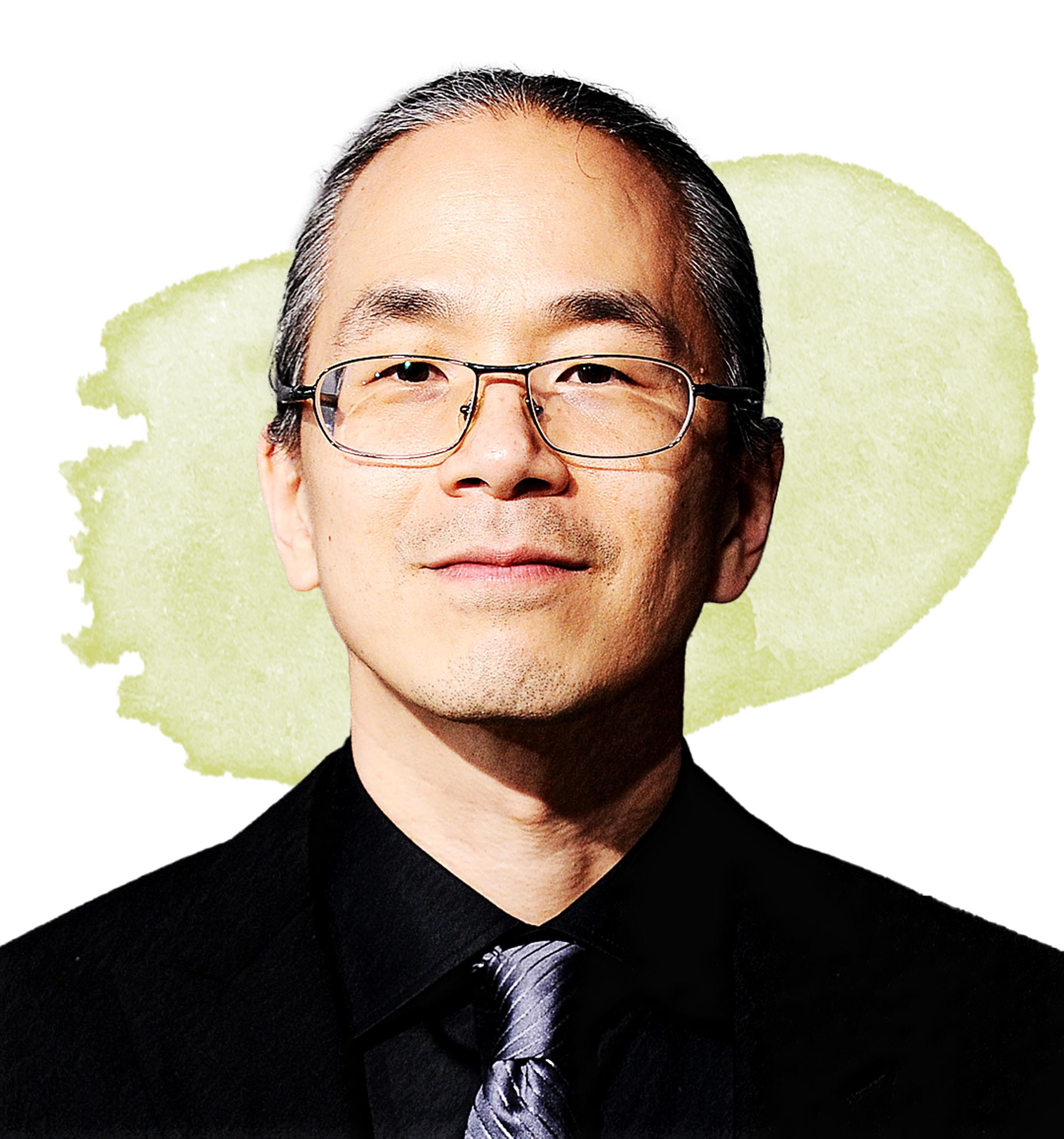
Ted Chiang, author of The Lifecycle of Software Objects. Illustration by Time; photo credit: Jason LaVeris, FilmMagic/Getty Images.
Continuing Your Research and Writing
After you complete your group exercise, you will have the remainder of the class period to work independently on your annotated bibliography and preface.
Tasks to undertake include these:
Using the HPU Libraries databases to locate an additional source and begin reading that article or book chapter.
Composing or revising an annotation for a source.
Reviewing the sources you have gathered and noting what similarities and differences you can identify among them. Those similarities and differences may serve as additional material for your preface or the commentary paragraphs in your annotations.
Drafting your preface.
Determining a theoretical lens for a larger project that may develop from your final essay and annotated bibliography.
In the last few minutes of class, you will compose a short piece of writing, a minimum of one complete sentence, that notes the particular task, or tasks, that you undertook during class.
Unexpected Finds–Sample Annotation
Last Thursday’s class notes detailed how perusing the works cited list for the peer-reviewed article “The Everyday Life of Artificial Intelligence: The Humanism of Ted Chiang’s The Lifecycle of Software Objects,” by Sunyoung Ahn, led me to three potential sources, one of which I have decided to include in my bibliography as a second peer-reviewed source. You are required to include only one peer-reviewed article or chapter from a university press book, but you are welcome to include more than one.
Tomorrow’s class notes will include a draft of my annotated bibliography entry for my second peer-reviewed source: “Losing Data Earth: Technological Obsolescence and Extinction in The Lifecycle of Software Objects,” by Stina Attebery.
Next Up
On Wednesday, we will examine Chapter Eight of Ted Chiang’s The Lifecycle of Software Objects, and you will have additional time to devote to your research and writing.
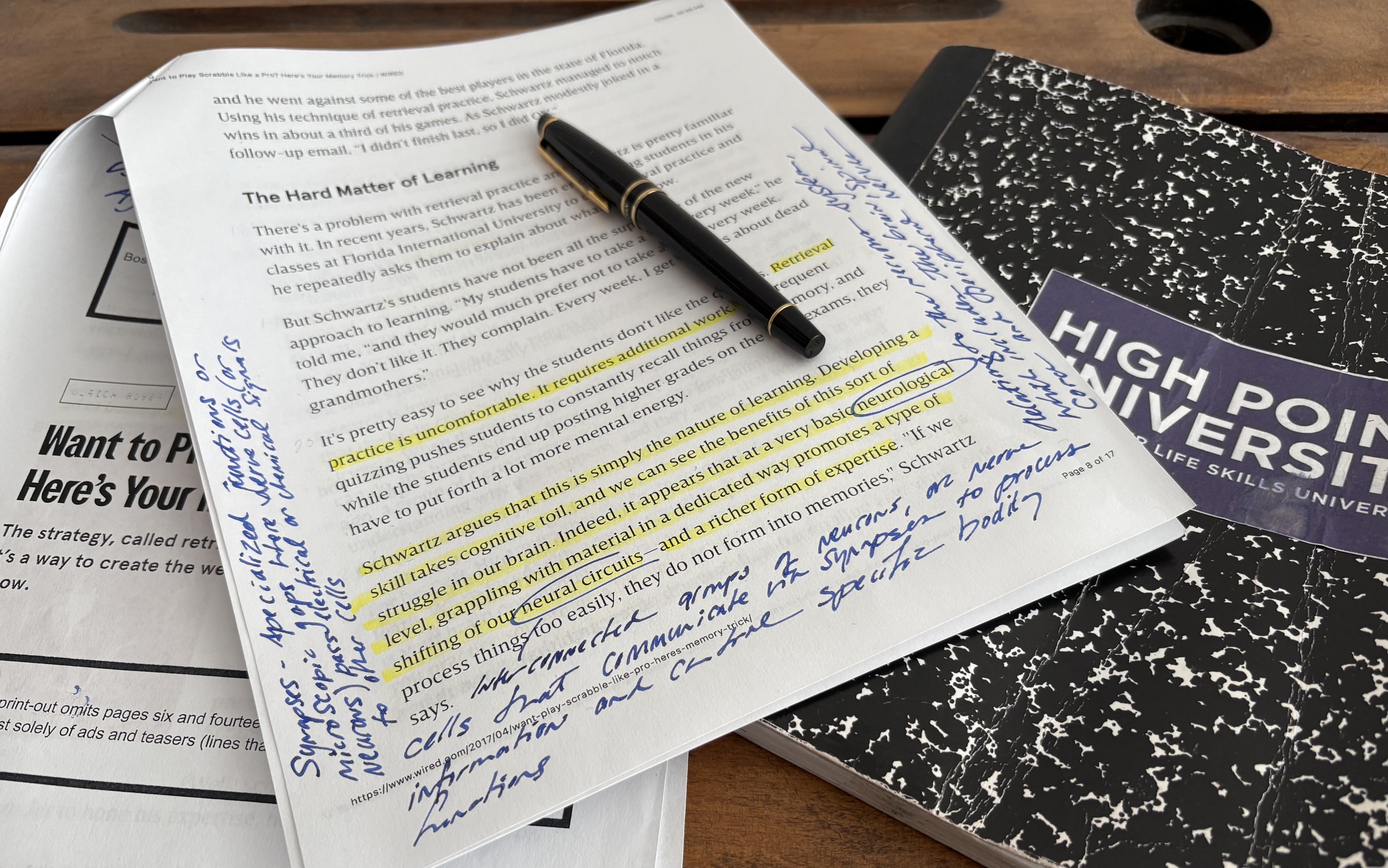
Ulrich Boser’s “Want to Play Scrabble Like a Pro? Here’s Your Memory Trick?” the Wired magazine article I found through a conversation with ChatGPT.
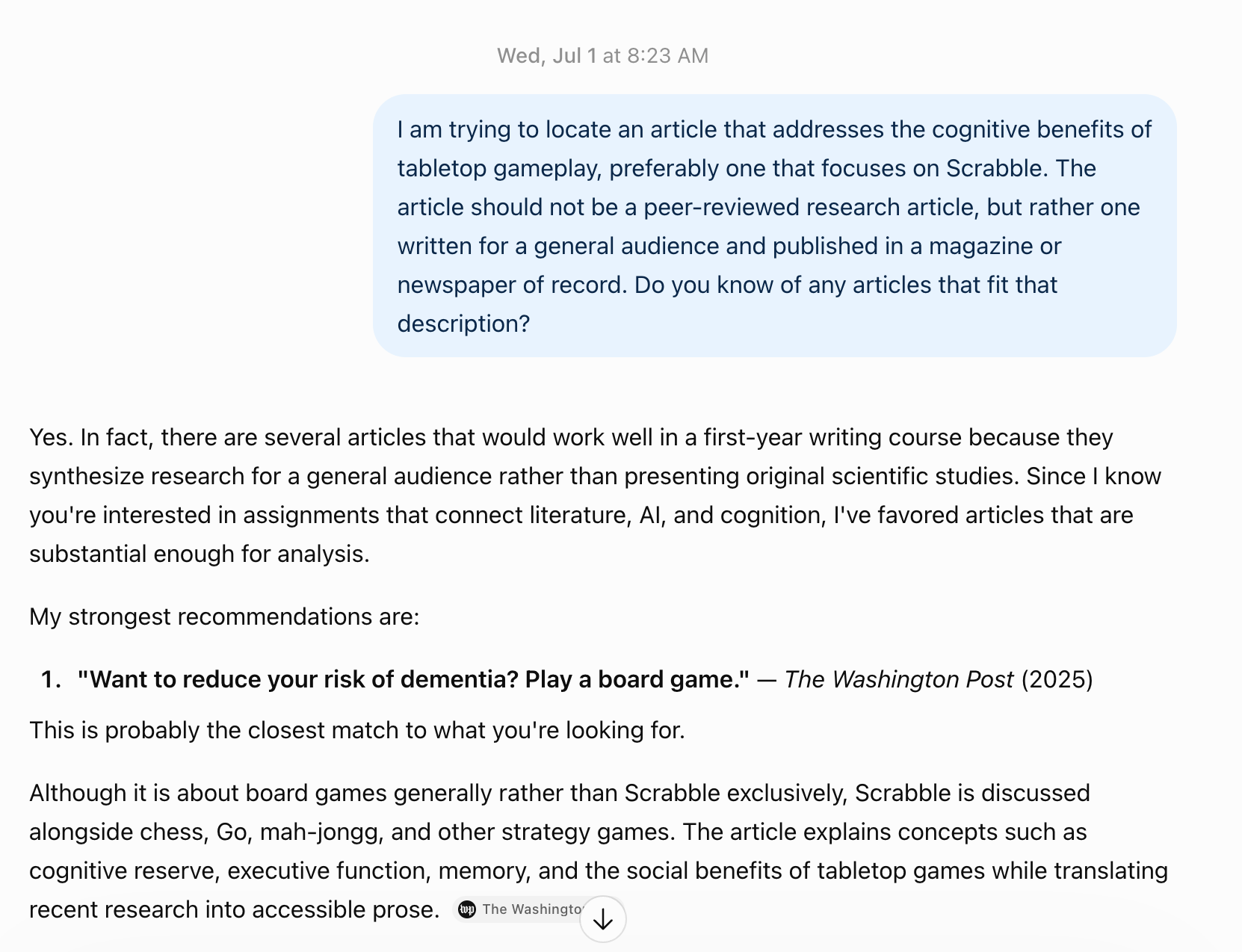
During last Wednesday’s library session in the 10:40 class, Lauren Ksa, Head of Research and Library Instruction, mentioned that she didn’t know what my policy was regarding students’ use of A.I. for online searches. I am grateful to Lauren for mentioning that because it prompted me to provide you with images of my own A.I.-assisted search for an article, followed by my commentary, as a model for using A.I. ethically in research. Turning to A.I. was a step I took only after I had explored other options thoroughly, and that’s when you should turn to A.I., if you use it at all.
For several years, my students have delivered group presentations on articles devoted to aspects of English 1103, but none of those presentations included an article on Scrabble. That’s because I was unable to find one that was comparable to articles on other aspects of the class. Although I knew of scholarly articles on the subject–and have cited some in my own writing–for the purposes of both the group presentations and a starting point for research, I needed an article written for a general audience.
Last summer, as I was planning for the fall semester, it occurred to me that I might see whether a conversation with ChatGPT would yield what I’d been looking for.
In the screenshot above, you can see ChatGPT’s first recommendation, a Washington Post article that could serve as one of the sources in a bibliography devoted to the cognitive benefits of Scrabble play, but it isn’t what I sought for a presentation article that could also be a starting point for research. I omitted the other two recommendations from the screenshot because they were off base. One was a health system site and the other was a general recommendation for the Washington Post ‘s Brain Matter column, written by Richard Sima, rather a particular column on the subject.
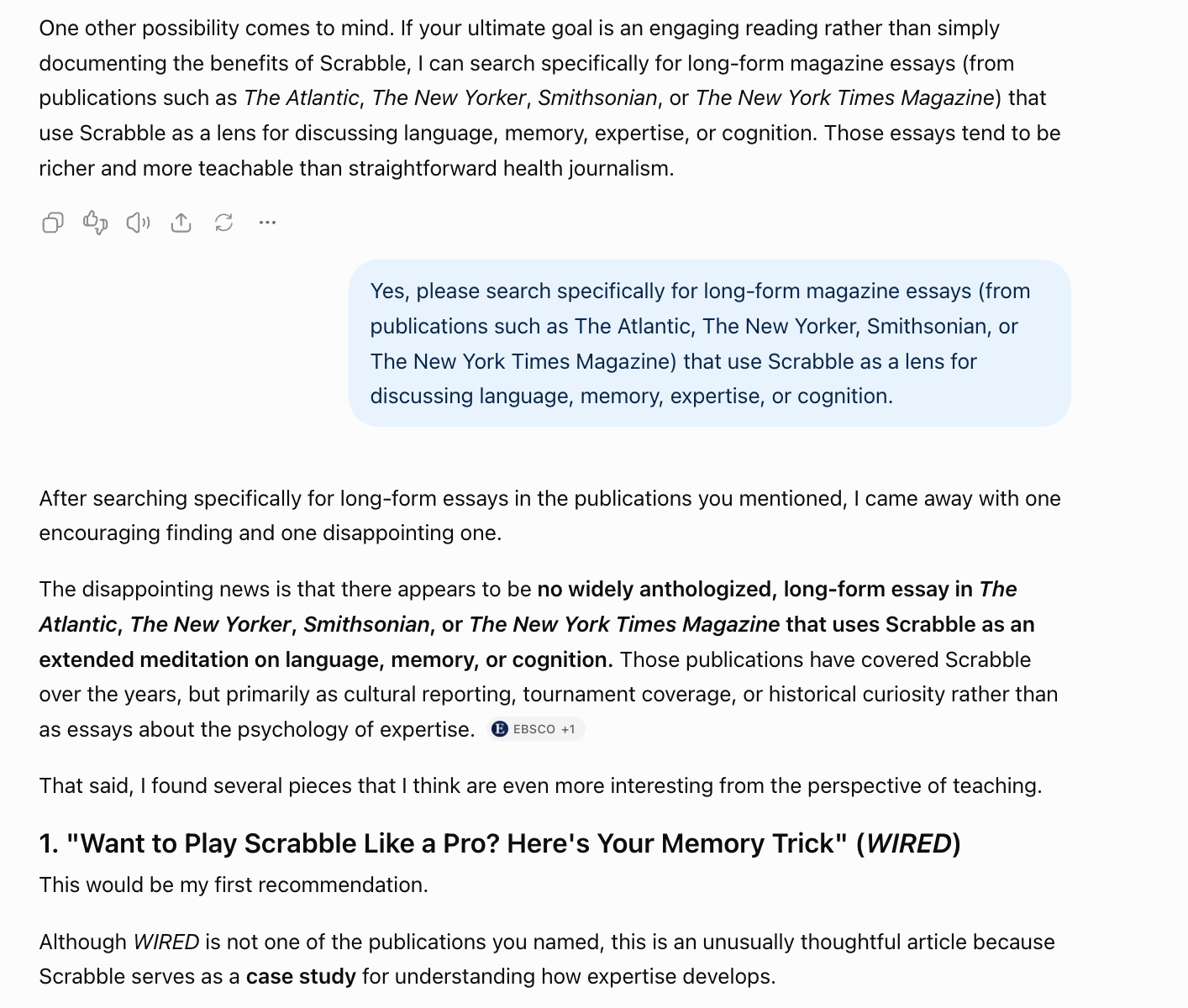
Although I had requested magazine articles, ChatGpt’s initial response included none, but a later reply from the A.I. assistant led me to what I’d sought.
ChatGPT’s number-one find (in the screenshot above) seemed to be precisely what I was looking for. I omitted the three suggestions that followed because the second one, Stefan Fatsis‘s Word Freak, while a valuable source and an engaging read, is a book rather than an article. The third recommendation was a Time magazine article on the history of the game, and the fourth was my own study of Scrabble, which ChatGPT located on my blog–and yes, identified as my own writing.
A.I. Recommended It, Now What?
If I had not been familiar with the magazine Wired, my next step would have been determining whether it’s a reliable and reputable source. Searching for Wired on the HPU Libraries site confirms its credibility. The magazine is cited in sources available through the library and the magazine itself is available through the ProQuest Central database and as an open source on the web.
Takeaways
Turn to A.I. for searches only after you have explored other options thoroughly.
If the conversation leads you to a promising source, determine whether its reliable and reputable and double-check the accuracy of A.I.’s details about the source.
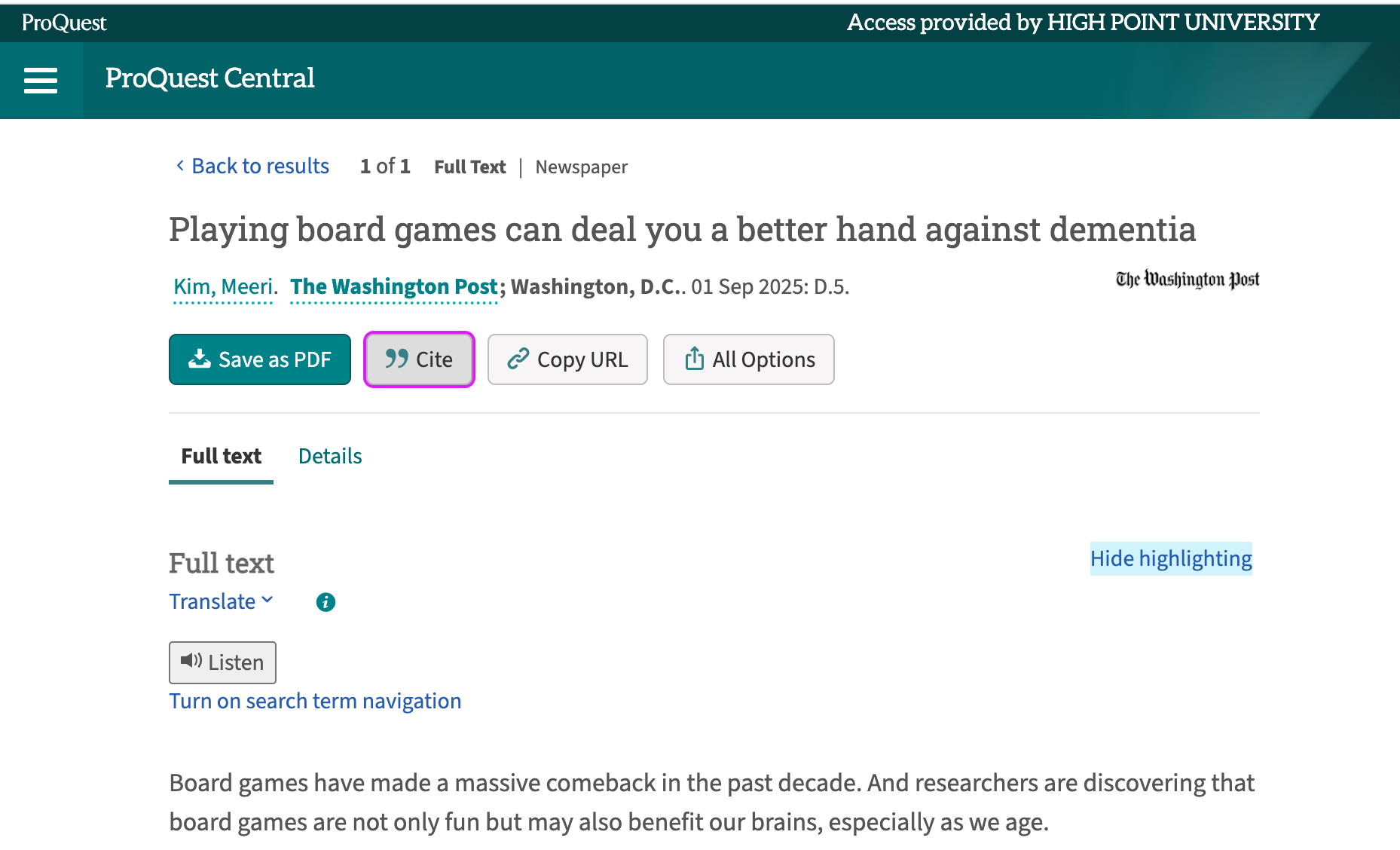
With the second takeaway in mind, look back at the first screenshot in this post. There, the A.I. agent recommends a Washington Post article titled “Want to Reduce Your Risk of Dementia? Play a Board Game.” As you can see in the screenshot that follows, the actual title is “Playing Board Games Can Deal You a Better Hand Against Dementia.”
As you continue your own research and writing, remember that using generative AI to write your bibliography, and/or your preface, and presenting an AI agent’s words as your own violates High Point University’s Honor Code and is grounds for an F. However, using AI ethically, as I do in the model above, can be a useful step.
Sample Bibliography and Preface: “All Hail the King”
This morning in class, after your Scrabble debriefing, you and two or three of your classmates will compose a short assessment of the student bibliography and preface “All Hail the King,” and use the assignment’s guidelines and rubric to determine a letter grade.
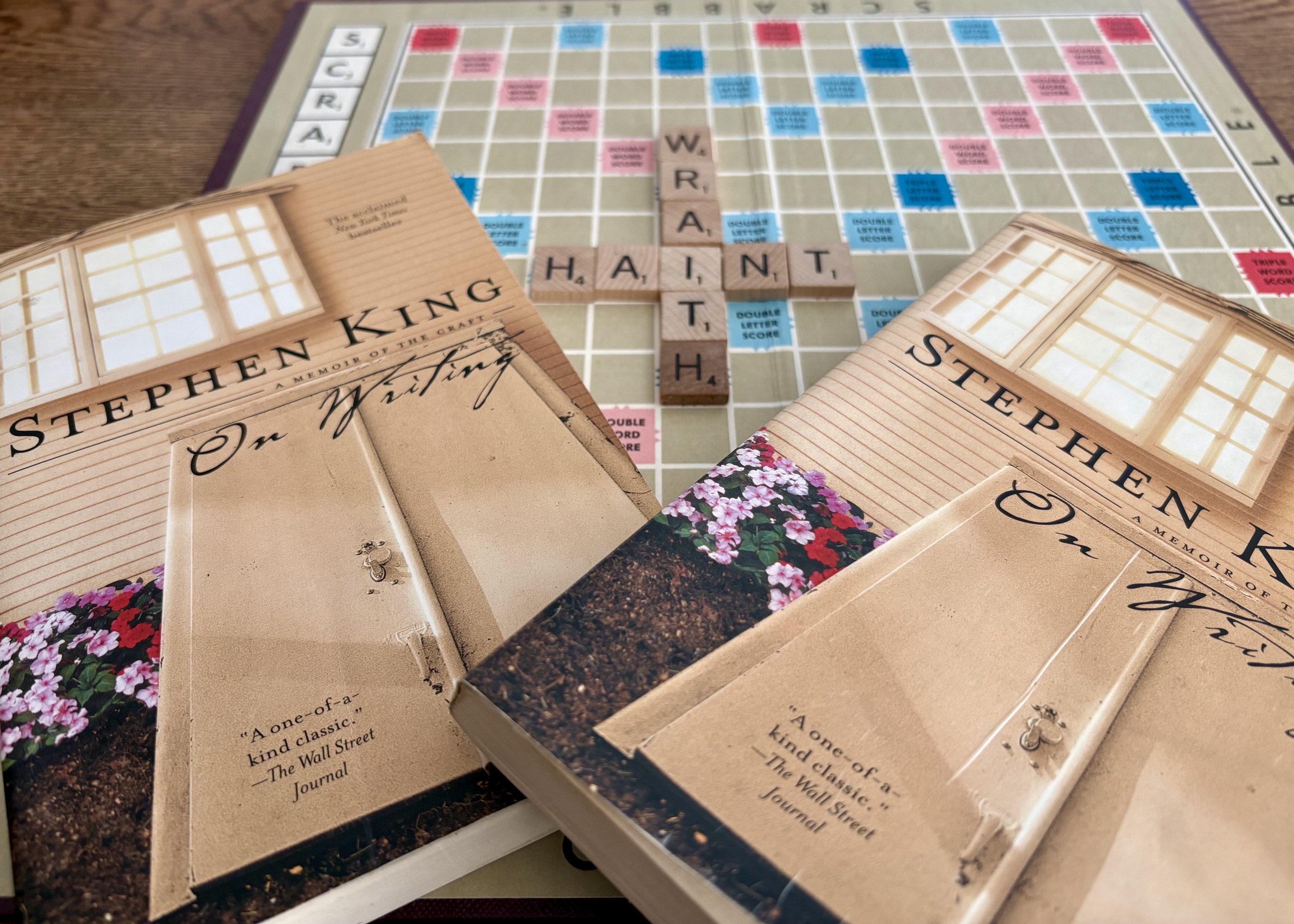
Congratulations to Gavin Godfrey-Ryan and Layla Rothberg, for winning copies of Stephen King’s On Writing (pictured above) in Friday’s drawings.
Next Up
In the first half of Wednesday’s class, you will interview a classmate, compose an MLA-style bibliographic entry for that interview, and craft a sentence incorporating a quote from that interview, a sentence you may include in your preface or your annotation for the interview. In the second half of class, you will have time for additional research and writing.
Yesterday in class, you and two or three of your classmates wrote about the conflicts and sources of potential conflicts in chapters one and two of Ted Chiang’s The Lifecycle of Software Objects. Those tensions you addressed and lines you quoted are included in the notes that follow.
As our study of Chiang’s novella progresses, return to these notes and consider how and where the moments detailed here seem to anticipate later complications in the narrative.
The differences between Ana Alvarado’s and Derek Brooks’s perceptions of the digients (69-70): You cited Ana’s observation that “it feels like we’re dressing them in circus costumes when we try to make them look like monkeys or pandas” (69) and how Derek, though initially hurt by Ana’s remark “appreciate[s] hearing a different perspective” (70). Though Ana and Derek’s contrasting visions of the digits may not be a source of tension between the two of them–since they seem to respectfully disagree–that lack of consensus could be an issue among other employees at Blue Gamma. It also raises a larger question about the digits: How will the digients’ relationships with their designers, trainers, and owners proceed when those humans are uncertain of the digients’ nature?
Lolly, the lion cub digient, learning an obscenity from Stefan, the Blue Gamma trainer in the Australian office (73-74): You referred to Stefan, “one of the trainers from Blue Gamma’s Australian office” (73), as the person from whom Lolly learned the curse word and mentioned one of Blue Gamma’s cofounders, Mahesh, saying they “can’t sell a digient that says” an obscenity (73). Stefan’s misstep and its consequences–namely Mahesh’s decision to roll back the digients’ memories demonstrate the considerable costs of raising the digients, both the learning loss they suffer and the productivity cost for Blue Gamma. It also highlights the vulnerability of the childlike digients.
Blue Gamma customer Andrew Nguyen’s interactions with his digient (76-77, 79): You noted Derek’s suspicion that “the user hadn’t read Blue Gamma’s recommendations on raising digients” (77) and Andrew’s response to Derek’s recommendations: “The Hell with that. I paid good money for this avatar, and I bought it specifically to wear when I’m on the social continents. I’m not going to stop wearing it for a digient” (79). Andrew’s resistance to Derek’s suggestions illustrates how some owners’ approaches to their digients disregard the company’s guidelines, which can lead to neglect. That negligence on the part of owners may in turn give rise to larger problems.
Jax, the digient with the neo-Victorian robot avatar, “inhabiting” the SaruMech robot body, and SaruMech’s plans to rent the robot bodies, rather than sell them (81-83): You addressed Ana’s comment on Jax’s progress, that “it’s cool to see him that way” (83) and her hope that “[f]or SaruMech’s sake, the experience translates well onto video” (83). You also noted that “[t]here were many reasons Blue Gamma targeted the virtual realm instead of the real one–lower cost, ease of social networking–but one was the risk of property damage” (83). Ana’s comments juxtaposed with SaruMech’s corporate decision to limit the robot bodies to rentals demonstrates the competing interests of Blue Gamma and Sarumech and prompts questions about the effects of Sarumech’s choice. How might Saumech’s rental-only hardware policy affect digient’s who may grow to prefer the experience of virtually inhabiting a body?
Blue Gamma’s design of an alien species, Xenotherians, commissioned by a group of artificial-life hobbyists (87): You cited the hobbyists’ haste, noting the narrator’s observation that “rather than wait for real intelligence to evolve on its own in the biomes, [they] commissioned Blue Gamma to design an intelligent alien life species for them” (87). You also mentioned that the hobbyists “intend to create a new culture from scratch” (87). The hobbyists’ desire to develop an alien digital world in isolation, using a custom dialect of an artificial language, Lojban, that only insiders can comprehend runs counter to what the professionals at Blue Gamma have identified as necessary practices for knowledge building, both for individual digients and their community. If creating a private continent for the Xenotherians is simply an intellectual exercise, will the hobbyists lose interest? If so, what might the Xenotherians do if left to their own devices?
Ted Chiang, author of The Lifecycle of Software Objects. Illustration by Time; photo credit: Jason LaVeris, FilmMagic/Getty Images.
Next Up
Tomorrow we will meet on the lower level of Smith Library in a glass-front room near the tables where we met on September 16, and I will distribute copies of your annotated bibliography and preface assignment. Lauren Ksa, Head of Research and Instructional Services, will lead us through the process of using library databases to locate sources for your bibliography.
This morning, after your Scrabble debriefing, you and two or three of your classmates will compose a short piece of writing that addresses one of the conflicts or sources of potential conflict in the first two chapters of Chiang’s novella. The guidelines for your assignment follow.
Directions
Compose a statement of at least one complete sentence that begins with a signal phrase for a quotation that addresses one of the bulleted items below, follows the quote with a parenthetical citation, and concludes with words that convey the situation’s conflict or indicate its potential for conflict. Do not include the word conflict. Instead, describe the conflict or explain its possibility.
Example
Ana Alvarado, who studied primate communication and “dreamed of following Fossey and Goodall to Africa” (66), and the animator Derek Brooks, whose design work is limited to such tasks as fashioning “a body that manifests the digients’ gestures” (67), both find themselves pursuing careers that differ considerably from the ones they had envisioned for themselves. The discrepancies between their plans and their current circumstances prompt questions about their futures. Will their days at Blue Gamma be marked by satisfaction or resignation, and how will their attitudes affect their relationships with the digients?
The differences between Ana Alvarado’s and Derek Brooks’s perceptions of the digients (69-70).
Lolly, the lion cub digient, learning an obscenity from Stefan, the Blue Gamma trainer in the Australian office (73-74).
Blue Gamma customer Andrew Nguyen’s interactions with his digient (76-77, 79).
Jax, the digient with the neo-Victorian robot avatar, “inhabiting” the SaruMech robot body, and SaruMech’s plans to rent the robot bodies, rather than sell them (81-83).
Blue Gamma’s design of an alien species, Xenotherians, commissioned by a group of artificial-life hobbyists (87).
In the second half of class, we will discuss what you’ve written about the conflicts and potential sources of conflict in chapters one and two. Afterward, I will introduce the annotated bibliography and preface assignment, your third and final major paper assignment for the course.
Scrabble Debriefing, Part II: Viruses You’d Like to Catch
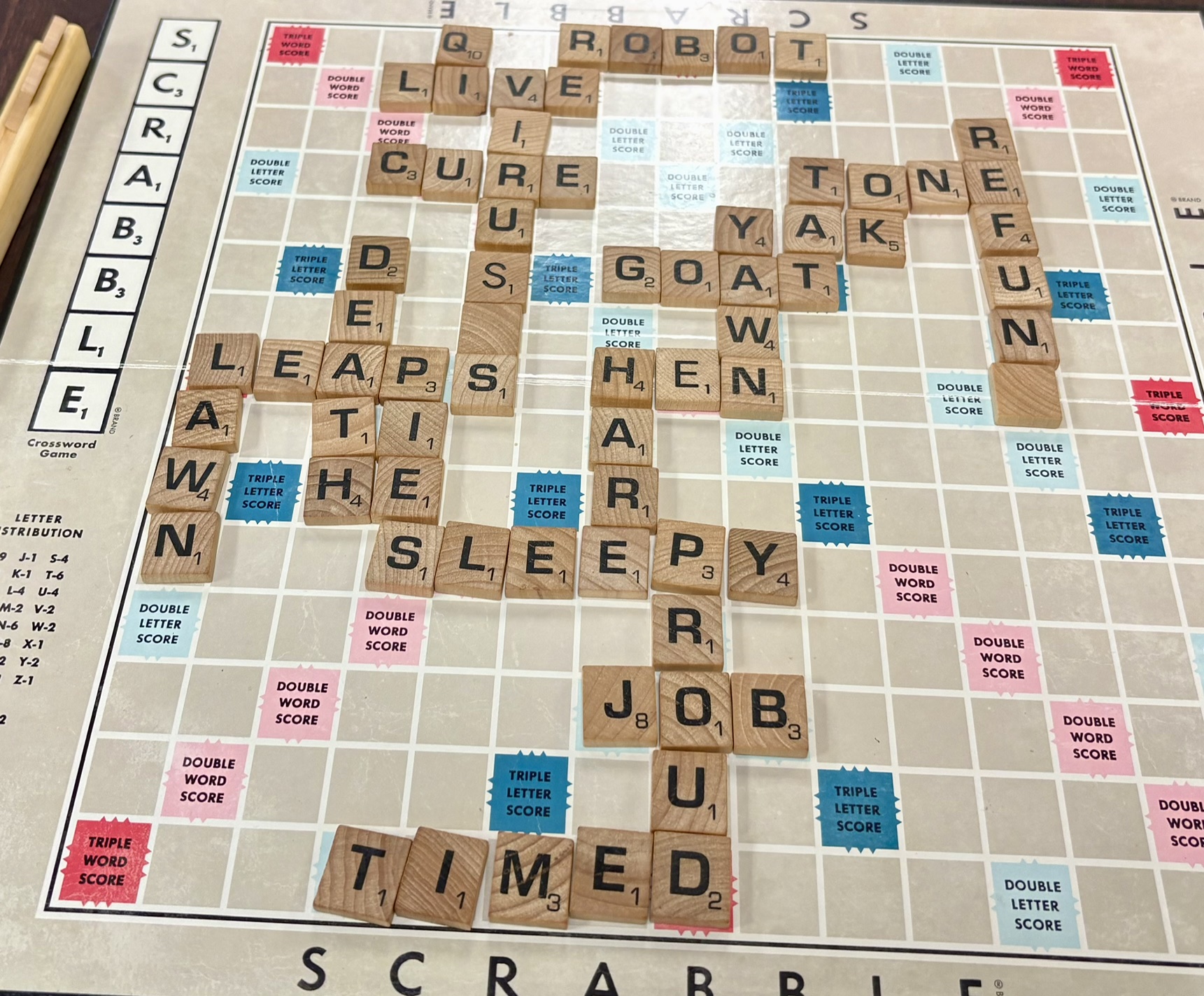
Although viruses are infections to avoid, playing viruses in Scrabble by using all seven of your tiles will earn you fifty bonus points. That was the case in last Friday’s game pictured above. Using a blank for the e, a team played viruses vertically by adding the s to leap for a total of seventy-five points.
Next Up
Wednesday we will meet on the lower level of Smith Library in a glass-front room near the tables where we met on September 16. Lauren Ksa, Head of Research and Instructional Services will lead us through the process of using library databases to locate sources for your bibliography.
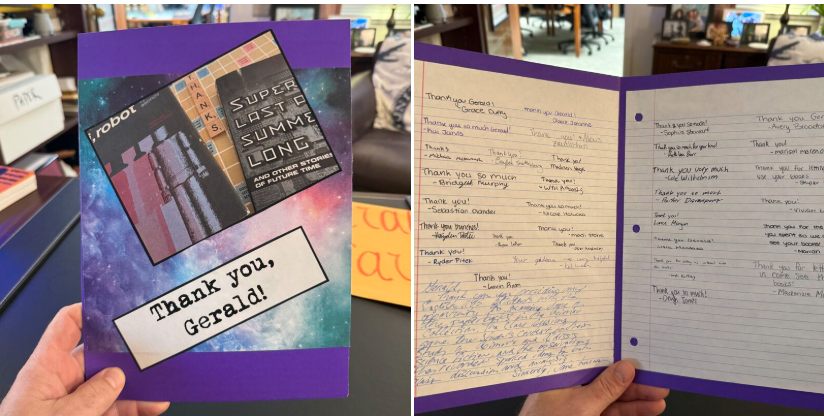
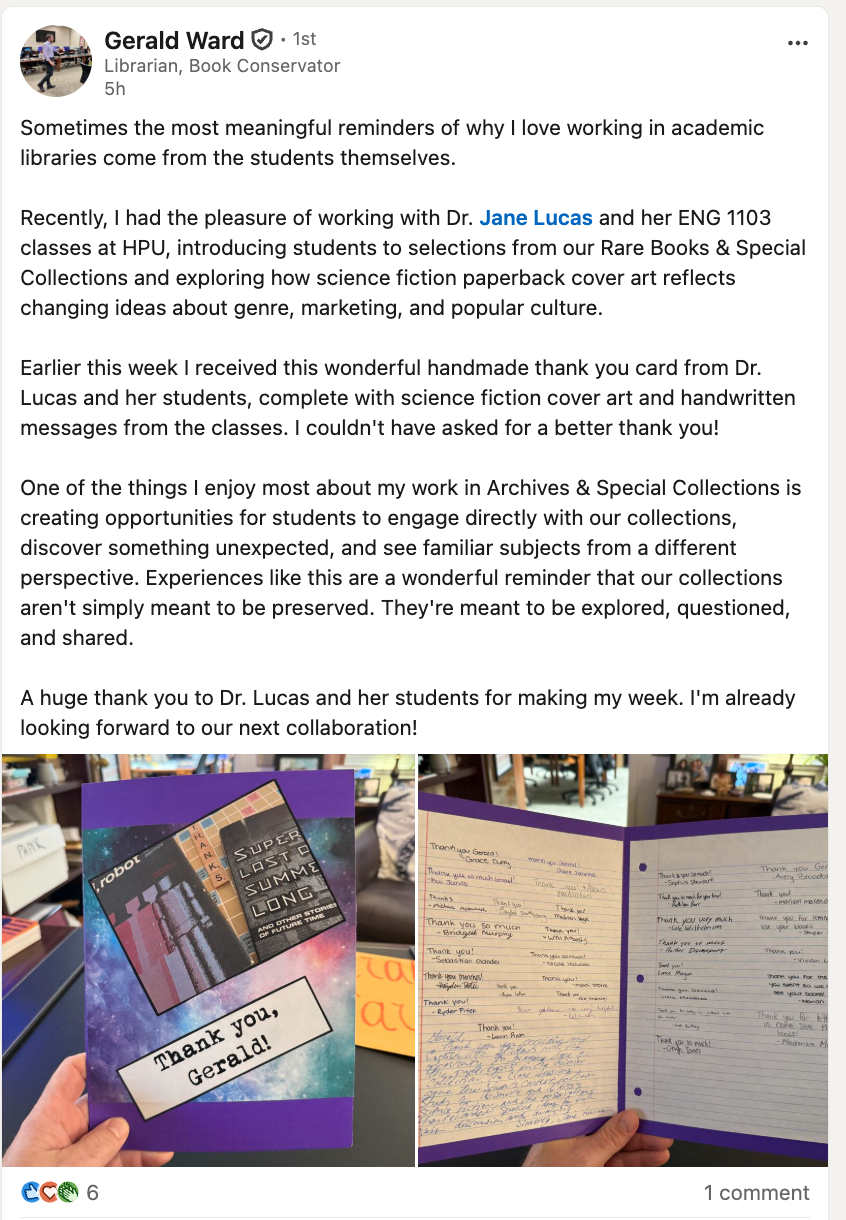
The pictures above, featuring the card we gave to Gerald Ward, Assistant Director and Head of Archives and Special Collections at HPU Libraries, are from a LinkedIn post he made about the card and our library session devoted to cover art from the Asimov Collection. The complete LinkedIn post appears later in today’s class notes.
Using AI Ethically for Your Analysis
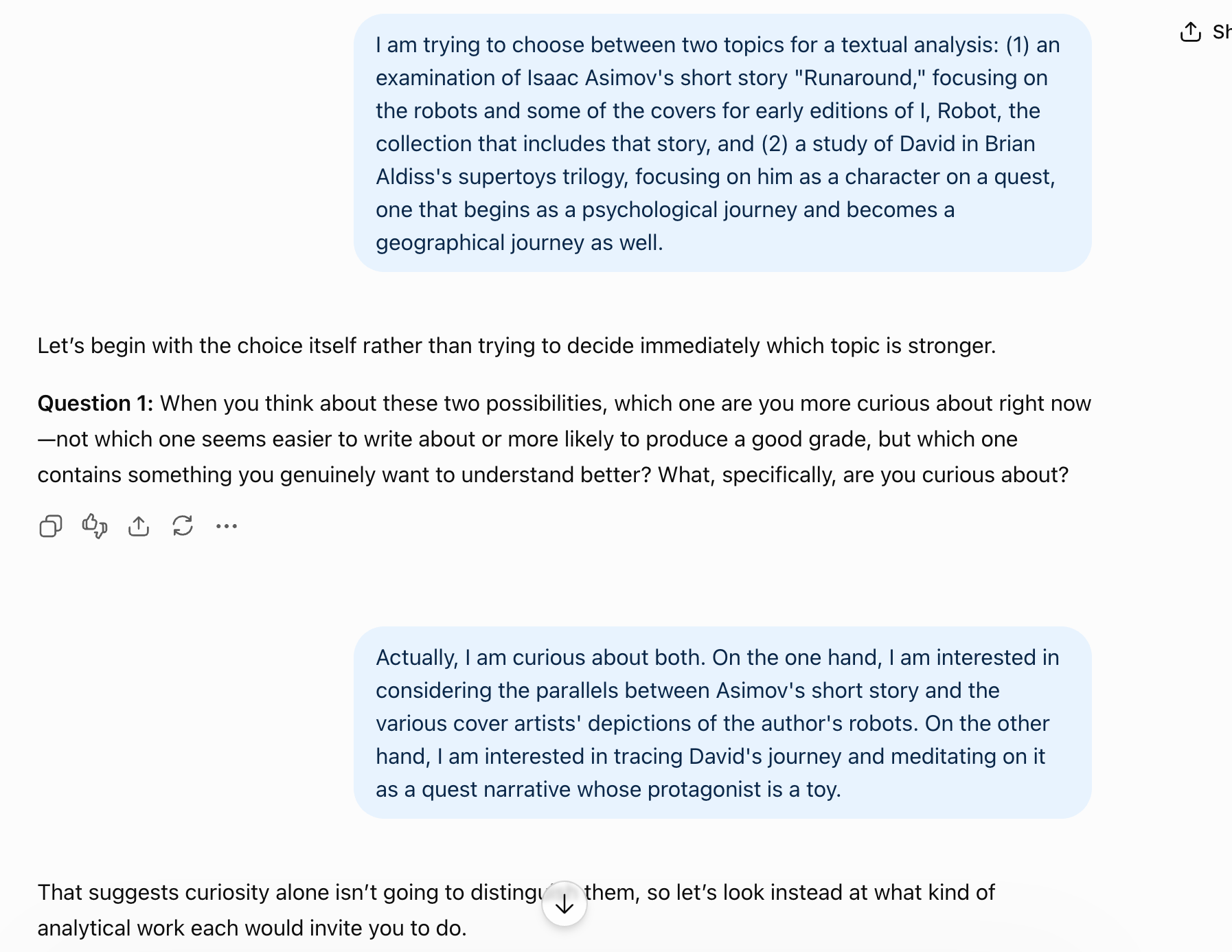
Just as I turned to ChatGPT as a model for your own possible literacy-narrative brainstorming with AI, I prompted ChatGPT to ask me a series of questions to help me choose a topic for a textual analysis. The images below are screenshots of that conversation.
Review the screenshot above and note how many specifics I offer about the two topics I’m considering and how I ask the AI agent to ask me a series of questions. Developing your initial question and requesting multiple questions in response will lead to a more productive exchange of ideas.
In response to my answer to the first question, the AI agent asks me a question I would ask you: “When you think about these two possibilities, which one are you more curious about right now . . . ?” If you’re still trying to decide between two or more topics, ask yourself that same question.
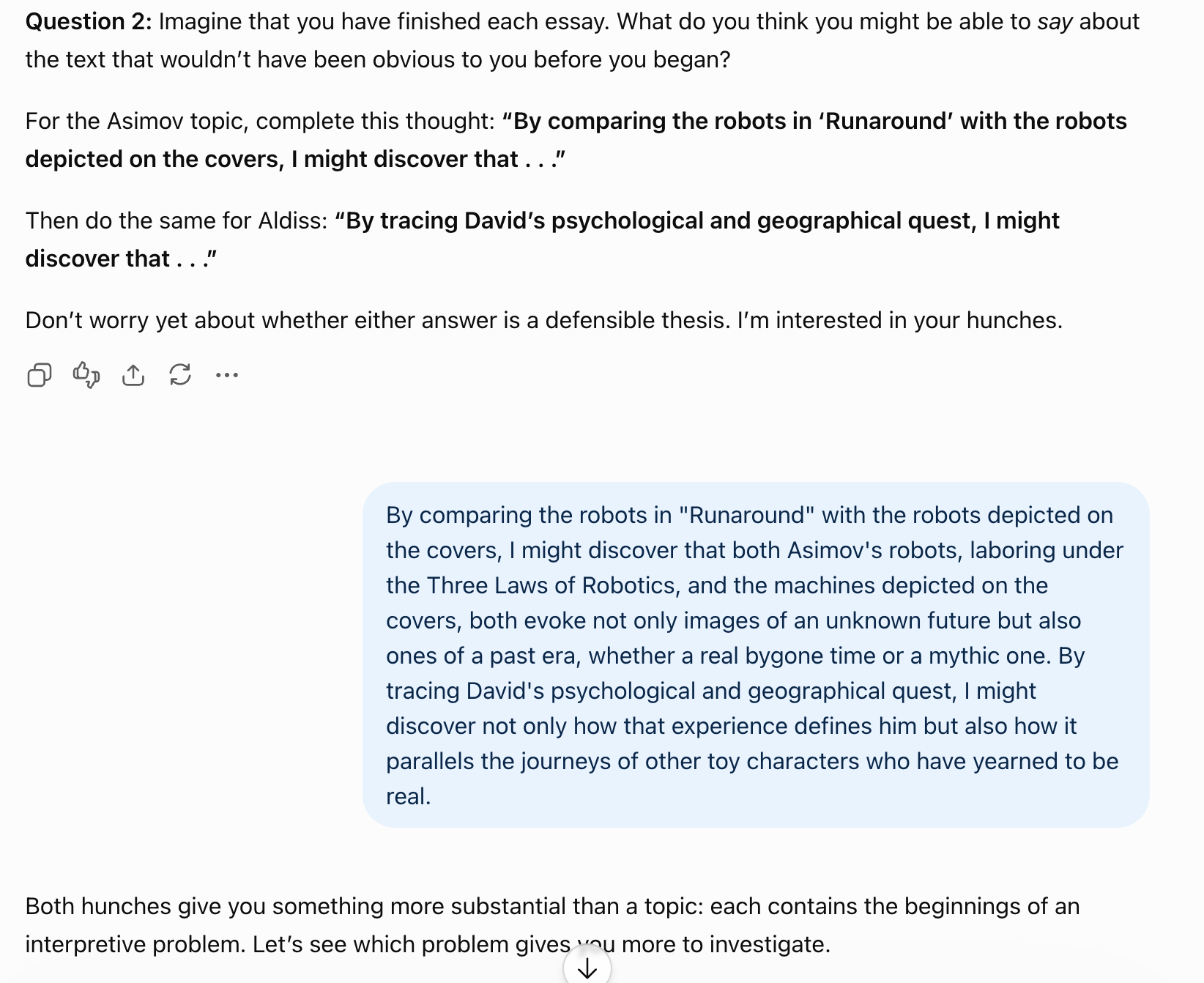
Note that the AI agent shifts from the question of curiosity to the kind of analytical work each topic involves. In the second question (pictured below), the AI agent asks me to imagine that I’ve already written each essay and what the writing might have led me to discover.
Notice how my reply to question two (pictured above) provides me with paths for my writing. Also note that the AI agent tells me, “Don’t worry yet about whether either answer is a defensible thesis.” Those words echo ones in your assignment: “Think of your preliminary draft as your down draft; your aim in the early stage of the process is to get your ideas down on the page. You may need the process of drafting to discover what you think the text means and how it conveys its meaning.”
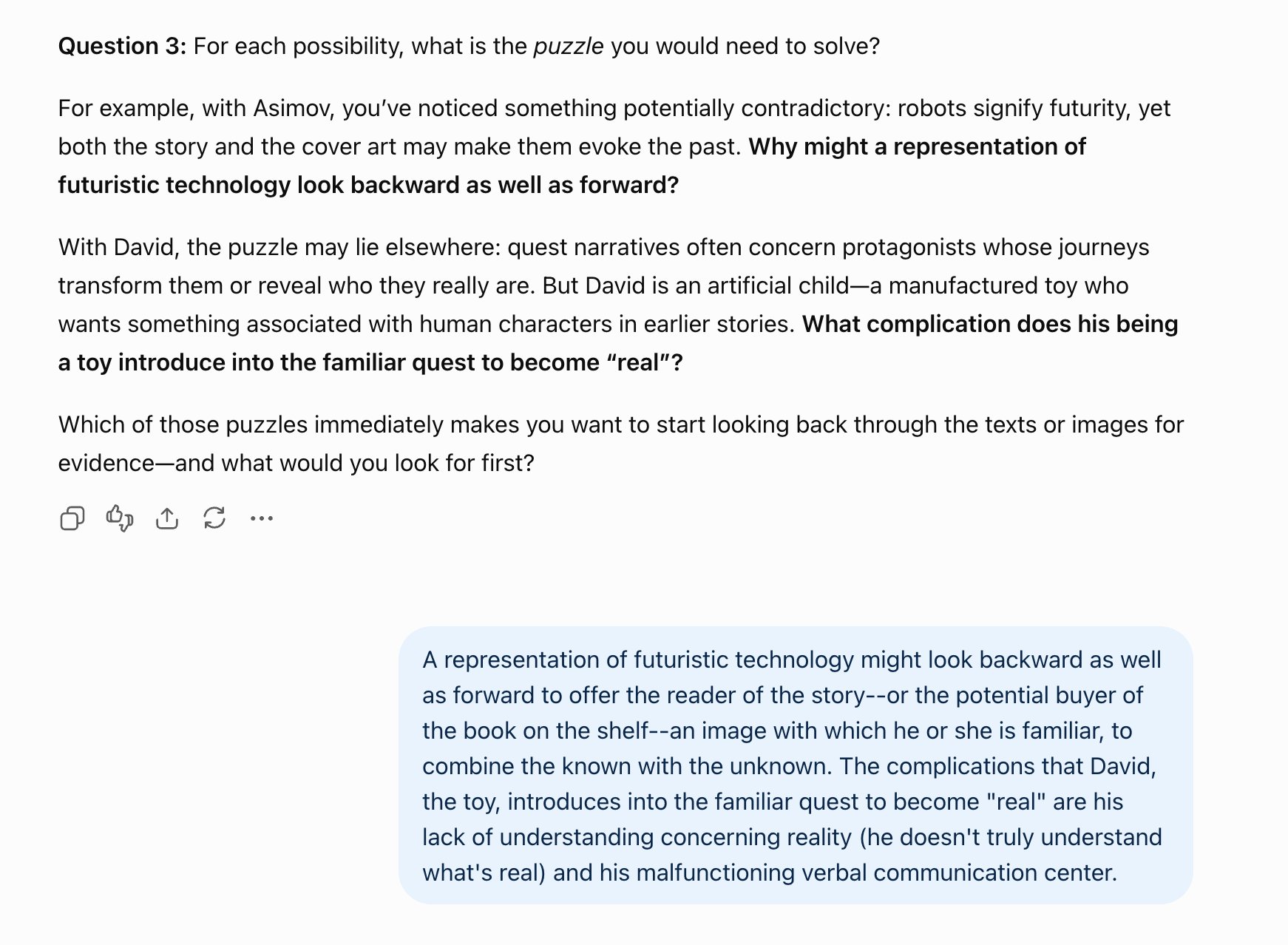
The AI agent’s third question (pictured above) and its examples lead me to additional points to consider by asking what puzzles I would need to solve.
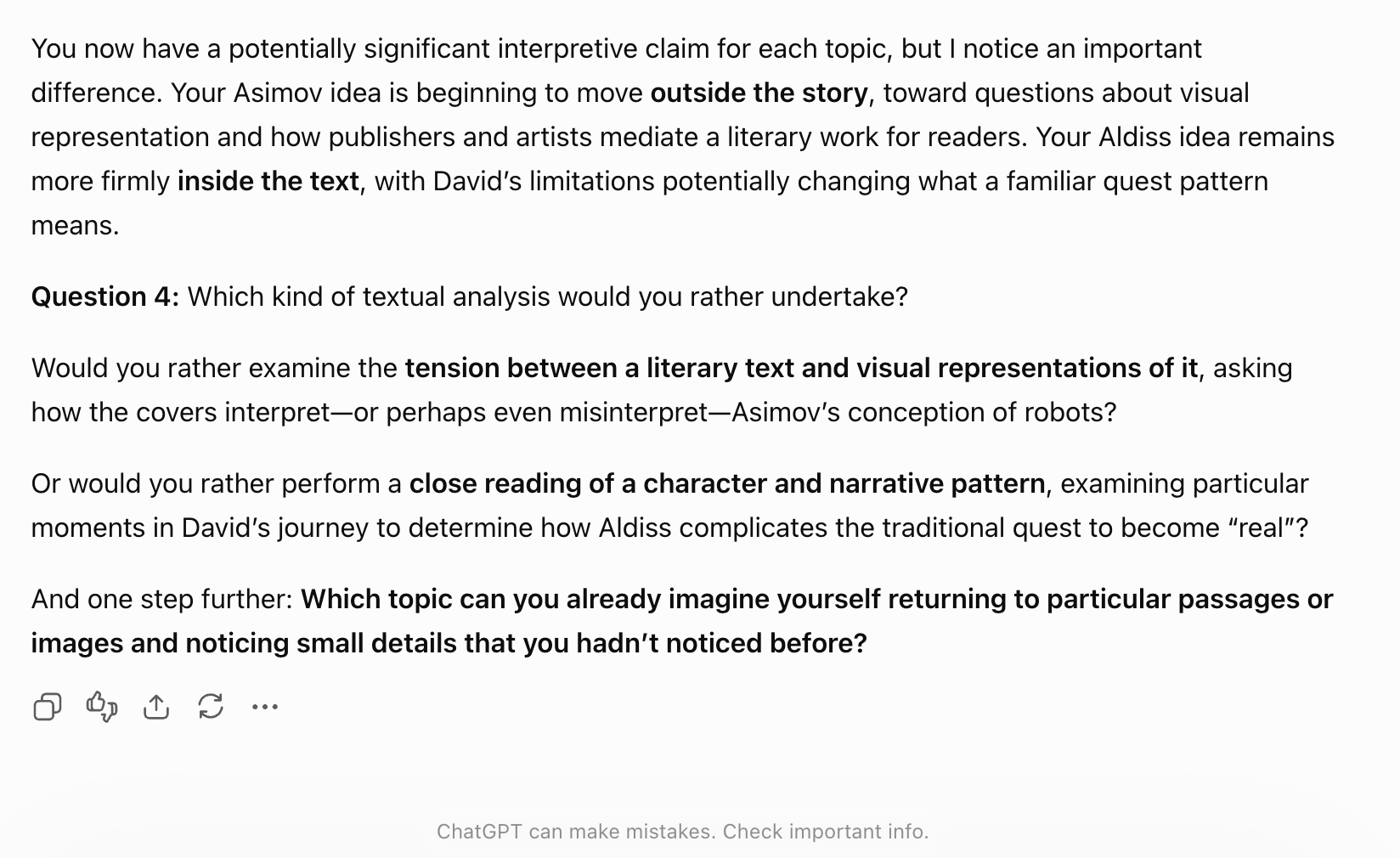
ChatGPT’s fourth question (pictured above) and the commentary that precedes it address the two distinctive types of analysis the projects would require. Would I rather “move outside the story” of “Runaround” or remain “more firmly inside the text” of the supertoys trilogy? The answer isn’t clear to me yet. It will emerge as I continue to put pen to paper and see where it leads.
Though I could have continued the conversation after question four, I was ready to turn away from AI and from the screen. As you continue your own draft, remember that using generative AI to write your analysis and presenting an AI agent’s words as your own violates High Point University’s Honor Code and is grounds for an F. However, using AI ethically, as I do in the model above, can be a useful step.
Congratulations to Brenna Murphy and Avery Broadbent, winners of yesterday’s drawings for Supertoys Last All Summer Long and Other Stories of Future Time.
Gerald Ward’s LinkedIn Post
Bonus Assignment Opportunity
Students who correctly respond to question below will earn a bonus assignment credit.
Uncovering the I, Robot Cover Blunder
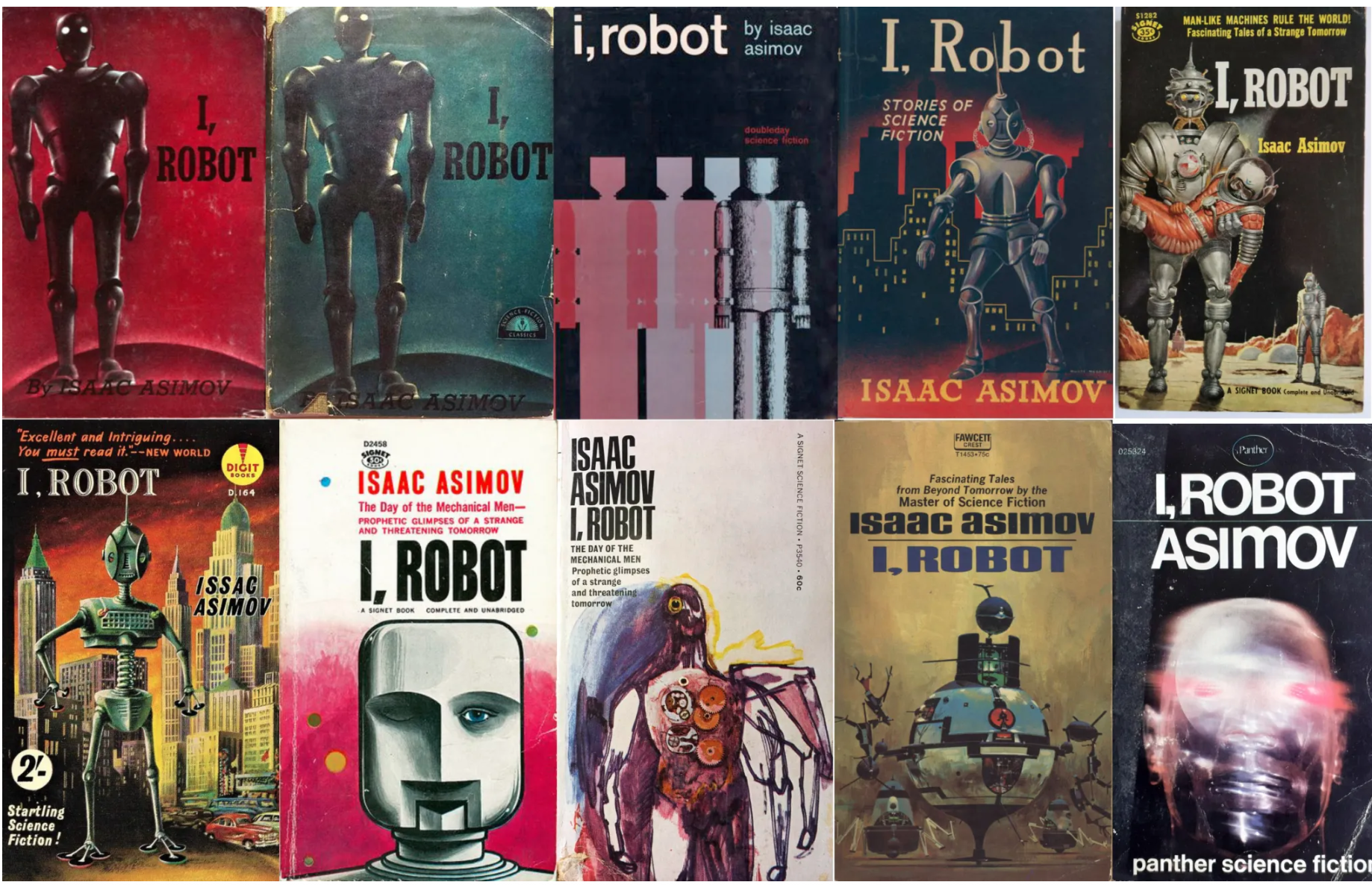
One of the eight early covers featured in the September 22 post includes a typo. Which one would have benefited from additional proofreading?
Directions for Finding and Submitting Your Answer
Examine the I, Robot covers in the September 22 post, and identify the one with a typo.
Compose a response of one or more complete sentences that identifies the edition of I, Robot by publisher and year (see the photo caption) and briefly explains the error.
Post your comment as a reply to this blog post by 7:30 a.m. on Monday, September 28.
To post your comment, click the title, “ENG 1103: Using AI Ethically . . . ,” then scroll down to the bottom of the post. There you will see the image of an airmail envelope with a rectangular box for your comment. Type your comment in the box and hit return. Voila! You have submitted your answer. I will make the comments visible before class on Monday, September 28.
Next Up
Wordplay Day! To prepare for class, revisit the Merriam-Webster Scrabble Word Finder page, and review your journal notes and the blog posts devoted to Scrabble tips.
This morning in class, you will begin drafting your analysis, which will focus on Isaac Asimov’s “Runaround,” one or more of Brian Aldiss‘s supertoys stories, or “Runaround” and one or more of the early covers for Asimov’s I, Robot. Assignment details are included below and on the handout you will receive in class. An additional copy of the assignment is posted on Blackboard.
Overview
A textual analysis aims to demonstrate how a text works, how it achieves its effects. The process of writing your analysis will include these steps:
Summarizing the text precisely so the reader can envision it. An analysis is not a summary, but your introductory paragraph will include one that will serve as a lead-in to your thesis or main claim: what you think the text achieves or what it means and how it conveys its meaning.
Paying close attention to details, what they imply, and how they relate to each other and the whole
Explaining what the text means or what it achieves and the significance of that.
Prompts
Compose an analysis in response to one of the prompts below.
Isaac Asimov’s “Runaround” recounts the events of the second Mercury expedition conducted by U.S. Robots and Mechanical Men, and Brian Aldiss’s supertoys stories chronicle the evolution of the Synth company, from Synthank, to Synthmania, to Worldsynth-Claws. Explore the trajectory of the technological advances in Asimov’s story or Aldiss’s trilogy.
Both “Runaround” and the supertoys stories portray robots in service to humans. Examine Asimov’s or Aldiss’s notion of robot service and how that vision of servitude shapes the character of one of the robots and the humans it serves. You may address more than one robot, but your analysis should focus on only one.
Probe Asimov’s Three Laws of Robotics and consider how one robot’s adherence to or violation of one or more of the laws reflects on the laws, the robots, and/or the humans whom the robots serve.
Brian Aldiss’s supertoys stories not only mark the change of seasons—referenced in the titles—they also depict changes in the environment. Explore those changes and their links to technological advancements.
Examine the interactions between one of the humans and one of the robots in “Runaround,” or between one of the humans and one of the robots in the supertoys stories. What do the human’s interactions reveal about his or her perceptions of artificial intelligence? You may address more than one human and one robot, but your analysis should focus on the relationship between one human and one robot.
Study the cover art for one or more early editions of I, Robot and consider the relevance of that cover or those covers to one or more aspects of “Runaround.”
In “Supertoys Last All Summer Long,” David questions whether he is real. That line of inquiry continues in the second and third supertoys stories where he short-circuits the illusions of his virtual home and tries to make sense of the ravaged reality that remains. Explore David’s desire to be real and his search for meaning in the world.
Directions for Planning and Drafting
Review the texts that you have read for class, and determine which one interests you most as a subject of analysis. You are not permitted to read any of the texts on screen during your drafting period today.
Identify the details in the text that are thought-provoking or revealing.
Develop your analysis through a close examination of those details.
Write in dark ink, preferably black.
Double-space to allow for room for my annotations. You are welcome to use both sides of the page.
Before you leave class today, staple your handout to the top of your draft and submit it to me. Next Wednesday, I will return your draft with notes, and you will have the class period to begin revising and editing on your laptop or tablet.
Think of your preliminary draft as your down draft; your aim in the early stage of the process is to get your ideas down on the page. You may need the process of drafting to discover what you think the text means and how it conveys its meaning.
Elements for Textual Analysis
Language and Stylistic Devices: Literary devices (metaphors, irony, symbolism), diction (word choice), and syntax (sentence structure).
Content and Themes: Recurring ideas, patterns, or points of contrast.
Structure: Organization, including scene structure, and how it adheres to or breaks from convention.
Characterization: Character development, motivation, and their role in the story.
Guidelines for Revising
Your revised analysis should include the following elements:
A title that offers a window into your analysis
An introduction that presents a summary of the text
A thesis statement, or main claim, that presents your take on the text based on your close study of it
Textual evidence that supports your claims
A minimum of two relevant quotations from the text, introduced with signal phrases and followed by parenthetical citations
A conclusion that revisits the thesis without restating it verbatim
A work cited entry
A minimum of 600 wordss
Directions for Formatting and Posting Your Revision
Save your revised essay as a Microsoft Word file or PDF and submit it to Blackboard in compliance with MLA manuscript guidelines.
Publish your revision as a blog post. In your post, omit the first-page information included in your file submitted to Blackboard (your name, course, section, professor’s name, and date). Add to your blog post an image that documents some part of your writing process away from the screen, such as a photo of your reading notes or a page of your draft. Also, add to your blog post an embedded link to a relevant website.
The complete guidelines for your assignment, along with the grade criteria, are also posted on Blackboard.
Next Wednesday, September 30, I will return your handwritten drafts (with my notes), and you will have the class period to begin revising on your laptops. Because the first week of October is Fall Break, you have two additional weeks to revise before you submit your analysis to Blackboard and publish it on WordPress. The due date for your revised analysis is Wednesday, October, 14 (before class). The deadline is Friday, October 16 (before class).
Writing about I, Robot Cover Art
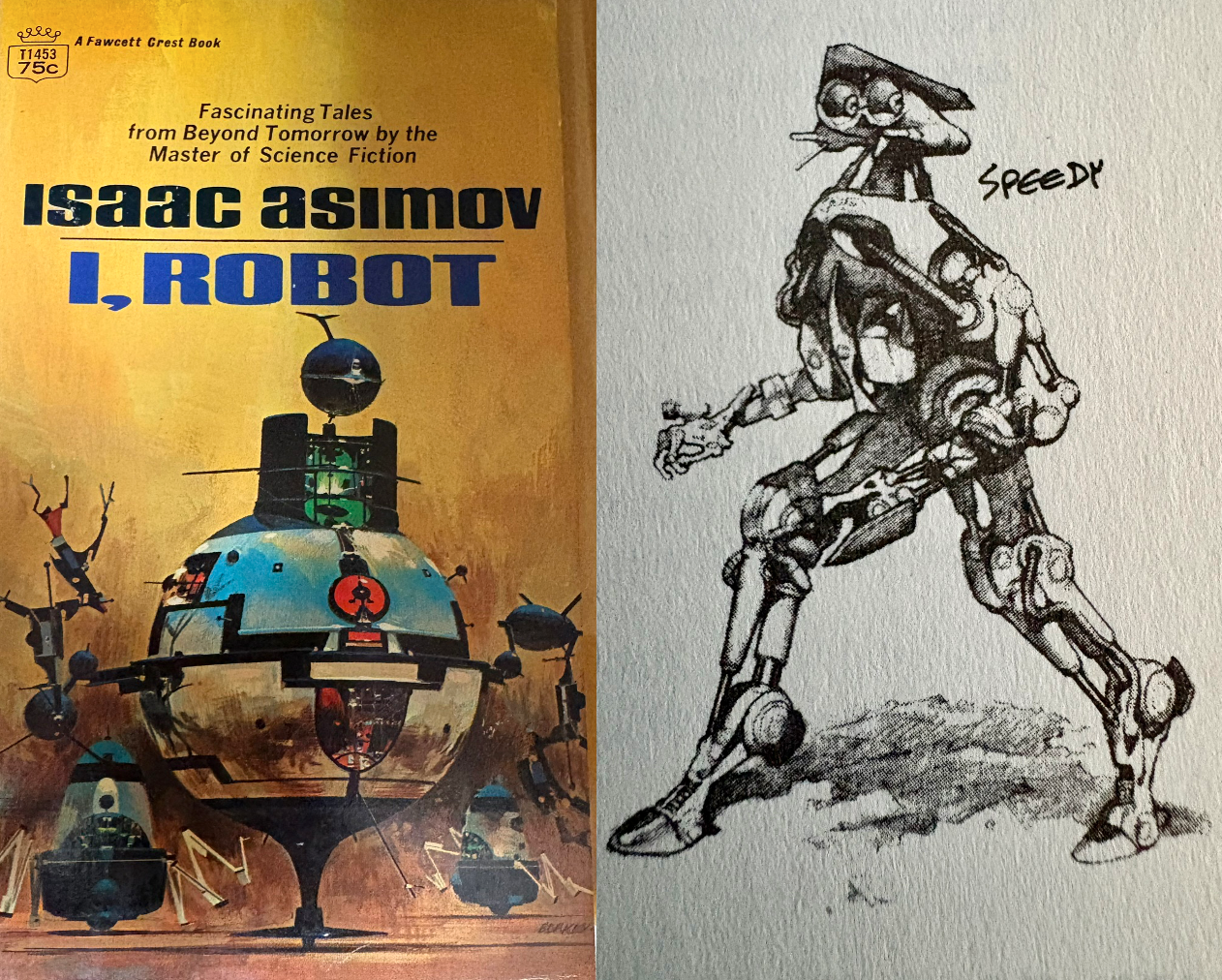
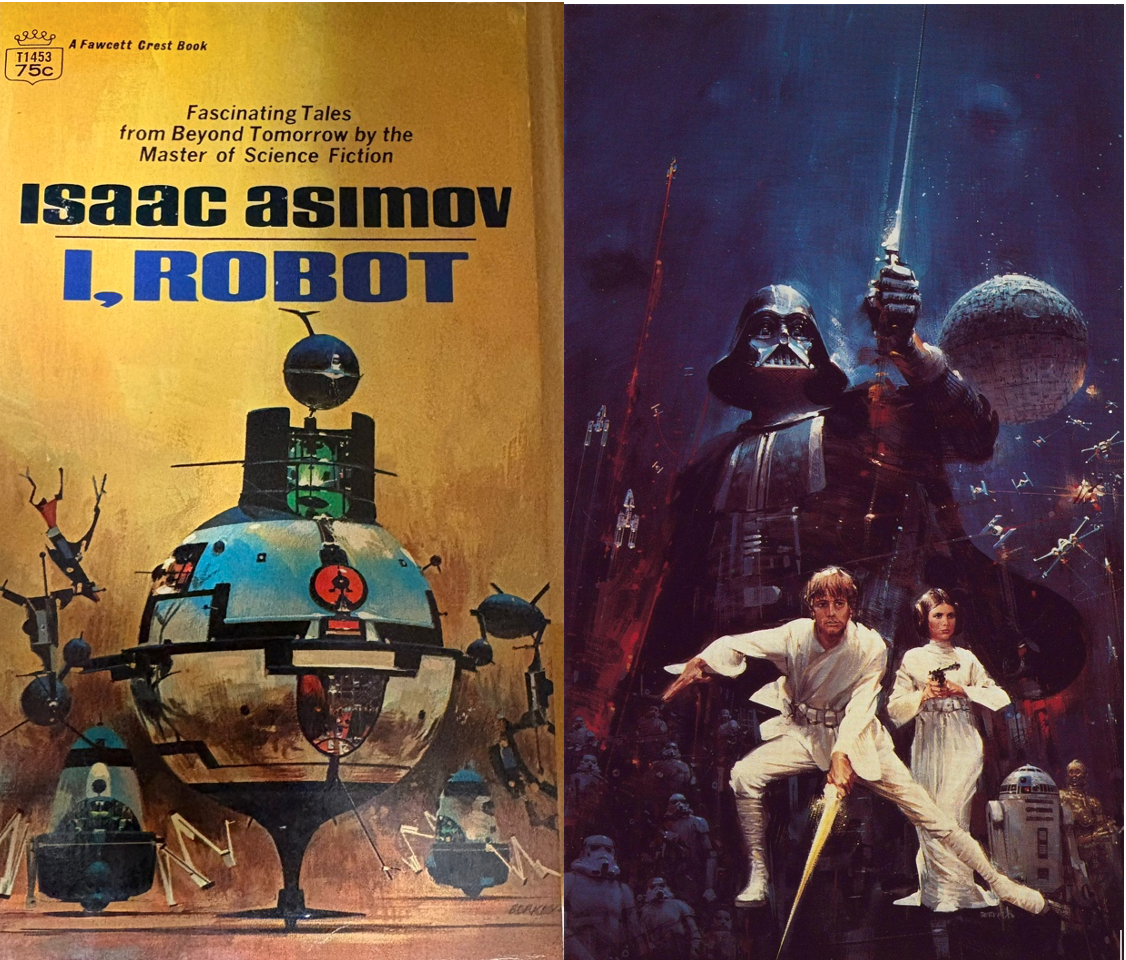
If focusing on a visual text in your analysis appeals to you, but the I, Robot covers you viewed don’t spark any ideas, that probably isn’t the prompt you should choose. As the side-by-side pictures below demonstrate, the robots in artist John Berkey’s cover for I, Robot (on the left) bear no resemblance to Mark Zug’s Speedy.
(L-R) John Berkey’s cover for the 1970 Fawcett Crest paperback edition of I, Robot and Mark Zug’s illustration of Speedy in I, Robot: The Illustrated Screenplay (1994).
Although Berkey’s painting and the other early covers of I, Robot may not initially lead you to any ideas for your analysis, thinking about “Runaround” as you plan your draft may reveal a connection between the story and one or more of the covers.
Be open to discovering unexpected parallels as you write, and alter your focus if your interest changes.
In your September 16 writing about the book covers in the Asimov Collection at Smith Library, some of you observed that the robots in Berkey’s cover resembled droids in Star Wars. Notably, Berkey’s painting pictured below served as a concept poster for the first film in the franchise.
(L-R) John Berkey’s cover for the 1970 Fawcett Crest paperback edition of I, Robot and his concept poster for Star Wars Episode IV: A New Hope (1977)
Next Up
Wordplay Day! To prepare for class, revisit the Merriam-Webster Scrabble Word Finder page, and review your journal notes and the blog posts devoted to Scrabble tips. Also, look back at the Scrabble debriefing notes on moving from observation to analysis. Those notes are included in the September 21 blog post.
Early editions of I, Robot (top row, l-r): 1950 1st edition hardcover by Gnome Press; 1950 dust jacket of 1st edition hardcover by Grosset & Dunlap; 1950 1st book club edition by Doubleday; 1952 1st UK edition by Grayson & Grayson; 1956 Signet cover; (bottom row, l-r): 1958 Digit Books; 1961 Signet 3rd printing; 1968 Signet 6th printing; 1970 Fawcett Crest; 1968 Panther Science Fiction.
Tomorrow in class, you will begin drafting your analysis, which will focus on Isaac Asimov‘s short story “Runaround, one or more of Brian Aldiss‘s supertoys stories, or “Runaround” in conjunction with one or more of the covers of I, Robot pictured above.
In the early stages of your work, pay attention to the details that interest you. Don’t concern yourself with developing a thesis before you begin writing. The preliminary writing itself is a step that will lead to your thesis and the textual evidence that will support that claim.
One of the details you and your classmates addressed in your writing on Monday may figure in your analysis. Review those prompts and your responses, included below. Could any of them serve as a building block for your analysis?
Below are the prompts from Monday’s class exercise, along with your responses. The groups’ statements appear in bold, followed by my notes.
Although “Supertoys When Winter Comes” and “Supertoys in Other Seasons” are sequels to “Supertoys Last All Summer Long,” Aldiss’s first supertoys story was published as a stand-alone work of fiction in Harper’s Bazaar magazine in December 1969. (The second and third stories were first published in 2001, in the collection Supertoys Last All Summer Long and Other Stories of Future Time, as never-before-seen sequels to the original.) If you chose to analyze “Supertoys Last All Summer Long” as a stand-alone story, what detail would you be certain to include?
Near the end of “Supertoys Last All Summer Long” by Brian Aldiss, the image of “artificial sunlight [. . .] growing long and golden across the lawn” (10) shows evidence of more than just the child robots not being real. It also points to a trend: Everyday things taken for granted may not be real in the future. Note: If you choose to focus on Aldiss’s “Supertoys Last All Summer Long” as a stand-alone story, you might explore how that image of the virtual sunlight and other illusions contrast with the depiction of the real world of the story. How have technological advancements impacted the environment and the people in it?
Towards the middle of “Supertoys Last All Summer Long,” Monica asks, “‘Why can’t we communicate?” to which Teddy responds, “‘Because David’s upstairs'” (6). That exchange captures how the relationship between Monica and David is being processed through Teddy. Note: The group’s statement does not convey why Teddy’s role as a go-between is significant. If you choose to focus solely on Aldiss’s first story, you might consider the nature of communication between Monica and the supertoys or between the two supertoys themselves.
Where and how is one or more of Asimov’s Three Laws of Robotics evident in the actions of David, Teddy, or Jules, the serving-man, or where and how do the actions of one of those characters defy one of the laws?
Near the end of “Supertoys When Winter Comes,” David, in a fit of despair, “had struck the house’s control centre” (21). That led to the house disappearing, which causes a dangerous situation for Monica to be in, breaking the first of the Three Laws of Robotics. Note: David’s violation of the first law causes more than the disappearance of the virtual facade of the Swinton’s apartment, the illusion of a Georgian Mansion. Striking the house’s control centre demolishes the Swintons’ actual apartment, apparently leaving Monica Swinton, Jules, the serving-man, and Teddy in the rubble. If you address one or more of the Three Laws of Robotics in your analysis, the first mention should be followed by a quotation or paraphrase of that law with a parenthetical citation for Isaac’s Asimov’s story: (Asimov 51).
In “Runaround,” one of The Three Laws of Robotics states, “One, a robot may not injure a human being, or through inaction, allow a human being to come to harm” (Asimov 51). David breaks that law in “Supertoys When Winter Comes” when he goes rogue, and it leads to his Mom’s passing: “David struck the house’s control centre, wrenching it from the wall in a fury of pain and despair. Everything stopped playing”(21). That allows the readers to see that nothing is left except David. Note: The group states what David’s actions allow the readers to see, but their statement doesn’t convey the implications of that action. What does his violation of the first law indicate about the laws, the robots, and/or the humans they serve?
Henry Swinton’s words about obesity and malnutrition in “Supertoys Last All Summer Long” are repeated by him, almost verbatim, in “Supertoys When Winter Comes” and the Crosswell Tape and weight gain are also mentioned in “Supertoys in Other Seasons.” How are those issues linked to technology in Aldiss’s fictional world?
In Brian Aldiss’s “Supertoys Last All Summer Long,” Henry Swinton states, “Obesity’s our problem, not malnutrition” (3). That observation indicates how becoming reliant on technology leads to unique problems that are not typically faced in the modern day. Note: The group’s statement indicates a contrast between the advances in technology in Aldiss’s fictional world and real-world advancement. In both classes, however, we considered the similarities between Synthank’s Crosswell Tape–the company’s leading product–and the synthetic peptides of GLP-1 drugs.
Throughout Aldiss’s story “Supertoys When Winter Comes,” he connects the conflicts of obesity and malnourishment with technology by mentioning the “safe parasitic worm [that] enables anyone to eat up to one hundred per cent more food and still keep his or her figure” (18). Aldiss continuously references Crosswell Technology to emphasize how technology plays a role in the pursuit of unrealistic beauty standards and issues in population and malnutrition within all three stories. Note: The group’s statement essentially rephrases the prompt rather than moving from observation to analysis. The group introduces the idea of body image, but doesn’t convey how that preoccupation with appearance is linked to Henry Swinton’s Synth company or how the conflicting issues of obesity and malnutrition correlate with technological advancement.
In “Supertoys When Winter Comes,” Monica Swinton tells David he’s “only a little android” (20). Where in the story do her words or actions seem to contradict that assertion?
In “Supertoys When Winter Comes,” Monica Swinton faces terror when her android friend dies. She says, “Oh God! It’s Jules. Poor Jules! He was a friend to me” (20). That contradicts her feelings about David because Jules is an android, but Monica valued him as more than that. Note: The group does mention that Jules is the Swintons’ serving-man, an important detail because his function in the household is different from the supertoys.’ Jules’s role is to serve, but Monica thinks of him as a friend. What does that reveal about her ambivalence regarding AI?
Near the beginning of “Supertoys When Winter Comes,” Monica, says to David and Teddy, “Come in now, children. Go upstairs and play”(14), demonstrating her connection to the boy and bear, the other “little android” (20), as she mourns the loss of her human child. Note: In your analysis, if you choose to address the inconsistencies in Monica Swinton’s exchanges with the androids, you might consider how her desire for a human child in the first story and the death of that child, revealed in the second story, may affect her words and actions.
“Supertoys in Other Seasons” begins in Throwaway Town, which the narrator calls “the land of the obsolete” (24). Who besides the mechanicals becomes obsolete, and who or what leads to his demise?
In “Supertoys in Other Seasons,” there is a parallel between the mechanicals being trashed in “the land of the obsolete” and how Henry’s life values have become obsolete as well. As Henry became increasingly greedy, his work decreased. Henry gets pushed out of the company and is made obsolete by the robot he created. Henry not only loses his company, he loses his wife and his son too. Henry’s life becoming obsolete leads Henry to remember that family is the most important thing and that David is family. That is further demonstrated when Henry asks, “David? Are you David Swinton?” (31). His words show Henry still claims ownership of David and shows that while everything else was lost, David never left. Note: The group refers to Sam Savvy as a robot, but there is no indication that he/it is mobile. Sam Savvy, the Supersoftputer Mk. V. that essentially runs Worldsynth-Claws, may be a form of AI more akin to the agents of Copilot, ChatGPT, and Claude. Also, the group writes that David “never left,” but he does leave the crumbled remains of the Swinton’s apartment for Throwaway Town. Later, Henry finds him.
In “Supertoys in Other Seasons,”Henry says, “My ambition got the better of me . . . my life is a complete cock-up” (33), showing how Henry becomes obsolete and how he leads himself to his demise. Note: The group does not mention that when Henry Swinton is forced into retirement by Worldsynth-Claws, it is Sam Savvy, the Supersoftputer Mk. V.–a product of Henry Swinton’s own company–that dismisses him. It is not only the decisions Henry makes but also his unwelcome proposals (decisions he isn’t permitted to make) that lead to his downfall.
In your brainstorming exercise last Wednesday, all of your groups developed analysis prompts that featured humans’ relationships with robots and the impact of artificial intelligence. Whatever you choose as the focus of your analysis, those two ideas are ones that you will be able to address in your conclusion. There, in your final paragraphs, you can express what your observations about the story (or stories) reveal about humans’ relationships with robots and the impact of A.I.
If your analysis focuses on “Runaround” and I, Robot cover art, you are also welcome to incorporate a study of one or both of the I, Robot covers pictured in the September 14 blog post: the 2020 Del Rey cover designed by Charles Brock and the 2004 Bantam cover designed by Jamie S. Warren Youll.
Seeing Letters and Words Anew
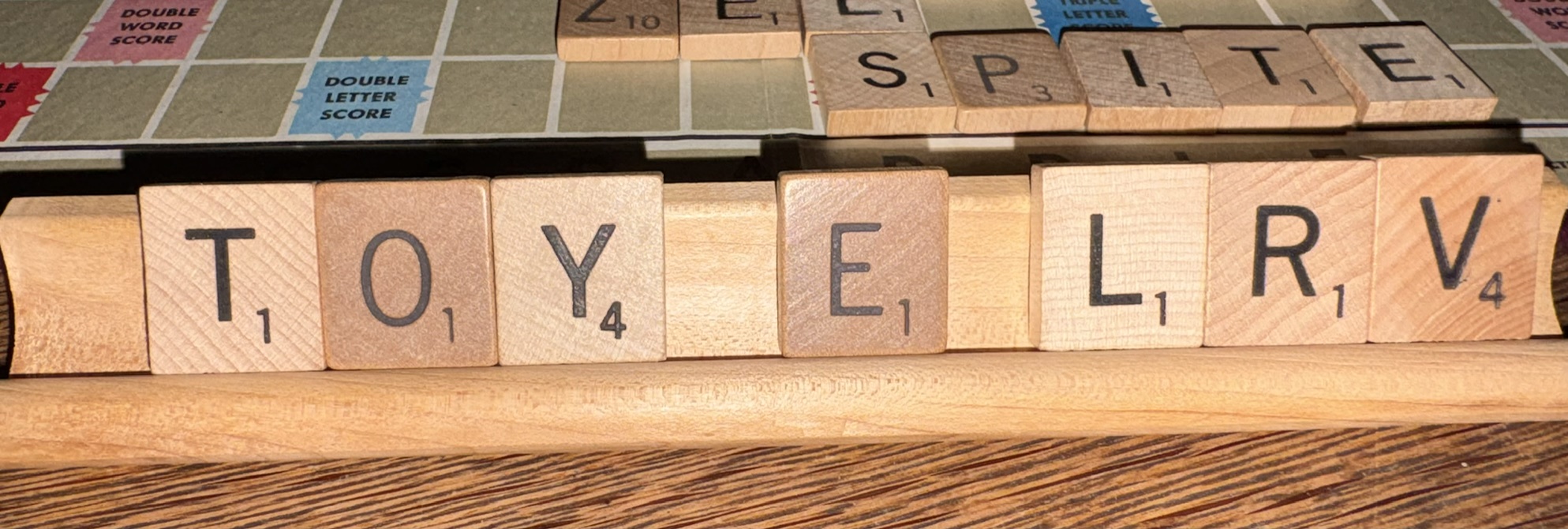
Seeing anew–which means seeing in a different, fresh, or modified way–is an important practice when you are studying your options for Scrabble play or analysis. When you play Scrabble, don’t hold some of the tiles in your hand. Keep all seven on the rack so your teammate can see them. And rearrange them as you consider options. Leaving the letters in one order may lead you and your teammate unable to see other possibilities (such as evil, which the second team missed in the September 4 game).
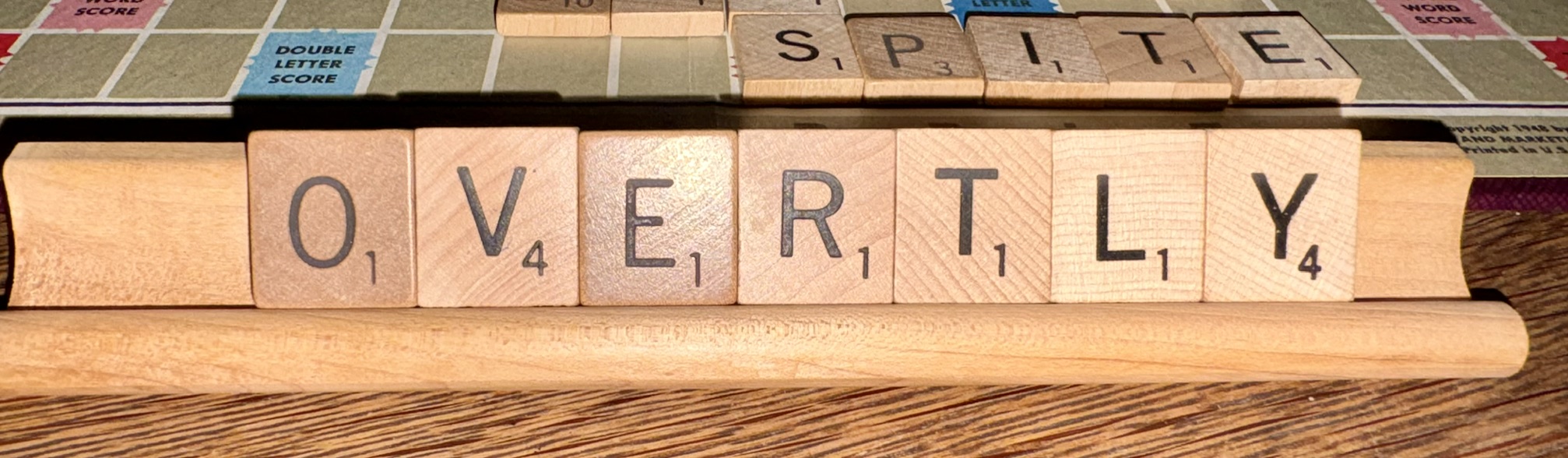
On the rack above, I have spelled a word, toy, as many players will when they first recognize a word among the seven letters. But leaving a word on the rack may prevent you from seeing other possibilities: lover, over,rove, toyer, very, vet, and one that’s far more valuable. What is it? See the end of this post for the answer.
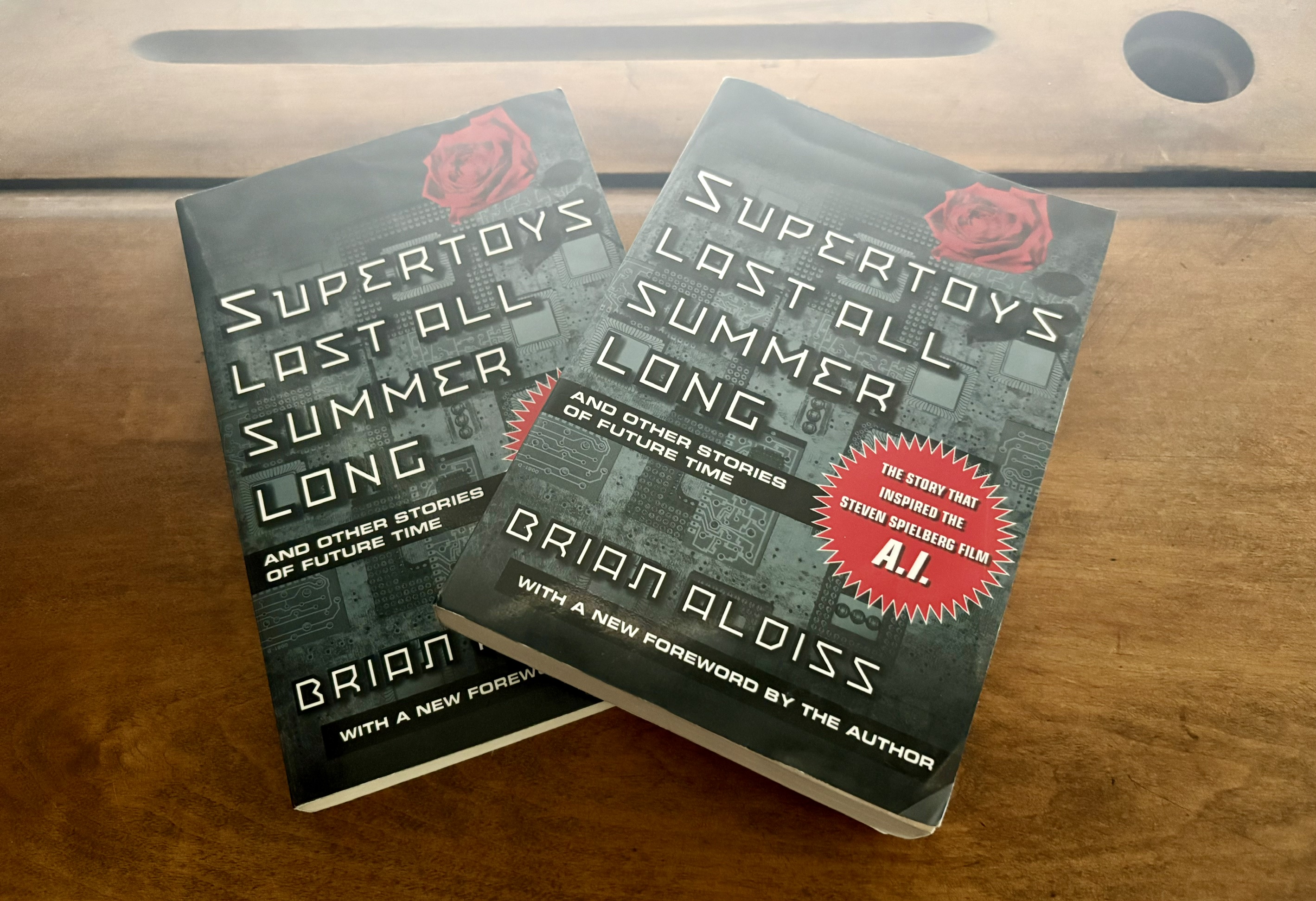
In tomorrow’s class drawing, you will have the chance to win one of the copies of Brian Aldiss’s short story collection pictured above.
Next Up
On Wednesday, we will briefly examine some additional details in Asimov’s and Aldiss’s stories. Afterward, you will begin drafting your analyses longhand. Next Wednesday, September 30, I will return your drafts, and you will have the remainder of the class period to begin revising on your laptops. Because the following week is Fall Break, you will have two additional weeks to continue revising before posting to Blackboard and WordPress. The due date for your analysis is Wednesday, October 14, before class; the hard deadline is Friday, October 16, before class.
Answer
Repeatedly rearranging the letters on your rack can lead you to discover new potential plays. Looking beyond toy and finding overtly could mean a play of more than fifty points if you were able to play all seven letters at once.
Just as rearranging the letters on your rack enables you to see them anew, rereading the story that’s the subject of your analysis and posing questions–for instance, What else might that detail indicate?–allows you to see the words and phrases anew and can lead you to more material for your analysis, details that had previously escaped your notice.
Yesterday in class, after you wrote your individual observations about the paperbacks from the Asimov Collection, you developed talking points for our discussions of “Runaround” and “Supertoys Last All Summer Long.”
Today’s blog post includes the talking points you generated, along with pictures of your observation work.
If you would like to revisit the cover art that you examined yesterday, remember that all the paperbacks are included in the images in yesterday’s blog post. Because there is a glare on the cover of I, Robot: The Illustrated Screenplay, that book figures prominently in the photo above. Notice that my copy has a slightly different cover from the one in the Asimov Collection. My edition has the same cover art by Mark Zug, but the image is framed by a black border with words of the Three Laws of Robotics in gray.
Foreground (L-R): Claire Jahnke, Ryder Pitek, Hayden Porter; Background (L-R): Michael McNamara, Kel Wadley, Brenna Murphy, Bridgette Murphy, Gavin Godfrey-Ryan, Madison Haugk, Nicole Halucka, Grace Duffy, Oliver Henderson
Talking Points
“A common theme of forced space exploration. Why do authors use this topic?”
“All very technologically centered, and show humans’ relationships with technology.”
“We discussed that the covers all convey a sense of danger.”
“The covers all also represent exploration, adventures, and discovering the unknown.”
“The covers convey a negative effect on humanity through artwork.”
(L-R): Ryder Pitek, Seb Olander, Kai Jarvis, Claire Jahnke, Michael McNamara, Brenna Murphy
“These books relate to the excerpts [sic] by showing the long-lasting detrimental affect [sic] technology has on humans.”
“One talking point is why do you think these authors/illustrators depict a sense of eerie loneliness when taling [sic] about the future?”
“How technology affects how society (high and lower class people) interact/ daily life/ and beliefs.”
“How sci-fi books influence technological development and our view of technology today.”
(L-R): Baylee Shattenberg, Madi Stone, Kel Wadley, Bridgette Murphy, and Oliver Henderson
“Very future orientated with robots and space.”
“The one group of books focused more on aging and time rather than space and technology.”
“The covers from the books we looked at today connect with ‘Runaround’ and ‘Supertoys Last All Summer Long’ by projecting and predicting visions of space and the possible future.”
“The covers of the books also connect to the short stories by visualizing adventure & possible danger.”
“How do humans view their relationships with technology in these novels?”
(Background to Foreground): Lance Morgan, Cole Wilhelmsen, Layla Rothberg
“Why do authors depict AI taking over society?”
“Most covers displayed a very optimistic view of the future through technology that allowed them to accomplish feats, even in space.”
“Some covers conveyed that the relationship between AI and humans was not good and might have caused conflict.”
“Supertoys Last All Summer Long”
Because our class time yesterday focused on the science fiction book covers in the Asimov Collection, we didn’t discuss Brian Aldiss’s short story. We will, however, examine it on Monday, along with his other two Supertoys stories: “Supertoys When Winter Comes” and “Supertoys in Other Seasons.”
As you prepare for Monday’s discussion of “Supertoys Last All Summer Long,” consider these questions:
Unlike Isaac Asimov’s method of presentation in “Runaround,” which maintains the focus on Mike Donovan and Gregory Powell, Aldiss employs cross-cutting: the technique of shifting back and forth between two locations: the Swintons’ apartment and the banquet hall where Henry Swinton, Managing Director of Synthank, delivers his speech. Why might Aldiss have chosen that technique? What does it achieve?
Near the end of the story, Aldiss reveals that Teddy is not the only robot in the Swinton household. What words reveal that fact?
What details foreshadow the story’s revelation?
Next Up
Wordplay Day! To prepare for class, revisit the Merriam-Webster Scrabble Word Finder page, and review your journal notes and the blog posts with Scrabble tips.
Coming Soon
For Monday’s class, you will read and annotate Brian Aldiss’s short stories “Supertoys When Winter Comes” and “Supertoys in Other Seasons,” which I distributed in class yesterday. If you were absent or misplaced your copies, print ones from Blackboard.