Today in class, you will begin planning and drafting your first essay assignment, a literacy narrative, which is an account of a learning experience involving reading, writing, or learning to speak a language.
Begin by asking yourself some of these questions: How have you come to think about yourself as a reader or writer? What were some of your most formative experiences as a reader or writer? What are some of the do’s and don’ts you have learned about writing? How has what you have learned about reading or writing enhanced your confidence and skill in that role? You don’t need to respond to all of those questions. Try picking one or two as a starting point, then begin bringing one of those experiences to life.
Your aim is to recreate your experience on the page and then to reflect on its significance. Your focus may be any one of the following:
a memory of a reading or writing assignment that you recall vividly
someone who helped you learn to read or write
a writing-related school event that you found humorous or embarrassing
a particular type of writing that you found (or still find) especially difficult or challenging
a memento that represents an important moment in your development as a reader or writer
learning to speak a second langauage
Detailed instructions are included in the assignment handout that you will receive in class today. An additional copy of the handout is posted on Blackboard in the essay assignments folder.
Notes on Last Friday’s Quiz
Rather than posting the answers to the quiz, I am asking you to review the class notes for January 9, 10, 13, and 17 to find the answers on your own. Doing so will enable you to retain more of the course content from the first two weeks of class.
Keep in mind that one of the reasons we write is to remember. Taking notes on all of the blog entries that I publish will both engage you in learning process and enable you to demonstrate your learning in the course.
Next Up
Wordplay Day! To prepare for class, review the Dictionary and World Builder pages on the Scrabble website. Also review tomorrow’s Scrabble post.
To honor Martin Luther King, Jr., today, I am asking you to you engage in a close study of his epistolary essay “Letter from Birmingham Jail.” Although I could ask you to listen to a recording of it, I ask that you to read it instead. King’s gift for oratory is well known, but for students of writing, closely examining his words on the page is a more pertinent exercise than listening to his voice.
What makes King’s letter an effective piece of writing? With that question in mind, consider these words: “Perhaps it is easy for those who have never felt the stinging darts of segregation to say, ‘Wait” (par. 11). Here King is addressing his initial audience, the eight white Birmingham-area clergymen who criticized his protest as “unwise and untimely” (par. 1). He suggests to those men that waiting to act isn’t difficult when you yourself aren’t the victim of injustice, when you haven’t, in King’s words, “felt the stinging darts of segregation” (par. 11). The sentence is notable not only for the contrast it illustrates between King’s reality and the lives of his readers but also for the words that King uses to show that contrast.
Consider King’s sentence and the paraphrase that follows:
Perhaps it is easy for those who have never felt the stinging darts of segregation to say, “Wait.”
Maybe it is simple for people who have not experienced segregation to say, “Wait.”
King’s sentence is stronger than the paraphrase that follows it because of the “stinging darts.” Writing that someone has not “experienced segregation” is abstract. Readers do not feel the general experience in the second sentence, but they feel King’s “stinging darts.” Sensory details strengthen sentences by appealing to readers’ senses, and figurative language invigorates writing by making the unfamiliar familiar. King’s white readers have not been the victims of segregation, but his choice of words makes them feel the sting.
While King’s “stinging darts” sentence—a relatively short one—is laudable, the long, winding sentence that follows is nothing short of staggering.
It starts with these words: “But when you have seen vicious mobs lynch your mothers and fathers at will and drown your sisters and brothers at whim.” King presents those atrocities in an introductory dependent clause, one whose full meaning depends on an independent clause that follows. But rather than immediately turning to an independent clause to complete the thought, King expands the sentence with this series of dependent clauses:
when you have seen hate filled policemen curse, kick and even kill your black brothers and sisters;
when you see the vast majority of your twenty million Negro brothers smothering in an airtight cage of poverty in the midst of an affluent society;
when you suddenly find your tongue twisted and your speech stammering as you seek to explain to your six-year-old daughter why she can’t go to the public amusement park that has just been advertised on television, and see tears welling up in her eyes when she is told that Funtown is closed to colored children, and see ominous clouds of inferiority beginning to form in her little mental sky, and see her beginning to distort her personality by developing an unconscious bitterness toward white people;
when you take a cross-county drive and find it necessary to sleep night after night in the uncomfortable corners of your automobile because no motel will accept you;
when you are humiliated day in and day out by nagging signs reading “white” and “colored”;
when your first name becomes “n—,” your middle name becomes “boy” (however old you are) and your last name becomes “John,” and your wife and mother are never given the respected title “Mrs.”;
when you are harried by day and haunted by night by the fact that you are a Negro, living constantly at tiptoe stance, never quite knowing what to expect next, and are plagued with inner fears and outer resentments;
when you are forever fighting a degenerating sense of “nobodiness”–(par. 11).
The independent clause that readers have been waiting for, the statement that completes the thought is this: “then you will understand why we find it difficult to wait” (par. 11). Those words could have immediately followed the first dependent clause, but instead King offers nine more dependent clauses, ten darts that sting his readers.
Ten dependent clauses connected by semicolons followed by a dash and an independent clause, a total of 316 words: That is not a structure I recommend for the sentences you write in English 1103, but it’s a valuable model, nevertheless.
I hope that you, as citizens, will continue to study the words of his letter. As your writing teacher, I hope that you will return to the sentence that I have examined in detail here. Along with showing his readers why his nonviolent protests could not wait, that sentence of King’s demonstrates how to develop a piece of writing through the accumulation of detail—not just the when, but the when and when and when . . . .
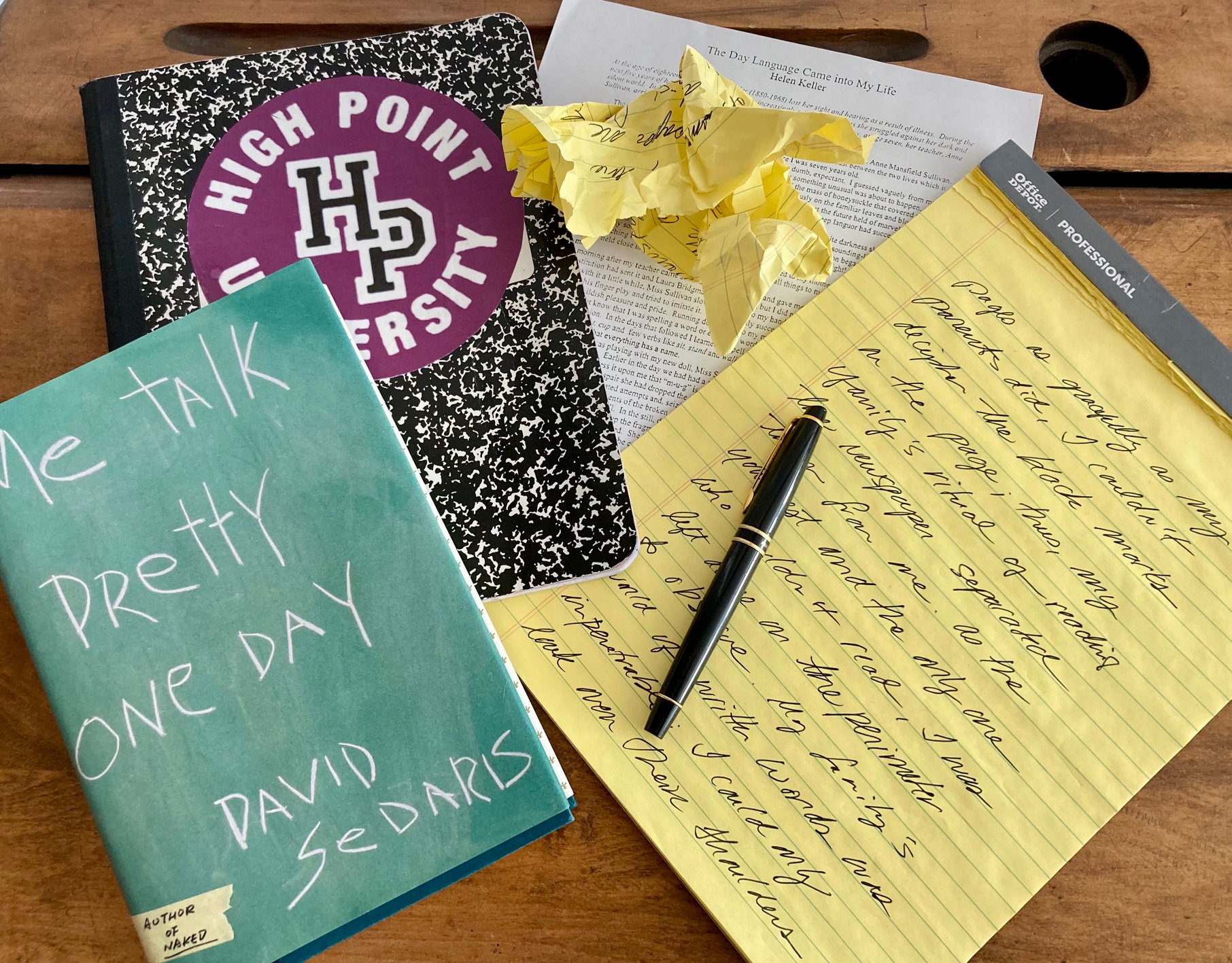
Yesterday morning in class, as models for your own literacy narrative, we examined David Sedaris‘s “Me Talk Pretty One Day” and “The Day Language Came into My Life,” Chapter Four of Helen Keller’s autobiography, The Story of My Life.
In groups of three, you and your classmates collaboratively addressed the following questions:
Which of Helen Keller’s paragraphs present scene, and which provide summary?
Where does Davis Sedaris first shift from summary to scene?
Where does Sedaris use figurative language?
Where does he employ hyperbole?
Bonus: Where does Keller include a biblical allusion?
Here are the answers to those questions:
The first, third, and ninth paragraphs of Helen Keller’s chapter provide summary. The majority of the chapter’s paragraphs–six of the nine, or two-thirds–present scene.
Sedaris’s first shifts from summary to scene when his French teacher says, “If you have not meimslsxp or lpgpdmurct by this time, then you should not be in this room” (167).
He employs similes when he writes “not unlike Pa Kettle trapped backstage at a fashion show” (167) and “like a translation of one of those Playmate of the Month data sheets” (168). Also, he includes a metaphor when he writes, “everybody into the language pool, sink or swim” (167).
Sedaris turns to hyperbole when he writes that one student had “front teeth the size of tombstones” (168). Due to our time constraints, I did not ask you to address figurative langauge in Keller’s chapter, but note that she uses it as well when she writes, “I was like that ship before my education began” (par. 3).
In the final paragraph of Keller’s chapter, she presents a biblical allusion with the words “like Aaron’s rod, with flowers” (par. 9). That line from the book of Numbers refers to the sprouting of flowers from the staff of Aaron. For Aaron and his brother, Moses, that flowering signified that their family was chosen to do the work of God. Similarly, for Keller, the blossoming of the world through language served as a revelation: the knowledge that words could give meaning to all that she could neither hear nor see.
For that exercise yesterday, I asked you to focus first on summary and scene because they are important methods of treating time in narratives. Simply put, scene shows the reader what is taking place, while summary tells the reader what has happened over time. Secondly, I asked you to examine details of language. Scene is to time what concrete details are to the senses. The specifics of figurative language–what the metaphors and similes show us–allow readers to experience a story as if they are looking over the narrator’s shoulder.
As you begin planning your own literacy narrative, look back at these notes and reread “Me Talk Pretty One Day” and “The Day that Language Came into My Life.” The acts of rereading model essays and analyzing their elements will strengthen your ability to craft your own literacy narrative.
Sedaris, David. “Me Talk Pretty One Day.” Me Talk Pretty One Day. Little Brown, 2000. pp. 166-73.
Next Up
Wordplay Day! To prepare for class, look to the Dictionary and World Builder pages on the Scrabble website, and review the posts devoted to Scrabble tips.
This morning in class, as models for your own literacy narratives, we will examine David Sedaris‘s “Me Talk Pretty One Day” and “The Day Language Came into My Life,” the first pages of Chapter Four of Helen Keller’s autobiography, The Story of My Life.
In groups of three or four, you and your classmates will collaboratively address the following questions:
Which of Helen Keller’s paragraphs present scene, and which provide summary?
Where does Davis Sedaris first shift from summary to scene?
Where does Sedaris use figurative language?
Where does he employ hyperbole?
Bonus: Where does Keller include a biblical allusion?
The first two questions focus on scene and summary because they are important methods of treating time in narratives. Simply put, scene shows the reader what is taking place, while summary tells the reader what has happened over time.
The last three questions focus on details of language. Scene is to time what concrete details are to the senses. Such details allow readers to experience the story as if they are looking over the narrator’s shoulder.
Together, Sedaris’s essay and Keller’s chapter excerpt demonstrate two vastly different ways to present a literacy narrative. “Me Talk Pretty One Day” offers a quirky look at the challenges of learning French from a sarcastic, soul-crushing instructor. Keller’s story poignantly recounts learning to make meaning through the sign language of her teacher, Annie Sullivan, learning that certain finger positions mean “water” for those who cannot hear it, and for others, like her, who can neither see nor hear it.
Next Up
Wordplay Day! To prepare for class, look to the Dictionary and World Builder pages on the Scrabble website, and review the posts devoted to Scrabble tips.
Today in class you will compose a final reflective essay that documents your work in the second half of the semester, focusing on what you consider some of your most significant work and the feature or features of the course that have benefited your development as a writer and a student. Since you have already written a reflective essay on your final essay and annotated bibliography, your final reflection should focus on other assignments and features, including two or three of the following:
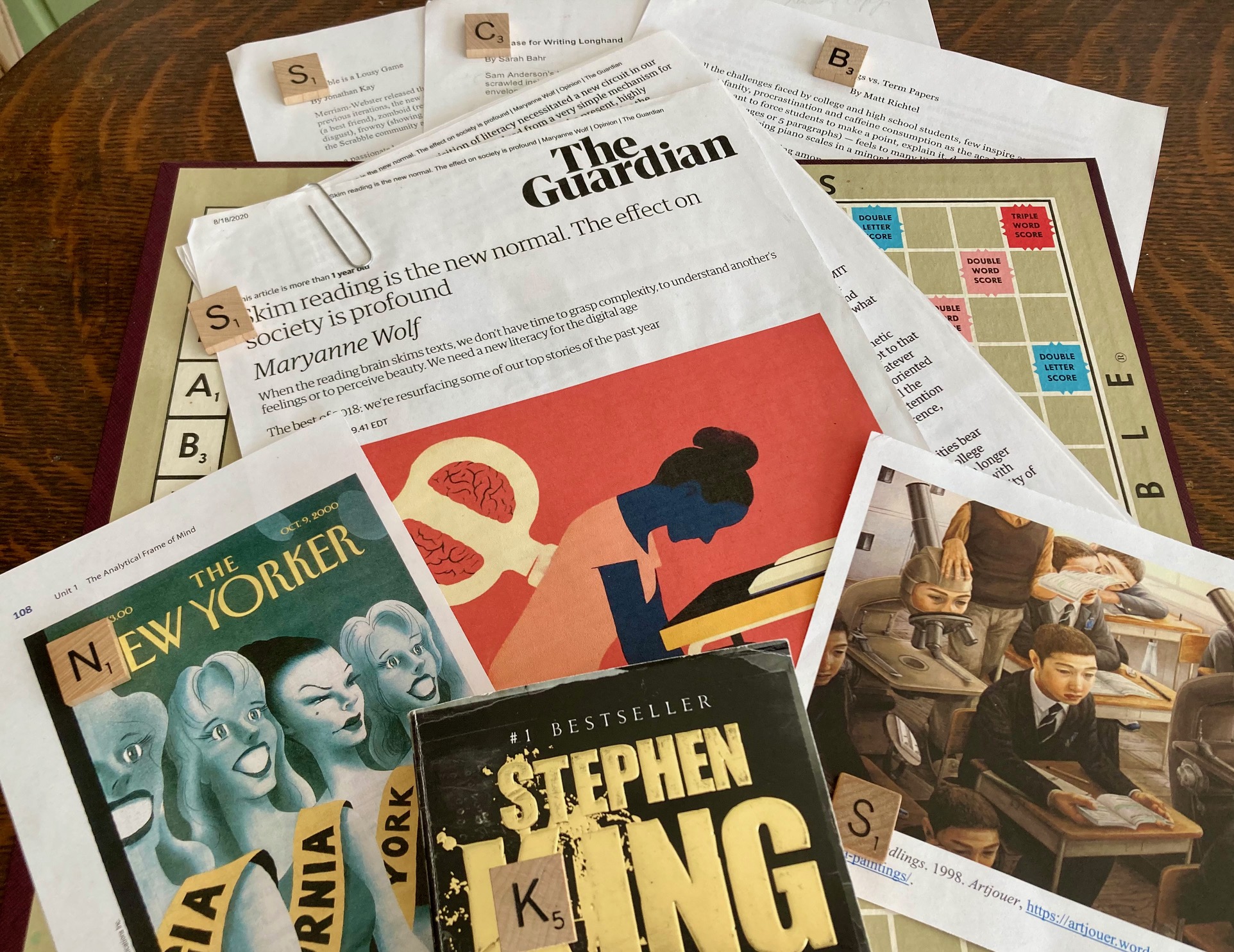
Studying one of the texts we have examined in the second half of the semester, including “The Case for Writing Longhand,” The Competition, “Scrabble is a Lousy Game,” Seedlings, “Skim Reading is the New Normal,” “Strawberry Spring,” or the sample final essay and annotated bibliography (“Scrabble as a Game Changer in the College Classroom”)
Writing for an online audience beyond the classroom/creating and maintaining a WordPress blog
Delivering your group presentation on one of the lessons in the Check, Please! Course
Collaborating with your classmates on in-class writing assignments
Playing Scrabble/Collaborating with your teammates on Wordplay Day
Writing longhand
Limiting screen time
Keeping a journal
Focus on one, two, or three assignments or features of the course.
Include in your reflective essay the following elements:
A title that offers a window into your reflection
An opening paragraph that introduces your focus and presents your thesis
Body paragraphs that offer concrete details from your work to support your thesis.
A relevant quotation from Writing Analytically or a relevant quotation from one of the texts that we have studied in the second half of the semester. Introduce your quotation with a signal phrase and follow it with a parenthetical citation. Refer to your citation handout for models.
A conclusion that revisits the thesis without restating it verbatim
Rosenwasser, David and Jill Stephen. “Arriving at an Interpretive Conclusion: Making Choices.” Writing Analytically, 9th edition. Wadsworth/Cengage, 2024. pp.111-12.
Rosenwasser, David and Jill Stephen. “Integrating Quotations into Your Paper.” Writing Analytically, 9th edition. Wadsworth/Cengage, 2024. pp. 343-46.
Rosenwasser, David and Jill Stephen. “The Idea of the Paragraph.” Writing Analytically, 9th edition. Wadsworth/Cengage, 2024. pp. 307-313.
Rosenwasser, David and Jill Stephen. “Two Methods for Conversing with Sources.” Writing Analytically, 9th edition. Wadsworth/Cengage, 2024. p. 325.
Rosenwasser, David and Jill Stephen. “Ways to use a Source as a Point of Departure.” Writing Analytically, 9th edition. Wadsworth/Cengage, 2024. p. 326.
Enjoy the holiday. When class resumes on Monday, December 2, we will examine the article that I distributed today and assigned for you to read. If you were absent, download a copy from Blackboard and print it. Also on Monday, you will receive your assignment for your exam-period presentation. Details TBA.
Falconer, Ian. “The Competition.” Writing Analytically by David Rosenwasser and Jill Stephen, 9th edition, Wadsorth/Cengage, 2024. p. 108.
Today in class, we will examine Ian Falconer’s New Yorker magazine cover The Competition, and you will compose a one-paragraph summary of the cover. Rather than following your summary with a paragraph of commentary on The Competition, we will examine two commentaries in our textbook:
In Writing Analytically, David Rosenwasser and Jill Stephen note that “[a]t its most serious, The New Yorker cover may speak to American history, in which New York has been the point of entry for generations of immigrants, the ‘dark’ (literally and figuratively) in the face of America’s blonde northern European legacy” (112).
Also, in Writing Analytically, David Rosenwasser and Jill Stephen observe that “we might find ourselves wishing to leaven this dark reading with comic overtones–that the magazine is . . . admitting, yes America, we do think that we’re cooler and more individual and less plastic than the rest of you, but we also know that we shouldn’t be so smug about it” (112).
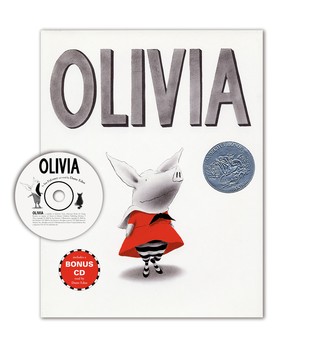
If the style of Ian Falconer’s New Yorker cover seems familiar to you, it may be because you encountered his work when you were a child. His book Olivia, published in 2000, received the 2001 Caldecott Medal, an award the Association for Library Service bestows upon the book they deem the best children’s picture book of the year. Falconer followed Olivia with several sequels, including Olivia Saves the Circus and Olivia Helps with Christmas.
After our dicsussion of The Competition, you will collaboratively compose a summary of another visual text, Tetsuya Ishida‘s Seedlings. Then, using the commentaries above as models, you will write a paragraph of commentary on the painting.
Rosenwasser, David and Jill Stephen. Chapter 3: “Interpretation: Asking So What?” Writing Analytically, 9th edition. Wadsworth/Cengage, 2019. pp. 81-118.
Next Up
At the beginning of class on Wednesday we will revisit Seedlings, and you will have the remainder of the period to devote to writing your reflection on your final essay and annotated bibliography.
This morning we will review a sample final essay and annotated bibliography, and you will have the remainder of the class period to conduct additional research and compose additional portions of your final essay or annotated bibliography. Tasks to undertake include these:
Using the HPU Libraries databases to locate additional sources.
If the subject of your final essay/annotated bibliography has a Wikipedia page, locating that page, scrolling down to the list of references, and identifying one that might serve as one of your sources.
Using Google Scholar to locate potential sources.
Composing an annotation for one of your sources.
Reviewing the sources you have gathered and noting what similarities and differences you can identify among them. Those similarities and differences may serve as material for your essay or your commentaries.
Next Up
Wordplay Day! To prepare for class, revisit the Dictionary and World Builder pages on the Scrabble website, and review the posts on my blog devoted to Scrabble tips.
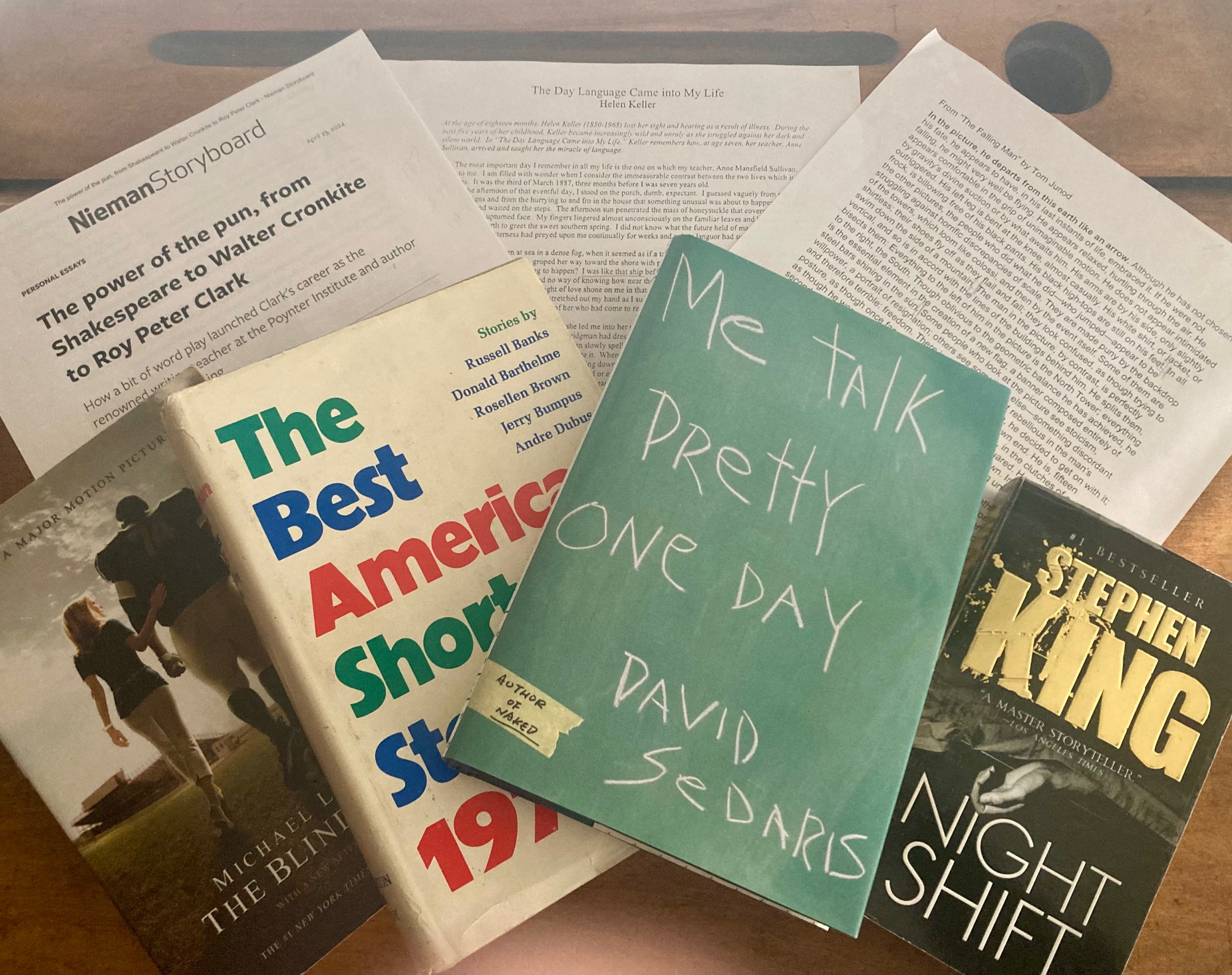
The best way to develop your skills as a writer is to write; the second best way is to study the prose of masterful writers. You will engage in those two practices simultaneously if you select one of the authors we’ve studied as the subject of your final essay and annotated bibliography. The majority of you have chosen instead to focus on one of the aspects of the course, namely playing Scrabble, writing longhand, or limiting screen time. To encourage you to take on a more intellectually rigorous exercise, I will award you 2.5 bonus points if you focus on the writing of one of our authors: Donald Barthleme, Roy Peter Clark, Tom Junod, Helen Keller, Stephen King, Michael Lewis, or David Sedaris. If you choose to write about one of those authors and consult with a Writing Center tutor, you will earn a total of 7.5 bonus points.
If, for example, you wrote about David Sedaris’s writing, your sources would consist of “Me Talk Pretty one Day,” a student interview about his writing, a secondary source–such as a study of his prose–and two additional essays by Sedaris. Only the first bibliographic entry for Sedaris would include his credentials. Including them in all three would be redundant. Below is a sample annotated bibliographic entry for a study of Sedaris’s writing, an anlaysis that’s available through the HPU Libraries’ databases.
In “The Ethics of Laughter: David Sedaris and the Humor Memoir,” Kylie Cardell and Victoria Kuttainen examine essays in three of Sedaris’s collections—Naked (1998), Dress Your Family in Corduroy and Denim (2008), and Squirrel Seeks Chipmunk: A Wicked Bestiary (2010)–as examples of real-life humor that veers from the truth, what Sedaris himself has described as “‘realish’” writing (qtd. in Cardell and Kuttainen, par. 1). Cardell and Kuttainen identify that gray area that Sedaris’s essays inhabit as “ethically hazardous territory” (par. 2).
Kylie Cardell is Senior Lecturer in English at Flinders University, South Australia, and author of Dear World: Contemporary Uses of the Diary, as well as editor (with Kate Douglas) of Telling Tales: Autobiographies of Childhood and Youth. Victoria Kuttainen is Senior Lecturer in English and Writing at James Cook University in North Queensland, Australia and the author of Unsettling Stories: Settler Postcolonialism and the Short Story Composite. Cardell’s and Kuttainen’s study of Sedaris’s writing offers insight into the role of artistic license in his essays, in particular how his humor blurs the line between fact and fiction and how that unclear division prompts questions regarding the ethics of embellishment—or otherwise altering the truth—in memoir.
Next Up
In class tomorrow, we will review a sample final essay and annotated bibliography, and you will have additional time to devote to researching and writing for your own final essay and annotated bibliography. Details and instructions TBA.
Tomorrow morning, before you begin your initial work on your final essay and annotated bibliography, we will revisit Stephen King‘s “Strawberry Spring” and discuss the answers to your collaborative exercise on the story.
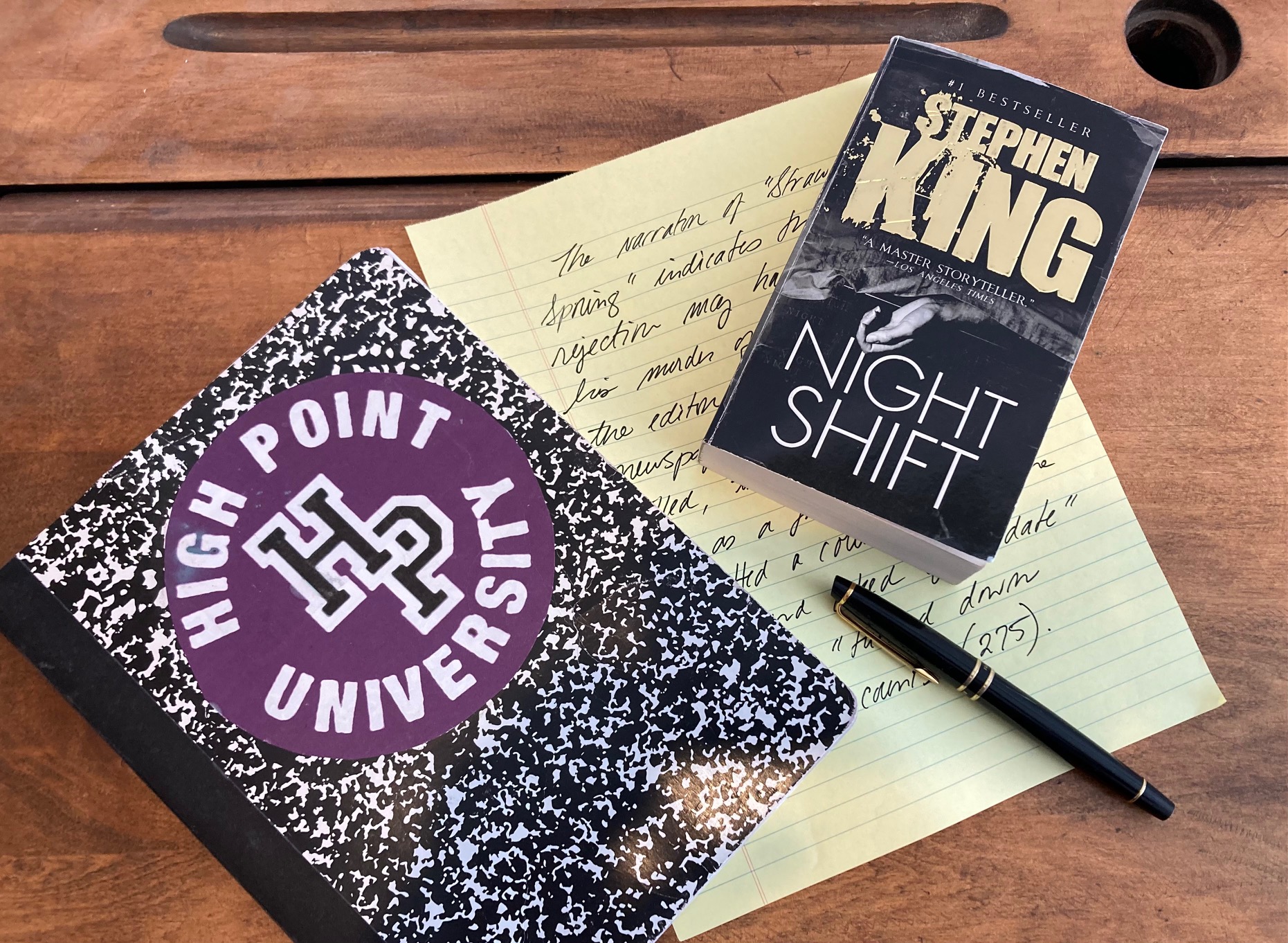
For that exercise, I asked you to determine whether you could identify any details that indicate why the narrator may have murdered any of his victims. Although there is no indication that the narrator knew Gale Cermann, Adelle Parkins, or Marsha Curran, he did know Ann Bray, which he reveals after he tells the readers that she was editor of the school newspaper: “In the hot, fierce bubblings of my freshman youth I had submitted a column idea to the paper and asked for a date–turned down on both counts” (275).
I also asked you to identify words and phrases that illustrate how the story is not only a horror story but also a commentary on war, the Vietnam War in particular, and the Vietnam era. Some of the words and phrases you may have identified include these:
(ice) sculpture of Lyndon Johnson . . . “cried melted tears” (269)
In addition to those questions on your assignment sheet, I asked you to try to identify the two literary allusions in King’s story. The first is an allusion to J.R.R. Tolkein‘s The Lord of the Rings trilogy: “You half expected to see Gollum or Frodo or Sam go hurrying past” (269). The second is an allusion to a poem by Carl Sandburg, titled–perhaps unsurprisingly–“The Fog” (272).
Next Up
In class tomorrow, you will complete an exercise as part of your initial work on your final essay and annotated bibliography. Details TBA.
Today in class we will read Stephen King‘s short story “Strawberry Spring,” which was published in Ubris magazine in 1968 and included in King’s first short story collection, Night Shift (1978).
For the collaborative exercise that you will complete after we read the story, I will ask you to determine whether you can identify any details that indicate why the narrator may have murdered any of his victims. Although there is no indication that the narrator knew Gale Cerman, Adelle Parkins, or Marsha Curran, he did know Ann Bray.
I will also ask you to identify words and phrases that illustrate how the story is not only a horror story but also a commentary on war, the Vietnam War in particular, and the Vietnam era.
Lastly, I will ask you to try to identify the two literary allusions in King’s story. We will address these questions near the end of class today or at the beginning of class on Wednesday, and I will post the answers on my blog.
Next Up
We will review “Strawberry Spring” at the beginning of Wednesday’s class, and you will have the remainder of the period to begin your initial work for your final essay and annotated bibliography.








 Jane Lucas