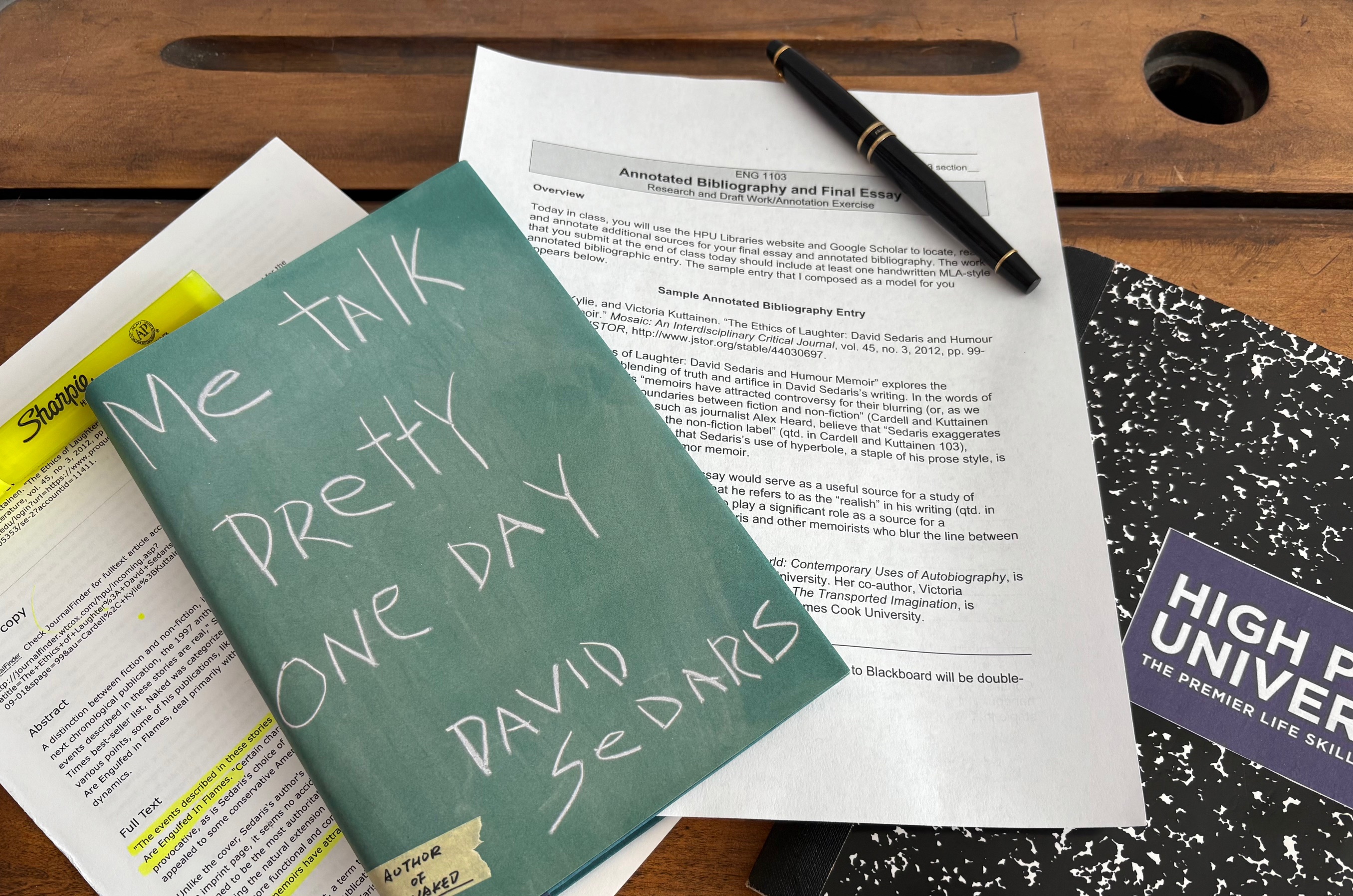
Today in class you will use the HPU Libraries website and Google Scholar to locate, read, and annotate additional sources for your final essay and annotated bibliography. The work that you submit at the end of class today should include at least one handwritten MLA-style annotated bibliographic entry. The sample entry that I composed as a model for you appears below.
Cardell, Kylie, and Victoria Kuttainen. “The Ethics of Laughter: David Sedaris and Humour Memoir.” Mosaic: An Interdisciplinary Critical Journal, vol. 45, no. 3, 2012, pp. 99-114. JSTOR, http://www.jstor.org/stable/44030697.
“The Ethics of Laughter: David Sedaris and Humour Memoir” explores the implications of the blending of truth and artifice in David Sedaris’s writing. In the words of the authors, Sedaris’s “memoirs have attracted controversy for their blurring (or, as we argue, contesting) of boundaries between fiction and non-fiction” (Cardell and Kuttainen 100). While some critics, such as journalist Alex Heard, believe that “Sedaris exaggerates too much for a writer using the non-fiction label” (qtd. in Cardell and Kuttainen 103), Cardell and Kuttainen assert that Sedaris’s use of hyperbole, a staple of his prose style, is ethical in the context of the humor memoir.
Cardell’s and Kuttainen’s essay would serve as a useful source for a study of Sedaris’s mingling of the real and what he refers to as the “realish” in his writing (qtd. in Cardell and Kuttainen 99). It could also play a significant role as a source for a comparative study of the writing of Sedaris and other memoirists who blur the line between fiction and nonfiction.
Kylie Cardell, Ph.D., author of Dear World: Contemporary Uses of Autobiography, is Associate Professor of Humanities at Flinders University. Her co-author, Victoria Kuttainen, Ph.D., author of Unsettling Stories and The Transported Imagination, is Associate Professor of Art and Creative Media at James Cook University.
Note that the blog format of the annotated bibliographic entry above is different from MLA format, which features paragraph indentations and double spacing.
The bibliographic entry above and the three paragraphs that follow total 241 words. The minimum word count for the entire assignment (essay and bibliography together) is 1,800 words.
If you compose five annotations of the length of the one above, you will be well on your way to completing your 1,800-word minimum, and your bibliography may be longer than your essay.
Next Up
Wordplay Day! To up your game and increase your word power, revisit the Dictionary and World Builder pages on the Scrabble website, and review the blog posts devoted to Scrabble tips.
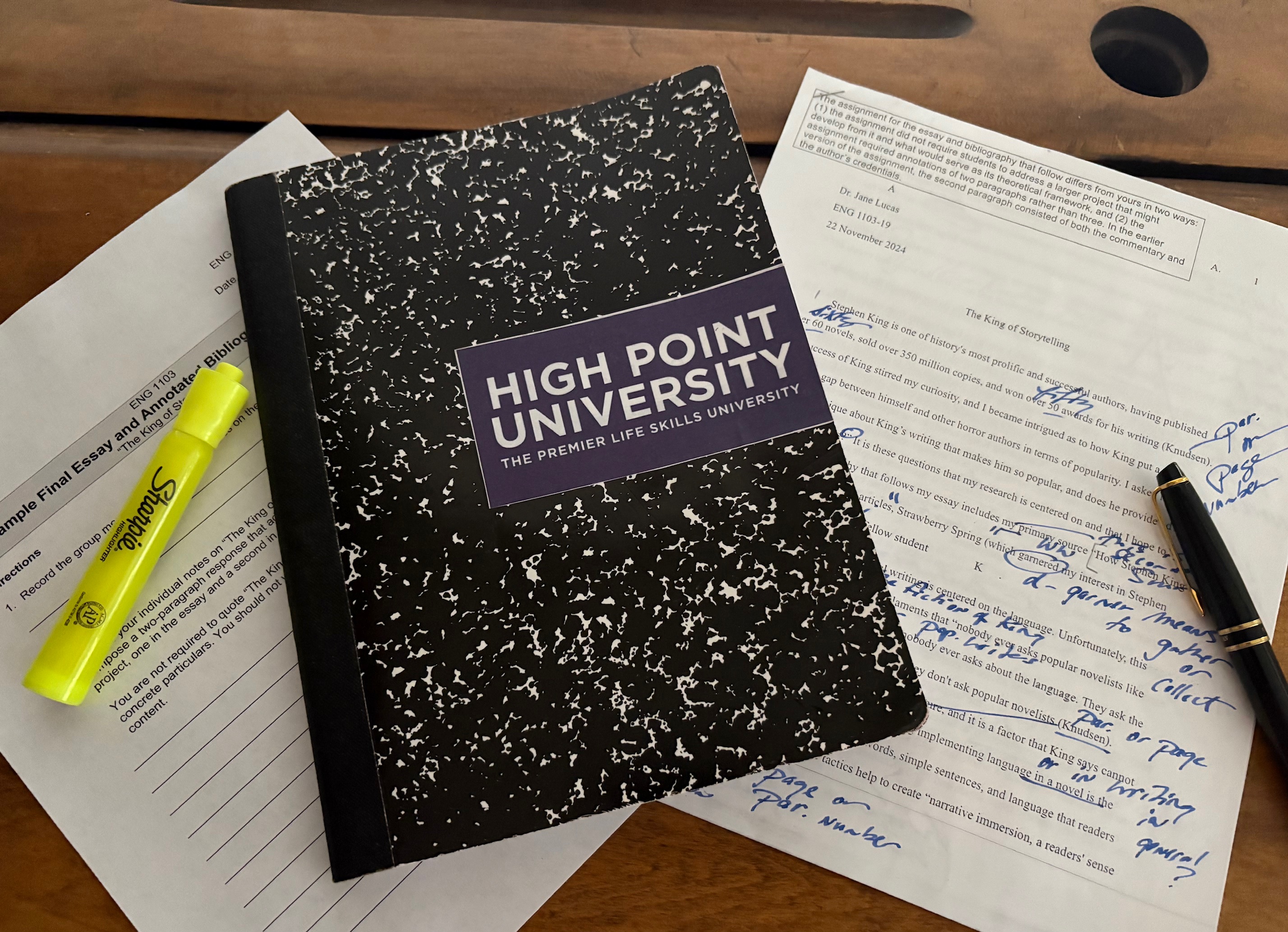
Yesterday’s class focused on a review of the sample student essay and annotated bibliography “The King of Storytelling,” an exercise that should continue to serve as a guide for you as you develop and revise your own essay and bibliography.
The notes that follow address points of content and form, some that we addressed in class, others that we didn’t. As you continue your own research and writing, revisit these notes.
Content
The essay’s introduction does fulfill its basic requirements: It addresses the writer’s purpose for compiling it, clarifies what drives the research and what interests the writer in the subject, and also states what questions the writer seeks to answer.
The body paragraphs of the essay do include a minimum of two quotations from two of the five sources; however, the student does not mention all of the sources in the body pargraphs. In the introduction, he lists the five sources, but two of them are simply referred to as “two other articles” (par 1).
The student misses the opportunity to draw on lines from “Strawberry Spring” as examples of the writing strategies that King recommends. In the third and fourth paragraphs, the student mentions King’s advice to avoid using adverbs that end in ly and to avoid passive voice but offers examples of neither.
Consider again the examples that I projected on the screen:
“‘He got another one,'” someone said to me, his face pallid with excitement” (273).
“He got another one,” someone said excitedly.
The first sentence, which is King’s, is more effective than the second one because the ly-ending adverb “excitedly,” which modifies the verb “said,” contributes virtually nothing to the story or to the reader’s experience of it. “Excitedly” is abstract; it isn’t something readers can see. They can, however, see a “face pallid with excitement” (273), an image that indicates that the speaker’s heightened state of emotion isn’t all together pleasant since “pallid” is a paleness associated with illness.
Springheel Jack . . . “I saw those two words in the paper this morning” (269).
Springheel Jack . . . Those two words in the paper this morning were seen.
Springheel Jack . . . Those two words in the paper this morning were seen by me.
The first sentence, which is King’s, is more effective than the second and third ones because it is written in active voice. Because the narrator is performing the action in the sentence, seeing the words in the paper, readers are looking over his shoulder, seeing the news story for themeslves. In the second sentence, no one performs the action. In the third, the narrator is present but is the recipient of the action. Both the second and the third sentences distance the reader from the narrator, making them passive observers of a passive narrator.
Including such examples would enable the student to enhance his essay in several ways: (1) he would demonstrate his understanding of active voice, passive voice, and ineffectual ly-ending adverbs, (2) he would illustrate how King draws on his own writing advice in his fiction, and (3) he would synthesize information from a secondary source (Marc Hye-Knudsen’s “How Stephen King Writes and Why”) with information from a primary one (Stephen King’s “Strawberry Spring”).
Such enhancements are always the products of revision. Only after rereading your sources and annotating them can you begin to see how they complement one another.
Form
The parenthetical citations include only the author’s last name, and in some cases only part of the last name. The only quotation that should not be followed by a parenthetical citation is the one from the student’s interview with his classmate.
The bibliographic information for two of the three scholarly sources is incomplete and the entries are marred by errors of mechanics and style.
Wherever the parenthetical citation (Knudsen) appears, the student should have replaced it with a (Hye-Knudsen 8) or (Hye-Knudsen, par. 12), depending on whether the source is paginated. Additionally, if the words are actually Stephen King’s, the student should attribute those words to him with a parenthetical citation for an indirect quotation: (King qtd. in Hye-Knudsen 8) or (King qtd. in Hye-Knudsen, par. 12).
Neither the bibliographic entry for Brown’s article or Hye-Knudsen’s includes the title of the journal where the article was published. The absence of the titles coupled with the absence of page or paragraph numbers in the parenthetical citations may lead readers to wonder whether the student actually accessed and read the articles or simply read abstracts or excerpts. More troubling than the omission of the journal names are the references to Brown’s short article as a book. No careful examination of a text would lead the reader to conclude that it’s a full-length book if it’s only a few pages long.
Next Up
Tomorrow you will have the class period to continue your research and writing. Although you will be working on your laptops and tablets, you will still be required to submit a handwritten exercise at the end of the class period. It will consist of a bibliographic entry for a source that is not one of the articles distributed in class; in other words, one that you have located on your own. To ensure that you have ample time to complete your bibliographic entry–including the publication information, the summary, the commentary, and the author’s credentials–give yourself a head start by completing part of the entry before Wednesday.
Some of you have probably located an additional source on your own and drafted a bibliographic entry for it. If that’s the case, you will simply have to transcribe it for tomorrow’s exercise, which means that you will be able to devote class time to locating, reading, and/or taking notes on additional sources.
This morning in class, after your Scrabble debriefing, you and two or three of your classmates will discuss your individual notes of “The King of Storytelling,” then collaboratively compose a two-paragraph response that addresses at least two specific details in the project: one in the essay and a second in the annotated bibliography.
You are not required to quote “The King of Storytelling,” but your response should offer concrete particulars. You should not write in general terms about the project’s form or content.
As you review the essay and bibliography, keep in mind two crucial differences between “The King of Storytelling,” written in 2024, and your own project in progress: (1) the assignment did not require students to address a larger project that might develop from it and what would serve as its theoretical framework, and (2) the assignment required annotations of two pargraphs rather than three. In the earlier version of the assignment, the second paragraph consisted of both the commentary and the author’s credentials.
Tomorrow’s blog post will serve as a follow-up to our examination of “The King of Storytelling” and provide more details about its content and form.
Next Up
At the beginning of class on Wednesday, we will discuss locating sources and will review a model annotated bibliography entry. After that, you will have the remainder of the class period to work on an annotation of your own
Tomorrow morning, before you begin work on your final essay and annotated bibliography, we will revisit Stephen King‘s “Strawberry Spring” and discuss the answers to your collaborative exercise on the story.
For that exercise, I asked you to determine whether you could identify any details that indicate why the narrator may have murdered any of his victims. Although there is no indication that the narrator knew Gale Cermann, Adelle Parkins, or Marsha Curran, he did know Ann Bray, which he reveals after he tells the readers that she was editor of the school newspaper: “In the hot, fierce bubblings of my freshman youth I had submitted a column idea to the paper and asked for a date–turned down on both counts” (275).
I also asked you to identify words and phrases that illustrate how the story is not only a horror story but also a commentary on war, the Vietnam War in particular, and the Vietnam era. I offered these examples as models:
King’s description of the snow sculpture “caricature of Lyndon Johnson” (269) signifies the derisive responses to the President’s Vietnam War policy.
The description of the snow sculpture “caricature of Lyndon Johnson” (King 269) signifies the derisive responses to the President’s Vietnam War policy.
Some of the words and phrases you may have identified include these:
In addition to those questions on your assignment sheet, I asked you to try to identify the two literary allusions in King’s story. The first is an allusion to J.R.R. Tolkein‘s The Lord of the Rings trilogy: “You half expected to see Gollum or Frodo or Sam go hurrying past” (269). The second is an allusion to a poem by Carl Sandburg, titled–perhaps unsurprisingly–“The Fog” (272).
Noteworthy Blog Images and Embedded Links
Kudos to the twelve students who took the initiative to respond to Thursday’s blog post and detail their selections for the most effective images and embedded links in the analyses. For their efforts, those students, whose names are listed below, have been credited with a bonus assignment.
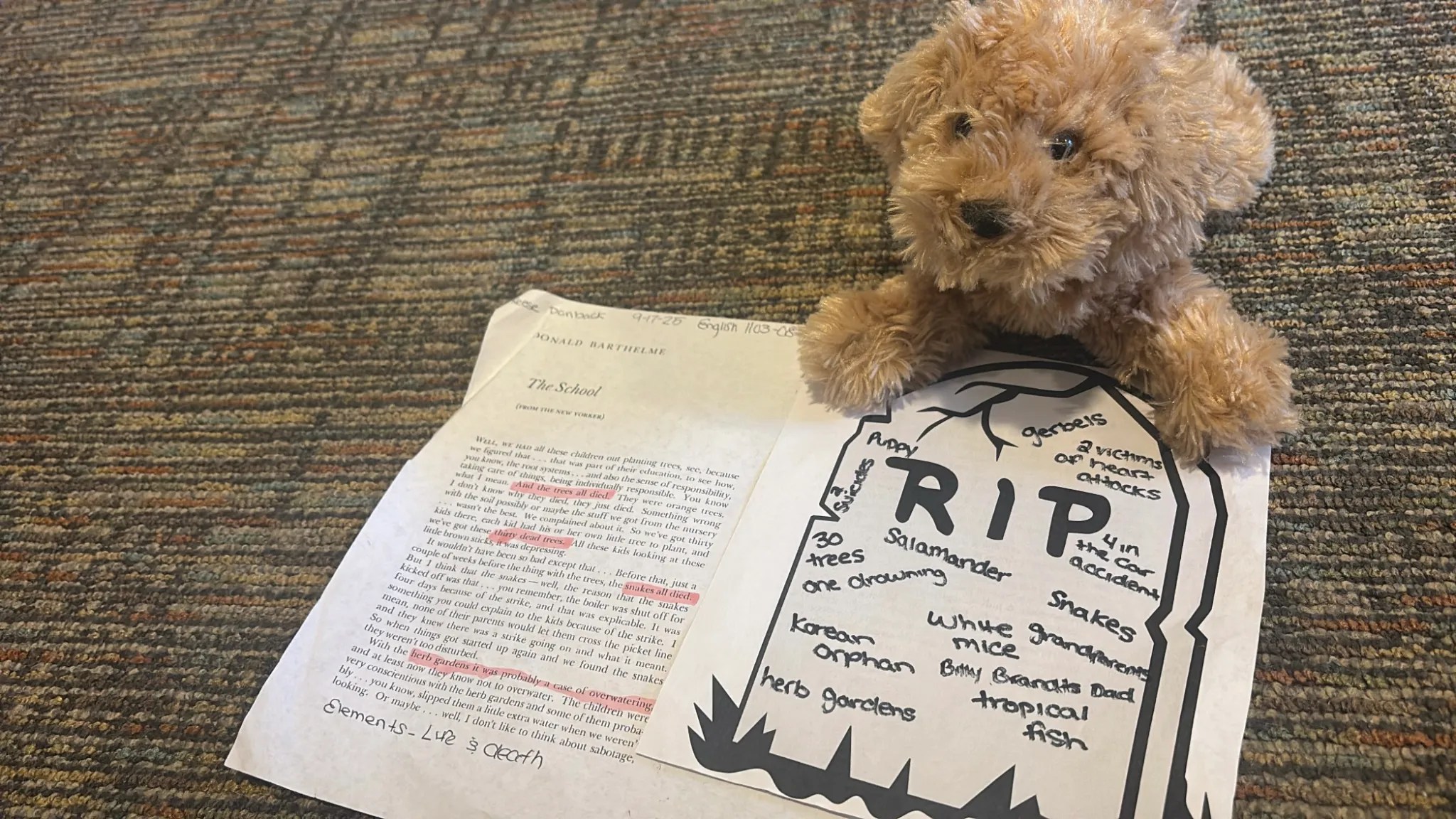
The image featured above, from Reese Danback’s post of her analysis, “Seventy-Four Classroom Pets Later,” does not include a page of her handwritten draft or her journal notes. However, the act of writing the names of the tombstone can be construed as part of her writing process–and it may have inspired her to craft a title that emphasizes the multitude of deaths that Edgar and his students experience.
Embedded Links
These students’ embedded links in their analysis posts were mentioned by their peers as particularly effective choices:
When you add a link to your blog post, be sure to embed it in a word that is part of the sentence; otherwise, the link name will create a faulty line of prose.
The link in Chloe Freeman’s analysis, “Fingers to Freedom,” a page devoted to Helen Keller on the website for the eye research foundation named for her, is a model I recommend. The link is embedded in Keller’s name in its first appearance in the analysis.
Next Up
At the beginning of tomorrow’s class, we will continue our discussion of “Strawberry Spring.” Afterward, you will have the remainder of the period to devote to your preliminary work for your final essay and annotated bibliography. Details TBA.
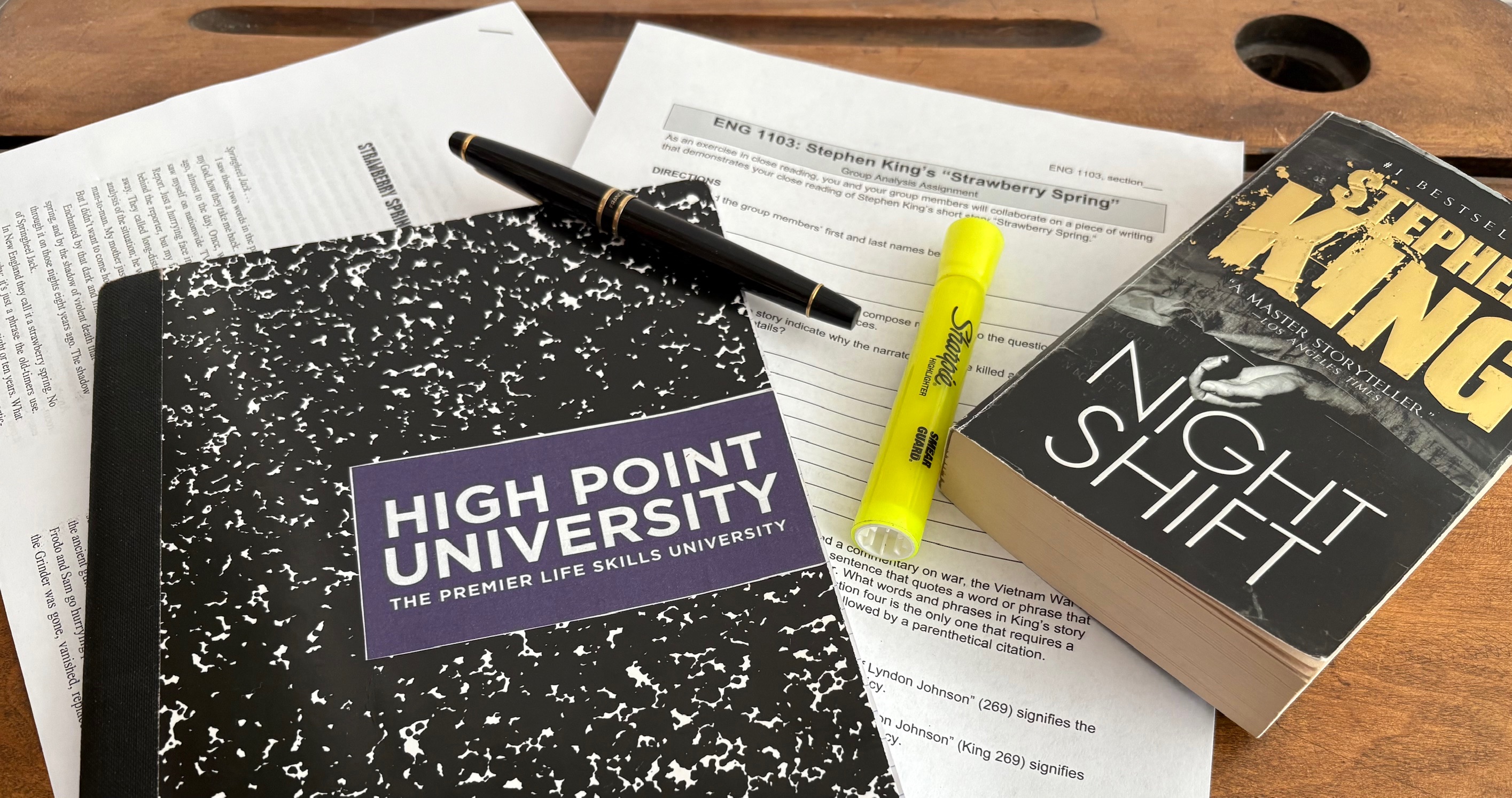
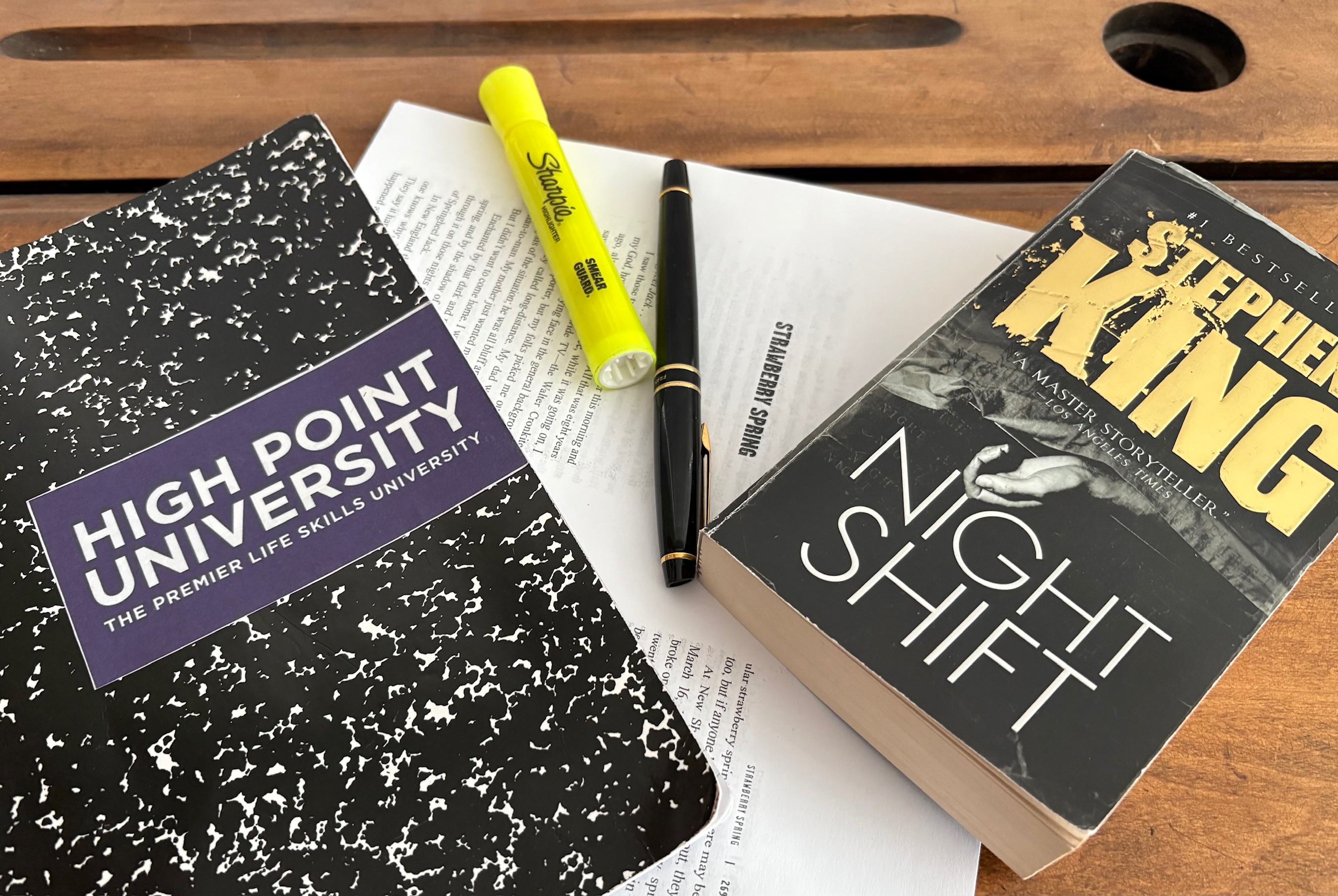
Today in class we will read Stephen King‘s short story “Strawberry Spring,” which was published in Ubris magazine in 1968 and included in King’s first short story collection, Night Shift (1978).
For the collaborative exercise that you will complete after we read the story, I will ask you to determine whether you can identify any details that indicate why the narrator may have murdered any of his victims. Although there is no indication that the narrator knew Gale Cerman, Adelle Parkins, or Marsha Curran, he did know Ann Bray.
I will also ask you to identify words and phrases that illustrate how the story is not only a horror story but also a commentary on war, the Vietnam War in particular, and the Vietnam era.
Lastly, I will ask you to try to identify the two literary allusions in King’s story. We will address these questions near the end of class today or at the beginning of class on Wednesday, and I will post the answers on my blog.
Next Up
We will review “Strawberry Spring” at the beginning of Wednesday’s class, and you will have the remainder of the period to begin your initial work for your final essay and annotated bibliography.
At the beginning of class tomorrow, I will collect your blog response assignments. If you were absent when I distributed copies or you have misplaced yours, refer to the directions below.
Directions
Go to the class blog page, and click on the link for the blog of the classmate whose name precedes yours on the roster. If you are first on the list, go to the blog of the student whose name is last on the list.
If the student’s blog is not accessible, choose another student’s analysis for your response.
Read the classmate’s analysis and compose a response (75 words, minimum) that addresses one or more of these elements: the title, the thesis, the support for the writer’s claims, the conclusion, the image documenting part of the writing process away from the screen, the embedded link to a relevant website.
Does the blog post include an image that documents part of the blogger’s writing process away from the screen? (yes or no)
Does the post include a relevant embedded link? (yes or no)
Bonus Assignment
Consider how the images and embedded links included on your blog enhance your posts; the pictures offer readers a glimpse of the writing process that isn’t evident from the typed words on the screen, and the embedded links provide readers with valuable additional information about your subject. View your classmates’ posts of their analyses, and carefully examine the images and the pages they have linked to their posts.
Directions
Determine which of the images and which of the embedded links are most effective. Consider what draws your attention to the picture. Does it include anything in addition to the required element (a portion of the blogger’s handwritten prose)? If so, what is that additonal element? To determine your choice for the most effective embedded link, ask yourself what further information it offers about the subject of the analysis–the essay, article excerpt, chapter, or chapter excerpt–or the author of the text. You are welcome to choose among the posts of analyses by students in both sections eight and eighteen.
Compose a comment of two complete sentences or more that includes (1) the titles of the analyses enclosed in quotation marks, (2) the first and last names of the students, and (3) a brief explanation of the image’s and embedded link’s effectiveness.
Post your comment as a reply to this blog entry no later than 9 a.m. Monday, October 27. (To post your comment, click on the title, and scroll down to the bottom of the page. You will then see the image of an airmail envelope with a leave comment option.)
I will approve your responses (make your comments visible) after the 9 a.m. deadline on Monday. Commenters will earn a bonus assignment credit in the course work/short assignments category.
This morning in the first half of class, you will deliver your group presentations, and in the second half, you will compose reflections. Directions for your reflections are included below.
Directions
Compose a short piece of writing (two paragraphs, minimum) that reflects on your individual preparation and delivery of your portion of the presentation and your group’s presentation overall. Elements to address include the following:
The roles of your reading and writing: How did the processes of rereading the text and writing and rewriting your remarks contribute to the effectiveness of your delivery?
The introduction of your group members and opening remarks
The examination of points in the article or textbook
The conclusion
Poise, eye contact, and avoidance of filler words
After you complete your reflection on your group’s presentation, compose an additional paragraph that addresses a presentation by one of the other groups. Choose the one that stands out the most to you. What element or elements of that presentation made it particularly effective (or not) and why?
As you continue to prepare for your presentation, be mindful of the valuable roles that reading and writing play in the process. Although the final product is your group’s three-to-four-minute oral presentation, your work began with reading and writing: reading the article or textbook sections that serve as your subject, and writing the plan that you composed in class yesterday.
Have you read more than once the article or textbook sections that serve as your subject? If not, turn back to the text itself at least two more times before Wednesday. Chances are, on a second or third reading, you will notice details you didn’t notice before, ones that you may want to add to your presentation.
In addition to recording key words on your notecard, write out your portion of the presentation in your journal. Though you will not be permitted to have your journal in hand during your presentation, the act of writing down your remarks and rewriting them will help you commit them to memory.
As you practice delivering your presentation, be sure to limit the time that you look down at your notecard and your copy of the reading. Your ability to limit those glances will be greater if you spend ample time rereading the text and writing and reviewing your remarks in your journal.
Next Up
In class tomorrow, you will deliver your group presentations. Afterward, in the second half of class, you will compose a short essay that reflects on both your own presentation and one by another group.
This morning in class, after your Scrabble debriefing, I will distribute your group presentation assignment, and you will have the remainder of the class period to devote to planning the short presentation that you will deliver in class on Wednesday. An additional copy of the assignment is included below.
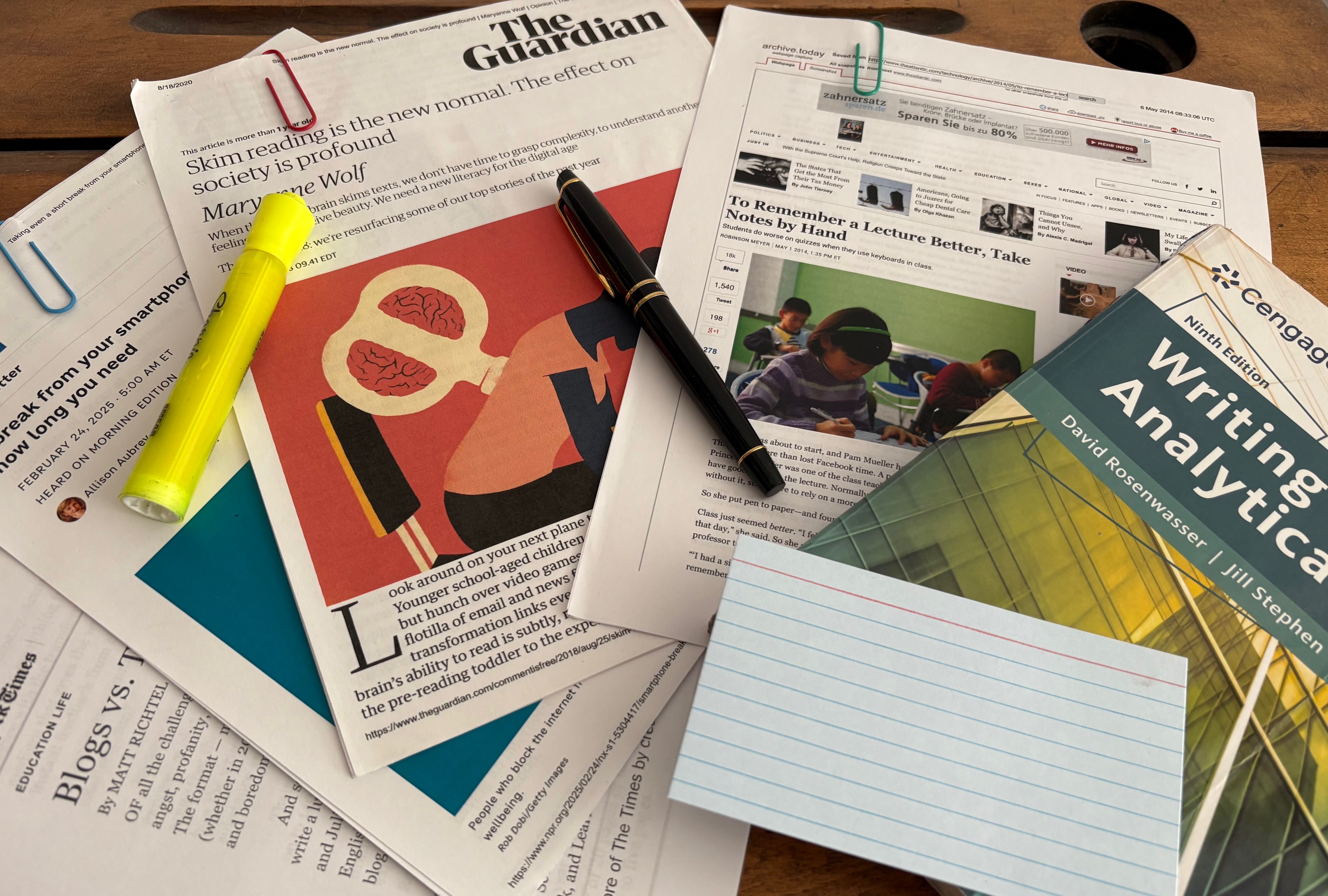
As an exercise in collaboration and oral communication, you and two or three of your classmates will plan, rehearse, and deliver a concise presentation focusing on a reading that addresses one of the practices implemented in the course. If you were absent when copies of the articles were distributed (see the titles in the group assignments below), download and print copies from the Blackboard readings folder.
Presentation Assignment Directions
Plan a presentation of three or four minutes that addresses the most significant points covered in your group’s designated reading. (The lists of group assignments and designated readings are included below.)
Include in your presentation the elements listed below (in items three through five).
An introduction that mentions (1) each group member’s first and last name (each group member may introduce himself or herself, or the group may assign one member the responsibility of introducing everyone), (2) the title and author, or authors, of the reading, and (3) a brief overview of the text.
A close examination of two or more points in the reading.
A conclusion that provides closure without restating the introduction and that invites questions. One strategy to consider for your conclusion is to address the relevance of the practice (the subject of your reading) to your work in English 1103, your work in other courses, and/or your life outside of the classroom.
Do not create a digital component, such as a PowerPoint or Google Slides show. You will not be permitted to use any digital devices during your presentation. Instead, you will rely on your index card with your notes and on your paper copy of the reading.
Every group member is not required to speak for the same length of time, but every member is required to deliver a portion of the presentation.
Directions for Rehearsing
In preparation for rehearsing, write your notes on an index card. If your initial notes are written in complete sentences, rewrite them to include only words and short phrases for your key points. If your notes are too detailed, you will risk relying too heavily on them and making minimal eye contact with the audience. Plan to make as much eye contact as possible and be sure to make eye contact with people throughout the room rather than fixing your eyes on one or two people.
Practice good posture. As you deliver your presentation, your ears should be directly above your shoulders. If you tend to shift your weight from one foot to the other, stand with your feet perpendicular to each other. If you do so, you will not be able to shift your weight from one foot to the other.
Avoid filler words, such as uh, um, like, and you know. If you tend to use filler words, practice pausing at the points where you are likely to use fillers.
Take turns delivering your portions of the presentation, and offer feedback to your group members. Offer both suggestions for improvement and words of encouragement.
Group Assignments for Section 8
Writing Analytically: Gi Amitrano, Amanda Franco, Madux Iovinelli, Campbell Nelson
“Skim Reading is the New Normal”: Casey Burkom, Aly Deters, Raven Houston, Luke Simpson
“Blogs vs. Term Papers”: Angelina Anzideo, Avery Falor, Ethan Howard, Nikki Parbhoo
“To Remember a Lecture Better,Take Notes by Hand”: Kylie Bussell, Dorian Grosber, Nolan Lafayette, Chloe Freeman
“A Break from Your SmartphoneCan Reboot Your Mood . . .”: Reese Danback, Preston Erwin, Lexie Owensby
Group Assignments for Section 18
Writing Analytically: Niko Bencharit, Mariana Pavajeau, Haven Tucker
“Skim Reading is the New Normal”: Annaliese Abboud, Grayson Crouch, Bella Richardson, Heloise Richer
“Blogs vs. Term Papers”: Kamauri Brown, Garrett Hickey, Maddie Tyranowski, Bailey Upchurch
“To Remember a Lecture Better,Take Notes by Hand”: Adrienne Brown, Myra Chatwal, Connor McFadden
“A Break from Your SmartphoneCan Reboot Your Mood . . .”: Cameron Anderson, Ellie Tejada, Jorja Mangeot, Shane Richardson
Grade Criteria
An A presentation includes all elements outlined in the directions for planning and rehearsing and demonstrates the group members’ poise and ability to avoid filler words.
A B presentation includes all elements outlined in the directions for planning and rehearsing but may be marred by group members’ lack of poise and/or inability to avoid filler words.
A C presentation includes most but not all elements outlined in the directions for planning and rehearsing and may also be marred by group members’ lack of poise and/or inability to avoid filler words.
A D presentation includes only some elements outlined in the directions for planning and rehearsing and may also be marred by group members’ lack of poise and/or inability to avoid filler words.
An F presentation includes few if any elements outlined in the directions for planning and rehearsing and may also be marred by group members’ lack of poise and/or inability to avoid filler words.
Next Up
In class on Wednesday, you will deliver your group presentations. Afterward, in the second half of class, you will compose a short essay that reflects on both your own presentation and one by another group, one that was notable for its strengths.
Rather than listing the answers to the questions on Monday’s quiz, I have followed each question below with a note regarding where to find the answer. By finding the answers yourself, you will learn more than you would from simply reading them in a list.
Write a brief but vivid description—a minimum of one complete sentence—of the page that you were assigned to read for today. See the page of Art Spiegelman’s memoir Maus posted in the Blackboard readings folder and featured in the October 13 class notes.
The blog post devoted to the sample student analysis that we studied includes several points about the content and form of the essay. Compose a sentence that specifies one of those points that was not addressed in class. See the October 2 class notes, specifically the five bullet points under the heading “Content” and the six bullet points under the heading “Form.”
What is the topic of the most recent Scrabble blog post? Note that Scrabble is the subject, not the topic. The topic is something more specific about the game. See the October 3 class notes.
Your quiz also included a bonus opportunity. Possible answers for that bonus are found in the class notes for October 3.
Scrabble Journal Exercise
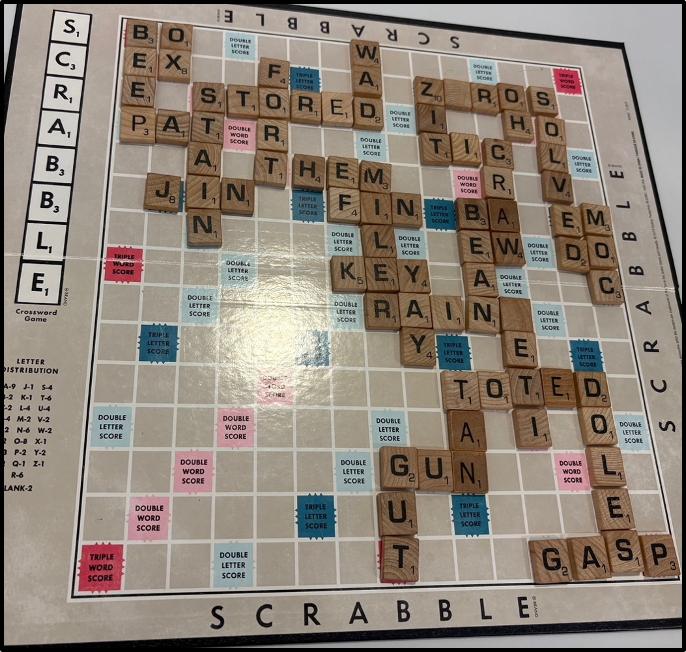
In the game pictured above, the first team played “ZIT” with “Z” on a triple-letter square for thirty-two points. Using a blank for an “E,” the second team followed with “ZEROS,” with the “S” on a double-letter square for twenty-six points. The first team then played “SOLVED,” building from the “S” in “ZEROES.”
With “SOLVED,” the only letter that the first team played on a bonus square was the “E”* on a triple-letter, giving that “E” a value of three points. How many points total did the first team earn for “SOLVED”? Would they have benefited from playing elsewhere on the board? If so, why? The first team earn a total of twelve points for “SOLVED.” They would have benefited from playing elsewhere on the board because playing “SOLVED” below “ZEROS” set up the second team to score a triple-word play with “MOC” and simultaneously form two additional words, “EM” and “DO” for a total of twenty-seven points, more than double the first team’s score for the previous play.
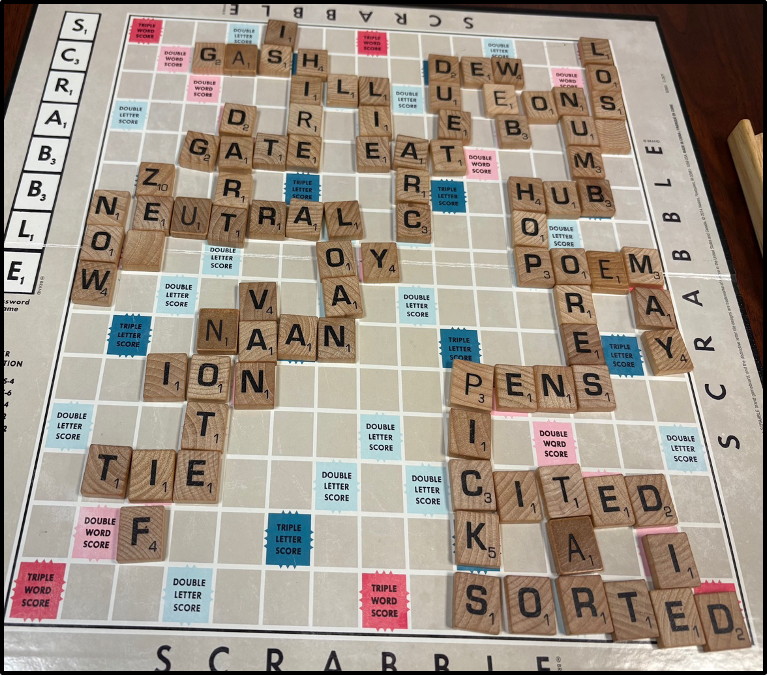
In the game pictured above, the first team earned twelve points for the first play, “TOY,” which appears as “OY” on the board. (Remember to make sure that all letters played remain on the squares where they are played.) The second team followed with “LOAN” for six. Then, using the “L” in “Loan” and the “T” in “TOY,” the first team played “NEUTRAL” and “AT.”
With “NEUTRAL,” the only letter that the first team played on a bonus square was “U” on a double-letter square, giving it two points. How many points total did the first team earn for “NEUTRAL”? Would they have benefited from playing elsewhere on the board? If so, why? The first team earned a total of ten points for “NEUTRAL” and “AT.” They would have benefited from playing elsewhere on the board because playing “N-E-U-T-R-A” in front of the “L” in loan set up the second team to score a triple word under the “N.” It also placed the vowel “E” under a triple-letter score, where the opponent would be able to play a high-value consonant. Although the first team may have played “NOW” and/or “ZEN” themselves, they set up their opponents to play on the squares where those words were played.
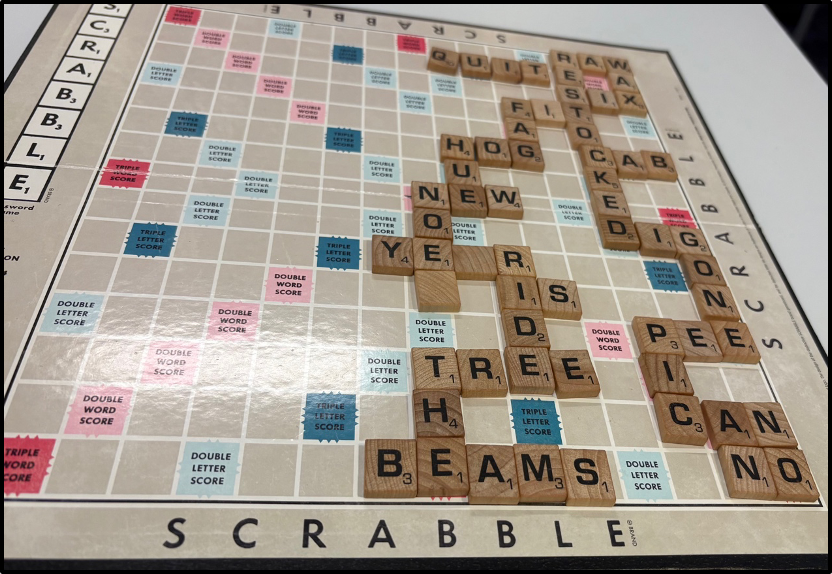
In the game above, the play is limited almost exclusively to the right quadrants. What words could the teams play horizontally below the “Q,” horizontally above or below the “Y,” and elsewhere to advance the game to the left quadrants?
Here are a few of the ways that the players might advance the game into the left quadrants:
Because no more than two letters can be played below the “Q,” the words that either team could play there are limited to “QAT,” “QUA,” and “QI.” A Team could play both below and above the “Q” by spelling “AQUA,” but that play would not be prudent because it would set up the opponents to play on the triple-word square. Playing “QAT” would be preferable because of the large number of words that end with “T.”
A team could play “T-A-T-T-O” above the “Y” and in front of the “O” to spell “TATTOO” and “OY.” A team could also play “I-D-E-A” below the “Y” and in front of the blank (“L”) to spell “IDEAL” and “YA.”
“NEW” offers more opportunities for advancing the board into the left quadrants. Spelling an a-ending word, such as “ALPHA” or “AREA” vertically with the final “A” in front of the “N” would form both the vertical word and “ANEW.”
“A-A,” “B-A,” “L-A,” M-A,” “P-A,” “R-A,” “W-A,” or “Y-A” could be played in front of the “H” to spell “AAH,” “BAH,” “LAH,” “MAH,” “PAH,” “RAH,” “WAH,” or “YAH” horizontally, along with “AB” vertically.
In the first game pictured above, playing down from the “J” would advance the game into the lower left quadrant, but playing only as much as the single letter “O” below it would set up the opponents to score a triple-word play.
Spelling a word that ends with “K-E-Y” would enable the first game to advance into the lower left quadrant, but “MONKEY” isn’t a possibility because both “M”s and both blanks have already been played. Ditto for “HICKEY,” “HOCKEY,” and “HOKEY” because both “H”s have been played. “JOCKEY” isn’t an option either because the “J” has been played. Three possibilities are “POKEY,” “SMOKEY,” and “TURNKEY.”
The last two rows of the board offer additional opportunities to advance into the left quadrant. Using the “U” or the “T” in “GUT” as one of the last letters in a horizontal word would advance the game into the left side of the second-to-last or last row of the board.