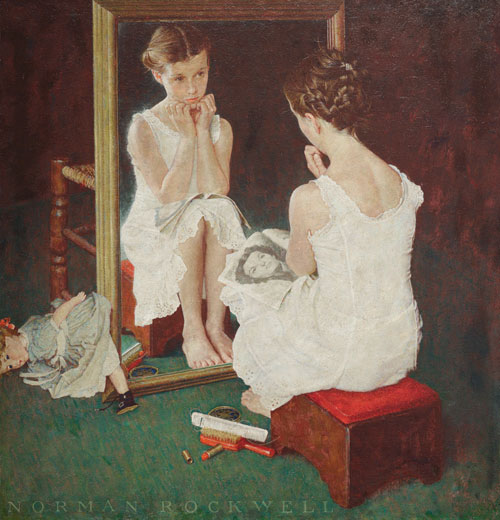
In Norman Rockwell’s painting Girl at the Mirror, the face that viewers see is the girl’s reflection—not her face itself, but the one she sees in the glass. What does she see in herself, and what do the paintings’ observers see, as we witness this private moment? Does her lace-trimmed petticoat evoke in her, or in us, thoughts of the wedding gown that she may wear one day? For Rockwell’s detractors—and for those who consider him a guilty pleasure—Girl at the Mirror and his other covers for The Saturday Evening Post present a sentimentalized depiction of American life, the same picket-fenced cliché that many who find fault with Our Town perceive as the prevailing image of the play. As theatre scholar Donald Margulies writes in his foreword to Our Town, many people who dislike it have “dismissed [it] as a corny relic of Americana and relegated Thornton Wilder to the kitsch bin along with Norman Rockwell and Frank Capra” (xi). Yet a close look at Our Town and Girl at the Mirror reveals portraits of American life that are far from idyllic.
As she gazes pensively in the mirror, the girl in Rockwell’s painting might be asking herself the same question that Emily Webb asks her mother: “[A]m I pretty?” (31). Though Mrs. Webb tries to reassure her daughter, Emily seeks an answer that her mother’s words fail to provide.
Both Emily and the Girl at the Mirror occupy that awkward space between childhood and adulthood—a notion that Rockwell emphasizes with the composition of his painting, placing the girl between her childhood toy, the doll that she has cast aside, and her new grown-up object of interest, movie star Jane Russell, who gazes up at her from the page of a magazine. Will I ever be beautiful and desirable, the way you are? the girl might be asking of Russell. Or, as Emily asks her mother: “Am I pretty enough . . . to get anybody . . . to get people interested in me? (32). Though Mrs. Webb answers Emily, she does not provide the answer that her daughter seeks. Telling Emily, instead, that she has “a nice pretty young face” (31) and that she’s “pretty enough for all purposes” (32), she avoids the subject of adult desire that underlies Emily’s questions.
Though the audience feels the frustration in Emily’s voice as she says, “Oh, Mama, you’re no help at all” (32), only later in the play do we feel the full weight of those words when Mrs. Webb confesses in the wedding scene that she has never talked to Emily about sex: “It’s cruel, I know, but I couldn’t bring myself to say anything” (76). Mrs. Webb’s monologue turns the scene of her daughter’s wedding into a reminder of the vulnerability and pain that come as a consequence of a lack of sexual knowledge. That same darkness at the edge of a seemingly quaint picture appears in Girl at the Mirror. Consider the doll, just beyond the mirror and the viewer’s focus, innocently cast aside perhaps, but backed up to the edge of the mirror’s frame. To the adult eye, the doll’s posture is clearly one of sexual submissiveness.
 Both Wilder’s and Rockwell’s visions are more complex than what their critics give them credit for—or more accurately deny them—rendering the trouble that lurks below the surfaces of our daily encounters. And while the sexual innocence of Emily Webb and Rockwell’s Girl at the Mirror may seem distant to us, the silence that endangers their innocence pervades our lives. Now as revelations of celebrities’ and politicians’ transgressions saturate our news streams, the silences of Wilder’s characters seem eerily prescient. Can anyone now hear Mrs. Webb say, “I couldn’t bring myself to say anything” (76), without thinking of our own culture of silence—and of Roy Moore and Louis C.K. and Kevin Spacey and Harvey Weinstein—and of all the predators in our own towns, places supposedly so far removed Grover’s Corners?
Meanwhile, back in Our Town, Mrs. Gibbs says of Simon Stimson’s alcoholism that “the only thing the rest of us can do is just not to notice it” (40). And Constable Warren says, “‘Twant much” (104), of a Polish immigrant nearly freezing to death, another way of saying that some lives do not matter as much as others, a prejudice that we know all too well as no mere relic of the past. Those moments in Our Town not only belie the notion of Grover’s Corners as a saccharine portrait of America but also demonstrate that the play critiques the very parochialism that its detractors denounce as its stock-in-trade.
In his reassessment of Rockwell’s paintings, Richard Halpern observes that “[a] false belief in our own sophistication or knowingness is just another form of innocence” (par. 17). The same innocence may prevent us from seeing Our Town with real clarity, the way that Emily only truly sees her twelfth birthday when she revisits it after death. As she says to the Stage Manager, “I can’t look at everything hard enough” (105). Perhaps in our own innocence, neither can we.
Works Cited
Halpern, Richard. “Manufacturing Innocence,” excerpt from Norman Rockwell: The Underside of Innocence, U. of Chicago P., http://press.uchicago.edu/ucp/books/book/chicago/N/bo3750655.html, Accessed 16 Nov. 2017.
Margulies, Donald. Foreword. Our Town by Thornton Wilder. 1938. Harper Perennial, 2003, xi-xx.
Rockwell, Norman. Girl at the Mirror. The Saturday Evening Post, 6 Mar. 1954. Norman Rockwell Museum, 2016, http://www.nrm.org/MT/text/GirlMirror.html, Accessed 16 Nov. 2017.
Wilder, Thornton. Our Town. 1938. Harper Perennial, 2003.
 When the thought of making small talk with the other guests at a fishing lodge overwhelms Charlie Baker, his friend Froggy LeSueur concocts a story to enable the shy, fretful Charlie to avoid conversation—and to do so without seeming rude. Froggy tells Betty Meeks, the owner of the lodge, that Charlie is a foreigner who doesn’t speak English. And to stave off questions about Charlie’s homeland, Froggy implies that he can’t disclose that information because Charlie is on a classified mission.
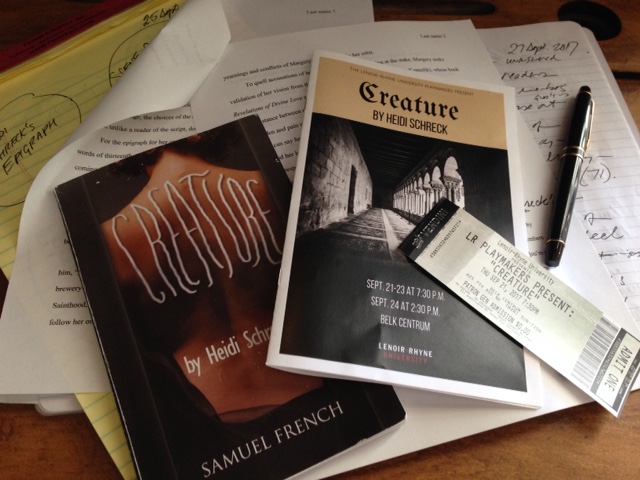 An epigraph stands out as a curious element in a play. For readers of the script, that quotation,which precedes the opening of the play and presents its prevailing theme, offers a signpost to guide them on their journey. However, for those who first encounter the play on the stage, the choices of the director and the actors must convey that idea, which the audience, unlike readers of the script, does not see in written form.






 struggles to come to terms with it. Though Cass chooses to start a new life, she continues to see the world through the lens of the ninth-grade teaching job that she leaves behind (along with Kip), equating her mistake of marriage to a mathematical miscalculation. As she explains to Kip: “Look, I agreed to marry you based on what I knew to be true. Kip equals X. X will make me happy. Everything added up. Seven years later I find out that you’re not X at all, you’re Z. And if you’re Z, then I did the math wrong” (1.1). Ever the math teacher, Cass perceives the world as a series of signs with determinate meaning, a tendency that seems to compound the difficulty of her quest. On the bus to Niagara, where Cass adopts fellow traveler Lois Coleman as her sidekick, Cass continues to think in terms of numbers, measuring her old life as “463 road signs behind me” (1.2). Though she eventually loses track of the signs, she remains focused on her numbered to-do list, which includes becoming a contestant on The Newlywed Game, a show that turns couples’ compatibility into a numbers game.
 therapy session, Cass says that “[i]t’s not just a game! Things have meaning. Or at least they should” (2.3). Her emphasis on “should” indicates that she has embraced the concept that meaning may be indeterminate. But neither she nor the other characters can leave numbers behind, not altogether. After Captain Mike, Kip’s rival for Cass’ affection, accidentally shoots himself, rather than reflecting on his death, the characters attempt to quantify fears as they quibble over which is number one: being alone, public speaking, or needles (2.3).
 The final scene on the river leaves the audience, along with Cass and Lois, in a holding pattern. What happens remains unclear. The ambiguity comes at a risk; it may try the patience of audience members who find the play’s farcical humor too ridiculous or contrived, or as New York Times reviewer Ben Brantley wrote “

 Jane Lucas