Today in class you began planning and drafting your midterm reflection longhand. If you brought a paper copy of your revised analysis to class and completed the sideshadowing exercise, the marginal notes and the summary you produced may figure prominently in your reflection if you choose to focus wholly or in part on your analysis. That said, as you continue to work on your reflection, you may find your focus shifts to another aspect or component of the course.
As I noted in the instructions for the reflection, you are welcome to focus on any components of the course but no more than four, total. A complete list follows.
Planning, drafting, and revising your analysis
Keeping a journal
Completing Check, Please! assignments
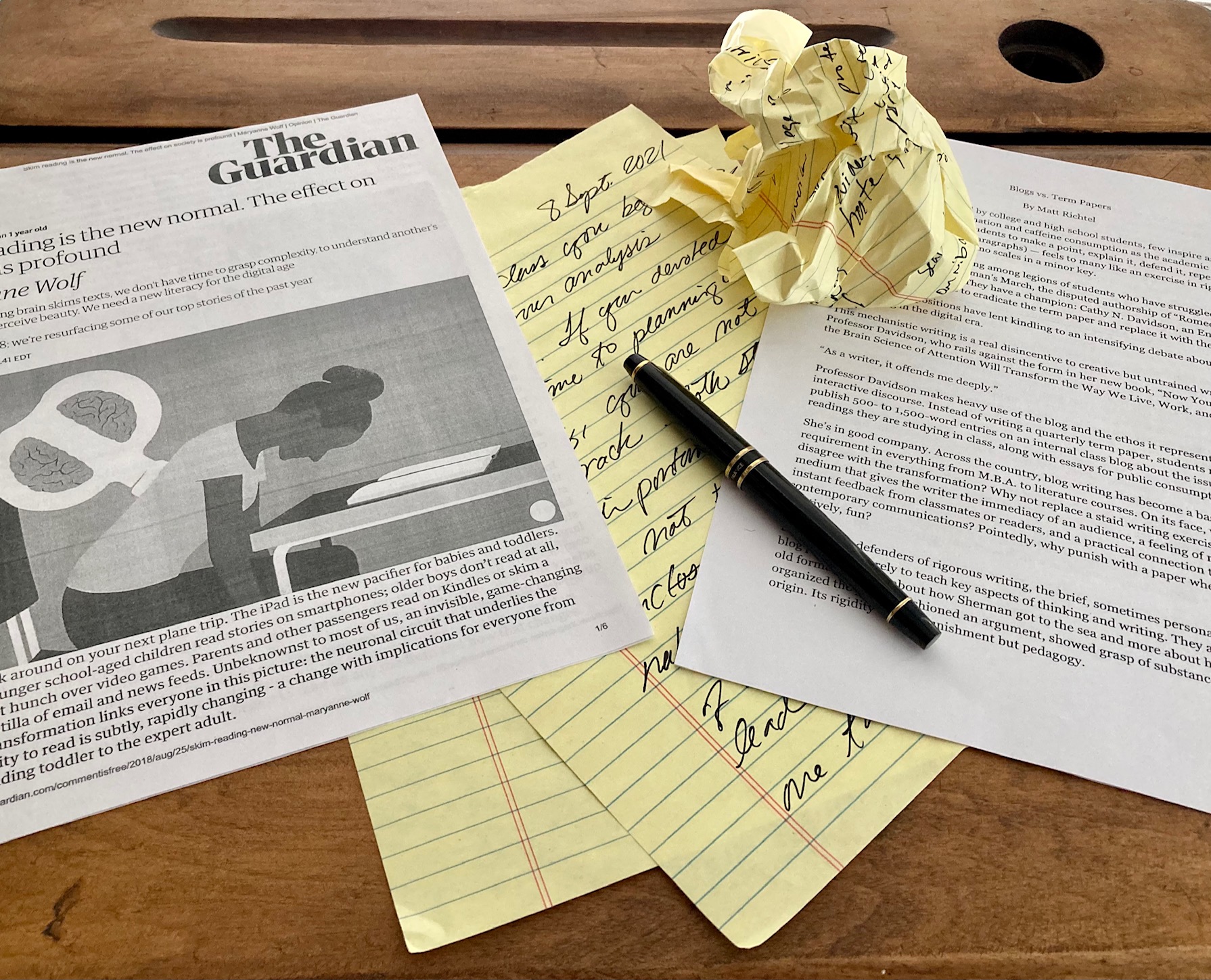
Studying one of the readings examined class, including “Blogs vs. Term Papers,” “Skim Reading is the New Normal,” the first paragraphs of “The Falling Man,” “Facebook Knows Instagram is Toxic for Teen Girls, Company Documents Show,” and the sample analyses
Writing for an online audience beyond the classroom/creating and maintaining a WordPress blog
Collaborating with your classmates on in-class writing assignments
Next Wednesday, October 4, you will receive your handwritten plans and drafts with my notes, and you will have the class period to begin revising your analysis on your laptop or tablet.
In the meantime, continue to think about your reflection as a work in progress. Freewrite and jot notes about your reflection in your journal.
If you take your reflection in progress to the Writing Center, you will earn extra credit for the assignment. To schedule an appointment with a tutor, follow this link: https://highpoint.mywconline.com/.
Next Up
Friday marks our sixth Wordplay Day of the semester. To prepare for class and to up your game, browse the Scrabble site’s Tips and Tools.
Falconer, Ian. The Competition. 2000. The New Yorker, 9 Oct. 2000. Copyright 2000 Condé Nast Publications, Inc.
Last Wednesday in class, we examined Ian Falconer’s The Competition, and you read two possible interpretations that the authors of Writing Analytically offer. As a group exercise in moving from observation to implication, you collaboratively composed a statement that included a detail that led you to find the first or second possibility more plausible.
Here are sample claims for each of the two interpretations:
The contrast between the raven hair and eyes of Miss New York and the platinum-blonde and pale-eyed contestants from Georgia, California, and Florida in The New Yorker cover The Competition by Ian Falconer suggests what the authors of Writing Analytically present as the first of two possible interpretations: The cover “speak[s] to American history, in which New York has been the point of entry for generations of immigrants, the ‘dark’ (literally and figuratively) in the face of America’s blonde European legacy” (Rosenwasser and Stephen 89).
The self-satisfied expression of Miss New York in The New Yorker cover The Competition by Ian Falconer suggests what the authors of Writing Analytically present as the second of two possible interpretations: “[T]he magazine is . . . admitting , yes America, we do think that we’re cooloer and more individual and less plastic than the rest of you, but we also know that we shouldn’t be so smug about it” (Rosenwasser and Stephen 89).
This semester, as you continue to practice moving from observation to implication, review these samples as models. Also note that each one is a statement that presents a quotation as an appostive, which is a word or group of words that explains the noun it follows. In each case, the noun is “interpretation” and what follows is the specific interpretation itself.
Work Cited
Rosenwasser, David and Jill Stephen. Chapter 3: “Interpretation: Moving from Observation to Implication.” Writing Analytically, 8th edition. Wadsworth/Cengage, 2019. pp. 70-97.
Check, Please! Lesson Three
In class on Wednesday, September 29, you will submit your completed worksheet for the third lesson in the Check, Please! assignment series. The sample assignment for lesson three that I wrote as a model for you appears below.
In the third lesson of the Check, Please!, Starter Course, Mike Caulfield, author of the course and Director of Blended and Networked Learning at Washington State University, continues his instruction on the second step in four-step SIFT approach to determining the reliability of a source. Lesson three, “Further Investigation” covers these topics: (1) Just add Wikipedia for names and organizations, (2) Google Scholar searches for verifying expertise, (3) Google News searches for information about organizations and individuals, (4) the nature of state media and how to identify it, and (5) the difference between bias and agenda.
One of the most instructive parts of lesson three focuses on two news stories about MH17, Malyasia Airlines Flight 17, a passenger flight scheduled to land in Kuala Lumpur that was shot down over eastern Ukraine on July 17, 2014. While the second story, a television news segment, appears to present detailed investigative reporting challenging the conclusion of the Dutch Safety Board and Dutch-led joint investigation team–the conclusion that Russia was to blame–a quick just-add-Wikipedia check reveals that RT (formerly Russia Today) is a Russian state-controlled international TV network, a government propaganda tool rather than a source of fair and balanced news. The first video, the one produced by Business Insider, a financial and business news site, delivers accurate coverage of MH17.
Another notable segment of “Further Investigation” addresses the important distinction between “bias” and “agenda.” There, Caulfield observes that “[p]ersonal bias has real impacts. But bias isn’t agenda, and it’s agenda that should be your primary concern for quick checks,” adding that “[b]ias is about how people see things; agenda is about what a news or research organization is set up to do.”
In The New York Times article “Blogs vs. Term Papers,” Matt Richtel reports on the debate in higher education on how best to teach writing in the digital age. While some professors have followed the lead of City University of New York’s Cathy N. Davidson, replacing the traditional term paper with shorter, more frequent blog assignments, their detractors—including Douglas B. Reeves, columnist for the American School Board Journal and William H. Fitzhugh, editor of The Concord Review—argue that blog writing lacks the academic rigor that fosters critical thinking. For Andrea Lunsford, professor of writing at Stanford University, pitting blogs against term papers creates a false opposition. Rather than replacing term papers with blog posts, Lunsford requires students to produce multi-modal assignments: term papers that evolve into blogs, websites, and video presentations. Although Richtel’s article appears to present an objective account of the disagreements among experts, a close examination of the diction and structure of “Blogs vs. Term Papers” reveals an implicit preference for the innovations advocated by Davidson and Lundsford.
The opening paragraph of Richtel’s article focuses on the academic paper as a primary cause of “angst, profanity, and caffeine consumption” among high school and college students. In stark contrast to the images of the term paper-induced misery in his lead, Richtel writes in the second paragraph that students may be “rejoicing” because Cathy Davidson—a professor at Duke when Richtel interviewed her—favors replacing the term paper with the blog. Richtel refers to Davidson as a “champion” for students and outlines her use of a course blog as a practice that has become commonplace in a variety of academic disciplines. Richtel reports that blogs provide students with a “feeling of relevancy” and “instant feedback,” then poses the question: “[W]hy punish with a paper when a blog is, relatively, fun?”
From that question Richtel turns to the argument of defenders of the traditional academic paper, namely that the term paper teaches essential components of writing and thinking that may be absent from blog posts. Yet after letting the advocates of old-school writing have their say, Richtel undercuts their claim with this one-sentence paragraph: “Their reductio ad absurdum: why not just bypass the blog, too, and move on to 140 characters about Shermn’s Mrch?” To assert that defenders of traditional academic writing carry their opponents’ argument to an absurd conclusion presents those advocates of old-school writing as purveyors of the same flawed logic that their own traditional rhetoric supposedly teaches students to avoid.
Notably, the one-sentence paragraph, unlike paragraphs with multiple sentences, places heavy emphasis on a single idea. It says to readers, this is important. By introducing an apparent contradiction in the argument of the advocates of old-school writing, Richtel subverts their claim; and by presenting that incongruity as a one-sentence paragraph, he highlights the issue.
Richtel’s reductio ad absurdum paragraph is one of only two one-sentence paragraphs in his article. The other consists entirely of Professor Davidson’s own words. Speaking of the mechanistic quality of the term paper, she says: “As a writer, it offends me deeply.” In addition to devoting that one-sentence paragraph to Davidson’s negative feelings about term papers, Richtel returns to those feelings of hers at the end of his article and lets Davidson have the last word, literally.
In the final paragraphs of the article, Richtel recounts a tutoring session Davidson conducted with a community college student. Though she frowned on his assignment’s rigid guidelines—including prescribed sentence length—she told the student to follow the rules, knowing that teaching him what she deemed the best practice might have led the student to fail. Reflecting on that moment, Davidson said, “I hated teaching him bad writing,” and with those words of hers, Richtel’s article ends.
Along with giving Davidson the last word, Richtel devotes far more of his article to the new literacies she and Lunsford foster in their students. Arguably, the innovative nature of the work could account for the considerable space that Richtel devotes to it. After all, what readers are familiar with—in this case the traditional term paper—isn’t news. But the preponderance of word choices that place old literacies in a negative light combined with a structure that diminishes the merits of old-school writing reveals Richtel’s implicit preference for Davidson’s and Lundsford’s innovations.
Readers revisiting Richtel’s article now, nearly ten years after he wrote it, may wonder how he would respond to the question he poses about the shift from page to screen: “On its Face, Who Could Disagree with the Transformation?” Richtel wrote “Blogs vs. Term Papers” in 2012, the year deemed the year of the MOOCs (massive open online courses). Once touted as the key to revolutionizing higher education, their success has been hampered by the same issues linked to the learning losses experienced during the pandemic. For the many students who have had little or no face-to-face instruction—writing or otherwise—in recent memory, more technology may not seem like an answer, much less an innovation.
On Monday, as an exercise in developing a thesis or main claim, you and your classmates collaboratively, in groups of four, examined the opening paragraphs of Tom Junod’s Esquire feature “The Falling Man” and crafted a thesis statement. The sample thesis that I wrote in class as a model for you appears below.
Sample Thesis Statement/Main Claim
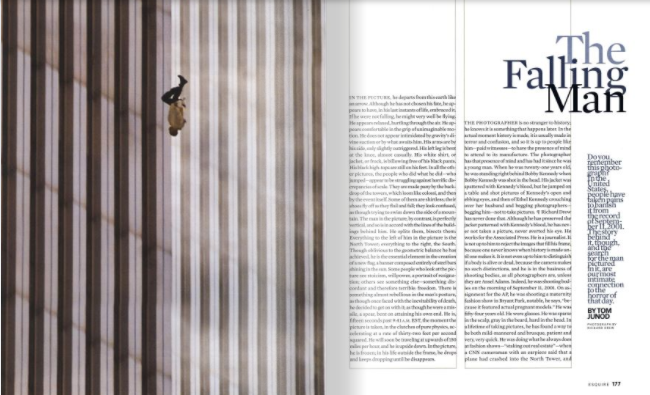
Esquire writer Tom Junod begins “The Falling Man” with an uncharacteristically long paragraph to recreate on the page the lengthy vertical passage of the 9/11 victim immortalized in Richard Drew’s photograph.
If I were to write an analysis of the opening of “The Falling Man,” I would develop my essay with textual evidence–words and phrases throughout the first paragraph–to illustrate the linear movement of the unidentified man from the beginning of the first paragraph to its conclusion.
The September 2003 issue of Esquire presents the opening paragraph of Junod’s article as two long columns that mirror the Twin Towers in Drew’s photograph on the facing page. (See the image below the title of this post.)
Your Revision in Progress
Today in class you received your handwritten drafts with my notes to you, and you began your revision work on your laptops. As you continue to revise your analysis of “Blogs vs. Term Papers” or “Skim Reading is the New Normal,” keep in mind our textbook authors’ words about effective thesis statements:
“The thesis of an analytical paper is an idea about your subject, a theory that explains what some feature or features of your subject mean. A good thesis comes from carefully examining and questioning your subject in order to arrive at some point about its meaning and significance that would not have been immediately obvious to your readers” (Rosenwasser and Stephen 180).
Also keep in mind our textbook authors’ explanation of the difference between analysis and argument: The claim that an analysis makes is often the answer to the question, what does it mean? The claim that an argument makes “is often an answer to a should question” (Rosenwasser and Stephen 7-8).
More on Tom Junod’s “The Falling Man”
Unless you subscribe to Esquire, the magazine’s paywall will deny you access to the full text of the feature, but you can access it through the HPU Library site by following these steps:
Screenshot of the side-by-side comparison of the websites for AAP and ACP in the second lesson of Check, Please!
On Wednesday you will submit your worksheet for the second lesson in the Check, Please! course. The assignments that I wrote as models for lessons one and two appear below.
Check, Please! Sample Assignment for Lesson One
In the first lesson of the Check, Please!, Starter Course, Mike Caulfield, author of the course and Director of Blended and Networked Learning at Washington State University, introduces the four-step SIFT approach to determining the reliability of a source: (1) “Stop,” (2) “Investigate,” (3) “Find better coverage,” and (4) “Trace claims, quotes, and media to the original context.”
One of the most useful practices presented in lesson one is what the author terms the “Wikipedia Trick.” Deleting everything that follows a website’s URL (including the slash), adding a space, typing “Wikipedia,” and hitting “enter” will yield the site’s Wikipedia page. The Wikipedia entry that appears at the top of the screen may indicate thesource’s reliability or lack thereof.
The most memorable segment of lesson one is the short, riveting video “The Miseducation of Dylann Roof,” which begins with the narrator asking the question, “How does a child become a killer?” Produced by the Southern Poverty Law Center, it documents how algorithms can lead unskilled web searchers down paths of disinformation. In the worst cases, such as Roof’s, algorithms can lead searchers to the extremist propaganda of radical conspiracy theorists.
In the second lesson of the Check, Please!, Starter Course, Mike Caulfield, author of the course and Director of Blended and Networked Learning at Washington State University, focuses on investigating a source, the second step in the SIFT approach that he introduces in lesson one.
One of the most useful practices presented in lesson two is Caulfield’s follow-up to the Wikipedia strategy that he outlines in the previous lesson. After he reviews that strategy, Caulfield explains how to use the control-f keyboard shortcut (command-f on a Mac). Typing control-f (or command-f) will open a small textbox in the upper right of the screen. Typing a word you are searching for will highlight the first appearance of the word in the text. Hitting return will highlight each subsequent appearance of the word.
Lesson two introduced me to fauxtire, a term for websites such as World News Daily Report, based in Tel Aviv, that present themselves as satirical but in fact serve primarily to perpetuate disinformation.
Perhaps the most memorable portion of lesson two was the side-by-side comparison of the websites for the American Academy of Pediatrics and the American College of Pediatricians. Though at first glance the two appear comparable, using the Wikipedia strategy reveals their profound differences. While AAP is the premiere authority on children’s health and well-being, ACP was founded to protest the adoption of children by single-sex couples and is widely viewed as a single-issue hate organization.
Turning from summary to commentary is a move you made in your Check, Please! worksheets and one that is similar to the move you will make in your analysis.
The authors of your textbook note that “[s]ummary is important to analysis because you can’t analyze a subject without laying out its significant parts for your reader” (6).
Your Check, Please! worksheet assignments require you to begin with a brief summary or presentation of the lesson’s significant parts. Summaries are objective by definition. They present the subject, not the writer’s opinion of it, and they do not include first- or second-person pronouns in singular or plural form (“I,” “me,” “we,” “us,” or “you”).
In the second paragraph of your Check, Please! assignments–and any subsequent paragraphs you include–you turn from summary to commentary. After answering the question, what is it? with your summary, you comment on the lesson with answers to one or more questions, such as these: What was most useful? What was most memorable? What was most instructive?
Work Cited
Rosenwasser, David and Jill Stephen. Writing Analytically, 8th edition. Wadsworth/Cengage, 2019.
And from Summary to Analysis
Similarly, in your analysis you will turn from summary to commentary but your comments will require a more sophisticated move. In your analysis, you will turn from laying out your subject’s significant parts to an analysis, or close study, of how some of those parts contribute to its overall effect. In your eyes, what does it mean, and what evidence can you offer to support your claims?
Backtracking to Notes
To begin the process of developing my analysis, I reread “Blogs vs. Term Papers” to look for patterns. What struck me as I reread Matt Richel’s article was the difference in the amount of the space devoted to old- and new-school writing practices, the contrast in the diction, or word choice, in the passages that addressed the two, and the article’s movement from old to new to old to new again. From there, I developed a tentative thesis that follows the summary in the paragraph below.
Introductory Paragraph Ending with a Thesis
In “Blogs vs. Term Papers,” Matt Richtel reports on the debate in higher education on how best to teach writing in the digital age. While some professors have followed the lead of City University of New York’s Cathy Davidson, replacing the traditional term paper with shorter, more frequent blog assignments, their detractors—including Douglas B. Reeves, columnist for The American School Board Journal and William H. Fitzhugh, editor of The Concord Review—argue that blog writing lacks the academic rigor that fosters critical thinking. For Andrea Lunsford, professor of writing at Stanford University, pitting blogs against term papers creates a false opposition. Rather than replacing term papers with blog posts, Lunsford requires students to produce multi-modal assignments: term papers that evolve into blogs, websites, and video presentations. Although Richtel’s article appears to present an objective report on the disagreements among experts, a close examination of the diction and structure of “Blogs vs. Term Papers” reveals a preference for the innovations advocated by Professors Cathy Davidson and Andrea Lundsford.
Next Up
On Wednesday, you will submit your worksheet for your second Check, Please! lesson and you will begin revising your analysis in class.
Today in class you began planning and drafting your analysis longhand. If you devoted more time to planning than drafting, you are not off track. Both steps are important Your aim was not to reach a conclusion today but rather to begin a process of discovery that will lead you to an analysis, one that you will continue to craft for two more weeks.
Next Wednesday, September 15, you will receive your handwritten plans and drafts with my notes, and you will have the class period to begin revising your analysis on your laptop or tablet.
In the meantime, continue to think about your analysis as a work in progress. Freewrite on your subject, “Blogs vs. Term Papers” or “Skim Reading is the New Normal,” in your journal, and practice “The Five Analytical Moves” outlined in our textbook:
“Move 1: Suspend judgment.
Move 2: Define significant parts and how they are related.
Move 3: Make the implicit explicit. Push observations to implications by ASKING ‘SO WHAT?’
Move 4: Look for patterns of repetition and contrast for anomalies (THE METHOD).
Move 5: Keep reformulating questions and explanations” (Rosenwasser and Stephen 16).
Next Up
Friday marks our third Wordplay Day of the semester. To prepare for class and to up your game, browse the Scrabble site’s Tips and Tools.
Coming Soon
Next week you will complete lesson two in the Check, Please! Starter Course and submit your completed worksheet in class on Wednesday, September 15. That due date and the ones for your other Check, Please! lessons are included on the course calendar in the syllabus. If you were absent from class today, you can download and print the worksheet from the link below or from Blackboard.
I hope that you will maintain your blog after the semester’s end and continue to seek other ways for your writing to have a life outside of the classroom.
Submitting your work to contests and publications offers you an opportunity to build your résumé. A list of prizes and bylines will increase your chances of landing the internships and jobs you seek.
Your literacy narrative and your textual analysis are both eligible for the annual Norton Writers prizes awarded for undergraduate writing. If you would like for one of your essays to be considered, please email me as soon as possible. A faculty member can nominate only one essay per year. The deadline is June 15.
Explore the possibility of writing articles for GTTC’s newspaper, Titan Shout, and consider submitting your literacy narrative to GTCC’s literary magazine,the Titan Review. For more information on Titan Shout and Titan Review, contact Zac Goldstein, Assistant Professor of English: zjgoldstein@gtcc.edu.
Many college literary journals accept submissions only from students at their own institution, but UNC-Wilmington’s Atlantis accepts submissions from undergraduate and graduate students enrolled at any college in the state of North Carolina (public, private, and community colleges). Check the Atlantis web page for their fall and spring submission periods.
To help you through the process of completing your end-of-semester requirements, I have compiled the checklist that follows.
Make sure that (1) your introductory post, (2) your revised literacy narrative, (3) your revised analysis of Maus, and (4) your revised reflection remain published on your blog until final grades are posted in WebAdvisor on Monday, May 10. Also make sure that you have deleted all placeholders/sample posts from your blog.
Complete the ENG 111 Post-Assessment no later than Friday, May 7. Scroll down your Moodle site to the course labeled ENG 111 Assessment (Spring 2021) to locate the post-assessment.
If you have worked one on one with our embedded tutor, Catherine Titus, please respond to the embedded tutor survey no later than May 12. I have not included a link to course evaluations here because the evaluation site closed on May 2. I hope that you evaluated ENG 111 as well as your other courses.
If you have issues editing your blog, visit the support page, https://wordpress.com/support/. If you cannot find a solution there, email help@wordpress.com.
Also look to the Titan Hub, https://www.gtcc.edu/student-life/tutoring-center-for-academic-engagement/titan-hub.php, as a resource. Located on the third floor of the Learning Resource Center on campus, the Titan Hub is open 9-4 Monday-Friday. The Hub can help you with all technical matters related to your course work at GTCC. In addition to visiting Titan Hub on the third floor of the LRC, you can contact the hub by phone or email: 336-334-4822, ext. 50318, cae@gtcc.edu.
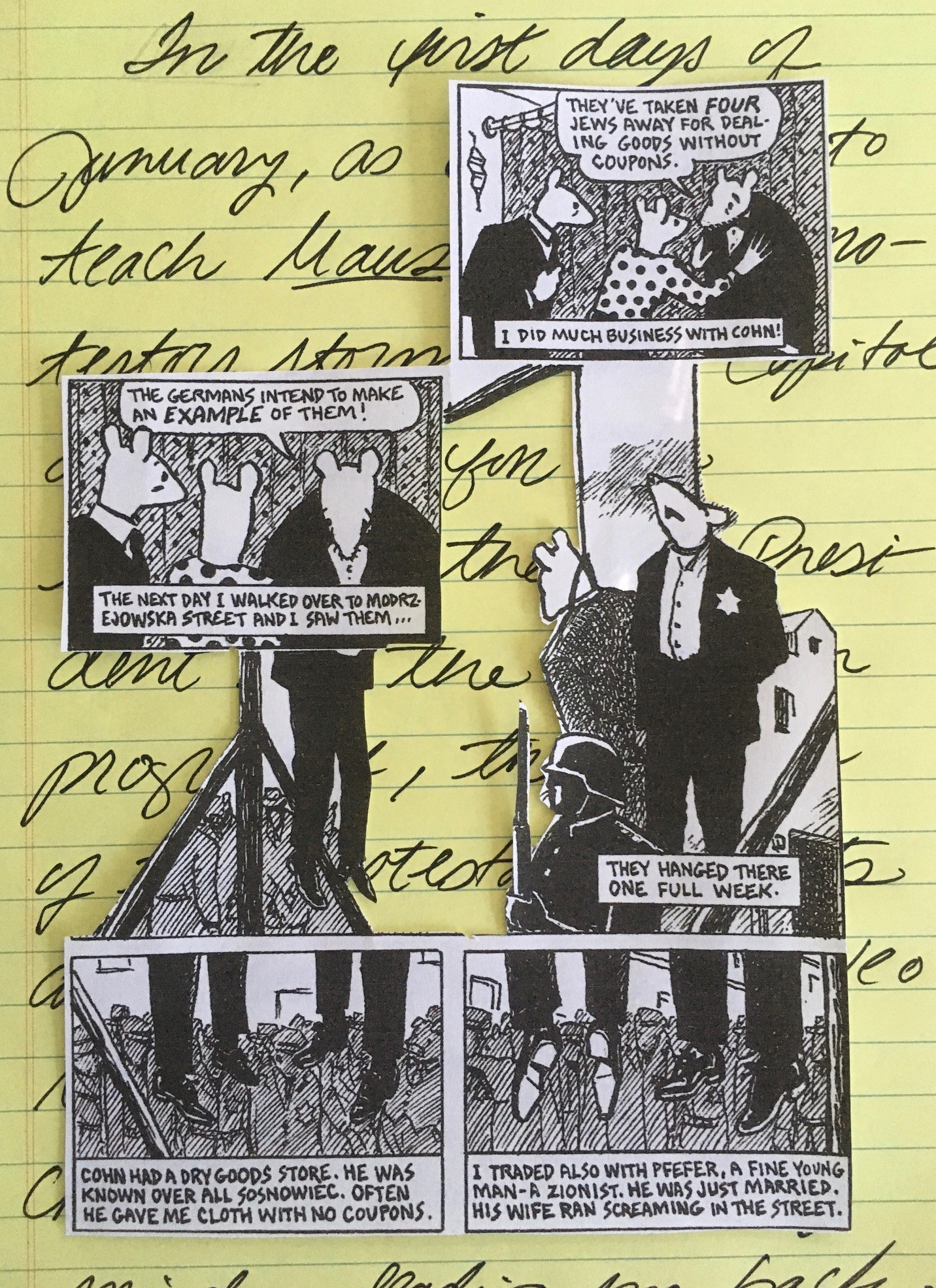
In the first days of January, as I prepared to teach Maus again, protestors stormed the Capitol and called for the hanging of the Vice President. As the semester progressed, the sound of the protestors’ chants and the image of a neo-Nazi T-shirt in the crowd lingered in my mind, leading me back repeatedly to Art Spiegelman’s depiction of the hanged merchants in Modrzejowska Street. Turning again and again to the same page of Maus solidified my decision to devote my analysis—the one I would write as a model for my students—to the panels that depicted the hangings, but I did not know how I would write about them. The prospect daunted me not only because of the painful nature of the images but also because I had written a sample analysis of Maus only a few months earlier as a model for my fall semester students. Perhaps I’ve already written all I can write about Maus, I told myself. But returning to the pages of Spiegelman’s memoir revealed that I did, after all, have more to write. Studying Spiegelman’s depiction of the hangings in Modrzejowska Street and finding the words to express my interpretation of those panels deepened my understanding of both Maus and the writing process.
The central image of the four hanged merchants, the one that evoked images of January 6, remained the panel that drew me back to the page. But as I continued to study it, I found myself drawn less to that panel in isolation than to its relationship to the ones that framed it. My observation that the bordering panels both linked the hanged men to their mourners and disconnected them from their persecutors, the Nazis, led me to my thesis: “His [Spiegelman’s] rendering of the panels of the living in conjunction with the fragmented panels of the hanged merchants simultaneously conveys connection and separation: both the grieving survivors’ ties to the dead and the hanged men’s objectification at the hands of the Nazis.”
That statement served not only as my thesis but also as an example to my students of how to develop an idea with a common form of appositive, a noun phrase that offers additional information. As we examined my analysis in class, I pointed to the abstract concept of “connection and separation” and showed how the appositive, the noun phrase that followed the colon, shows readers the specific “connection and separation,” namely “both the grieving survivors’ ties to the dead and the hanged men’s objectification at the hands of the Nazis.”
That learning opportunity grew from an essay that I had doubted would ever find its way to the page. The fact that it did take form illustrates the surprising rewards that the writing process yields.
This school year, perhaps more than any other, has demonstrated the value of writing as a mechanism for making sense of the world. Studying a Holocaust narrative is never easy. But writing to make meaning of Maus now—as we continue to don our own masks—honors the path that Spiegelman himself followed in his struggle to make meaning of his father’s life, a story that we sense, in the words of journalist Adam Gopnik, “is too horrible to be presented unmasked” (qtd. in Wilner 109).
Though I doubted that I could write a second analysis of Maus, facing the challenge expanded my understanding of Spiegelman’s achievement and strengthened my writing and teaching, providing me with another model essay for my students. As we continue to reckon with racial injustice and cultural and political division in our own country, Vladek Spiegelman’s story serves as a sobering reminder that the atrocities his son depicts in Maus are not relics of another place and time—or, as I wrote in the conclusion of my analysis, that “[t]he strange fruit of our past, both distant and recent, should seem far stranger.” As I began to put these words on paper, Derek Chauvin was convicted for the murder of George Floyd; but as I progressed from draft to revision, Andrew Brown, Jr., was shot and killed by sheriff’s deputies in Elizabeth City. As we continue to pick up the pieces of our broken world, I return to the page with the hope that putting pen to paper will also help my students—not only develop their writing but also make sense of it all—as we move toward renewal.
Wilner, Arlene Fish. “‘Happy, Happy Ever After’: Story and History in Art Spiegelman’s Maus.” Considering Maus: Approaches to Art Spiegelman’s “Survivor’s Tale” of the Holocaust, edited by Deborah R. Geis, U of Alabama P, 2003, pp. 105-21.
Earlier this week, I asked you to focus on the big picture, on the “clarity and effectiveness” (Hacker and Sommers 29) of your reflection. Continue to focus on those elements, and determine which two sources you will integrate into your analysis. Links to recommended sources are included in the sample works cited list in the class notes for April 19.
Later this week, as the assignment deadline nears, shift your focus to finding and correcting errors.
Proofreading
A Writer’s Reference presents excellent advice on proofreading, which I am including verbatim below.
“Proofreading is a special kind of reading: a slow methodical search for misspellings, typographical mistakes, and missing words or word endings. Such errors can be difficult to spot in your own work because you may read what you intended to write, not what is actually on the page. To fight this tendency, try one or more of the following tips.
Proofreading Tips
Remove distractions and allow yourself ten to fifteen minutes of pure concentration–without your cell phone.
Proofread out loud, articulating each word as it is actually written.
Proofread your sentences in reverse order.
Proofread hard copy pages; mistakes can be difficult to catch on-screen.
Don’t rely too heavily on spell checkers and grammar checkers. Before automatically accepting their changes, consider accuracy and appropriateness.
Ask a volunteer (a friend, roommate, or co-worker) to proofread after you. A second reader may catch something that you didn’t.” (31)
Grammar, Punctuation and Mechanics, and Word Choice
The items listed below are the ones that I noted most often in the drafts of your reflections and in your previous assignments. Review the ones that are trouble spots for you.
active verbs/voice, 153
apostrophes, 275-78
capitalization, 293-96
colons and semicolons, 271-73
commas, 259-71
empty or inflated phrases, 151
end punctuation, 283-84
hyphens, 291-92
italics for titles, 301
lay, lie, 182-83
like, as, 146
numbers expressed as words, 299
paragraph focus
paragraph length, 53-54
pronoun case, 196-97
reason why, 148
Redundancies, 150
reflexive pronouns, 306
sentence fragments, 207-13
standard idioms, 166
subject-verb agreement, 171-79
than, then, 149
that, which, 149
there, their, they’re, 149
to, too, two, 149
who’s, whose, 150
who, which, that, 150
Concluding Your Reflection
In addition to returning to your thesis, consider developing your final paragraph in one of these ways:
Include a quotation from or reference to one of your sources, a line that emphasizes the essay’s main point or puts it in a different perspective.
Place the reflection in a different, perhaps larger, context. For example, you might end by linking your reflection to the pandemic or the current social or political climate.
Consider the implications of the reflection. What does it imply, or involve, or suggest about the learning process in general or about the process of reading, writing, or critical thinking in particular?
In conclusion, To conclude
Avoid the phrases “in conclusion,” “to conclude,” “in summary,” and “to sum up.” These can be useful, even welcome, in oral presentations. But readers can see, on the page or the screen, when a short essay is about to end.
Since conclusions can be particularly challenging, I have included a link here to Harvard’s excellent guide on closing paragraphs, “Ending the Essay.”
More Writing Help
If you would like for someone to review your reflection before you submit it, look to the Center for Academic Engagement, which offers a variety of options:




 Jane Lucas