In Garrison Keillor’s recent Op-Ed column in The Washington Post, he responds to U.S. citizens who say they’ll flee the country if Republican presidential front-runner Donald Trump wins the election. Keillor recommends that prospective ex-patriots stay home instead. According to Keillor, if you truly want to escape Trump, you shouldn’t travel abroad, where suddenly you’ll be “hauling a knapsack of nationality.” As evidence to support his claim, Keillor recounts the years he spent in Europe during the George W. Bush era when, as Keillor describes it, “foreigners hear[d] your voice and it’s like you’re wearing a big fat A around your neck.” In contrast, he notes that no one broached the subject of W with him when he stayed in Houston in 2006 and 2007.
In the first line of his column, Keillor calls Trump “the Great White Snapper,” a moniker he repeats four times with slight variations–“the Great Turtle” (paragraph two), “the Big Snapper” (paragraph four), “the Snapper” (paragraph four), and “the Great White Turtle” (paragraph six), making that combative creature the column’s prevailing image.
Keillor’s depiction of Trump as a snapping turtle was one of our points of discussion when my students and I read his column in class last Wednesday. Though I had planned to have my students study a piece of Keillor’s writing as a prelude to his appearance on Thursday–as one of the featured authors in Lenoir-Rhyne’s Visiting Writers Series–I had no idea when I was constructing the syllabus that Trump would descend onto campus–or that his rally would be followed by an Op-Ed column by Keillor before his own scheduled appearance at L-R. The Op-Ed offered a valuable opportunity that I couldn’t have planned: one that let us look at one high-profile campus visitor’s remarks about another, one who had stood on the same stage only two weeks earlier.
Though our study of Keillor’s column was an exercise in rhetorical analysis, not in politics, it proved difficult–and appropriately so–to separate the two as we considered Trump as “the Great White Snapper.”
Gerald Graff and Cathy Birkenstein assert that the most effective writing about literature takes the form of a conversation, whether it’s a dialogue with a published literary critic, a classmate, a hypothetical reader, or the literary text, itself. Graff and Birkenstein observe that what distinguishes literary analysis from other types of academic writing–which are also forms of conversation–are the subject’s lack of an explicit thesis (poems and stories show rather than tell) and the central role of conflict (problems move stories forward).
A close reading of Flannery O’Connor’s short story “Everything that Rises Must Converge” offers a case in point for Graff and Birkenstein’s guide for literary analysis, which itself–intentionally or not–may raise questions in readers’ minds about what happens to Julian’s mother.
The title story of O’Connor’s posthumous collection Everything that Rises Must Converge chronicles the conflict between Julian, a recent college graduate who embraces the changes brought on by the Civil Rights movement and his mother, who clings to the racial hierarchy of the old South and refuses to travel alone on desegregated buses.
One evening as Julian accompanies his mother en route to her reducing class at the Y, he takes a seat beside a black man–an act that Julian perceives as a lesson for his mother–and witnesses her annoyance increase when she realizes that the large black woman who has boarded the bus with her young son, Carver, is wearing the same purple and green hat that she wears, as Julian sees it, “like a banner of her imaginary dignity” (277).
Later, as the two mothers and sons exit the bus, Julian’s mother rummages in her purse for a coin to give to Carver, an act that Julian anticipates will fuel the ire of Carver’s mother, believing that she will see the gesture as yet-more-condescension-by-the-bigoted-white-woman. When Julian’s mother offers the little boy a penny, Carver’s mother’s frustration and anger escalate, prompting her to swing her purse at Julian’s mother and knock her to the sidewalk. Julian helps his mother to her feet, but she remains mobile only briefly. Delusional, she asks Julian to tell her grandfather and her childhood nurse–both long dead–to come get her, and she collapses on the sidewalk.
Reading O’Connor’s story closely reveals that Julian, though on the right side of history, doesn’t place himself there through compassion but instead through “an evil urge to break [his mother’s] spirit” (277).
After reading Graff and Birkenstein in conjunction with O’Connor, what lingers in this reader’s mind aren’t the interpretive possibilities that the story invites but rather the one that Graff and Birkenstein seemingly ignore or dismiss. When they write that the “mother’s death [. . .] could be seen as evidence that we are supposed to disapprove of her” (195), they acknowledge the open-endedness of her character but not of the story’s conclusion, itself. The underlying assumption that Julian’s mother is dead precludes the ambiguity that Graff and Birkenstein illustrate with the duck-rabbit drawing. Is Julian’s mother (a) dead (duck), or has she suffered (and survived) a massive debilitating stroke?
O’Connor writes that one of Julian’s mother’s eyes came “unmoored” and the other “closed” (291), but she doesn’t state that she died. The fact that Graff and Birkenstein refer to her death serves as a reminder–apparently an unwitting one–that we as readers need to keep our own eyes open.
Works Cited
Graff, Gerald and Cathy Birkenstein. “‘On Closer Examination’: Entering Conversations about Literature.” “They Say/I Say”: The Moves that Matter in Academic Writing. Ed. Gerald Graff and Cathy Birkenstein. 3rd ed. New York: Norton, 2014. 184-201. Print.
O’Connor, Flannery. “Everything that Rises Must Converge.” “They Say/I Say”: The Moves that Matter in Academic Writing. Ed. Gerald Graff and Cathy Birkenstein. 3rd ed. New York: Norton, 2014. 272-91. Print.
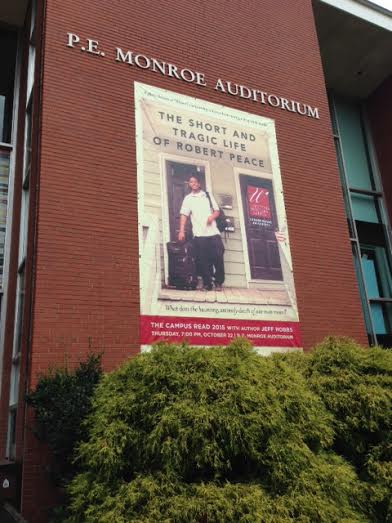
The large banner that hangs beside the entrance to P. E. Monroe auditorium suggests that The Short and Tragic Life of Robert Peace figures prominently on campus as this year’s common reading selection at Lenoir-Rhyne. But unlike the books that many other colleges and universities choose for their incoming freshman class, Jeff Hobbs’ biography of his Yale roommate wasn’t the subject of orientation-week discussion groups and isn’t required reading for all sections of FYE (First-Year Experience) or English 131 (Critical Thinking and Writing). Even so, I included a study of it in my English 131 classes to give Hobbs’ book its due as the campus common reading. For my students and me, the biography served not only as a subject of textual analysis but also as a starting point for a conversation about the common reading programs that so many colleges have adopted in recent years.
Last semester and again this semester, I wrote an essay on the book along with my students. Unlike the one that I posted to my blog last semester, the one that follows isn’t a revised and expanded version of what I wrote longhand while my students wrote. Instead, it’s simply a typed version of what I wrote when I put pen to paper in class on March 9.
The Unstoppable Drive of Robert Peace
In Part Four of The Short and Tragic Life of Robert Peace, Jeff Hobbs recounts the hours Rob spent mentoring Truman Fox, one of the water polo players he coached at St. Benedict’s when he returned to his alma mater to teach biology. After observing Truman’s laziness, evidenced in the way he “tiptoed along the bottom during laps” (267), Rob says to Truman: “You’re not making it hard” (268). Those words of Rob’s inspire Truman to take more initiative, and the following Saturday when Rob heads to the weight room to open it for a voluntary training session, he finds Truman in the hall waiting for him. Hobbs writes of Truman that “[h]e felt that if Rob saw a spark in him, even if Truman himself did not, then it was his responsibility to stoke it” (268).
Rob’s time with Truman echoes his tutoring of his high school friend Tavarus Hester. And later after Rob leaves his teaching position at St. Benedict’s, he reprises that tutoring role, helping Dawn—the daughter of his airline co-worker Lisa Wingo—“guid[ing] her through fifth-grade reading lists and simple division” (314). With Tavarus, Truman, and Dawn, Rob models the same self-discipline, but the passage that chronicles his conversations with Truman differs from the others, revealing the dark side of Rob’s determination, a side that remains unseen to Truman: “[W]hile he and his teammates were changing back into dry clothes, his coach was mentally preparing to spend the night dealing drugs” (268).
The stress of Rob’s post-Yale days, Newark-proofing himself and negotiating and compartmentalizing his identities, explains how the same Rob Peace who aced his molecular biophysics and biochemistry courses at Yale failed the Realtor’s exam, not once but twice. If he had pored over his notes for that exam with the same focus that he gave to perfecting Sour Diesel, his hybrid strain of marijuana, he probably would have passed the Realtor’s exam on his first try. The fact that he didn’t underscores what his friends saw with clarity but Rob himself could not.
What ultimately stopped Robert Peace wasn’t a weakness plain and simple but a more complicated trait, one that could be a strength—and usually was—but that became a weakness when he found himself “focusing that unstoppable drive on the very thing that could stop him” (311).
Work Cited
Hobbs, Jeff. The Short and Tragic Life of Robert Peace. New York: Scribner, 2014. Print.
Page two of Nora Krug’s graphic story “Kamikaze” /nora-krug.com
In “The End of the College Essay,” Rebecca Schuman, education columnist for Slate, advocates abolishing papers in required humanities courses and replacing them with written and oral exams. Schuman denounces the required-course essay for three reasons: first, because of rampant plagiarism; second, because the few students who actually write their own essays do so hastily—often at 4 a.m.—and third, because professors who teach writing-intensive courses often labor for hours over detailed comments that students merely skim or, worse, don’t read at all.
When I initially re-read Schuman’s reasons, it occurred to me that each one could serve as the topic of a body paragraph in an essay questioning her argument point by point. Add an introduction and a conclusion, and—voilà!—a five-paragraph essay of the very sort that she proposes we end. But I’m not an advocate of the five-paragraph essay per se, and I do understand and share Schuman’s frustration. Still, I don’t think that the solution to the college-essay problem is to end it altogether.
While it’s true that eliminating all essays in required humanities courses rids us of the ones pulled from fraternity files and downloaded from online paper mills, such a solution only seems viable if we ignore the moral component of education. The process of analyzing another writer’s ideas and placing them in conversation with our own, rather than falsely presenting them as our own, not only hones our critical thinking and writing skills but also develops our moral and ethical sensibilities.
Instead of eliminating the essay as an antidote to plagiarism, we can require our students to write some of their papers in class. Timed writing has its drawbacks—students cannot edit and revise to the extent that they can outside of the classroom—but many students don’t edit and revise anyway. And those of us who require our students to compose essays longhand in the classroom are granting time and space for the sustained focus that writing needs, undivided attention that more and more students are unable or unwilling to give themselves in the age of digital distraction.
Schuman laments the hours she has labored writing detailed comments that students look at only briefly, if at all. In the cost-benefit analysis, those hours spent writing comments in the margins don’t make much sense. So why not offer alternate forms of feedback? Scheduling some class meetings as a series of individual one-on-one conferences gives professors an opportunity to convey as much to students in few minutes of conversation as they can in a paragraph of prose. And by offering students a variety of feedback—oral comments along with minor notes penciled in the margin and general notes (for all students) typed, photocopied, and stapled to drafts—professors can accommodate students with a variety of learning styles.
Schuman might say that offering multiple forms of feedback is still a waste of time when students exert so little effort writing papers, but she provides no evidence that she has tried to develop assignments that students will care more about. If students simply write essays for their professors alone to read and evaluate, it’s no wonder that many students don’t care. Class workshops can go a long way in giving students more of a stake in their writing. If they know that all of their classmates will be reading and discussing their work, they are far more likely to produce writing that their peers will want to read—and they will strive to write essays that are as strong as their classmates.’ Simply put, when our work has a life in the classroom, we don’t want to fall short.
Giving students’ work a life outside of the classroom provides another way of encouraging personal investment in their writing. Requiring students to post their writing assignments to blogs offers them practice both in writing for an online audience and maintaining a website that they can continue long after the class has ended.
Schuman doesn’t mention blogs or peer workshops in her essay-to-end-essays, though she claims she’s “tried everything.” Everything? Really? Since she mentions only two remedies (a clinic addressing vague introductions and a mini-essay assignment that eliminates introductions and conclusions altogether), I’m doubtful that she’s tried anything close to everything. But I am grateful for what’s she’s written. Though I don’t believe that we should eliminate the required college essay, I do believe that we need to rethink it.
As I read and re-read Schuman’s words, I reflected on my own writing assignments and came up with ideas for some new ones. One is a photo essay—not one composed solely of images but rather a narrative composed of a combination of photographs and paragraphs that could serve as an introductory post or stand-alone page on students’ blogs. Another idea came to me when I was re-reading Schuman’s essay and was reminded of the graphic narrative “Kamikaze” by illustrator Nora Krug, a story that I taught in a sophomore literature course a year or so ago. In the introductory note to the story, Krug observes that drawing is a form of research for her:
[W]ith every new story I create, I try to find out something about an issue I am interested in. It’s not only the historic, textual research that inspires me. I see the act of drawing itself as a research tool. (qtd. in Charters)
Just as Krug sees the act of drawing as a research tool, we can see drawing and photography as tools for composition in the re-imagined college essay.
Of course, we could instead “return to old-school, hardcore exams, written and oral,” as Schuman recommends, but a false dichotomy underlies her assumption. According to her either/or fallacy, we should replace essays with exams because we can’t offer students practice in both. But in reality we can, and Schuman’s essay has enabled me to see new ways of doing that. By turning her ideas over in my mind and placing myself in conversation with them on the page, I’ve developed some new ideas of my own. And that in itself is evidence of the college essay’s enduring value.
Works Cited
Biographical Note on Nora Krug. The Story and Its Writer. Ed. Ann Charters. Compact 9th ed. Boston: Bedford/St. Martin’s, 2015. 532.
The speaker in Billy Collins’ poem “Snow Day” meditates on the “revolution of snow” (1) as he listens to the radio announcements of school closings, steeping himself in the pleasure of the sounds of the whimsical names of the preschools and the sights of the little girls playing outside in the “grandiose silence of snow” (37). That’s a summary of the poem, the first part of the assignment that I asked my students to write today in lieu of class. The second part of the assignment asked them to look at the poem with a critical eye—not to write a full-blown analysis but to consider at least one of Collins’ choices, a word or an image. For that, I turn to the porpoise.
In the third stanza, Collins’ persona, the “I” of the poem, speaks of his plan to walk his dog, whom he imagines in the snow—as he probably has seen him many times before–frolicking as a porpoise would in the water: “In a while, I will put on some boots / and step out like someone walking on water / and the dog will porpoise through the drifts” (11-13).
By using porpoise as a verb, Collins merges the movement of the dog and the sea mammal. Collins doesn’t liken the dog in the snow to the porpoise. Instead, he fashions a verb that transforms the dog. It morphs into the porpoise, at least for a moment in the readers’ minds.
The dog-porpoise isn’t the prevailing image in the poem. Children and snow cover far more real estate. But the dog-porpoise conveys the spirit of playfulness that abounds in the poem, the same unbridled joy we may feel in our own lives when the adult institutions that govern our days are shut down–as many are now–by snow.
Work Cited
Collins, Billy. “Snow Day.” The Poetry Foundation. The Poetry Foundation, n.d. Web. 25 Jan. 2016.
One-hundred and seventy-nine words (29 lines) and the thousands that inform them.
When I was fourteen years old and first saw Bernard Pomerance’s The Elephant Man as a teleplay on ABC, the lack of makeup and prosthetics made no sense to me. If you could make Joseph Merrick look monstrous—as John Hurt did in David Lynch’s film—then why wouldn’t you? Only much later would I understand that Pomerance was more concerned with the grotesqueness of British imperialism and Victorian society, which is why his Merrick doesn’t look like Lynch’s.
Though I didn’t comprehend the playwright’s vision at the time, I kept watching because I had to know what happened next—what would transpire between Merrick and Mrs. Kendal, the actress who befriends him and whom Merrick asks to be his mistress? Mrs. Kendal wouldn’t consent; that I knew, but I also knew that she had grown to care for Merrick and was saddened by the knowledge that his hideous deformities would prevent him from experiencing physical intimacy of any kind, much less sexual intercourse. As I watched Mrs. Kendal speak to Merrick, I realized that no matter what I secretly thought of my awkward adolescent self, that I would never be perceived as the freak that Merrick was, that one day I would love and be loved. And when Mrs. Kendal tells Merrick that she has seen photographs of him—of his naked body, taken for display at lectures—and starts to undress so that he can see her breasts, I knew that I was witnessing something that was considered scandalous but that was, in fact, morally just.
Those moments between Merrick and Kendal that now replay so vividly in my mind mark a moment in my moral education. For decades they’d continued to dwell in some far corner of my imagination, waiting to rise to my consciousness again, as they did recently when I had the opportunity to act in a local production of The Elephant Man. When I was cast in the show, I seized the chance not only as an opportunity to perform but also as an occasion to research Joseph Merrick so that my work on stage would be informed by my study of his life.
The bibliography that follows includes the play, itself—which first stirred my interest in Merrick—the memoir of his doctor, Frederick Treves, and two book-length studies that revise and expand Merrick’s story: Ashley Montagu’s exploration of his psyche, The Elephant Man: A Study in Human Dignity; and the first comprehensive biography of Merrick, The True History of the Elephant Man.
Though Treves aimed to tell Merrick’s story as accurately as possible, as Montagu notes, “his attempt to reconstruct Merrick’s past was to a great extent erroneous” (69). Nevertheless, his memoir still offers readers what no other writing about Merrick can: a look at him through the eyes of his own doctor. And as Michael Howell and Peter Ford observe in their biography: “Of all of Treves’ writings, ‘The Elephant Man’ is undoubtedly the one that will continue to be read long after the others are forgotten” (164).
Whether these annotations will serve as preliminary writing for a larger project, I cannot say. But I can say that as I have stepped on stage to enter Merrick’s world, I have carried with me what I’ve learned.
Annotated Bibliography
Howell, Michael and Peter Ford. The True History of the Elephant Man. 1980. New York: Skyhorse, 2010. Print.
The first comprehensive biography of Joseph “John” Carey Merrick, The True History of the Elephant Man, co-written by physician Michael Howell and editor and writer Peter Ford, chronicles the life of Merrick, beginning with his initial encounter with Frederick Treves, at the storefront across from the London Hospital in 1884, then turning back to his birth in Leicester in 1862. Howell and Ford document the death of Merrick’s mother, Mary Jane Merrick, née Potterton, from pneumonia in 1873, his years of labor at the Leicester Union Workhouse, his exhibition—by showmen Sam Torr, Tom Noonan, and Sam Roper—and his final years in residence at the London Hospital under the care of surgeon Frederick Treves.
Howell and Ford’s research reveals that Merrick chose not to disclose to Treves essential details about his family background, namely that his mother and his sister, Marion Eliza, were both “crippled” (42, 46), and they clarify that Treves’ error regarding Merrick’s first name was intentional, citing the manuscript of Treves’ memoir in which he crossed out “Joseph” and replaced it with “John.”
The True History of the Elephant Man also addresses the question of Merrick’s condition—with neurofibromatosis and Proteus syndrome as the prevailing diagnoses—noting that to the frustration of future researchers, the skin samples of Merrick’s preserved at the London Hospital dried out when the hospital staff was evacuated during World War II. Dry rot in the hospital, a consequence of damage from the bombings, affected the specimens, which were subsequently burned.
Montagu, Ashley. The Elephant Man: A Study in Human Dignity. 1971. Lafayette: Acadian, 2001. Print.
In The Elephant Man: A Study in Human Dignity, anthropologist Ashley Montagu explores how Joseph Merrick developed a healthy personality despite the “reality of his physical hideousness” and the “cruelly lacerating expressions of horror and revulsion by all who beheld him” (100). With chapters devoted to Merrick’s doctor, Frederick Treves, and the London Hospital, as well as chapters on maternal love and personality development, Montagu’s study provides both historical and psychological context for Merrick’s story.
Observing that Treve’s two-paragraph account of Merrick’s early years seems “utterly incompatible with [his] loveable personality” (85), Montagu asserts that Merrick was not abandoned by his mother as Treves suggests in his memoir. In the third edition, published in 1996, Montagu notes that his views on Merrick’s mother were confirmed by Michael Howard and Peter Ford in The True History of the Elephant Man.
Pomerance, Bernard. The Elephant Man. New York: Grove, 1979. Print.
Though its time frame corresponds with that of Frederick Treves’ memoir of Joseph “John” Merrick, Bernard Pomerance’s play departs from Treves’ account, reimagining the last four years of Merrick’s life in twenty-one short scenes. Throughout the play, the actor portraying Merrick wears no makeup or prosthetics to alter his appearance, a stipulation of Pomerance’s introductory note, where he asserts that any attempt to reproduce the Elephant Man’s grotesque physical deformities would be both “counterproductive” and “distracting” (v). Pomerance fashions a fictional relationship between Merrick and the actress Madge Kendal (who raised funds for Merrick’s care and arranged for him to attend the theatre but never met him), employs dream sequences to explore the unconscious of Merrick and Treves, and uses as a central metaphor Merrick’s building of a cardboard model of St. Philip’s Church, a model he did in fact construct with his one good hand during his stay at the London Hospital.
Treves, Frederick. “The Elephant Man.” The Elephant Man and Other Reminisces. London: Cassel, 1923. 1-37. Print.
Frederick Treves’ memoir “The Elephant Man” chronicles the final years in the life of Joseph “John” Carey Merrick, the grotesquely deformed man who came under the care of Treves two years after the doctor examined Merrick at the London Hospital.
Beginning in 1884 with Treves first encounter with Merrick as a freak-show attraction at a storefront across from the hospital, the narrative details Treves’ plan for Merrick to be transported across the street for examination—under his cloak and hat, lest he be mobbed or beaten—Treves’ reunion with Merrick after his dismissal from a traveling show in Belgium, and Merrick’s subsequent residence at the London Hospital, where he lived until his death in April 1890.
To introduce my students to the writing of pop culture critic Chuck Klosterman—last night’s featured writer in Lenoir-Rhyne’s Visiting Writers Series—I assigned “My Zombie, Myself: Why Modern Life Feels Rather Undead.” Of the dozens of columns and essays of Klosterman’s I could have assigned, I chose his commentary on zombies in part because of the continuing popularity of zombies in general, and in particular the comic-book-turned-TV series The Walking Dead, now joined on AMC by its prequel, Fear the Walking Dead. I also chose “My Zombie, Myself” because it’s a well-constructed argument, one that makes the same moves that we make in academic writing.
In class on Wednesday, my students collaboratively examined “My Zombie, Myself,” identified its components, and summarized the essay’s argument with their answers to these questions:
What is the standard view of zombies?
What is Klosterman’s claim about them?
What is Klosterman’s support for his claim?
What naysayers or counterargument does Klosterman address?
What does Klosterman write to convey why it matters? (Who cares why zombies are the monster of the moment?)
As the students in my 8 a.m. class collaboratively composed their summaries, I drafted this one of my own:
In ‘My Zombie, Myself: Why Modern Life Feels Rather Undead,’ Chuck Klosterman challenges the standard view that the monster of the moment personifies our unconscious fears, claiming instead that battling the undead provides us with an allegory for our daily lives. In Klosterman’s words, ‘[t]he principal downside to any zombie attack is that the zombies will never stop coming; the principal downside to life is that you will never be finished with whatever it is that you do.’ To those who contend that zombies have merely replaced vampires as the current it-monster, Klosterman says their argument is deceptive. He maintains that the Twilight series isn’t about vampires but about ‘nostalgia for teenage chastity, the attractiveness of its film cast and the fact that contemporary fiction consumers tend to prefer long serialized novels that can be read rapidly.’ Klosterman reminds us that our zombie fixation matters because they “come at us endlessly (and thoughtlessly),” like all of the annoyances of life, but we can manage them.
Last night I was reminded of Klosterman’s claim about the popularity of zombies—how they’re an allegory for our daily lives—when interviewer Mike Collins, host of WFAE’s Charlotte Talks, asked him about the continuing popularity of the reality show Survivor. In response to Collins’ question—why is it still so popular after so many years?—Klosterman said that what you see over and over in Survivor is the elimination of the oldest and the weakest first, then you see the elimination of the strongest, the contestants who are perceived as the biggest threats. What Survivor really rewards is mediocrity, Klosterman said, and that’s something that we see in our own lives.
Near the end of the interview—which covered topics ranging from Klosterman’s childhood in North Dakota, to his work at ESPN and Spin, to his interviews with Taylor Swift and Tom Brady, to the presidential candidates—Klosterman spoke about his writing process. I think that most writers come up with a thesis and then write about it, he said. What I do is write about what interests me and then look for a thesis.
Klosterman’s method is far more common than he realizes. It’s the one I use, and the one I encourage my students to use when their assignments give them the opportunity to see their interests “through academic eyes” (Laff qtd. in Graff 250).
Works Cited
Graff, Gerald. “Hidden Intellectualism.” “They Say/I Say”: The Moves That Matter in Academic Writing. Eds. Gerald Graff and Cathy Birkenstein. 3rd ed. New York: Norton, 2014. 244-51. Print.
Yesterday afternoon, Jeff Hobbs—one of the featured authors in Lenoir-Rhyne’s Visiting Writers Series—conducted a Q&A session with an audience primarily of students, mostly freshman who are reading his book The Short and Tragic Life of Robert Peace for their FYE (First-Year Experience) classes. As Hobbs began to speak, I was reminded of the phone conversation that he recounts in Chapter 12: “You sound like a mouse,” Rob says, “same as you did in college” (295). Though I thought his voice was too low-pitched to be mouse-like, I could see how Rob had found it mousy—and admittedly it was, as Hobbs describes in Chapter 12, “soft-spoken” and “halting” (295).
Yet despite the “soft-spoken” and “halting” quality of Hobbs’ voice, he delivered powerful responses to students’ questions. When someone asked, what made you want to write the book? Hobbs answered with remarks about the vast array of mourners—evidence of the variety of people whose lives had been touched by Rob—echoing Hobbs’ words in Chapter 17:
The line for the viewing was two blocks long and one of the most diverse collections of people I’d ever seen: Yale students and professors, people conversing in Portuguese, Croatian, and Spanish, young and old residents of all of the boroughs of New York City and all the townships surrounding Newark. (388)
Near the end of Hobbs’ Q&A, my thoughts returned to Chapter 12, when in response to a question regarding how the process of writing the book had affected him, Hobbs answered that it made him “lament the nature of male friendship,” which he illustrates in his reflections on his conversation with Rob:
Jeff Hobbs / visitingwriters.lr.edu
The distance between us and the maleness of our friendship precluded revealing anything that truly mattered, and at the time I was too naïve to know that if you were friends with someone—truly friends—then you told him what was going on (“It’s called ‘catching up,’” my wife informed me when I asked how it was possible for her to yap with her girlfriends for as long as she did and share every innocuous detail of her life). Instead, I thought that by concisely presenting the most easygoing and put-together version of myself, I was being ‘all good.’ (295-96)
Hobbs did not address his writing process—something he may have spoken about at one of his other two appearances at L-R, Thursday evening and Friday morning—but he did convey what he hoped his biography of Rob would give to readers: a narrative that challenges the “predictable media spin of potential squandered” (386). The questions that audience members asked—as if they, too, had been acquainted with Rob—indicated that Hobbs did achieve that goal, one that any of us writing a book-length narrative would hope for: breathing life into our subjects, whether fictional or real, and enabling readers to see them as three-dimensional human beings, with all of their consistent inconsistencies.
Work Cited
Hobbs, Jeff. The Short and Tragic Life of Robert Peace. New York: Scribner, 2014. Print.
Last Thursday, when Jaki Shelton Green appeared at Lenoir-Rhyne as the first featured author in this year’s Visiting Writers Series, she spoke as both a poet and a storyteller, noting that her poems live inside her stories.
Jaki Shelton Green / visitingwriters.lr.edu
I found myself drawn more to her stories than the poems they linked, but my ears welcomed the sound of Green’s own voice reading her poem “i know the grandmother one had hands,” just a day after my students and I studied the poem and read it aloud ourselves in class. As she introduced the poem, Green recounted her stint teaching poetry writing to women on death row, giving them the assignment of writing about hands because of the acts that they had committed with their own hands. She didn’t say that the poem was her answer to the assignment, but it may have been, just as this blog entry and the earlier one on the poem, itself, are my answers to the blog assignment that I have given to my students.
Through her poems and stories, Green spoke of painful subjects on the eve of 9/11: the imminent anniversary, her great-great grandmother’s life in slavery, and the death of her own daughter. But her words offered hope rather than sadness. As I reflect on those words, I hope that the ones that my students and I write this semester will show us what Green’s showed us Thursday night: that writing gives us a way of making sense of the world.
Jaki Shelton Green’s poem “i know the grandmother one had hands” evokes images of a woman whose busy hands remain unseen as they perform a litany of tasks, some literal: “folding, pinching, rolling the dough” (3), others metaphorical: “growing knives” (14).
As my students and I read Green’s poem in class yesterday–in preparation for her presentation tonight as one of the featured writers in Lenoir-Rhyne’s Visiting Writers Series–I expected that the conversation that followed might be markedly different from the ones last semester in my Introduction to Creative Writing class. Those students, after all, were reading poems, short stories, plays, and narrative nonfiction as models for their own work. Yet even though my current students in Critical Thinking and Writing will not produce creative writing for class, their responses to Green’s work were similar to those of my creative writing students.
In retrospect, I realize that the similarities should not surprise me since I asked the students in ENG 131 (Critical Thinking and Writing) to begin their exploration of Green’s poem by considering her choices, just as I asked the students in ENG 281 (Intro. to Creative Writing) to begin.
I do not know why Green uses a lower-case “i,” or why she refers to “the grandmother one,” rather than a grandmother or my grandmother, but posing such questions and considering the effects of those choices places us on the path of writing, whether the destination is a poem of one’s own or a study of someone else’s.





 Jane Lucas