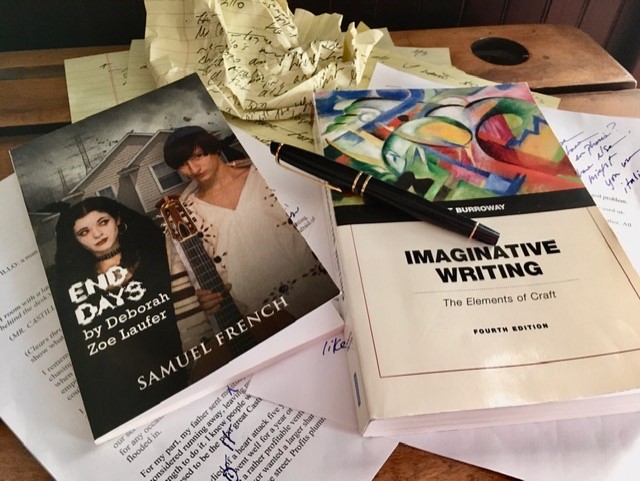
 Welcome to our second drama workshop session, and thank you for your thoughtful feedback on the first script, Twins of an Ill Fate. Before we turn to the next two scripts, The Slow Decline and the monologue from Bound, I offer these follow-up notes:
- Brandy, Brennan, and Zane mentioned the difficulty of distinguishing Harry from Henry. That’s a point that I’ll return to later in my notes.
- Mia and Brennan both envisioned the story as one better suited for another medium, and Brennan added that there were moments that would be difficult if not impossible to stage. Since the realm of Twins of an Ill Fate lies somewhere between fourth wall realism and extreme theatricality, it might be staged with scene changes–as Mia suggested–and the Angel-to-Grim Reaper transformation could take place in a black-out or otherwise out of view.
- Trevor recommended condensing the stage directions, and Brennan noted that some of them could be omitted. Often the characters’ words alone suffice. As I mentioned in our first session, in Imaginative Writing, Janet Burroway notes that “good dialogue will convey most of its tone as an integral part of the lines, and when this is the case, there is no need to announce the tone of voice in a stage direction” (327).
- Although Henry and Harry are easily confused on the page, seeing them on stage played by two actors, wearing clothes that aren’t identical, would enable the audience to distinguish Harry from Henry more easily. And in all likelihood they’d be played by actors who aren’t identical twins. That said, I’ll return to the what-if I asked in our first session and add another.
- What if Henry and Harry were never on stage at the same time? What if everyone except the surviving twin–Sally, Margret, the Grim Reaper, and the audience–was left without an answer to the question, did one brother lie to save his own life?
- Mia questioned the need for the twins to be identified as adopted, and Trevor mentioned Romulus and Remus,
 the adopted twins of Rome’s founding myth, and the opportunities that twin characters present, both as archetypes and subjects for exploration of nature and nurture. One reason for the revelation of the twins’ adoption–which Margret’s phone conversation provide–may be the existential crisis that crests with the realization that we are not who we thought we were, whether children of God or the children of the people we believed were our biological parents. I don’t know whether that’s what the writer intended, but the symbolic framework of the play leaves it open to that possibility.
 - One play I recommend to the writer is Deborah Zoe Laufer’s End Days, a dark comedy about a family preparing for Armageddon. The mother has visions of Jesus, and the daughter has visions of Stephen Hawking. One actor plays both Jesus and Hawking.
The points I have included below are not ones that you’re required to address in your comments about The Slow Decline and the monologue from Bound. I offer them as suggestions only. I will address some of them in the follow-up remarks that I’ll post at the beginning of our third session.
The Slow Decline
- Mr. Castillo begins with his earliest memories and offers his story chronologically. Where else might he begin, and what might that alternate starting point contribute to his monologue?
- What costume notes could place Mr. Castillo at odds with his words? Is there a stage lie? Is he wearing pajamas or or a pin-striped suit? How does that affect our reading of the line, “[t]he doctors say I don’t have much time left”?
- The tape recorder’s breakdown thwarts Mr. Castillo’s plan. What other obstacles, internal or external, might complicate the delivery of his story?
- What plays, if any–ones in Imaginative Writing or others that you’ve read–would you recommend to the writer as models or possible sources of inspiration?
Monologue from Bound
- What is the risk of beginning, as this monologue does, with a solution rather than a problem?
- Where might the writer use italics for emphasis? David Ives’ play The Philadelphia (see Imaginative Writing, 158-64) uses italics effectively in the conversation between the characters Al and Mark. Imagine the narrator emphasizing “finally” when he repeats it, then imagine him emphasizing “god.” How does the change in emphasis affect your perception of the narrator’s stance?
- Consider the stage lie again. Is the narrator reliable? What actions or gestures might reveal his reliability or lack thereof?
- What plays, if any–ones in Imaginative Writing or others that you’ve read–would you recommend to the writer as models or possible sources of inspiration?
- Post your two responses, twenty-five words or more each, as replies. If you address a point that one of your classmates has written in a previous reply, mention that classmate by name in your own reply. Post by 5 p.m. on Thursday, April 9.
Remember to check your CVCC email and Blackboard regularly for updates and assignments.
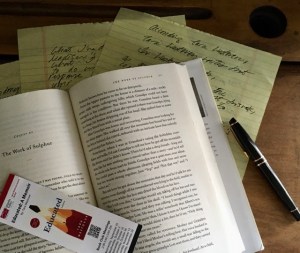 Reading your textual analyses demonstrated that an exercise in integrating quotations would be a valuable follow-up assignment. In academic writing, sentences never begin with quotations. Instead, they’re introduced with signal phrases, such as these:
 Welcome to our first drama workshop and our first WordPress gathering. Although I wouldn’t have chosen for us to work exclusively online as a community of writers, I value the opportunity that it will afford us, in May, to look back and weigh the merits of the two versions of our class: the before and the after–or, more accurately, the before and during (COVID-19 time).
 The points I have included below are not ones that you’re required to address in your comments. I offer them as suggestions only. I will probably address some of them in the follow-up remarks that I’ll post at the beginning of our second session.
 Chapter 22, “What We Whispered and What We Screamed,” marks a change in
 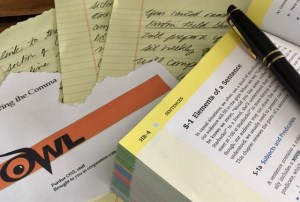 Your revised readings in The Norton Field Guide to Writing will prepare you for the six quizzes that you will complete during the remaining weeks of the semester. I selected the six subjects for the quizzes (words often confused, punctuation, precise words, active and passive voice, main points and support, and MLA documentation) based on patterns that I have identified in your essays. Most of the readings that will prepare you for the quizzes are in the yellow-edged Handbook section of Norton.
 This post serves as both a welcome back note and a blog entry on the writer’s craft, the second one I’ve written with you. (I posted the first one on
 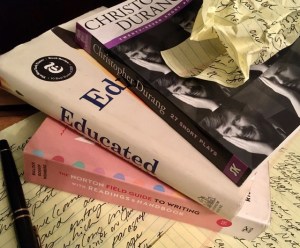 Another dovetail discovery occurred when my composition students were studying Chapter 11 of Tara Westover’s memoir, Educated. The latter half of that chapter, “Instinct,” depicts Westover’s brother Shawn reining in the frightened gelding, Bud, preventing him from throwing Tara.
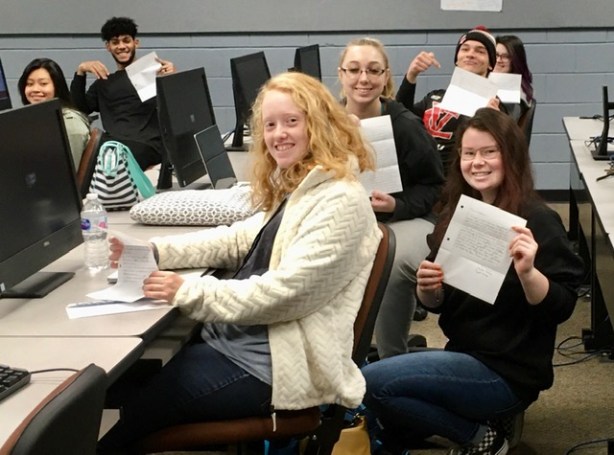 More than twenty years ago, in August of 1997, National Public Radio’s Morning Edition featured a story about Nancy Johnson, a second- and third-grade teacher who gave her students the assignment of writing letters to themselves, letters that covered such details as “their favorite toys, what makes them different from other kids and what they want to do in the future” (Morning par. 1). Johnson collected the letters and mailed them back to her pupils at the end of their senior year of high school. As I pictured Nancy Johnson’s eighteen-year-old students reading the words written by their seven- and eight-year-old selves, I began wondering how I might create a similar letter-writing experience for my college students. Following Johnson’s model wouldn’t be practical. My students’ addresses would change repeatedly throughout their twenties; I doubted that many of their letters would find their way back to them. Rather than requiring pieces of writing that might end up at the dead letter office, I crafted an alternate assignment. I required my students to write to themselves at the beginning of the semester, and I returned their letters to them on the last day of class.
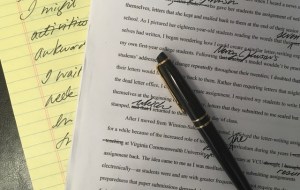 I was thinking about that last spring—how few of my students receive snail mail and how I wished more of them received replies—when it occurred to me that retirement communities offered potential pen pals—people who might not only welcome snail mail from college students but who might also write them back. Margaret Shepherd, author of The Art of the Handwritten Note, recommends that if you don’t know whom to write snail mail to, “reach out to deserving strangers” (qtd. in
 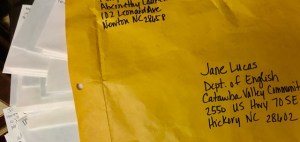 When the students composed their letters in class, some asked when they would receive a reply. I could only tell them, I don’t know when you will, or if you will. After a month passed and I hadn’t heard from Abernethy Laurels, it occurred to me that the activities director may have been overwhelmed by the number of letters she received, forty-one in all. And what if the residents didn’t want to write back? Or what if some wanted to reply, but couldn’t? I imagined the activities director transcribing letter after letter for residents with arthritic hands. If I had given her a formidable task, I didn’t want her to feel compelled to complete it. If I phoned or emailed to request an update, I might put her in an awkward position. So I waited until the first week of November to email her. She replied that the residents had responded to thirty-five of the letters and would soon complete responses to the remaining six.
 What makes a book a page-turner? If it’s fiction, it’s the narrative arc. If it’s nonfiction, it’s the same arc imposed on truths that are stranger than the lies of novels.
  I wrote my first research paper in seventh grade. All of us in Mr. Lord’s English class were required to select a subject of our choice, perhaps the subject had to be a historical figure. Whatever the case, I chose Albert Einstein. I remember sitting at the small, drop-front desk in my bedroom, printing sentence after sentence on three-by-five index cards. Mr. Lord had told us in class that we should limit each card to one fact. One of my most vivid memories of that project is the sight of my large, uneven letters spilling over onto the back of the cards. What I construed as one fact wouldn’t fit on one side.
