For my students’ final writing assignment in English 111: Writing and Inquiry, they compose a reflective essay that addresses the features of the course that have contributed to their development as writers and critical thinkers. As I embarked on this final assignment with them, my thoughts repeatedly returned to the hours they had devoted to playing Scrabble on Wordplay Days, a bimonthly feature that I included in my classes for the first time this semester.
 When the students in the Monday-Wednesday 8 o’clock class tore the plastic from the boxes of Retro Edition Scrabble, I had no idea how they would respond to the game. Back in August, when I had decided to include bimonthly Wordplay Days on the calendar, I did so to achieve two of my goals as a teacher: first, to offer students an opportunity to collaborate on low-stakes assignments that would develop their critical thinking skills and word power; and second, to provide another chance for them to turn away from screens.
A year earlier, in August 2017, when I revised my writing class curriculum to minimize my students’ screen time, I did so because both the research of psychologists and my own anecdotal evidence revealed the critical need to do so for the benefit of students’ mental health and cognitive development. With that in mind, I reserved more class time for my students to turn the pages of our textbook, to read aloud and pore over words, and to compose essay drafts in longhand—all while still maintaining blogs and devoting class time to typing essay revisions and posting comments to their classmates’ blogs.
Over the summer, as I looked back on the previous school year, I thought of the students’ faces. Some had seemed to express genuine interest, but more often they conveyed resignation or resistance. Research and my own observations of students’ progress assured me that my teaching practices were sound, but I remained troubled by how reading and writing away from the screen, rereading for deeper understanding, and putting pen to paper all seemed like drudgery to my students. How could I enliven the classroom? I asked myself. Scrabble came to me as an answer as I mulled over possibilities for collaborative classroom activities. By using a grading system with a participation and preparedness category, I am able to give students opportunities to improve their grades with low-stakes assignments, such as submitting monthly letters in stamped, addressed, and sealed envelopes. I do not grade the students on the quality of their letter writing (since I don’t read them). Instead, I grade them for the act of submitting the letters for me to mail.
I realized that I could similarly grade students for their participation in Scrabble Days, or—as I chose to call them—Wordplay Days, if I devised a score sheet that I could use to document their participation.
“Each team will appoint a scorekeeper,” I told the students on the first Wordplay Day, “but your grades will not be based on those scores. Instead, they will be based on your participation and the completion of the score sheet. If you participate in the game, don’t reach for your smartphones, and complete the score sheet, you will achieve one-hundred percent participation for the day.”
Then I held my breath.
The students gathered in their designated groups (drawn at random by a student volunteer) and began to play. When the class period ended, I had to remind them that it was time to leave. Let me repeat that: When the class period ended, I had to remind them that it was time to leave. What I had witnessed on that first Wordplay Day was not only students forming words on Scrabble boards but also posing questions about words (Is that a word?), and passing around the box top to study the rules of play. As they played, their postures and facial expressions changed. They were comfortable and happy. It’s not an overstatement to say that Scrabble transformed the classroom.
 Noting that transformation isn’t to say that all of the students liked Scrabble. Some clearly didn’t. But even the students who agreed that “Scrabble, to put it bluntly, is a lousy game” (Kay C5) seemed to appreciate the opportunity to earn credit for an activity that didn’t seem dull or menial. And their other work in the classroom began to seem less arduous to them. Perhaps they didn’t mind reading and writing as much when they knew more Wordplay Days were still to come. Or perhaps they began to make connections between their book work and board play as they increased their word power and became more sophisticated strategists.
One of the first reading assignments that followed the inaugural Wordplay Day focused on games—not board games but electronic ones. When my students and I read portions of Sam Anderson’s “Just One More Game . . .” in class, I was struck by his reference to Jane McGonigal. Anderson notes that “[i]n her book Reality is Broken, Jane McGonigal argues that play is possibly the best, healthiest, most productive activity a human can undertake—a gateway to our ideal psychological state” (108). What I witnessed when my students played Scrabble seemed to attest to that. But McGonigal, I later learned, is a video game designer. My awareness of the research that links screen time with increased anxiety, depression, and sleep deprivation (Twenge par. 43) makes the notion of video games as a “gateway to our ideal psychological state” (Anderson 108) seem perverse.
That said, I am not opposed to electronic versions of Scrabble and similar word games, such as Words with Friends. But replacing board-game Scrabble with its digital counterpart—or with another video game, or smartphone app—would be contrary to my aim of limiting students’ screen time. And bearing in mind the research, I believe there’s a critical need to repeat this unpopular line at the beginning of class: “Your digital devices should be tucked away.”
As the semester progressed, fewer students were staring at screens when I entered the classroom, and rarely—and in some classes never—did I find myself asking a student to put away a phone during a Scrabble game.
About a month before the semester’s end, on a day when the students enjoyed a scheduled break from classes, our school’s administrators, faculty, and staff were on hand for an event called the Tenth-Grade Extravaganza, which brings more than one-thousand high school students to our campus to learn about the college.
Late in the day, one of the campus administrators shepherded the last tour group to the Blackbox Theatre, where I was assisting the theatre professor and her student volunteers. The last portion of the Theatre Department’s tour took place in the costume area, where we had set up a station for selfies and group photos. On a table nearby, we’d placed hats and various props for students to pose with. As the students fiddled with the hats and props, trying one, then another, their shepherd-administrator nudged me and said: “That girl over there has looked sad throughout the tour, but when she put that sock puppet on her arm, her face lit up with joy.” When I turned and saw that tenth-grader’s joyful face, she became one of my own students who had transformed before my eyes. The sock puppet was her Scrabble.
My return this semester to public higher education marked my first experience with lockdown drills. While they are new to me, most of my students’ years in school have long been disrupted by periodic exercises in avoiding slaughter. Witnessing how quickly they sprang into action, how the protocol was second nature to them, was heartbreaking. As I crouched with them in the corner, I thought of how now, more than ever, classrooms need to provide our students with a gateway out of the darkness and into joy.
Works Cited
Anderson, Sam. “Just One More Game . . . : Angry Birds, Farmville, and Other Hyperaddictive Stupid Games.” The Norton Field Guide to Writing with Readings and Handbook. 4th ed., by Richard Bullock, Maureen Daly Goggin, and Francine Weinberg. Norton, 2016, pp. 105-110.
Kay, Jonathan. Review. “Scrabble is a Lousy Game.” The Wall Street Journal, 6-7 Oct. 2018, C.5.
Twenge, Jean. “Have Smartphones Destroyed a Generation?” The Atlantic, https://www.theatlantic.com/magazine/archive/2017/09/has-the-smartphone-destroyed-a-generation/534198/, Sept. 2017, Accessed 28 Aug. 2018.

 In “Proficiency,” one of the essays in


 I bought my first pair of Chuck Taylors at the Salvation Army when I was in high school. My then-boyfriend had introduced me to thrift-store shopping, much to my parents chagrin. They didn’t mind when my boyfriend and I combed the local flea market and thrift stores for vinyl records, but buying clothes there was a different matter.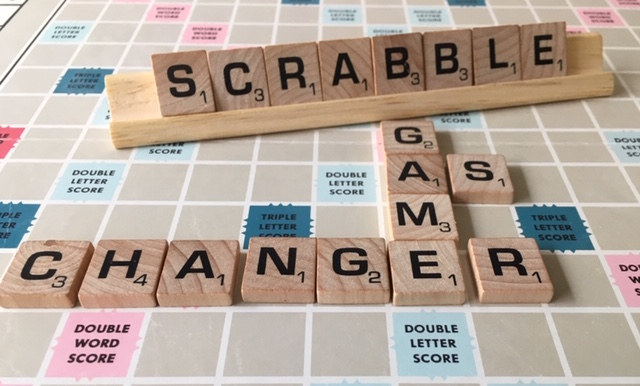
 In “Just One More Game . . . ,” journalist and critic Sam Anderson examines the appeal of hand-held video games—Tetris and its offspring—observing the concurrence of the crumbling of the Berlin Wall and Japanese game-maker Nintendo’s introduction of the Game Boy, the hand-held device that freed gamers to play wherever they chose. No longer were they confined to play within the walls of rec rooms and arcades.



 I never became an auction-goer, but I share my parents’ fascination with objects from the past. And I can trace the allure of artifacts back to those outings with them. Rather than standing and listening to an auction chant, I prefer the quiet pastime of browsing the shelves of antique shops and thrift stores. What appeals to me about such excursions is the possibility of the unexpected find: most recently a set of wooden letter blocks at