
Summary
Last week I asked you to focus your journal writing on the epigraph for Maus I, first by writing a short summary and afterward by writing about how the short two-page epigraph relates to Chapter 1.
Here’s my version of that journal exercise:
In Art Spiegelman’s epigraph for Maus I, “Rego Park, N.Y., c. 1958,” he recounts the events of a summer’s day when he was ten or eleven years old. He and two of his friends are racing together on roller skates until one of Artie’s skates comes loose and he falls. Rather than waiting for Artie, the other two boys skate away, leaving him behind to be the “Rotten egg” (5). After Artie returns home, his father asks why he is crying. When Artie tells his father what happened, his father questions his son’s use of the word “friend.” He replies, “If you lock them together in a room with no food for a week . . . / . . . Then you could see what is, friends! . . .” (6).
The cutting remark that Spiegelman’s father makes as he saws wood illustrates the communication breakdown between him and Artie. Spiegelman’s depiction of that gulf foreshadows the trials he will encounter: struggling to understand his father and himself as he aims to make meaning of their lives through his comics.
Notice how the first paragraph, the summary, does not express my opinion. By definition, summaries are objective. When you write a summary, you aim to convey a text’s main ideas in your own words but without offering your own opinion.
Analysis
In the second paragraph, I turn to analysis. I connect the father’s cutting, or unkind, remark to the sawing of the wood, which is itself an act of separation—a detail that I might add to the paragraph if choose to develop my analysis.
Summary and analysis are building blocks of both academic and professional writing. We summarize to increase our understanding of texts, and we analyze them to demonstrate our ability to think critically.
For more information on summary and analysis, see pages 63-64 of A Writer’s Reference.
Writing about Maus in Your Journal
After you complete each reading assignment in Maus, summarize it in your journal. You are not required to analyze each reading, but you should make note of any questions you have and points that you would like to address in class.
What to Focus on as You Read Maus
Because Maus is a memoir and your first essay assignment for English 111 is a literacy narrative, a form of memoir, focus on this question: How can Maus serve as a model for my own memoir, my literacy narrative?
In your literacy narrative, which you will draft and revise in September, you will write on one of these topics:
- any early memory about writing, reading, speaking, or another form of literacy that you recall vividly
- someone who taught you to read or write
- someone who helped you understand how to do something
- a book that has been significant to you in some way
- an event at school that was related to your literacy and that you found interesting, humorous, or embarrassing
- a literacy task that you found (or still find) especially difficult or challenging
- a memento that represents an important moment in your literacy development
- the origins of your current attitudes about writing, reading, or speaking
- creating and maintaining your WordPress blog

Maus isn’t a precise model; it’s a book-length comic rather than an essay, but Spiegelman’s memoir serves as a guide for us as writers. Here are some points to consider:
- Consider the title, Maus, the subtitle of the book, A Survivor’s Tale, and the subtitle of Part I, My Father Bleeds History. What does each one tell you about the book? After you decide on a topic for your literacy narrative, ask yourself what you want the title to tell the reader. Will your essay also have a subtitle? Sometimes the best title isn’t clear at the beginning of the writing process. Think about your title, but don’t get hung up on it. Return to it after you have finished drafting.
- Study Spiegelman’s scenes. Your narrative will include one or more scenes, but yours will be created solely with words, rather than with words and drawings. As you examine the panels in Maus, note which ones convey conflict, either a character’s inner conflict or a character’s conflict with another character. Conflict is essential to narrative.
- Note that the epigraph for Maus could be scenes in a literacy narrative. Imagine the two scenes in paragraph form. What would Art Spiegelman add as the final paragraph to give his readers some sense of the narrative’s significance? (What did it mean to him, and what did he learn from it?)
Spiegelman, Art. Maus I. Pantheon, 1986.
 It started with the rock. Actually, it started for me with the rock. For you, the story would start elsewhere, I’m sure. I came across the rock, now your rock, in the backyard shortly after my husband and I moved into the house. I was struck by the granite’s natural beauty, its graceful belt of pale stripes. I moved the rock from its cradle of broken bricks and overgrown grass to a spot on the corner of the deck. There I could see it from the window in the kitchen door, and from there I would soon see you, too.
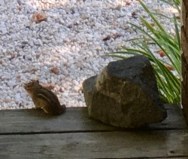 Now, as I continue to forage for the right words, I pause in my writing and picture you back on your perch, contemplating life. The stripes in the granite reflect the ones that border your curved back.
 Reading your recommendations for revisions last week reminded me of poet Marianne Moore’s relentless revisions, including changes to one poem titled “Poetry,” which she tinkered with for five decades. Many of her readers were puzzled and frustrated when they opened The Complete Poems of Marianne Moore (1967) to find “Poetry” radically reduced to three lines. Gone from the poem were thirty-five lines, including this metaphor that speaks to many forms of art: “imaginary gardens with real toads in them” (line 32).
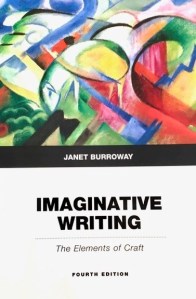 line breaks. In Imaginative Writing,
  Directions:
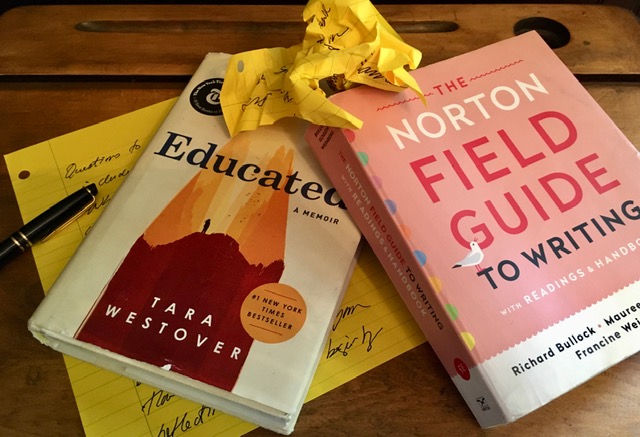
 As you revise your reflection for Wednesday, review the pages of The Norton Field Guide to Writing that cover key features (259-61) and methods of organizing a reflective essay (262-63).
 The presence of double slash marks in one of our workshop poems led me to reflect on the ways we use slashes in writing and how they both connect and separate (and/or). In a passage of prose that quotes lines of poetry, we use slashes, or virgules, to indicate a line break. Some playwrights use a slash mark to indicate the start of the next spoken line when one character talks over another. Since that stylistic convention doesn’t figure in the plays that we read in Imaginative Writing, I’m including an example here.
  Drama Follow-Up
 sample poem that I posted for you on Blackboard, is an ekphrastic poem that I wrote based on Momoyo Torimitsu’s Somehow I Don’t Feel Comfortable (the giant inflated pink rabbit in the photo) for an
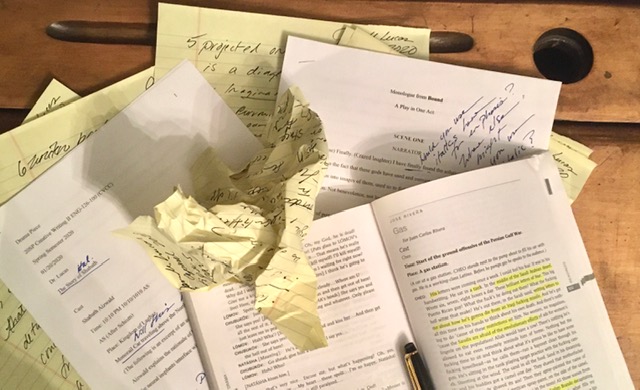 Welcome to our third drama workshop session, and thank you for your thoughtful feedback on The Slow Decline and the monologue from Bound. Before we turn to the untitled monologue and The Story of Shabath, I offer these follow-up notes:
 In the second paragraph of the monologue, Deen reveals the inciting incident, the event that creates the situation in which she finds herself: “and then they died.” In the fifth paragraph, she first mentions her current obstacle: the officer to whom she is pleading her case. Consider how altering the order of the details that Deen presents would affect the monologue’s tension and the audience’s perceptions of Deen.
