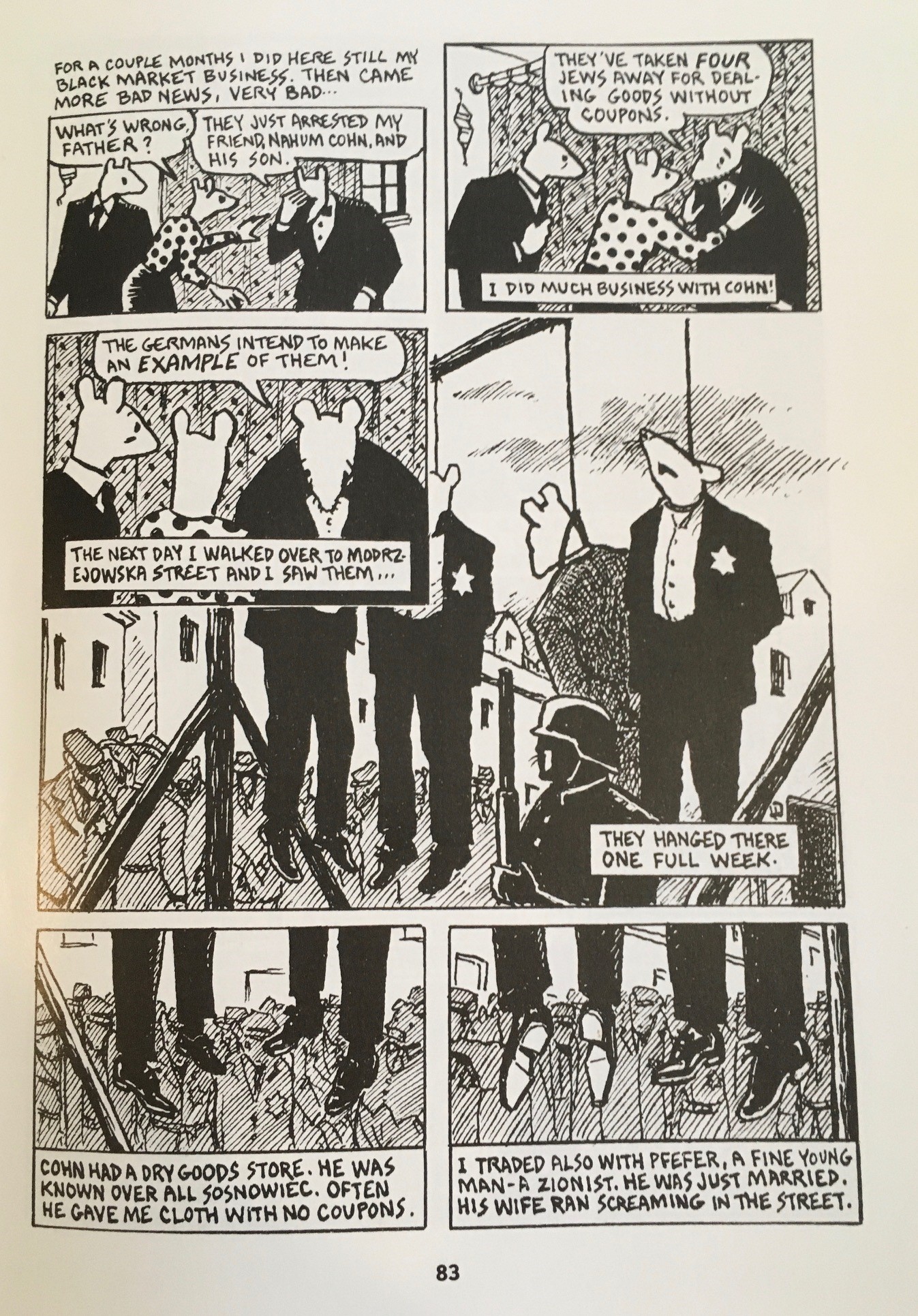
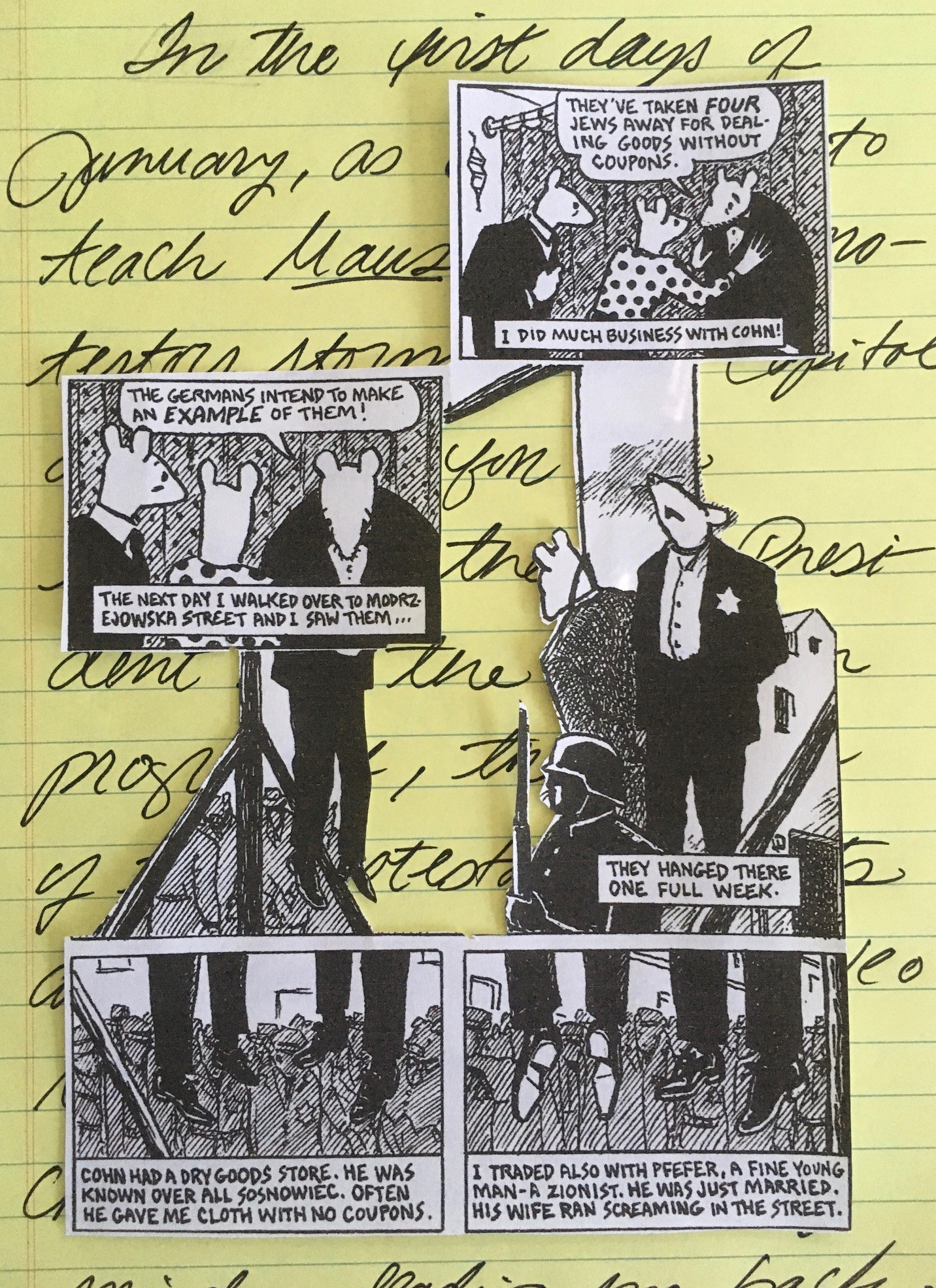
Today in class we will use the “Notice and Focus” strategy as we examine a page of Art Spiegelman’s graphic memoir Maus. As the authors of your textbook observe, the strategy “help[s] you to stay open longer to what you can notice in your subject matter” (Rosenwasser and Stephen 17).
We will closely examine the page featured above, write what we notice (not what we think or like/dislike about it), and discuss our observations as a way of moving toward analysis.
Afterward, we will study an analysis of the page that I wrote as a model for my students last semester. An MLA style copy of the analysis can be downloaded from the link that follows. The assignments that you submit to Blackboard–your own analysis and your other major assignments for English 1103–should follow the same format.
At the beginning of class on Wednesday, you will submit your completed worksheet for the first lesson in the Check, Please! series. If you did not receive a copy of the worksheet or you have misplaced yours, you can download and print a copy from the link below.
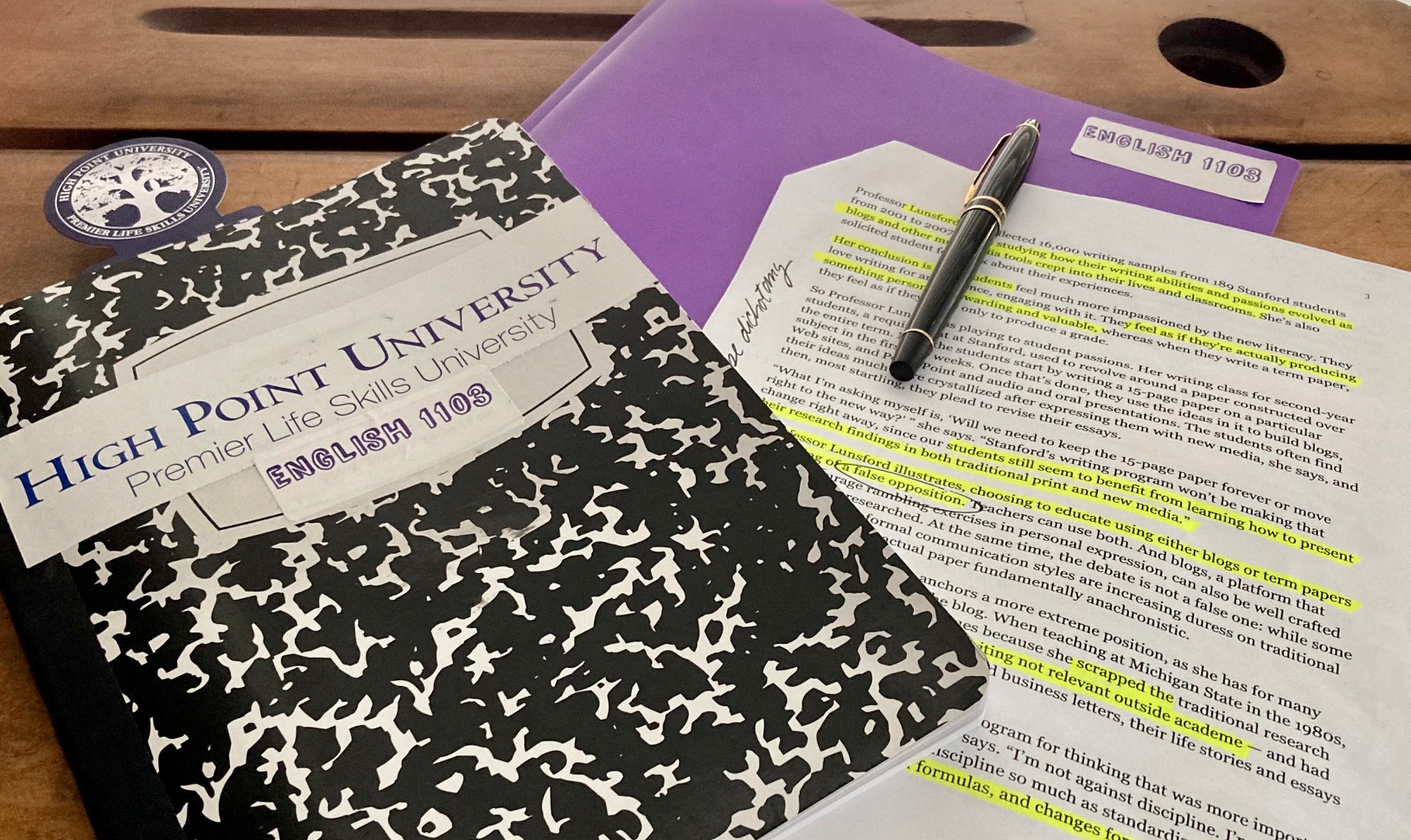
On Wednesday you will also begin drafting your analysis in class. That prelimary draft and the first drafts of all of your papers will be handwritten in class. Be sure to bring loose leaf paper, a pen with dark ink, and your copies of “Blogs vs. Term Papers” and “Skim Reading is the New Normal.”
Work Cited
Rosenwasser, David and Jill Stephen. Writing Analytically, 8th edition. Wadsworth/Cengage, 2019.
When I am not teaching, you may find me at the theatre preparing for another role. Though I have played an English teacher twice, I am often someone quite different from myself: a seventy-two-year-old bag lady, a medieval abbess, or a Spanish-speaking maid.
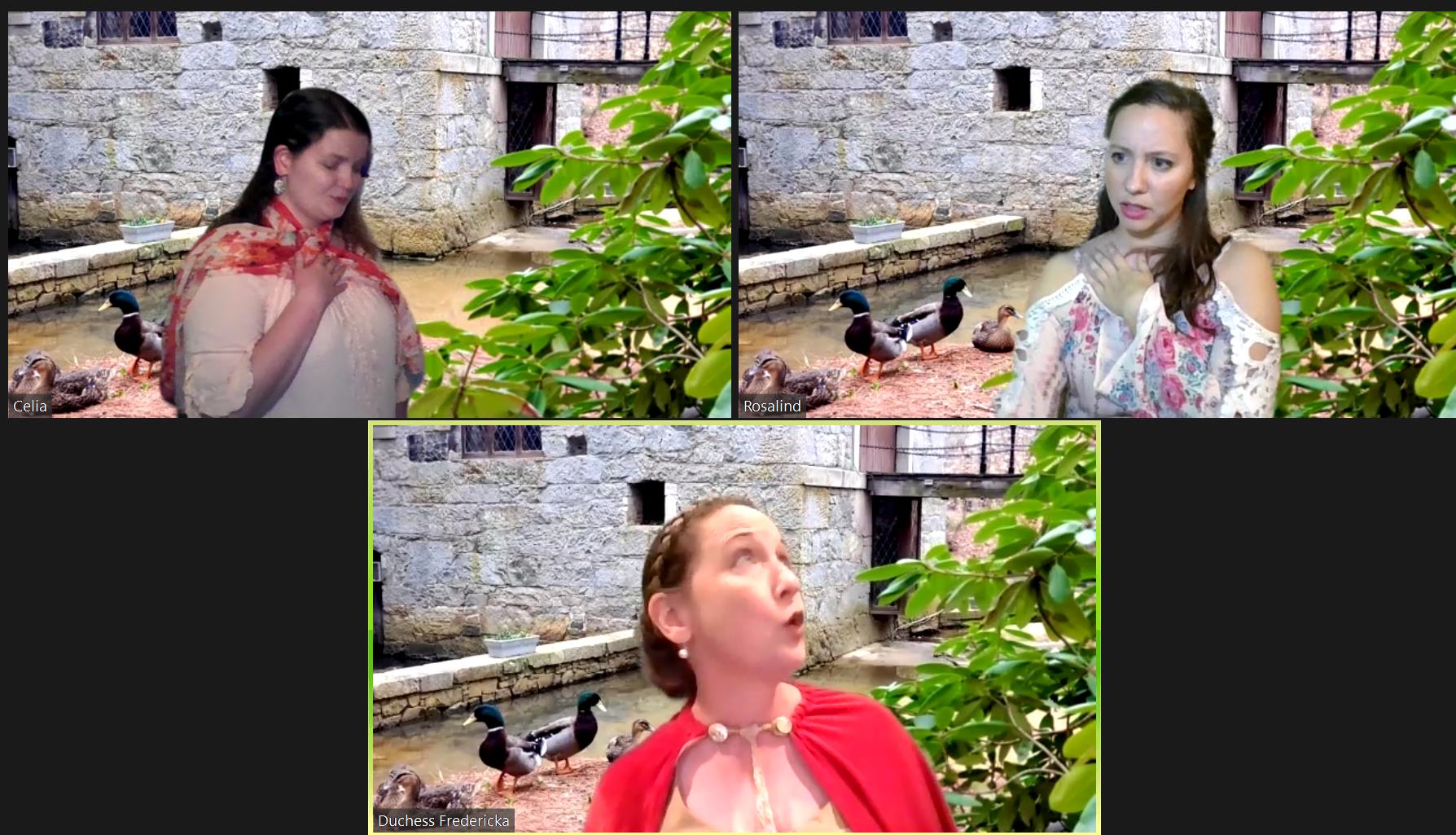
Clockwise from right: Rosalind (Stephanie Nussbaum), Duchess Fredericka (Jane Lucas), and Celia (Maggie Swaim) in dress rehearsal for the Shared Radiance Zoom production of As You Like It.
When the pandemic shut down live theatre, I found myself performing on a virtual stage, playing the role of Duchess Fredricka in the Shared Radiance Zoom production of Shakespeare’s As You Like It. Though I missed the face-to-face experience of live theatre, playing the duchess introduced me to performing on camera with a green screen and learning how to carry on conversations convincingly with actors who were invisible to me.
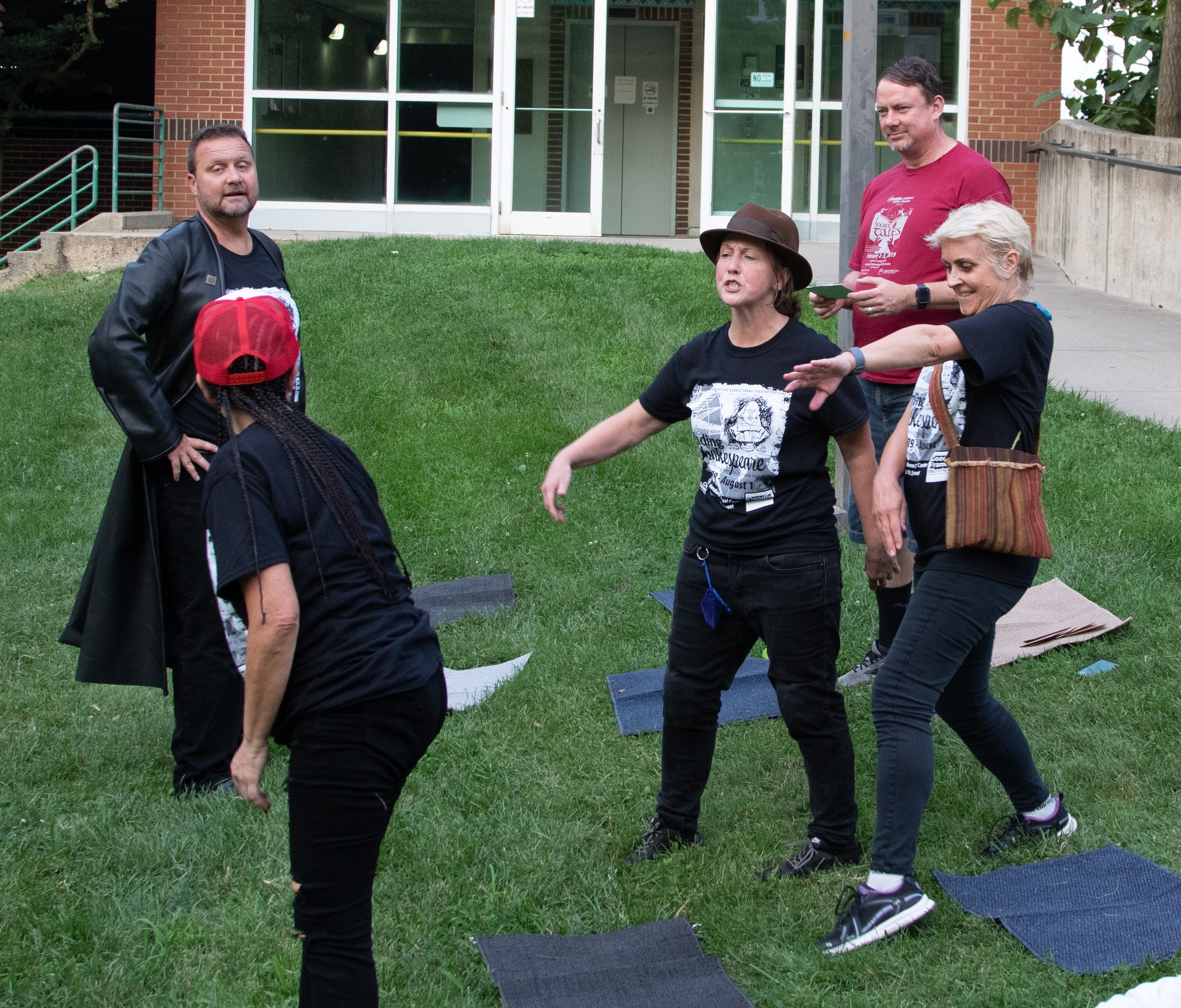
After the pandemic restrictions relaxed temporarily, I found myself performing live again but in a way that was new to me. Goodly Frame’s Finding Shakespeare required me to play three different characters in a fifteen-minute outdoor production of Shakespeare’s A Midsummer Night’s Dream.
Rehearsal for Goodly Frame’s Finding Shakespeare: A Midsummer Night’s Dream, (L-R): Theseus (Axel Tolksdorf), Lysander (Tabitha Stillwell Wilkins), Egeus (Jane Lucas), Creative Greensboro’s Todd Fisher, and Hermia (Sally Kinka) / Sam McClenaghan
Now actors find themselves in rehearsals akin to–but not the same as–the ones of our pre-pandemic nights at the theatre. They don literal masks until they step on stage to wear their figurative ones. I look forward to the days when I will not have to pull off a mask before I step into the light, but for now I am simply grateful for the innovative pandemic-era theatre opportunities I’ve had.
In class today, I distributed copies of two sample introductory posts for us to examine before we turned our attention to your own blogs. As you prepared to study the sample introductions, I asked you to keep in mind the “Cures for the Judgment Reflex” that your textbook’s authors outline in Chapter 1. As a preface to the cures, the authors offer this general rule:
“[T]ry to figure out what your subject means before deciding how you feel about it. If you can break the judgment reflex and press yourself to analyze before judging a subject, you will often be surprised at how much your initial responses change” (Rosenwasser and Stephen 11).
This semester we will follow that general rule each time we examine a text as a subject of analysis.
An additional copy of the exercise (with the two sample introductory posts) can be downloaded from the link below.
Remember that you need to email me your blog address, or URL, so that I can link your WordPress site to the course page. Most of you in the 9:15 class have already done that. Many of you in the 10:40 class still need to do so. If you encounter difficulties creating your blog or your first post, email help@wordpress.com. My students have maintained WordPress blogs since 2013, and no student has ever experienced a problem with a blog that WordPress wasn’t able to resolve eventually. If your blog isn’t up and running, don’t panic. Take a deep breath and email WordPress.
Along with the exercise, I distributed copies of the worksheet for the first of your five lessons in the Check, Please! assignment. Some of you in the 9:15 class left before I handed out the worksheets. If you did not receive one, you may pick up one in class on Friday, or download and print one from the link below.Submit your completed worksheet in class on Wednesday, September 8. That due date and the ones for your other Check, Please! lessons are included on the course calendar.
Friday marks our second Wordplay Day of the semester. To prepare for class, review the Scrabble site’s “Tips and Tools.” Unless you encounter technical difficulties with WordPress, your introductory post should be published before Friday’s class. We will begin examining your introductions in class next week. An additional copy of the blog overview and introductory assignment can be downloaded from the link below.
On Monday, after reviewing the material we covered in the first week of the course, we turned our attention to the newspaper column that you read for class, “Skim Reading is the New Normal,” by Maryanne Wolf, Director of the Center for Dyslexia, Diverse Learners, and Social Justice in the Graduate School of Education and Information Studies at UCLA.
Although Wolf’s Guardian column, like Matt Richtel’s article “Blogs vs. Term Papers,” is a newspaper piece, it is not a work of objective reporting. Rather than reporting on the ideas of researchers, educators, and consultants, as Richtel does in The New York Times, Wolf presents the findings of linguists, psychologists, and cognitive scientists whose recent work supports her claim that “[w]e need to cultivate a new kind of brain: a ‘bi-literate brain’ reading brain capable of the deepest forms of thought in either digital or traditional mediums.”
Exposition, Analysis, and Argument
Matt Richel’s article “Blogs vs. Term Papers” is exposition; it’s primary aim is to convey information. Wolf’s column is an argument. In our textbook, Writing Analytically, the authors offer this explanation of the difference between analysis and argument: The claim that an analysis makes is often the answer to the question, what does it mean? The claim that an argument makes “is often an answer to a should question” (Rosenwasser and Stephen 7-8). Similarly, Wolf’s argument is the answer to a need question. Her answer is “[w]e need to cultivate a new kind of brain.”
Matters of Style
In newspaper headlines, only the first word and proper nouns are capitalized.
In MLA (Modern Language Association) style, all words except articles, prepositions, coordinating conjunctions, and the to in infinitives are capitalized—unless the word is the first or last in the title or subtitle.
Newspaper articles include a space before and after the em dash.
MLA style includes no space before and after the em dash.
For more examples of documentation style, see OWL, Purdue University’s Online Writing Lab, and Writing Analytically, 255-63.
Next Up
In class on Wednesday, I will distribute copies of two sample introductory posts for us to examine before we turn our attention to your own blogs.
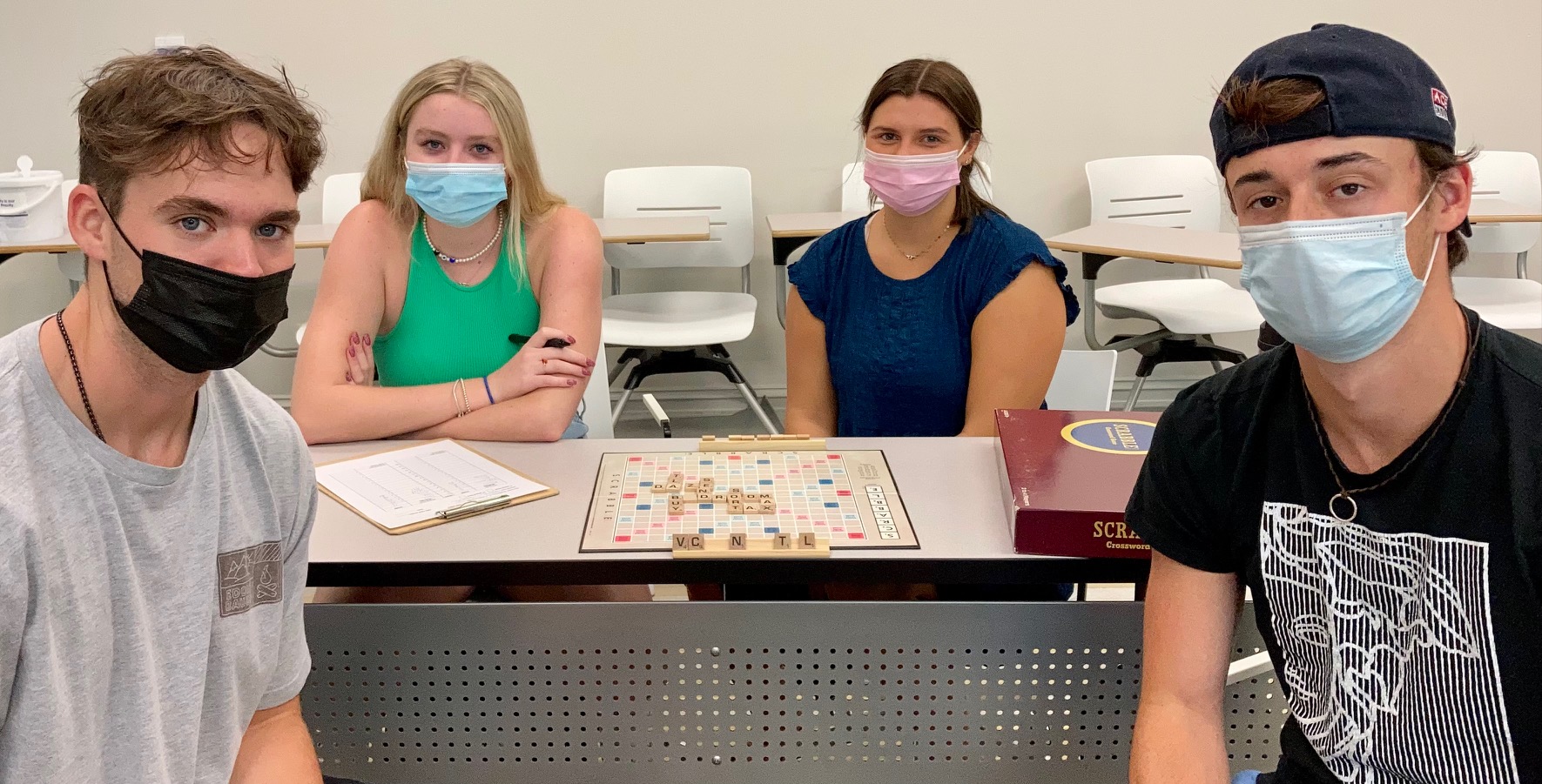
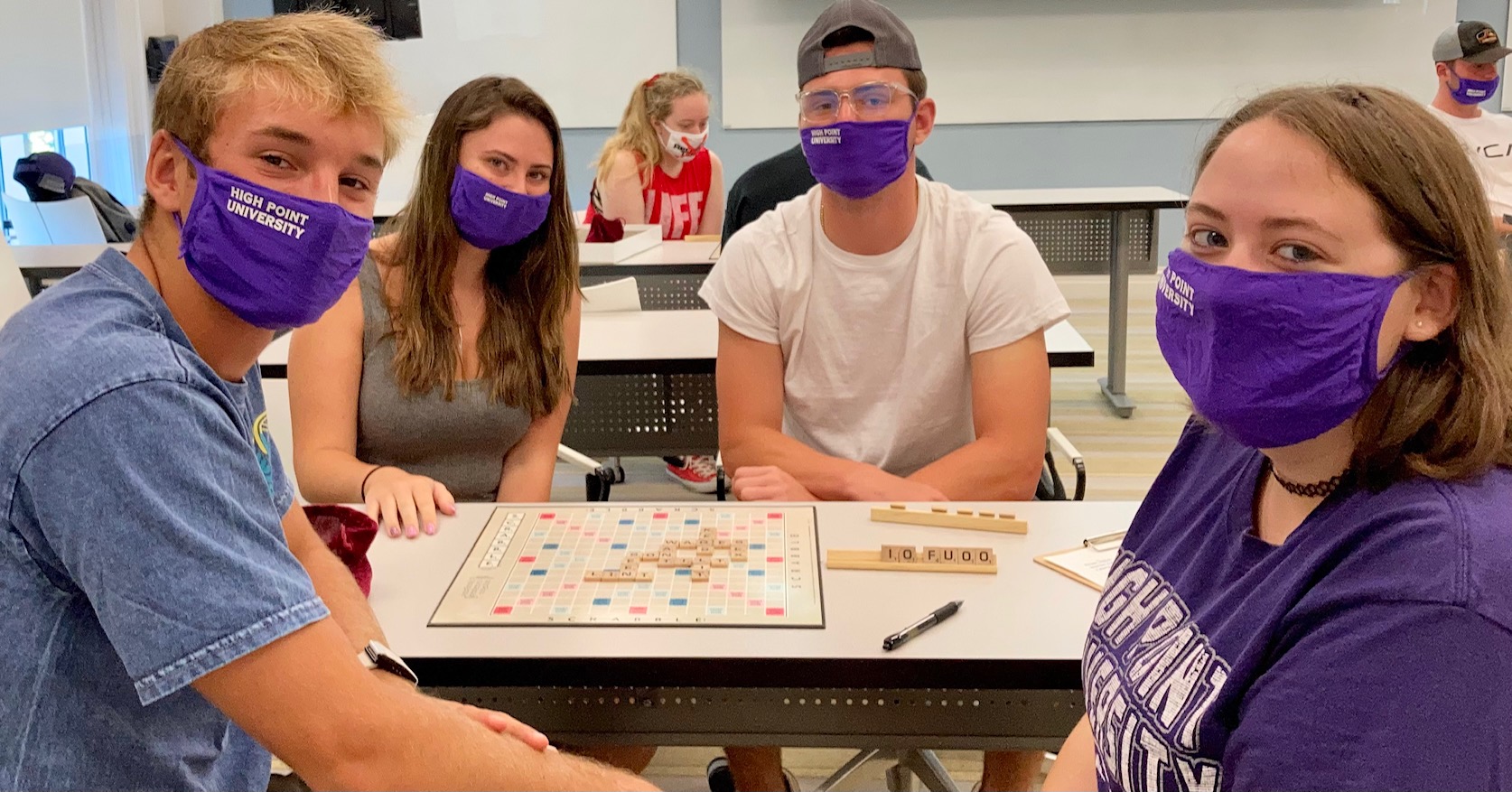
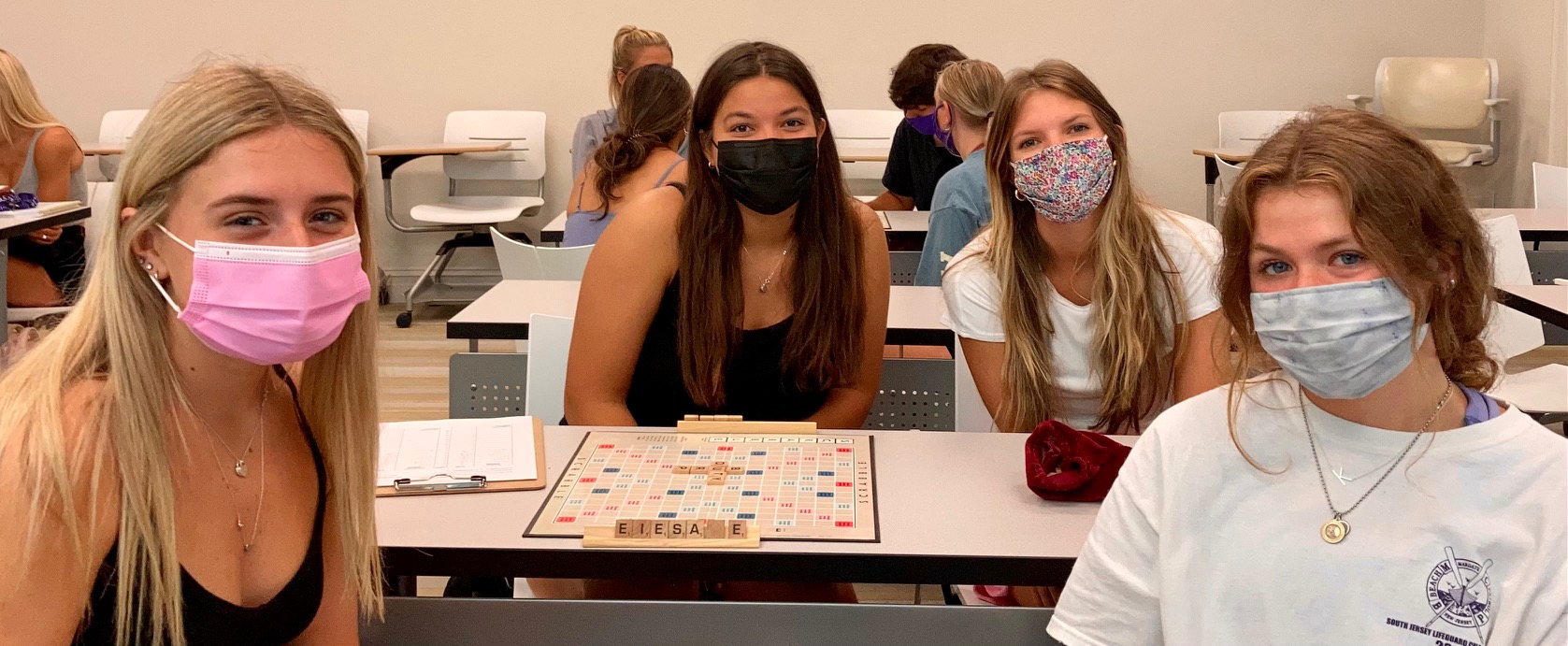
Ordinarily Wordplay Days are days when we all turn away from our screens, but yesterday I took the opportunity to photograph you as a way of helping us continue to put names with faces. In between the photographs of you and your classmates, I’ve included lists of some first names that are playable in Scrabble (because they are common nouns as well as proper ones). Continue to review these pictures and their captions to learn the names of your classmates, and study the lists of names in between to build your vocabulary.
10:40-11:50 a.m. (L-R): Christina Muniz, Madeleine Bee, Audrey Giles
Fay: to join together closely
Florence: a former European gold coin
Franklin: a nonnoble medieval English landowner
Fritz: a nonworking or semi-functioning state
Gilbert: a unit of magneto-motive force
10:40-11:50 a.m. (L-R): Braeden Thompson, Ryan Benjamin, Anderson Tracy, Kendall Krasinski
Gilly: to transport on a type of train car
Graham: whole wheat flour
Hank: to secure a sail
Hansel: to give a gift to, usually to commence a new year (also handsel)
Harry: to harrass
10:40-11:50 a.m. (L-R): Emma Steadman, Maddie Pierre, Julia Patti, Kiley McTamney
Henry: a unit of electric inductance
Herby: full of herbs
Jack: to hoist with a type of lever
Jacky: a sailor
Jake:okay, satisfactory
To learn whether a name is playable in Scrabble, type it in the box on the Scrabble Dictionary page, and click “GO!”
Next Up
For class on Monday, August 30, read “Skim Reading is the New Normal.” Afterward, compose brief reading notes in your journal. Include (1) the title and author, (2) the main points, and (3) any questions or observations you would like to address in class. If you are unfamiliar with any of the terms in the article, look up their meanings and jot those in your journal as well.
Today in class, you identified one of the ideas expressed by three of the education experts featured in Matt Richtel’s article “Blogs vs. Term Papers”: Douglas B. Reeves, William H. Fitzhugh, and Andrea A. Lunsford. Collaboratively, you paraphrased each idea in a sentence that began with the person’s name and credential. As a model, I offered the example below.
Example: Professor Cathy N. Davidson of the City University of New York maintains that blogging offers students a more relevant alternative to the traditional term paper (ctd. in Richtel).
The abbreviation “ctd.” lets readers know that the idea is cited, or mentioned, in Matt Richtel’s article.
Indirect Quotations
If I had quoted Davidson, rather than paraphrasing her, the abbreviation “qtd.,” for “quoted,” would appear in parentheses to indicate that I quoted Davidson. Both a paraphrase of Davidson’s words drawn from Richtel’s article, and a direct quotation of her words drawn from Richtel’s article are referred to as indirect quotations because Davidson is a source who is cited or quoted in another source (Richtel).
In our discussion of Richtel’s article, I noted that Davidson was a professor at Duke at the time the article was published in The New York Times. One student asked how a writer should address such a change. One option is an explanatory endnote; you can also include it in the sentence itself, as I do in the example that follows.
Example: As a professor at Duke, Cathy N. Davidson turned to blogs to offer students a more relevant alternative to the traditional term paper (ctd. in Richtel). Now at the City University of New York, she continues to embrace new technologies.
When to Paraphrase, When to Quote
I could have asked you to quote Reeves, Fitzhugh, and Lunsford, but putting their ideas into your own words requires more thought, and more specifically moves you closer to analysis. As the authors of your textbook note: “You will almost invariably begin to interpret a source once you start paraphrasing its key language” (Rosenwasser and Stephen 221).
Summary and Analysis
A summary objectively presents key points; it answers the question, what is it? An analysis answers the questions, what does it mean, and how is itsmeaning constructed?
Here is the summary that I wrote in my notebook after I read Matt Richtel’s article.
In “Blogs vs. Term Papers,” Matt Richtel reports on the debate in higher education on how best to teach writing in the digital age. While some professors have followed the lead of City University of New York’s Cathy Davidson, replacing the traditional term paper with shorter, more frequent blog assignments, their detractors—including Douglas B. Reeves, columnist for The American School Board Journal and William H. Fitzhugh, editor of The Concord Review—argue that blog writing lacks the academic rigor that fosters critical thinking. For Andrea Lunsford, professor of writing at Stanford University, pitting blogs against term papers creates a false opposition. Rather than replacing term papers with blog posts, Lunsford requires students to produce multi-modal assignments: term papers that evolve into blogs, websites, and video presentations.
Summarizing the key points of the article led me to think about the article’s structure, how Richtel presents Davidson’s ideas followed by Reeves’ and Fitzhugh’s, returns to Davidson’s, introduces Lunsford’s, and ends by returning again to Davidson’s. In the 9:15 class we considered this possible interpretation of Richtel’s choices:
By devoting more of his article to Davidson’s and Lunsford’s practices–and ultimately giving Davidson the last word–Matt Richtel reveals that he favors their approaches to teaching writing over the ideas advocated by Reeves and Fitzhugh.
In the 10:40 class, we considered that interpretation as well as a second one:
Matt Richtel devotes more of his article to Davidson’s and Lunsford’s practices–and ultimately gives Davidson the last word–because she and Lundsford are innovators. Richtel doesn’t need to detail ideas that are already familiar to his readers.
Both are valid claims; the success of either depends on how effectively the writer presents evidence as support.
Logical Fallacies
Richtel’s article “Blogs vs. Term Papers” mentions two common types of logical fallacies to avoid:
Reductio ad absurdum is a form of the straw man argument. It involves oversimplifying an opponent’s argument by reducing it to an absurdity.
False opposition or false dichotomy implies that two possibilities are mutually exclusive. Richtel’s headline–in all likelihood written by a copy editor rather than himself–indicates a false dichotomy. (A term paper can be presented as a blog post.) False opposition is one form of hasty generalization.
For more on logical fallacies, see Writing Analytically, 93-97.
Next Up
This Friday, August 27, will mark the first of our weekly Wordplay Days. To prepare for class, read the Scrabble Rules and review the Ground Rules for Wordplay posted on Blackboard (and below). To up your game, browse the Scrabble site’s Tips and Tools.
Required materials for English 1103, sections 18 and 19. (L-R): Mask, Writing Analytically by David Rosenwasser and Jill Stephen, class notebook/journal, pocket portfolio, and loose leaf paper
Am I the person who will teach your English 1103 class? I posed that question yesterday as a starting point for analysis, one of the key features of the course.
To begin the collaboration and inquiry that will figure prominently this semester–along with analysis–you worked together in groups to find the answers to some of the most frequently asked questions about the course. Continue to review the syllabus, which is posted in the Information section of Blackboard. An additional copy of the syllabus is included at the end of this blog entry. If you have any questions about the assignments, the course policies, or the calendar, please let me know.
Textbook
All of you in sections 18 and 19 of English 1103 are required to have the paperback edition of the textbook, Writing Analytically, 8th edition, by David Rosenwasser and Jill Stephen. Bring your copy to class on the days when the title, Writing Analytically, appears in bold on the course calendar. On those days, we will examine portions of the chapters in class and complete some of the “Try This” exercises.
Your first reading assignment in the textbook is scheduled for September 1, which will give you time to order and receive your copy before you are required to have it in class. (Unlike my copy, pictured at the top of this blog entry, your textbook will not be in a binder.)
Other Required Materials
Class notebook/journal—bring it to every class.
Loose leaf paper (for drafts and short in-class assignments)—bring to every Monday and Wednesday class
Pocket portfolio (for class handouts)—bring to every class
Mask–wear in every class
These required materials are listed on page 2 of the syllabus with the exception of the mask. The mask policy is included on page 5.
WordPress Blog
As practice in developing your web literacy and writing for a broader online audience, you will maintain a free WordPress blog for the class. As soon as possible, create a free blog at wordpress.com. After you create your blog, email the address, or URL, to me, and I will link your blog to our class page, English at High Point.
You will post to your blog (1) an introduction to yourself (see Blackboard later this week for assignment details), (2) your creative project, and (3) revisions of the essays and the portfolio that you will produce for the course.
You may also be asked to post comments to your classmates’ blogs and to mine. The posts that you publish for class will be public.
If you would like to create additional posts that are not public, keep them in draft form or choose the private visibility option.
If you encounter technical difficulties creating your blog or publishing a post, email help@wordpress.com or contact the HPU Help Desk: helpdesk@highpoint.edu, 336-841-HELP (3457).
Next Up
For class on Wednesday, August 25, read “Blogs vs. Term Papers.” Afterward, compose brief reading notes in your journal. Include (1) the title and author, (2) the main points, and (3) any questions or observations you would like to address in class. If you are unfamiliar with any of the terms in the article, look up their meanings and jot those in your journal as well.
I hope that you will maintain your blog after the semester’s end and continue to seek other ways for your writing to have a life outside of the classroom.
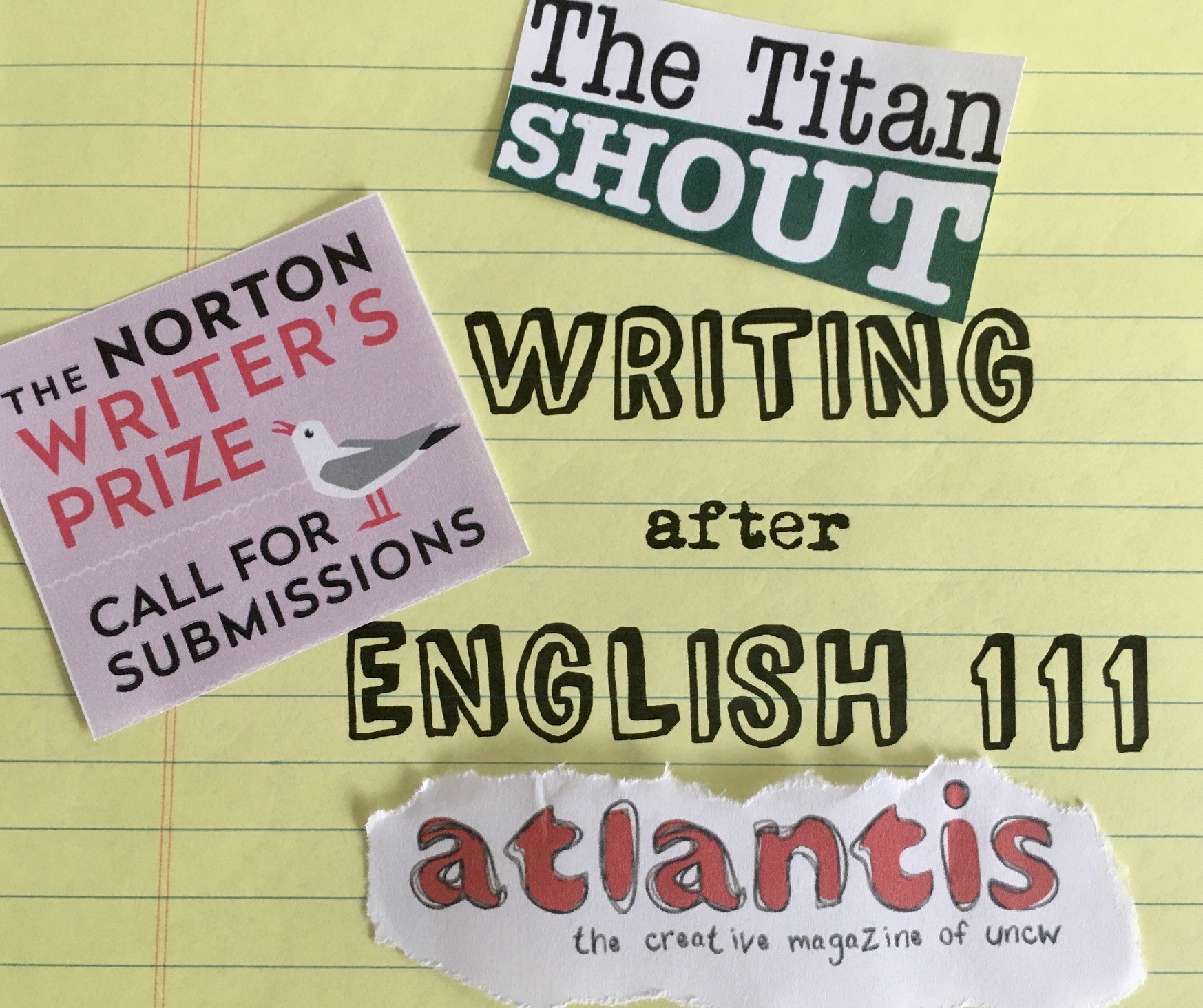
Submitting your work to contests and publications offers you an opportunity to build your résumé. A list of prizes and bylines will increase your chances of landing the internships and jobs you seek.
Your literacy narrative and your textual analysis are both eligible for the annual Norton Writers prizes awarded for undergraduate writing. If you would like for one of your essays to be considered, please email me as soon as possible. A faculty member can nominate only one essay per year. The deadline is June 15.
Explore the possibility of writing articles for GTTC’s newspaper, Titan Shout, and consider submitting your literacy narrative to GTCC’s literary magazine,the Titan Review. For more information on Titan Shout and Titan Review, contact Zac Goldstein, Assistant Professor of English: zjgoldstein@gtcc.edu.
Many college literary journals accept submissions only from students at their own institution, but UNC-Wilmington’s Atlantis accepts submissions from undergraduate and graduate students enrolled at any college in the state of North Carolina (public, private, and community colleges). Check the Atlantis web page for their fall and spring submission periods.
To help you through the process of completing your end-of-semester requirements, I have compiled the checklist that follows.
Make sure that (1) your introductory post, (2) your revised literacy narrative, (3) your revised analysis of Maus, and (4) your revised reflection remain published on your blog until final grades are posted in WebAdvisor on Monday, May 10. Also make sure that you have deleted all placeholders/sample posts from your blog.
Complete the ENG 111 Post-Assessment no later than Friday, May 7. Scroll down your Moodle site to the course labeled ENG 111 Assessment (Spring 2021) to locate the post-assessment.
If you have worked one on one with our embedded tutor, Catherine Titus, please respond to the embedded tutor survey no later than May 12. I have not included a link to course evaluations here because the evaluation site closed on May 2. I hope that you evaluated ENG 111 as well as your other courses.
If you have issues editing your blog, visit the support page, https://wordpress.com/support/. If you cannot find a solution there, email help@wordpress.com.
Also look to the Titan Hub, https://www.gtcc.edu/student-life/tutoring-center-for-academic-engagement/titan-hub.php, as a resource. Located on the third floor of the Learning Resource Center on campus, the Titan Hub is open 9-4 Monday-Friday. The Hub can help you with all technical matters related to your course work at GTCC. In addition to visiting Titan Hub on the third floor of the LRC, you can contact the hub by phone or email: 336-334-4822, ext. 50318, cae@gtcc.edu.
In the first days of January, as I prepared to teach Maus again, protestors stormed the Capitol and called for the hanging of the Vice President. As the semester progressed, the sound of the protestors’ chants and the image of a neo-Nazi T-shirt in the crowd lingered in my mind, leading me back repeatedly to Art Spiegelman’s depiction of the hanged merchants in Modrzejowska Street. Turning again and again to the same page of Maus solidified my decision to devote my analysis—the one I would write as a model for my students—to the panels that depicted the hangings, but I did not know how I would write about them. The prospect daunted me not only because of the painful nature of the images but also because I had written a sample analysis of Maus only a few months earlier as a model for my fall semester students. Perhaps I’ve already written all I can write about Maus, I told myself. But returning to the pages of Spiegelman’s memoir revealed that I did, after all, have more to write. Studying Spiegelman’s depiction of the hangings in Modrzejowska Street and finding the words to express my interpretation of those panels deepened my understanding of both Maus and the writing process.
The central image of the four hanged merchants, the one that evoked images of January 6, remained the panel that drew me back to the page. But as I continued to study it, I found myself drawn less to that panel in isolation than to its relationship to the ones that framed it. My observation that the bordering panels both linked the hanged men to their mourners and disconnected them from their persecutors, the Nazis, led me to my thesis: “His [Spiegelman’s] rendering of the panels of the living in conjunction with the fragmented panels of the hanged merchants simultaneously conveys connection and separation: both the grieving survivors’ ties to the dead and the hanged men’s objectification at the hands of the Nazis.”
That statement served not only as my thesis but also as an example to my students of how to develop an idea with a common form of appositive, a noun phrase that offers additional information. As we examined my analysis in class, I pointed to the abstract concept of “connection and separation” and showed how the appositive, the noun phrase that followed the colon, shows readers the specific “connection and separation,” namely “both the grieving survivors’ ties to the dead and the hanged men’s objectification at the hands of the Nazis.”
That learning opportunity grew from an essay that I had doubted would ever find its way to the page. The fact that it did take form illustrates the surprising rewards that the writing process yields.
This school year, perhaps more than any other, has demonstrated the value of writing as a mechanism for making sense of the world. Studying a Holocaust narrative is never easy. But writing to make meaning of Maus now—as we continue to don our own masks—honors the path that Spiegelman himself followed in his struggle to make meaning of his father’s life, a story that we sense, in the words of journalist Adam Gopnik, “is too horrible to be presented unmasked” (qtd. in Wilner 109).
Though I doubted that I could write a second analysis of Maus, facing the challenge expanded my understanding of Spiegelman’s achievement and strengthened my writing and teaching, providing me with another model essay for my students. As we continue to reckon with racial injustice and cultural and political division in our own country, Vladek Spiegelman’s story serves as a sobering reminder that the atrocities his son depicts in Maus are not relics of another place and time—or, as I wrote in the conclusion of my analysis, that “[t]he strange fruit of our past, both distant and recent, should seem far stranger.” As I began to put these words on paper, Derek Chauvin was convicted for the murder of George Floyd; but as I progressed from draft to revision, Andrew Brown, Jr., was shot and killed by sheriff’s deputies in Elizabeth City. As we continue to pick up the pieces of our broken world, I return to the page with the hope that putting pen to paper will also help my students—not only develop their writing but also make sense of it all—as we move toward renewal.
Wilner, Arlene Fish. “‘Happy, Happy Ever After’: Story and History in Art Spiegelman’s Maus.” Considering Maus: Approaches to Art Spiegelman’s “Survivor’s Tale” of the Holocaust, edited by Deborah R. Geis, U of Alabama P, 2003, pp. 105-21.






 Jane Lucas