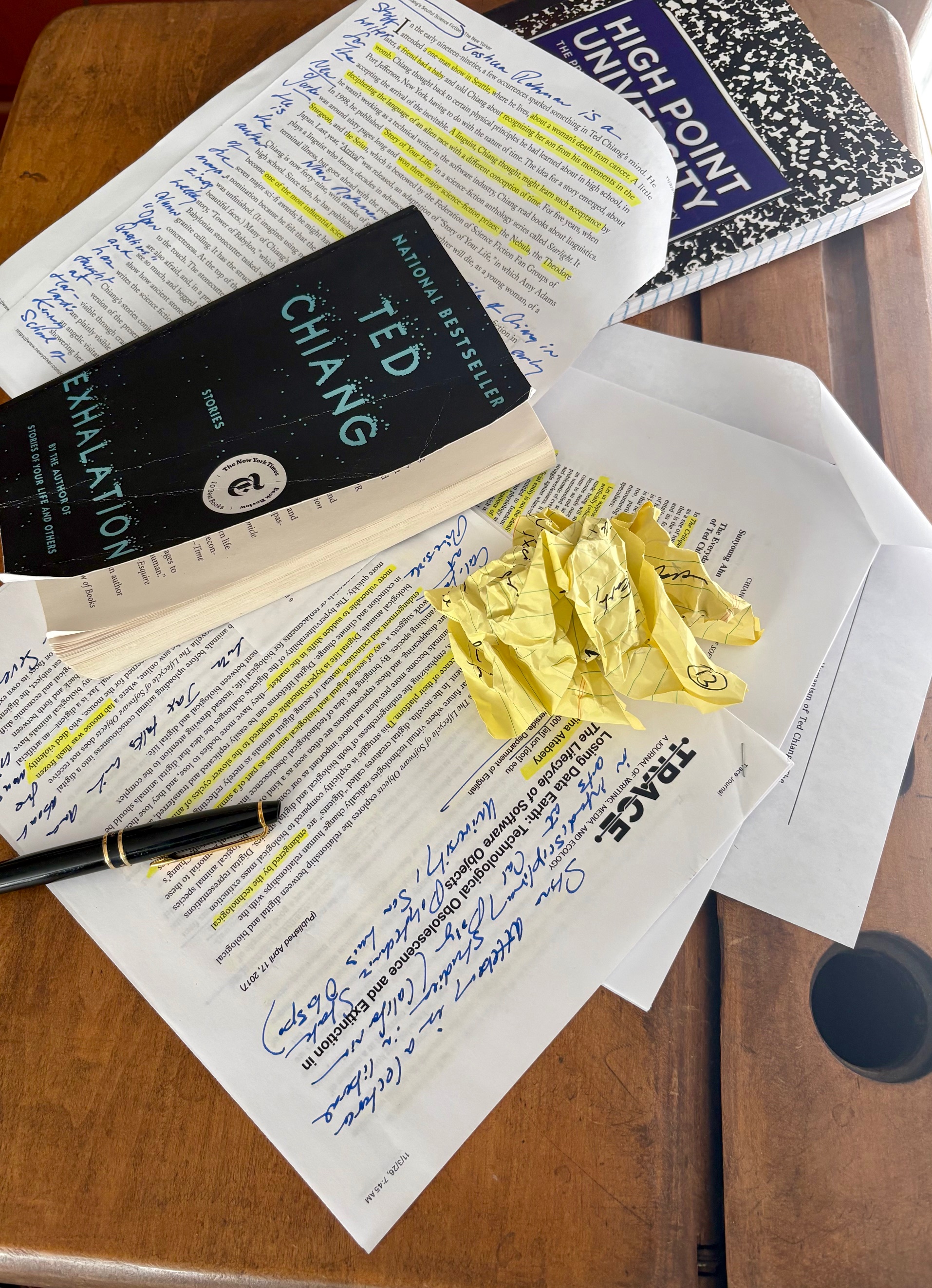
The research and writing for your annotated bibliography and preface culminates this week with the submission of your revison to Blackboard and WordPress and the reflection you will write today in class. Directions for your reflection follow.
Directions
Compose a reflective essay that documents your research and writing process and includes at least one relevant quotation that complies with the directions in yesterday’s class notes.
Questions to consider in your reflection include the following:
- When you began transferring the words from your handwritten annotations and preface to your laptop or tablet, what did you observe about the process?
- When you searched for sources, did you follow the model in the November 2 blog post for using AI ethically? If so, did the conversation lead you to an article or book chapter for your bibliography? If so, which source did the AI assistant locate?
- What aspect of the writing seemed the most challenging? Locating relevant sources through the HPU Libraries’ databases or through Google Scholar? Composing your annotations? Developing the preface? Why did that aspect seem the most challenging?
- Did your subject change? If so, what was your original subject, and why did you change it?
- Did either of the sample bibliography and prefaces (“All Hail the King” or “Soul-Searching Science Fiction”) prove helpful to you? If so, which one? How was it helpful?
- What do you consider the strongest element of your annotated bibliography and preface?
- Did any examples in the theoretical frameworks handout give you an idea for a lens that would guide your research if you chose to develop your bibliography and preface into a larger project for an upper-level course? If so, which ones?
- What is the title, and at what point in the process did you decide on it? Did you change the title during the writing process? If so, what was the original title?
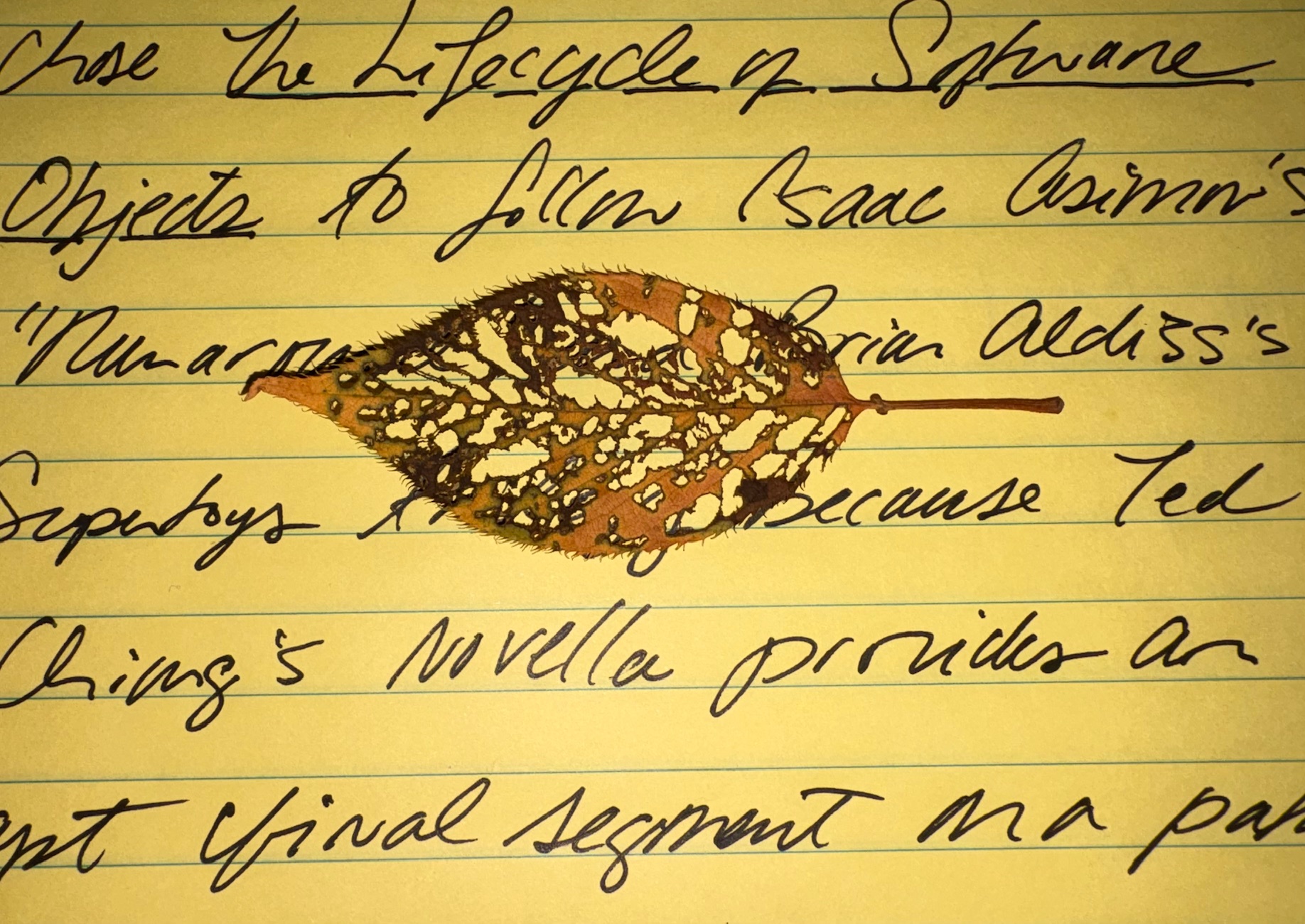
- What image that documents part of your writing process away from the screen did you include in your blog post? Why did you choose that particular image?
- To which relevant website did you include an embedded link in your blog post?
Sample Annotated Bibliography and Preface
Yesterday in class, I distributed copies of “Soul-Searching Science Fiction,” the annotated bibligraphy and preface that I wrote as a model for you. An additional copy of that model follows.
Soul-Searching Science Fiction: An Annotated Bibliography on Ted Chiang’s The Lifecycle of Software Objects
Preface
For the sequence of science fiction readings for my first-year writing classes, I chose The Lifecycle of Software Objects to follow Isaac Asimov’s “Runaround” and Brian Aldiss’ Supertoys trilogy because Ted Chiang’s novella provides an apt final segment on a path of advances in artificial intelligence that parallels its real-world trajectory. The A.I. that increasingly shapes our daily lives is not mirrored in the pages Asimov’s, Aldiss’s, and Chiang’s stories, but their fictional landscapes offer an analog virtual reality where we can wrestle with the same issues their characters face.
I discovered Chiang’s novella as a possible reading for my classes when I was browsing lists of freshman and all-campus book selections. Exhalation: Stories (which includes The Lifecycle of Software Objects) caught my eye as one of the books listed that featured artificial intelligence. As I read Chiang’s novella for the first time, I was struck by the true-to-life quality of the protagonists, Ana Alvarado and Derek Brooks. For all their virtues, the characters in “Runaround” and the Supertoys stories tend toward types: the greedy corporate chief and his neurotic housewife, the polar-opposite astronauts (one man of thought, another of action). Ana and Derek, however, embody contradictions as people marked by their ambivalence about the artificial intelligence that occupies their days as professionals and later their personal lives as they assume the role of caregivers. For Ana and Derek, becoming parental figures for Neuroblast digients results from their work in jobs they had never imagined for themselves. Readers first meet Ana “preparing for a job interview, the first one in months to reach the video conference stage” (62), but that interview never happens. Instead, the company hires someone else. Though Ana inhabits the realm of science fiction, the scarcity of employment opportunities she faces will be a reality for my students, young men and women who will enter a workforce altered by A.I. in ways we cannot fully predict.
While I was impressed by the verisimilitude and grace of Chiang’s prose, I was surprised he had achieved a degree of critical and commercial success rarely attained by a writer with a relatively small output. He has published only two collections, Stories of Your Life and Others (2002) and Exhalation: Stories (2019), but has won four Nebula awards, four Hugo awards, six Locus awards, and the John W. Campbell Award for Best New Writer. And in 2020, he was inducted into the Science Fiction and Fantasy Hall of Fame. What sets Ted Chiang apart from his contemporaries and elevates him to the status of a master of his craft? That question prompted me to research The Lifecycle of Software Objects.
Chiang’s choice to depict Ana as an animal communications specialist enables Chiang to juxtapose human interactions with biological animals and digital entities. Through Ana’s meditations, readers see the two forms as more alike than different. That link became clearer to me as I continued to read, and I was gaining a sense of the holistic approach that distinguished his fiction. Yet reading Stina Attebery’s study introduced me to another connection, one I had not considered. Although in my own reading I had grown aware of the parallels between the vanishing worlds of animals and software, Attebery’s article demonstrates how the humans in Chiang’s novella could follow a similar path to obsolescence. In Attebery’s words, “[T]he novella portrays digital technologies as hypervulnerable to many of the same forces of exploitation that impact the lives of animals, children, and corporate employees” (par. 25).
Ana and Derek try to shield their digients from that exploitation, and Chiang’s rendering of their willingness to sacrifice for their loved ones stems from the author’s notion of how artificial life should be nurtured in its early stages: “‘[W]hat makes any human being a good, reliable worker? . . . . A hundred thousand hours of good parenting, of unpaid emotional labor. That’s the kind of investment on which the business world places no value; it’s an investment made by people who do it out of love’” (qtd. in Rothman, par. 10).
Those observations of Chiang’s led him to write The Lifecycle of Software Objects, a novella that in turn led me to the research in the bibliography that follows. Along with Chiang’s novella, it contains four additional sources: Attebery’s “Losing Data Earth,” a second peer-reviewed article, a New Yorker profile, and a student interview. My research could lead to a larger interdisciplinary examination of biological and digital life in Chiang’s fiction and its real-world parallels. However, as an English professor and a writer, my primary interest lies in the craftsmanship of his prose. Whether my research leads to a more formal analysis of his fiction—a close study of his figurative language, perhaps—the research presented in my bibliography will inform my teaching when I return to the pages of Ted Chiang’s novella next semester.
Annotated Bibliography
Ahn, Sunyoung. “The Everyday Life of Artificial Intelligence: The Humanism of Ted Chiang’s The Lifecycle of Software Objects.” Science Fiction Studies, vol. 47, no. 1, Mar. 2020, pp. 73–92. EBSCOhost, https://doi.org/10.5621/sciefictstud.47.1.0073.
In Sunyoung Ahn’s “The Everyday Life of Artificial Intelligence: The Humanism of Ted Chiang’s The Lifecycle of Software Objects,” Ahn cites French philosopher Henri Lefebvre’s The Critique of Everyday Life (1977), in which Lefebvre speculates “that in the not-too-distant future human cells will be created artificially (which is perfectly conceivable) and given consciousness” (qtd. in Ahn 73). From that premise, Lefebvre supposes that such artificial intelligence will experience the same struggles in everyday life that humans face. For Ahn, that philosophy of Lefebvre’s aligns with Ted Chiang’s depiction of his digients’ development and their relationships to the trainer Ana Alvarado and animator Derek Brooks, the humans who work with the digients at Blue Gamma and later become their caregivers. Ahn notes that such scenarios in science fiction are rare: Rather than turning to the trope of the cautionary dystopian tale, Chiang presents characters who “take responsibility for their own creation[s]” (88) and who, along with the digients, “stay useful and relevant by constantly modifying themselves” (87).
Ahn’s study delineates Chiang’s focus on the formative stage of artificial intelligence as a point of contrast to AI as it is widely imagined as “developed, perfected, and therefore culminant” (78). Ahn demonstrates the singular vision of The Lifecycle of Software Objects as a narrative in which “humans anthropomorphize the digients” (87) and the digients lead the humans to “think digitally” (87).
Sunyoung Ahn, an associate professor of English at Korea University in Seoul, is the author of “New Sincerity, New Worldliness: Post 9/11 Fiction of Don Delillo and David Foster Wallace.”
Attebery, Stina. “Losing Data Earth: Technological Obsolescence and Extinction in The Lifecycle of Software Objects.” Trace: A Journal of Media, Writing, and Ecology, 17 April 2017, http://tracejournal.net/trace-issues/issue1/07-attebery.html.
In “Losing Data Earth,” Stina Attebery examines Ted Chiang’s The Lifecycle of Software Objects as a narrative in which digital entities do not substitute for their dwindling counterparts in the wild but instead experience obsolescence that parallels the endangerment and extinction of biological animals. Attebery suggests that the Neuroblast digient Jax’s anxiety regarding his vanishing platform, Data Earth, indicates that digital life may be “hypervulnerable compared to the slow cycles of animal death found in extinction and climate change” (par. 4).
Attebery’s study elucidates how life forms whose genomes are written in code—both the digients in Chiang’s novella and real-world digital entities—are surprisingly similar to biological animals in terms of their risk for endangerment. In Attebery’s words, “[d]igital life forms can be easily replicated and transformed and are more vulnerable to shifts in the market” (par. 4). As Attebery explains, since Chiang’s Neuroblast digients’ Data Earth virtual environment is a casualty of corporate takeover, and they cannot run on the newer platform Real Space, they are deemed irrelevant, but those technological changes alone do not lead to their change in fortunes. Because they are not task-oriented like the newer Sophonce digients, they are perceived as lacking commercial value.
Stina Attebery is a lecturer in interdisciplinary studies in liberal arts at Cal Poly (California Polytechnic State University, San Luis Obispo). She is the author of “Coshaping Digital and Biological Animals: Companion Species Encounters and Biopower in the Videogames Pikmin and Pokémon.” She also serves as managing editor for the Eaton Journal of Archival Research in Science Fiction.
Bowry, Skylar. Interview. Conducted by Jane Lucas. 6 Nov. 2026.
Skylar Bowry reflects on first encountering Ted Chiang’s novella The Lifecycle of Software Objects as required reading in English 1103: Academic Research and Writing, a class in which the reading assignments differ significantly from those of her high school English courses. Although she had never read Chiang’s fiction before and wasn’t a fan of sci-fi, she notes, it “kept my attention and pulled me in, so I actually enjoyed it. It made me like that type of fiction.”
Bowry’s observations provide a first-person account of an undergraduate’s initial experience with Chiang’s fiction. Her recollections of high school English reveal that her classes focused on short works of nonfiction, mostly news articles. That emphasis reflects a shift in the secondary education English curriculum prompted by the release of the Common Core Standards in 2010, which stipulate that 70% of high school seniors’ reading should be nonfiction and only 30% should be literature.
Skylar Bowry is a freshman criminal justice major at High Point University, where she is enrolled in English 1103, section eight.
Chiang, Ted. “The Lifecycle of Software Objects.” Exhalation and Other Stories. 2019. Vintage,2020. pp. 62-172.
Ted Chiang’s novella The Lifecycle of Software Objects chronicles twenty years in thelives of its protagonists, Ana Alvarado and Derek Brooks, two software firm employees who—because of shifting economic and environmental landscapes—devote their days to jobs that differ markedly from the careers they imagined for themselves. Ana, a zoologist by training, finds herself training digients, short for digital entities, at the start-up company Blue Gamma. Her coworker, animation artist Derek Brooks, designs avatars for the digients that comply withthe company’s specifications rather than his own aesthetic preferences. Though initially Ana and Derek’s interactions with the digients are limited to the workplace, as the novella progresses and Blue Gamma folds, the digients enter their personal lives, with Ana and Derek taking on the roles of caregivers.
As a primary source for studies of Chiang’s writing, The Lifecycle of Software Objects presents a possible microcosm of his wider fictional world. In the opening pages of the novella, readers do not meet the one-dimensional characters typical of genre fiction but rather two true-to-life twentysomethings forced to pivot from their life plans. Juxtaposing The Lifecycle of Software Objects with other novellas and stories of Chiang’s enables readers to identify patterns in his fiction and determine whether the verisimilitude of Ana and Derek’s narrative is the exception or the rule.
Ted Chiang is the author of two short story collections: Stories of Your Life and Others and Exhalation: Stories. He has won four Hugo Awards, four Nebula Awards, and the Pen/Malamud Award for Short Story Writing. His story “The Story of Your Life” is the basis for the Academy Award-winning film Arrival. In 2023, Time magazine named him to its list of One Hundred Most Influential People in A.I.
Rothman, Joshua. “Ted Chiang’s Soulful Science Fiction.” The New Yorker, 5 January 2017, https://www.newyorker.com/culture/persons-of-interest/ted-chiangs-soulful-science-fiction#rid=0e7a1ee1-66e1-4887-9ee2-6ec69a30630f&q=ted+chiang%27s+soulful+science+fiction.
Joshua Rothman’s New Yorker profile of Ted Chiang combines his reflections on the author’s first collection, Stories of Your Life and Others (2002), and his novella, The Lifecycle of Software Objects (2010), which was published alone by Subterranean Press before it was included in the collection Exhalation: Stories (2019). To his observations on those works of fiction, Rothman adds excerpts from a series of interviews conducted with Chiang in late 2016 to coincide with the film release of Arrival, the adaptation of his story “The Story of Your Life.” Regarding The Lifecycle of Software Objects, Rothman notes Chiang’s assertion that the novella “grew . . . out of his intellectual skepticism about how artificial life is imagined in science fiction” (par. 10).
“Ted Chiang’s Soulful Science Fiction” offers Rothman’s insights into the quality of Chiang’s writing that sets him apart from his contemporaries. Rothman observes, “Chiang has been described as a writer of ‘humanist’ sci-fi; many readers feel that his stories are unusually moving and wonder, given their matter-of-fact tone, where their emotional power comes from” (par. 6). Rothman does not pinpoint the source of their emotional power, but the response he elicits from Chiang provides a sense of it: “‘[W]hat makes any human being a good, reliable worker? . . . . A hundred thousand hours of good parenting, of unpaid emotional labor. That’s the kind of investment on which the business world places no value; it’s an investment made by people who do it out of love’” (qtd. in par. 10). The vital role of parenting at the heart of Chiang’s statement is also a key factor in both Sunyoung Ahn’s and Stina Attebery’s studies of his novella, and the humanism Rothberg notes is central to Ahn’s analysis.
Joshua Rothman is a staff writer for The New Yorker. He is the author of the magazine’s weekly column “Open Questions” and has taught at Harvard’s Kennedy School of Government.
Next Up
Wordplay Day! To prepare for class, revisit the Merriam-Webster Scrabble Word Finder page, and review your journal notes and the blog posts devoted to Scrabble tips.

