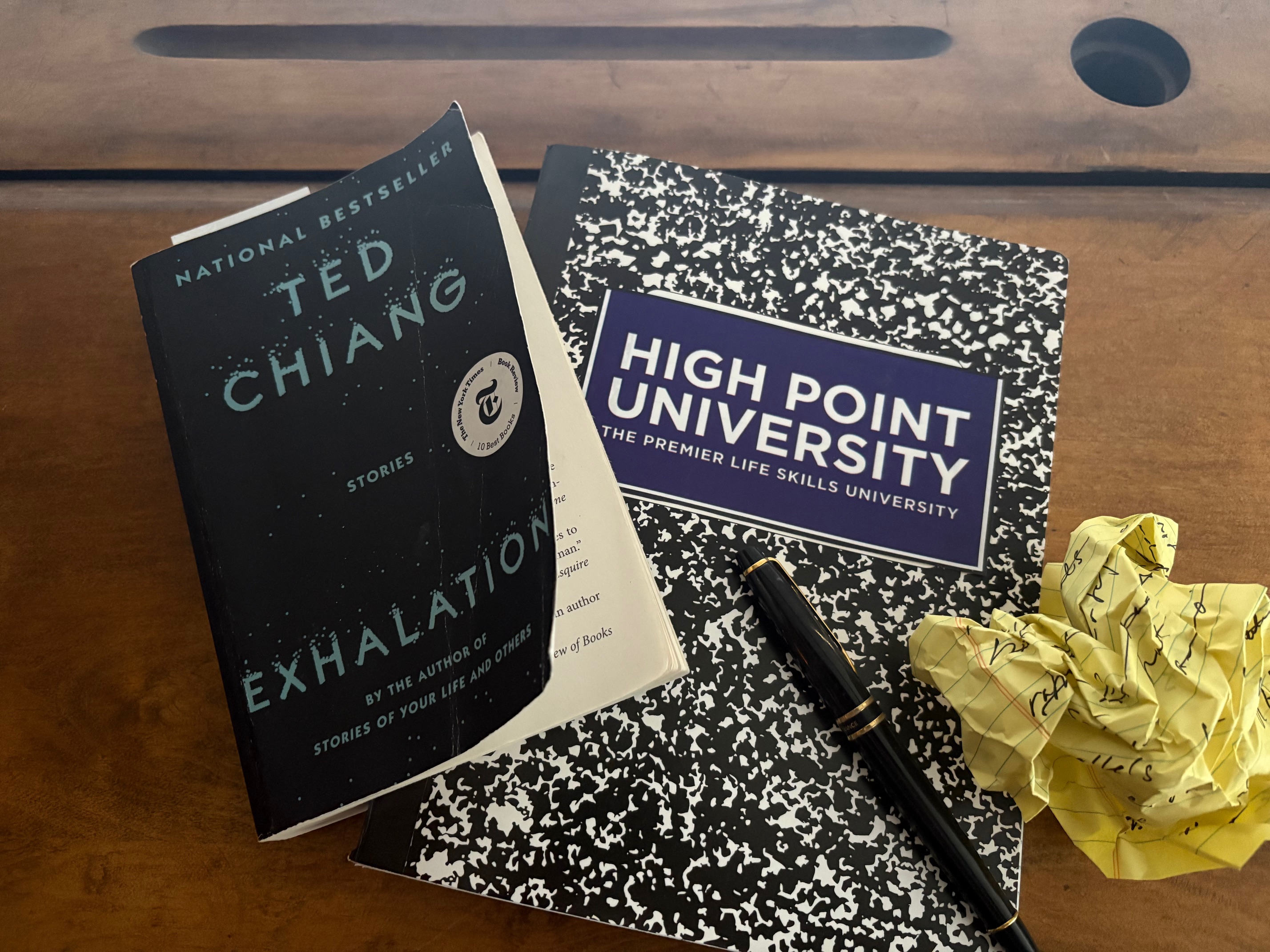
This morning, after your Scrabble debriefing, you and two or three of your classmates will compose a short written response to one of the developments in your recent reading in Ted Chiang’s The Lifecycle of Software Objects. The two prompts you will choose from follow.
- The Sophonce digient Voyl and his owner, Gerald Hecht, enter the narrative through a conversation the Neuroblast digients Marco and Polo have with Derek Brooks, their caregiver. Why does Ted Chiang introduce Voyl and Hecht into the story, and what may their circumstances indicate about the future of the digients?
- Ted Chiang’s depictions of Ana Alvarado and her Neuroblast digient, Jax, show the two interacting in both of their terrains: in the physical world through Jax’s SaruMech robot body, and in the virtual world through Ana’s avatar. Later, Jax tells Ana about witnessing a different attempt to merge digital and biological life. Why does Ted Chiang include that exchange between Jax and Ana, and what may it indicate about the digients’ future?
Continuing Your Research and Writing
After you complete your group exercise, you will have the remainder of the class period to work independently on your annotated bibliography and preface.
Tasks to undertake include these:
- Using the HPU Libraries databases to locate an additional source and begin reading that article or book chapter.
- Composing or revising an annotation for a source.
- Reviewing the sources you have gathered and noting what similarities and differences you can identify among them. Those similarities and differences may serve as additional material for your preface or the commentary paragraphs in your annotations.
- Drafting your preface.
- Determining a theoretical lens for a larger project that may develop from your final essay and annotated bibliography.
In the last few minutes of class, you will compose a short piece of writing, a minimum of one complete sentence, that notes the particular task, or tasks, that you undertook during class.
Unexpected Finds–Sample Annotation
Last Thursday’s class notes detailed how perusing the works cited list for the peer-reviewed article “The Everyday Life of Artificial Intelligence: The Humanism of Ted Chiang’s The Lifecycle of Software Objects,” by Sunyoung Ahn, led me to three potential sources, one of which I have decided to include in my bibliography as a second peer-reviewed source. You are required to include only one peer-reviewed article or chapter from a university press book, but you are welcome to include more than one.
Tomorrow’s class notes will include a draft of my annotated bibliography entry for my second peer-reviewed source: “Losing Data Earth: Technological Obsolescence and Extinction in The Lifecycle of Software Objects,” by Stina Attebery.
Next Up
On Wedenesday, we will examine Chapter Eight of Ted Chiang’s The Lifecycle of Software Object, and you will have additional time to devote to your research and writing.

