Posted in Reading, Teaching, Writing

A Closer Look at Klosterman, on the Page and the Stage

Chuck Klosterman / visitingwriters.lr.edu

To introduce my students to the writing of pop culture critic Chuck Klosterman—last night’s featured writer in Lenoir-Rhyne’s Visiting Writers Series—I assigned “My Zombie, Myself: Why Modern Life Feels Rather Undead.” Of the dozens of columns and essays of Klosterman’s I could have assigned, I chose his commentary on zombies in part because of the continuing popularity of zombies in general, and in particular the comic-book-turned-TV series The Walking Dead, now joined on AMC by its prequel, Fear the Walking Dead. I also chose “My Zombie, Myself” because it’s a well-constructed argument, one that makes the same moves that we make in academic writing.

In class on Wednesday, my students collaboratively examined “My Zombie, Myself,” identified its components, and summarized the essay’s argument with their answers to these questions:

  1. What is the standard view of zombies?
  2. What is Klosterman’s claim about them?
  3. What is Klosterman’s support for his claim?
  4. What naysayers or counterargument does Klosterman address?
  5. What does Klosterman write to convey why it matters? (Who cares why zombies are the monster of the moment?)

As the students in my 8 a.m. class collaboratively composed their summaries, I drafted this one of my own:

In ‘My Zombie, Myself: Why Modern Life Feels Rather Undead,’ Chuck Klosterman challenges the standard view that the monster of the moment personifies our unconscious fears, claiming instead that battling the undead provides us with an allegory for our daily lives. In Klosterman’s words, ‘[t]he principal downside to any zombie  attack is that the zombies will never stop coming; the principal downside to life is that you will never be finished with whatever it is that you do.’ To those who contend that zombies have merely replaced vampires as the current it-monster, Klosterman says their argument is deceptive.  He maintains that the Twilight series isn’t about vampires but about ‘nostalgia for teenage chastity, the attractiveness of its film cast and the fact that contemporary fiction consumers tend to prefer long serialized novels that can be read rapidly.’ Klosterman reminds us that our zombie fixation matters because they “come at us endlessly (and thoughtlessly),” like all of the annoyances of life, but we can manage them.

Last night I was reminded of Klosterman’s claim about the popularity of zombies—how they’re an allegory for our daily lives—when interviewer Mike Collins, host of WFAE’s Charlotte Talks, asked him about the continuing popularity of the reality show Survivor. In response to Collins’ question—why is it still so popular after so many years?—Klosterman said that what you see over and over in Survivor is the elimination of the oldest and the weakest first, then you see the elimination of the strongest, the contestants who are perceived as the biggest threats. What Survivor really rewards is mediocrity, Klosterman said, and that’s something that we see in our own lives.

Near the end of the interview—which covered topics ranging from Klosterman’s childhood in North Dakota, to his work at ESPN and Spin, to his interviews with Taylor Swift and Tom Brady, to the presidential candidates—Klosterman spoke about his writing process. I think that most writers come up with a thesis and then write about it, he said. What I do is write about what interests me and then look for a thesis.

Klosterman’s method is far more common than he realizes. It’s the one I use, and the one I encourage my students to use when their assignments give them the opportunity to see their interests “through academic eyes” (Laff qtd. in Graff 250).

Works Cited

Graff, Gerald. “Hidden Intellectualism.” “They Say/I Say”: The Moves That Matter in Academic Writing. Eds. Gerald Graff and Cathy Birkenstein. 3rd ed. New York: Norton, 2014. 244-51. Print.

Klosterman, Chuck. “My Zombie, Myself: Why Modern Life Feels Rather Undead.” The New York Times. The New York Times, 3 Dec. 2010. Web. 11 Nov. 2015.
Posted in Reading, Teaching, Writing

Q&A with Rob Peace’s Nick Carraway

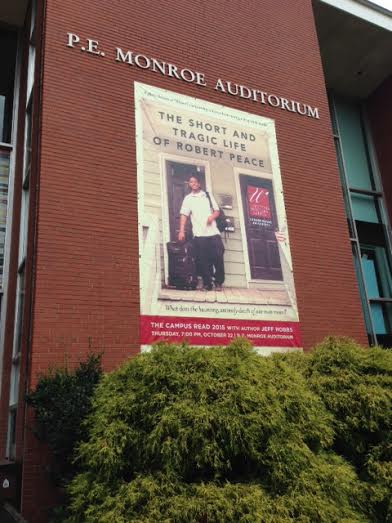
Yesterday afternoon, Jeff Hobbs—one of the featured authors in Lenoir-Rhyne’s Visiting Writers SeriesSTLRP Bannerconducted a Q&A session with an audience primarily of students, mostly freshman who are reading his book The Short and Tragic Life of Robert Peace for their FYE (First-Year Experience) classes. As Hobbs began to speak, I was reminded of the phone conversation that he recounts in Chapter 12: “You sound like a mouse,” Rob says, “same as you did in college” (295). Though I thought his voice was too low-pitched to be mouse-like, I could see how Rob had found it mousy—and admittedly it was, as Hobbs describes in Chapter 12, “soft-spoken” and “halting” (295).

Yet despite the “soft-spoken” and “halting” quality of Hobbs’ voice, he delivered powerful responses to students’ questions. When someone asked, what made you want to write the book? Hobbs answered with remarks about the vast array of mourners—evidence of the variety of people whose lives had been touched by Rob—echoing Hobbs’ words in Chapter 17:

The line for the viewing was two blocks long and one of the most diverse collections of people I’d ever seen: Yale students and professors, people conversing in Portuguese, Croatian, and Spanish, young and old residents of all of the boroughs of New York City and all the townships surrounding Newark. (388)

Near the end of Hobbs’ Q&A, my thoughts returned to Chapter 12, when in response to a question regarding how the process of writing the book had affected him, Hobbs answered that it made him “lament the nature of male friendship,” which he illustrates in his reflections on his conversation with Rob:

Jeff Hobbs / visitingwriters.lr.edu

The distance between us and the maleness of our friendship precluded revealing anything that truly mattered, and at the time I was too naïve to know that if you were friends with someone—truly friends—then you told him what was going on (“It’s called ‘catching up,’” my wife informed me when I asked how it was possible for her to yap with her girlfriends for as long as she did and share every innocuous detail of her life). Instead, I thought that by concisely presenting the most easygoing and put-together version of myself, I was being ‘all good.’ (295-96)

Hobbs did not address his writing process—something he may have spoken about at one of his other two appearances at L-R, Thursday evening and Friday morning—but he did convey what he hoped his biography of Rob would give to readers: a narrative that challenges the “predictable media spin of potential squandered” (386). The questions that audience members asked—as if they, too, had been acquainted with Rob—indicated that Hobbs did achieve that goal, one that any of us writing a book-length narrative would hope for: breathing life into our subjects, whether fictional or real, and enabling readers to see them as three-dimensional human beings, with all of their consistent inconsistencies.

Work Cited

Hobbs, Jeff. The Short and Tragic Life of Robert Peace. New York: Scribner, 2014. Print.

Posted in Reading, Teaching

Grandmaster Flash and the Quiet Fury of Robert Peace

“The Message” / undergroundhiphop.com

Prologue: 33.3 RPM 33 Years Later

When I read the scene in the first chapter of The Short and Tragic Life of Robert Peace where three-year-old Rob sings himself to sleep with Grandmaster Flash and the Furious Five lyrics, I remembered the summer of 1982 when I listened over and over in my bedroom to a recording of “The Message,” taped on a cassette from the WARR radio show hosted by Freddie “The Preacherman” Hargrove.

I kept hearing “The Message” as I continued to read Jeff Hobbs’ biography of Robert Peace and began thinking of the song as the first cut on Rob’s soundtrack.  When I started  to plan the paper that would serve as a model for my students’ own analyses of Hobbs’ book, I knew that “The Message” would be my subject–one that would enable me to heed the advice that I ask my students to follow: to see their interests “through academic eyes” (Laff qtd. in Graff 250) and one that would give me an opportunity to meditate more on “The Message” as a prelude to Rob’s story.

Grandmaster Flash and the Quiet Fury of Robert Peace

In the first chapter of The Short and Tragic Life of Robert Peace, Jeff Hobbs recounts Rob’s mother, Jackie, wincing on those nights when she put her toddler son “to bed with a book and heard him instead singing himself to sleep with Grandmaster Flash and the Fabulous [sic] Five lyrics” (16). Readers of that sentence may wince as well, not because they share Jackie’s sentiments about rap music, but because they recognize the error (of “Fabulous” for “Furious”) that eluded the book’s author and editor. Yet despite that mistake—one that risks marring the memory that Hobbs narrates—his account of young Rob singing Melle Mel’s words still resonates as a prelude to his biography. “The Message” isn’t Rob’s story, but as the implicit first cut on his soundtrack, Grandmaster Flash and Furious Five’s groundbreaking rap introduces Rob’s fascination with music, and its references to illegal drugs, mental breakdowns, and untimely death echo the events of his life.

When Jackie hears Rob singing himself to sleep with the words of Grandmaster Flash and the Furious Five, she thinks not of her three-year-old son’s uncanny ability to learn lyrics but rather of the world that “The Message” depicts. The line “Broken glass everywhere” (Fletcher et al. 5) evokes images of the “bits of glass from crack pipes and vials [that] were embedded in the dirt beneath the swing set” in the park where Rob played (18). The pervasiveness of illegal drugs in the neighborhood, evidenced by the fragments of pipes and vials, prompts Jackie to do whatever she can to ensure that Rob will get away from East Orange. When Jackie looks up at her old high school, she realizes that “with a few more years of determination and sacrifice on her part, Rob would leave. He would do so in spectacular fashion” (69).

Though Rob leaves East Orange in spectacular fashion, he and the handful of other Yale students from the inner city find their new surroundings in New Haven less-than-spectacular, so much less that they’re often pushed “close to the edge” (Fletcher et al. 13, 27 . . .) by the rarefied world of the Ivy League but are reluctant to seek help. One of Rob’s classmates, Raquel Diaz, who grew up in poverty in Miami, “believed that ‘going crazy’ was a luxury of the wealthy, because poor people like her had too many responsibilities to deal with mental health episodes” (178). Rather than seeking help, Raquel opts to take her junior year off to work as an au pair in Italy and to visit China. As Rob helps her lug her furniture to the dorm’s basement for storage, he tells her “not to worry about anything at all except getting yourself right” (178).

Whether he believed, as Raquel did, that losing his head was a luxury he couldn’t afford, Rob and Raquel’s classmate Oswaldo Gutierrez, who grew up in Newark’s predominantly Puerto Rican North Ward, finds himself “in the grip of a full-fledged psychotic break” (177). In Chapter Eight, Hobbs writes that Oswaldo’s “brain had begun to crumple under the weight of all it had to bear; his spiraling family in Newark; his affluent classmates whose constant whining about how hard their lives were made him want to turn a gun on them” and eventually his “[f]antasies of turning a gun on the people around him evolved into turning a gun on his forehead” (177). The events leading up to Oswaldo’s stint in Yale’s Psychiatric Institute seem eerily similar to those that Rob’s high school principal, Friar Leahy, recalls when he contemplates offering Rob a position teaching science at St. Benedict’s:

[Rob’s] situation reminded him of one of his first students [. . .]. The very bright African American student had gone to Harvard and won a Rhodes Scholarship. Then he’d returned to Newark during one of the most accelerated spans of the city’s deterioration. Overeducated and underskilled for most jobs available, he hadn’t been able to find work. The man had cracked up under the pressure of living in two worlds—being surrounded by friends from a hardscrabble youth and yet set apart by his elite education. Eventually, he’d kill himself. (231)

Rob doesn’t visibly crack  the way the unnamed man from St. Benedict’s Class of ’74 does, or his Yale classmates Raquel and Oswaldo do, but his ability to maintain his composure ultimately proves more of a liability than the detours that Raquel and Oswaldo take to get themselves right again. Unlike the man in “The Message,” Rob doesn’t hang himself in a cell, but he remains a prisoner of his drug-dealing—the selling more of a “Neon King Kong standin’ on [his] back” (Fletcher et al. 41) than the use, itself.

Elsewhere in Rob’s biography, references to music reveal his developing intellect and his evolving tastes. In Chapter Three, Hobbs writes of Rob “devot[ing] much of his time to memorizing rap lyrics of groups like A Tribe Called Quest: breaking them down, analyzing them, internalizing the words as poetry” (71). Chapter Four depicts Rob as the “boy in the class who knew the lyrics of every single Bones Thugs-N-Harmony song, every single word to every single song. Because these songs were typically so fast-paced [. . .] learning one song, let alone all of them, was a feat that inspired awe” (79-80). And in Chapter Eight, chronicling Rob and Jeff’s senior year at Yale, Hobbs observes how his roommate’s “musical tastes seemed to have softened over time, and in the room I’d been hearing fewer freestyle-based, full-throttle gangster rappers like Ludacris and more melodic, over-produced songs like the one we were hearing now, [Nelly’s] “Ride Wit Me.” (190). While those songs compose Rob’s soundtrack as well, the opening cut by Grandmaster Flash and Furious Five—unfortunately misnamed by the author—echoes throughout the book, it’s refrain underscoring Rob’s drug-dealing, how “close to the edge” (Fletcher et al. 13, 27 . . .) he and so many of his peers came, and how, though his musical taste “softened over time,” his risk-taking continued “full throttle” (190) in a life in which he “lived so fast and died so young” (Fletcher et al. 106).

Works Cited

Fletcher, E. and M. Glover, S. Robinson, and J. Chase. “The Message.” Grandmaster Flash and the Furious Five. The Message. Sugar Hill, 1982.

Graff, Gerald. “Hidden Intellectualism.” “They Say/I Say”: The Moves That Matter in Academic Writing. Eds. Gerald Graff and Cathy Birkenstein. 3rd ed. Norton, 2014. 244-51.

Hobbs, Jeff. The Short and Tragic Life of Robert Peace. Scribner, 2014.

Posted in Reading, Teaching, Writing

A Storytelling Poet on the Eve of 9/11

Last Thursday, when Jaki Shelton Green appeared at Lenoir-Rhyne as the first featured author in this year’s Visiting Writers Series, she spoke as both a poet and a storyteller, noting that her poems live inside her stories.

Jaki Shelton Green / visitingwriters.lr.edu

I found myself drawn more to her stories than the poems they linked, but my ears welcomed the sound of Green’s own voice reading her poem “i know the grandmother one had hands,” just a day after my students and I studied the poem and read it aloud ourselves in class. As she introduced the poem, Green recounted her stint teaching poetry writing to women on death row, giving them the assignment of writing about hands because of the acts that they had committed with their own hands. She didn’t say that the poem was her answer to the assignment, but it may have been, just as this blog entry and the earlier one on the poem, itself, are my answers to the blog assignment that I have given to my students.

Through her poems and stories, Green spoke of painful subjects on the eve of 9/11: the imminent anniversary, her great-great grandmother’s life in slavery, and the death of her own daughter. But her words offered hope rather than sadness. As I reflect on those words, I hope that the ones that my students and I write this semester will show us what Green’s showed us Thursday night: that writing gives us a way of making sense of the world.

Posted in Teaching

Through a Class Darkly: Declining by Degrees Ten Years Later

The film with a draft of this blog post

Ten years ago, PBS first aired the documentary Declining by Degrees, transporting viewers to the campuses of the University of Arizona, Western Kentucky, the Community College of Denver, and Amherst College to see through the eyes of students, faculty, and administrators there the challenges facing higher education in the twenty-first century. I first showed the film to my students in 2006 as a professor piloting one of the many First-Year Experience programs created in the aughts to remedy some of problems that the film addresses, namely the lack of community and continuity students need as they transition from high school to college. As students watch the film, they witness how that lack of vital support can lead some freshmen to leave college altogether, as Keith Caywood did, dropping out of the University of Arizona because, in his words: “When I started hearing about these [academic counseling] programs, I was already too deep in it, already failing my classes. So at that point I decided to leave college.”

Though I could stand at the lectern and compare my students’ first days at Lenoir-Rhyne with those of freshmen beginning college at a flagship state university, or a regional state university, or a community college, or an elite liberal arts college, Declining by Degrees sends them to classrooms at schools different from their own. That alone serves as one practical reason to continue showing it: I cannot put my students in other students’ shoes, but the film can.

Nevertheless, the naysayer in me utters, it’s ten years old now. It’s dated. I have chosen to quiet that voice in my head that tells me no, because the problems that the film addresses persist as college costs continue to rise faster than the rate of inflation (Lorin). And as more and more students find themselves burdened by debt, it’s critical for them to be able to place their college experience in a broader context and consider not only the financial costs, but the educational and social ones as well in a system that enables students to tread water, as one of the students in the film, Robin Bhalla, does.

Bhalla, in his own words, was a student who was “working with” or “manipulating” the system. Even though he partied four or five nights a week and his course work was only an afterthought, he still maintained a B average. The students who concern many faculty and administrators the most are ones like Bhalla who tread water, fulfilling course requirements and graduating without the intellectual development their diplomas should represent. Yet despite the film’s focus on treading water as a problem, many students who view the film don’t see it as one. In fact, they don’t even see it as treading water. Bhalla did move forward, some of my students have pointed out. In one of the class discussions following a viewing, a student referred to the “good job” that Bhalla obtained after graduation, though the film’s narrator, John Merrow, didn’t mention any specifics about Bhalla’s job at a pharmaceutical company. For some students, Bhalla’s job translated as good because they believe that people who obtain Bachelor’s degrees will eventually find good jobs and people who don’t, won’t. Thus, they conclude that Bhalla’s approach to his college years wasn’t a problem because he did graduate with a B average and did get a “good” job. Understandably, many students entering college don’t recognize such flaws in reasoning, but instead focus on the flaws in a system that requires them to pay ever-increasing sums of tuition for courses they perceive as irrelevant to their careers.

Yet even students with tunnel vision can see much of what’s wrong. Why should they devote time to courses that we tell them they need, if what they see is lecture halls where the professors don’t know their names, where it doesn’t matter if they don’t show up for class, where the professors don’t encourage questions from students?

One such professor, Paulette Kurzer, at the University of Arizona, claims she cannot answer students’ questions in a large lecture class, maintaining with students an unspoken contract that she calls “You-don’t-bother-me-and-I-don’t-bother-you.” Throughout the segment of the film devoted to her political science classes, she expresses her concern about students’ lack of engagement without recognizing how her own approach to teaching may encourage the very apathy that’s the source of her complaint. When the film’s narrator John Merrow suggests to Kurzer that students aren’t interested in classes like hers because the professors are boring, some students in my classes have laughed at Merrow’s blunt honesty, perhaps wishing they could similarly act on instinct in their classes without the risk of negative repercussions. In class discussions of Kurzer, my students have acknowledged her shortcomings and those of her students’ alike, but often haven’t seen the disconnect between Merrow’s assertion: “You’re boring,” and Kurzer’s response: “The students know how hard I work on my lectures.” Just as devoting hours to planning a lecture doesn’t guarantee its success, devoting hours to writing a paper or studying for an exam doesn’t guarantee a successful outcome. Kurzer’s staunch belief in her unacknowledged success in the classroom isn’t very different from many students’ self-perceptions. If she mistakenly believes that she has earned an A, why shouldn’t they believe that they have earned A’s, too?

Paulette Kurzer’s and Robin Bhalla’s stories, along with those of the other professors, students, and administrators on screen, reveal that the problems in higher education aren’t limited to one facet of the university; they’re systemic. But the message that some of my students at Lenoir-Rhyne glean may be quite different. They may see the treading-water approach as a big-school problem, one they have now seen on screen at the University of Arizona, and Western Kentucky, and the Community College of Denver but will not witness in their own classrooms. But Robin Bhallas and Paulette Kurzers are here as well; small classes alone don’t insure that students and professors are engaged and accountable.

On the first days of class we could have viewed any documentary and subjected it to the analysis that’s integral to our course. But Declining by Degrees, though now a decade old, claims us in a way that few other films can. Watching scenes that reveal problems that persist in higher education means watching ourselves, not mirror images but traces, and the challenges and risks that we as students and professors continue to face.

Works Cited

Declining by Degrees. Dir. Robert Frye. Narr. John Merrow. PBS Video, 2005. DVD.

Lorin, Janet. “College Tuition in the U.S. Again Rises Faster Than the Rate of Inflation.” Bloomberg Business.               Bloomberg, 13 Nov. 2014. Web. 12 Sept. 2015.

Posted in Reading, Teaching, Writing

A Poem in the Hands of a Composition Class

Jaki Shelton Green’s poem “i know the grandmother one had hands” evokes images of a woman whose busy hands remain unseen as they perform a litany of tasks, some literal: “folding, pinching, rolling the dough” (3), others metaphorical: “growing knives” (14).

As my students and I read Green’s poem in class yesterday–in preparation for her presentation tonight as one of the featured writers in Lenoir-Rhyne’s Visiting Writers Series–I expected that the conversation that followed might be markedly poemdifferent from the ones last semester in my Introduction to Creative Writing class. Those students, after all, were reading poems, short stories, plays, and narrative nonfiction as models for their own work. Yet even though my current students in Critical Thinking and Writing will not produce creative writing for class, their responses to Green’s work were similar to those of my creative writing students.

In retrospect, I realize that the similarities should not surprise me since I asked the students in ENG 131 (Critical Thinking and Writing) to begin their exploration of Green’s poem by considering her choices, just as I asked the students in ENG 281 (Intro. to Creative Writing) to begin.

I do not know why Green uses a lower-case “i,” or why she refers to “the grandmother one,” rather than a grandmother or my grandmother, but posing such questions and considering the effects of those choices places us on the path of writing, whether the destination is a poem of one’s own or a study of someone else’s.

Posted in Reading, Writing

Go Set a Watchful Editor

Watchman and Mockingbird with a draft of this blog post
“Watchman” and “Mockingbird” with a draft of this blog post.

In To Kill a Mockingbird, when Nathan Radley discovers that his brother, Arthur “Boo” Radley, has been leaving gifts for Jem and Scout in the knot-hole of a live oak tree, he fills the hole with cement. Some readers would like to entomb Go Set a Watchman in a similar fashion, troubled as they are by the timing of the novel’s publication—suspicious of the motives of Harper Lee’s estate trustee, Tonja Carter—and angered by the revelation of Atticus Finch’s bigotry.

When readers of Watchman learn along with Scout that Atticus not only opposes desegregation but was also once a member of the Klan, it’s more than we and the twenty-six-year-old Jean Louise can take. She says to her father, “You’ve cheated me in a way that’s inexpressible” (252), and we agree, wondering if Lee was cheated as well. Whatever the motives for its publication, the novel is here for us now, its appearance stopping us the way the knot-hole stops Scout and Jem. Rather than deeming Watchman’s arrival unwelcome, it serves us to examine the book with care, in particular the scene at the courthouse where Jean Louise secretly watches her father at a meeting of the Maycomb County Citizen’s Council. As Scout looks down at Atticus from the balcony, she remembers a very different scene twenty years earlier, one of her father “accomplish[ing] what was never before or afterwards done in Maycomb County: he won an acquittal for a colored boy on a rape charge” (109).

Reading that brief flashback, Harper Lee’s editor at Lippincott, Tay Hohoff, realized what was only a five-paragraph summary could become the moral and structural center of the novel. Though he isn’t acquitted in Mockingbird, the unnamed defendant gains a name, Tom Robinson, an arm—in Watchman it was “chopped off in a sawmill accident” (109)—and, most importantly, his essential human dignity. After more than two years of revision, Harper Lee gave us the re-imagined Tom, and Maudie Atkinson, and Mrs. Henry Lafayette Dubose, and added to them Boo, who along with the rest of the Radley family is absent from Watchman. We know those characters and empathize with them because Lee, with the coaxing of a watchful editor, returned to them again and again, giving us people we can consider from their own points of view, whose skin we “walk around in” (32), as Atticus teaches young Scout to do.

Near the end of Mockingbird, Scout reflects on Boo’s gifts to her and Jem: “two soap dolls, a broken watch and chain, a pair of good luck pennies, and our lives. But neighbors give in return. We never put back into the tree what we took out of it: we had given him nothing, and it made me sad” (253).

The least we can give Go Set a Watchman is our attention. It isn’t Harper Lee’s greatest gift to us, but it’s something more important in a way: it’s the apprentice work that gave life to the classic we love.

Works Cited

Lee, Harper. Go Set a Watchman. New York: HarperCollins, 2015. Print.

—. To Kill a Mockingbird. Philadelphia: Lippincott, 1960. Print.

Posted in Teaching

Postscript: While the Students Performed Their Collaborative Plays . . .

Booklet for the 2015 Campus Celebration of Academic Excellence
Booklet for Lenoir-Rhyne’s 2015 Campus Celebration of Academic Excellence

. . . I was rehearsing to perform one as well. Tuesday, April 28, as eight of my students prepared to perform their collaborative one-acts for SOURCE, Lenoir-Rhyne‘s Symposium on University Research and Creative Expression, I was preparing to perform a script of a different sort, one that I’d co-written with two other members of the Board of Directors for the community theatre group Foothills Performing Arts.

Though I had seen the students’ plays once, in class, I wish that I could have seen their encore performances at SOURCE. I had no idea that I would have a schedule conflict, much less one of such coincidence. I had designed my students’ genre assignments–including the one for their collaborative one-act plays–in early January, before the semester began, with no way of knowing that a month later, organizers of the volunteer celebration for Caldwell Hospice and Palliative Care would ask Foothills Performing Arts to provide the entertainment for their banquet in April. They wanted a skit about the importance of volunteering. So I volunteered, along with Michelle and Chrystal.

Writing an eight- to ten-minute skit is no eight- to ten-minute task. It requires hours and hours of work, and in our case that included finding a way to to honor the work of volunteers who help people during their most difficult hours. We would be there to entertain them, not to remind them of that, though. And volunteering is all about help and support, the very antithesis of the tension and conflict essential to drama and to all storytelling. And then there was the theme for the banquet, elegant safari. How do you work the idea of volunteering into a safari, an elegant safari?

With all of that in mind, I drafted the first pages of the script that Michelle and Chrystal and I developed into a five-page meta-play about writing a script, one that broke the fourth wall with this sequence:

Elegant Safari
Standing with eyes closed behind my collaborators, Michelle Holman (left) and Chrystal Hass (right).

JANE: But we don’t have a story, or rather this is the story. What we have is a skit about not-having-a-skit.

CHRYSTAL: What we have is writers in desperate need of help. (SHE pulls binoculars from the bag.)

MICHELLE: We could get volunteers.

JANE: How can we get volunteers? We can’t just snap our fingers and suddenly have a roomful of volunteers . . .

(JANE, MICHELLE, and CHRYSTAL exchange glances.)

CHRYSTAL: Then again . . .

MICHELLE: It’s worth a try.

The process of collaboration was worth a try as well. I’m grateful that I had the opportunity, in part because it’s my practice to do what I ask of my students, including writing along side of them, composing the same assignments that I require them to write. But when I wrote a one-scene play in March as a model for theirs, it wasn’t the product of collaboration. I couldn’t show them the script I could show them now–one that I’ll offer to my students as a model in semesters to come.


Posted in Reading, Teaching, Writing

A Slow-moving Reminder

"Mov[ing] like a hovercraft . . ."
“mov[ing] like a hovercraft” across one of the granite steps that lead to the front porch
Earlier this afternoon when I spotted a snail on one of the steps to the front porch, I thought of the snail in Paul Muldoon‘s poem “Hedgehog,” the subject of my post from March 4. As I watched the snail glide across the granite, still wet from the rain, I remembered Muldoon’s snail “mov[ing] like a hovercraft, held up by a/Rubber cushion of itself,/Sharing its secret/With the hedgehog.”

And I thought of these lines from my post on March 4:

I cannot say precisely why Muldoon chose to run the simile ‘The snail moves like a/Hovercraft’ from the first line to the second, but I can say—and did say to my students—that it’s an example of enjambment, something to try if we want to achieve a similar run-on effect.

As we begin drafting our own poems, I keep thinking about the pleasure of reading that simile, the surprise followed by recognition. Never before had I thought of a snail moving like a propeller-driven hovercraft. And never before had I thought of the hedgehog and the snail as kindred animals for their ability to retreat into themselves.

The snail, the hovercraft, the hedgehog, the crown of thorns: these are now linked in my mind. That’s what ‘Hedgehog’ has given me.

Posted in Teaching, Writing

Last Canto(s) for the Semester

Cantos
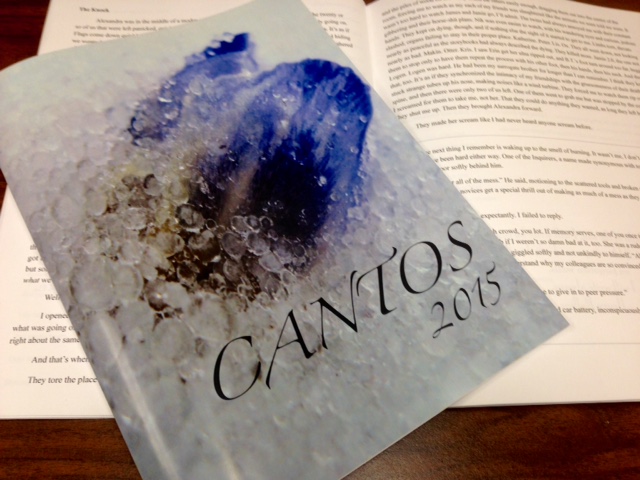
Cantos, Lenoir-Rhyne University’s literary magazine, featuring cover photography by a schwiebert (Annette Schwiebert).

I have taken a break from reading portfolios to offer this short post, one inspired by seeing so many of my students’ names in the pages of Cantos, Lenoir-Rhyne’s literary magazine.  From the Italian for song, a canto is a section of a long poem, a chapter of sorts, and the students’ work both in the magazine and in their portfolios for ENG 281 serves as a last canto for the course, a final chapter in a series of innovative exercises that they, and I, have produced in our multi-genre Introduction to Creative Writing course. I look forward to reading their selections in Cantos after I finish reading their portfolios, but the two aren’t mutually exclusive. Some of the pieces in Cantos appear in their portfolios as well.

  • “Black Dog” and “Regulars” by Ryan Baxter (ENG 281.02)
  • “Strangers” by Rhonda Cheshire (ENG 281.02)
  • “Neither Nor was I Made for Either Door” by Charles Clark (ENG 281.02)
  • “Pigskin” by Peyton Hoyle (ENG 281.01)
  • “Green Eyes” by Richard Jordan (ENG 281.02)
  • “Holmes Triumphant” by Kati Waldrop (ENG 281.02)
  • Cantos also features photography by ENG 281.02 student a schwiebert (Annette Schwiebert) and an essay by Eddie Stiltner (ENG 231, Fall 2014).
  • Kati Waldrop (ENG 281) serves as Cantos’ Editor-in-Chief, and Peyton Hoyle (ENG 281) and Alexis Monthony (ENG 131, Spring 2014) serve as staff readers.