Posted in Reading, Writing

The Sentences of Courtroom Drama. . .

. . . and Jean Stafford, or How Writing about Defending Jacob (the July Coffee Talk Book Club selection) isn’t Really Writing about Defending Jacob 

Since I don’t read legal thrillers, I can’t compare William Landay’s prose with John Grisham’s or Scott Turow’s. But I appreciate Defending Jacob for leading me to contemplate the differences between Landay’s sentences and the ones crafted by Jean Stafford, whose Selected Stories I’m reading now.

In Chapter 3 of Defending Jacob,  the narrator, Andy Barber, catalogs the contents of his son’s room with these lines:
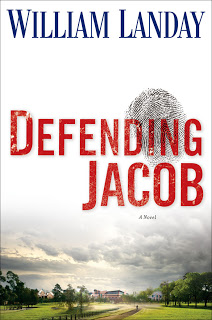
Defending Jacob (2012)

“Jacob’s room was cluttered with huge oafish sneakers, a MacBook covered with stickers, an iPod, schoolbooks, paperback novels, shoe boxes filled with old baseball cards and comic books. In the corner, an Xbox was hooked up to an old TV. The Xbox disks and their cases were piled nearby, mostly combat role-play games. There was dirty laundry, of course, but also two stacks of clean laundry neatly folded and delivered by Laurie, which Jacob had declined to put away in his bureau because it was easier to pluck clean clothes right from the piles. On top of a low bookcase was a group of trophies Jacob had won when he was a kid playing youth soccer. He had not been much of an athlete, but back then every kid got a trophy, and in the years since he had simply never moved them” (23).

Back then every kid got a trophy? Back then? (Unlike now?)

I won’t dwell on the sentence about the trophy; it’s less troublesome than the string of missed opportunities that precede it, where we don’t see anything unexpected: “There was dirty laundry, of course. . . .” And the expected isn’t presented to us in surprising ways:

“. . .but also two stacks of clean laundry neatly folded and delivered by Laurie, which Jacob had declined to put away in his bureau because it was easier to pluck clean clothes right from the piles.”

As a counterpoint, consider this passage from Jean Stafford’s short story “Bad Characters,” which catalogs the contents of a dresser drawer:

“I loved the smell of the lavender she kept in gauze bags among her chamois gloves and linen handkerchiefs and filmy scarves; there was a pink fascinator knitted of something as fine as a spider’s thread, and it made me go quite soft—I wasn’t soft as a rule, I was as hard as nails and I gave my mother a rough time—to think of her wearing it around her head as she waltzed on the ice in the bygone days. We examined stockings, nightgowns, camisoles, strings of beads, and mosaic pins, keepsake buttons from dresses worn on memorial occasions, tortoiseshell combs, and a transformation made from Aunt Joey’s hair when she had racily had it bobbed. Lottie admired particularly a blue cloisonné perfume flask with ferns and peacocks on it. ‘Hey,’ she said, ‘this sure is cute. I like thing-daddies like this here.’ But very abruptly she got bored and said, ‘Let’s talk instead. In the front room’” (104).
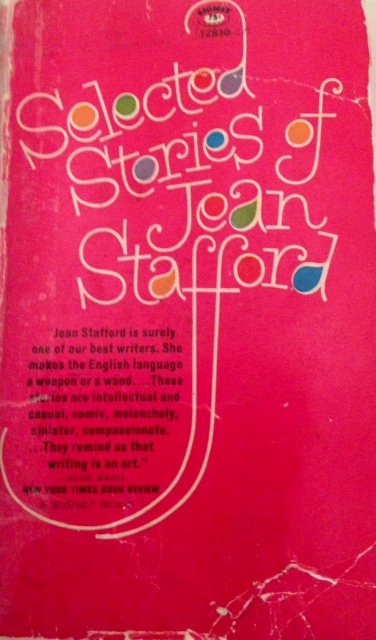
Selected Stories of Jean Stafford (1966)

Stafford’s deft prose conveys far more than Landay’s. His narrator’s inspection of Jacob’s room yields nothing of the father’s character and scarcely more of the son’s. Essentially, he’s a fourteen-year-old from central casting.

In contrast, the passage from “Bad Characters” reveals details about the narrator, her Aunt, and Lottie. The narrator “love[s] the smell of lavender”; she’s a romantic who can also be “hard as nails” and gives her “mother a rough time.” Her Aunt  “racily” had her hair bobbed. (Perhaps she was racier than the narrator’s mother, who wore the transformation fashioned from Joey’s hair.) And Lottie admires “thing-daddies,” like the “blue cloisonné perfume flask,” but she gets bored “very abruptly.”

From the list, we know less of the mother than we know of her sister, her daughter, and her daughter’s partner in crime. But the list  doesn’t need to reveal the mother’s character because it serves another purpose. That’s not the case with Landay’s list. His only substitutes for character; Stafford’s constructs a scaffold for building it.

Landay, William. Defending Jacob. 2012. New York: Dell, 2013.

Stafford, Jean. Selected Stories of Jean Stafford. New York: Signet, 1966.
 

Posted in Reading, Teaching, Writing

“Against the Workshop”

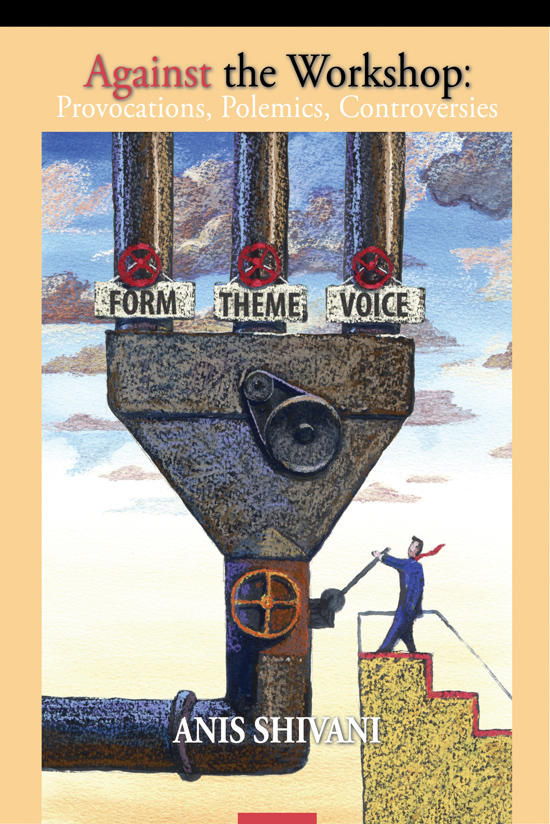
Against the Workshop (2011)

What’s wrong with American letters? Ask Anis Shivani, and he’ll tell you in no uncertain terms: “Mediocre new writers, whose only talent seems to be to have understood the rules of the marketing game, are lauded week after week as brilliant”  while “[o]ld favorites mired in repetitive self-imitation are still offered as awesome masters” (15).  Variations on those lines from his  essay “Why is American Fiction in its Current Dismal State?,” appear throughout his book Against the Workshop, which brings together a decade of his essays and reviews.

Shivani offers convincing arguments, but some of his choices threaten his credibility. He chastens journals for “engag[ing] only in the mutual flattery business” (16) while his review of Jay Parini’s poetry and Parini’s introduction to the book present evidence of the same. Shivani calls Parini’s poetry “fiery hot to the touch, the apparent simplicity a form of high art” (134). Parini reciprocates–because Shivani’s pretty hot, too, it seems–writing of him as “one of the sanest voices in criticism today” a “keen vision” and “cruel wit” (xiv).

For Shivani, Billy Collins‘ poems are “single-mindedly predictable imaginative exercises” (61). But Shivani tends toward formula too, castigating in the same mode, repeatedly pinning the failings of fiction and poetry (in Best New American Voices, Best American Poetry, et al.) on an undemocratic system of graduate Creative Writing Programs rife with problems.

Shivani closes his book with an essay that likens Writing  Programs to medieval guilds.  It’s true; they have their masters, journeymen, and apprentices, but so do graduate programs in all other disciplines. The source of the problem isn’t Creative Writing, it’s the university credentialing system, itself. And that system now faces a challenge from MOOCs (Massive Open Online Courses). I wish that Anis Shivani would consider teaching one, or try working within the current system to effect change.

Shivani, Anis. Against the Workshop: Provocations, Polemics, Controversies. Huntsville: Texas Review, 2011.


Posted in Reading, Teaching, Writing

Appalachian MacBeth

Serena (2008)

As I finished reading Serena last week, my thoughts turned to teaching it. A Southern Gothic novel with the feel, and some of the form, of Elizabethan drama, it’s well-suited for courses in world literature as well as Southern and Appalachian fiction.  It’s a regional novel that’s universal, as all the best “regional” writing is.

In an interview in the journal Grist, Serena’s author, Ron Rash, said: “To me, one of the most interesting aspects of literature is how the most intensely ‘regional’ literature is often the most universal. There’s no better example of this than James Joyce’s Ulysses. The best regional writers are like farmers drilling for water; if they bore deep enough and true enough into that particular place, beyond the surface of local color, they tap into universal correspondences, what Jung called the collective unconscious. Faulkner’s Mississippi, Munro’s Ontario, and Marquez’s Columbia are exotic, and they are also familiar” (5-6).

Rash “consciously evoked MacBeth,” he said in his Grist interview but “see[s] the book more in the tradition of Marlowe’s plays, which are always about the will to power” (8).

September brings the release of the film adaptation, starring Jennifer Lawrence and Bradley Cooper. Will it evoke Tamburlaine or a mash-up of  MacBeth and Silver Linings Playbook?

The interview with Rash published in the premier issue of Grist is reprinted in Ecco’s paperback edition of the novel.

Graves, Jesse and Randall Wilhelm. “An Interview with Ron Rash.” Serena by Ron Rash. 2008. New York: Ecco, 2009.

Posted in Reading, Writing

The Lives of Books Beyond the Classroom

Highland Coffee House 113 Main Street, Lenoir, NC
Highland Coffee House
113 Main Street, Lenoir, NC

Talking about Olive Kitteredge Thursday at the Highland Coffee House marked a couple of firsts for me: my first book club meeting, and my first  discussion of a book with a group composed neither of students nor colleagues. Our conversation offered me a welcome reminder of the lives of books beyond the classroom.

The members of the Coffee Talk Book Club, sponsored by  Caldwell County Public Library, read  constantly and widely. The  June, July, and September selections (the club takes a holiday in August) reflect the members’ penchant for variety: a recent Pulitzer Prize winner, a courtroom drama, and a nineteenth-century English classic.

We considered Olive Kitteredge as a collection of linked stories, but our talk focused primarily on matters of character and theme.  I’ve been meditating on the book’s structure though, because I plan to grow a novel from one of my own stories. After examining how the stories of Olive Kitteridge form a novel, I’ve concluded that three could be omitted. And I’m curious about the book’s genesis.

In The New York Times review of Olive Kitteridge, Louisa Thomas observes that the novel’s weakest two stories are ones in which Olive “is merely mentioned. Without her, the book goes adrift, as if it has lost its anchor.”

The two stories that Thomas refers to, but doesn’t name, are “Ship in a Bottle” and “Criminal.” Both feature a former student of Olive’s who recalls something that Olive said in her seventh-grade math class. In “Ship in a Bottle,” Julie tells her younger sister, Winnie, how Mrs. Kittredge said, “Don’t be scared of your hunger. If you’re scared of your hunger, you’ll be just one more ninny, like everyone else” (195). In “Criminal,” Rebecca remembers Olive once stopping her in the hall and saying, “If you ever want to talk to me about anything, you can” (242).

Olive Kitteredge
Olive Kitteredge (2008)

Both stories appeared in the pages of magazines years before the publication of Olive Kitteridge in 2008. (“Ship in a Bottle” as Running Away” in Seventeen in 1992,  and “Criminal” in South Carolina Review in 1994.) When Elizabeth Strout wrote those stories, had she begun thinking of Olive as the anchor of a book? Whatever the case, Olive’s mere mention doesn’t warrant the inclusion of either story, and the novel doesn’t need them. Nor does it need the “The Piano Player.” Though it’s an admirable story, the life of of Angela O’Meara, the piano player of the title, doesn’t intersect with Olive Kittredge’s. Olive simply passes through the piano bar. Her cameo prompts me to wonder if Strout drafted “The Piano Player” sans Olive, adding her later only so the story could serve as one of the novel’s chapters.

Strout, Elizabeth. Olive Kitteredge. New York: Random, 2008.

Posted in Reading, Social Media, Teaching, Writing

Reading for the Norton Writer’s Prize

W. W. Norton’s decision to replace its Scholar’s Prize with the Writer’s Prize reflects some recent and not-so-recent changes in undergraduate writing assignments. From 1998 to 2008, the Scholar’s Prize recognized what Norton calls “an outstanding undergraduate essay on a literary topic,” an essay of the sort that many of us who teach composition frequently wrote when we were freshman. Our own students write fewer literary analyses than we did, because many composition courses are no longer literature based. Instead, they’re interdisciplinary.

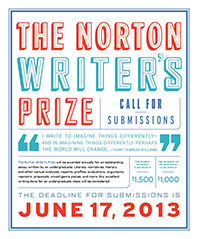
writers_prize_2013I’ve been thinking about these changes for the past few days as I’ve reread my students’ work to select something to nominate for the fourth annual Norton Writer’s Prize, a competition that invites a broad range of submissions, encompassing the variety of writing that’s now typical of composition classes: “[l]iteracy narratives, literary and other textual analyses, reports, profiles, evaluations, arguments, memoirs, proposals, mixed-genre pieces, and more: any excellent writing done for an undergraduate writing class will be considered.”

For their final major writing assignment of the school year, my students wrote ethical reasoning arguments per program requirement. But over the course of the year, they also wrote blog posts, snail mail, personal narratives, timed essay exams, cover letters, résumés, and highly imaginative scripts in which they placed themselves in conversation with the writers of some of the articles and essays they’d read. For some students, those scripts evolved into traditional research arguments. For others, the process of working with those sources revealed that their real research interest lay elsewhere.

I wish I could have nominated more than one piece of writing. For reasons of privacy, I won’t address the particulars of the one that I chose, and I won’t offer any details from the nominating letter that I wrote to accompany it. I will note, instead, how many students shone brightest when an assignment took them by surprise, asking that they write in new ways.

Posted in Reading, Writing

“A Good Way of Putting Things”

Early in the novel Mountains of the Moon, Louise Alder recounts how her teacher Miss Connor read Louise’s (Lulu’s) story aloud in class because Miss Connor “reckons I got a good way of putting things” (65).

Mountains of the Moon (2012)

Author I. J. Kay (a pseudonym) has a good way of putting things as well. But that good way of hers makes for no easy read. Though the first American edition of her debut novel appeared last July, it’s no beach book. Kay’s fractured narrative forces us to read carefully for shifts in diction and setting that signal the age and whereabouts of Louise (a.k.a. Kim, Beverley, Jackie, Dawn, and Catherine) through a parade of squalor that ends with her release from prison for a crime she may or may not have committed.

Confusing? Yes, but keep reading. Chances are, you’ll find yourself less confused. And more and more impressed with Kay’s achievement.

At thirty-one, after her ten-year prison stint, Louise travels to Uganda to see up close those mountains she first saw as a child in the pages of her book on Africa, a gift from her grandfather.

As a young teenager, she receives another book as a gift from a father figure. “The Velvit Gentleman,” as she calls him, a surreal sugar daddy—Professor Higgins and lover—gives her Lord of the Flies, which she slings across the floor of the psych ward after reading the death of Piggy.

“I wouldn’t have given it to you if I’d thought it would upset you so much,” Anton, “the Velvit Gentleman,” says. “Will you continue with it, though?”

“Seems rude not to,” Lulu answers. “Was a shock how bad I believed it. You said it was fiction, lies, but it int. It int.”

“Good,” Anton says. “That’s the point; stories tell lies in the service of truth” (287).

Kay’s own lies in the service of truth ring truer than those that shock her protagonist. Lulu’s no middle-class kid stuck on an uninhabited island. Donning a Masai’s red cloth and wielding a spear or not, she’s more warrior than any of Golding’s boys.

What makes her a warrior? The mountains (of the title) that dwell in her imagination, the ones she dreams of and writes about on wallpaper “wonky where the pattern is bossed” (87) to counter violence, poverty, and neglect.

Though flawed as all novels are—and undoubtedly some of its shortcomings escaped me—Mountains of the Moon shines with fresh language, Kay’s “good way of putting things,”  that invigorates Louise’s story, reminding us of what novels can achieve but rarely do.

Kay. I. J. Mountains of the Moon. New York: Viking, 2012.

Posted in Reading, Teaching, Writing

Flying Without a Map

Movies and the Meaning of Life (2005), which includes the essay “Flying Without a Map: Chasing Amy and the Quest for Satisfying Relationships”

I don’t want my students to feel as if they’re flying without a map.

So, as a model for them—many of whom are currently writing annotated bibliographies–I spent the better part of the morning composing the sample annotation that follows. The process awakened in me an interest in writing about Chasing Amy and Jerry L. Walls’ study of the film. Perhaps that’s a project for the summer.

Walls, Jerry L. “Flying Without a Map: Chasing Amy and the Quest for Satisfying Relationships.” Movies and the Meaning of Life. Ed. Kimberly A. Blessing and Paul J. Tudico. Chicago: Open Court, 2005. 137-149.

“Flying without a Map: Chasing Amy and the Quest for Satisfying Relationships” considers Kevin Smith’s film Chasing Amy (1997) as a reflection of our moral ambiguity. In the words of the essay’s author, Jerry L. Walls, Chasing Amy offers “a vivid picture of what happens to us emotionally, morally, and relationally when we try to revise morality in some fairly radical ways, while still holding onto selected parts of our traditional morality” (140).

In his analysis of the film’s principle characters, Walls cites Edward O. Wilson’s article “The Biological Basis of Morality,” highlighting the two options Wilson identifies as the ones that determine and divide our worldviews: (1) that moral and ethical principles “exist outside of the human mind,” or (2) “they are inventions of human minds” (141). Subsequently, Walls’ examination of Holden McNeil (Ben Affleck), who holds the former view, and Alyssa Jones (Joey Lauren Adams), who holds the latter view, illustrates how Alyssa challenges Holden to rethink his beliefs. While Holden tells Alyssa that he likes girls “Because that is the standard,” he cannot explain to her why he believes what he believes or why he should believe it.

Walls chronicles Holden’s and Alyssa’s moral evolution, noting the irony of Holden’s 180-degree shift, marked by the solution he proposes to Alyssa and Banky (Jason Lee), and concludes his essay by suggesting that Chasing Amy depicts “an even larger quest,” one for God (149).

Though I agree with Walls’ central thesis (that the film offers “a vivid picture of what happens to us emotionally, morally, and relationally when we try to revise morality. .  .”), I disagree with his conclusion, which rests on the questionable assumption that religion offers a map that other foundations for ethics and morals cannot. It comes as no surprise that Walls as a professor of the philosophy of religion turns to faith in the final pages of his essay. But by choosing that path, he overlooks how the film’s characters—all comic-book artists—turn to art as a way of making sense of their lives.

Posted in Social Media, Teaching, Writing

Letters of Recommendation

Last week in the midst of writing letters of recommendation, I decided to devote my next blog entry to the subject. As I tried to explain to students why they should waive their rights to read their letters, I realized that in our age of social media, many students have never stopped to consider why they should waive their rights to read what their professors and employers have written about them.

Here’s why: You’re asking someone with whom you have an excellent working relationship to vouch for your abilities. If you aren’t sure the person thinks highly enough of you to write a strong recommendation, don’t ask that person for a letter. Ask someone else.

Not waiving your rights implies not only a lack of trust–I’m asking you to write a letter, but I don’t trust that it will be good–it also indicates a degree of self-doubt. (I doubt that I’m good enough.) When selection committees and potential employers read your application, you don’t want them to question your trust in others or your confidence in yourself.

When you ask someone to write a letter for you, give that person a copy of your resume. As a professor, I can address my students’ work in the classroom, but I can’t refer to their extracurricular activities and awards if I don’t know what they are.

Lastly, on a practical note, make sure that you give your letter-writers the full address of the company, school, or scholarship foundation to which you are applying. Even if the letter-writer will be submitting the letter to you in a sealed envelope to include in your application–and often that’s the case–the letter-writer still needs the full address of the recipient.

Why does the letter-writer need the recipient’s address if the letter-writer isn’t going to mail the letter?

The answer is simple: The recipient’s address appears in a business letter below the date and above the salutation (Dear Dr./Professor/Mr./Ms.). If a letter-writer doesn’t follow proper form, the recipient may question his or her credibility. And you don’t want  selection committees and potential employers to question the person you’ve called upon to vouch  for you.

For more valuable advice on letters of recommendation, see Mitch Harden’s “Waiving Your Rights“–which isn’t just about waiving your rights, it offers other useful tips as well.

Posted in Reading, Teaching

Groundhog Day and Nietzsche

Movies and the Meaning of Life (2005), which includes the essay “What Nietzsche Could Teach You: Eternal Return in Groundhog Day.”

For Monday my Focused Inquiry students will read “What Nietzsche Could Teach You,” which considers the film Groundhog Day (1993) as an illustration of eternal return. It’s an essay I’ve never taught before. I decided to teach it this semester as a way of responding to a suggestion some students offered last spring on their anonymous questionnaires—specifically that we discuss more of the big questions that we ponder throughout our lives.

So, for our first post-Groundhog Day class, we’ll view scenes from the film and consider the evolution of Phil Connors (Bill Murray), from unhappy weatherman living for the future to renascence man happily embracing the present.

According to James H. Spence, author of “What Nietzsche Could Teach You,” Phil Connors’ change signifies his rejection of the Christian view of linear time in which the future gives value to the present. Nietzsche’s alternative, his eternal return, posits that “[r]ather than moving on to a better (or worse, if we are bad) place after this life, we would relive our life over and over again, exactly as we had before” (274).

Today as I meditate on Spence’s essay and on the film, I’m aware of how rarely I live in the moment, and I’m reminded of a line that friend and teacher Doug Jones often says: We teach what we need to learn. We do, Doug. We really do.

Spence, James H. “What Nietzche Could Teach You: Eternal Return in Ground Hog Day.” Movies and the Meaning of Life. Ed. Kimberly A. Blessing and Paul J. Tudico. Chicago: Open Court, 2005. 274.

Posted in Reading, Social Media, Teaching, Writing

Storytelling and Simulated Worlds

Sunday’s New York Times Magazine featured an essay on narration that a friend mentioned on Facebook. I didn’t see her comment initially because I don’t frequent Facebook. My husband posts there several times a day though, so he passed the news along to me. Now that I’ve read the essay, I’m ready to enter the conversation–but not on Facebook, where it seems too late. My friend’s request–“I’d love to hear more thoughts on this”–now lies buried beneath four days of links and “likes” and photos.

The essay “Once Upon a Time, There was a Person Who Said, ‘Once Upon a Time‘” reminds me of Ray Bradbury’s story “‘The Veldt” (1950), which my students and I read and studied this week. The  story’s crystal-walled virtual-reality nursery leads the Hadley children away from creativity toward passivity. When the son, Peter, admonishes his father for removing the picture painter from the nursery, George Hadley replies: ‘. . . I wanted you to learn to   paint all by yourself, son” (76).

“I don’t want to do anything but look and listen and smell,” Peter replies. “What else is there to do?” (76).

Ray Bradbury’s short story collection The Illustrated Man (1950), which includes “The Veldt.”

In “Once Upon a Time. . . ,” writer Steven Almond addresses how visual media (Bradbury’s crystal-walled virtual-reality) has changed how we conceive of storytelling. “Traditionally,” Almond writes, “stories represented an active collaboration. Listeners and readers were called upon to create the world described by the artist. Film advanced a new model of collaboration. An array of artists (screenwriters, actors, cinematographers, set designers, etc.) worked together to invent an ultra-vivid artificial world. The audience’s role became increasingly passive–to absorb and react, not to imagine. Television shrunk the wonders of film and delivered them directly to our living rooms.”

The absence of narration in “the shrunken wonders of film”–now shrunken to fit our iPhone 5 screens–isn’t simply the loss of a literary device. It’s the atrophy of an essential skill: one that enables us to make sense of the world. It’s no surprise that Almond’s creative writing students produce short stories that lack coherence. Or that many of the freshman in my classes struggle to produce essays of more than 1,500 words. If I write any more, I’ll be repeating myself, they often say, not because they can’t write more, but because they can’t imagine writing more. To do so would require the sustained attention and reflection that our digital culture leaves behind.

Posting to Facebook about the decline of narration isn’t the equivalent of driving and texting about the dangers of driving and texting. But it does underscore a consistent contradiction in our lives. As a writer and a teacher, I attempt to reconcile that incongruity with blog posts–writing that my students and I can draft and revise before our words enter the sphere Almond describes as “the simulated world through which most of us flit from one context to the next, from Facebook post to Tumblr feed to YouTube clip, from ego moment to snarky rant to carnal wormhole.”