In a 1954 interview for Look magazine, Duke Ellington observed that “Playing bop is like Scrabble with all the vowels missing.” If you find yourself faced with a Scrabble rack full of consonants, you can play bop with these words:
brr: used to indicate that one feels cold (also brrr)
crth: an ancient stringed instrument (pl. -s) (pronounced to rhyme with booth)
cwm: a cirque (a deep, steep-walled basin on a mountain) (pl. -s) (pronounced to rhyme with boom)
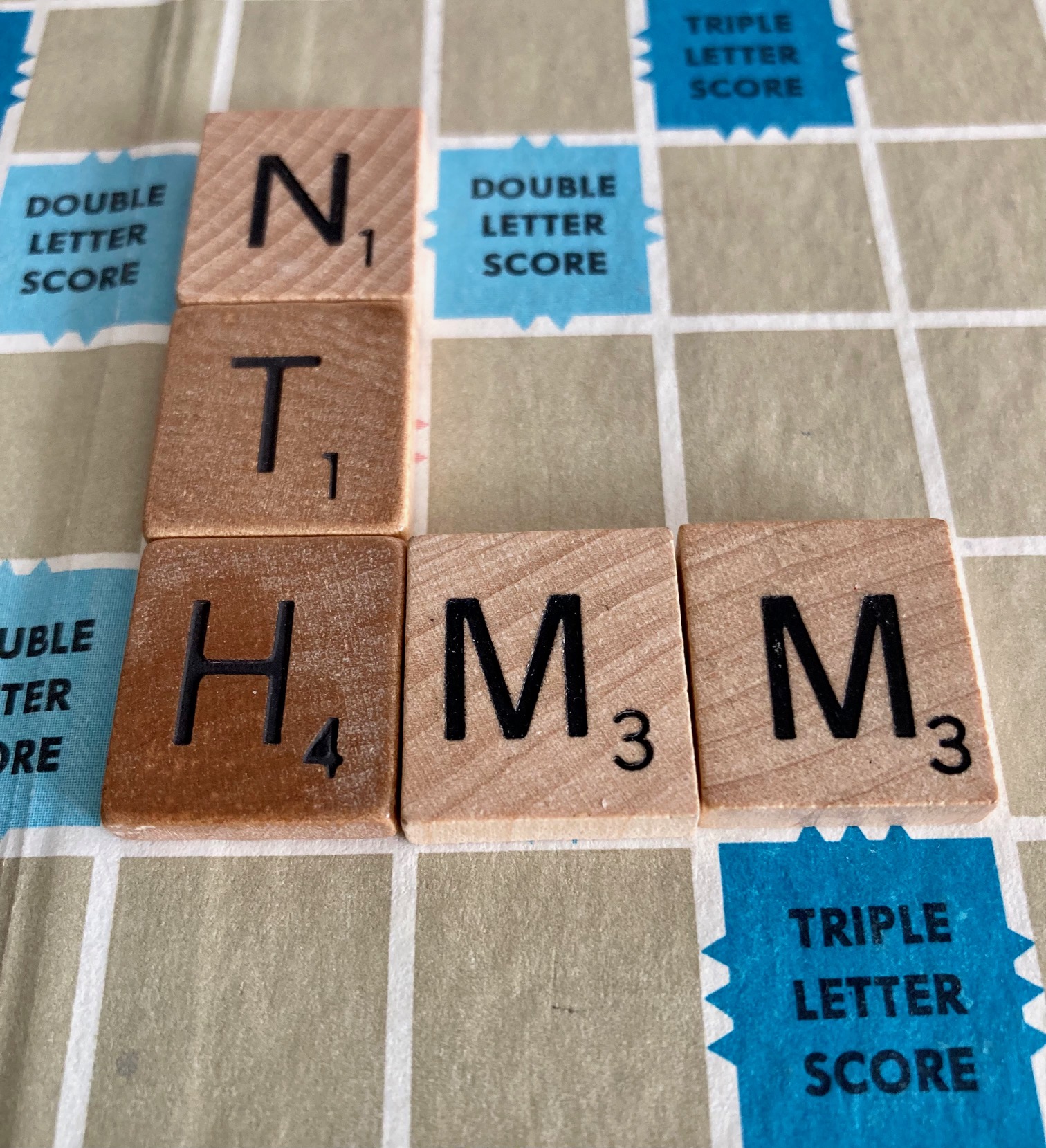
hm: used to express thoughtful consideration (also hmm)
nth: describing an unspecified number
pfft: used to express a sudden ending
psst: used to attract someone’s attention
sh: used to urge silence (also shh and sha)
tsk: to utter an exclamation of annoyance (-ed, -ing, -s)
During Wednesday’s class, while you were planning, drafting, and researching, some students asked whether it was acceptable to write your final essay in first person. Yes, you are welcome to write in first person.
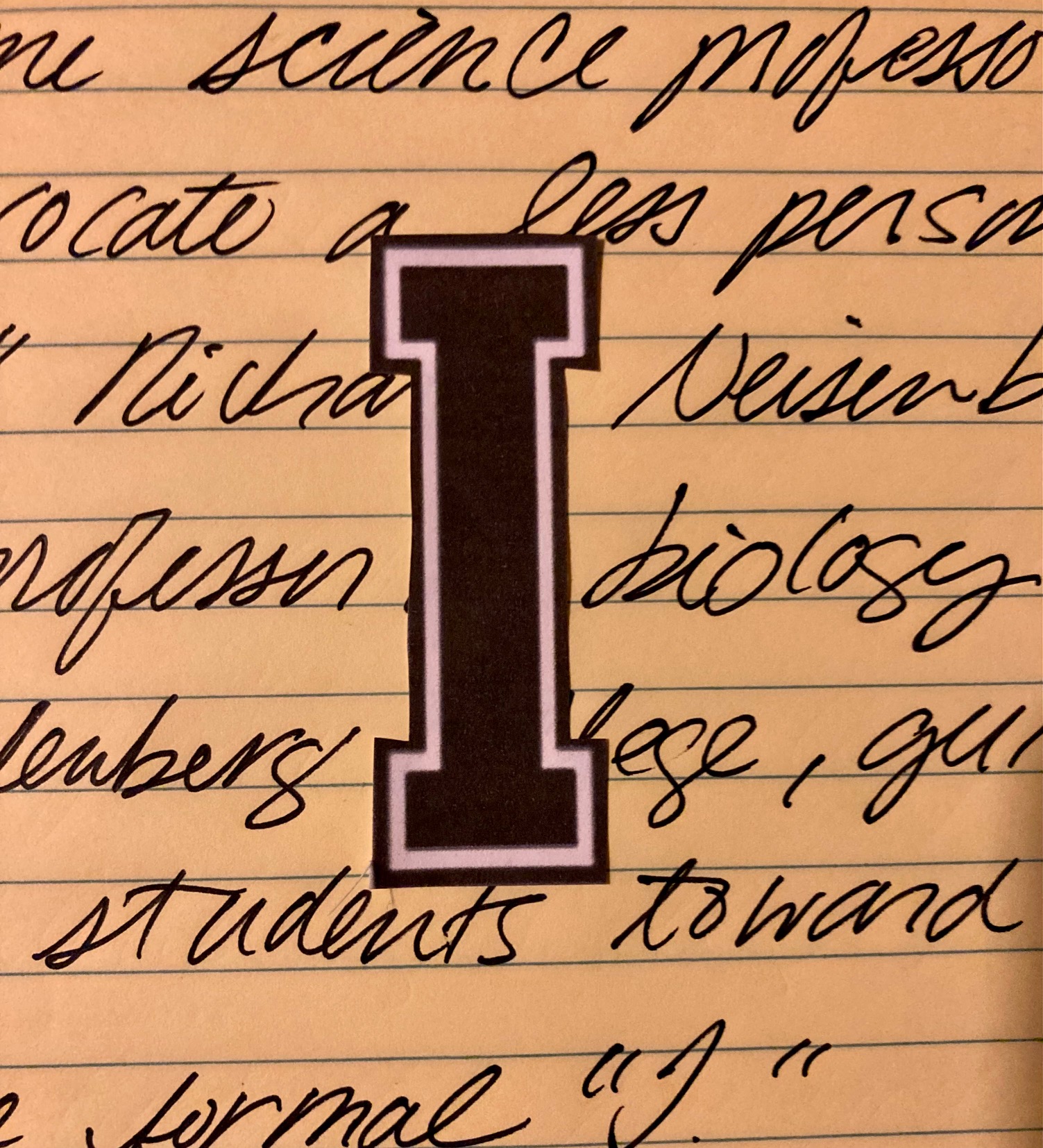
Some of the writing you produce as a college student and as a professional will require third person, but writing in the humanities—fields such as English, history, philosophy, religion, and art—often features first person. Although “I” is far less common in the sciences, some science professors advocate a less personal “I.” Richard Neisenbaum, a professor of biology at Muhlenburg College, guides his students toward a more formal “I.” In his words:
“The biggest stylistic problem is that students tend to be too personal or colloquial in their writing, using phrases such as the following: ‘Scientists all agree,’ ‘I find it amazing that,’ ‘The thing that I find most interesting.’ Students are urged to present data and existing information in their own words, but in an objective way. My preference is to use the active voice in the past tense. I feel this is the most direct and least wordy approach: “I asked this,” “I found out that,” These data show” (ctd. in Rosenwasser and Stephen 335).
Keri Colabroy, a professor of Chemistry Muhlenburg College, favors a different approach. On the subject of pronouns, she tells her students, “[I]t’s safer to avoid them” (ctd. in Rosenwasser and Stephen 335).
Work Cited
Rosenwasser, David and Jill Stephen. Chapter 11: “Choosing Words, Shaping Sentences.” Writing Analytically, 8th edition. Wadsworth/Cengage, 2019. pp. 299-340.
Yesterday in class, I demonstrated a variety of starting points for your research, including these:
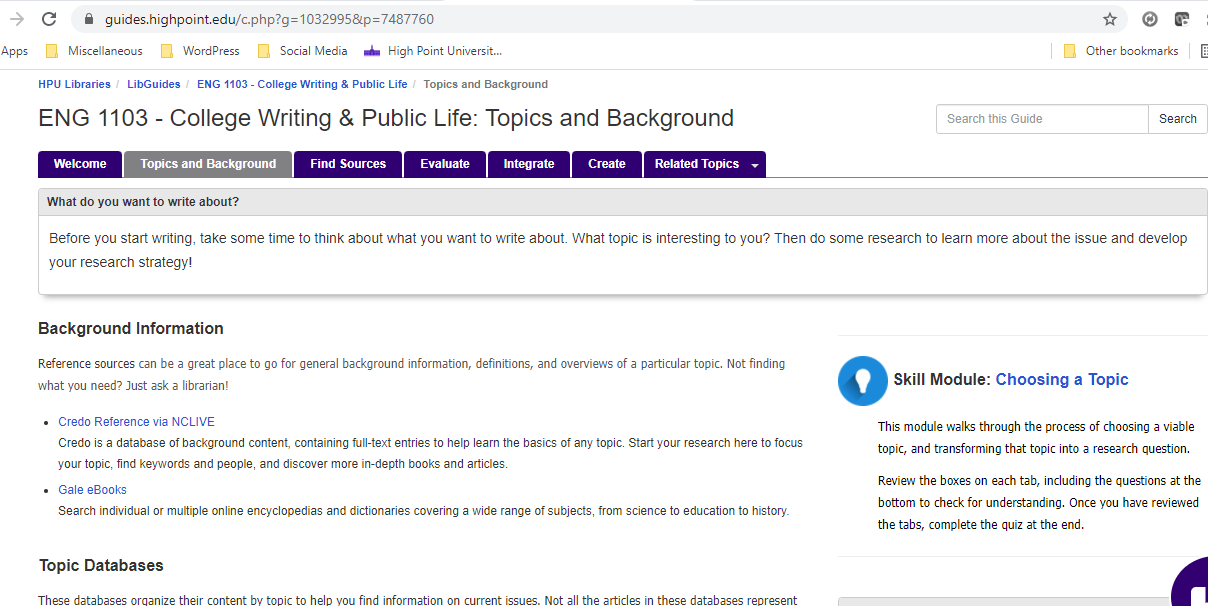
The English 1103 Research Guide, which is linked to my blog (see the list of links on the right).
The HPU Library home page, which is also linked to my blog. At the library’s home page, you can conduct searches by source type (articles, books, etc.), you can search for articles in particular publications, such as newspapers of record–including The New York Times, The Wall Street Journal, and The Washington Post—and you can search by keywords or by an author’s name.
An article you have read may offer a starting point. For example: If you’re interested in writing about the harmful effects of Instagram reported in September 14 Wall Street Journal article, you might look for research by Jean Twenge, a professor of psychology at San Diego Sate University, who is quoted in the article.
Though you will plan and draft longhand in class tomorrow, you will have the opportunity to use your laptop to conduct research. Your revised essay will include a minimum of three relevant sources, but the notes and any draft work that you produce in class tomorrow, November 3, does not need to incorporate three sources. You may devote a significant portion of class time tomorrow to research itself.
Stephen King’s “Strawberry Spring”
King, Stephen. Night Shift. Doubleday, 1978.
To earn an extra-credit course work assignment, read Stephen King’s short story, and publish a response to it of seventy-five words or more on your blog no later than Wednesday, November 10. Questions to consider include, but are not limited to, the following:
What, if anything, in Stephen King’s story prepared you for its ending? (What, if anything, would you point to as foreshadowing?)
Where in the story did you encounter references to war? Why might King have included so many references to Vietnam and the U.S. Civil War?
How is “Strawberry Spring” similar to or different from another horror story of Stephen King’s? How is the story similar to or different from a horror story by another writer?
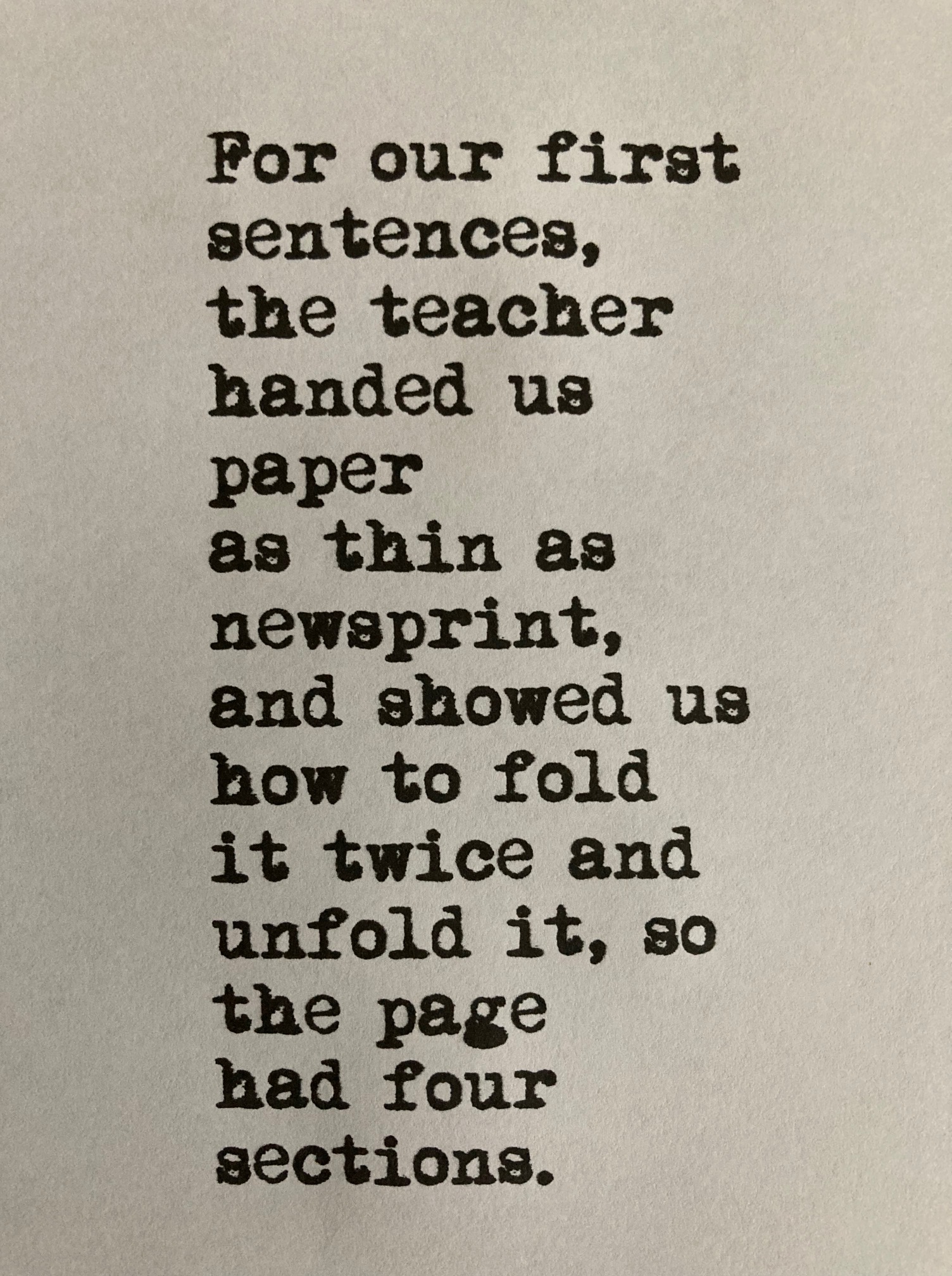
The “stanzas” below and the two paragraphs that follow them are my version of the English 1103 creative project.
A First Sentence
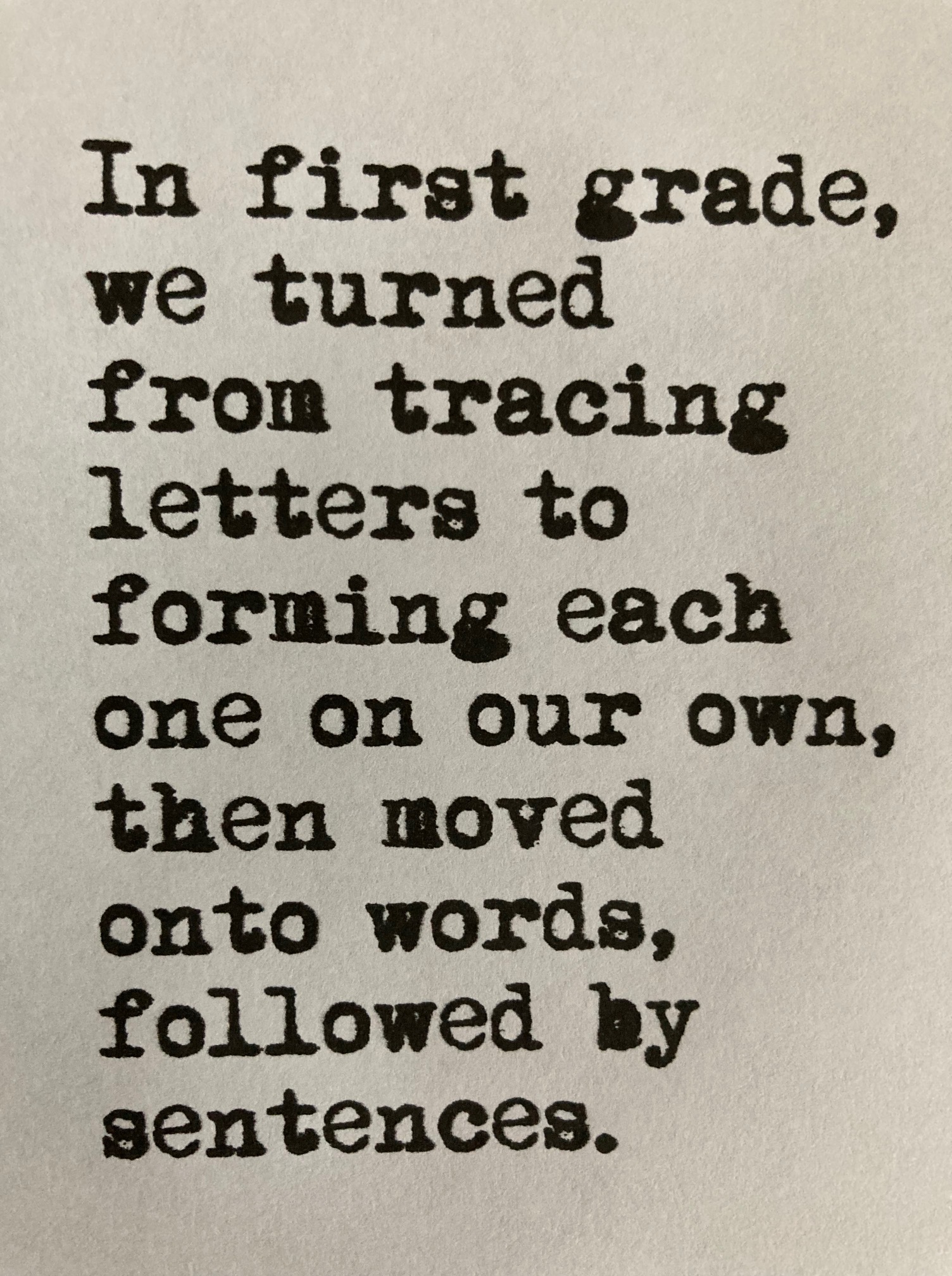
Although many moments of my childhood are lost to me, the memory of writing one of my first sentences resurfaces in my mind because it marks a turning point. Before that sentence-writing exercise, I had recorded letters on a page, but I had not truly written. When I looked at the words on the chalkboard and said to myself, “The pig wore a wig,” I had formed an idea. I composed it in my mind and wrote it on the page.
I cannot return to the pure joy of that moment whenever I sit down to write, but I try to remind myself often that all writing is creative. We always begin with a blank page or screen and create.
The fake photograph of Biggie Smalls and Kurt Cobain featured in Lesson Five of Check, Please!
At the beginning of class today, you submitted your worksheet for the fifth and final lesson in the Check, Please! series. My version of the assignment, which I wrote along with you, follows.
Check, Please! Assignment for Lesson Five
In the fifth lesson of the Check, Please!, Starter Course, Mike Caulfield, author of the course and Director of Blended and Networked Learning at Washington State University, covers the final step in the five-step SIFT approach: “Trace Claims, Quotes, and Media to Their Original Context.” Caulfield outlines the process of locating the original context as an antidote to the issues of accuracy that occur when information passes through intermediaries.
One of the most instructive portions of lesson five features a passage in which Caulfield cites a study of how stories evolve as gossip through the processes of leveling (stripping details), sharpening (adding or emphasizing details), and assimilating, which combines the two. In the process of assimilation “the details that were omitted and the details that were added or emphasized are chosen because they either fit what the speaker thinks is the main theme of the story, or what the speaker thinks the listener will be most interested in.” Similarly, leveling, sharpening, and assimilating all figure in the altered photographs and memes in lesson four. The abbreviated speech of the NRA’s CEO, Wayne LaPierre, which omits commentary, inaccurately indicates a contradiction in his stance on the presence of guns in schools.
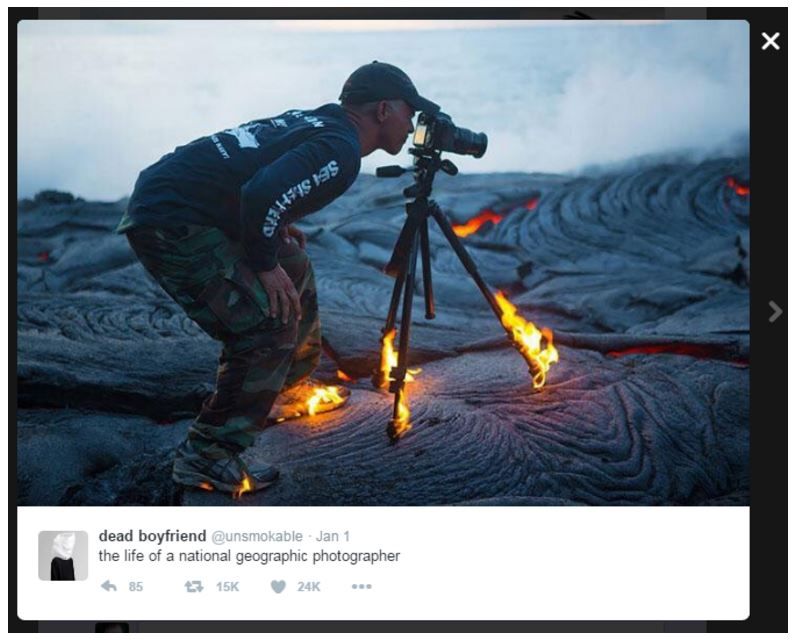
Kawika Singson’s real photograph–real but reposted with inaccurate commentary–featured in Lesson Five of Check, Please!
The image of photographer Kawika Singson with flames at his feet serves as an example of leveling. Although the flames are real, they were not caused by the heat of the lava flow where Singson stands with his tripod. Instead, to create the image, a friend of his poured accelerant on the lava before Singson stepped into the frame. The deception wasn’t intentional; Singson simply wanted the image for his Facebook cover photo.
Unlike Singson’s photograph, the altered photograph of the Notorious B.I.G. with Kurt Cobain was created with the intent to deceive. Cropping and merging the two photographs illustrates the assimilation process adopted by photoshop users to appeal to music fans eager to think that such fictional meetings of icons took place. Krist Novoselic, who founded Nirvana with Cobain, replied to the is-it-real question with his own fake photo, making the claim that the hand holding the cigarettes was Shakur’s, that he had been cropped from the right.
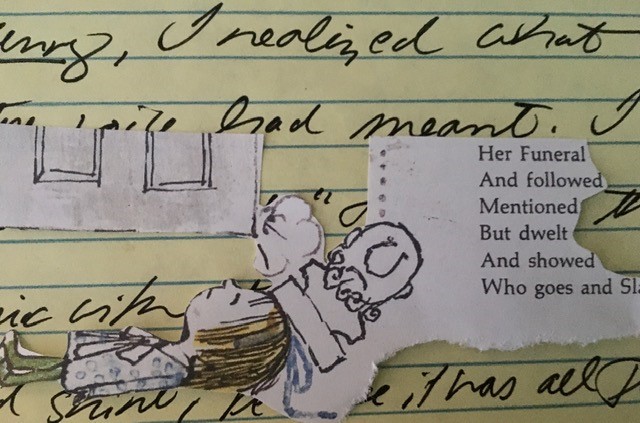
Collage image: an illustration by Alice and Martin Provensen for the poem “Rebecca” by Hilaire Belloc
Today in class you freewrote on seven prompts to generate ideas for the creative project that you will produce this week. The project is a variation on a literacy narrative, which the authors of our text book refer to as “an acount of how you came to think about writing in the ways that you do” (118).
Your project is a variation on the literacy narrative; it’s a piece of imaginative writing–in prose, verse, or a combination of the two–that recreates a memory of one of your reading or writing experiences and conveys the significance of that experience in your development as writer, a reader, and/or a critical thinker.
At the beginning of class on Wednesday, you will receive the assignment, and you will have the class period to continue planning and begin drafting. Your project is due on your blog Friday morning; the hard deadline is Monday before class. You will not post your project to Blackboard.
Consider asking family members about their memories of your early reading or writing experiences. What they remember may lead you to additional ideas for your project. You might also browse the children’s collection at the Stout School of Education Resource Center.
Work Cited
Rosenwasser, David and Jill Stephen. Chapter “Thinking Like a Writer.”Writing Analytically, 8th edition. Wadsworth/Cengage, 2019. pp. 1116-4
The image above illustrates how the second player’s, or team’s, knowledge of playable two-letter words could enable a Scrabble on the second play of the game. The first player, or team, spelled mosque. By using all seven letters, the second player earned a total of sixty-two points for pointed alone, a word that couldn’t have been played without the knowledge of the five two-letter words that the player formed vertically: op, so, qi, un, and et. The first player scored forty points with a double-word score square. Without a double-word score square, the second team scored eighty-five.
Two of the previous Wordplay Day posts include the first sixty-four of the 101 playable two-letter words, A-E (October 3) and F-N (October 8). Today’s post features the remaining thirty-seven, O-Z.
od: a hypothetical force.
oe: a whirlwind of the Faeroe Islands
of: originating from
oh: an exclamation of surprise
oi: an expression of dismay (also oy)
om: a sound used as a mantra
on: physically in contact with
op: a style of abstract art dealing with optics
or: used to link conjunctions
os: a bone
oy: an expression of dismay (also oi)
pa: a father
pe:a Hebrew letter
qi:the central life force in traditional Chinese culture (also ki)
re:a tone of the diatonic scale
sh:used to encourage silence
si: a tone of the diatonic scale (also ti)
so: to such a great extent; a tone on the diatonic scale
ta: an expression of thanks
ti:a tone of the diatonic scale
to: in the direction of
uh: used to express hesitation
un:one
up: to raise
us: a plural pronoun
ut: the musical tone C in the French solemnization system, now replaced by do
we: a first-person plural pronoun
wo: woe
xi: a Greek letter
xu: a former monetary unit of Vietnam equal to one-hundredth of a dong
ya: you
ye: you
yo: an expression used to attract attention
za: a pizza
Up Next
In next Monday’s class, you will begin work on your creative project. Details TBA.
Coming Soon
At the beginning of class on Wednesday, you will submit your fifth and final Check, Please! worksheet. If you misplace the copy you received in class, you can download one from the link below.
Today our class will meet in Smith Library where the Head Reference Services Librarian, Lauren Brewer, will offer us instruction in conducting library research.
Where We’ll Meet
The library lab is in the basement. When you enter the building, you’ll see the staircase. At the bottom of the stairs, you’ll see a set of double doors. Go through the doorway and turn left. The lab is the glass-front room with desktop computers.
Looking Ahead to the Final Paper
Today’s library class will introduce you to the kinds of research you will conduct for your final paper, which will include a minimum of three sources. Think of the research ahead of you as the search for an answer you want to find, more specifically an answer to a question about our lives in the digital world (our theme).
If you are interested in the social media issues covered in the recent Facebook Files series published in The Washington Post, you might ask yourself what questions they lead you to ask. One of those questions could serve as your starting point. For example: Should Facebook be regulated to minimize its harmful effects?
On Another Note
In class I will distribute the worksheet for lesson five in the Check, Please! assignment series, due next Wednesday, October 27, at the beginning of class. If you misplace your copy of the worksheet, you can download one from the link below.
Although I have read Matt Richtel’s article “Blogs vs. Term Papers” many times, this semester marked the first time I had studied it as an exercise in analysis. Ordinarily, I include Richtel’s article on the syllabus as a prologue to my students’ own blogging. The article served that purpose in August as well. But as I found myself teaching a different composition curriculum that features an analysis as the first major paper assignment, Richtel’s article served a dual purpose: It not only oriented my students to the role that blogs would play in the class, it also provided them with the opportunity to study the way a writer—in this case, Matt Richtel—presents the ideas of the experts he interviews. By reading Richtel’s article, the students learned about changes in writing practices in college classrooms; by rereading Richtel, they began to see how his writing takes shape. The same was true for me.
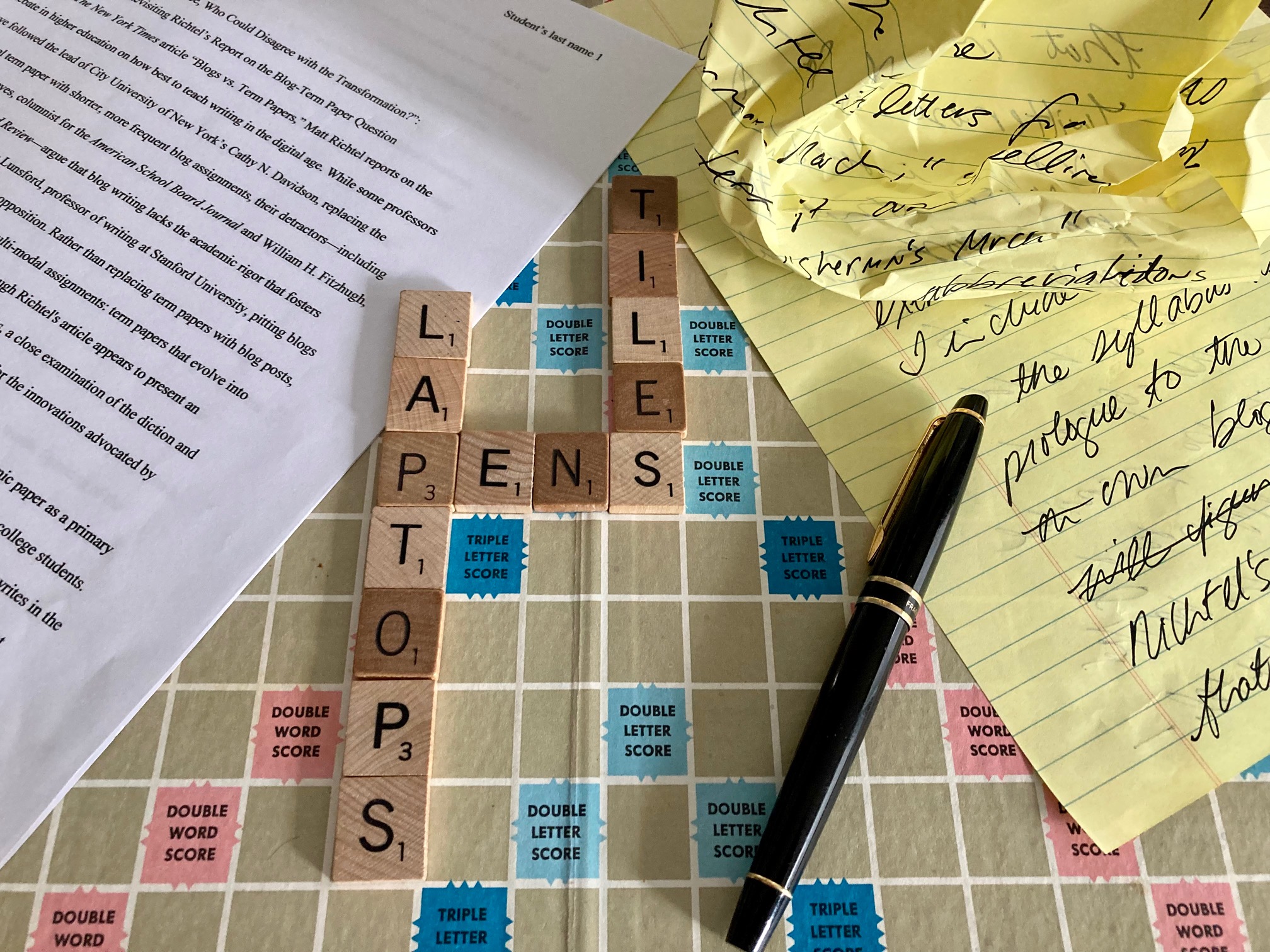
The process of crafting a study of “Blogs vs. Term Papers” prompted me to meditate on the similarities between analysis and Scrabble, another feature of the course. The more I examined Richtel’s words, the more details I noticed. Similarly, the more closely I study the words on a Scrabble board and the tiles on a rack, the more opportunities for word building become apparent to me. This semester, the processes of writing an analysis of “Blogs vs. Term Papers” and playing Scrabble have deepened my understanding of how those two activities cultivate the focus that leads to the discoveries intrinsic to learning.
One of those moments of discovery occurred for me as I was rereading the paragraph in Richtel’s article where he addresses an argument put forth by experts who frown on replacing the term paper with the blog. Richtel reports their claim that if teachers want to reduce term papers to blog posts, why not bypass blogs altogether and ask nothing more of their students than tweets? In my previous readings of the paragraph, I was drawn primarily to the clever mimicry at the end. There Richtel omits letters from the words “Sherman’s March,” spelling it as “Shermn’s Mrch” to imitate the word-shortening technique characteristic of the Twitter platform.
As I studied the paragraph more closely, I saw beyond the intentional misspellings at the conclusion. Subsequently, what preceded the imitation of Twitterese became far more revealing. I noticed that the paragraph consisted of only one sentence—one of only two one-sentence paragraphs in the article—and that Richtel’s presentation of the claim demonstrates a flaw in the experts’ logic: “Their reductio ad absurdum: why not just bypass the blog, too, and move on to 140 characters about Shermn’s Mrch?” Realizing that Richtel presented one of their assertions as a logical fallacy, led me to this point: “To assert that defenders of traditional academic writing carry their opponents’ argument to an absurd conclusion presents those advocates of old-school writing as purveyors of the same flawed logic that their own traditional rhetoric supposedly teaches students to avoid.”
Additionally, I considered the effect of choosing to present the fallacy as a one-sentence paragraph, noting that “[b]y introducing an apparent contradiction in the argument of the advocates of old-school writing, Richtel subverts their claim; and by presenting that incongruity as a one-sentence paragraph, he highlights the issue.”
Reflecting on the effect of the one-sentence paragraph, with its emphasis on a single idea, led me to reexamine the other one-sentence paragraph in the article. That paragraph, a sentence spoken by Professor Cathy Davidson of the City University of New York, underscores the prominence of her words and ideas in Richtel’s article, an observation of mine that led me to the thesis, that “[a]lthough Richtel’s article appears to present an objective account of the disagreements among experts, a close examination of the diction and structure of ‘Blogs vs. Term Papers’ reveals a preference for the innovations advocated by Davidson and Lundsford.”
Rereading Richtel’s article through a writer’s lens showed me details I had scarcely noticed before, ones that now in plain view lead me to ask repeatedly, How could I have missed that? It’s a question I have also found myself asking when a word emerges from a seemingly hopeless combination of Scrabble tiles. Sometimes my students chide themselves for what they didn’t see on the board or the rack, but those realizations are almost always part of the composing process, whether we’re building words with tiles, or pens, or laptops. The closer we look, the more we discover, which is learning in its purest form.
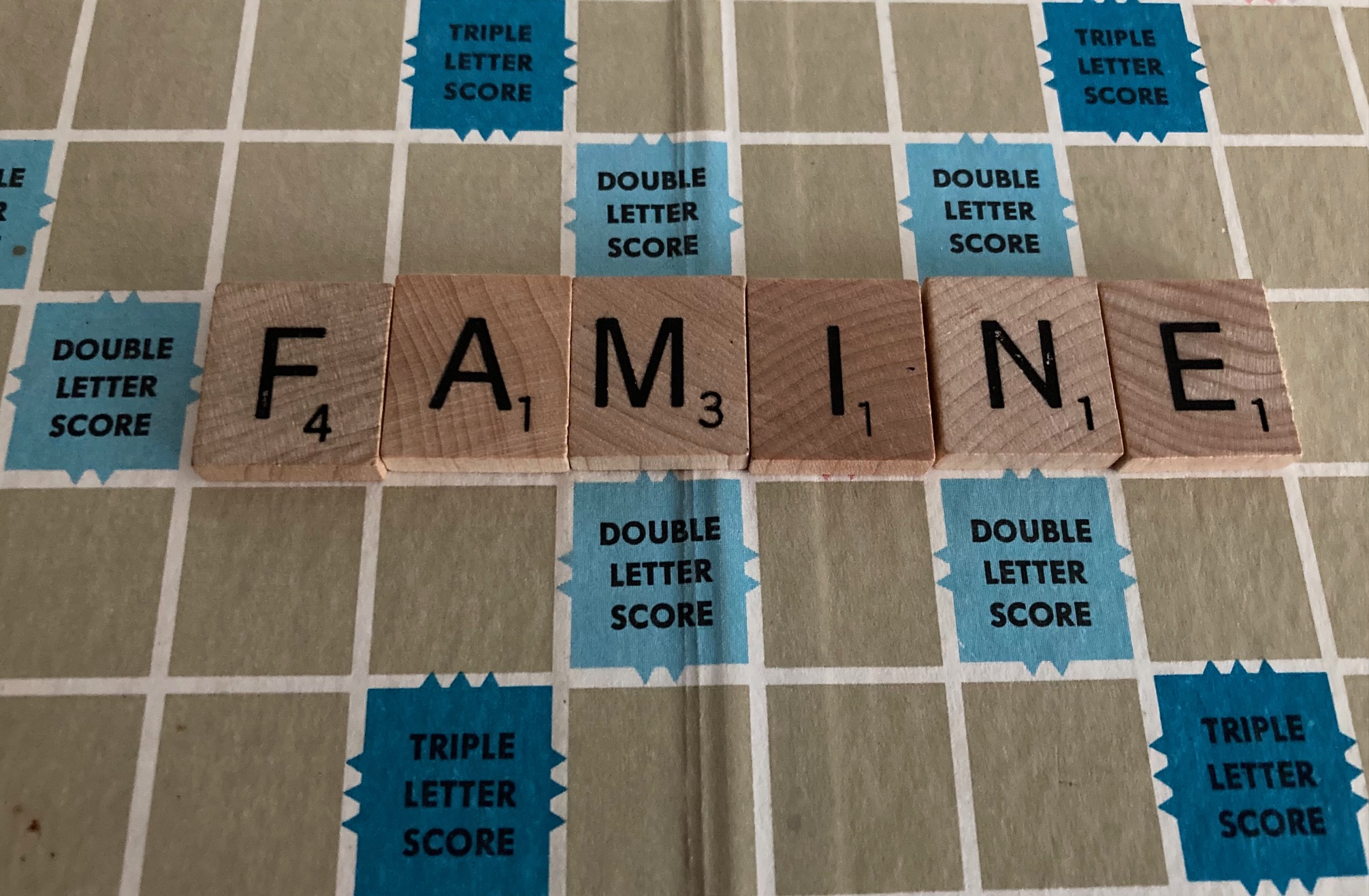
Playing “famine” here earns the first player, or team, twenty-two points.
Last week’s Wordplay Day post included a list of the first thirty-three of the 101 playable two-letter words. Today’s post features the next thirty-one, f–n.
fa: a tone in the diatonic scale
fe: a Hebrew letter
go: leave
ha: used to express surprise
he: a pronoun signifying a male
hi: an expression of greeting
hm: used to express consideration
ho: used to express surprise
id: the least censored part of the three-part psyche
if: a possibility
in: enclosed or surrounded
is: the third-person singular form of “to be”
it: a neuter pronoun
jo: a sweetheart
ka: the spiritual self in ancient Egyptian spirituality
ki: the vital life in Chinese spirituality (also qi)
la: a tone in the diatonic scale
li: a Chinese unit of distance
lo: an expression of surprise
ma: mother
me: a singular objective pronoun
mi: a tone in the diatonic scale
mm: an expression of approval
mo: a moment
mu: a Greek letter
my: a first-person possessive adjective
na: no; not
ne: born with the name of
no: a negative answer
nu: a Greek letter
Playing “famine” here earns the first player, or team, thirty points, but possibly sets up the opposing player, or team, to earn double, double-letter scores with high-value consonants.
Two-Letter “M” Words
M is the consonant that offers the most options for two-letter words. In the first position, it pairs with every vowel, plus y.
ma: mother
me: a singular objective pronoun
mi: a tone in the diatonic scale
mo: a moment
mu: a Greek letter
my: a first-person possessive adjective
With parallel play, the second player, or team, scores a total of forty-one points with the four words “oxo,” “om,” “xi,” and “on.”
In the second position, m pairs with every vowel, except i.
am: the first-person singular present form of “to be”








 Jane Lucas