Posted in English 1103, Teaching, Writing

ENG 1103: From Drafting to Revision

Today in class you received your handrwritten draft with my notes and you began revising your midterm reflection on your laptop. I am writing a reflection as a model for you and will post it to Blackboard and to my blog before your reflection is due on October 20, the Wednesday after fall break. In the meantime, I am including here, as well as on Blackboard, the model reflection that I wrote for my students in late November and early December 2020.

Check, Please!

Also in class today, you submitted the worksheet for the fourth lesson in the Check, Please! course. The summary and commentary that I wrote along with you appears below.

In the fourth lesson of the Check, Please!, Starter Course, Mike Caulfield, author of the course and Director of Blended and Networked Learning at Washington State University, focuses his instruction on the third step in the four-step SIFT approach to determining the reliability of a source. Lesson four, “Find Trusted Coverage,” addresses these topics: (1) scanning Google News for relevant stories, (2) using known fact-checking sites, and (3) conducting a reverse-image search to find a relevant source for an image.

One of the concepts Caulfield introduces in lesson four is click restraint, which was given its name by Sam Wineberg, Professor of History and Education at Stanford, and Sarah McGrew, Assistant Professor of Education at the University of Maryland. Click restraint is an activity that fact checkers practice regularly, but many average people do not. Fact checkers resist the impulse to click on the first result, opting instead to scan multiple results to find one that combines trustworthiness and relevance.

Caulfield also considers the issue of false frames and offers as an example the miscaptioned photo of a young woman that circulated widely after the 2017 London Bridge attack. In the photo, the woman, who is wearing a hijab, is looking down at her phone as she walks past one of the victims lying by the side of the road, surrounded by members of the rescue team. Because the woman’s face is blurred, viewers of the miscaptioned picture cannot see the look of shock that is visible in her face in another image taken by the same photographer. Subsequently, her apparent lack of concern for the victim seems to confirm the caption in the infamous tweet.

Choosing a general search term over a specific one is a useful and unexpected tip Caulfield includes in his discussion of image searches. He explains that the benefit of such a bland term as “letter” or “photo” will prevent the confirmation bias that can lead to the proliferation of disinformation through false frames.

Work Cited

Caulfield, Mike. Check, Please! Starter Course, 2021,             https://webliteracy.pressbooks.com/front-matter/updated-resources-for-2021/.

Next Up

Friday marks our seventh Wordplay Day of the semester. To prepare for class and to up your game, browse the Scrabble site’s Tips and Tools and my blog posts devoted to the game.

Posted in English 1103, Reading, Teaching, Writing

ENG 1103: Starting with Summary

Today in class you read and summarized the September 15 article from The Wall Street Journal’s Facebook Files series. The summary that I wrote along with you appears below.

In The Wall Street Journal article “Facebook Tried to Make its Platform a Healthier Place. It Got Angrier Instead,” investigative reporters Keach Hagey and Jeff Horwitz document the social media company’s changes in its algorithms, adjustments that the company supposedly made to increase meaningful social interaction, or MSI. Although data scientists working for Facebook concluded that “[m]isinformation, toxicity, and violent content are inordinately prevalent among reshares,” the company resisted removing the boost that its algorithms gave to content most likely to be reshared by a long chain of users. In essence, the change had the opposite effect of its apparent aim.

And Moving Beyond Summary

Composing a summary seves as a useful follow-up to reading. Identifying the key points in a piece of writing and presenting them in your own words–and perhaps including a brief quotation–demonstrates that you understand what you’ve read.

When you move beyond summary to analysis, you shift your focus from a description of the subject to a close study of what the text means and how the writer constructs that meaning.

The movement from summary to argument–the move you will make in your final essay–involves a different turn. Rather than focusing on what the text means and how the writer constructs that meaning, you are placing the writer in conversation other credible sources on the subject and finding your own place in the conversation.

Next Up

On Wednesday, October 6, you will submit your completed Check, Please! Worksheet for the fourth lesson in the series. If you misplace your worksheet and cannot print a copy, complete the assignment on a sheet of notebook paper. Be sure to submit it at the beginning of class on Wednesday.

Also, on Wednesday you will receive your draft of your midterm reflection with my notes, and you will have the class period to begin revising your essay.

Work Cited

Hagey, Keach, and Jeff Horwitz. “Facebook Tried to Make its Platform a Healthier Place. It Got Angrier Instead. Internal Memos Show How a Big 2018 Change Rewarded Outrage and that CEO Mark Zuckerberg Resisted Proposed Fixes.” Wall Street Journal, Sep 15, 2021. ProQuest, https://libproxy.highpoint.edu/login?url=https://www-proquest-com.libproxy.highpoint.edu/newspapers/facebook-tried-make-platform-healthier-place-got/docview/2572526410/se-2?accountid=11411.

Posted in English 1103, Scrabble, Teaching

ENG 1103: Two-Letter Words, A-E

Learning the two-letter words you can play in Scrabble increases your opportunities to form multiple words in parallel play. The list that follows includes the first thirty-three of the 101 playable two-letter words.

  • aa: a type of stony, rough lava,
  • ab: an abdominal muscle
  • ad: an advertisement
  • ae: one
  • ag: agriculture
  • ah: an exclamation
  • ai: a three-toed sloth
  • al: a type of East Indian tree
  • am: the first-person singular present form of “to be”
  • an: an indefinite article
  • ar: the letter r
  • as: similar to
  • at: the position of
  • aw: an expression of protest or sadness
  • ax: a sharp-edged tool
  • ay: a vote in the affirmative
  • ba: the soul in ancient Egyptian spirituality
  • be: to exist
  • bi: a bisexual
  • bo: a pal
  • by: a side issue
  • de: of; from
  • do: a tone on a scale
  • ed: education
  • ef: the letter f
  • eh: used to express doubt
  • el: an elevated train
  • em: the letter m
  • en: the letter n
  • er: used to express hesitation
  • es: the letter s
  • et: a past tense of eat
  • ex: the letter x

Coming Soon

On Wednesday, October 4, you will receive your midterm reflection draft with my notes, and you will have the class period to begin your revision work. The works cited list that follows includes entries for some of the sources that you may cite. You are required to quote or paraphrase two relevant sources, one of which may be your analysis. If you choose to cite your analysis, follow the format of the work cited entries for my sample papers, “The Strange Fruit of Sosnowiec,” and “On its Face, Who Could Disagree with the Transformation?: Revisiting Richtel’s Report on the Blog-Term Paper Question.”

Works Cited

Hagey, Keach, and Jeff Horwitz. “Facebook Tried to Make its Platform a Healthier Place. It Got Angrier Instead. Internal Memos Show How a Big 2018 Change Rewarded Outrage and that CEO Mark Zuckerberg Resisted Proposed Fixes.” Wall Street Journal, Sep 15, 2021. ProQuest, https://libproxy.highpoint.edu/login?url=https://www-proquest-com.libproxy.highpoint.edu/newspapers/facebook-tried-make-platform-healthier-place-got/docview/2572526410/se-2?accountid=11411.

Horowitz, Jeff, Deepa Seetharaman, and Georgia Wells. “Facebook Knows Instagram is Toxic for Teen Girls, Company Documents Show.” Wall Street Journal, Sep 14, 2021. ProQuest, https://libproxy.highpoint.edu/login?url=https://www-proquest-com.libproxy.highpoint.edu/newspapers/facebook-knows-instagram-is-toxic-teen-girls/docview/2572204393/se-2?accountid=11411.

Junod, Tom. “The Falling Man.” Esquire, vol. 140, no. 3, Sept. 2003, pp. 176+. Gale Academic OneFile Select, https://link.gale.com/apps/doc/A106423422/EAIM?u        =hpu_main&sid=bookmark-EAIM&xid=ce48797f

Lucas, Jane. “ENG 111: The Strange Fruit of Sosnowiec.” Jane Lucas, 2 Apr. 2021,  https://janelucas.com/2021/04/02/the-strange-fruit-of-sosnowiec/.

—. “ENG 1103: On its Face, Who Could Disagree with the Transformation?: Revisiting Richtel’s Report on the Blog-Term Paper Question.” https://janelucas.com/2021/09/20/eng-1103-on-its-face-who-could-disagree-with-the-transformation-revisiting-richtels-report-on-the-blog-term-paper-question/.

Richtel, Matt. “Blogs vs. Term Papers,” The New York Times, 20 Jan. 2012,  https://www.nytimes.com/2012/01/22/education/edlife/muscling-in-on-the-term-paper-tradition.html.

Rossenwasser, David and Jill Stephen. “Writing on Computers vs. Writing on Paper.”  Writing Analytically, 8th edition. Wadsworth/Cengage, 2019. pp. 124-25.

Wolf, Maryanne. “Skim Reading is the New Normal.” The Guardian, 25 Aug. 2018, https://www.theguardian.com/commentisfree/2018/aug/25/skim-reading-new-normal-maryanne-wolf.

Posted in English 1103, Teaching, Writing

ENG 1103: Beginning Your Midterm Reflection

Today in class you began planning and drafting your midterm reflection longhand. If you brought a paper copy of your revised analysis to class and completed the sideshadowing exercise, the marginal notes and the summary you produced may figure prominently in your reflection if you choose to focus wholly or in part on your analysis. That said, as you continue to work on your reflection, you may find your focus shifts to another aspect or component of the course.  

As I noted in the instructions for the reflection, you are welcome to focus on any components of the course but no more than four, total. A complete list follows. 

  • Planning, drafting, and revising your analysis
  • Keeping a journal
  • Completing Check, Please! assignments
  • Studying one of the readings examined class, including “Blogs vs. Term Papers,” “Skim Reading is the New Normal,” the first paragraphs of “The Falling Man,” “Facebook Knows Instagram is Toxic for Teen Girls, Company Documents Show,” and the sample analyses
  • Writing for an online audience beyond the classroom/creating and maintaining a WordPress blog
  • Collaborating with your classmates on in-class writing assignments
  • Writing longhand
  • Limiting screen time

Next Wednesday, October 4, you will receive your handwritten plans and drafts with my notes, and you will have the class period to begin revising your analysis on your laptop or tablet.

In the meantime, continue to think about your reflection as a work in progress. Freewrite and jot notes about your reflection in your journal. 

If you take your reflection in progress to the Writing Center, you will earn extra credit for the assignment. To schedule an appointment with a tutor, follow this link: https://highpoint.mywconline.com/.

Next Up

Friday marks our sixth Wordplay Day of the semester. To prepare for class and to up your game, browse the Scrabble site’s Tips and Tools.

Posted in English 1103, Teaching, Writing

ENG 1103: From Observation to Implication

Falconer, Ian. The Competition. 2000. The New Yorker, 9 Oct. 2000. Copyright 2000 Condé Nast Publications, Inc.

Last Wednesday in class, we examined Ian Falconer’s The Competition, and you read two possible interpretations that the authors of Writing Analytically offer. As a group exercise in moving from observation to implication, you collaboratively composed a statement that included a detail that led you to find the first or second possibility more plausible.

Here are sample claims for each of the two interpretations:

The contrast between the raven hair and eyes of Miss New York and the platinum-blonde and pale-eyed contestants from Georgia, California, and Florida in The New Yorker cover The Competition by Ian Falconer suggests what the authors of Writing Analytically present as the first of two possible interpretations: The cover “speak[s] to American history, in which New York has been the point of entry for generations of immigrants, the ‘dark’ (literally and figuratively) in the face of America’s blonde European legacy” (Rosenwasser and Stephen 89).

The self-satisfied expression of Miss New York in The New Yorker cover The Competition by Ian Falconer suggests what the authors of Writing Analytically present as the second of two possible interpretations: “[T]he magazine is . . . admitting , yes America, we do think that we’re cooloer and more individual and less plastic than the rest of you, but we also know that we shouldn’t be so smug about it” (Rosenwasser and Stephen 89).

This semester, as you continue to practice moving from observation to implication, review these samples as models. Also note that each one is a statement that presents a quotation as an appostive, which is a word or group of words that explains the noun it follows. In each case, the noun is “interpretation” and what follows is the specific interpretation itself.

Work Cited

Rosenwasser, David and Jill Stephen. Chapter 3: “Interpretation: Moving from Observation to Implication.” Writing Analytically, 8th edition. Wadsworth/Cengage, 2019. pp. 70-97.

Check, Please! Lesson Three

In class on Wednesday, September 29, you will submit your completed worksheet for the third lesson in the Check, Please! assignment series. The sample assignment for lesson three that I wrote as a model for you appears below.

In the third lesson of the Check, Please!, Starter Course, Mike Caulfield, author of the course and Director of Blended and Networked Learning at Washington State University, continues his instruction on the second step in four-step SIFT approach to determining the reliability of a source. Lesson three, “Further Investigation” covers these topics: (1) Just add Wikipedia for names and organizations, (2) Google Scholar searches for verifying expertise, (3) Google News searches for information about organizations and individuals, (4) the nature of state media and how to identify it, and (5) the difference between bias and agenda.

One of the most instructive parts of lesson three focuses on two news stories about MH17, Malyasia Airlines Flight 17, a passenger flight scheduled to land in Kuala Lumpur that was shot down over eastern Ukraine on July 17, 2014. While the second story, a television news segment, appears to present detailed investigative reporting challenging the conclusion of the Dutch Safety Board and Dutch-led joint investigation team–the conclusion that Russia was to blame–a quick just-add-Wikipedia check reveals that RT (formerly Russia Today) is a Russian state-controlled international TV network, a government propaganda tool rather than a source of fair and balanced news. The first video, the one produced by Business Insider, a financial and business news site, delivers accurate coverage of MH17.

Another notable segment of “Further Investigation” addresses the important distinction between “bias” and “agenda.” There, Caulfield observes that “[p]ersonal bias has real impacts. But bias isn’t agenda, and it’s agenda that should be your primary concern for quick checks,” adding that “[b]ias is about how people see things; agenda is about what a news or research organization is set up to do.”

Work Cited

Caulfield, Mike. Check, Please! Starter Course, 2021,           https://webliteracy.pressbooks.com/front-matter/updated-resources-for-2021/.

Posted in English 1103, Scrabble

ENG 1103: A Close Study of the Board

Developing the ability to analyze involves becoming more observant. As you continue to play Scrabble on Wordplay Days this semester, consider how each game is an additional exercise in becoming more observant. 

Examine the image at the top of this post. There you will see what could be the opening play in a game of Scrabble. Any of the three letters in “lox” could be on the center square. Why might the player, or team, have placed the “l” rather than the “o” on the center square?

The image directly above this paragraph illustrates the potential benefit of not placing the “o” on the center square. If the opponent has two high-value consonants, the first player, or team risks the chance of the opponent playing those consonants and doubling their value on the bonus squares, whereas it’s unlikely that the opponent will be able play consonants–high value ones or not–on both sides of the “I” or the “x.”

Coming Soon

In class on Wednesday, September 29, you will submit your completed worksheet for the third lesson in the Check, Please! assignment series. The students in the 10:40 a.m. class received the worksheet today. The students in the 9:15 a.m. class will receive the worksheet on Monday. Also, you can download the worksheet at the link below. In class on Wednesday, you will begin drafting your midterm reflection. For that preliminary work, you will need to bring a paper copy of your revised analysis to class.

Posted in English 1103, Teaching

ENG 1103: Research Rookies

Today’s class will feature guest speaker Dr. Joanne Altman, Director of Undergraduate Research and Creative Works, who will speak to us about Research Rookies. Founded by Altman in 2014, Research Rookies introduces first-year students to the culture of research. Participating involves remaining active in the program for two consecutive semesters, performing fifteen research-related tasks, and participating in a mini-research project.

Becoming a Research Rookie offers the first step in the path toward undergraduate research. Later, engaging in research as an upper-level undergraduate will provide an excellent opportunity not only to develop your research skills but also your writing and public speaking skills. And presenting your work at undergraduate research conferences—and possibly publishing it as well—will give you an edge when you apply for internships and jobs.

If you are interested in becoming a Research Rookie, please email Dr. Altman, jaltman0@highpoint.edu.

Moving from Observation to Implication

Today’s class will also include a journal exercise in moving from observation to implication, and time permitting, you will complete a group exercise as a follow-up to your journal writing.

Next Up

Friday marks our fifth Wordplay Day of the semester. To prepare for class, review the Scrabble site’s “Tips and Tools.”

Coming Soon

Next Wednesday, September 29, you will submit your completed Check, Please! Worksheet for the third lesson in the series. (I will distribute copies of the worksheet on Friday.) In class next Wednesday, you will begin writing your midterm reflection. For that preliminary writing, you will need to have paper copy of your analysis revision with you.

Posted in English 1103, Teaching, Writing

ENG 1103: “On its Face, Who Could Disagree with the Transformation?”: Revisiting Richtel’s Report on the Blog-Term Paper Question

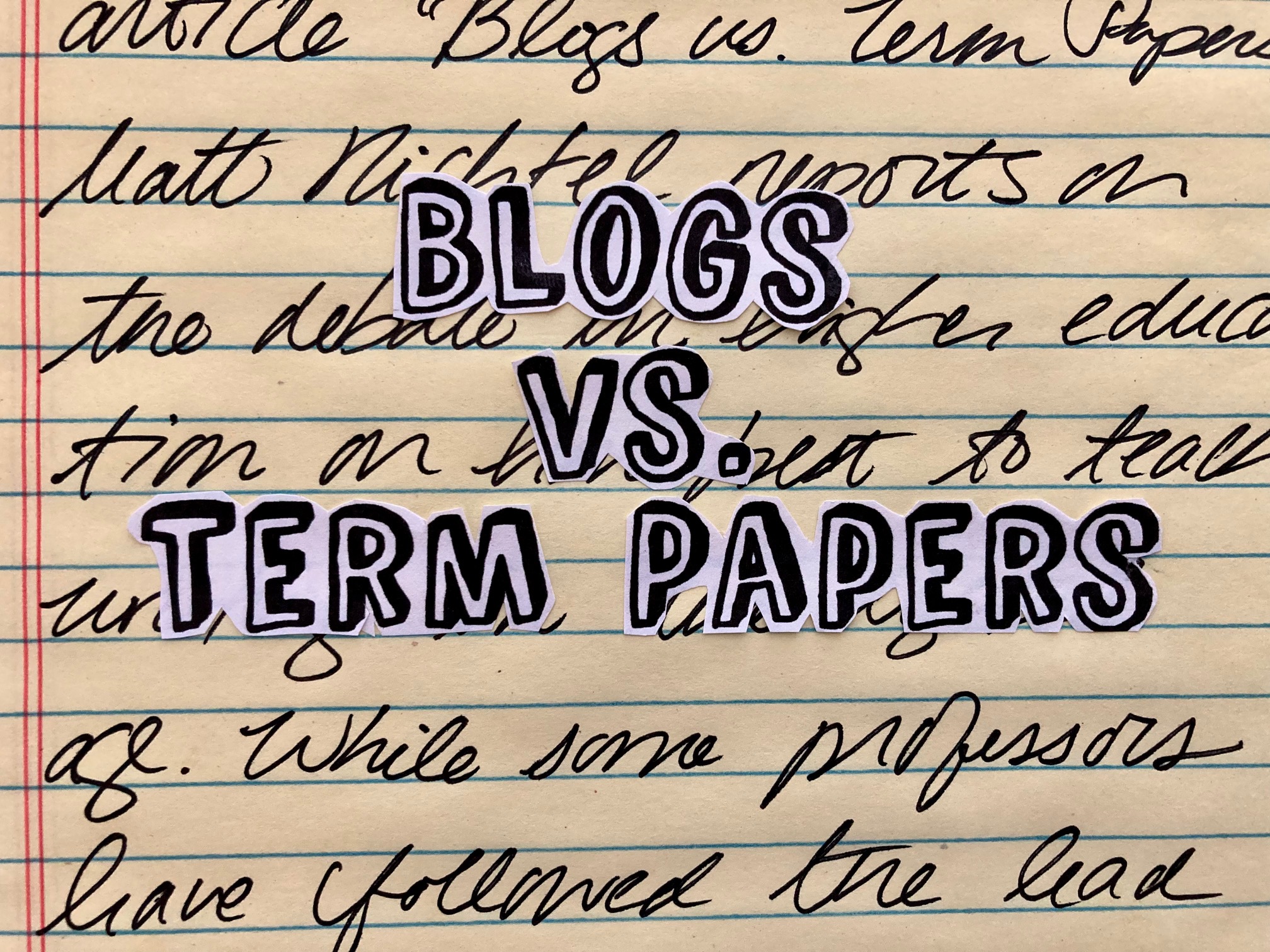
In The New York Times article “Blogs vs. Term Papers,” Matt Richtel reports on the debate in higher education on how best to teach writing in the digital age. While some professors have followed the lead of City University of New York’s Cathy N. Davidson, replacing the traditional term paper with shorter, more frequent blog assignments, their detractors—including Douglas B. Reeves, columnist for the American School Board Journal and William H. Fitzhugh, editor of The Concord Review—argue that blog writing lacks the academic rigor that fosters critical thinking. For Andrea Lunsford, professor of writing at Stanford University, pitting blogs against term papers creates a false opposition. Rather than replacing term papers with blog posts, Lunsford requires students to produce multi-modal assignments: term papers that evolve into blogs, websites, and video presentations. Although Richtel’s article appears to present an objective account of the disagreements among experts, a close examination of the diction and structure of “Blogs vs. Term Papers” reveals an implicit preference for the innovations advocated by Davidson and Lundsford.

The opening paragraph of Richtel’s article focuses on the academic paper as a primary cause of “angst, profanity, and caffeine consumption” among high school and college students. In stark contrast to the images of the term paper-induced misery in his lead, Richtel writes in the second paragraph that students may be “rejoicing” because Cathy Davidson—a professor at Duke when Richtel interviewed her—favors replacing the term paper with the blog. Richtel refers to Davidson as a “champion” for students and outlines her use of a course blog as a practice that has become commonplace in a variety of academic disciplines. Richtel reports that blogs provide students with a “feeling of relevancy” and “instant feedback,” then poses the question: “[W]hy punish with a paper when a blog is, relatively, fun?”

From that question Richtel turns to the argument of defenders of the traditional academic paper, namely that the term paper teaches essential components of writing and thinking that may be absent from blog posts. Yet after letting the advocates of old-school writing have their say, Richtel undercuts their claim with this one-sentence paragraph: “Their reductio ad absurdum: why not just bypass the blog, too, and move on to 140 characters about Shermn’s Mrch?” To assert that defenders of traditional academic writing carry their opponents’ argument to an absurd conclusion presents those advocates of old-school writing as purveyors of the same flawed logic that their own traditional rhetoric supposedly teaches students to avoid.

Notably, the one-sentence paragraph, unlike paragraphs with multiple sentences, places heavy emphasis on a single idea. It says to readers, this is important. By introducing an apparent contradiction in the argument of the advocates of old-school writing, Richtel subverts their claim; and by presenting that incongruity as a one-sentence paragraph, he highlights the issue.

Richtel’s reductio ad absurdum paragraph is one of only two one-sentence paragraphs in his article. The other consists entirely of Professor Davidson’s own words. Speaking of the mechanistic quality of the term paper, she says: “As a writer, it offends me deeply.” In addition to devoting that one-sentence paragraph to Davidson’s negative feelings about term papers, Richtel returns to those feelings of hers at the end of his article and lets Davidson have the last word, literally.

In the final paragraphs of the article, Richtel recounts a tutoring session Davidson conducted with a community college student. Though she frowned on his assignment’s rigid guidelines—including prescribed sentence length—she told the student to follow the rules, knowing that teaching him what she deemed the best practice might have led the student to fail. Reflecting on that moment, Davidson said, “I hated teaching him bad writing,” and with those words of hers,  Richtel’s article ends.

Along with giving Davidson the last word, Richtel devotes far more of his article to the new literacies she and Lunsford foster in their students. Arguably, the innovative nature of the work could account for the considerable space that Richtel devotes to it. After all, what readers are familiar with—in this case the traditional term paper—isn’t news. But the preponderance of word choices that place old literacies in a negative light combined with a structure that diminishes the merits of old-school writing reveals Richtel’s implicit preference for Davidson’s and Lundsford’s innovations.

Readers revisiting Richtel’s article now, nearly ten years after he wrote it, may wonder how he would respond to the question he poses about the shift from page to screen: “On its Face, Who Could Disagree with the Transformation?” Richtel wrote “Blogs vs. Term Papers” in 2012, the year deemed the year of the MOOCs (massive open online courses). Once touted as the key to revolutionizing higher education, their success has been hampered by the same issues linked to the learning losses experienced during the pandemic. For the many students who have had little or no face-to-face instruction—writing or otherwise—in recent memory, more technology may not seem like an answer, much less an innovation.

Work Cited

Richtel, Matt. “Blogs vs. Term Papers,” The New York Times, 20 Jan. 2012, https://www.nytimes.com/2012/01/22/education/edlife/muscling-in-on-the-term-paper-tradition.html.     

Posted in English 1103, Scrabble, Teaching

ENG 1103: Scrabble/Bingo

If a player, or a team, uses all seven of its tiles in one play, the player, or team, earns fifty points in addition to the points for the words played. Congratulations to the team of Zack Chadwell and Tanner Rothenbereger in the 9:15 class for Scrabbling by building on “trap” with “minutes” (using a blank for the s), and also forming “am” (first-person singular form of the verb “be”) and “pi” (the numerical value of the ratio of the circumference of a circle to its diameter), which later in the game became “pig.”

If the players had not seen the opportunity to form the two-letter words “am” and “pi,” they would not have Scrabbled.

Look for opportunities that two-letter words can offer. There are sixteen two-letter words starting with a, so you have a 62% chance that any tile you put after an a will form a word.

Posted in English 1103, Teaching, Writing

ENG 1103: Developing a Thesis

Junod, Tom. “The Falling Man.” Esquire, vol. 140, no. 3, Sept. 2003, pp. 176+. Gale Academic OneFile Select, https://link.gale.com/apps/doc/A106423422/EAIM?u=hpu_main&sid=bookmark-EAIM&xid=ce48797f.

On Monday, as an exercise in developing a thesis or main claim, you and your classmates collaboratively, in groups of four, examined the opening paragraphs of Tom Junod’s Esquire feature “The Falling Man” and crafted a thesis statement. The sample thesis that I wrote in class as a model for you appears below.

Sample Thesis Statement/Main Claim

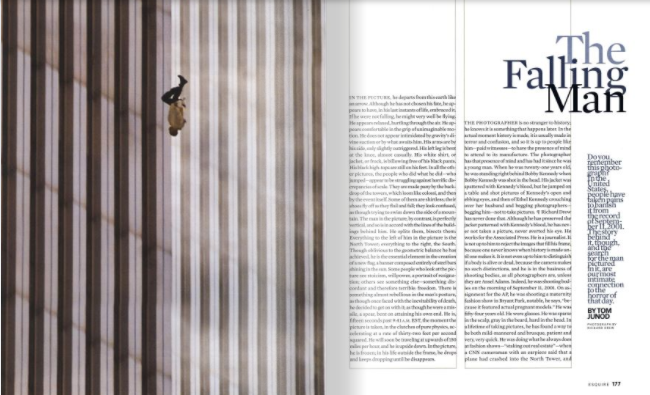
Esquire writer Tom Junod begins “The Falling Man” with an uncharacteristically long paragraph to recreate on the page the lengthy vertical passage of the 9/11 victim immortalized in Richard Drew’s photograph.

If I were to write an analysis of the opening of “The Falling Man,” I would develop my essay with textual evidence–words and phrases throughout the first paragraph–to illustrate the linear movement of the unidentified man from the beginning of the first paragraph to its conclusion.

The September 2003 issue of Esquire presents the opening paragraph of Junod’s article as two long columns that mirror the Twin Towers in Drew’s photograph on the facing page. (See the image below the title of this post.)

Your Revision in Progress

Today in class you received your handwritten drafts with my notes to you, and you began your revision work on your laptops. As you continue to revise your analysis of “Blogs vs. Term Papers” or “Skim Reading is the New Normal,” keep in mind our textbook authors’ words about effective thesis statements:

“The thesis of an analytical paper is an idea about your subject, a theory that explains what some feature or features of your subject mean. A good thesis comes from carefully examining and questioning your subject in order to arrive at some point about its meaning and significance that would not have been immediately obvious to your readers” (Rosenwasser and Stephen 180).

Also keep in mind our textbook authors’ explanation of the difference between analysis and argument: The claim that an analysis makes is often the answer to the question, what does it mean? The claim that an argument makes “is often an answer to a should question” (Rosenwasser and Stephen 7-8).

More on Tom Junod’s “The Falling Man”

Unless you subscribe to Esquire, the magazine’s paywall will deny you  access to the full text of the feature, but you can access it through the HPU Library site by following these steps:

  1. Go to the HPU Library site.
  2. Under the heading “Search HPU Libraries . . . ,” click on the “Articles” tab.
  3. Under the “Articles” tab, type Tom Junod “Falling Man” Esquire in the search box and click “search.”
  4. On the next screen, you will see a brief summary of the article. Click “Access Online” to view the full article.

Next Up

Friday marks our fourth Wordplay Day of the semester. To prepare for class, review the Scrabble site’s “Tips and Tools.”

Coming Soon

In class on Monday, we will examine the sample analysis that I am writing as a model for you.

Works Cited

Rosenwasser, David and Jill Stephen.Chapter 1: “The Five Analytical Moves.” Writing Analytically, 8th edition. Wadsworth/Cengage, 2019. pp. 1-37.

—.Chapter 7: “Finding and Evolving a Thesis.” Writing Analytically, 8th edition. Wadsworth/Cengage, 2019. pp. 178-212.