This final Scrabble post of the semester features the names of authors and characters that are playable words. Learning these will not only increase your word power (and up your game), it will also broaden your knowledge of literature. If you haven’t read some of classics listed here, I encourage you to check them out.
eyre: a long journey (the last name of of the title character in Charlotte Bronte’s Jane Eyre, 1847)
dickens: a devil (Charles Dickens, 1812-1870)
fagin: a person, usually an adult, who instructs others, usually children, in crime (from a character of that type in Dickens’ Oliver Twist)
holden: the past participle of hold (Holden Caulfield, the protagonist in J.D. Salinger’s The Catcher in the Rye)
huckleberry: a berry like a blueberry (the first name of the title character in Mark Twain’s Adventures of Hucklebery Finn, 1884)
oedipal: describing libidinal feelings of a child toward the parent of the opposite sex (from the title character in Sophocles’ Oedipus Rex, c. 429 B.C.)
quixote: a quixotic, or extremely idealistic person; also quixotry, a quixotic action or thought (the title character in Michael de Cervantes’ Don Quixote, Part I: 1605, Part II: 1615)
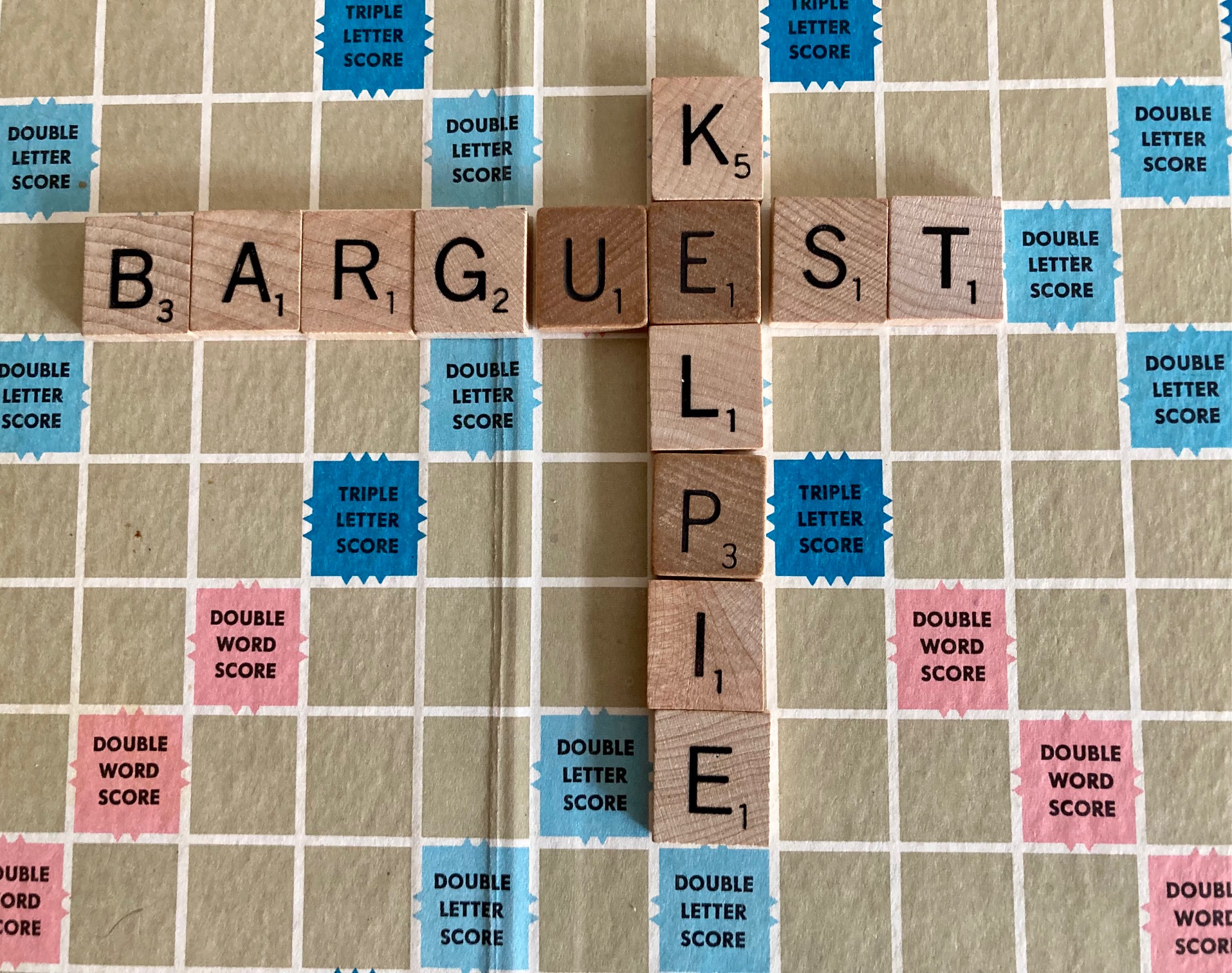
Could the words in the hypothetical game featured in the image at the top of this post be the first plays in an actual game of Scrabble? They couldn’t be the first two plays, but they could be the first three. “Huckleberry” with the “b” on the center square/double-word bonus square would be worth fifty-eight points, but “huckleberry” has eleven letters, and the first player, or team, could not play more than seven letters. But the first play could be “berry” for twenty-eight points. The second player, or team, could follow with “q-u-i-x-o-t” to the left of the “e” in in berry for twenty-five points. Then the first player, or team, could add h-u-c-k-l-e to “berry” for a total of twenty-five points.
Next Up
Beginning at noon on Monday, May 1, you and your classmates will deliver your exam-period presentations. As you prepare, review the directions for rehearsing on your assignment sheet.
In honor of William Shakespeare’s birthday this weekend, Sunday, April 23,* today’s Scrabble post features Shakespeare characters whose names are also playable common nouns.
ariel: a gazelle found in Africa (Ariel, The Tempest, 1611-12)
dogberry: the fruit of a dogwood tree (Dogberry, Much Ado about Nothing, 1598-1599)
hamlet: a village (the title character of Hamlet, 1600-1601)
lear: learning (the title character of King Lear, 1605-1606)
puck: a disk used in ice hockey and other games (Puck, A Midsummer Night’s Dream, 1595-1596)
romeo: a seductive lover, a male lover (one of the title characters in Romeo and Juliet, 1594-1595)
shylock: to lend money with a high interest rate (Shylock, The Merchant of Venice, 1596-1597)
*April 23, the day of Shakespeare’s death in 1616, is traditionally given for his birth in 1564.
Next Up
Wordplay Day! To up your game and increase your word power, review the tips and tools on the Scrabble website as well as this blog post and my other posts devoted to the game.
This week’s Scrabble post features comic book characters whose names are playable because they have common noun definitions as well. Learning these playable words will up your game–and it may lead you discover that Scrabble dominance is your super power!
batgirl: a young woman whose job it is to mind baseball equipment
batman: a British officer’s orderly
corsair: a pirate
hulk: to appear large or intimidating
iceman: a man whose job it is to supply ice
ironman: a man of great strength or endurance
joker: one who habitually makes jokes
magneto: a small electric generator containing a magnet
mystique: an aura of attractiveness
riddler: one who poses riddles
robin: a type of thrush
superman: an idealized, superior man
superwoman: an exceptional woman, especially one who succeeds in having a career and raising a family
wolverine: a smallish, vicious carnivore of the weasel family, native to the tundra
Could the words in the hypothetical game featured in the image at the top of this post be the first plays in an actual game of Scrabble? They couldn’t be the first two plays, but they could be the first three. “Wolverine” with the “e” on the double word score would be worth forty points, but “wolverine” has nine letters, and the first player, or team, could not play more than seven letters. But the first play could be “wolver” (one who hunts wolves) for thirty-two points. The second player, or team, could follow with “batgirl” for fifteen points. Then the first player, or team, could add i-n-e to “wolver” for a total of sixteen points.
Next Up
Wordplay Day! To up your game and increase your word power, review the tips and tools on the Scrabble website, this blog post of heroes and villians, and my other posts devoted to the game.
The final essay and annotated bibliogaphy are ones that I wrote as models for you. The bibliography includes Jonathan Kay’s essay “Scrabble is a Lousy Game,” the starting point for my research, four refereed research articles, and a newspaper story featuring a Scrabble prodigy who began playing the game during the COVID-19 pandemic lockdown.
Scrabble as a Game Changer in the College Classroom
Earlier this month, when I reread Jonathan Kay’s Wall Street Journal review “Scrabble is a Lousy Game,” I once again meditated on his criticism of Scrabble as a word game that deemphasizes semantics. In Kay’s words, “Scrabble treats language the way computers do—as arbitrarily ordered codes stored in a memory chip” (C5). I asked myself, if I want my students to play a board game that cultivates word power, collaboration, critical thinking skills, is Scrabble the game to choose? Thus, Kay’s review became the starting point for my research on the benefits of Scrabble play. As I scrolled through search results, I found only a handful of articles that specifically addressed Scrabble in the college classroom, but many that focused on the value of the game, itself, for sharpening the mind.
The dearth of articles on Scrabble in the college classroom may be explained by the emphasis on classwork with assessable outcomes rather than activities that foster the habits of mind essential to lifelong learning. The bibliography that follows includes Kay’s review, the starting point for my research, four refereed research articles, and a newspaper story featuring a Scrabble prodigy who began playing the game during the COVID-19 pandemic lockdown. Three of the four refereed articles offer windows into the classrooms of professors whose students play Scrabble: one an English professor at a two-year college in California, a second, a director of the honors program at a university in Kansas; and third, a professor of engineering at a polytechnic university in Russia. The fourth article addresses cognitive evaluations of competitive Scrabble players and what they reveal about how experience shapes word recognition.
Though Kay’s criticism of Scrabble warrants reconsidering the inclusion of Scrabble in my first-year writing classes, his disapproval of the game stems from the practices of tournament-level players, not people for whom the game is a pastime—or from students, like mine, who play Scrabble as a classroom exercise. It’s also notable that collaboration, which is an essential component of team Scrabble, does not factor in Kay’s review.
In “Tabletop Games and 21st Century Skills Practice in the Undergraduate Classroom,” Mark Hayse observes that “[T]wo of the four Cs, communication and collaboration, figured prominently” (298). And he and his two colleagues who participated in the study all reported “that tabletop gameplay helped students move from classroom passivity to classroom ‘engagement’” (298).
How much does Scrabble play cultivate our word power? The answer to that question remains unclear, but the research of psychologists and educators points to the merits of team Scrabble for improving not only our language skills, but also our facility with critical thinking, team-building, and spatial skills.
As I review my research on Scrabble, I look forward to searching for additional studies and commentary on the game. Whether it will lead to a larger project of my own, I do not know. But the knowledge I have gained will inform my teaching as I continue to revise the curriculum and consider additional opportunities for wordplay in the classroom.
“Critical Habits of Mind” addresses the teaching practices of a group of college math and writing faculty who collaborated to develop lessons to foster intellectual capacities, such as motivation and self-efficacy. Developmental educational instructors from three California colleges, Cabrillo, California State University-Monterey Bay, and Hartnell College, partnered to pilot classroom activities, including clicker technology, peer writing review, improvisation, metacognitive writing activities (e.g. “Math Anxiety Essays”), and Scrabble Fridays. Reflecting on their collaboration, Fletcher observes that foregrounding procedural knowledge, as their pilot activities did, enabled them to couple their teaching of discipline-specific content with the set of behaviors essential to teaching and learning. Fletcher notes that Hetty Yelland observes “the extra effort students have to make to overcome the boredom—and their passive word knowledge—that eventually leads to more active and internalized language practices” (54).
Jennifer Fletcher is a Professor of English at California State University, Monterey Bay. Her books include Teaching Arguments, Teaching Literature Rhetorically, and Writing Rhetorically. Fletcher’s account of Hartnell writing instructor Hetty Yelland’s Scrabble Fridays is of particular value to educators who are considering Scrabble play as a classroom activity.
“How a Hobby Can Shape Cognition” presents the findings of Canadian researchers in the Departments of Psychology and Medicine at Calgary University who investigated how the word recognition skills of competitive Scrabble players differed from those of age-matched nonexperts. The researchers’ cognitive evaluations revealed differences only in Scrabble-specific skills, such as anagramming. Also, the researchers observed that Scrabble expertise was associated with two specific effects: vertical fluency and semantic deemphasis. The study’s results indicate that experience shapes visual word recognition.
Ian Hargreaves is Professor Emeritus of Journalism, Media, and Culture at Cardiff University and one of the contributors to A Manifesto for the Creative Economy, a the-point plan for bolstering creative industries. The research of Hargreaves and his former colleagues at Cardiff is pertinent to educators who seek to understand the cognitive benefits of frequent Scrabble play. Notably, the semantic deemphasis that the study identifies—and that Jonathan Kay addresses in his review—contrasts the gains in language skills that Hetty Yelland observes in her English students.
Mark Hayse’s and his colleagues’ primary research question was, “Does tabletop gameplay require the practice of 21st century skills?” (290). Their secondary question was, “What initial links might be drawn between tabletop gameplay, 21st century skill practice, and undergraduate learning?” All three professors reported “that tabletop gameplay helped students move from classroom passivity to classroom ‘engagement’” (298) and that “[e]ven though tabletop gameplay technically was coursework . . . the nontraditional nature of it seemed to render it as play more than work” (298).
Mark Hayes is Director of the Honors Program and Mobee Library Professor at MidAmerica Nazarene University. His other publications include an essay on the World of Warcraft, a study of the video game featured in the collection Don’t Stop Believin’: Pop Cultureand Religion from Ben Hur to Zombies, edited by Robert K. Johnston, Craig Detweiler, and Barry Taylor.
In “Scrabble is a Lousy Game,” writer and editor Jonathan Kay criticizes Scrabble for its lack of emphasis on semantics. In Kay’s words, the game “is like a math contest in which you are rewarded for reciting pi to the 1,000th decimal place but not knowing that it expresses the ratio of a circle’s circumference to its diameter” (C5). Kay asserts that the best board games for casual players involve a mix of luck and skill and recommends two other board games, Codenames and Paperback, as better options for wordplay.
Jonathan Kay is senior editor of the journal Quillette and the author of Your Move: What Board Games Teach Us About Life. While Kay’s review focuses on the competitive player’s approach to Scrabble, the concerns he raises about the game’s deemphasis of word meaning and the frustration that novice players can experience warrant the attention of educators who are researching the potential drawbacks of introducing Scrabble play into their classrooms.
“Scrabble as a Tool for Engineering Students’ Critical Thinking Skills and Development” presents research involving second-year engineering students and teachers of EFL (English as a Foreign Language) at Tomsk Polytechnic University in Tomsk, Russia. The students—all non-native speakers of English—played Scrabble as an in-class and out-of-class-activity for one academic year. At the end of the year, the best six student players competed in teams in a tournament against two teams of the six EFL teachers. Throughout the tournament—which was conducted outside of the classroom to relieve students of the pressure to obtain a high score—the researcher, Nadezda Kobzeva, observed the contrast in the students’ and teachers’ practices as players. While the EFL instructors possessed an advanced knowledge of English language, they were newcomers to Scrabble. On the other hand, the engineering students with limited knowledge of English relied on the skills they developed throughout their year-long Scrabble program. In the feedback the students provided after the tournament, which they won, the majority of students rated the skills they developed as Scrabble players as excellent in all five fields assessed, including team building, thinking, spatial skills, vocabulary, and spelling.
Kobzeva, Professor of Engineering at Tomsk Polytechnic University, focuses her research on engineering students, but her findings are valuable to researchers and teachers in other fields who seek answers to the questions of how Scrabble can be used effectively as a learning tool, and what specific skills students may develop through frequent play.
Liu, Rebecca. “‘Dig Deep and Think as Hard as Possible: The Secrets of Success in Scrabble, Sudoku, Jenga and More.” TheGuardian, 24 Dec. 2022. Gale Business: Insights, link.gale.com/apps/doc/A731074943/GBIB?u=hpu_main&sid=bookmark-GBIB&xid=174c68bc.
“‘Dig Deep and Think as Hard as Possible: The Secrets of Success in Scrabble, Sudoku, Jenga and More,” introduces Guardian readers to Samarth Manchali, a Scrabble prodigy who began playing the game at seven during the pandemic, after watching his mother and his older brother play while stuck at home during COVID-19. For those aspiring to improve their Scrabble play, Manchali offers these tips: (1) learn all permissible two- and three-letter words, (2) put the high-scoring letters—such as J, K, Q, Z—on the triple-letter squares, (3) have “board vision,” which means taking your lead from the board, rather than your letters , and (4) focus on what spots can give maximum points, and places where you can block your opponent from high-scoring words. Manchali’s mother describes a more advanced method called tracking, which involves keeping tabs on which tiles haven’t been played. In her words, “If I know that my opponent is left with a Q, I will look for the place where it can be put, and I’ll try to place a letter there.”
Rebecca Liu is a commissioning editor at The Guardian and staff writer for the feminist film journal Another Gaze. Her work has been published in The Guardian, The Times Literary Supplement, gal-dem, The Financial Times, The White Review, and Internazionale, and has been translated into Italian and Portuguese. Liu’s Guardian article would be useful to educators who are researching the particular strategies that Scrabble players employ to improve their game. It would also be a valuable source for those researching the rise in the popularity of board games during the COVID-19 pandemic.
Next Up
At the beginning of class on Wednesday, you will receive your drafts with my written feedback, and you will have the class period to devote to additional research and writing. The revision of your final essay and annotated bibliography is due on Blackboard and your blog the following Wednesday, April 12. The hard deadline is Friday, April 14.
To mark the end of one windy month and the beginning of another,* this Scrabble post features playable wind-related words. If your rack contains the right letters, spelling these words will be a breeze.
bayamo: a strong wind found in Cuba
bhut: a warm, dry wind in India (also bhoot)
bise: a cold, dry wind, found especially blowing from the northeast in Switzerland (also bize)
blaw: to blow
bleb: a blister (an extremely intense or severe wind)
bora: a cold wind in lowland regions
brr: used to indicate feeling cold (also brrr)
bura: a violent Eurasian windstorm (also buran)
chinook: a warm wind that flows off the east side of the Rockies; or a type of Pacific Northwest salmon named after the Chinook people)
fon: a warm dry wind that blows down off some mountains (also fohn and foehn)
*March and April are usually the windiest months of the year.
Next Up
Wordplay Day! To up your game and increase your word power, review the tips and tools on the Scrabble website as well as this blog post of wind-related words and my other posts devoted to the game.
Last week’s Scrabble post featured a list of toponyms (place names) in the first half of the alphabet. This post includes a list of toponyms in the second half. Learning these playable place names will broaden your vocabulary and up your game.
oxford: a type of shoe, also known as a bal or balmoral
panama: a type of wide-brimmed hat
paris: a type of plant found in Europe and Asia that produces a lone, poisonous berry
roman: a romance written in meter
scot: an assessed tax
scotch: to put an end to; or to etch or scratch (as in hopscotch)
sherpa: a soft fabric used for linings
siamese: a water pipe providing a connection for two hoses
swiss: a sheer, cotton fabric
texas: a tall structure on a steamboat containing the pilothouse
toledo: a type of sword known for its fine craftsmanship, originally from Toledo
wale: to injure, to create welts on the skin
warsaw: a type of grouper fish
waterloo: a definitive defeat
zaire: a currency of Zaire
Next Up
Monday you will begin your initial research for your final essay and annotated bibliography. Review your reading handouts, and determine which writer or which element of the course will serve as your subject.
During our Friday Wordplay Days, some of you have asked whether names of places are playable Scrabble words. If the place name is also a common noun, the answer is yes. The term for such a word is toponym. The list that follows includes toponyms in the first half of the alphabet. Learning these words will broaden your vocabulary and up your game.
afghan: a wool blanket
alamo: a cottonwood poplar tree
alaska: a heavy fabric
berlin: a type of heavy fabric
bermudas: a variety of knee-length, wide-legged shorts
bohemia: a community of unconventional, usually artistic, people
bolivia: a soft fabric
bordeaux: a wine from the Bordeaux region
boston: a card game similar to whist
brazil: a type of tree found in Brazil used to make instrument bows (also brasil)
brit: a non-adult herring
cayman: a type of crocodile, also known as a spectacled crocodile (also caiman)
celt: a type of axe used during the New Stone Age
chile: a spicy pepper (also chili)
colorado: used to decsribe cigars of medium strength and color
congo: an eellike amphibian
cyprus: a thin fabric
dutch: referring to each pperson paying for him or herself
egyptian: a sans serif typeface
english: to cause a ball to spin
french: to slice food thinly
gambia: a flowering plant known as cat’s claw (also gambier, which is a small town in Ohio)
geneva: gin, or a liquor like gin
genoa: a type of jib (a triangular sail), also known as a jenny, first used by a Swedish sailor in Genoa
german: also known as the german cotillon, an elaborate nineteenth-century dance
greek: something not understood
guinea: a type of British coin minted from 1663 to 1813
holland: a linen fabric
japan: to gloss with black lacquer
java: coffee
jordan: a chamber pot
kashmir: cashmere
mecca: a destination for many people
Next Up
Wordplay Day! To up your game and increase your word power, review the tips and tools on the Scrabble website as well as this blog post of toponyms and my other posts devoted to the game.
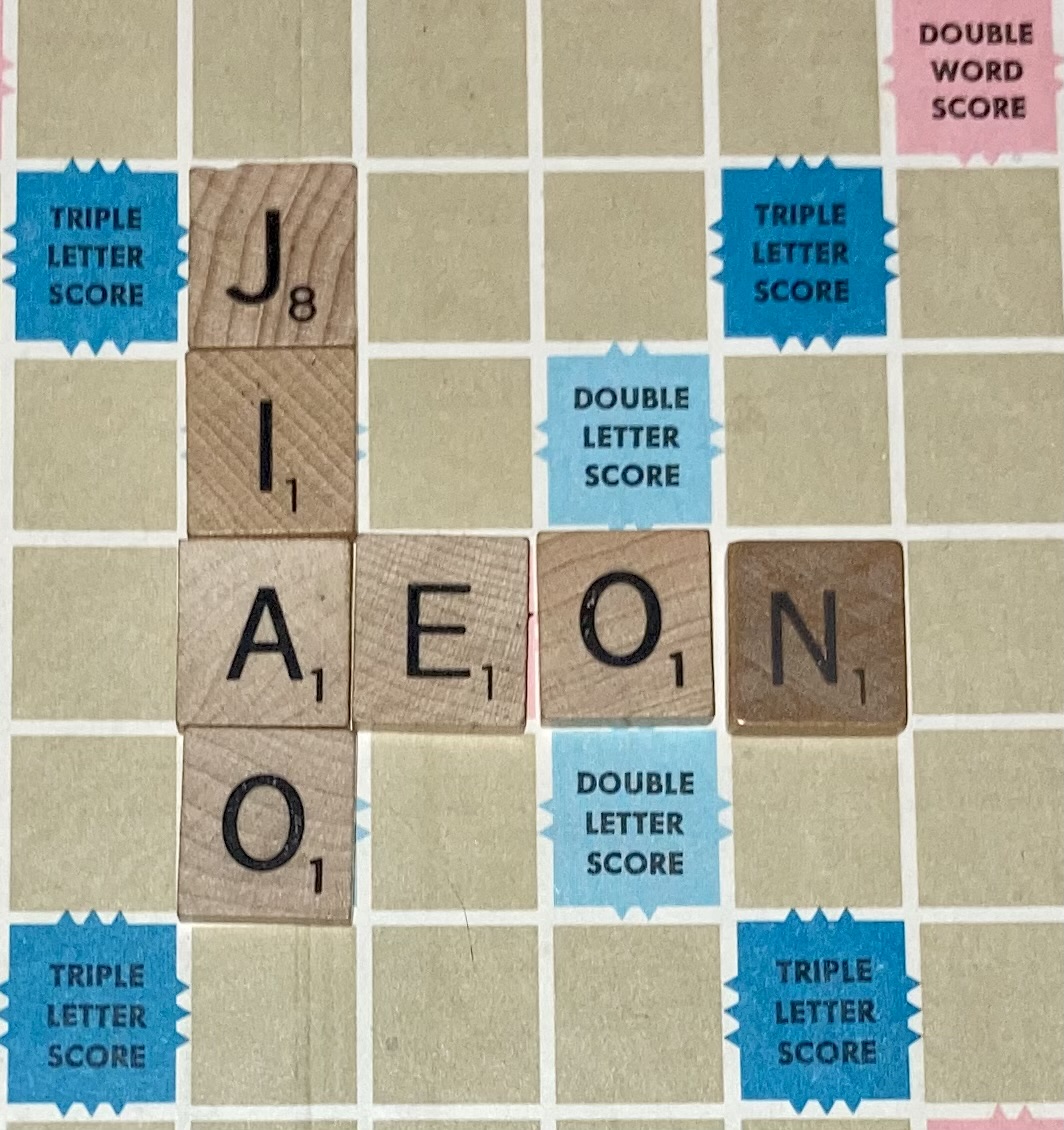
Last week I published a blog post that listed the first twenty-two playable four-letter words with three vowels. Knowing those words, and others with multiple vowels, proves useful when you’re faced with a rack of mostly, or all, vowels. Here’s a list of the remaining fourteen playable four-letter words with three vowels:
naoi: ancient temples (pl. of naos)
obia: form of sorcery practiced in the Caribbean (also obeah)
odea: concert halls (pl. of odeum)
ogee: an S-shaped molding
ohia: a Polynesian tree with bright flowers (also lehua)
olea: corrosive solutions (pl. of oleum)
olio: a miscellaneous collection
ouzo: a Turkish anise-flavored liquor
raia: a non-Muslim Turk (also rayah)
roue: a lecherous old man
toea: a currency in Papua, New Guinea
unai: a two-toed sloth (pl. unai; an ai is a three-toed sloth)
Knowing words with multiple vowels proves useful when you’re faced with a rack of mostly, or all, vowels. Here’s a list of the first twenty-two playable four-letter words with three vowels:
aeon: a long period of time (also eon)
agee: to one side (also ajee)
agio: a surcharge applied when exchanging currency
ague: a sickness associated with malaria
ajee: to one side (also agee)
akee: a tropical tree
alae: wings (pl. of ala)
alee: on the side shielded from wind
amia: a freshwater fish
amoa: a kind of small buffalo
awee: a little while
eaux: waters (pl. of eau)
eide: distinctive appearances of things (pl. of eidos)
emeu: an emu
etui: an ornamental case
euro: an Australian marsupial, also known as wallaroo, for being like the kangaroo and the wallaby; also a unified currency of much of Europe
ilea: the terminal portions of small intestines (pl. of ileum)
ilia: pelvic bones (pl. of ilium)
jiao: a Chinese currency (also chiao)
luau: a large Hawaiian feast
meou: to meow
moue: a pouting expression
Next Up
Today marks your seventh Wordplay Day of the semester. To up your game and increase your word power, review the tips and tools on the Scrabble website as well as this blog post and my other posts devoted to the game.
Coming Soon
In class on Monday you will read one of your classmate’s analyses and compose a response that addresses one of the nine basic writing errors or identifies one of the well-written sentences in the essay. Remember to bring Writing Analytically to Class.
cwm: a cirque (a deep, steepwalled basin on a mountain, pl. -s, prounounced to rhyme with “boom”)
hm: used to express thoughtful consideration (also “hmm“)
mm: used to express assent or satisfaction
nth: describing an unspecified number in a series
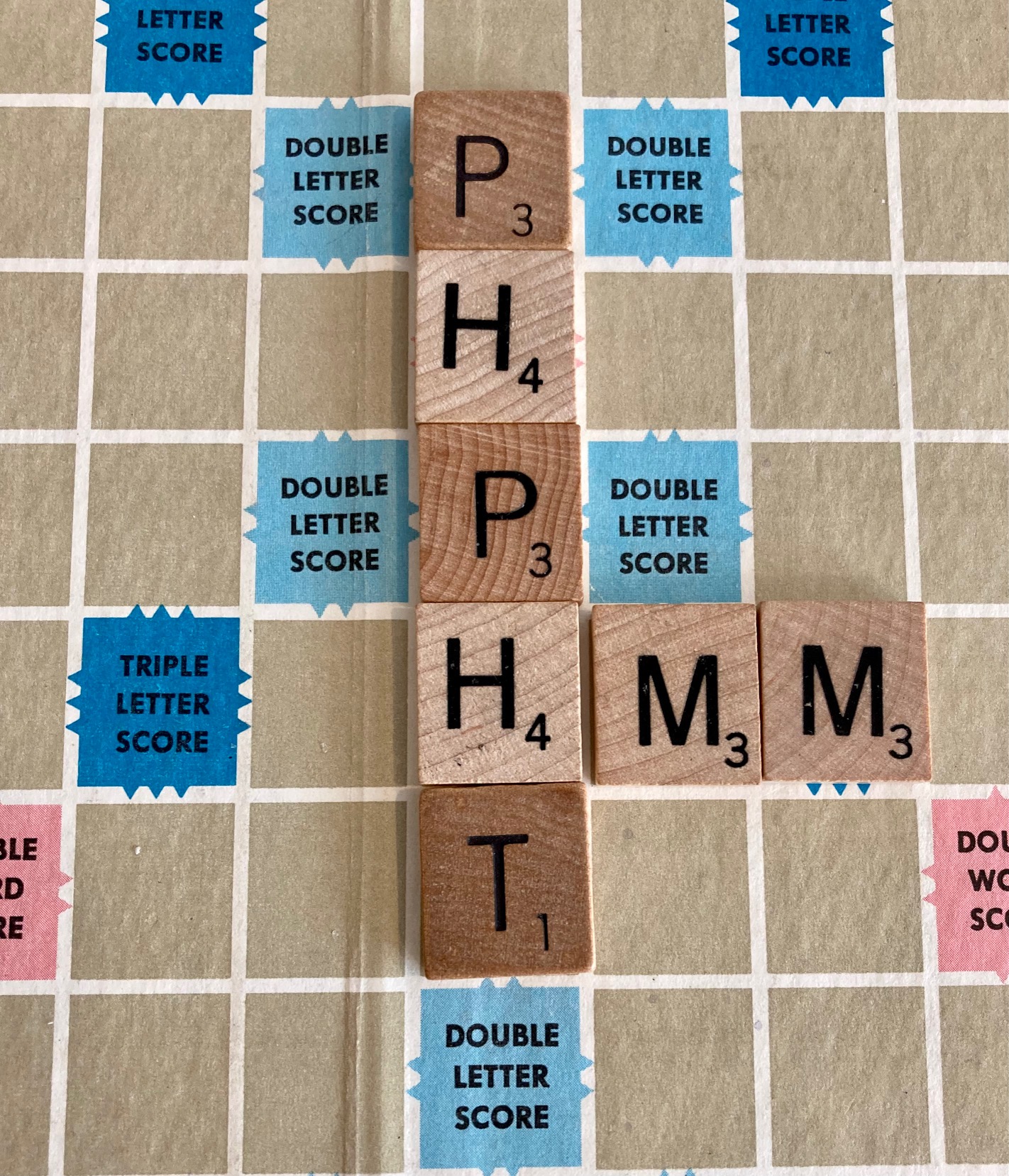
phpht: used as an expression of mild anger or annoyance (also “pht“)
psst: used to attract someone’s attention
sh: used to urge silence (also “shh” and “sha“)
tsk: to utter an exclamation of annoyance (-ed, -ing, -s)
tsktsk: to “tsk” (-ed, -ing, -s)
Learning these words will enable you to continue the game when you’re faced with a rack without vowels.
Next Up
Friday marks your sixth Wordplay Day of the semester. To up your game and increase your word power, review the tips and tools on the Scrabble website as well as my blog posts devoted to the game.