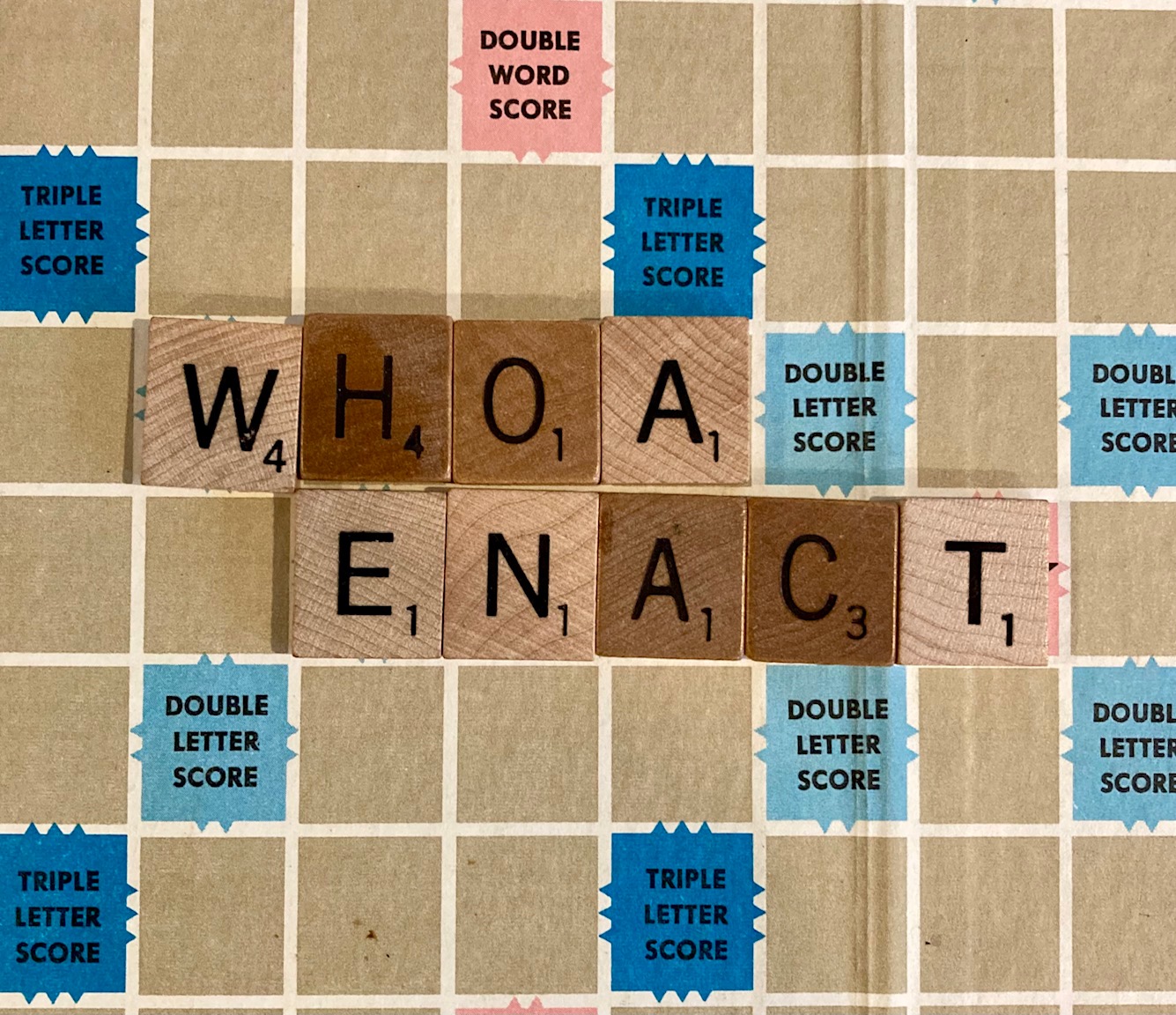
Parallel play increases your score through the points you earn by spelling more than one word in a single turn. In the first play of the game pictured above, the team scored sixteen points by spelling “enact” with the “t” on the center double word square. With the second turn, the other team took advantage of the opportunity for parallel play. Because the team knew that “aa” is a type of lava, they earned twenty-four points with four words: “whoa,” “he,” “on,” and “aa.”
Two-Letter Words Beginning with A
“Aa” is one of sixteen playable two-letter words beginning with “a.” Learning these two-letter words, as well as the others that follow in the alphabet, will enable you to see more options for play and increase the number of points you earn in a single turn.
aa: a type of stony, rough lava
ab: an abdominal muscle
ad: an advertisement
ae: one
ag: agriculture
ah: an exclamation
ai: a three-toed sloth
al: a type of East Indian tree
am: the first-pesron singular present form of “to be”
an: an indefinite article
ar: the letter “r”
as: similar to
at: in the position of
aw: an expression of sadness or protest
ay: a vote in the affirmative
Next Up
In class on Monday, January 24, you will create your WordPress blog and begin work on your introductory blog post. Bring your laptop to class.
Yesterday, as exercise in examining a writer’s claim and joining the conversation, you and two or three of your classmates collaboratively composed a paragraph in response to Jonathan Kay’s 2018 Wall Street Journal column “Scrabble is a Lousy Game.” The paragraph that you wrote included the following required elements:
the name of the publication
the author’s first and last name and credential
his explanation for why Scrabble is a lousy game
your own thoughts on his explanation (In your opinion, in what ways is Scrabble a lousy game or not?)
Below is a paragraph written by one of the groups. Read it and note what changes, if any, you would recommend.
In a 2018 column in The Wall Street Journal, Jonathan Kay, a senior editor at Quillette, claims that Scrabble “to put it bluntly, is a lousy game because it treats words as a memorization. Athough as Kay observes Scrabble emphasize remembering lists and compares it to a math contest, it provides innovation and creative thinking to formulate words to beat your opponent. We believe that Kay’s criticism is accurate but does not represent the meaning of Scrabble. Through teamwork and communication we concluded that Scrabble has provided a positive impact on English 1103 and growth in the classroom.
Today in class you revisited the exercise of examining the stance, structure, and sources of an essay. But instead of studying those components of my sample essay–as you did in groups on Monday–you looked closely at those parts of one of your classmates’ essays and composed a blog repsonse. That close study of the building blocks of a research essay is one of the most beneficial practices to engage in when you’re in the process of developing a research project of your own. It broadens your understanding of how stance, source, and structure combine to create a unified piece of writing and can serve as an example of how you might move forward with your own paper in progress.
Next Up
This week you will post your final essay to Blackboard and publish it on your blog (if you haven’t done so already). The hard deadline is Friday before class. Remember that you have the opportunity to earn extra credit points for consulting with a writing center tutor. To schedule an appointment, go to https://highpoint.mywconline.com/. If you encounter technical difficulties when you try to schedule an appointment, email Professor Justin Cook, director of the writing center: jcook3@highpoint.edu.
Coming Soon
Friday marks our last Wordplay Day for the month of November. To prepare for class and to up your game, review the Scrabble site’s tips and tools.
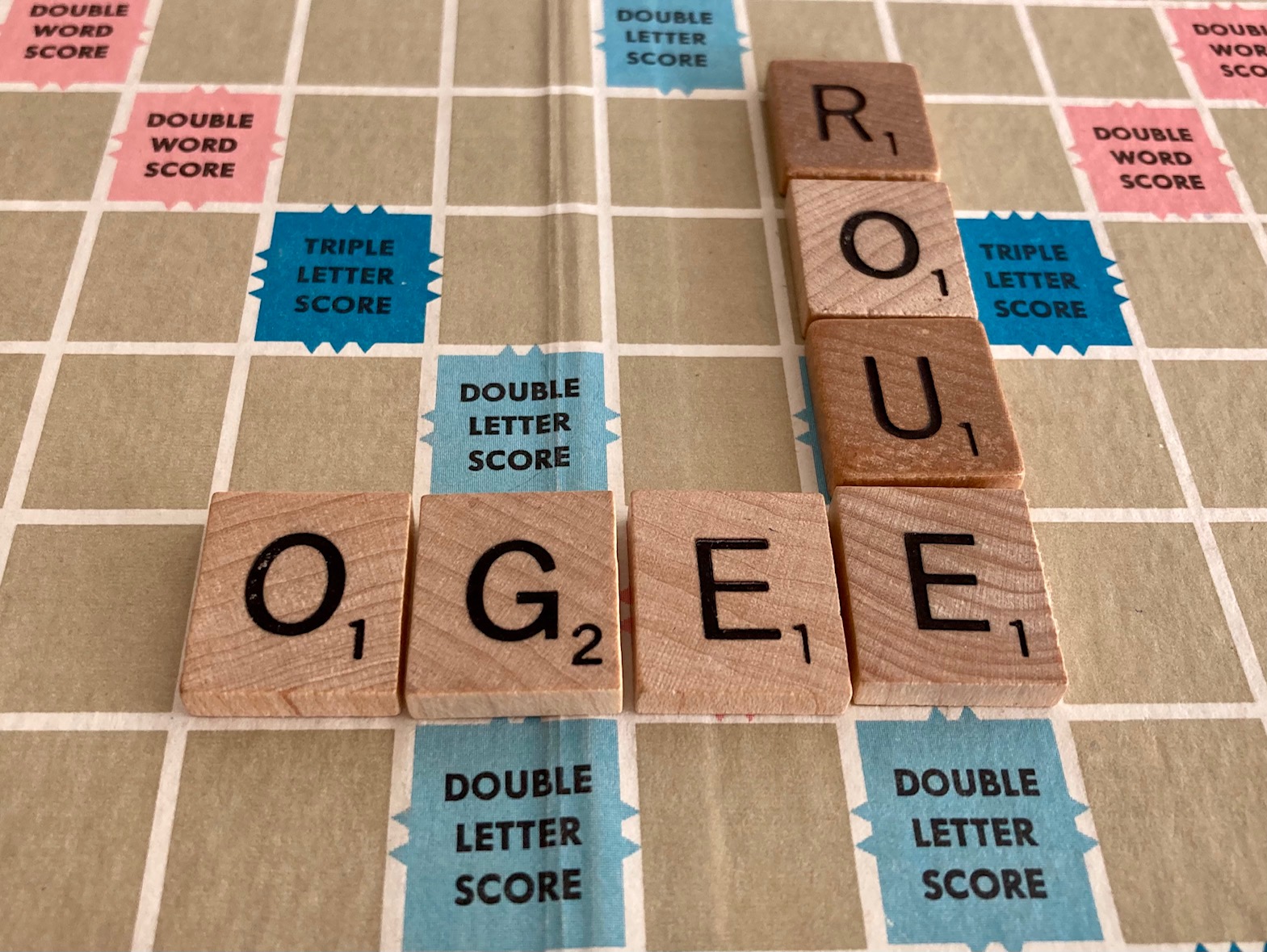
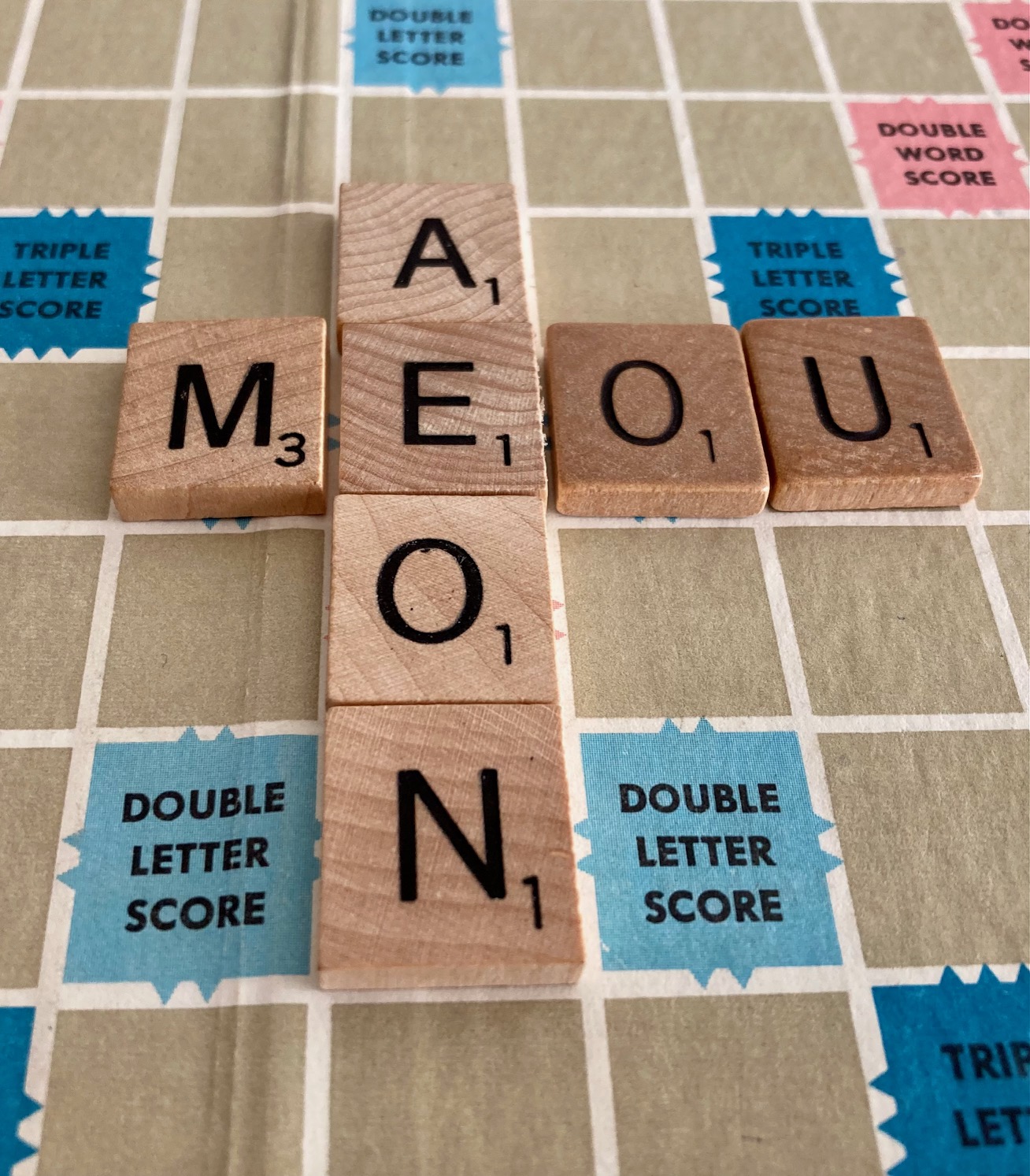
In my sample final essay, I noted that “[d]etermining how to move forward with only consonants or only vowels—or nearly all consonants and vowels—serves as some of Scrabble’s best opportunities for creative problem solving.” Here I offer a list of possible solutions: twenty-five four-letter words with three vowels:
aeon: a long period of time (also eon)
agee: to one side (also ajee)
agio: a surcharge applied when exchanging currency
ague: a sickness associated with malaria
ajee: to one side (also agee)
akee: a tropical tree
alae: wings (pl. of ala)
alee: on the side shielded from wind
amia: a freshwater fish
amoa: a kind of small buffalo
awee: a little while
eaux: waters (pl. of eau)
eide: distinctive appearances of things (pl. of eidos)
emeu: an emu
etui: an ornamental case
euro: an Australian marsupial, also known as wallaroo, for being like the kangaroo and the wallaby; also a unified currency of much of Europe
ilea: the terminal portions of small intestines (pl. of ileum)
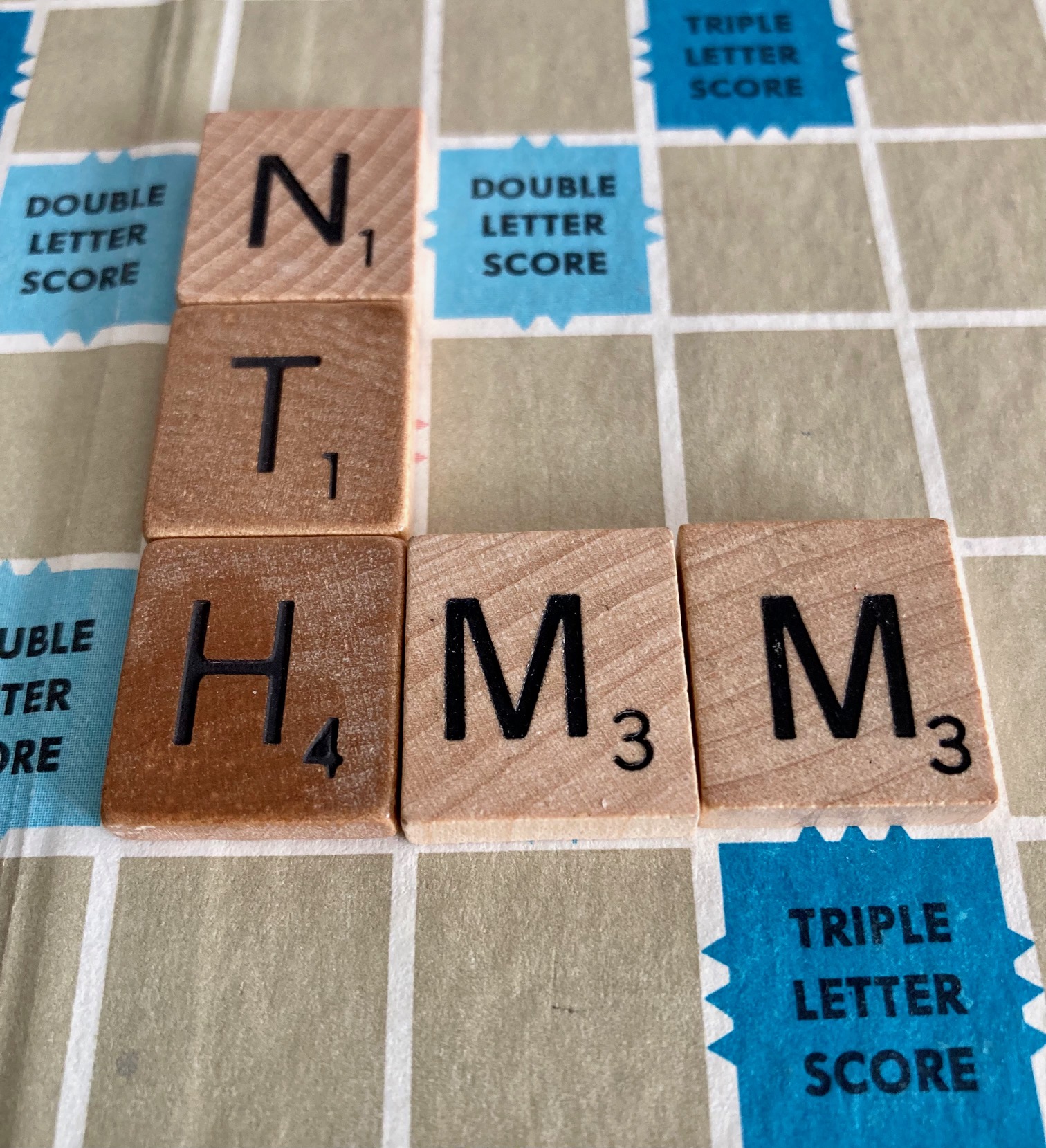
In a 1954 interview for Look magazine, Duke Ellington observed that “Playing bop is like Scrabble with all the vowels missing.” If you find yourself faced with a Scrabble rack full of consonants, you can play bop with these words:
brr: used to indicate that one feels cold (also brrr)
crth: an ancient stringed instrument (pl. -s) (pronounced to rhyme with booth)
cwm: a cirque (a deep, steep-walled basin on a mountain) (pl. -s) (pronounced to rhyme with boom)
hm: used to express thoughtful consideration (also hmm)
nth: describing an unspecified number
pfft: used to express a sudden ending
psst: used to attract someone’s attention
sh: used to urge silence (also shh and sha)
tsk: to utter an exclamation of annoyance (-ed, -ing, -s)
The image above illustrates how the second player’s, or team’s, knowledge of playable two-letter words could enable a Scrabble on the second play of the game. The first player, or team, spelled mosque. By using all seven letters, the second player earned a total of sixty-two points for pointed alone, a word that couldn’t have been played without the knowledge of the five two-letter words that the player formed vertically: op, so, qi, un, and et. The first player scored forty points with a double-word score square. Without a double-word score square, the second team scored eighty-five.
Two of the previous Wordplay Day posts include the first sixty-four of the 101 playable two-letter words, A-E (October 3) and F-N (October 8). Today’s post features the remaining thirty-seven, O-Z.
od: a hypothetical force.
oe: a whirlwind of the Faeroe Islands
of: originating from
oh: an exclamation of surprise
oi: an expression of dismay (also oy)
om: a sound used as a mantra
on: physically in contact with
op: a style of abstract art dealing with optics
or: used to link conjunctions
os: a bone
oy: an expression of dismay (also oi)
pa: a father
pe:a Hebrew letter
qi:the central life force in traditional Chinese culture (also ki)
re:a tone of the diatonic scale
sh:used to encourage silence
si: a tone of the diatonic scale (also ti)
so: to such a great extent; a tone on the diatonic scale
ta: an expression of thanks
ti:a tone of the diatonic scale
to: in the direction of
uh: used to express hesitation
un:one
up: to raise
us: a plural pronoun
ut: the musical tone C in the French solemnization system, now replaced by do
we: a first-person plural pronoun
wo: woe
xi: a Greek letter
xu: a former monetary unit of Vietnam equal to one-hundredth of a dong
ya: you
ye: you
yo: an expression used to attract attention
za: a pizza
Up Next
In next Monday’s class, you will begin work on your creative project. Details TBA.
Coming Soon
At the beginning of class on Wednesday, you will submit your fifth and final Check, Please! worksheet. If you misplace the copy you received in class, you can download one from the link below.
Although I have read Matt Richtel’s article “Blogs vs. Term Papers” many times, this semester marked the first time I had studied it as an exercise in analysis. Ordinarily, I include Richtel’s article on the syllabus as a prologue to my students’ own blogging. The article served that purpose in August as well. But as I found myself teaching a different composition curriculum that features an analysis as the first major paper assignment, Richtel’s article served a dual purpose: It not only oriented my students to the role that blogs would play in the class, it also provided them with the opportunity to study the way a writer—in this case, Matt Richtel—presents the ideas of the experts he interviews. By reading Richtel’s article, the students learned about changes in writing practices in college classrooms; by rereading Richtel, they began to see how his writing takes shape. The same was true for me.
The process of crafting a study of “Blogs vs. Term Papers” prompted me to meditate on the similarities between analysis and Scrabble, another feature of the course. The more I examined Richtel’s words, the more details I noticed. Similarly, the more closely I study the words on a Scrabble board and the tiles on a rack, the more opportunities for word building become apparent to me. This semester, the processes of writing an analysis of “Blogs vs. Term Papers” and playing Scrabble have deepened my understanding of how those two activities cultivate the focus that leads to the discoveries intrinsic to learning.
One of those moments of discovery occurred for me as I was rereading the paragraph in Richtel’s article where he addresses an argument put forth by experts who frown on replacing the term paper with the blog. Richtel reports their claim that if teachers want to reduce term papers to blog posts, why not bypass blogs altogether and ask nothing more of their students than tweets? In my previous readings of the paragraph, I was drawn primarily to the clever mimicry at the end. There Richtel omits letters from the words “Sherman’s March,” spelling it as “Shermn’s Mrch” to imitate the word-shortening technique characteristic of the Twitter platform.
As I studied the paragraph more closely, I saw beyond the intentional misspellings at the conclusion. Subsequently, what preceded the imitation of Twitterese became far more revealing. I noticed that the paragraph consisted of only one sentence—one of only two one-sentence paragraphs in the article—and that Richtel’s presentation of the claim demonstrates a flaw in the experts’ logic: “Their reductio ad absurdum: why not just bypass the blog, too, and move on to 140 characters about Shermn’s Mrch?” Realizing that Richtel presented one of their assertions as a logical fallacy, led me to this point: “To assert that defenders of traditional academic writing carry their opponents’ argument to an absurd conclusion presents those advocates of old-school writing as purveyors of the same flawed logic that their own traditional rhetoric supposedly teaches students to avoid.”
Additionally, I considered the effect of choosing to present the fallacy as a one-sentence paragraph, noting that “[b]y introducing an apparent contradiction in the argument of the advocates of old-school writing, Richtel subverts their claim; and by presenting that incongruity as a one-sentence paragraph, he highlights the issue.”
Reflecting on the effect of the one-sentence paragraph, with its emphasis on a single idea, led me to reexamine the other one-sentence paragraph in the article. That paragraph, a sentence spoken by Professor Cathy Davidson of the City University of New York, underscores the prominence of her words and ideas in Richtel’s article, an observation of mine that led me to the thesis, that “[a]lthough Richtel’s article appears to present an objective account of the disagreements among experts, a close examination of the diction and structure of ‘Blogs vs. Term Papers’ reveals a preference for the innovations advocated by Davidson and Lundsford.”
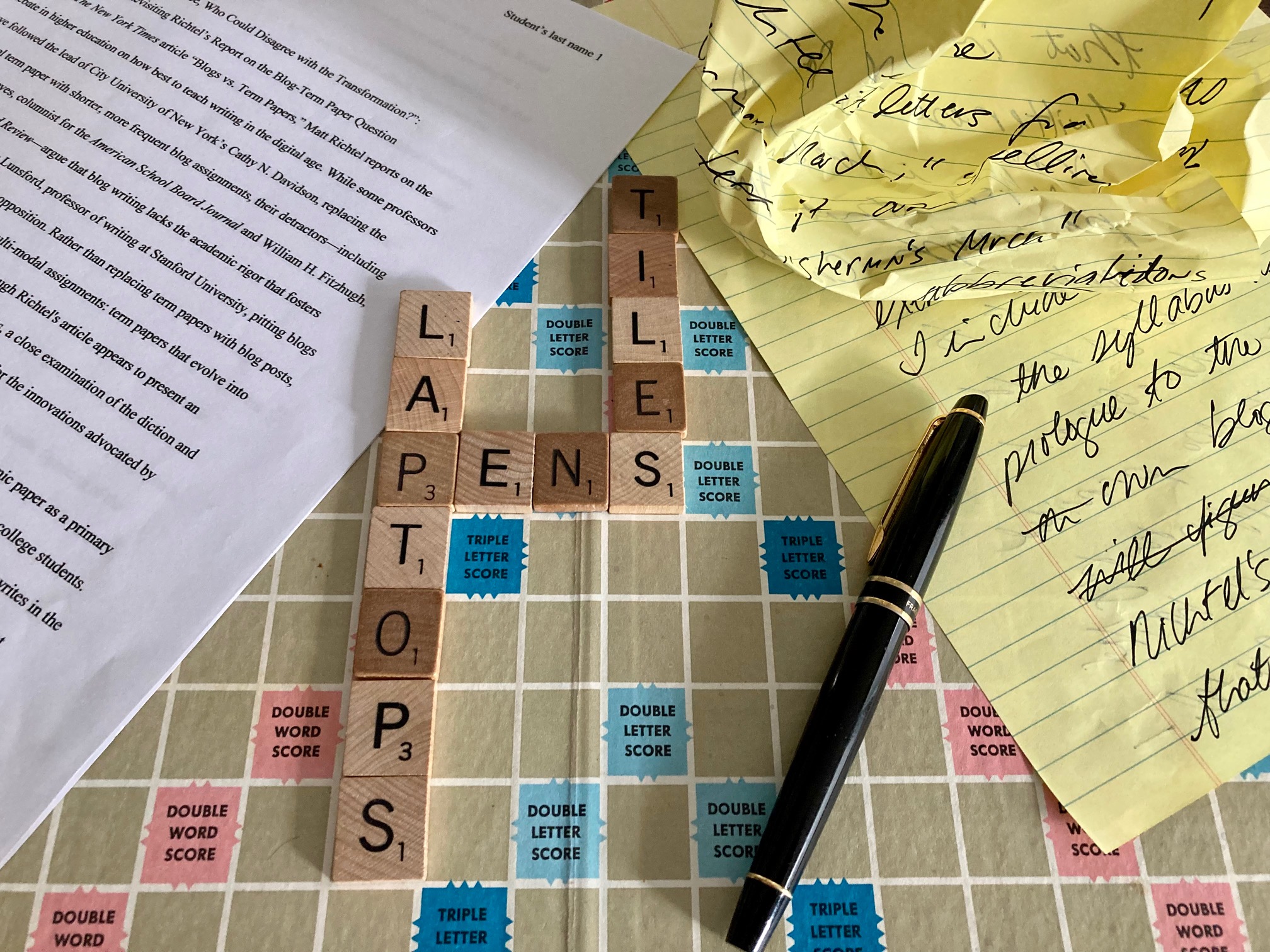
Rereading Richtel’s article through a writer’s lens showed me details I had scarcely noticed before, ones that now in plain view lead me to ask repeatedly, How could I have missed that? It’s a question I have also found myself asking when a word emerges from a seemingly hopeless combination of Scrabble tiles. Sometimes my students chide themselves for what they didn’t see on the board or the rack, but those realizations are almost always part of the composing process, whether we’re building words with tiles, or pens, or laptops. The closer we look, the more we discover, which is learning in its purest form.
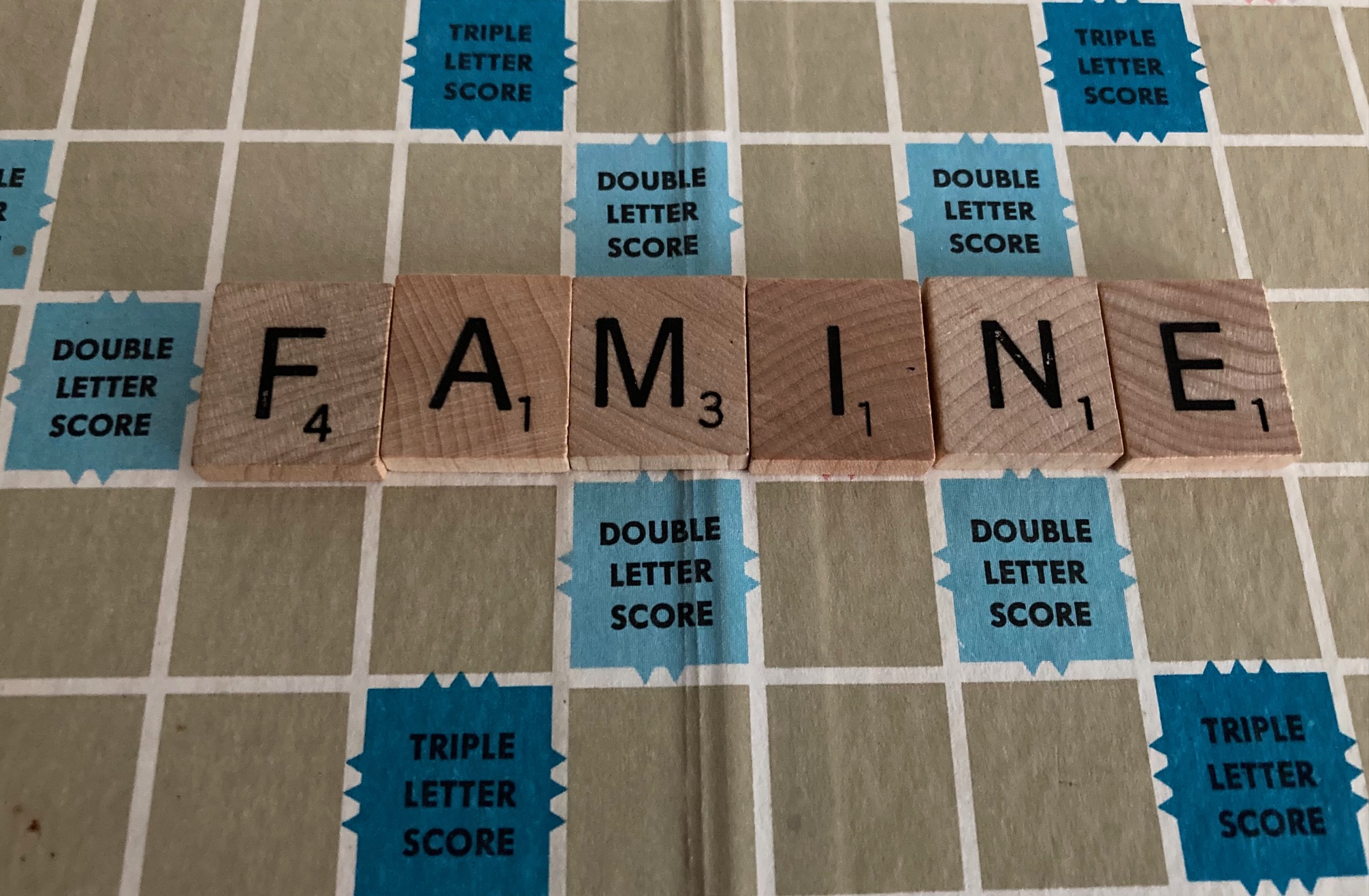
Playing “famine” here earns the first player, or team, twenty-two points.
Last week’s Wordplay Day post included a list of the first thirty-three of the 101 playable two-letter words. Today’s post features the next thirty-one, f–n.
fa: a tone in the diatonic scale
fe: a Hebrew letter
go: leave
ha: used to express surprise
he: a pronoun signifying a male
hi: an expression of greeting
hm: used to express consideration
ho: used to express surprise
id: the least censored part of the three-part psyche
if: a possibility
in: enclosed or surrounded
is: the third-person singular form of “to be”
it: a neuter pronoun
jo: a sweetheart
ka: the spiritual self in ancient Egyptian spirituality
ki: the vital life in Chinese spirituality (also qi)
la: a tone in the diatonic scale
li: a Chinese unit of distance
lo: an expression of surprise
ma: mother
me: a singular objective pronoun
mi: a tone in the diatonic scale
mm: an expression of approval
mo: a moment
mu: a Greek letter
my: a first-person possessive adjective
na: no; not
ne: born with the name of
no: a negative answer
nu: a Greek letter
Playing “famine” here earns the first player, or team, thirty points, but possibly sets up the opposing player, or team, to earn double, double-letter scores with high-value consonants.
Two-Letter “M” Words
M is the consonant that offers the most options for two-letter words. In the first position, it pairs with every vowel, plus y.
ma: mother
me: a singular objective pronoun
mi: a tone in the diatonic scale
mo: a moment
mu: a Greek letter
my: a first-person possessive adjective
With parallel play, the second player, or team, scores a total of forty-one points with the four words “oxo,” “om,” “xi,” and “on.”
In the second position, m pairs with every vowel, except i.
am: the first-person singular present form of “to be”
Learning the two-letter words you can play in Scrabble increases your opportunities to form multiple words in parallel play. The list that follows includes the first thirty-three of the 101 playable two-letter words.
aa: a type of stony, rough lava,
ab: an abdominal muscle
ad: an advertisement
ae: one
ag: agriculture
ah: an exclamation
ai: a three-toed sloth
al: a type of East Indian tree
am: the first-person singular present form of “to be”
an: an indefinite article
ar: the letter r
as: similar to
at: the position of
aw: an expression of protest or sadness
ax: a sharp-edged tool
ay: a vote in the affirmative
ba: the soul in ancient Egyptian spirituality
be: to exist
bi: a bisexual
bo: a pal
by: a side issue
de: of; from
do: a tone on a scale
ed: education
ef: the letter f
eh: used to express doubt
el: an elevated train
em: the letter m
en: the letter n
er: used to express hesitation
es: the letter s
et: a past tense of eat
ex: the letter x
Coming Soon
On Wednesday, October 4, you will receive your midterm reflection draft with my notes, and you will have the class period to begin your revision work. The works cited list that follows includes entries for some of the sources that you may cite. You are required to quote or paraphrase two relevant sources, one of which may be your analysis. If you choose to cite your analysis, follow the format of the work cited entries for my sample papers, “The Strange Fruit of Sosnowiec,” and “On its Face, Who Could Disagree with the Transformation?: Revisiting Richtel’s Report on the Blog-Term Paper Question.”
Rossenwasser, David and Jill Stephen. “Writing on Computers vs. Writing on Paper.” Writing Analytically, 8th edition. Wadsworth/Cengage, 2019. pp. 124-25.





 Jane Lucas