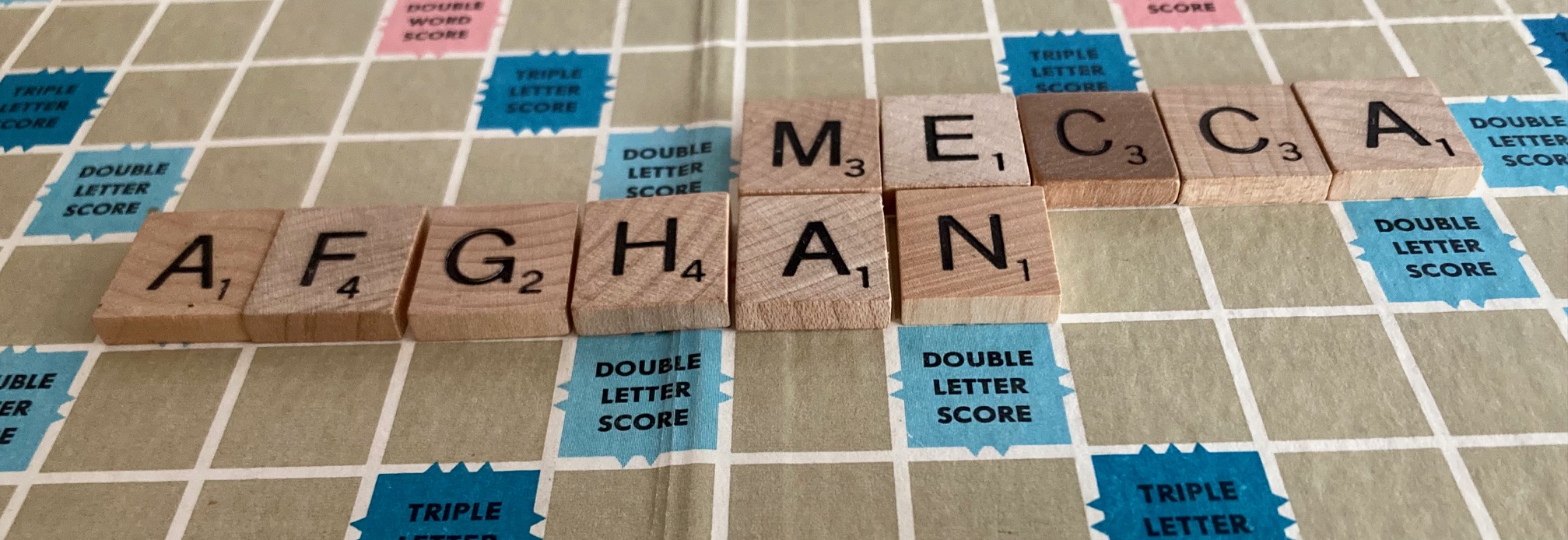
The second Scrabble post of the semester featured first names that are also common nouns, making them playable in Scrabble. Today’s post includes place names and words derived from places, or toponyms–more proper nouns that are playable in Scrabble because they’re also common nouns. Studying these words offers you additional opportunities to broaden your vocabulary and up your game.
- afghan: a wool blanket
- alamo: a cottonwood poplar tree
- alaska: a heavy fabric
- berlin: a type of carriage
- bermudas: a variety of knee-length, wide-legged shorts
- bohemia: a community of unconventional, usually artistic, people
- bolivia: a soft fabric
- bordeaux: a wine from the Bordeaux region
- boston: a card game similar to whist
- brazil: a type of tree found in Brazil used to make instrument bows (also brasil)
- brit: a non-adult herring
- cayman: a type of crocodile, also known as a spectacled crocodile (also caiman)
- celt: a type of axe used during the New Stone Age
- chile: a spicy pepper (also chili)
- colorado: used to describe cigars of medium strength and color
- congo: an eellike amphibian
- cyprus: a thin fabric
- dutch: referring to each person paying for him or herself
- egyptian: a sans serif typeface
- english: to cause a ball to spin
- french: to slice food thinly
- gambia: a flowering plant known as cat’s claw (also gambier, which is a small town in Ohio)
- geneva: gin, or a liquor like gin
- genoa: a type of jib (a triangular sail), also known as a jenny, first used by a Swedish sailor in Genoa
- german: also known as the german cotillon, an elaborate nineteenth-century dance
- greek: something not understood
- guinea: a type of British coin minted from 1663 to 1813
- holland: a linen fabric
- japan: to gloss with black lacquer
- java: coffee
- jordan: a chamber pot
- kashmir: cashmere
- mecca: a destination for many people
“Want to Play Scrabble Like a Pro? . . .”
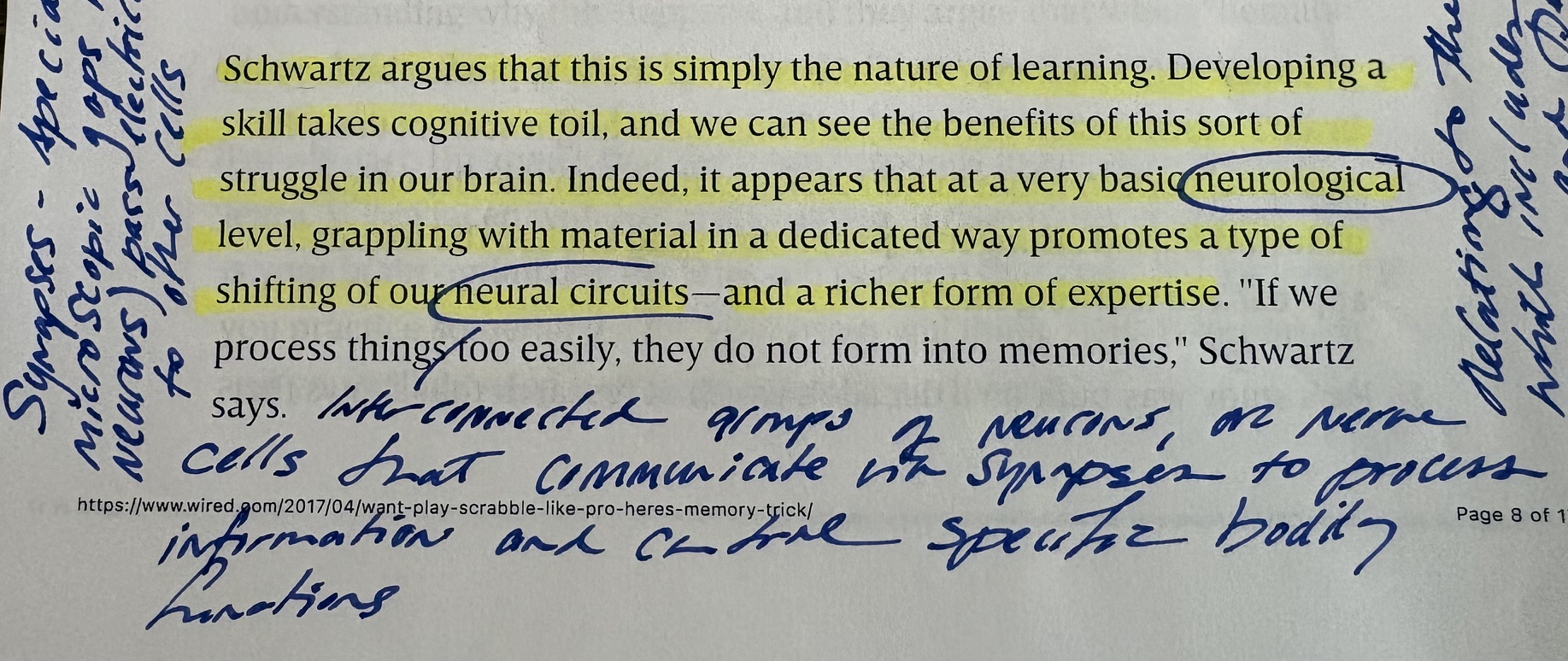
In Monday’s 7:50 class (section one), when we discussed the readings as a follow-up to the presentations, I omitted Ulrch Boser’s Wired article, “Want to Play Scrabble Like a Pro? Here’s Your Memory Trick.” I intended to address the passage pictured above, which I also mentioned in Tuesday’s class notes. In that post, I referred to Bennett Schwartz’s retrieval process as a strategy for you to try as you rehearsed your presentation:
Try turning away from the written page–and away from the sound of your voice if you record it–and simply ask yourself what words and phrases you recall. The more often you ask yourself, the more you will remember. As Boser notes, “Indeed, it appears that at a very basic neurological level, grappling with material in a dedicated way promotes a type of shifting in our neural circuits–and a richer form of expertise” (par. 21). In the words of Schwartz, himself, “If we process things too easily, they do not form in our memories” (qtd. in Boser, par. 21). Memorizing lines is a tedious process, but embracing the process will help you develop into a stronger public speaker.
Next Up
After Monday’s Scrabble debriefing, we will examine chapter two of “The Lifecycle of Software Objects” (74-87), which you should read and annotate before class. Remember that each reading assignment listed on the calendar denotes what you should read before the class where it’s listed.
If you do not want to mark up your copy of Ted Chiang’s Exhalation, rather than annotating “The Lifecycle of Software Objects,” take notes on each chapter in your journal.
In the second half of class, I will introduce your third and final major paper asignment: the annotated bibliography and preface.
Coming Soon
Wednesday we will meet on the lower level of Smith Library. Near the tables where we met on September 16, there’s a glass-front room with desktop computers. That’s where we’ll meet with Lauren Ksa, Head of Research and Instructional Services, who will lead you through the process using library databases to locate sources for your bibliography.

