
In the conclusion of your preface, you addressed a larger project that might develop from your annotated bibliography and the theoretical framework, or academic lens, that would guide you. As the end of the semester draws near, expanding a project you have just crossed off your to-do list is not in the forefront of your mind–and may not be on your mind at all. However, your bibliography and preface and some of the other papers you write for general education courses can serve as starting points for a variety of projects that can benefit you as your academic career progresses:
- Many applications for scholarships and internships require writing samples. Revising and expanding your papers may provide you with writing samples you will need to distinguish yourself from other candidates.
- Innovation, High Point University’s student journal of creative and scholarly work (pictured above), offers you the opportunity to see your writing in print. If the editors select your work, that publication credit will be a line for your resume. For information on submissions, visit Innovation or email the journal: journal.urcw@highpoint.edu.
- HighPURCS (HPU’s Research and Creativity Symposium), held annually in April, provides another showcase for your work. For more information, visit High-PURCS.
Lorelei Lingard’s “Bonfire Red Titles”
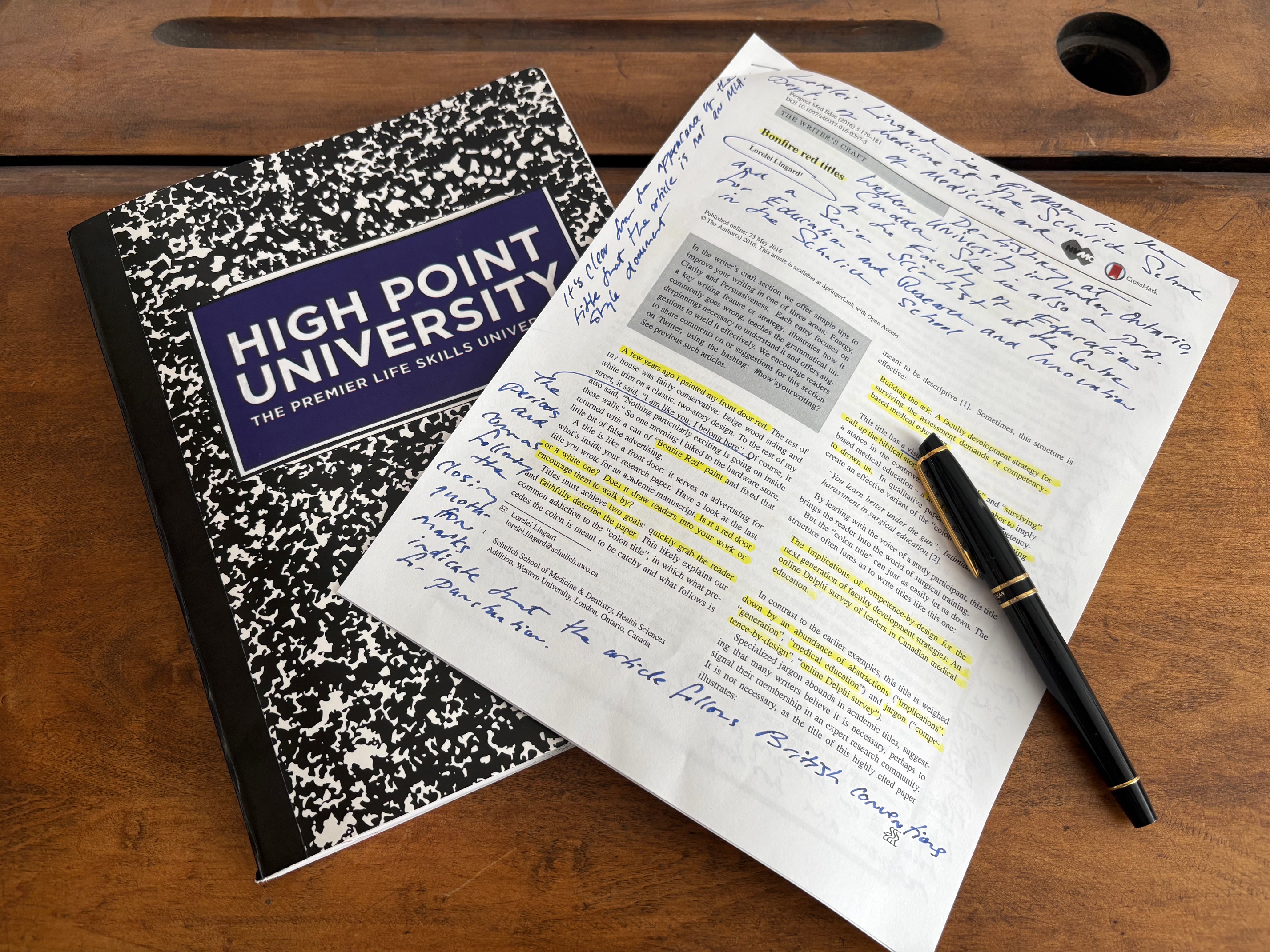
Yesterday in class, while you were composing your reflections for your bibliography and preface, I distributed copies of Lorelei Lingard‘s “Red Bonfire Titles,” along with a journal exercise on the article. An additional copy of that exercise follows.
Journal Exercise
Compose a two-paragraph journal entry (a minimum of twenty-five words each, or fifty total) that addresses (1) the title of your bibliography, (2) how and why you chose it, and (3) one or more of the recommendations for titles in “Bonfire Red Titles” by Lorelei Lingard. You are not required to quote Lingard’s article, but your journal entry should include the title of the article, the full name of the author, and one or more specific suggestions the article offers. Complete your journal entry before class on Friday, November 20.
I also noted you would have the chance to revise your journal entry for a bonus assignment. Directions for that bonus appear below.
Bonus Assignment
The assignment that follows is one that you may complete in addition to your journal entry.
Directions
- Revise your two-paragraph journal entry to publish as a post on your blog. Begin by linking your examination of your bibliography’s title to one or more of the ideas about titles presented in Lorelei Lingard’s “Bonfire Red Titles.” If your journal entry already makes a connection between the two, aim to strengthen that connection.
- Embed a link to to the blog post of your bibliography (not your site address, the address for the bibliography and preface post) in the title where it first appears in the first paragraph. For example, I chose the title “Soul-Searching Science Fiction” to highlight the protagonists’ introspection prompted by the moral and ethical dilemmas they face. You can embed the link without leaving your draft page by opening my site in another tab: Jane Lucas > English at High Point University > Your blog > Your bibliography and preface post.
- Quote a phrase, clause, or sentence from “Bonfire Red Titles” that states one of the dos or don’ts. Introduce the the quotation with a signal phrase, and follow it with a parenthetical citation with the page number.
- Include a work cited entry for Lingard’s article. (See the sample that follows the directions.)
- After you have drafted your post, add a photo of your annotated copy of “Bonfire Red Titles.”
- Once you have added all required elements to your post, publish it. Email me to let me know your post is published, so I can credit you with the assignment. To receive credit, you must publish your post no later than 4 p.m. on Tuesday, December 1.
Work Cited
Lingard, Lorelei. “Bonfire Red Titles.” Perspectives on Medical Education, vol. 5, no. 3, 2016, pp. 179-181. ProQuest, https://libproxy.highpoint.edu/login?url=https://www.proquest.com/scholarly-journals/bonfire-red-titles/docview/2670513669/se-2,doi:https://doi.org/10.1007/s40037-016-0267-3.
Kudos
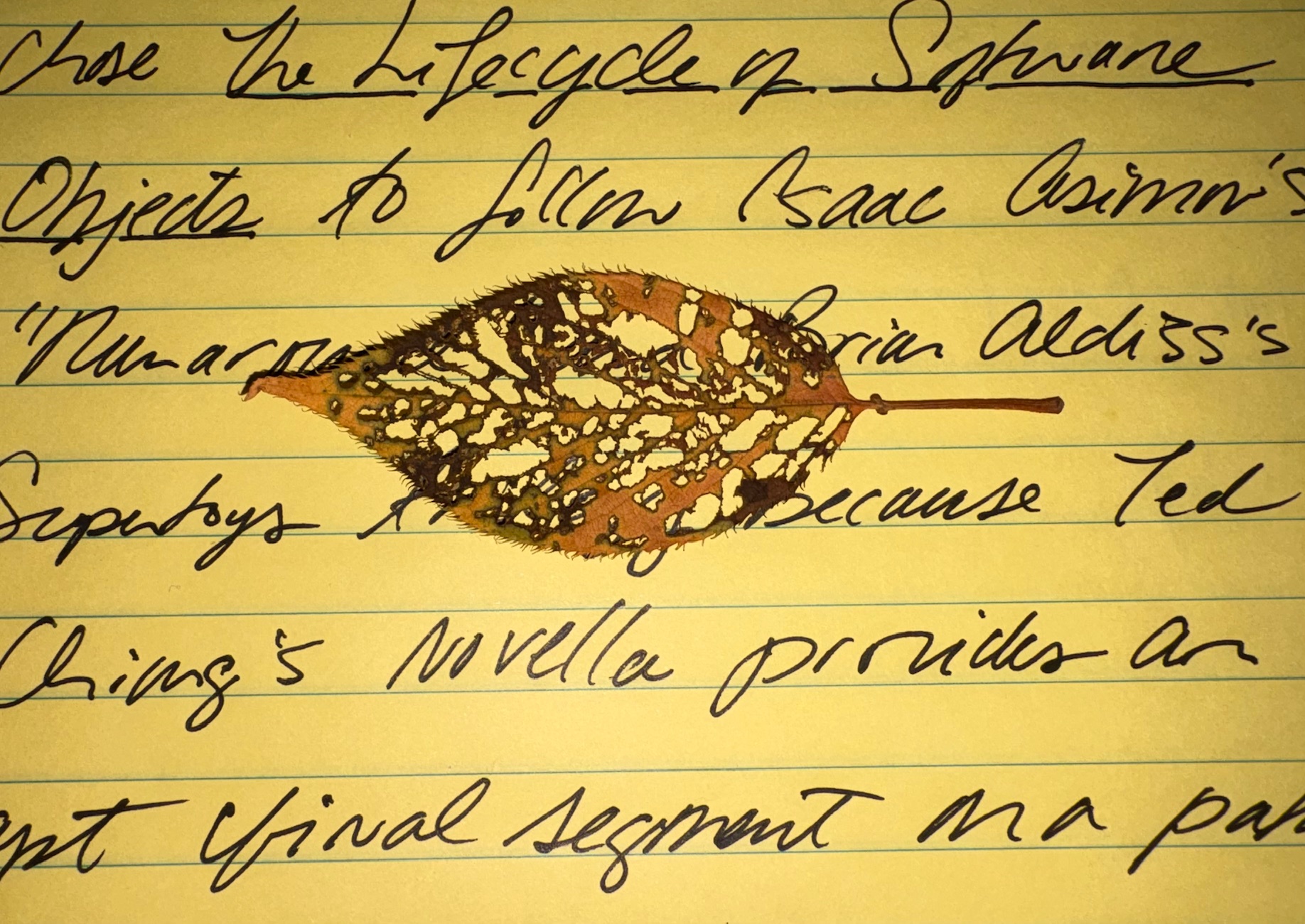
Madison Haugk identified the decomposing leaf (overlaying the draft of my preface) as an allusion to the similar leaf that figures in Ted Chiang’s The Lifecycle of Software Objects when Derek meets Ana in the park. He meets her there to return the Sarumech robot suit, which Ana bought for Jax and shares with Derek for Marco to use. After Marco leaves the suit to return to Data Earth, Zaff, a digient with a jaguar-cub avatar “inhabits” the suit.
Ana and Derek “watch as Zaff sorts through the leaf litter, extracts a leaf decayed to near transparency, and holds it up to his face to look through it, a mask of vegetable lace” (98). Chiang lingers over that image of the skeletal leaf, sharpening it with the metaphor “mask of vegetable lace” to emphasize the Neuroblast digients’ fascination with the natural world.
For recalling that scene I alluded to with the leaf above, Madison earned a bonus assignment credit.
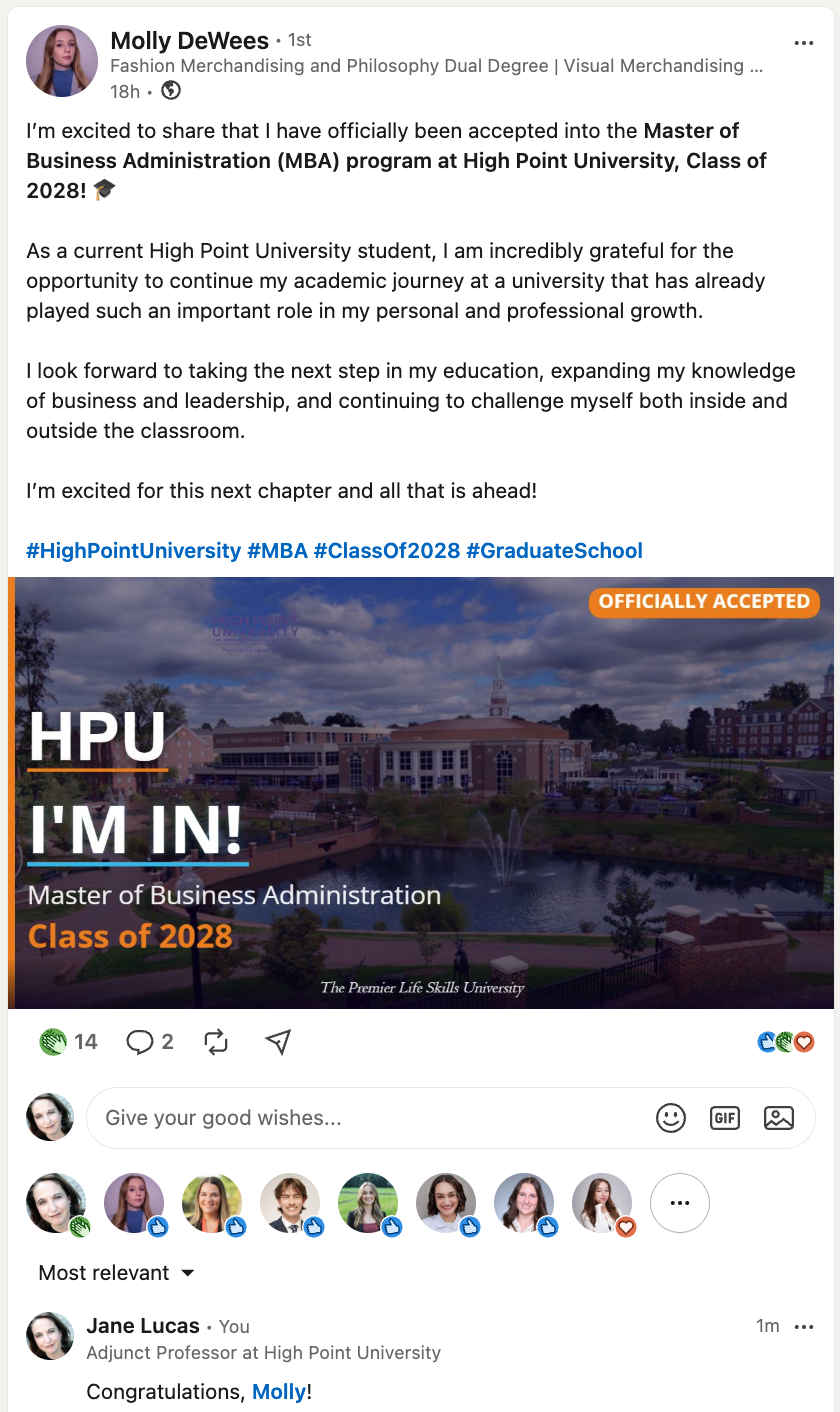
Congratulations to Molly DeWees (ENG 1103.19, Fall 2023) for her acceptance into HPU’s MBA program!
Next Up
Wordplay Day! To prepare for class, revisit the Merriam-Webster Scrabble Word Finder page, and review your journal notes and the blog posts devoted to Scrabble tips.


