
Today’s Scrabble post features Shakespeare characters whose names are also playable common nouns. Because Thanksgiving Break begins next Wednesday, next week’s class notes will not include a post devoted to Scrabble, but the class notes for the final week of the semester will include another list–one with more words drawn from literature
- Ariel: a gazelle found in Africa (Ariel, The Tempest, 1611-12)
- Dogberry: the fruit of a dogwood tree (Dogberry, Much Ado about Nothing, 1598-1599)
- Hamlet: a village (the title character of Hamlet, 1600-1601)
- Lear: learning (the title character of King Lear, 1605-1606)
- Puck: a disk used in ice hockey and other games (Puck, A Midsummer Night’s Dream, 1595-1596)
- Romeo: a seductive lover, a male lover (one of the title characters in Romeo and Juliet, 1594-1595)
- Shylock: to lend money with a high interest rate (Shylock, The Merchant of Venice, 1596-1597)
Preparing for Your Final Reflection
On Monday, you will compose a final reflective essay documenting your work in the second half of the semester, focusing on what you consider some of your most significant work and the feature or features of the course that have benefited your development as a writer and a student.
Since you have already written a reflective essay on your annotated bibliography and preface, your final reflection should focus on Ted Chiang’s The Lifecycle of Software Objects and one, two, or three—but no more than three—additional assignments or features of the course. In your reflection, you will include a minimum of one quotation (see the directions below for details), which you will introduce with a signal phrase and follow with a parenthetical citation. Following your reflection, you will include a work cited entry.
To comply with the requirements for your reflection, you will need to complete the planning exercise that follows. In class, you will not be permitted to refer to this blog post or any other online resources. You will need to have all the necessary information written longhand in your journal.
The Lifecycle of Software Objects concludes with Ana telling Jax, “Time to do your homework” (172), words that return the novella to its recurring theme of learning. For the exercise that follows, you will revisit one of the novella’s earlier passages that focuses on learning: Ana’s meditation on it in Chapter Nine, or an another observation. Then you will plan a portion of your reflection that quotes a phrase, clause or sentence that expresses an idea about learning and compares or contrasts that notion with your own development as a writer and a student in English 1103.
Directions
- Review Ana’s meditation on learning in Chapter Nine, and the novella’s earlier passages that address learning.
- Choose one of those passages to quote in your reflection. Do not quote the last line of the novella.
- In your journal, draft a sentence that begins with a signal phrase that introduces the words about learning in the passage. Follow the signal phrase with the quotation, and follow the quotation with a parenthetical citation with the page number.
- Compose one or more additional sentences that juxtapose the idea of learning conveyed in the passage with with your own development as a writer and a student in English 1103.
- Write a work cited entry for Chiang’s novella. (See the sample below the directions.) If you plan to include a second quotation, one in addition to the required quotation from The Lifecycle of Software Objects, write an MLA-style works cited entry for that text in addition to the entry for Chiang’s novella. MLA-style works cited entries for your readings are included on those handouts, in rectangular boxes on the first or last page.
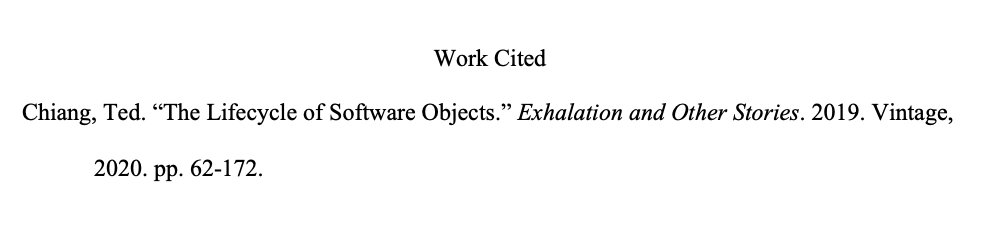
Note that the singular work (not the plural works) appears in the header above as a sample for a reflection that cites only one source. If you opt to quote a second reading, write an MLA-style works cited entry for that text in addition to the entry for Chiang’s novella.
Next Up
On Monday, you will compose a reflective essay documenting your work in the second half of the semester, focusing on what you consider some of your most significant work and the feature or features of the course that have benefited your development as a writer and a student. Complete the planning exercise above to ensure that your reflection fulfills the assignment’s requirements.

