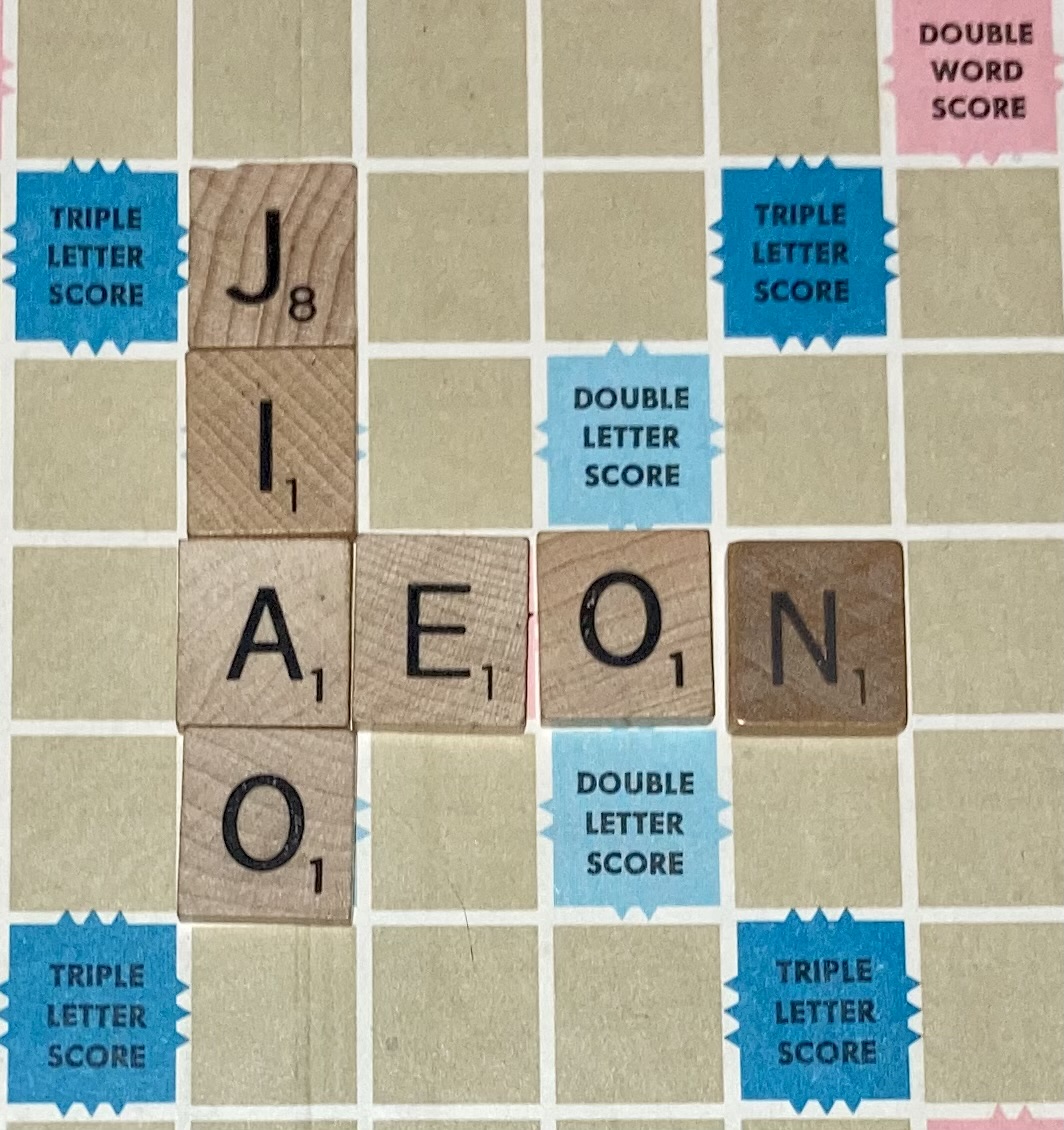
Learning these two-letter words, as well as the others in the alphabet, will enable you to see more options for play and increase the number of points you earn in a single turn.
M, by the way, is the most versatile consonant. In the first position, m pairs with every vowel, ma, me, mi, mo, mu, and also my. In the second position, m with pairs with every vowel except i: am, em, om, um.
ma: a mother
me: a singular objective pronoun
mi: a tone of the diatonic scale
mm: an expression of assent
mo: a moment
mu: a Greek letter
my: a first-person possessive adjective
na: no, not
ne: born with the name of
no: a negative answer
nu: a Greek letter
od: a hypothetical force
oe: a whirlwind off the Faero Islands
of: originating from
oh: an exclamation of surprise
oi: an expression of dismay (also oy)
om: a sound used as a mantra
on: the batsman’s side in cricket
op: a style of abstract art dealing with optics
or: the heraldic color gold
os: a bone
ow: used to express pain
ox: a clumsy person
oy: an expression of dismay
pa: a father
pe: a Hebrew letter
pi: a Greek letter
Next Up
Wordplay Day! To up your game and increase your word power, review the tips and tools on the Scrabble website as well as my blog posts devoted to the game.
In class today you will plan and draft your analysis, which will focus on one of the articles or essays that we have studied in class: “Me Talk Pretty One Day,” “The Day that Language Came into My Life,” “Back Story” (from The Blind Side), “The Falling Man,” “Skim Reading is the New Normal,” or the essay that I will distribute today, “Scrabble is a Lousy Game.”
Many students find the transition from expressive writing, such as a literacy narrative, to analysis to be a difficult one, but as the authors of your textbook note, “[i]n practice though, the best versions of analysis and expressive writing can overlap a lot” (Rosenwasser and Stephen 7). They go on to observe that “[v]irtually all forms of description are implicitly analytical” (7).
“When you choose to take what you take to be the three most telling details about your subject, you have selected significant parts and used them as a means of getting at what you take to be the character as a whole. This is what analysis does: it goes after an understandingof what something means, its nature, by zeroing in on the function of significant detail.” (7)
As a starting point, you will read some of the passages in Writing Analytically devoted to analysis, including “Analysis Does More than Break a Subject into Its Parts,” 4-5; and “Distinguishing Analysis from Summary, Expressive Writing, and Argument,” 5-8.
After you read the pages in Writing Analytically devoted to analysis, you will review the articles and essays you’ve read, and read “Scrabble is a Lousy Game.” Determine which article or essay appeals to you most as a subject of analysis. Reread that article or essay and identify three or more elements that contribute to its effectiveness. Develop your analysis through a close examination of those elements.
Work Cited
Rosenwasser, David and Jill Stephen. Writing Analytically, 8th edition. Wadsworth/Cengage, 2019.
A viral photo featured in Lesson Four as an example of false framing.
This morning in class I collected your worksheets for the fourth lesson of Check, Please! The paragraphs that follow are my version of the assignment.
Check, Please! Lesson Four Assignment
In the fourth lesson of the Check, Please!, Starter Course, Mike Caulfield, author of the course and Director of Blended and Networked Learning at Washington State University, focuses his instruction on the third step in the four-step SIFT approach to determining the reliability of a source. Lesson four, “Find Trusted Coverage,” addresses these topics: (1) scanning Google News for relevant stories, (2) using known fact-checking sites, and (3) conducting a reverse-image search to find a relevant source for an image.
One of the concepts Caulfield introduces in lesson four is click restraint, which was given its name by Sam Wineberg, Professor of History and Education at Stanford, and Sarah McGrew, Assistant Professor of Education at the University of Maryland. Click Restraint is an activity that fact checkers practice regularly, but average people do not. Fact checkers resist the impulse to click on the first result, opting instead to scan multiple results to find one that combines trustworthiness and relevance.
Caulfield also considers the issue of false frames and offers as an example the miscaptioned photo of a young woman that circulated widely after the 2017 London Bridge attack. In the photo, the woman, who is wearing a hijab, is looking down at her phone as she walks past one of the victims lying by the side of the road, surrounded by members of the rescue team. Because the woman’s face is blurred, viewers of the miscaptioned picture cannot see the look of shock that is visible in her face in another image taken by the same photographer. Subsequently, her apparent lack of concern for the victim seems to confirm the caption in the infamous tweet.
Choosing a general search term over a specific one is a useful and unexpected tip Caulfield includes in his discussion of image searches. He explains that the benefit of such a bland term as “letter” or “photo” will prevent the confirmation bias that can lead to the proliferation of disinformation through false frames.
Wednesday in class you will plan and draft your analysis. Be sure to bring your copy of Writing Analytically to class as well as your pocket portfolio with the articles and essays we have studied in class. You will have the opportunity to devote your analysis to any one of those readings, including “Blogs vs. Term Papers,” “Me Talk Pretty One Day,” “The Day Language Came into My Life,” “Back Story” (from The Blind Side), “The Falling Man,” and “Skim Reading is the New Normal.”
Lillian Ellmore, who was an English 1103 student of mine last spring, has been named the national winner of the 2021 Hungry for Education scholarship program sponsored by the restaurant Denny’s. In an article about Ellmore’s achievement, The High Point Enterprise staff reported that Hungry for Education “recognizes and rewards students who show initiative and creativity in helping Denny’s fight childhood hunger.”
In addition to composing an essay for the contest, Ellmore also appeared on Denny’s podcast to be considered for the scholarship.
Ellmore, who is from Lexington, Massachussetts, is a sophomore communications major.
Congratulations, Lillian, on a job well done!
Check, Please! Lesson Three
At the beginning of class on Monday, I collected your Check, Please! worksheets for lesson three. The paragraphs that follow are my version of the assignment.
In the third lesson of the Check, Please!, Starter Course, Mike Caulfield, author of the course and Director of Blended and Networked Learning at Washington State University, continues his instruction on the second step in four-step SIFT approach to determining the reliability of a source. Lesson three, “Further Investigation” covers these topics: (1) Just add Wikipedia for names and organizations, (2) Google Scholar searches for verifying expertise, (3) Google News searches for information about organizations and individuals, (4) the nature of state media and how to identify it, and (5) the difference between bias and agenda.
One of the most instructive parts of lesson three focuses on two news stories about MH17, Malyasia Airlines Flight 17, a passenger flight scheduled to land in Kuala Lumpur that was shot down over eastern Ukraine on July 17, 2014. While the second story, a television news segment, appears to present detailed investigative reporting challenging the conclusion of the Dutch Safety Board and Dutch-led joint investigation team–the conclusion that Russia was to blame–a quick just-add-Wikipedia check reveals that RT (formerly Russia Today) is a Russian state-controlled international TV network, a government propaganda tool rather than a source of fair and balanced news. The first video, the one produced by Business Insider, a financial and business news site, delivers accurate coverage of MH17.
Another notable segment of “Further Investigation” addresses the important distinction between “bias” and “agenda.” There, Caulfield observes that “[p]ersonal bias has real impacts. But bias isn’t agenda, and it’s agenda that should be your primary concern for quick checks,” adding that “[b]ias is about how people see things; agenda is about what a news or research organization is set up to do.”
In class today we will examine two additional models for your literacy narrative. Unlike Keller’s and Sedaris’ essays, “The Falling Man” and The Blind Side aren’t literacy narratives but Tom Junod‘s and Michel Lewis‘ writing serve as excellent examples for anyone engaged in the craft of writing nonfiction.
Unless you subscribe to Esquire, the magazine’s paywall will deny you access to the full text of “The Falling Man”; but if you’re interested in reading it in full, you can access it through the HPU Library site by following these steps:
Under the heading “Search HPU Libraries . . . ,” click on the “Articles” tab.
Under the “Articles” tab, type Tom Junod “Falling Man” Esquire in the search box and click “search.”
On the next screen, you will see a brief summary of the article. Click “Access Online” to view the full article.
Some of you have asked about paragraphing. As a rule, you should begin a new paragraph whenyou present a new idea or point. If you have an extended idea that spans multiple paragraphs, each new point within that idea should have its own paragraph. But there are exceptions to this. Although the first paragraph of “The Falling Man” could be divided into two or more paragraphs, Lewis chooses to present it as one paragraph of more than four hundred words, more than the minimum length of your entire literacy narrative. Consider why Lewis may have chosen to present the beginning of his essay as one long paragraph rather than two or more shorter ones.
Among the elements of the first paragraph of The Blind Side that I asked you to examine was Michael Lewis’ use of appositives.
The Chaos Machine, the new book by New York Times journalist Max Fisher explores how social media has altered our lives. Because Fisher’s books focuses on our class theme, our lives in the digital world, it’s an ideal text for us to examine, and the High Point Univeristy Library has agreed to buy a copy for our use. We will study an excerpt from Fisher’s book in class, and you will have the opportunity to use it as one of the sources for your final essay and annotated bibliography.
Next Up
At the beginning of class on Monday, I will collect your completed worksheets for Lesson Three in the Check, Please! course. If you are absent from class today, Friday, September 9, when I distribute the worksheet, you can download a copy from Blackboard.
Also, in class on Monday, we will examine two additional models for your literacy narrative, and you will collaboratively explore the writers’ use of description and development.
The September 1 Scrabble blog post featured the sixteen playable two-letter words beginning with “a.” Learning those two-letter words, as well as the others that follow in the alphabet, will enable you to see more options for play and increase the number of points you earn in a single turn.
Here’s a list of the playable words beginning with “b,” “d,” and “e.”
ba: the soul in ancient Egyptian spirituality
bi: a bisexual
bo: a pal
by: a side issue
de: of; from
do: a tone on a scale
ed: education
ef: the letter f (also eff)
eh: used to express doubt
el: an elevated train
em: the letter m
en: the letter n
er: used to express hesitation
es: the letter s
et: a past tense of eat
ex: the letter x
Next Up
Wordplay Day! To prepare for class, review Tips and Tools on the Scrabble site. Also review the blog posts devoted to Scrabble.
Coming Soon
At the beginning of class on Monday, I will collect your completed worksheets for Lesson Three in the Check, Please! course. If you are absent from class on Friday, September 9, when I distribute the worksheet, you can download a copy from Blackboard.
Also, in class on Monday, we will examine two additional models for your literacy narrative, and you will collaboratively explore the writers’ use of description and development.
For your literacy narrative, as well as all of your other major writing assignments, you have the opportunity to earn five extra credit points for consulting with a Writing Center tutor.
To schedule an appointment, visit https://highpoint.mywconline.com, email the Writing Center’s director, Justin Cook, at jcook3@highpoint.edu, or scan the QR code below. To earn bonus points for your literacy narrative, consult with a writing center tutor no later than Thursday, September 15.
Check, Please! Lesson Two
At the beginning of class on Monday, September 5, I collected your worksheets for Check, Please! lesson two. My sample version of the assignment appears below.
Check, Please! Lesson Two Assignment
In the second lesson of the Check, Please! Starter Course, Mike Caulfield, author of the course and Director of Blended and Networked Learning at Washington State University, introduces the second step in four-step SIFT approach to determining the reliability of a source. Lesson two offers instruction in “move” (“Investigate the Source”) and one of the web search techniques associated with it (“[J]ust add Wikipedia”).
One of the most useful practices presented in lesson two is Caulfield’s follow-up to the Wikipedia strategy that he outlines in the previous lesson. After he reviews that strategy, Caulfield explains how to use the control-f keyboard shortcut (command-f on a Mac). Typing control-f (or command-f) will open a small textbox in the upper right of the screen. Typing a word you are searching for will highlight the first appearance of the word in the text. Hitting return will highlight each subsequent appearance of the word.
Lesson two introduced me to fauxtire, a term for websites such as World News Daily Report, based in Tel Aviv, that present themselves as satirical but in fact serve primarily to perpetuate disinformation.
Perhaps the most memorable portion of lesson two was the side-by-side comparison of the websites for the American Academy of Pediatrics and the American College of Pediatricians. Though at first glance the two appear comparable, using the Wikipedia strategy reveals their profound differences. While AAP is the premiere authority on children’s health and well-being, ACP was founded to protest the adoption of children by single-sex couples and is widely viewed as a single-issue hate organization.
As a model for your own literacy narratives, today in class we will examine “Me Talk Pretty One Day,” originally published in Esquire magazine and later as the title essay in David Sedaris’ 2000 essay collection.
After we read Sedaris’ essay, you will collaborate in groups of four to complete an exercise that involves exploring these aspects of his writing:
Shifts from summary to scene and vice versa
Figurative language
Hyperbole
Vivid detail
I will also ask you to consider what elements are the strongest aspects of the essay and whether “Me Talk Pretty One Day” has given you any ideas for developing your own narrative. Time permitting, we will also read Helen Keller’s essay “The Day Language Came into My Life.”
To read more of Sedaris’ essays, see the list of links under the heading Writing and Radio on his website. You can read more of Helen Keller’s autobiography, the full text in fact, here: The Story of My Life. “The Day Language Came into My Life” is Chapter Four.
Next Up
For Wednesday you should read Keller’s essay (if you don’t have time to read it in class today), and compose a short summary of both her essay and Sedaris.’ Aim for a minimum of fifty words each.
Keep Keller’s and Sedaris’ essays in your pocket portfolio and continue to look to them as models as you revise your literacy narrative. You will receive your draft with my notes at the beginning of Wednesday’s class, and you will have the class period to continue to revise. You will have an additional week to devote to your essay before you post it. It is due (on Blackboard and on your WordPress blog) before class the morning of Wednesday, September 14; the hard deadline is the morning of Friday, September 16.
Parallel play increases your score through the points you earn by spelling more than one word in a single turn. In the first play of the hypothetical game pictured above, the team would score sixteen points by spelling enact with the t on the center double word square. With the second turn, the other team could take advantage of the opportunity for parallel play. If the team knew that aa is a type of lava, they could earn twenty-four points with four words: whoa, he, on, and aa.
Two-Letter Words Beginning with A
Aa is one of sixteen playable two-letter words beginning with a. Learning these two-letter words, as well as the others that follow in the alphabet, will enable you to see more options for play and increase the number of points you earn in a single turn.
aa: a type of stony, rough lava
ab: an abdominal muscle
ad: an advertisement
ae: one
ag: agriculture
ah: an exclamation
ai: a three-toed sloth
al: a type of East Indian tree
am: the first-person singular present form of to be
an: an indefinite article
ar: the letter r
as: similar to
at: in the position of
aw: an expression of sadness or protest
ay: a vote in the affirmative (also aye)
Important Note about Challenges
The game rules inside the Scrabble box top do not specify that a player or team that challenges a playable word will lose a turn, but David Bukszpan’s book Is That a Word? notes that the player or team does lose a turn. According to Bukszpan:
“[I]f a word is challenged and found not to be legal (called a phony in Scrabble parlance), the player that set it down loses a turn. Conversely, if a challenged word is found to be playable, the challenger loses his turn” (19).
Work Cited
Bukszapan, David. Is That a Word?: From AA to ZZZ, the Weird and Wonderful Language of SCRABBLE. Chronicle, 2012. p.19.
Coming Soon
At the beginning of class on Monday, September 5, I will collect your completed worksheet for Lesson Two of the Check, Please! starter course. If you are absent tomorrow when I distribute worksheets or you misplace your copy, you can download and print one from Blackboard or here: