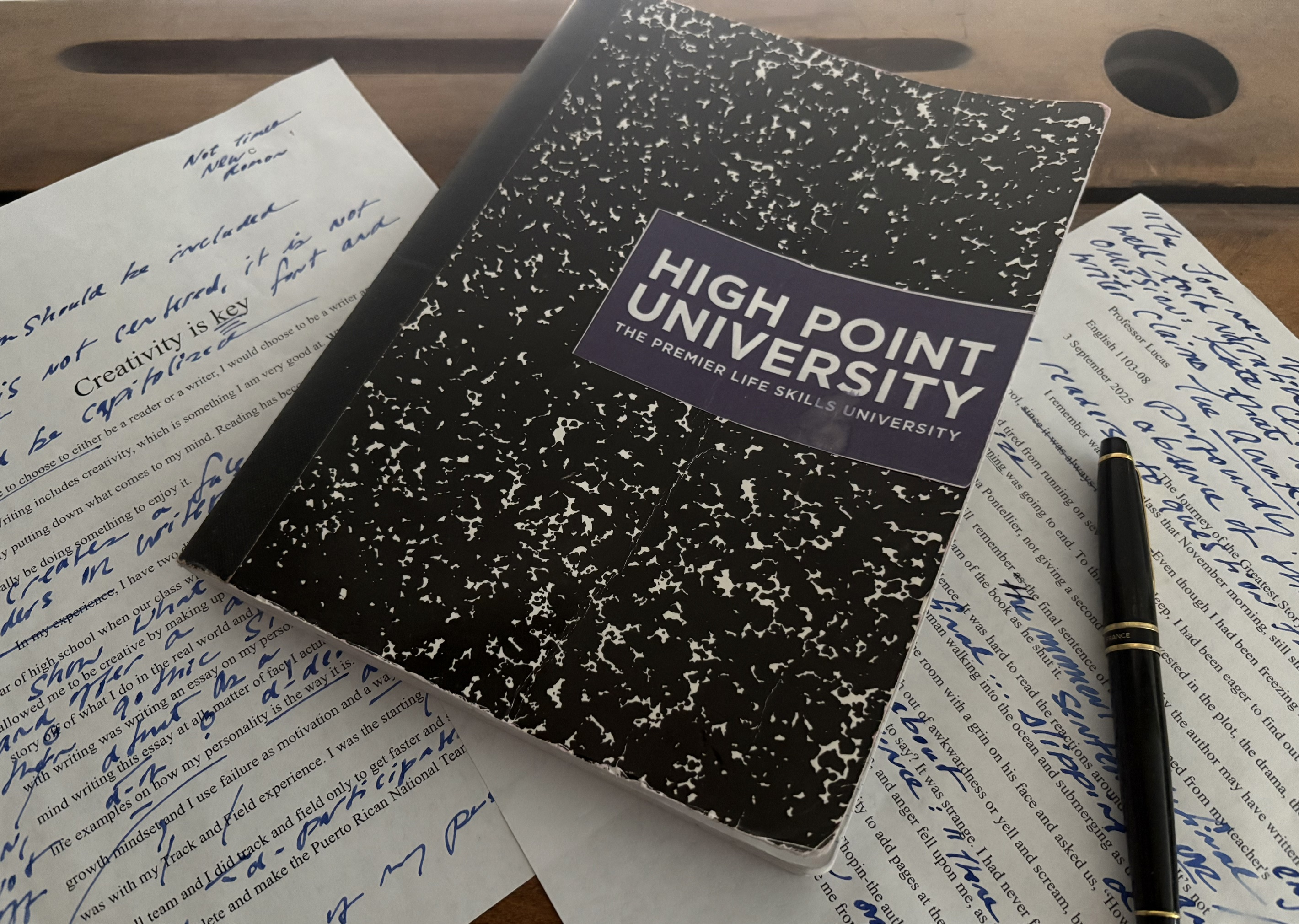
The paragraphs that follow include detailed but not comprehensive notes on the two sample essays that you read and evaluated yesterday. Look to these notes as a guide for editing your own literacy narrative.
“Creativity is Key”: Notes on Content
The essay is not a narrative. The writer mentions his experience writing a Southern gothic story, and he briefly recounts writing about his training for track and field and international football (soccer), but the writer offers very few details. Focusing on one of those experiences and recreating one or more moments from it would transform the essay into a narrative and develop it into one that meets the six hundred-word minimum requirement.
“Creativity is Key”: Notes on Form
Form is less important than content, but easily avoidable errors of form may prevent readers from appreciating the content of your narrative. Creating a compelling story is hard work; proofreading isn’t. If you don’t get the easy part right, readers may stop reading.
- The writer changes the font of the body of the paper to Times New Roman but does not change the font of the running header, which should also be Times New Roman.
- The writer incorrectly adds an extra space between the first-page course information (in the upper left) and between the title and the first line of the essay. MLA-style manuscripts are double-spaced. Note that later, the writer also incorrectly adds space between the paragraphs.
- The title should be typed in twelve-point font, which is the font size that should be used throughout the document.
- The title should not appear in boldface.
- The title should be centered.
- In MLA style, all major words in a title, including the final one, are capitalized (“key” should be “Key).
- The second “sentence” of the second paragraph is a fragment because the meaning of “one being my senior year . . .” is dependent upon the clause that ends the previous sentence. See Writing Analytically, page 426-29.
- The comma between “all” and “matter” is a comma splice. See Writing Analytically, 429.
- “[R]eal life” should be hyphenated (as real-life) when it functions as a compound modifier. Ditto for “open minded” and “four to five.”
- Errors of letter case–upper rather than lower, or vice versa–are mistakes of mechanics that are prevalent in the second paragraph. Track, Field, defensive back, and Athlete should all begin with a lowercase letter.
- “[F]elt like” should be “felt as if.” In comparisons, use “like” before a noun and “as if” before a clause.
- “I’m a writer that” should be “I’m a writer who.” The correct relative pronoun for a person is “who,” not “that.”
“The Journey of the Greatest Story”: Notes on Content
“The Journey of the Greatest Story” is a well-told narrative, but one with a glaring omission: Kate Chopin’s words. The writer claims that the last sentence of The Awakening affected her profoundly, but the absence of those words may lead readers to question the writer’s reliability. If Chopin’s words were so memorable, why aren’t they on the page? Near the end of the narrative, the writer states that she “can still recall key details from the story” (par. 4), but provides no examples. The only detail the writer mentions is Edna Pontelier’s suicide by drowning, which is a well-known fact about the novel.
The writer may have chosen to withhold Chopin’s last sentence from her introductory paragraph because she wanted to focus instead on what followed: the “loud slam of the book as he [the teacher] shut it” (par.1). Still, the writer could have included it later. For example, when she writes about the feelings the novel evokes, she might have included a sentence such as this:
I kept thinking about the last sentence: “There was a hum of bees, and the musky odor of pinks filled the air” (Chopin, ch. 39).
Quoting The Awakening doesn’t require having a copy of the novel at hand. The complete text is available on Project Gutenberg. The parenthetical citation in the example above follows the format for an unpaginated online book (author’s last name, chapter abbreviation, and chapter number). The MLA work cited entry for the book appears below. Note that in a manuscript, the entry would have a hanging indent, which means the first line would be flush left and any subsequent lines would be indented five spaces or one-half inch.
Chopin, Kate. The Awakening. 1899. Project Gutenberg, Aug. 1994, https://www.gutenberg.org/files/160/160-h/160-h.htm#link2H_4_0040.
“The Journey of the Greatest Story”: Notes on Form
- The Awakening (pars. 2, 4) should be italicized rather than underlined. In the process of composing her draft longhand, the writer learned that titles of book-length works are underlined in handwritten documents, and she mistakenly applied that rule to her typed revision.
- The word as should not precede “the final sentence” (par. 1), because it is used improperly there. As offers comparison, shows reason, or introduces a clause. Here are two ways the writer could revise the sentence:
I still remember the moment the final sentence of the story slipped from my teacher’s mouth, and the loud slam of the book as he shut it.
I still remember the final sentence of the story slipping from my teacher’s mouth, and the loud slamming of the book as he shut it.
- The second example above is more direct because the writer doesn’t tell the reader it’s a moment. Instead, she lets the moment happen. The strike-throughs indicate that “of the story” (par. 1) is an unnecessary phrase. The writer has already established that The Awakening is her subject. Also, if specifying the book is necessary at any point, it should be referred to as a novel, not a story.
- The writer describes Edna Pontelier as “submerging as death grew upon her” (par. 2), but growing indicates a rise, while submersion indicates a lowering. Grew should be replaced with engulfed.
- The writer incorrectly uses hyphens to set off the appositive “-the author-” (par. 2). Here are two ways the writer could correct the presentation of the appositive and edit the passage for brevity:
I yearned for more pages to materialize to clarify the ending, or to have a chat with Kate Chopin–the author–so she could relieve my frustration by explaining the conclusion. Instead, I just sat and pondered those aggravating feelings.
I yearned for more pages to materialize to clarify the ending, or to have a chat with Kate Chopin, the author, so she could relieve my frustration by explaining the conclusion. Instead, I just sat and pondered those aggravating feelings.
- An appositive can be set off by em dashes or commas, but commas are preferable for short appostives, so the second correction above is recommended.
- The line “having me read this class” (par. 3) is not what the writer intended. The words shoud be having me enroll in the course or having me read Chopin’s novel.
- When the teacher responds to the student (par. 3), the writer should begin a new paragraph because the speaker changes.
- And when the writer responds to her teacher, she should begin a new paragraph yet again because the speaker changes from the teacher to the writer-student, with her words, “Have a nice day” (par. 3).
- Years are an exception to MLA’s numbers rule regarding words and figures. 2025 should be written as 2025, not “twenty-twenty-five” (par. 4).
Next Up
On Wednesday, after our follow-up discussion of “Creativity is Key” and “Journey of the Greatest Story,” I will return your literacy narrative drafts, and you will have the remainder of the class period to begin revising on your laptops. You will have an additional week to continue revising before posting to Blackboard and WordPress. The due date for your literacy narrative is Wednesday, September 9, before class; the hard deadline is Friday, September 11, before class.

