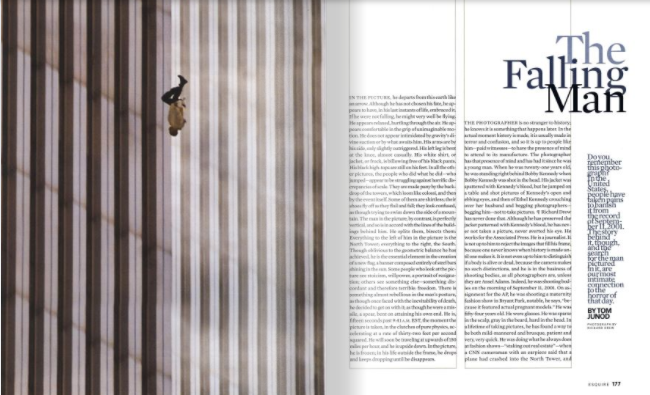
Tom Junod’s “The Falling Man”
Today in class, before you begin your Scrabble games, we will examine the opening of Tom Junod‘s article “The Falling Man,” published in Esquire magazine two years after 9-11. One of the elements that we will consider is the unusually long first paragraph.
The authors of Writing Analytically recommend that “[i]f you find a paragraph growing longer than half a page–particularly if it is your opening or second paragraph–find a place to make a paragraph break” (Rosenwasser and Stephen 308). Junod does not follow that advice. He opts instead to open his article with a paragraph of more than four hundred words.
If Junod had chosen to divide the first paragraph, where might he have divided it?
Work Cited
Rosenwasser, David, and Jill Stephen. “The Idea of the Paragraph.”Writing Analytically, 9th edition. Wadsworth/Cengage, 2024. pp. 307-313.
If you would like to read more of Junod’s article than the first paragraph, you won’t be able to do so on Esquire‘s website because the magazine’s paywall will deny you access to the full text, unless you are a subscriber. However, students and faculty at HPU can access the full text of articles published in any of the magazines and newspapers included in the libraries’ databases. To access “The Falling Man” through the HPU Library site, follow these steps:
Directions for Accessing “The Falling Man” (Full Text)
- Go to the HPU Library site.
- Under the heading Search HPU Libraries . . . , click on the Articles tab.
- Under the Articles tab, type Tom Junod “Falling Man” Esquire in the search box and click search.
- On the next screen, you will see a brief summary of the article. Click View full text to see the complete article.
- On the next screen, click View full text beside one of the database options.
Literacy Narrative Blog Response Assignment
Directions
- After this morning’s hard deadline for the literacy narrative,10:40, go to the class page, and click on the link for the blog of the classmate whose name follows yours. If you are last on the list, go to the blog of the student whose name is first.
- If your designated classmate’s blog is not linked to the page, or his or her literacy narrative is not published, choose another classmate’s blog.
- Read the classmate’s literacy narrative.
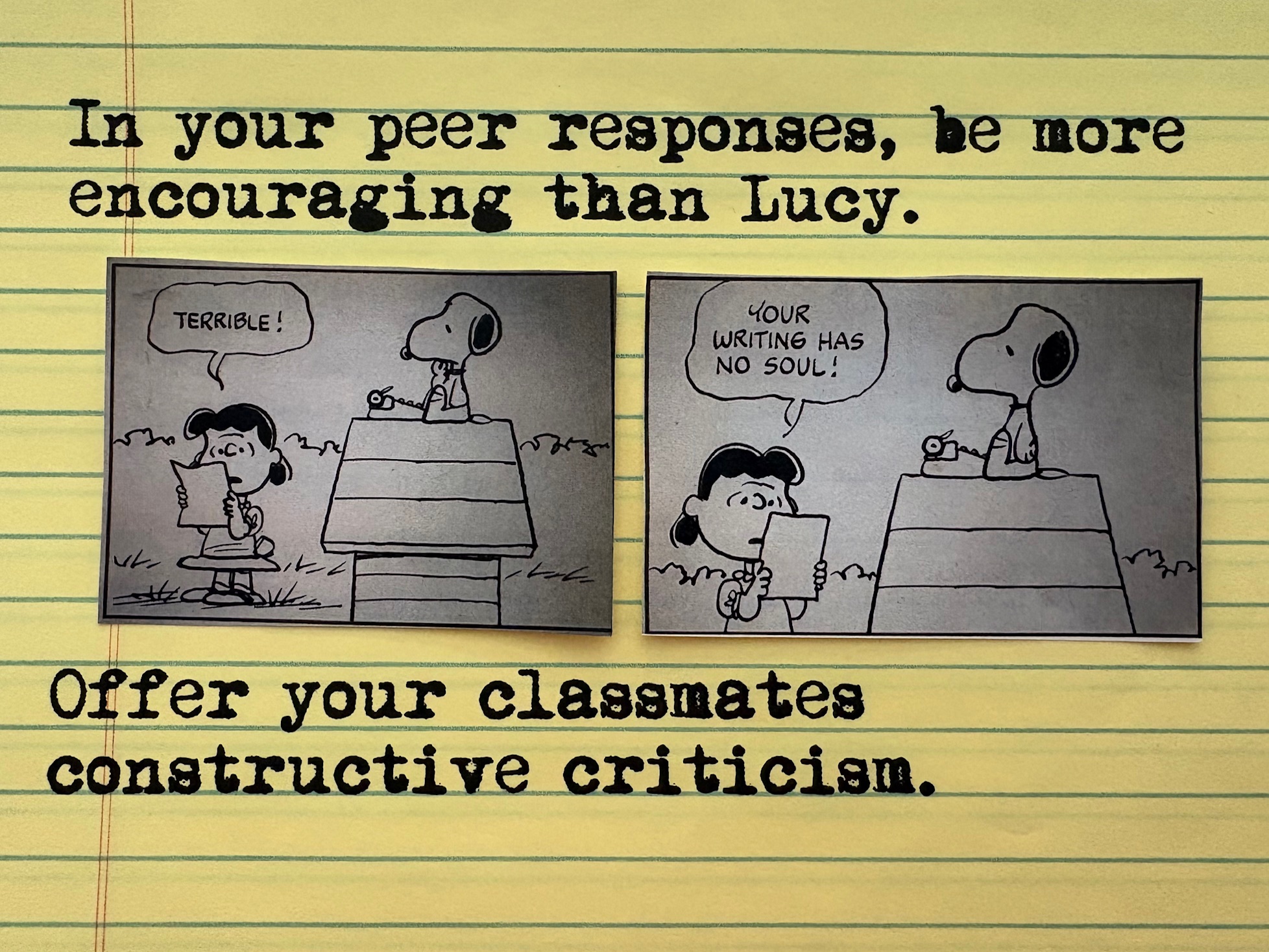
- Compose a one- or two-paragraph response (75 words, minimum) that includes both the classmate’s name and the title of his or her literacy narrative. In your comment, address one or more of these elements: the title, vivid details, scene, dialogue, the image documenting part of the writing process away from the screen, the embedded link to a relevant website. Note that you will mention the classmate by name, but you will not refer to him or her in third person. In other words, you will not write, John’s description made me feel as if I were with him in his fourth-grade classroom. Instead, you will write, John, your description made me feel as if I were with you in your fourth-grade classroom.
- Recommended (not required): Draft your comment longhand in your journal.
- Type your response as a comment. You should see a leave comment/reply option at the top or bottom of the post. If you do not see that option, click the title of the post and scroll down. You should then see leave comment/reply.
- Before you click leave comment/reply, copy your comment (on a PC, copy with control + c; on a Mac, copy with command + c).
- After you submit your comment on your classmate’s literacy narrative, return to this blog post, and paste your comment as a reply (on a PC, paste with control + v; on a Mac, paste with command + v). This step is critical because your classmate may not approve your comment, which means it will not be visible on his or her blog. To receive credit for the assignment, you must post your duplicate comment as a reply to this post, ENG 1103: “The Falling Man” . . . . To submit your comment, click the title of the post, then scroll down to the bottom. There you will see the image of an airmail envelope with a box for your comment. Type your comment in the box and click Comment. Post your comment by 7:30 a.m. on Monday, September 14. I will make your comments visible after the deadline.
You are not required to read other classmates’ literacy narratives, but I encourage you to browse their blogs and read the posts that pique your interest.
Next Up
Wordplay Day! To prepare for class, revisit the Merriam-Webster Scrabble Word Finder page, and review your journal notes and the blog posts with Scrabble tips, including this one
Coming Soon
For Monday’s class, you will read and annotate Isaac Asimov’s short story “Runaround,” which I distributed in class on Wednesday. If you were absent or misplaced your copy, print one from Blackboard.
Also, before Monday morning’s 7:30 deadline, remember to post your peer blog response as a comment on today’s post.

