Today in class you revisited the exercise of examining the stance, structure, and sources of an essay. But instead of studying those components of my sample essay–as you did in groups on Monday–you looked closely at those parts of one of your classmates’ essays and composed a blog repsonse. That close study of the building blocks of a research essay is one of the most beneficial practices to engage in when you’re in the process of developing a research project of your own. It broadens your understanding of how stance, source, and structure combine to create a unified piece of writing and can serve as an example of how you might move forward with your own paper in progress.
Next Up
This week you will post your final essay to Blackboard and publish it on your blog (if you haven’t done so already). The hard deadline is Friday before class. Remember that you have the opportunity to earn extra credit points for consulting with a writing center tutor. To schedule an appointment, go to https://highpoint.mywconline.com/. If you encounter technical difficulties when you try to schedule an appointment, email Professor Justin Cook, director of the writing center: jcook3@highpoint.edu.
Coming Soon
Friday marks our last Wordplay Day for the month of November. To prepare for class and to up your game, review the Scrabble site’s tips and tools.
In his recent essay “Scrolling,” physician and writer Gavin Francis recounts a visit to the woods near Concord, Massachusetts, where Henry David Thoreau built his cabin and wrote Walden. Although Francis anticipated that the area—now a tourist site—would be busy, what he didn’t expect “was the forest of arms holding smartphones, taking selfies, engaging in video calls.” Francis opens his essay with that anecdote about his visit to Thoreau’s woods to emphasize the pervasiveness of digital devices in our lives. Not even at a place synonymous with the retreat from daily distractions can we turn away from our phones. Francis observes one of Walden’s visitors, a student perched on a rock, “arms outstretched, angling his phone while shouting out to his retreating companions: ‘I don’t think you guys realize how much this place means to me, I mean privately.’”
Disentangling from our distractions is particularly problematic for those of us who teach, whose role in our students’ lives involves cultivating the undivided attention essential to learning. Seeking a balance between screen time and time away from it is an ongoing process, one that has taken on new importance in the last year and a half, since the onset of COVID-19. Even as the pandemic has required us to spend more hours in front of our screens, we have witnessed the critical need to turn away from them.
That ability to turn away from the screen has substantial benefits for us when we write. In their textbook, Writing Analytically, David Rosenwasser and Jill Stephen detail the problems that present themselves when we begin the process with our fingers on the keyboard:
Perhaps the most common problem with writing on a computer is that this practice can lock you into a draft or a particular idea too soon. Words that come up on a screen look more like finished text than handwritten words in a notebook, and so, the problem of trying to draft and edit at the same time is more likely to arise, as is the likelihood that you will close off fruitful options too soon by prematurely hitting the delete button. And then there is what we might call the low-hanging fruit problem: the temptation to keep interrupting ourselves to chase links to other people’s thinking (and any number of funny pet pictures) online. (125)
Rosenwasser and Stephen, professors emeriti at Muhlenberg College, note that “[w]riters tend to be more than a little divided” regarding writing on computers versus writing on paper, and they acknowledge that they “have had students who manage to capture their best ideas by jotting them down on their cell phones” (124). Still, they recommend that “at earlier stages in the writing process, and also, perhaps, in trying to work through a difficult revision, taking pen to paper might be the better tactic” (125).
Though many teachers have moved to all-digital assignments, I still require my students to draft longhand and move to the keyboard during the revision process. My initial reason for continuing that practice was the benefits it offers us as writers, including the ones cited by Rosenwasser and Stephen. Now I realize that the benefits extend beyond writing. Putting pen to paper means less time in front of the screen. That said, drafting longhand doesn’t eliminate digital distractions for writers; it simply delays them. But the deferral alone is a plus. Even as I wrote these words that you are reading, I struggled to maintain my focus. I found myself returning to pen and paper to develop my ideas, ones that were too easily cut short when I hit the delete key.
Along with drafting handwritten assignments, my students play Scrabble once a week. Initially those weekly games served primarily as companions to their writing, exercises in word building and analysis on a smaller scale. But like writing longhand itself, Scrabble presented another opportunity to turn away from our screens.
In the process of writing this paper, I found minimal research on Scrabble. Notably, the one article that focused on Scrabble in the college classroom mentioned that “[t]abletop games appeared to receive less attention from game researchers than video games, particularly within the postsecondary context” (289). The author of that study, Mark Hayse, co-director of the Center for Games and Learning at MidAmerican Nazarene University, drew his findings from the reports of three of his colleagues who incorporated tabletop games into their classes in Christian leadership, theology, and history. The professors’ focused their attention on the possible connections between gameplay and twenty-first century “learning and innovation skills,” also known as the “4Cs”: critical thinking and problem solving, creativity and innovation, communication, and collaboration (290).
The MNU professors’ primary research question was, “Does tabletop gameplay require the practice of 21st century skills?” (290). Their secondary question was, “What initial links might be drawn between tabletop gameplay, 21st century skill practice, and undergraduate learning?” They found that two of the four Cs, communication and collaboration, figured prominently, and the students themselves identified collaboration as the primary component of their gameplay. All three professors reported “that tabletop gameplay helped students move from classroom passivity to classroom ‘engagement’” (298). In my own classroom, I have observed the same movement from passive learning to active learning when my students play Scrabble. Sometimes they are so absorbed in their games, they are surprised to hear me announce that it’s time for their five-minute break. I also shared the MNU professors’ observation that “[e]ven though tabletop gameplay technically was coursework . . . the nontraditional nature of it seemed to render it as play more than work” (298). Even though some students don’t like the particulars of the game—such as the rule that prohibits proper nouns, acronyms, and hyphenated words—most of the students enjoy the time collaborating with their classmates on an activity that doesn’t seem like a compulsory task.
Describing the process of gameplay, one student in the MNU study said, “There were those intense suspense moments, but there was also this ‘Oh yeah, we got this’ when we were strategizing [together]” (299). Those intense moments of suspense occur in my classes during Scrabble games when a team challenges a word and waits for me to find it in the dictionary or deem it unplayable (because it isn’t there). And there are frequent we-got-this moments when a team suddenly sees a possibility that wasn’t apparent to them before; for example: a square between two vowels where they can form two, two-letter words by playing one of seven consonants on their rack. Determining how to move forward with of only consonants or only vowels—or nearly all consonants and vowels—serve as some of Scrabble’s best opportunities for creative problem solving.
The findings of the MNU professors are markedly similar to my own classroom observations. And although adding Scrabble to the English 1103 curriculum has not been a subject of research for me, the process of writing this paper has prompted my interest in building on the study of MNU’s Professor Mark Hayse, perhaps with a project that explores the links between the problem-solving aspects of Scrabble and the writing process.
As I continue to reflect on writing longhand and playing Scrabble and how they figure in my classes, I am grateful that those practices—ones that I chose for skill development—have taken on greater importance as endeavors that lead us away from our screens.
The challenge of turning away from the digital devices that consume more and more of our lives isn’t simply a good habit to aspire to—a mere item on a list of New Year’s resolutions—instead it’s a critical need. Recent revelations regarding Facebook’s own internal research underscore the platform’s harmful effects, ones to which young people are particularly vulnerable. One of Facebook’s research reports found that “social comparison is worse on Instagram” and that the app’s Explore page, “which serves users photos and videos curated by an algorithm, can send users deep into content that can be harmful” (ctd. in Horwitz et al.).
Riana Elyse Anderson, an assistant professor of health behavior and health education at the University of Michigan, observes that “we’re watching college students really get impacted by the comparison that they’re seeing in their classmates online, in social media. They’re using comparison and they’re feeling particularly anxious about it for themselves” (qtd. In Yang).
While Anderson notes that she’s heartened by Gen Z students’ willingness to seek mental health resources, “[i]t’s another thing, though, when . . . professors like myself are now saying, what do we do? How do we contend with teaching, with meeting, with doing the things we have to do for school” (qtd. In Yang). Many of us who teach college students find ourselves asking the same questions in the face of both our own anecdotal evidence and the reports of mental health crises on college campuses.
Less than a month after The Wall Street Journal reported the findings of Facebook’s internal research, the University of North Carolina at Chapel Hill canceled classes after student leaders demanded a mental wellness day following the suicides of two students—and the hospitalization of another student after a suicide attempt. A 2021 study conducted by the American College Health Association “found that 48 percent of college students reported moderate or severe psychological distress, 53 percent reported being lonely, and one in four had considered suicide” (ctd. in Yang).
Facebook’s internal research includes an Instagram research manager’s report of teenagers “wanting to spend less time on Instagram . . . but lack[ing] the self-control to do so” (ctd. In Horwitz et al.). I observe that same lack of self-control in some of my students. And to help them overcome it, I follow a variation on a piece of advice from journalist and technologist William Powers. In his book Hamlet’s Blackberry, he recommends that “[e]very home could have at least one Walden Zone, a room where no screens of any kind are allowed” (191). When my students put words on paper and form words on a Scrabble gameboard, they are in the Walden Zone that I have created in the classroom, a place where we become temporarily free of the screens that occupy so many moments of our lives. In his conclusion to Walden, Thoreau remarks on “how easily and insensibly we fall into a particular route” (990). The one that leads us to our screens again and again cannot be abandoned, nor should it be, but the Walden zones we can strive to maintain offer a much-needed detour.
Powers, William. Hamlet’s Blackberry: A Practical Philosophy for Building a Good Life in the Digital Age. Harper, 2010.
Thoreau, Henry David. Walden; or, Life in the Woods. 1854. The Norton Anthology of American Literature: Beginnings to 1865. 9th ed. Robert S. Levine, General Editor. W.W. Norton, 2017. pp. 919-96.
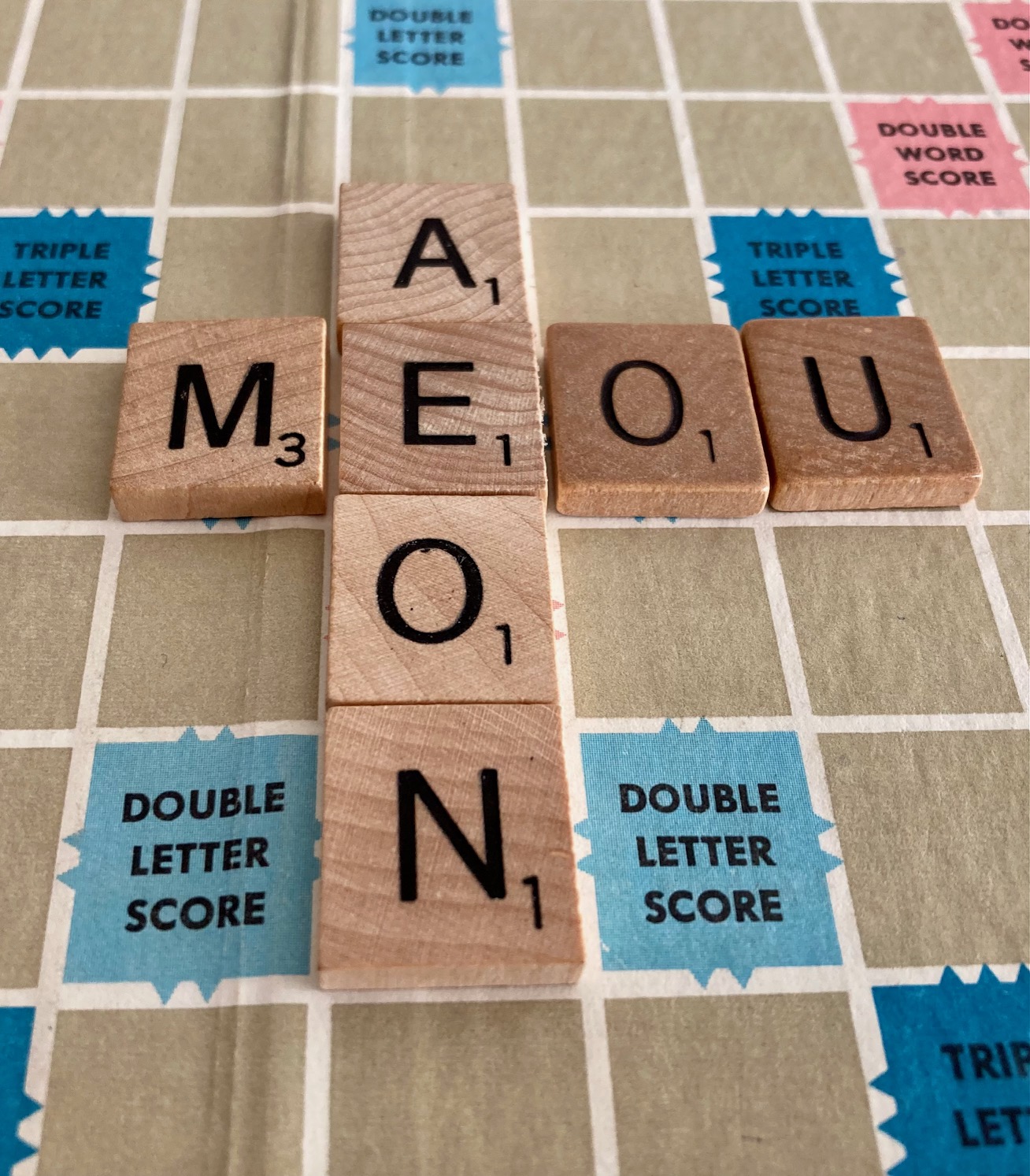
In my sample final essay, I noted that “[d]etermining how to move forward with only consonants or only vowels—or nearly all consonants and vowels—serves as some of Scrabble’s best opportunities for creative problem solving.” Here I offer a list of possible solutions: twenty-five four-letter words with three vowels:
aeon: a long period of time (also eon)
agee: to one side (also ajee)
agio: a surcharge applied when exchanging currency
ague: a sickness associated with malaria
ajee: to one side (also agee)
akee: a tropical tree
alae: wings (pl. of ala)
alee: on the side shielded from wind
amia: a freshwater fish
amoa: a kind of small buffalo
awee: a little while
eaux: waters (pl. of eau)
eide: distinctive appearances of things (pl. of eidos)
emeu: an emu
etui: an ornamental case
euro: an Australian marsupial, also known as wallaroo, for being like the kangaroo and the wallaby; also a unified currency of much of Europe
ilea: the terminal portions of small intestines (pl. of ileum)
Rosenwasser, David, and Jill Stephen. “Six Strategies for Analyzing Sources.” Writing Analytically, 8th edition. Wadsworth/Cengage, 2019. p. 219.
Using the six strategies that follow will help your develop a nuanced revision:
“Make Your Sources Speak
Attend Carefully to the Language of Your Sources by Quoting or Paraphrasing
Supply Ongoing Analysis of Your Sources (Don’t Wait Until the End)
Use Your Sources to Ask Questions, Not Just to Provide Answers
Put Your Sources in Conversation with One Another
Find Your Own Role in the Conversation”
Work Cited
Rosenwasser, David, and Jill Stephen. “Six Strategies for Analyzing Sources.” Writing Analytically, 8th edition. Wadsworth/Cengage, 2019. p. 219.
The Writing Center
Remember that you have the opportunity to earn extra credit for your essay if you consult with a Writing Center tutor. To schedule an appointment, go to https://highpoint.mywconline.com.
Today in class you will complete two exercises that offer practice in integrating sources and creating in-text citations in MLA style. One of the exercises features the excerpt above, from Malcom Gladwell‘s New Yorker article “Big and Bad.”
For more information on integrating sources and in-text citations, see the MLA Style Center and OWL, Purdue University’s Online Writing Lab.
Next Up
In class on Wednesday, November 10, I will return your handwritten drafts with my notes, and you will have the class period to continue drafting and begin revising on your laptops.
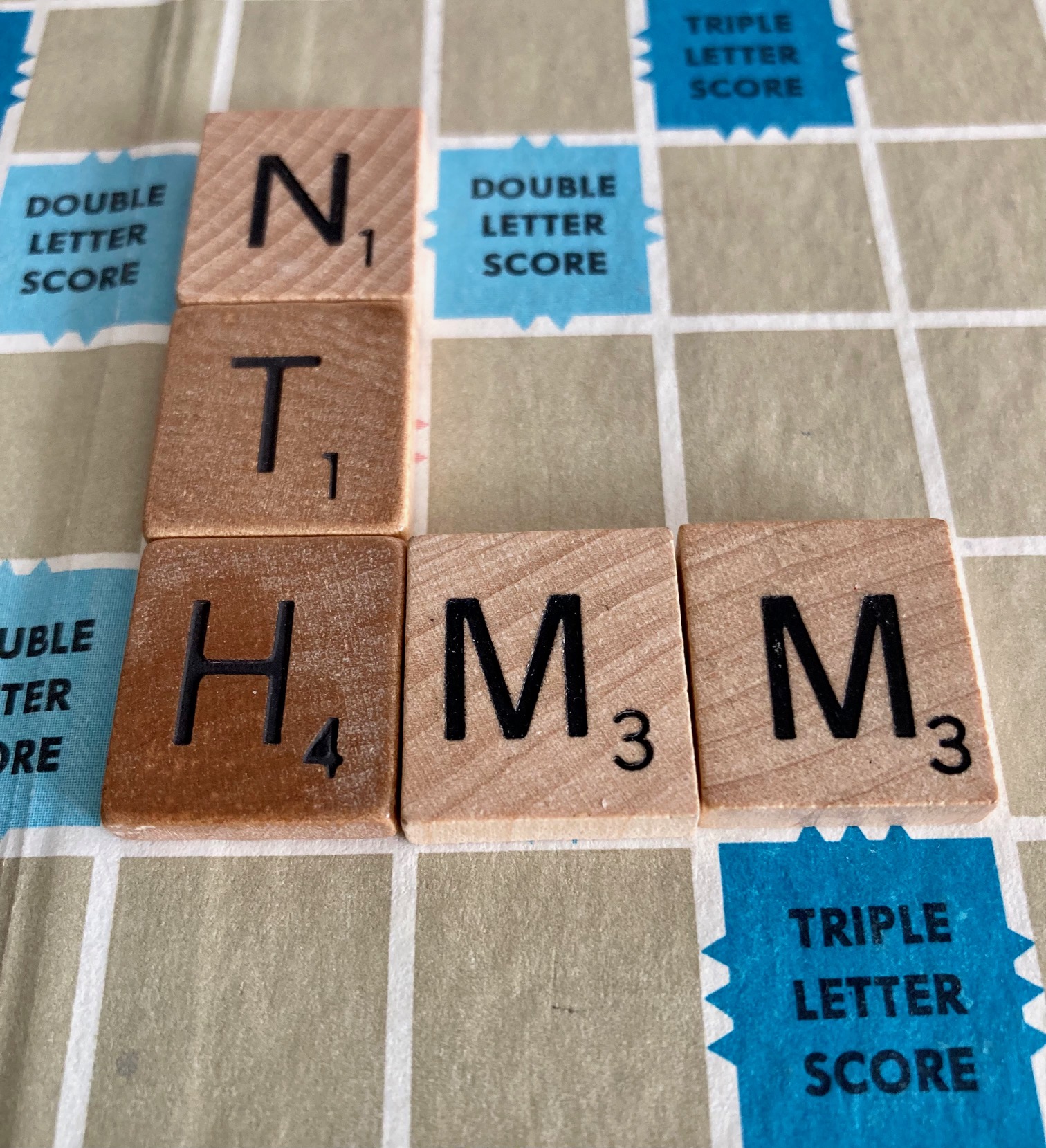
In a 1954 interview for Look magazine, Duke Ellington observed that “Playing bop is like Scrabble with all the vowels missing.” If you find yourself faced with a Scrabble rack full of consonants, you can play bop with these words:
brr: used to indicate that one feels cold (also brrr)
crth: an ancient stringed instrument (pl. -s) (pronounced to rhyme with booth)
cwm: a cirque (a deep, steep-walled basin on a mountain) (pl. -s) (pronounced to rhyme with boom)
hm: used to express thoughtful consideration (also hmm)
nth: describing an unspecified number
pfft: used to express a sudden ending
psst: used to attract someone’s attention
sh: used to urge silence (also shh and sha)
tsk: to utter an exclamation of annoyance (-ed, -ing, -s)
During Wednesday’s class, while you were planning, drafting, and researching, some students asked whether it was acceptable to write your final essay in first person. Yes, you are welcome to write in first person.
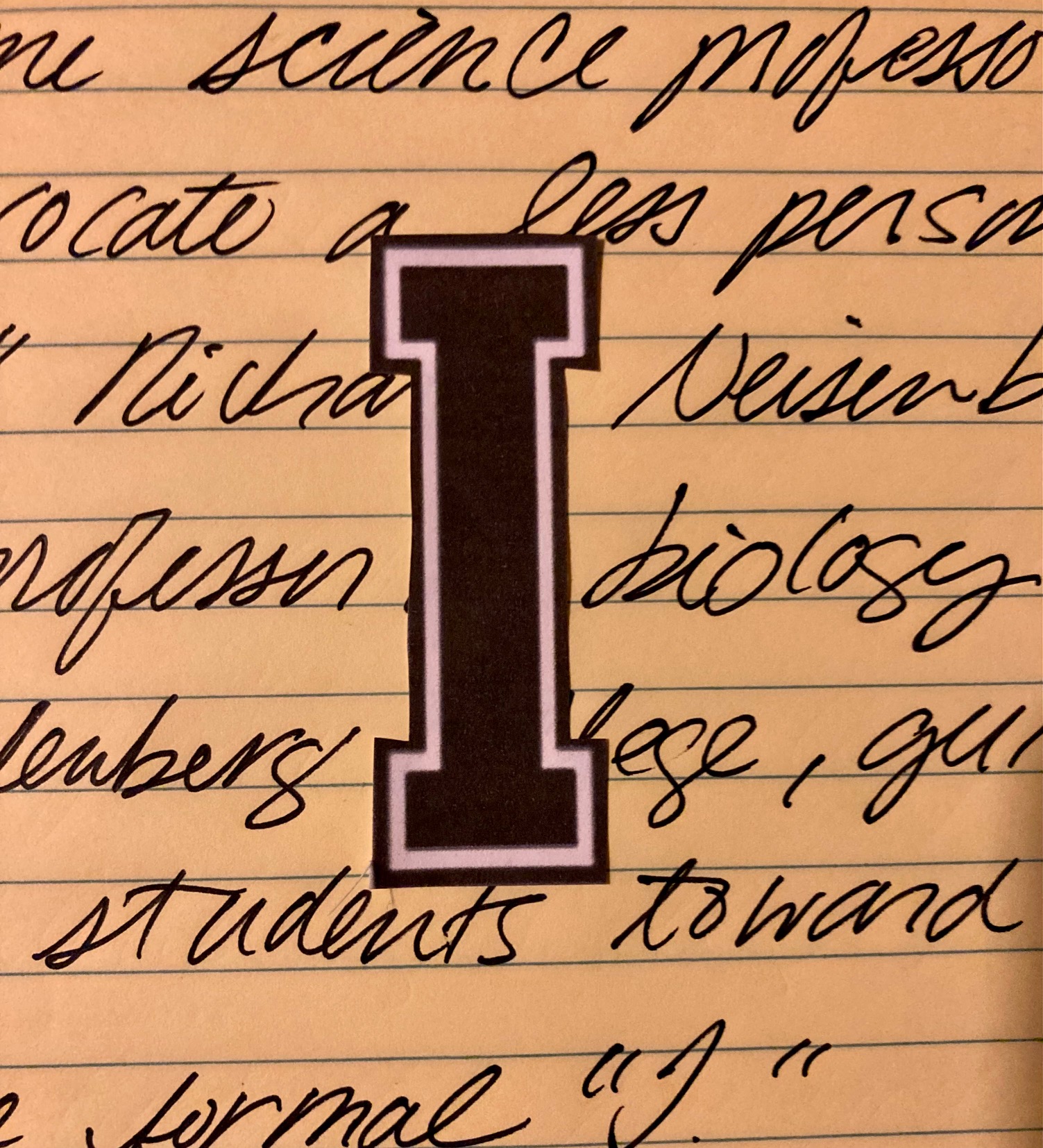
Some of the writing you produce as a college student and as a professional will require third person, but writing in the humanities—fields such as English, history, philosophy, religion, and art—often features first person. Although “I” is far less common in the sciences, some science professors advocate a less personal “I.” Richard Neisenbaum, a professor of biology at Muhlenburg College, guides his students toward a more formal “I.” In his words:
“The biggest stylistic problem is that students tend to be too personal or colloquial in their writing, using phrases such as the following: ‘Scientists all agree,’ ‘I find it amazing that,’ ‘The thing that I find most interesting.’ Students are urged to present data and existing information in their own words, but in an objective way. My preference is to use the active voice in the past tense. I feel this is the most direct and least wordy approach: “I asked this,” “I found out that,” These data show” (ctd. in Rosenwasser and Stephen 335).
Keri Colabroy, a professor of Chemistry Muhlenburg College, favors a different approach. On the subject of pronouns, she tells her students, “[I]t’s safer to avoid them” (ctd. in Rosenwasser and Stephen 335).
Work Cited
Rosenwasser, David and Jill Stephen. Chapter 11: “Choosing Words, Shaping Sentences.” Writing Analytically, 8th edition. Wadsworth/Cengage, 2019. pp. 299-340.
Yesterday in class, I demonstrated a variety of starting points for your research, including these:
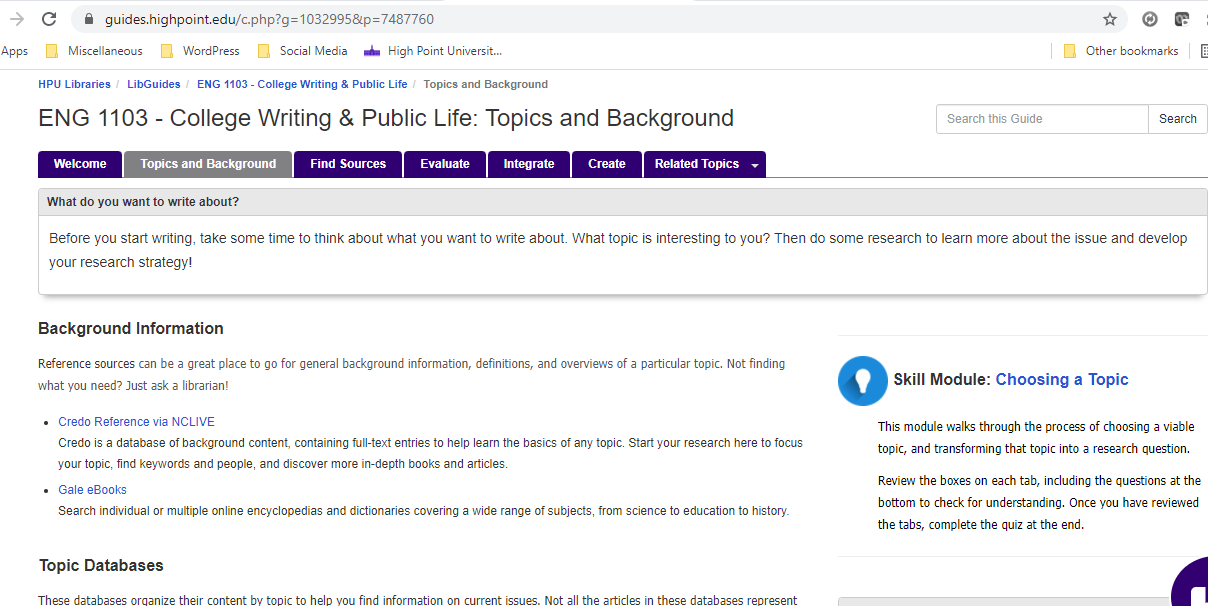
The English 1103 Research Guide, which is linked to my blog (see the list of links on the right).
The HPU Library home page, which is also linked to my blog. At the library’s home page, you can conduct searches by source type (articles, books, etc.), you can search for articles in particular publications, such as newspapers of record–including The New York Times, The Wall Street Journal, and The Washington Post—and you can search by keywords or by an author’s name.
An article you have read may offer a starting point. For example: If you’re interested in writing about the harmful effects of Instagram reported in September 14 Wall Street Journal article, you might look for research by Jean Twenge, a professor of psychology at San Diego Sate University, who is quoted in the article.
Though you will plan and draft longhand in class tomorrow, you will have the opportunity to use your laptop to conduct research. Your revised essay will include a minimum of three relevant sources, but the notes and any draft work that you produce in class tomorrow, November 3, does not need to incorporate three sources. You may devote a significant portion of class time tomorrow to research itself.
Stephen King’s “Strawberry Spring”
King, Stephen. Night Shift. Doubleday, 1978.
To earn an extra-credit course work assignment, read Stephen King’s short story, and publish a response to it of seventy-five words or more on your blog no later than Wednesday, November 10. Questions to consider include, but are not limited to, the following:
What, if anything, in Stephen King’s story prepared you for its ending? (What, if anything, would you point to as foreshadowing?)
Where in the story did you encounter references to war? Why might King have included so many references to Vietnam and the U.S. Civil War?
How is “Strawberry Spring” similar to or different from another horror story of Stephen King’s? How is the story similar to or different from a horror story by another writer?
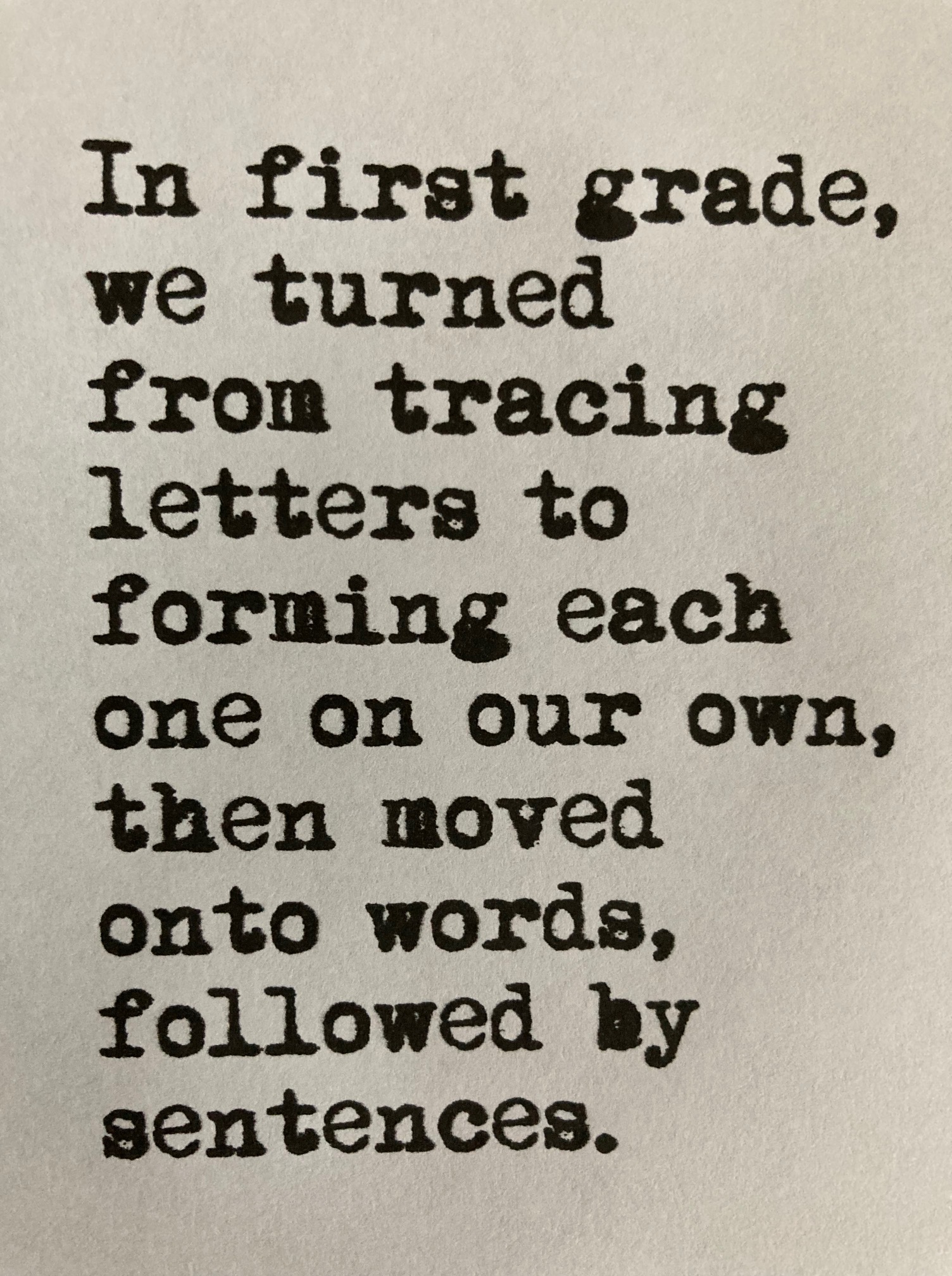
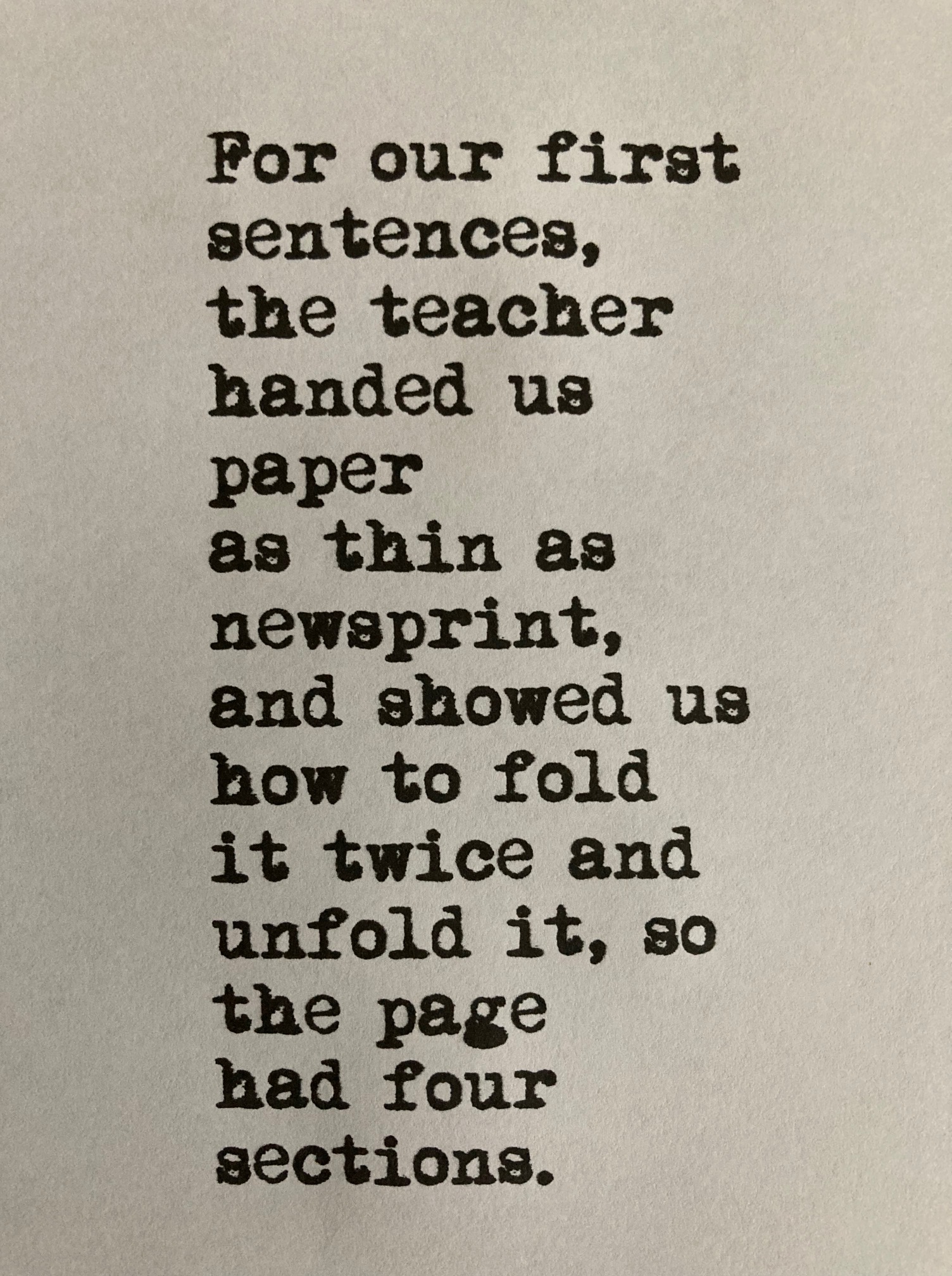
The “stanzas” below and the two paragraphs that follow them are my version of the English 1103 creative project.
A First Sentence
Although many moments of my childhood are lost to me, the memory of writing one of my first sentences resurfaces in my mind because it marks a turning point. Before that sentence-writing exercise, I had recorded letters on a page, but I had not truly written. When I looked at the words on the chalkboard and said to myself, “The pig wore a wig,” I had formed an idea. I composed it in my mind and wrote it on the page.
I cannot return to the pure joy of that moment whenever I sit down to write, but I try to remind myself often that all writing is creative. We always begin with a blank page or screen and create.
The fake photograph of Biggie Smalls and Kurt Cobain featured in Lesson Five of Check, Please!
At the beginning of class today, you submitted your worksheet for the fifth and final lesson in the Check, Please! series. My version of the assignment, which I wrote along with you, follows.
Check, Please! Assignment for Lesson Five
In the fifth lesson of the Check, Please!, Starter Course, Mike Caulfield, author of the course and Director of Blended and Networked Learning at Washington State University, covers the final step in the five-step SIFT approach: “Trace Claims, Quotes, and Media to Their Original Context.” Caulfield outlines the process of locating the original context as an antidote to the issues of accuracy that occur when information passes through intermediaries.
One of the most instructive portions of lesson five features a passage in which Caulfield cites a study of how stories evolve as gossip through the processes of leveling (stripping details), sharpening (adding or emphasizing details), and assimilating, which combines the two. In the process of assimilation “the details that were omitted and the details that were added or emphasized are chosen because they either fit what the speaker thinks is the main theme of the story, or what the speaker thinks the listener will be most interested in.” Similarly, leveling, sharpening, and assimilating all figure in the altered photographs and memes in lesson four. The abbreviated speech of the NRA’s CEO, Wayne LaPierre, which omits commentary, inaccurately indicates a contradiction in his stance on the presence of guns in schools.
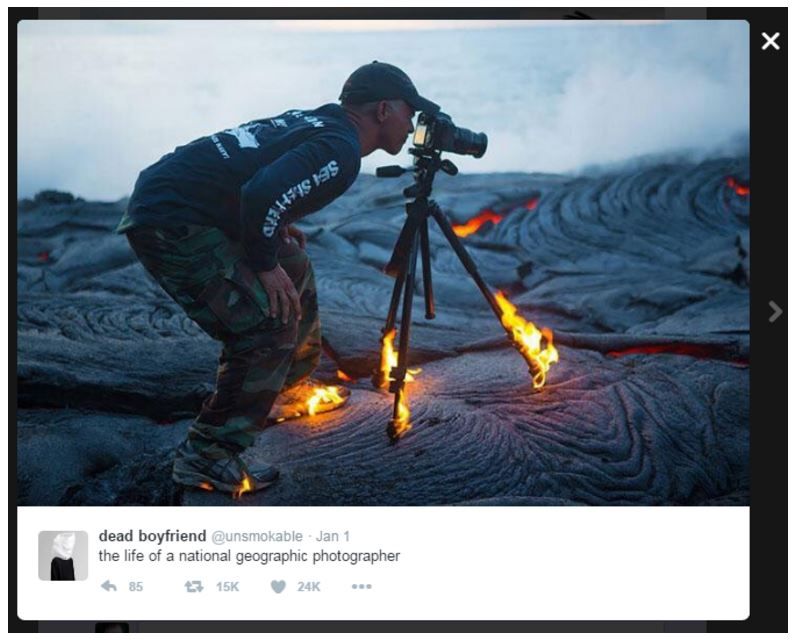
Kawika Singson’s real photograph–real but reposted with inaccurate commentary–featured in Lesson Five of Check, Please!
The image of photographer Kawika Singson with flames at his feet serves as an example of leveling. Although the flames are real, they were not caused by the heat of the lava flow where Singson stands with his tripod. Instead, to create the image, a friend of his poured accelerant on the lava before Singson stepped into the frame. The deception wasn’t intentional; Singson simply wanted the image for his Facebook cover photo.
Unlike Singson’s photograph, the altered photograph of the Notorious B.I.G. with Kurt Cobain was created with the intent to deceive. Cropping and merging the two photographs illustrates the assimilation process adopted by photoshop users to appeal to music fans eager to think that such fictional meetings of icons took place. Krist Novoselic, who founded Nirvana with Cobain, replied to the is-it-real question with his own fake photo, making the claim that the hand holding the cigarettes was Shakur’s, that he had been cropped from the right.








 Jane Lucas