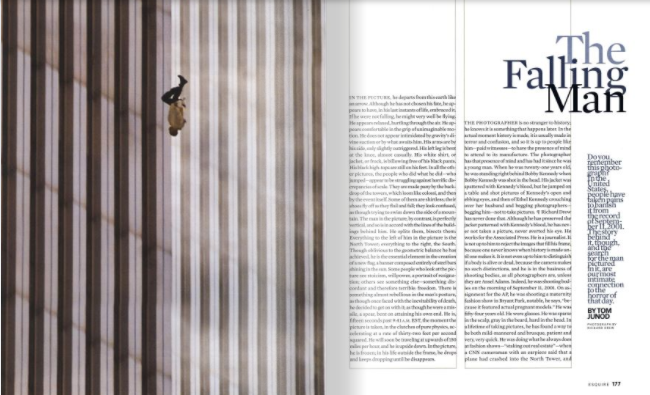
Tom Junod’s “The Falling Man”
Today in class, before you begin your Scrabble games, we will examine the opening of Tom Junod‘s article “The Falling Man,” published in Esquire magazine two years after 9-11. One of the elements that we will consider is the unusually long first paragraph.
The authors of Writing Analytically recommend that “[i]f you find a paragraph growing longer than half a page–particularly if it is your opening or second paragraph–find a place to make a paragraph break” (Rosenwasser and Stephen 308). Junod does not follow that advice. He opts instead to open his article with a paragraph of more than four hundred words.
If Junod had chosen to divide the first paragraph, where might he have divided it?
Work Cited
Rosenwasser, David, and Jill Stephen. “The Idea of the Paragraph.”Writing Analytically, 9th edition. Wadsworth/Cengage, 2024. pp. 307-313.
If you would like to read more of Junod’s article than the first paragraph, you won’t be able to do so on Esquire‘s website because the magazine’s paywall will deny you access to the full text, unless you are a subscriber. However, students and faculty at HPU can access the full text of articles published in any of the magazines and newspapers included in the libraries’ databases. To access “The Falling Man” through the HPU Library site, follow these steps:
Directions for Accessing “The Falling Man” (Full Text)
- Go to the HPU Library site.
- Under the heading Search HPU Libraries . . . , click on the Articles tab.
- Under the Articles tab, type Tom Junod “Falling Man” Esquire in the search box and click search.
- On the next screen, you will see a brief summary of the article. Click View full text to see the complete article.
- On the next screen, click View full text beside one of the database options.
Literacy Narrative Blog Response Assignment
Directions
- After this morning’s hard deadline for the literacy narrative,10:40, go to the class page, and click on the link for the blog of the classmate whose name follows yours. If you are last on the list, go to the blog of the student whose name is first.
- If your designated classmate’s blog is not linked to the page, or his or her literacy narrative is not published, choose another classmate’s blog.
- Read the classmate’s literacy narrative.
- Compose a one- or two-paragraph response (75 words, minimum) that includes both the classmate’s name and the title of his or her literacy narrative. In your comment, address one or more of these elements: the title, vivid details, scene, dialogue, the image documenting part of the writing process away from the screen, the embedded link to a relevant website. Note that you will mention the classmate by name, but you will not refer to him or her in third person. In other words, you will not write, John’s description made me feel as if I were with him in his fourth-grade classroom. Instead, you will write, John, your description made me feel as if I were with you in your fourth-grade classroom.
- Recommended (not required): Draft your comment longhand in your journal.
- Type your response as a comment. You should see a leave comment/reply option at the top or bottom of the post. If you do not see that option, click the title of the post and scroll down. You should then see leave comment/reply.
- Before you click leave comment/reply, copy your comment (on a PC, copy with control + c; on a Mac, copy with command + c).
- After you submit your comment on your classmate’s literacy narrative, return to this blog post, and paste your comment as a reply (on a PC, paste with control + v; on a Mac, paste with command + v). This step is critical because your classmate may not approve your comment, which means it will not be visible on his or her blog. To receive credit for the assignment, you must post your duplicate comment as a reply to this post, ENG 1103: “The Falling Man” . . . . To submit your comment, click the title of the post, then scroll down to the bottom. There you will see the image of an airmail envelope with a box for your comment. Type your comment in the box and click Comment. Post your comment by 7:30 a.m. on Monday, September 14. I will make your comments visible after the deadline.
You are not required to read other classmates’ literacy narratives, but I encourage you to browse their blogs and read the posts that pique your interest.
Next Up
Wordplay Day! To prepare for class, revisit the Merriam-Webster Scrabble Word Finder page, and review your journal notes and the blog posts with Scrabble tips, including this one
Coming Soon
For Monday’s class, you will read and annotate Isaac Asimov’s short story “Runaround,” which I distributed in class on Wednesday. If you were absent or misplaced your copy, print one from Blackboard.
Also, before Monday morning’s 7:30 deadline, remember to post your peer blog response as a comment on today’s post.


Kai, I really enjoyed reading your narrative “The Words That Shaped Me.” I liked how you described the struggle of writing to your younger self. You explained how you had many memories and emotions from high school, including your mom’s encouragement, sports, and many positive experiences. When you included that your mom said, “You are truly blessed, and highly favored,” I felt like my mom had said something similar to me before. I was able to relate to your narrative and see how your mom’s words continued to encourage you through school, sports, and music. Your narrative was not only relatable, but it also showed how a few words can have a powerful impact and stick with people.
Kel Wadley: Journey to the East
Kel, your dialogue in your literacy narrative is really great! I admire the flow of your narrative and how you switch between past and present tense. Your dialogue between you and the man on the moped is not only comical, but it helps readers understand how awkward and uncomfortable you felt in that moment. I also like how the dialogue shows your curiosity about the Chinese language, even though you were frustrated with learning it. It made the story more interesting and engaging to read. Even with the cultural shock of a new continent you were still able to be yourself!
Madi, I really enjoyed reading “What We Leave Behind”! Your narrative was easy to follow and has a great message. You set the scenes very well and the story progressed naturally. Your use of vivid details was great and I especially like how you described reading with your mom. I also enjoyed the direct quotes from the text, it made it easier to feel the connection that you had with The Giving Tree. Overall, you had a great narrative!
Lance, I really enjoyed reading your literacy narrative, “The Morning I Couldn’t Hide.” Your vivid details made the classroom scene easy to imagine, especially the hot and muggy room at 7:30 in the morning and you sitting in the back with your iPad and off-brand Apple Pencil. The dialogue, especially when Markian says, “I pick Lance,” made the moment feel real and helped build the suspense. I could feel your nervousness as you waited to see if you would be called on.
I also liked how you ended by explaining that the moment you feared most was not nearly as bad as you imagined. That made the narrative feel meaningful instead of just being a story about an uncomfortable class. Your description of your heart racing and the difficult textbook sentence showed how much anxiety you were feeling without having to directly explain it. The ending shows how experiences like this can teach us that sometimes our fears are worse than the actual situation.
Layla Rothberg: “Building Language Skills and Confidence”
Layla, I really enjoyed reading your narrative “Building Language Skills and Confidence.” I found your title to be very fitting as your language learning experience also taught you to have confidence in yourself as a learner. Your vivid detail made it feel very exciting when the reader learns that you ended the year with an A+, but it also made it easier for the reader to feel for you when you were struggling at the beginning of the year because it isn’t easy to learn a new language. Thank you for sharing your language learning story, and the lessons you learned from it!
I really liked how you explained the symbolism in Lord of the Flies, especially the glasses and how they represented Piggy’s life throughout the story. I also thought it was interesting how your teacher encouraged you to look beyond the basic definitions of objects and think about what they actually represented. It shows how looking for symbolism can completely change the way you understand and experience a book! It also made your personal connection to the story really interesting.
Kathleen, I enjoyed reading your literacy narrative “My Writing Process” about your senior year writing assignment. It must’ve been very difficult to turn a 1500 word essay into a 350 word essay. I liked how you added at the end that you thought before this assignment you were not as good as writing as you thought and after this assignment, you realize that you were a great writer. Your narrative was very well written, as well as very easy to read. Thank you for sharing your incredible writing process during this essay. This was a wonderful literacy narrative.
Rocco, I enjoyed reading your narrative. One thing in particular that stood out to me was your title, and how well it played into the narrative as a whole. Looking back after reading it for the first time, the title definitely fits with the development you experienced and described in detail. On a side note, the details you provided in the scene of you trying to avoid being asked about Shakespears, Macbeth. Your narrative was not only excelled in development of the story, but was also very relatable to myself and many others.
Zach Roseman – 3 Minutes of Fear
Zach, I really enjoyed reading about your experiences with this oral presentation. I could feel how terrified you were about this assignment based on how you described your fear. The way you described the actual presentation really captured that almost “blacked out” feeling that I also get when presenting, where you barely realize what you’re doing until it’s already over. I really like the title; however, I do believe you should have included in your narrative that the speech was three minutes, or something along those lines, because I was a little confused at first. I also think you should include a picture of your writing process and incorporate a link into the narrative. Overall, I enjoyed the way you portrayed your experience and the bigger picture it taught you beyond just learning a new literacy skill.
Olivia, your literacy narrative, “More Than a Grade”, did an exceptional job showing how your writing process evolved over the years. The scene where you’re sitting with the blank document and describing how you would type an opening sentence and delete it made me feel the stress that you were experiencing. Also, the descriptive language of calling the blank white page intimidating was powerful. Then, towards the end, the inner dialogue of you changing your mindset from “Is this good enough?” to “How can I make this better?” was truly inspiring. Additionally, the photo you chose does a really good job of showing your writing process and how you still may struggle sometimes. Your embedded link was really effective. It connects directly to the new writing process you learned about. Overall, “More Than a Grade” truly showed how you became more confident in your writing and learned to overcome your focus only on the final grade.
Alexis Zavalishin: If Looks Could Kill
I thoroughly enjoyed how thought-provocking your literacy narrative was! You combined a past story that portrayed your interest in researching, and how the people around you only amplified your passion for knowledge. This writing really made me think about how society treats men, and how that ties into the (sometimes obsessive) views of women believing they can fix them. Due to your paper bringing that idea up, it not only allowed me as a reader to become curious, but also allowed me to understand why your passion for writing was increased due to this new-found knowledge!
Madison, I really enjoyed reading “The Stories We Tell.” You were able to convey such a strong story with great imagery and story-telling–I can really tell that you gained great story-telling skills from both theater and broadcasting. I could also see the growth that you experienced throughout your narrative and really appreciated the transfer from telling the story of an oftentimes fictional character, to telling the stories of actual people. Madison, I also really appreciate the title you came up with, since it truly encapsulates the duality of your experiences of story-telling.
Brenna, I like how your title Rediscovering Mrs. puppy is a play on the title of your original story Mrs. Puppy Goes to A Restaurant. When you mentioned how you kept redrawing how you pictured Mr puppy I thought it showed your dedication to the original work. My favorite part of your story is when you mentioned how its ok for a writing to not start off perfect, I definitely agree with you on this.
Hayden, what stood out the most to me in Speech of Dread was how relatable it was to me. The way you said that you put off your writing speech until you couldn’t seemed like something I would do in high school. I also found it relatable when you stated that you tried thinking of the positives when writing the speech, especially when you said that no one would ever have to see you again if you did make a mistake. When you were describing how it felt walking up to the podium, it almost felt like I could visually see what you were doing before you started your speech. Overall, your literacy narrative was able to perfectly detail how you felt when you spoke to a large crowd during a graduation ceremony.
Skylar in your narrative, “My Nancy Drew Book Collection”, you talk about the process in which you first experienced joy through reading. You also go through your experience working through dyslexia in middle school and working with a tutor to find ways to work through dyslexia and find the joy with reading and writing. You have an amazing way of including small details that makes me see and feel like I’m in the library or sitting on the floor at the coffee table with you. You have managed to connect to reading and writing in your own way that brings you joy and will continue to bring you joy if you let it.
ENG 1103: The Falling Man.
Hey Ryder Pitek, your literacy narrative “A Cure for Boredom” included a lot of vivid imagery that made it easy to follow your story. The details that you included, when talking about writing in google docs for hours shows just how much time you spend in order to make your stories well-written. I also liked how you incorporated the fact that you started to catch your own mistakes and correct them to be a better writer each time you write.
Devyn, your literacy narrative, “The Meaning of Movement,” was really interesting to read. I loved how you described ballet and how the older dancers appeared to be free from their struggles while dancing. That detail helped me picture the studio and understand why ballet means so much to you. I also liked how you connected learning French to ballet terminology. Your story showed how changing your mindset helped you overcome challenges. I can relate to how difficult it can be to start something new and feel behind others. Your ending about having a growth mindset was inspiring and showed how much you learned from the experience.
Alexis- Wow I truly thought that this narrative was so interesting and eye opening. As a woman myself, I genuinely have always felt so uncomfortable by the fact that some other women have felt a sexual connection towards criminals, specifically killers. I’m quite happy that I got to read your narrative because it made me really think about this more in depth, particularly looking into the definition of the word hybristophilia. Another thing I enjoyed about this piece of writing was the mention of the popular movie, Tangled. I also love that movie so much, but it never even occurred to me that it was also categorized as hybristophilia. This shocks me slightly as it is a Disney movie that is supposed to empower young women and make them feel good about themselves and love someone who will love and care for them back. Overall, If Looks Could Kill, is an incredibly well thought out narrative that really sheds light onto a subject that should be more familiarized to young women.
Dev, your literacy narrative, “More Than Just a Monter”, really shows how your experience with Frankenstein changed your thoughts about reading and the way you are able to understand others. I liked the vivid detail you included from the book, about the monster being judged due to his appearance instead of who he truly was, and how you were able to relate it back to your personal life. You are able to show how reading more was able to help you become more understanding of others in your own life. Your personal experience makes the message about feeling empathetic makes your writing feel more genuine and relatable. I also liked how your title was able to be incorporated and related to throughout your whole literacy narrative.
Sophia, your writing was so vivid. Especially when you describe your teacher, I can picture her. It felt as if I was in the classroom with you. I also loved how you incorporated speech into your literacy narrative; it made it feel vivid. You also chose a perfect topic for this assignment. Your literacy narrative flowed nicely, too. The title was also amazing because it reflects your college essay and the writing as a whole. It really sets the scene. Great job, Sophia!
Cole, I thoroughly enjoyed your literary narrative, “The Day Reading Changed for Me, about your experience in elementary school and your teacher, Mrs. Groseclose. It is apparent that she played a big role in your academic career as a kid and had a big impact on your life. I thought that your story was personal in many ways and you did a good job of going into detail about how something as simple as a ruler made a difference in your life. I also thought that your title was perfect for your essay and you did a great job of tying it in.
I really enjoyed reading your essay!
Marisol, I enjoyed reading your literacy narrative, “Lost in Translation” I thought you did a good job including specific details that made the story feel realistic, such as watching Frozen with your grandpa, eating pizza, and sitting with your family at the dinner table. I also found the dialogue with your brother interesting because it showed how you did not realize at the time that your struggles with reading and spelling had affected your family’s decision to stop speaking Spanish. I especially liked how you connected this experience to learning resilience and overcoming challenges.
Avery, in your Narrative: Learning to Look Beneath the Letter, you talked about how you felt like Nathaniel Hawthorne’s writing was much more interesting and that it changed the way you thought about reading. I can relate to this feeling when I first started reading the Nancy Drew Books that I as well wrote my narrative about. I enjoyed reading your narrative because I felt like many of your points were similar to mine in learning not just how to read, but how to enjoy and appreciate it. You also had said in your writing “the way characters interacted with one another became clues” and this gave me a new perspective to look for when I read something next. As for your writing process, I like that at the top of your paper you didn’t just jump into your writing, you started by writing down points that were important to you and that you wanted to include. I think this was a great idea and having it at the beginning of your document was great to be able to go back and refer to it.
Hi Ariana, I enjoyed reading your literacy narrative. I like that learning a new language became a meaningful experience for you and your grandmother. The whole story about your eleventh birthday stood out to me because you didn’t understand the phrase “Dios te Bendiga” at that time, but its meaning became way more important as you got older. I think it is interesting how a simple phrase can stay with someone for years, my family has many. Your description of the birthday, especially the cake and family aspect, made the memory feel very personal and helped show why those specific words just became so meaningful to you.
I also liked how you explained that literacy can be more than just reading and writing. You show how learning a language can help someone understand their family and culture. Learning Spanish so that you could talk better with your grandmother better gave you a good personal reason to continue even when it was difficult. The part about getting the phrase tattooed on you after your grandmother passed was also meaningful because it shows how just some words can help you keep memories to her or loved ones in general. I have been to Puerto Rico before and have seen the culture firsthand, and I think it was very cool of you to want to learn more about it and the Spanish language as a whole. Overall, your narrative shows how learning Spanish changed a phrase that was unfamiliar into something that represents your grandmother, your Puerto Rican background, and the relationship you shared.
After reading others comments on their selected peoples posts, I now realize it was only supposed to be 75 word minimum total. I thought it was meant to be for both paragraphs. I apoligize.
Alexis’s concussion protocol requires her to avoid screen time, so I am posting her comment on her behalf: Grace Duffy- I thought your narrative provided such a beautiful interpretation of how you learned to read better and provided such detail into your journey. It reminded me of how Shel Silverstein was also such an important author in my life and how my dad and I also used to bond over it. I love that you were able to change your mindset in how to respond to the help you were receiving and knowing that you are a smart woman. The detail of what you had told me has provided me with understanding of. not only your journey but how the people in your life impacted it. It was a very enjoyable read.
Ryan, I really liked how you described your first reaction to Kindred. I could even relate to they way you said the class had “confused faces” even though I didn’t read this book. I can definitely see how this storyline could be very confusing when you first start reading it. I really enjoyed how you explained how you originally thought the story was strange and almost disrespectful, but then you started to understand what Octavia Butler was really trying to showcase.
I especially liked your explanation of how Butler used time travel to make the serious topics in the book feel more “real”. The discussion of Dana’s experience in “The Fall” helped show how the story made you see slavery and power differently. I think you did an amazing job showing how your opinion changed throughout your journey of reading this and how the class discussions helped you understand the deeper meaning of this book overall.
Layla, I enjoyed reading your narrative about your past experiences. You did a great job with the first scene in the second paragraph. The details added in this scene displayed the embarrassment that you went through at the time. From when the teacher frowned and everyone in your class was looking at you, I could feel the embarrassment that you felt in the moment. That also helped throughout the narrative as I could experience the growth you made from the first scene to the end of the paragraph when you regained the self confidence you were lacking at the beginning.
Mackenzie, I really enjoyed reading your literacy narrative, “But at Least I try” The title immediately caught my attention because it reflects both the literal challenges of Auditory Processing Disorder and the the main message of wanting to be understood. Your description of conversations feeling like “trying to put together a puzzle while someone keeps taking away pieces” was especially detailed and I appreciated that. That metaphor helped me better understand what it must be like to process language differently and made your experience feel very real.
I also thought the section about COVID masks was powerful because it showed how much you relied on lip-reading without even realizing it. The poem you included added a personal touch and showed how long you have been thinking on these experiences. I liked that you also included the Wilson Language Training link because it gave us more context about one of the strategies that helped you. Overall, your narrative was thoughtful, detailed, and helped me see literacy from a perspective I had never thought about before.